Analysis of Weaving,
Merging, and Diverging
Movements
CIVL 4162/6162
Weaving, Diverging, Merging Segments
• Weaving – one movement must cross the
path of another along a length of facility
without the aid of signals or other traffic
control devices
• Merging – two separate traffic streams join
to form a single one
• Diverging – one traffic stream separates to
form two separate traffic streams
• Why do we consider these separately from
BFS/Multilane Segments?
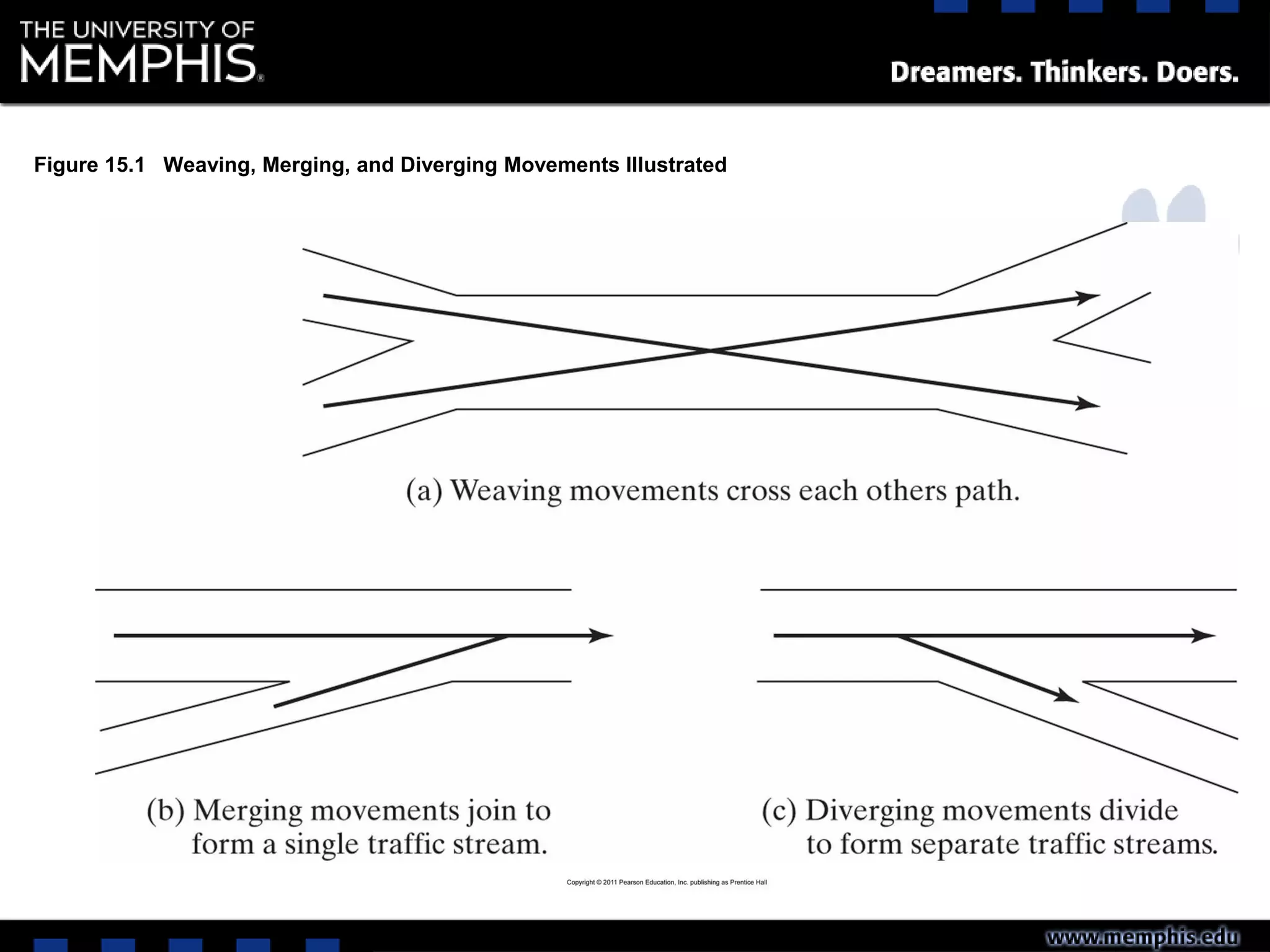
Figure 15.1 Weaving, Merging, and Diverging Movements Illustrated
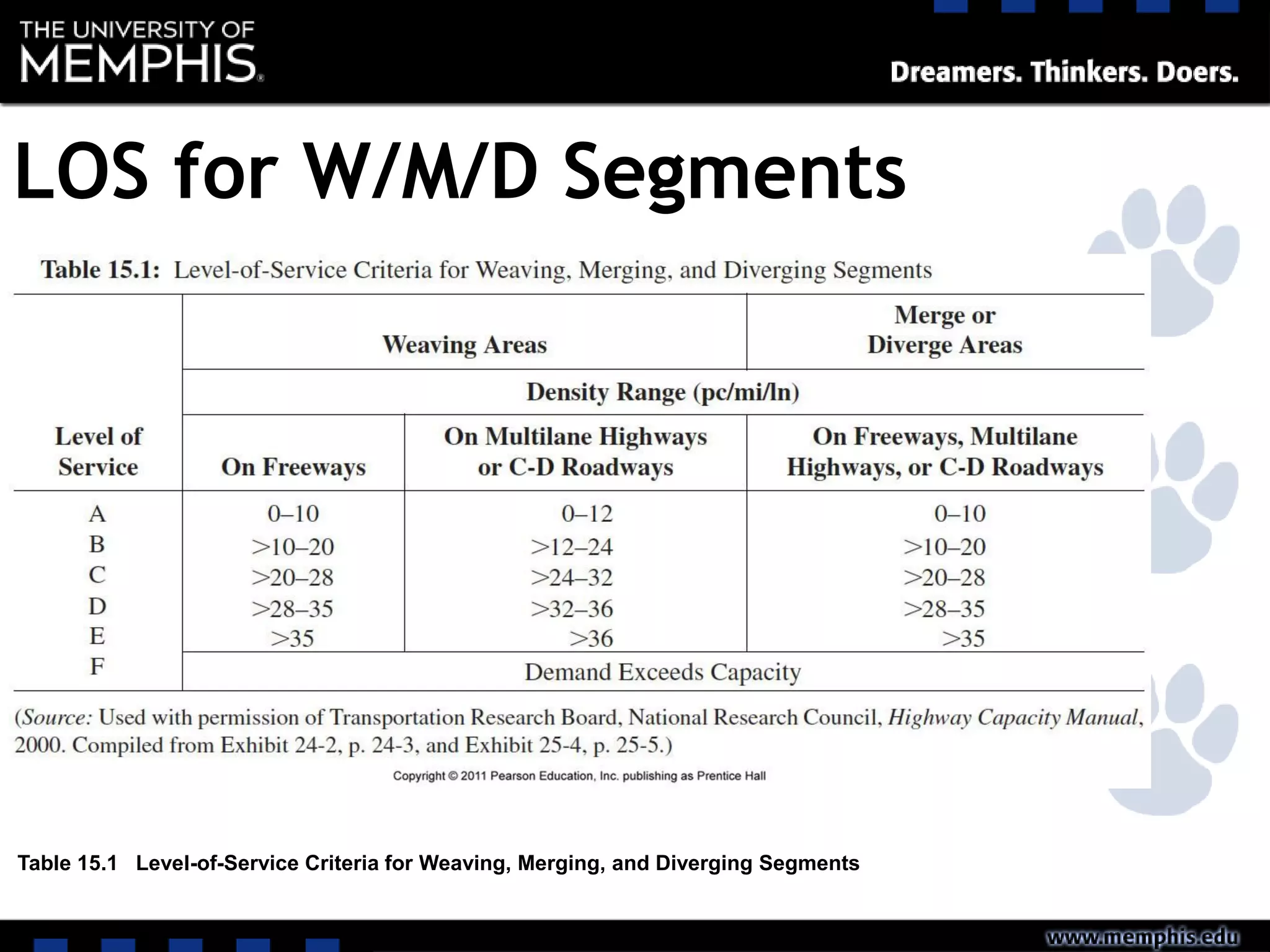
LOS for W/M/D Segments
• Based on density
Table 15.1 Level-of-Service Criteria for Weaving, Merging, and Diverging Segments
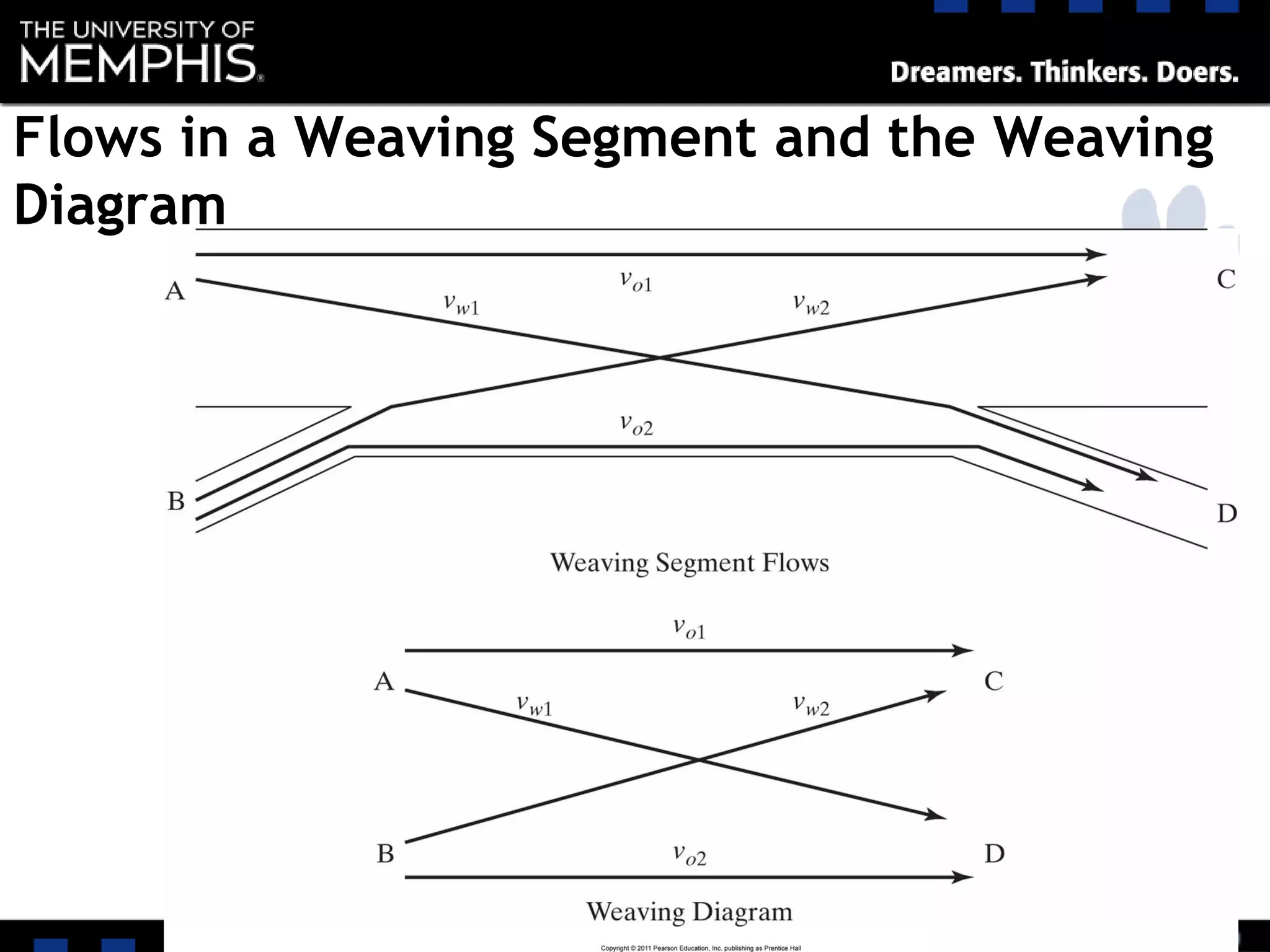
Flows in a Weaving Segment and the Weaving
Diagram
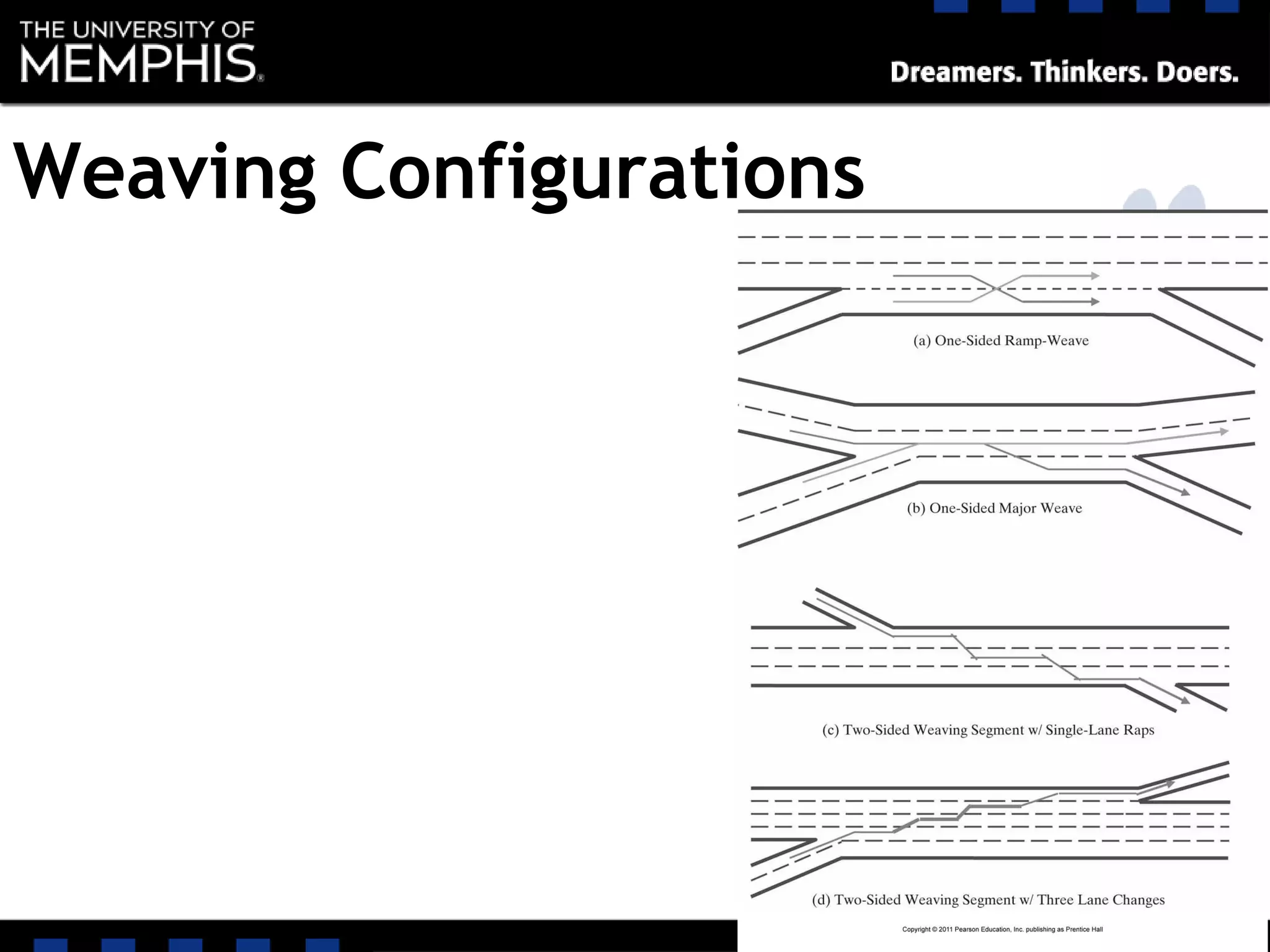
Weaving Configurations
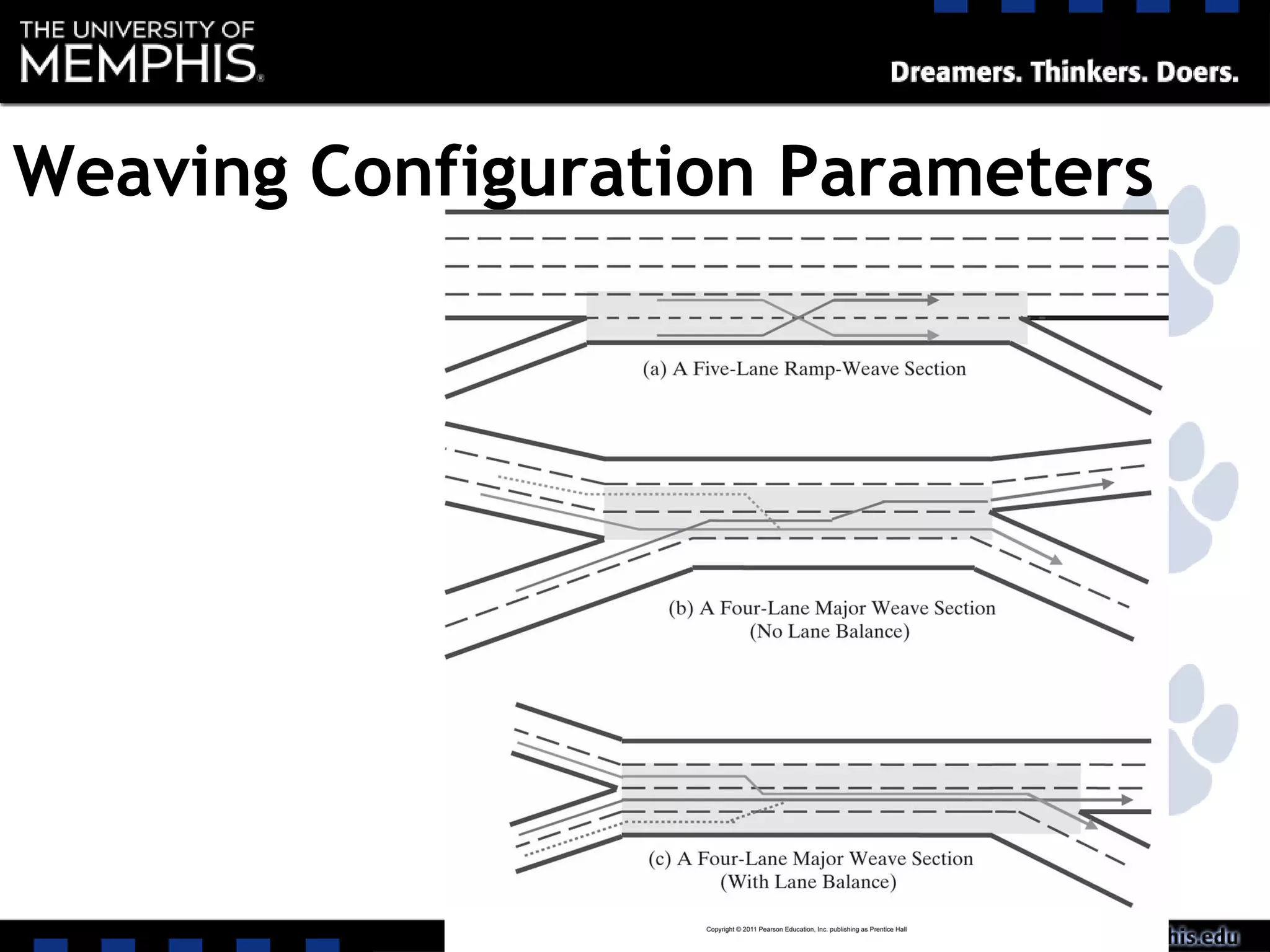
Weaving Configuration Parameters
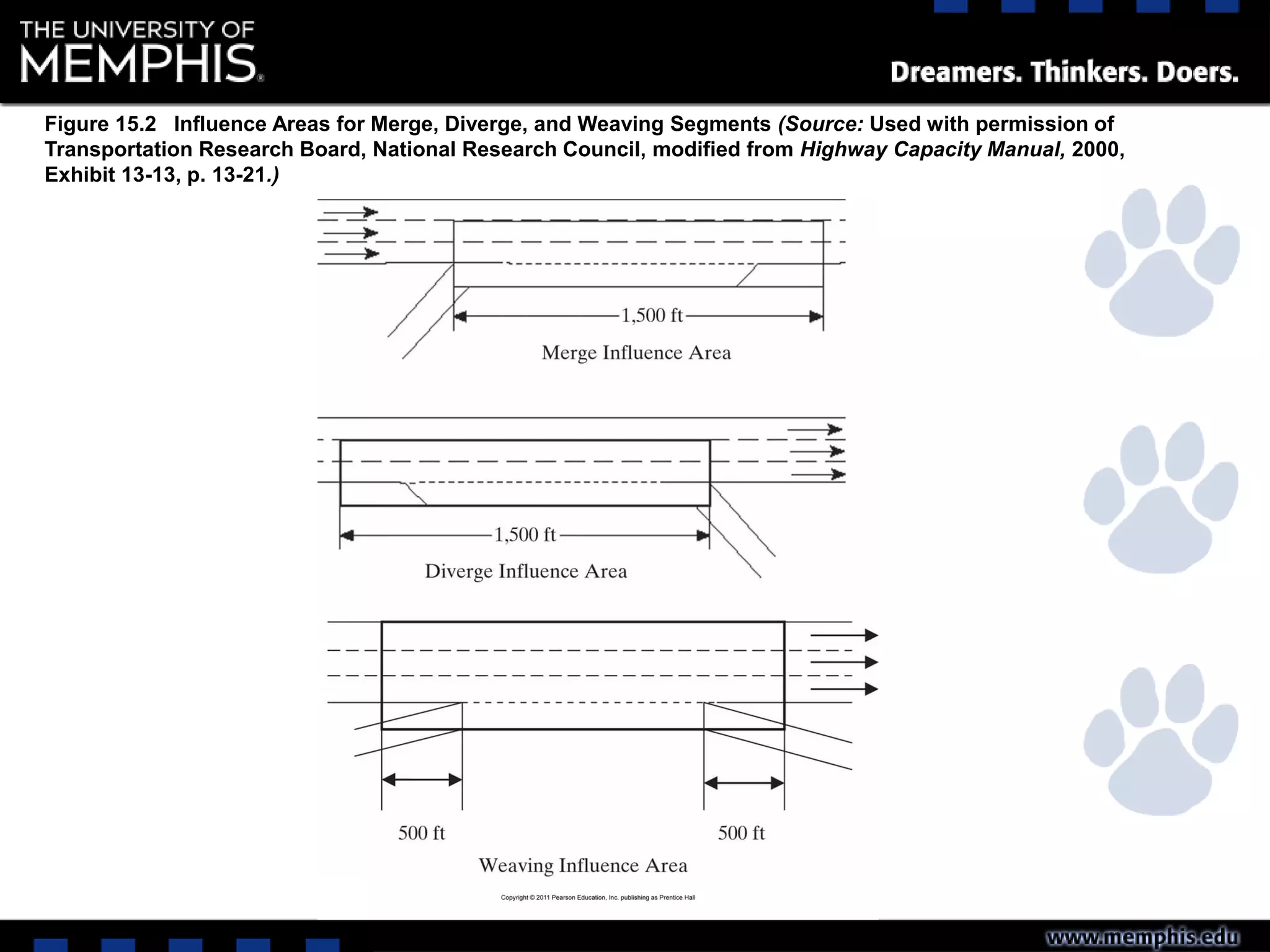
Figure 15.2 Influence Areas for Merge, Diverge, and Weaving Segments (Source: Used with permission of
Transportation Research Board, National Research Council, modified from Highway Capacity Manual, 2000,
Exhibit 13-13, p. 13-21.)
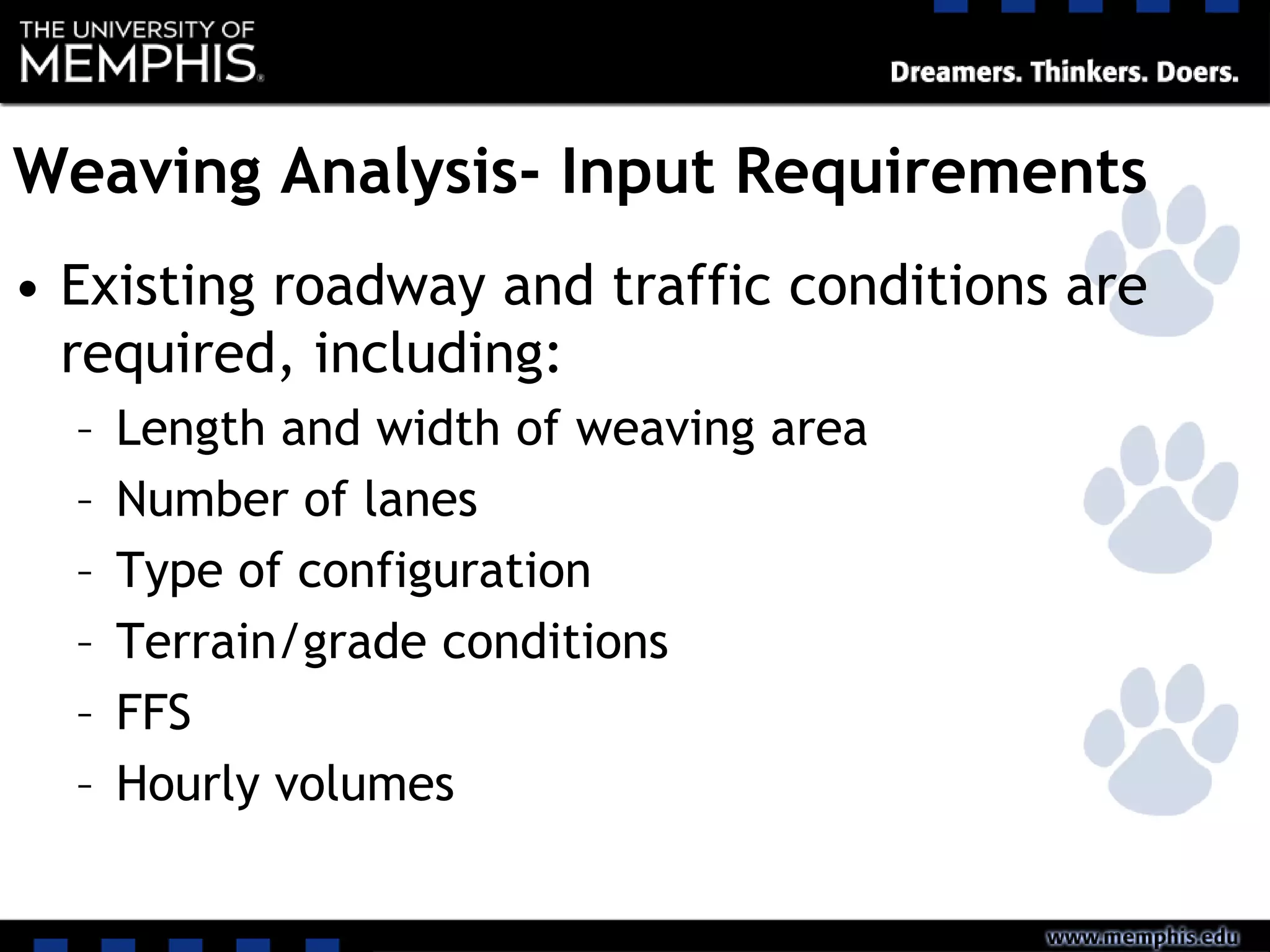
Weaving Analysis- Input Requirements
• Existing roadway and traffic conditions are
required, including:
– Length and width of weaving area
– Number of lanes
– Type of configuration
– Terrain/grade conditions
– FFS
– Hourly volumes
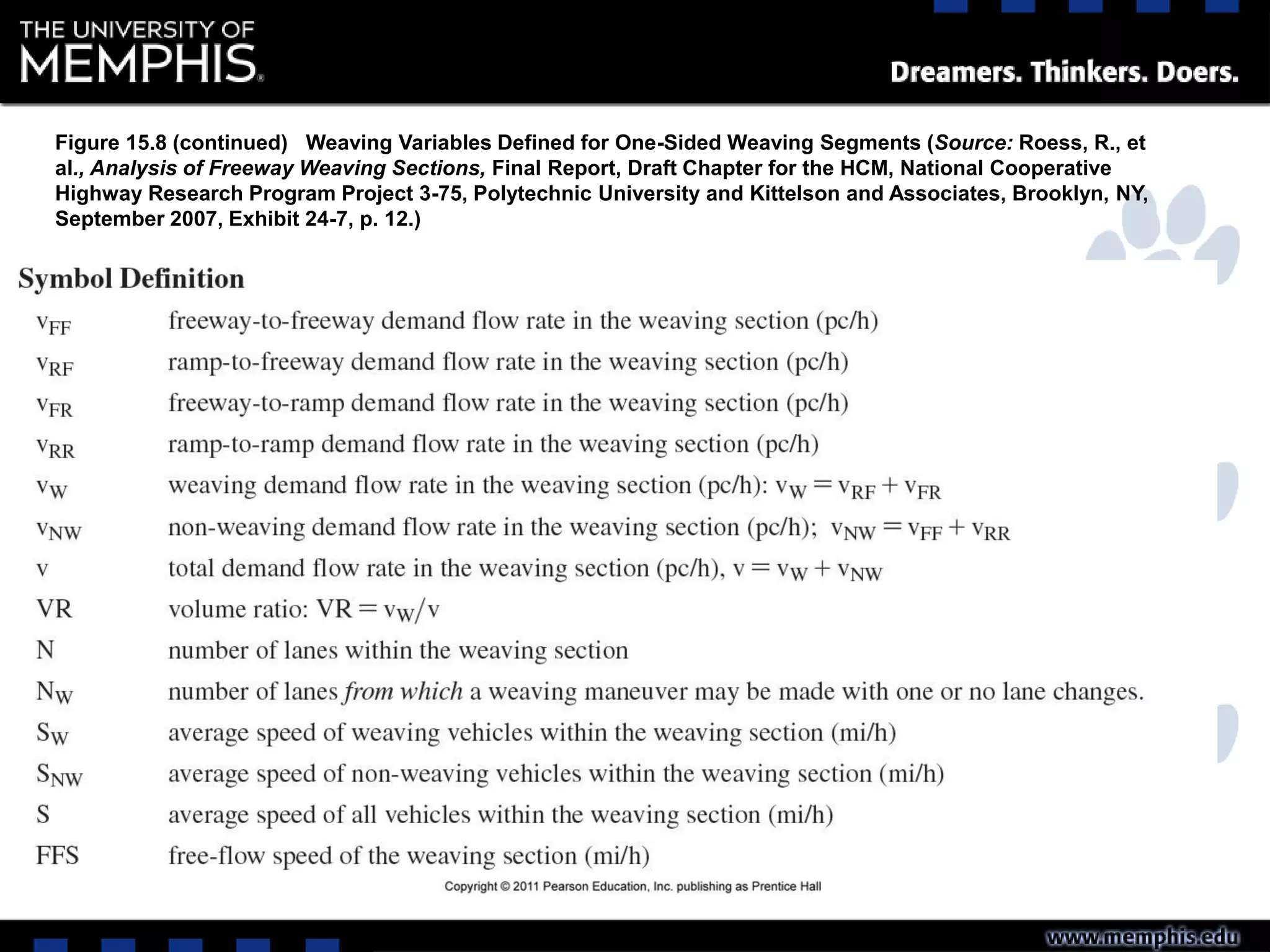
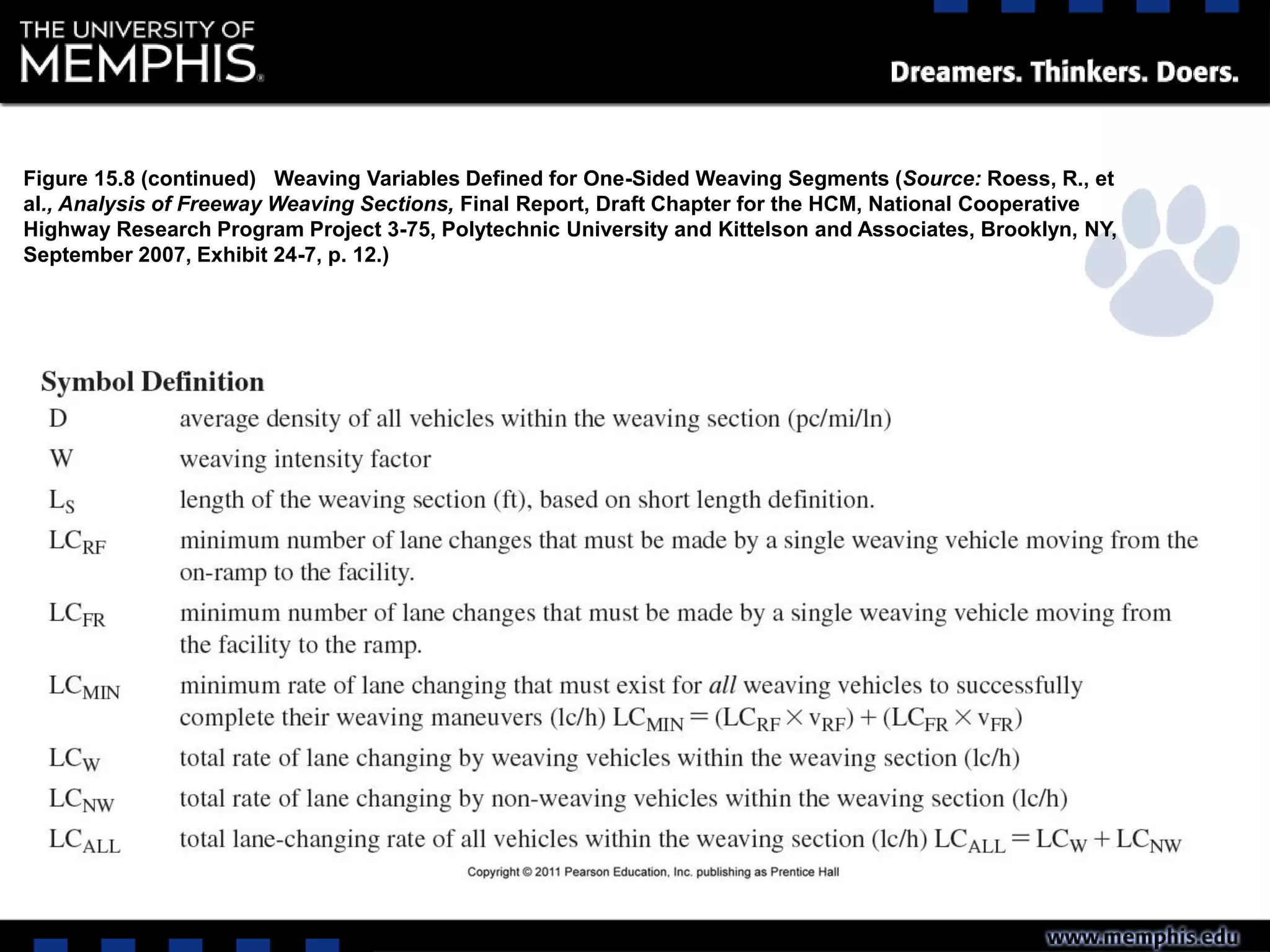
Figure 15.8 (continued) Weaving Variables Defined for One-Sided Weaving Segments (Source: Roess, R., et
al., Analysis of Freeway Weaving Sections, Final Report, Draft Chapter for the HCM, National Cooperative
Highway Research Program Project 3-75, Polytechnic University and Kittelson and Associates, Brooklyn, NY,
September 2007, Exhibit 24-7, p. 12.)
Figure 15.8 (continued) Weaving Variables Defined for One-Sided Weaving Segments (Source: Roess, R., et
al., Analysis of Freeway Weaving Sections, Final Report, Draft Chapter for the HCM, National Cooperative
Highway Research Program Project 3-75, Polytechnic University and Kittelson and Associates, Brooklyn, NY,
September 2007, Exhibit 24-7, p. 12.)
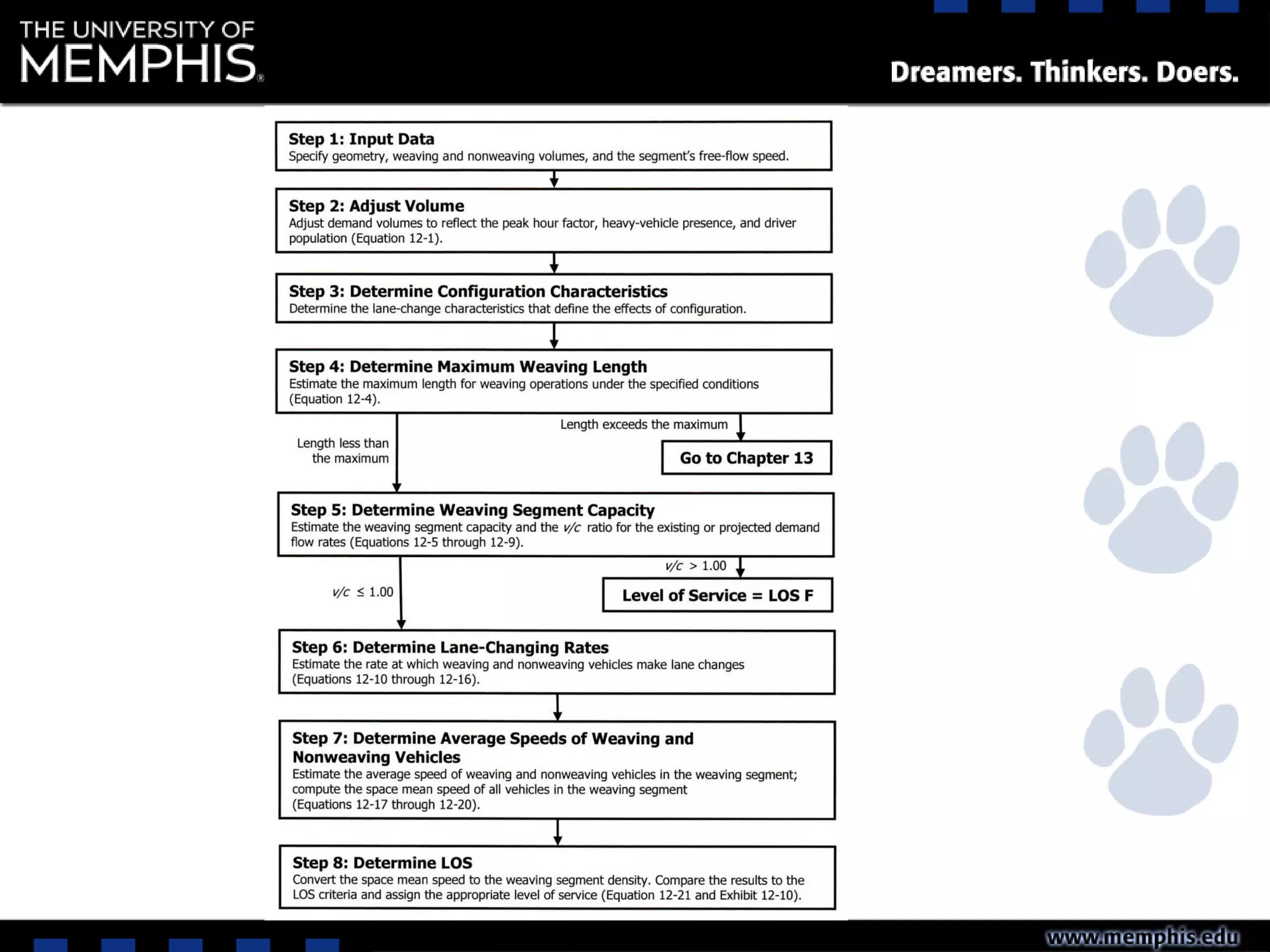
Step-1: Input Data
• Ensure to write all the input data in one place
before analyzing the weaving section
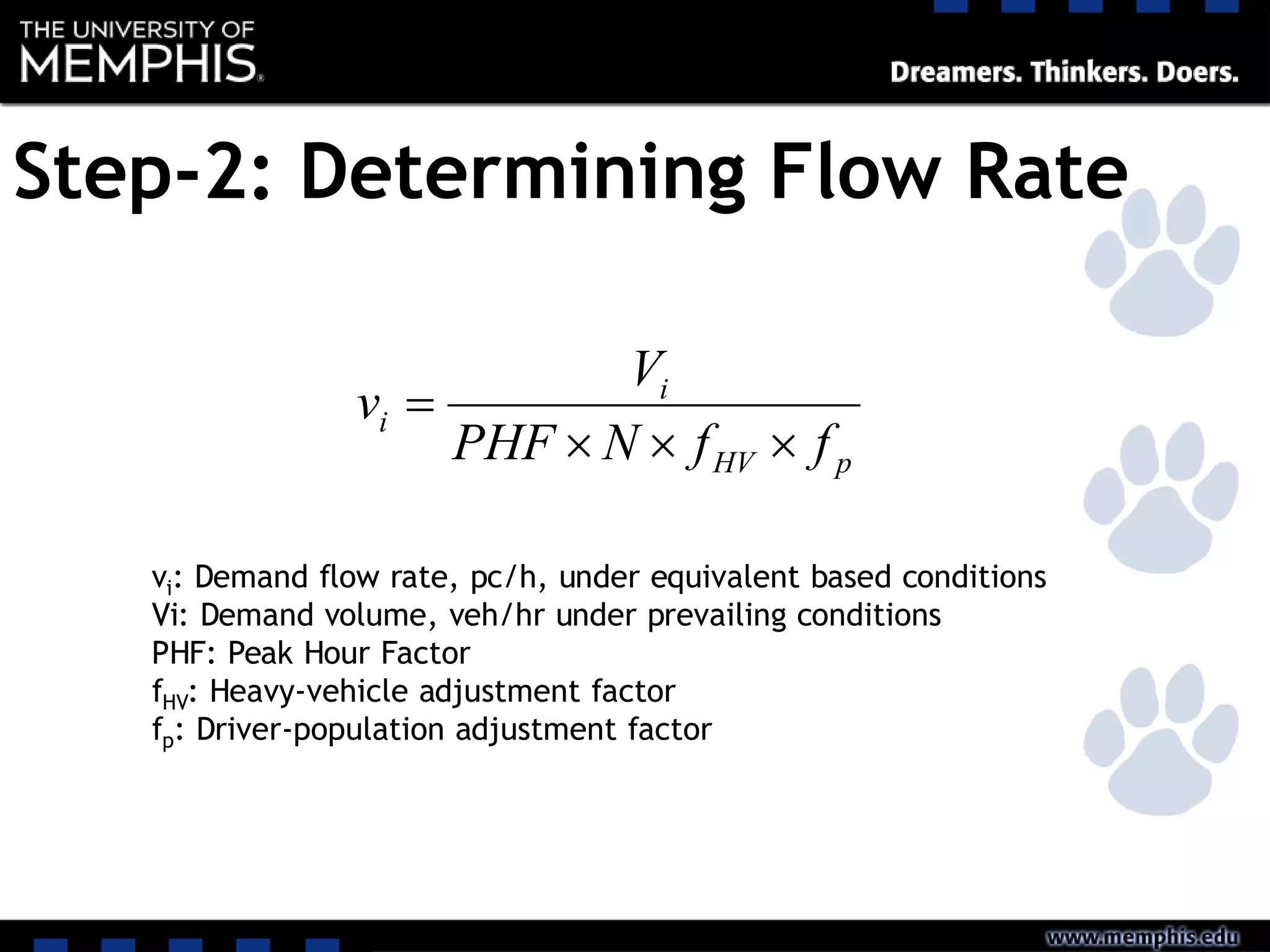
Step-2: Determining Flow Rate
pHV
i
i
ffNPHF
V
v


vi: Demand flow rate, pc/h, under equivalent based conditions
Vi: Demand volume, veh/hr under prevailing conditions
PHF: Peak Hour Factor
fHV: Heavy-vehicle adjustment factor
fp: Driver-population adjustment factor
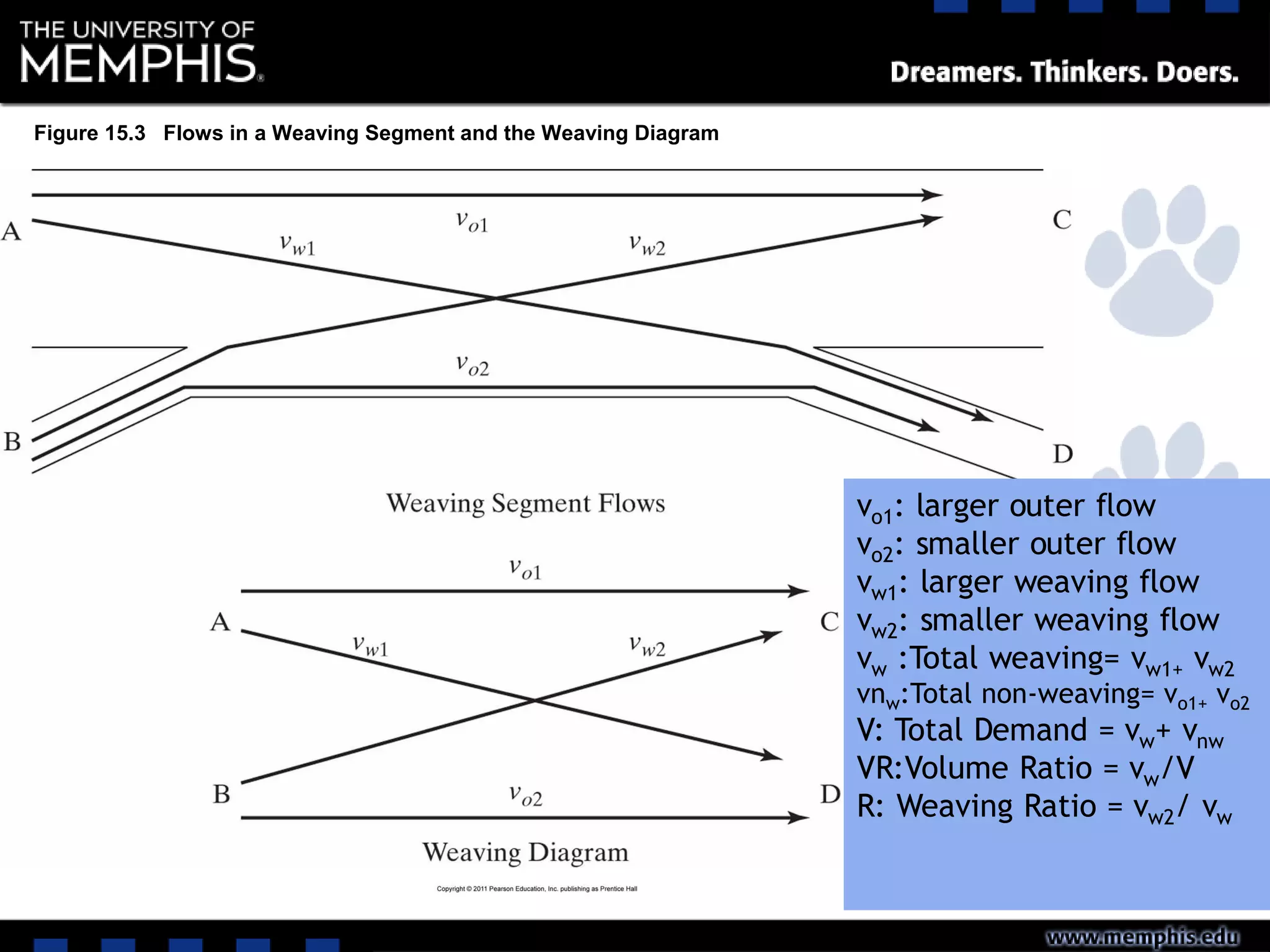
Figure 15.3 Flows in a Weaving Segment and the Weaving Diagram
vo1: larger outer flow
vo2: smaller outer flow
vw1: larger weaving flow
vw2: smaller weaving flow
vw :Total weaving= vw1+ vw2
vnw:Total non-weaving= vo1+ vo2
V: Total Demand = vw+ vnw
VR:Volume Ratio = vw/V
R: Weaving Ratio = vw2/ vw
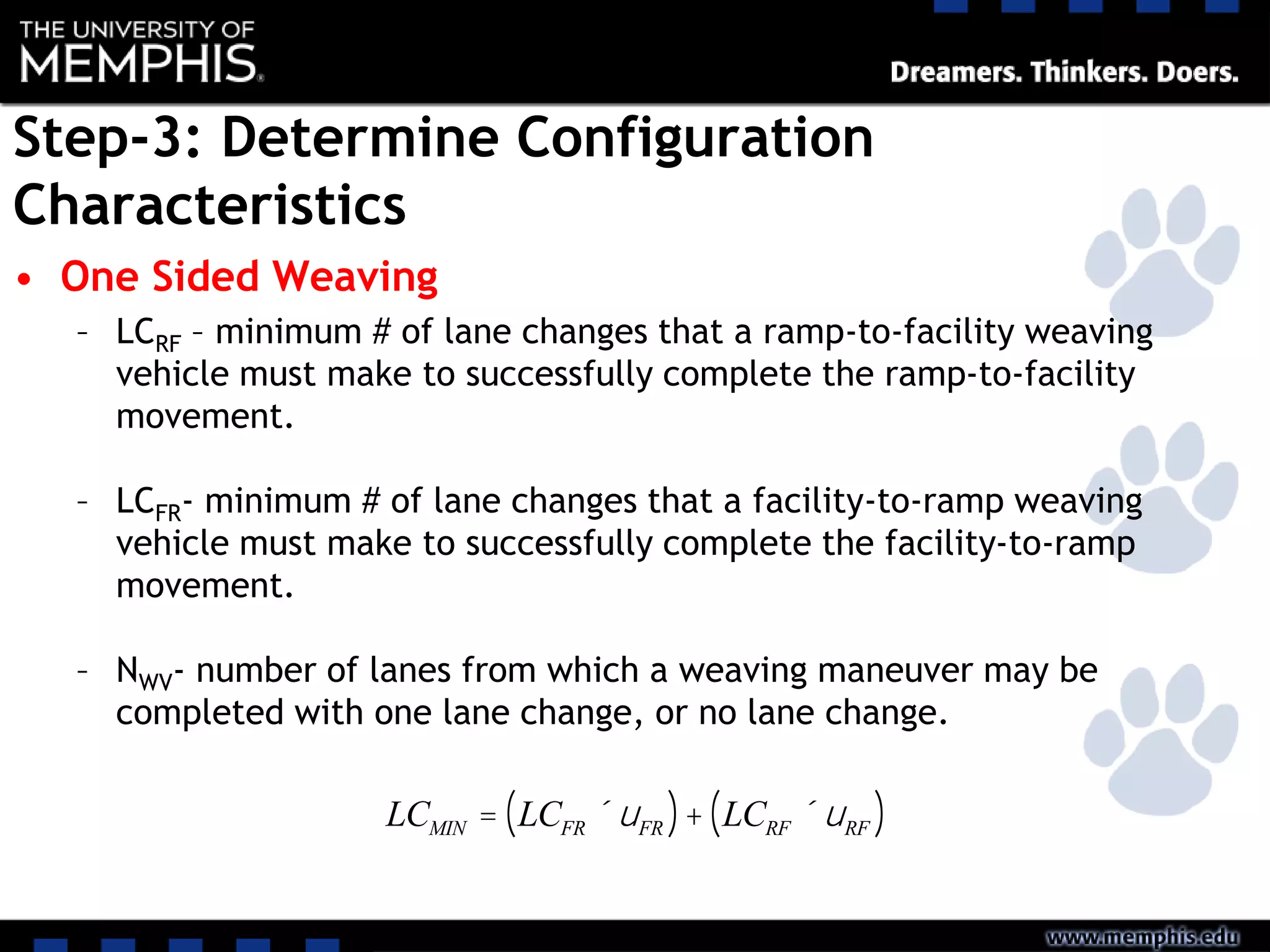
Step-3: Determine Configuration
Characteristics
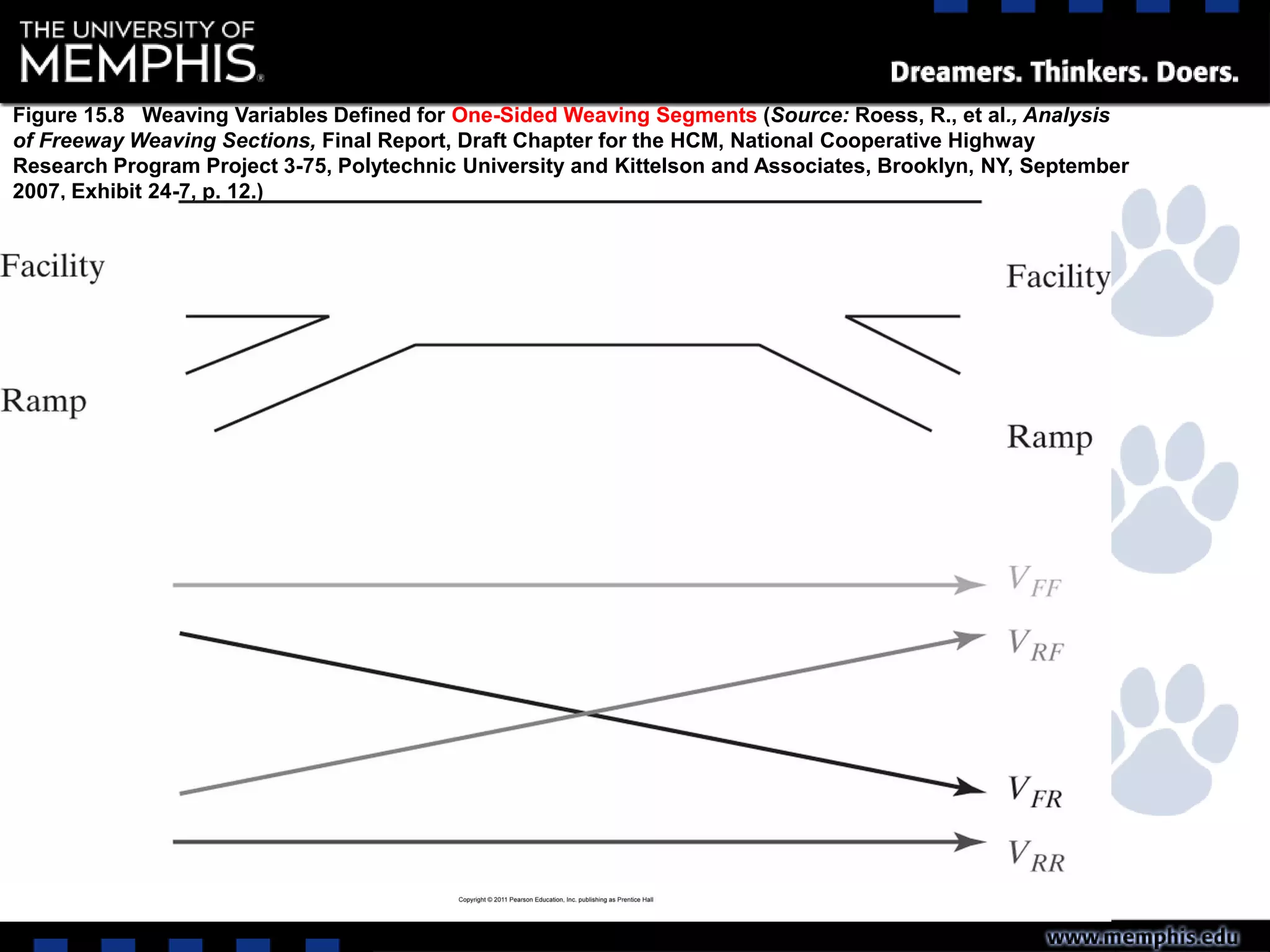
• One Sided Weaving
– LCRF – minimum # of lane changes that a ramp-to-facility weaving
vehicle must make to successfully complete the ramp-to-facility
movement.
– LCFR- minimum # of lane changes that a facility-to-ramp weaving
vehicle must make to successfully complete the facility-to-ramp
movement.
– NWV- number of lanes from which a weaving maneuver may be
completed with one lane change, or no lane change.
LCMIN = LCFR ´uFR( )+ LCRF ´uRF( )
Step-3: Determine Configuration
Characteristics
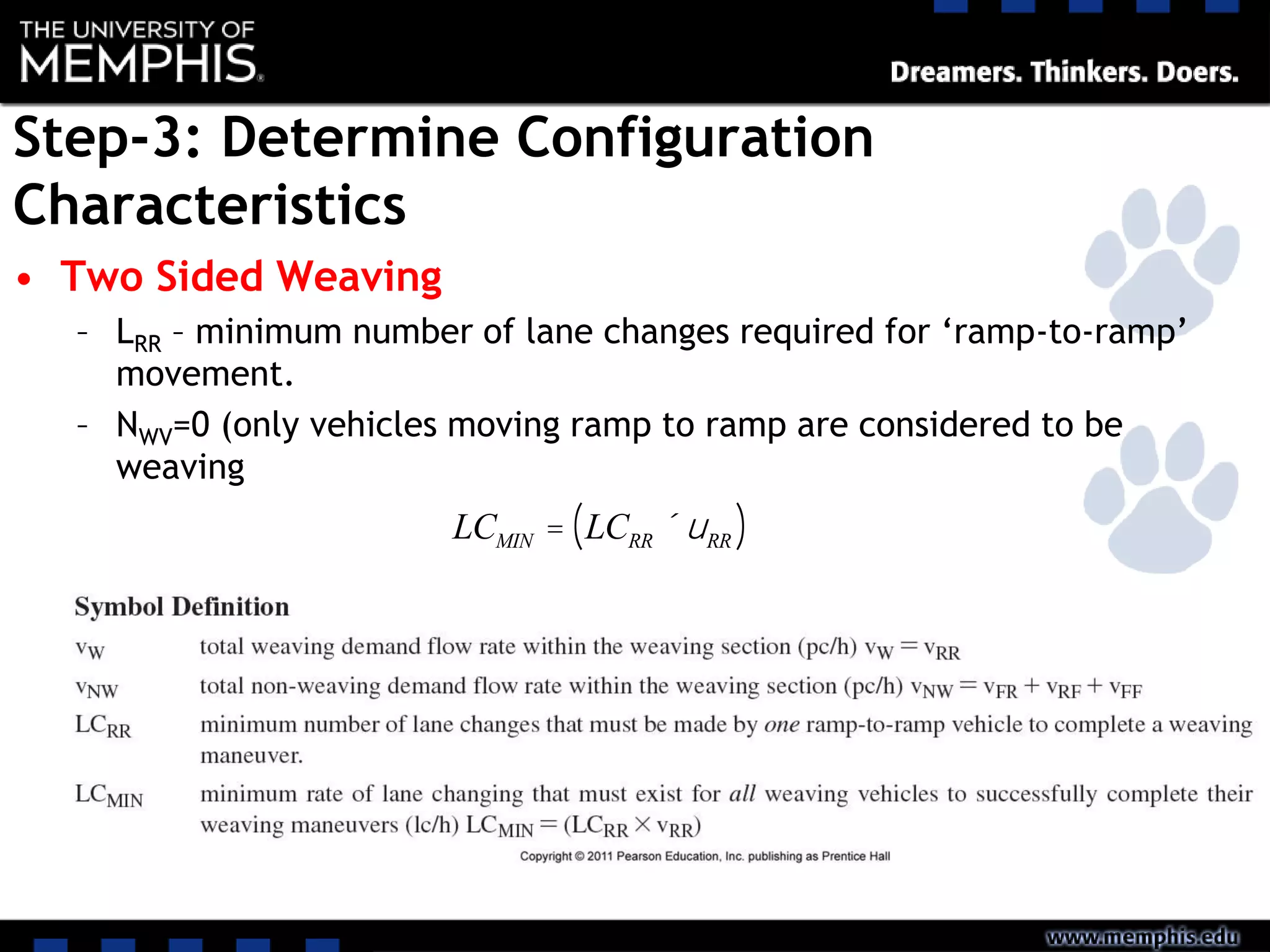
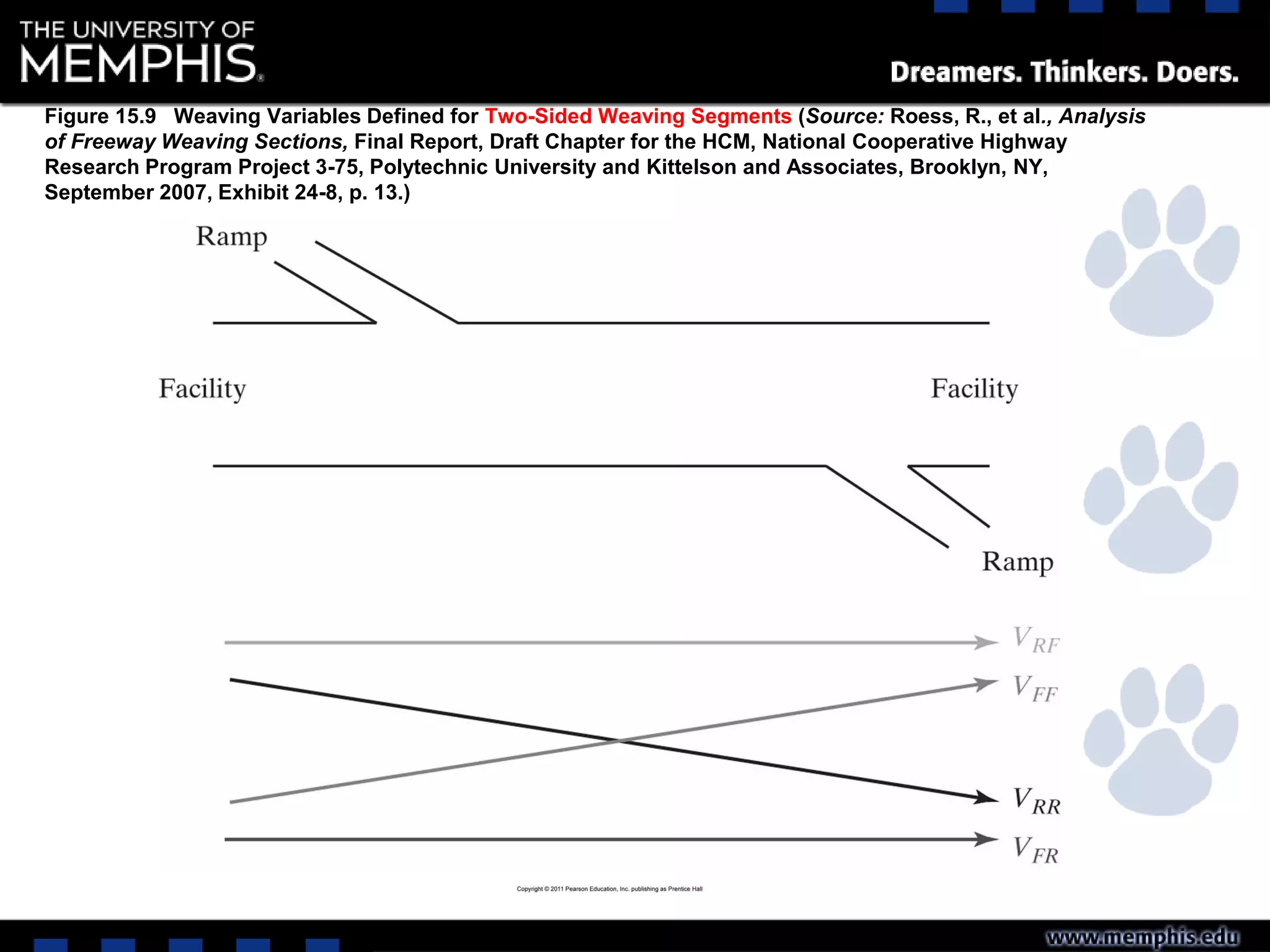
• Two Sided Weaving
– LRR – minimum number of lane changes required for ‘ramp-to-ramp’
movement.
– NWV=0 (only vehicles moving ramp to ramp are considered to be
weaving
LCMIN = LCRR ´uRR( )
Figure 15.8 Weaving Variables Defined for One-Sided Weaving Segments (Source: Roess, R., et al., Analysis
of Freeway Weaving Sections, Final Report, Draft Chapter for the HCM, National Cooperative Highway
Research Program Project 3-75, Polytechnic University and Kittelson and Associates, Brooklyn, NY, September
2007, Exhibit 24-7, p. 12.)
Figure 15.9 Weaving Variables Defined for Two-Sided Weaving Segments (Source: Roess, R., et al., Analysis
of Freeway Weaving Sections, Final Report, Draft Chapter for the HCM, National Cooperative Highway
Research Program Project 3-75, Polytechnic University and Kittelson and Associates, Brooklyn, NY,
September 2007, Exhibit 24-8, p. 13.)
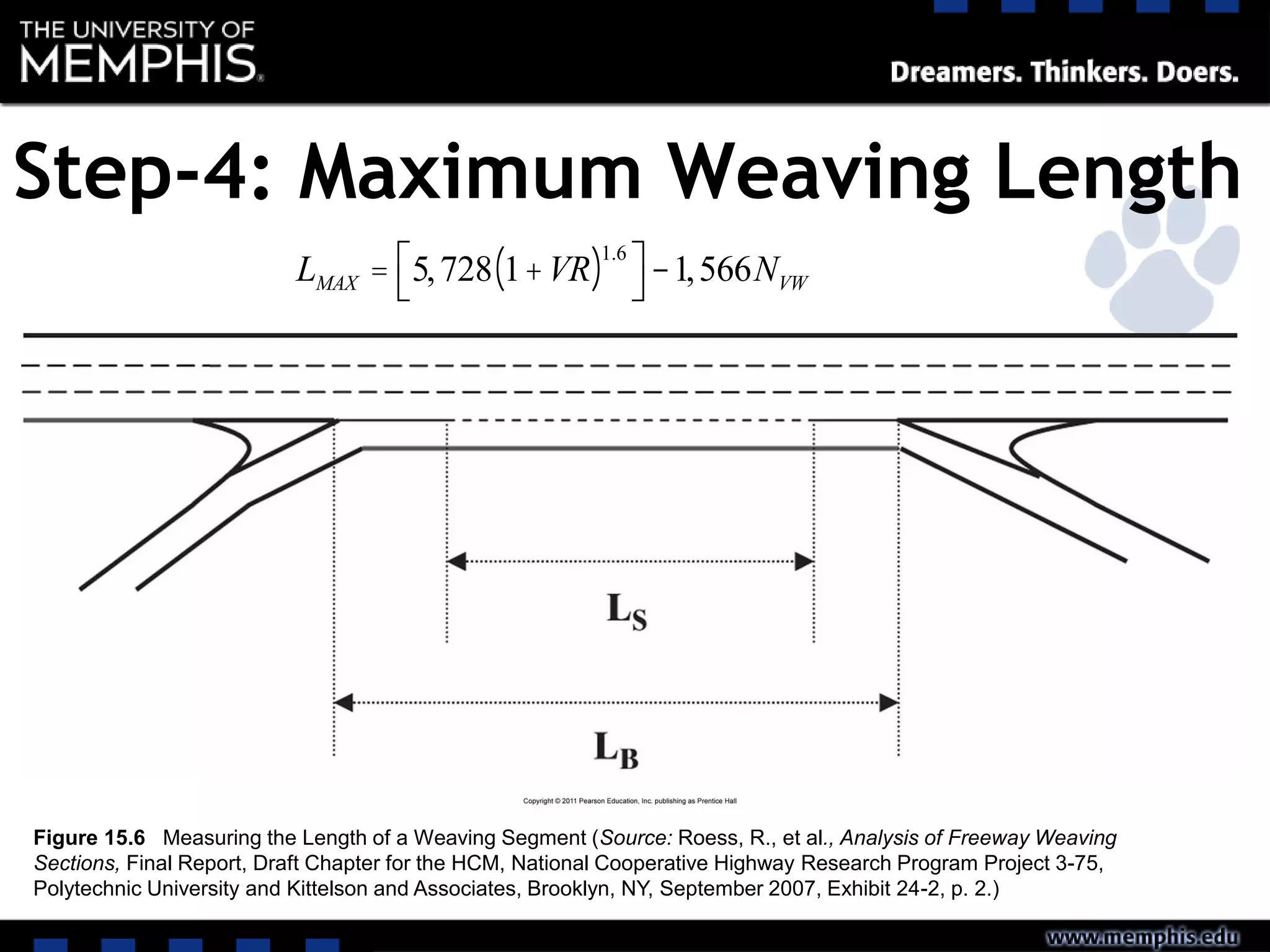
Step-4: Maximum Weaving Length
Figure 15.6 Measuring the Length of a Weaving Segment (Source: Roess, R., et al., Analysis of Freeway Weaving
Sections, Final Report, Draft Chapter for the HCM, National Cooperative Highway Research Program Project 3-75,
Polytechnic University and Kittelson and Associates, Brooklyn, NY, September 2007, Exhibit 24-2, p. 2.)
LMAX = 5,728 1+VR( )1.6
é
ë
ù
û -1,566NVW
Step-5: Capacity of the Weaving Segment
• Based on Breakdown Density
cIWL = cIFL - 438.2(1+VR)1.6
éë ùû + 0.0765LS[ ]+ 119.8NWV[ ]
Calculate CIWL (cap per lane of weaving section under ideal conditions:
Convert CIWL to total capacity for the weaving segment under prevailing conditions:
pHVIWLW ffNcc 1
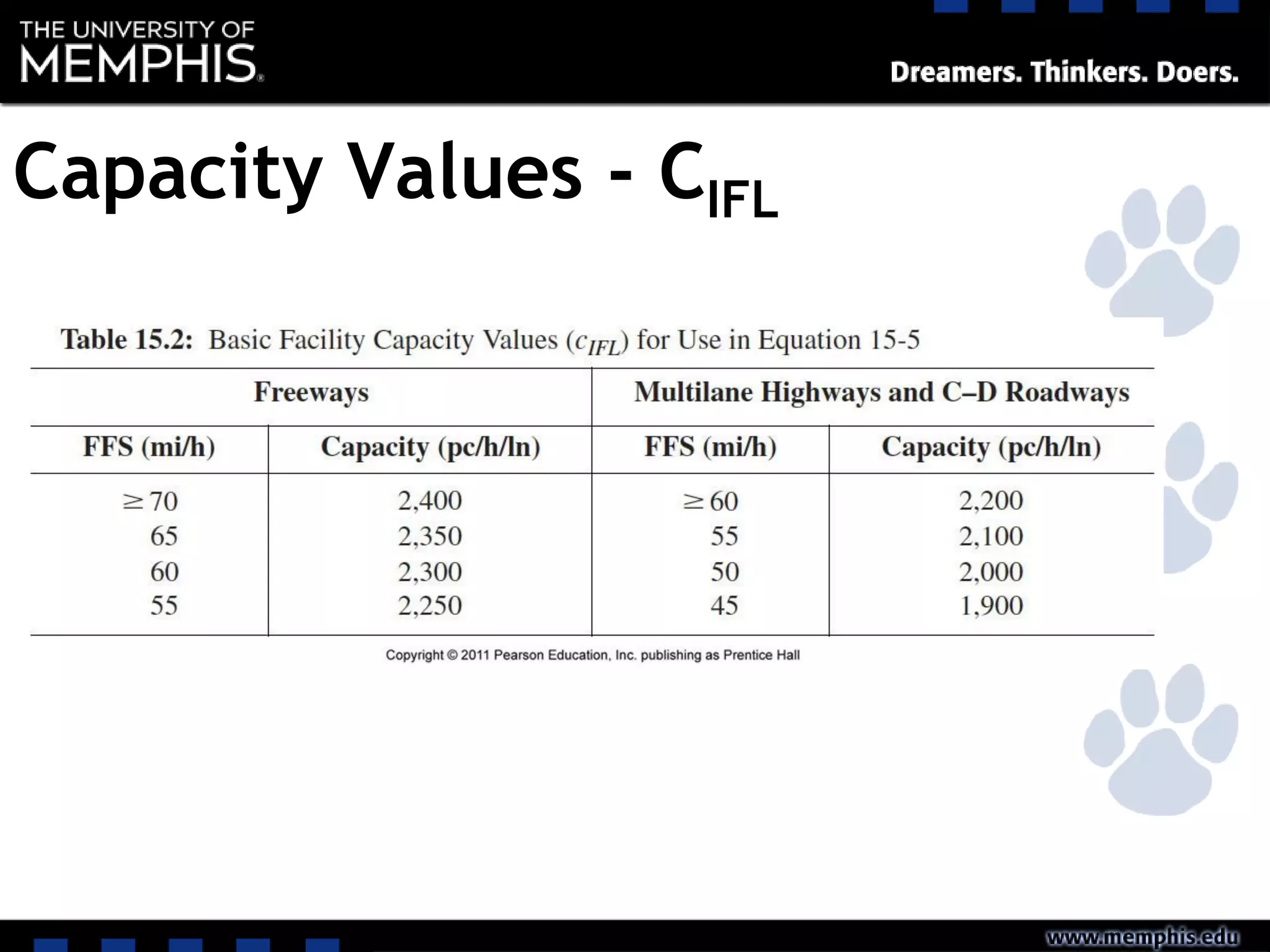
Capacity Values - CIFL
Step-5: Capacity of the Weaving Segment
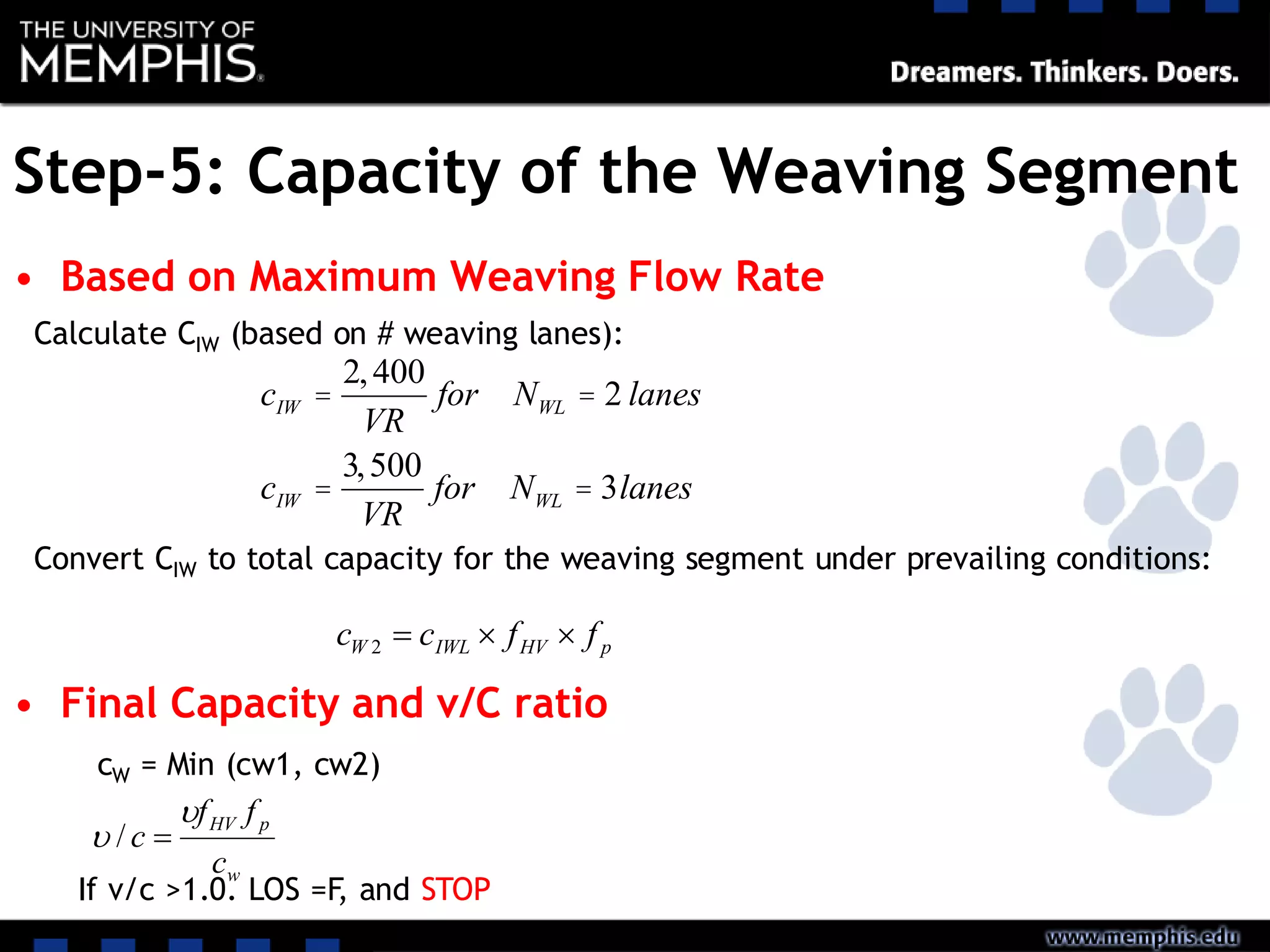
• Based on Maximum Weaving Flow Rate
• Final Capacity and v/C ratio
cIW =
2,400
VR
for NWL = 2 lanes
cIW =
3,500
VR
for NWL = 3lanes
Calculate CIW (based on # weaving lanes):
Convert CIW to total capacity for the weaving segment under prevailing conditions:
pHVIWLW ffcc 2
cW = Min (cw1, cw2)
w
pHV
c
ff
c

 /
If v/c >1.0. LOS =F, and STOP
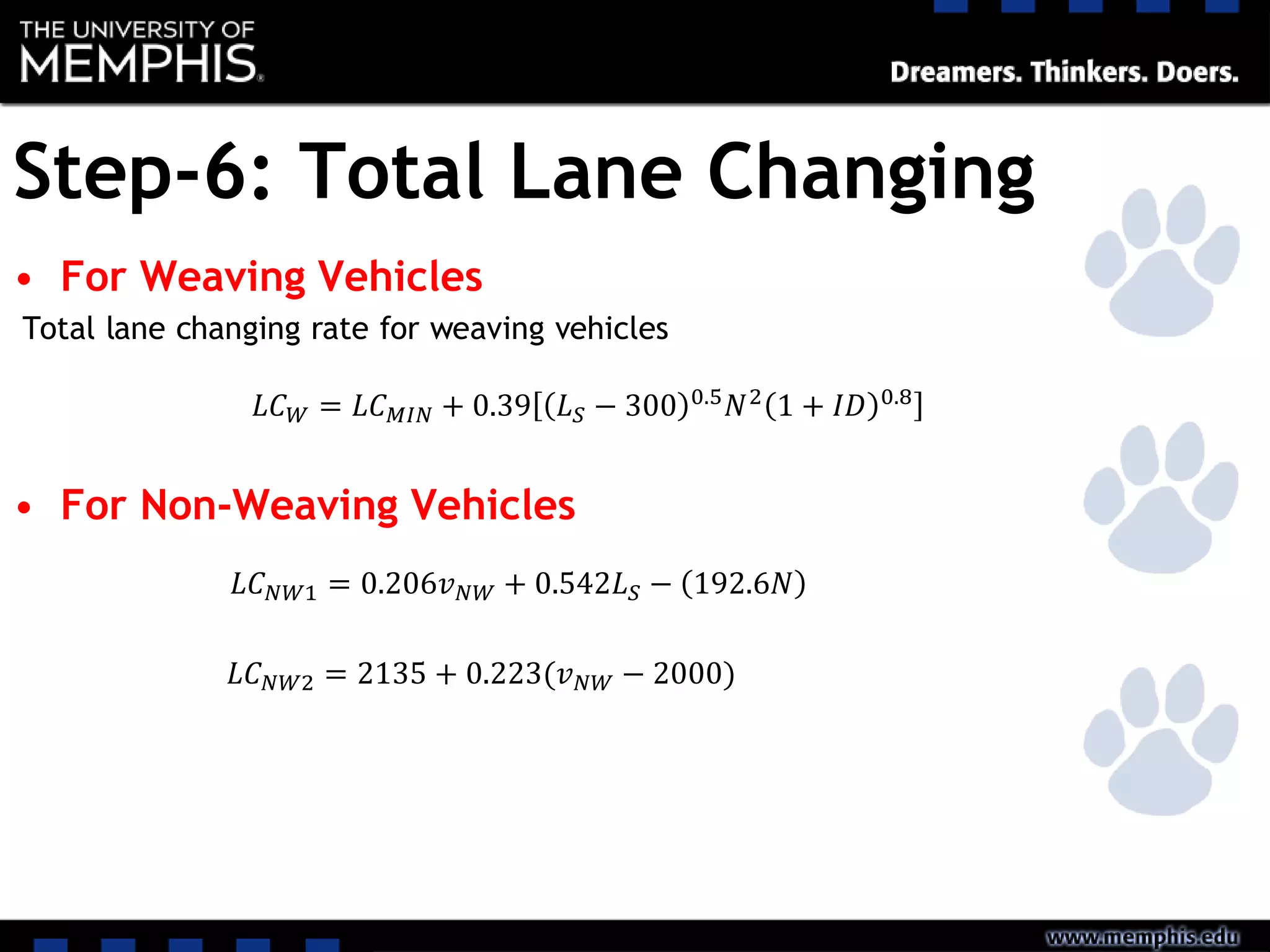
Step-6: Total Lane Changing
• For Weaving Vehicles
Total lane changing rate for weaving vehicles
• For Non-Weaving Vehicles
𝐿𝐶 𝑊 = 𝐿𝐶 𝑀𝐼𝑁 + 0.39 𝐿 𝑆 − 300 0.5
𝑁2
1 + 𝐼𝐷 0.8
𝐿𝐶 𝑁𝑊1 = 0.206𝑣 𝑁𝑊 + 0.542𝐿 𝑆 − 192.6𝑁
𝐿𝐶 𝑁𝑊2 = 2135 + 0.223(𝑣 𝑁𝑊 − 2000)
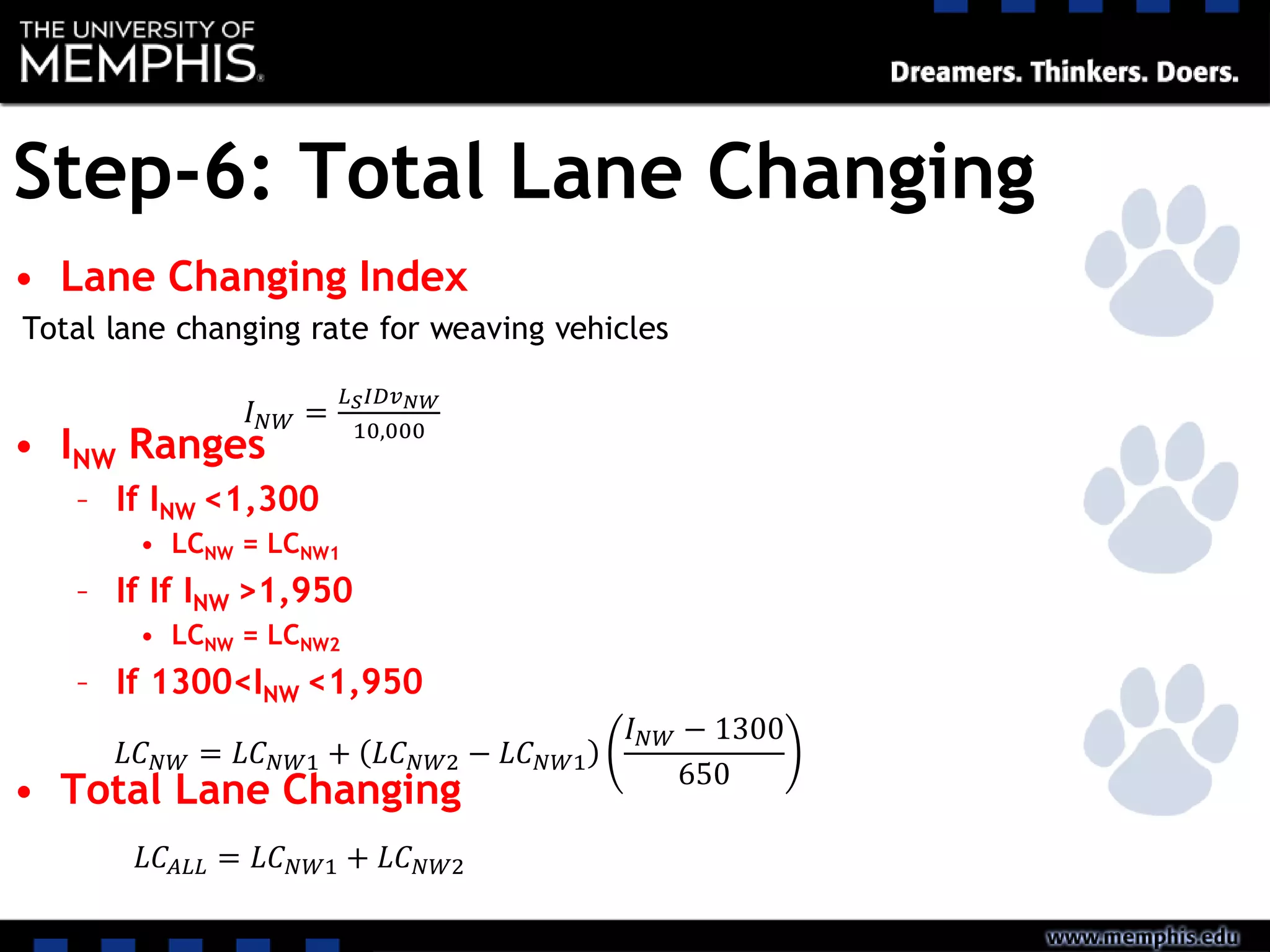
Step-6: Total Lane Changing
• Lane Changing Index
Total lane changing rate for weaving vehicles
• INW Ranges
– If INW <1,300
• LCNW = LCNW1
– If If INW >1,950
• LCNW = LCNW2
– If 1300<INW <1,950
• Total Lane Changing
𝐼 𝑁𝑊 =
𝐿 𝑆 𝐼𝐷𝑣 𝑁𝑊
10,000
𝐿𝐶 𝑁𝑊 = 𝐿𝐶 𝑁𝑊1 + 𝐿𝐶 𝑁𝑊2 − 𝐿𝐶 𝑁𝑊1
𝐼 𝑁𝑊 − 1300
650
𝐿𝐶𝐴𝐿𝐿 = 𝐿𝐶 𝑁𝑊1 + 𝐿𝐶 𝑁𝑊2
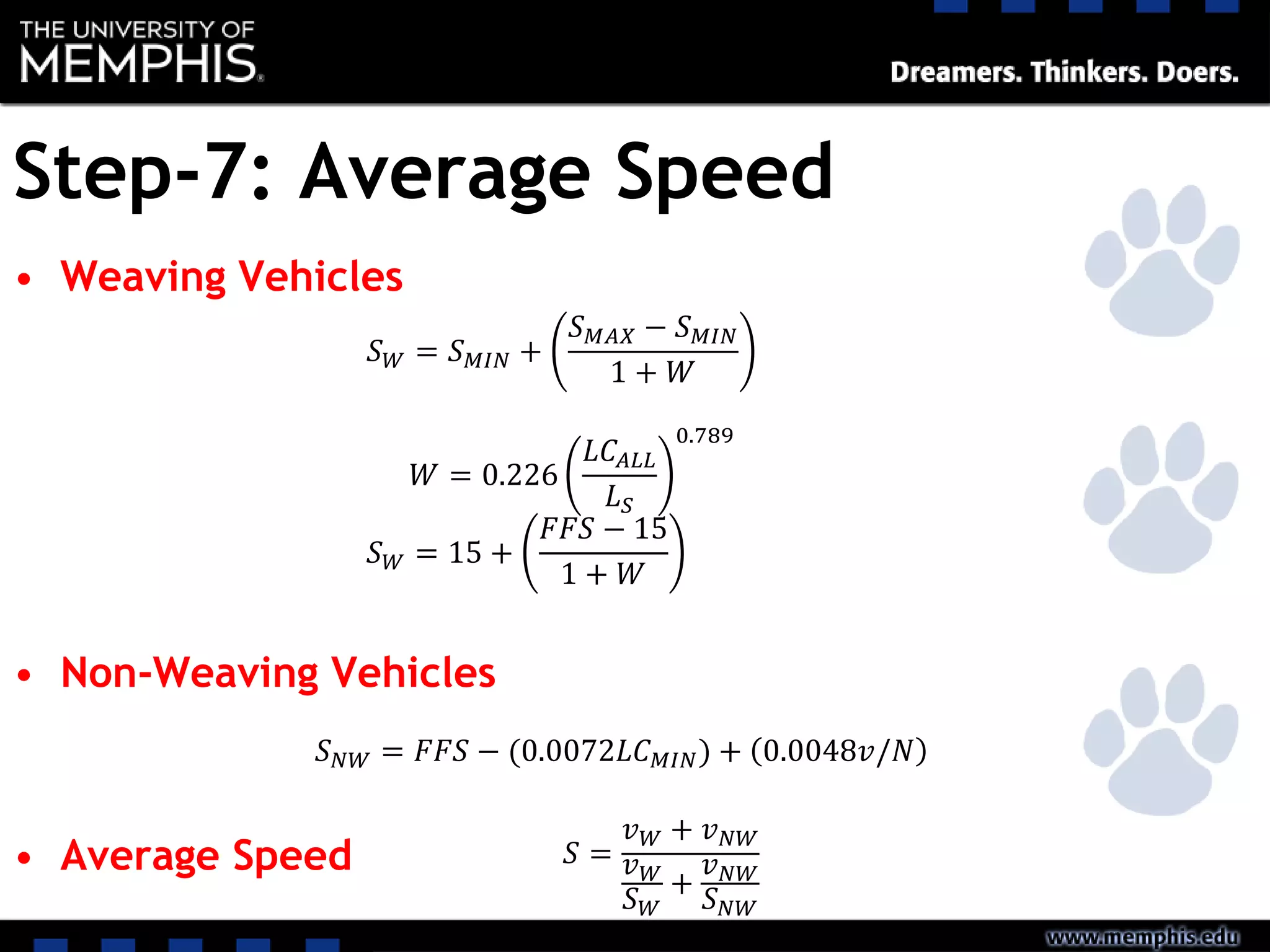
Step-7: Average Speed
• Weaving Vehicles
• Non-Weaving Vehicles
• Average Speed
𝑆 𝑊 = 𝑆 𝑀𝐼𝑁 +
𝑆 𝑀𝐴𝑋 − 𝑆 𝑀𝐼𝑁
1 + 𝑊
𝑊 = 0.226
𝐿𝐶𝐴𝐿𝐿
𝐿 𝑆
0.789
𝑆 𝑊 = 15 +
𝐹𝐹𝑆 − 15
1 + 𝑊
𝑆 𝑁𝑊 = 𝐹𝐹𝑆 − (0.0072𝐿𝐶 𝑀𝐼𝑁) + 0.0048𝑣/𝑁
𝑆 =
𝑣 𝑊 + 𝑣 𝑁𝑊
𝑣 𝑊
𝑆 𝑊
+
𝑣 𝑁𝑊
𝑆 𝑁𝑊
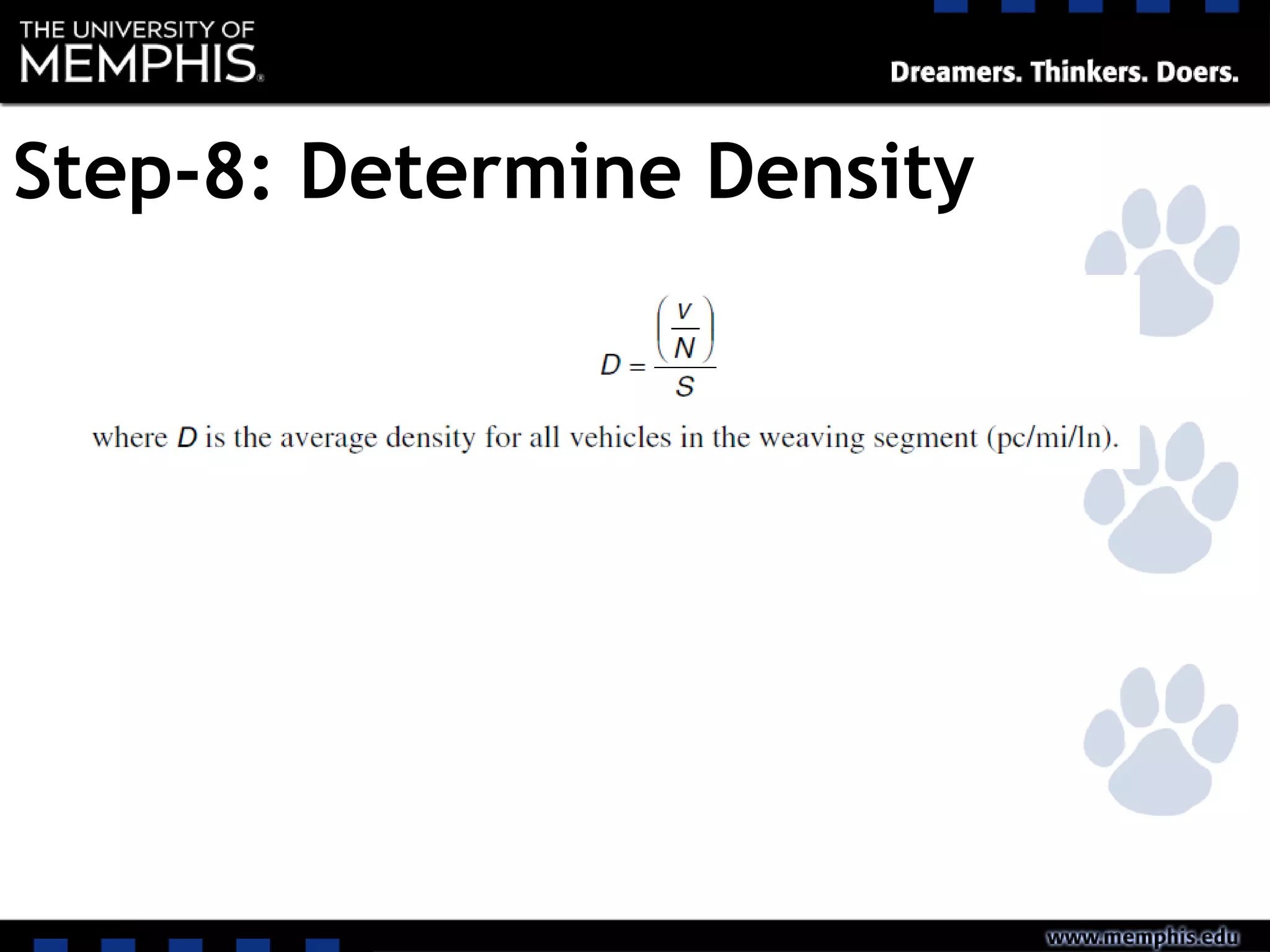
Step-8: Determine Density
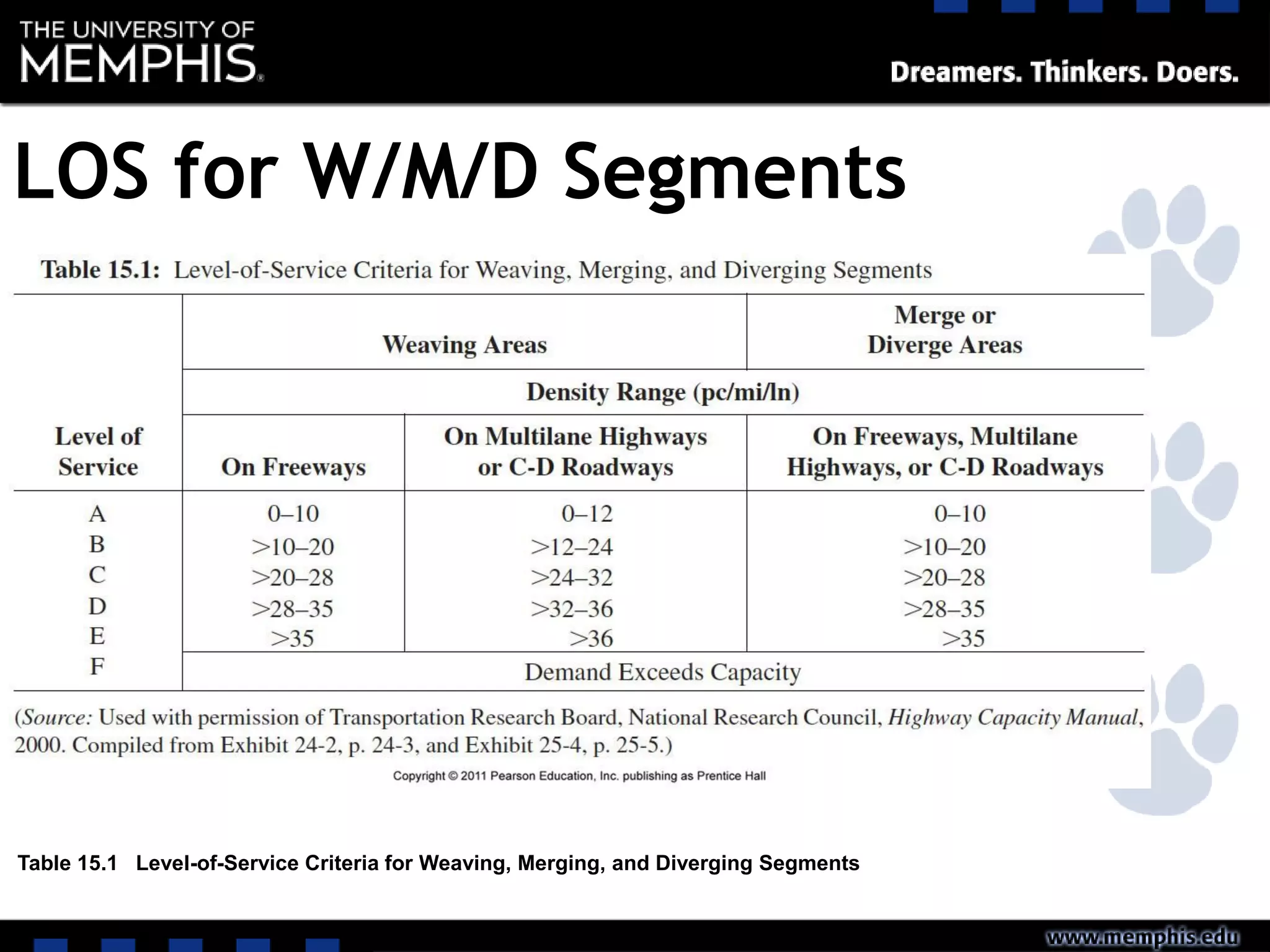
LOS for W/M/D Segments
• Based on density
Table 15.1 Level-of-Service Criteria for Weaving, Merging, and Diverging Segments
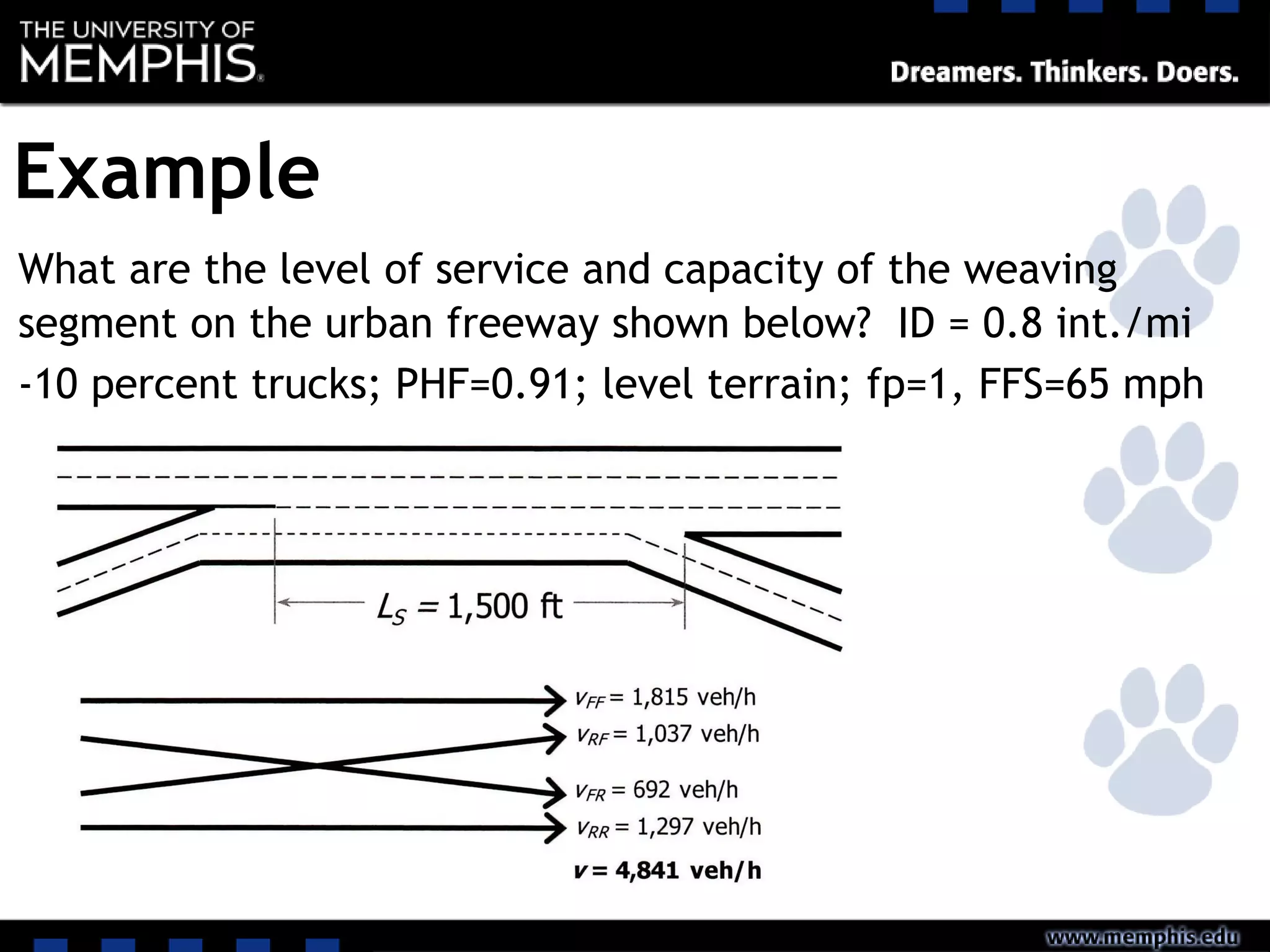
Example
What are the level of service and capacity of the weaving
segment on the urban freeway shown below? ID = 0.8 int./mi
-10 percent trucks; PHF=0.91; level terrain; fp=1, FFS=65 mph
Example
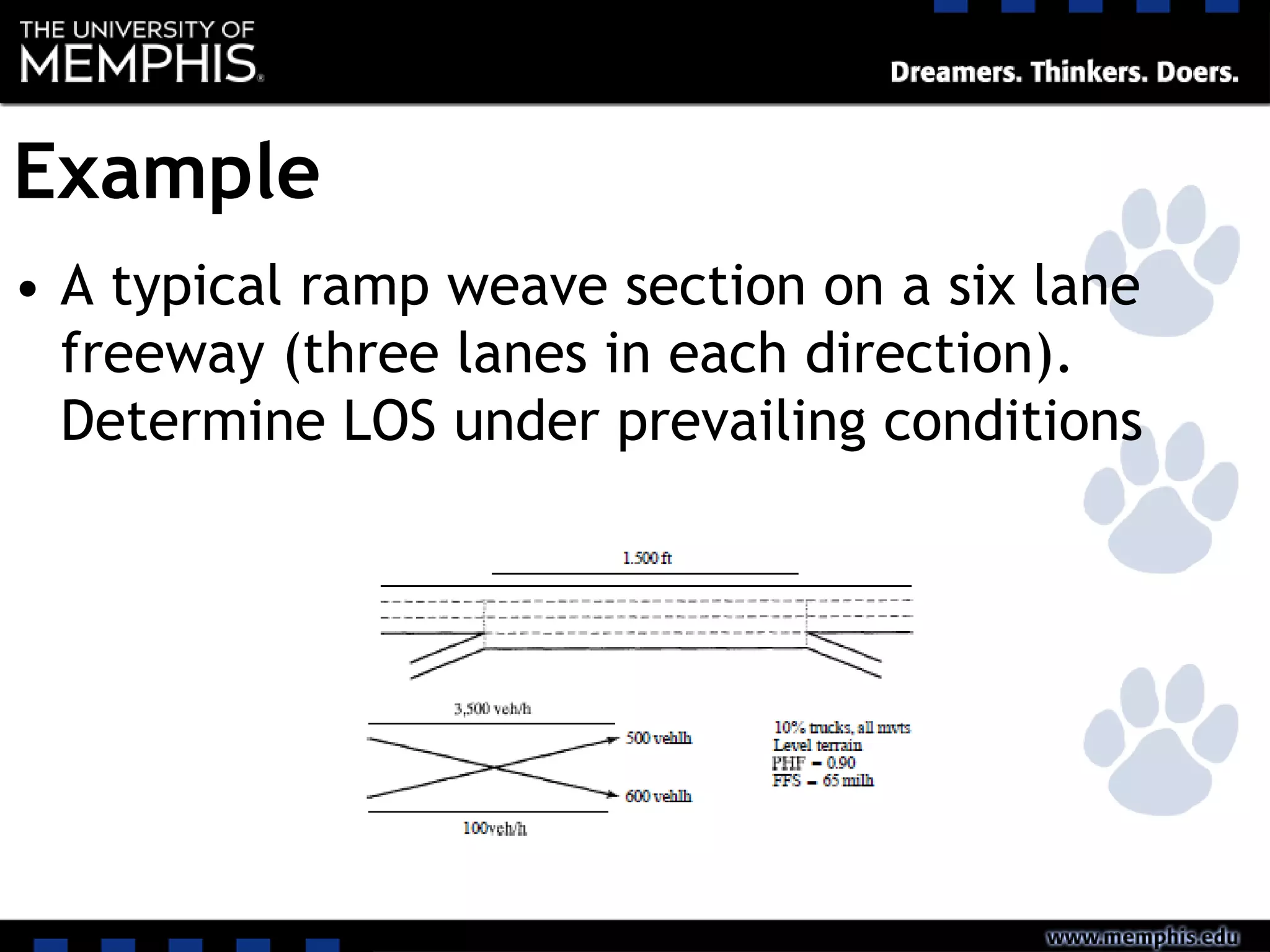
• A typical ramp weave section on a six lane
freeway (three lanes in each direction).
Determine LOS under prevailing conditions

L20 Weaving Merging and Diverging Movements

  • 1.
    Analysis of Weaving, Merging,and Diverging Movements CIVL 4162/6162
  • 2.
    Weaving, Diverging, MergingSegments • Weaving – one movement must cross the path of another along a length of facility without the aid of signals or other traffic control devices • Merging – two separate traffic streams join to form a single one • Diverging – one traffic stream separates to form two separate traffic streams • Why do we consider these separately from BFS/Multilane Segments?
  • 3.
    Figure 15.1 Weaving,Merging, and Diverging Movements Illustrated
  • 4.
    LOS for W/M/DSegments • Based on density Table 15.1 Level-of-Service Criteria for Weaving, Merging, and Diverging Segments
  • 5.
    Flows in aWeaving Segment and the Weaving Diagram
  • 6.
  • 7.
  • 8.
    Figure 15.2 InfluenceAreas for Merge, Diverge, and Weaving Segments (Source: Used with permission of Transportation Research Board, National Research Council, modified from Highway Capacity Manual, 2000, Exhibit 13-13, p. 13-21.)
  • 9.
    Weaving Analysis- InputRequirements • Existing roadway and traffic conditions are required, including: – Length and width of weaving area – Number of lanes – Type of configuration – Terrain/grade conditions – FFS – Hourly volumes
  • 11.
    Figure 15.8 (continued)Weaving Variables Defined for One-Sided Weaving Segments (Source: Roess, R., et al., Analysis of Freeway Weaving Sections, Final Report, Draft Chapter for the HCM, National Cooperative Highway Research Program Project 3-75, Polytechnic University and Kittelson and Associates, Brooklyn, NY, September 2007, Exhibit 24-7, p. 12.)
  • 12.
    Figure 15.8 (continued)Weaving Variables Defined for One-Sided Weaving Segments (Source: Roess, R., et al., Analysis of Freeway Weaving Sections, Final Report, Draft Chapter for the HCM, National Cooperative Highway Research Program Project 3-75, Polytechnic University and Kittelson and Associates, Brooklyn, NY, September 2007, Exhibit 24-7, p. 12.)
  • 13.
    Step-1: Input Data •Ensure to write all the input data in one place before analyzing the weaving section
  • 14.
    Step-2: Determining FlowRate pHV i i ffNPHF V v   vi: Demand flow rate, pc/h, under equivalent based conditions Vi: Demand volume, veh/hr under prevailing conditions PHF: Peak Hour Factor fHV: Heavy-vehicle adjustment factor fp: Driver-population adjustment factor
  • 15.
    Figure 15.3 Flowsin a Weaving Segment and the Weaving Diagram vo1: larger outer flow vo2: smaller outer flow vw1: larger weaving flow vw2: smaller weaving flow vw :Total weaving= vw1+ vw2 vnw:Total non-weaving= vo1+ vo2 V: Total Demand = vw+ vnw VR:Volume Ratio = vw/V R: Weaving Ratio = vw2/ vw
  • 16.
    Step-3: Determine Configuration Characteristics •One Sided Weaving – LCRF – minimum # of lane changes that a ramp-to-facility weaving vehicle must make to successfully complete the ramp-to-facility movement. – LCFR- minimum # of lane changes that a facility-to-ramp weaving vehicle must make to successfully complete the facility-to-ramp movement. – NWV- number of lanes from which a weaving maneuver may be completed with one lane change, or no lane change. LCMIN = LCFR ´uFR( )+ LCRF ´uRF( )
  • 17.
    Step-3: Determine Configuration Characteristics •Two Sided Weaving – LRR – minimum number of lane changes required for ‘ramp-to-ramp’ movement. – NWV=0 (only vehicles moving ramp to ramp are considered to be weaving LCMIN = LCRR ´uRR( )
  • 18.
    Figure 15.8 WeavingVariables Defined for One-Sided Weaving Segments (Source: Roess, R., et al., Analysis of Freeway Weaving Sections, Final Report, Draft Chapter for the HCM, National Cooperative Highway Research Program Project 3-75, Polytechnic University and Kittelson and Associates, Brooklyn, NY, September 2007, Exhibit 24-7, p. 12.)
  • 19.
    Figure 15.9 WeavingVariables Defined for Two-Sided Weaving Segments (Source: Roess, R., et al., Analysis of Freeway Weaving Sections, Final Report, Draft Chapter for the HCM, National Cooperative Highway Research Program Project 3-75, Polytechnic University and Kittelson and Associates, Brooklyn, NY, September 2007, Exhibit 24-8, p. 13.)
  • 20.
    Step-4: Maximum WeavingLength Figure 15.6 Measuring the Length of a Weaving Segment (Source: Roess, R., et al., Analysis of Freeway Weaving Sections, Final Report, Draft Chapter for the HCM, National Cooperative Highway Research Program Project 3-75, Polytechnic University and Kittelson and Associates, Brooklyn, NY, September 2007, Exhibit 24-2, p. 2.) LMAX = 5,728 1+VR( )1.6 é ë ù û -1,566NVW
  • 21.
    Step-5: Capacity ofthe Weaving Segment • Based on Breakdown Density cIWL = cIFL - 438.2(1+VR)1.6 éë ùû + 0.0765LS[ ]+ 119.8NWV[ ] Calculate CIWL (cap per lane of weaving section under ideal conditions: Convert CIWL to total capacity for the weaving segment under prevailing conditions: pHVIWLW ffNcc 1
  • 22.
  • 23.
    Step-5: Capacity ofthe Weaving Segment • Based on Maximum Weaving Flow Rate • Final Capacity and v/C ratio cIW = 2,400 VR for NWL = 2 lanes cIW = 3,500 VR for NWL = 3lanes Calculate CIW (based on # weaving lanes): Convert CIW to total capacity for the weaving segment under prevailing conditions: pHVIWLW ffcc 2 cW = Min (cw1, cw2) w pHV c ff c   / If v/c >1.0. LOS =F, and STOP
  • 24.
    Step-6: Total LaneChanging • For Weaving Vehicles Total lane changing rate for weaving vehicles • For Non-Weaving Vehicles 𝐿𝐶 𝑊 = 𝐿𝐶 𝑀𝐼𝑁 + 0.39 𝐿 𝑆 − 300 0.5 𝑁2 1 + 𝐼𝐷 0.8 𝐿𝐶 𝑁𝑊1 = 0.206𝑣 𝑁𝑊 + 0.542𝐿 𝑆 − 192.6𝑁 𝐿𝐶 𝑁𝑊2 = 2135 + 0.223(𝑣 𝑁𝑊 − 2000)
  • 25.
    Step-6: Total LaneChanging • Lane Changing Index Total lane changing rate for weaving vehicles • INW Ranges – If INW <1,300 • LCNW = LCNW1 – If If INW >1,950 • LCNW = LCNW2 – If 1300<INW <1,950 • Total Lane Changing 𝐼 𝑁𝑊 = 𝐿 𝑆 𝐼𝐷𝑣 𝑁𝑊 10,000 𝐿𝐶 𝑁𝑊 = 𝐿𝐶 𝑁𝑊1 + 𝐿𝐶 𝑁𝑊2 − 𝐿𝐶 𝑁𝑊1 𝐼 𝑁𝑊 − 1300 650 𝐿𝐶𝐴𝐿𝐿 = 𝐿𝐶 𝑁𝑊1 + 𝐿𝐶 𝑁𝑊2
  • 26.
    Step-7: Average Speed •Weaving Vehicles • Non-Weaving Vehicles • Average Speed 𝑆 𝑊 = 𝑆 𝑀𝐼𝑁 + 𝑆 𝑀𝐴𝑋 − 𝑆 𝑀𝐼𝑁 1 + 𝑊 𝑊 = 0.226 𝐿𝐶𝐴𝐿𝐿 𝐿 𝑆 0.789 𝑆 𝑊 = 15 + 𝐹𝐹𝑆 − 15 1 + 𝑊 𝑆 𝑁𝑊 = 𝐹𝐹𝑆 − (0.0072𝐿𝐶 𝑀𝐼𝑁) + 0.0048𝑣/𝑁 𝑆 = 𝑣 𝑊 + 𝑣 𝑁𝑊 𝑣 𝑊 𝑆 𝑊 + 𝑣 𝑁𝑊 𝑆 𝑁𝑊
  • 27.
  • 28.
    LOS for W/M/DSegments • Based on density Table 15.1 Level-of-Service Criteria for Weaving, Merging, and Diverging Segments
  • 29.
    Example What are thelevel of service and capacity of the weaving segment on the urban freeway shown below? ID = 0.8 int./mi -10 percent trucks; PHF=0.91; level terrain; fp=1, FFS=65 mph
  • 30.
    Example • A typicalramp weave section on a six lane freeway (three lanes in each direction). Determine LOS under prevailing conditions