What coastal landforms are
produced by deposition?
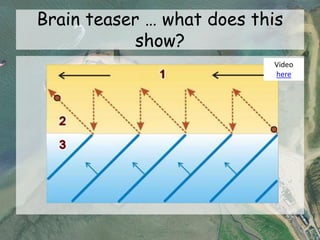
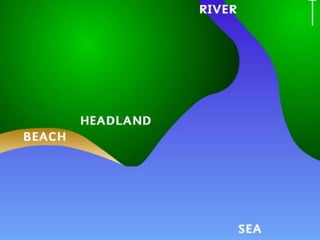
Brain teaser … what does this
show?
Video
here
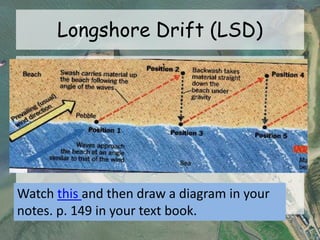
Longshore Drift (LSD)
Watch this and then draw a diagram in your
notes. p. 149 in your text book.
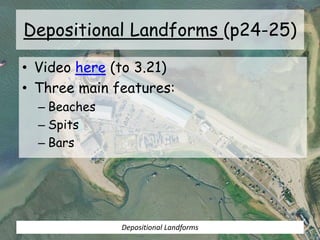
Depositional Landforms (p24-25)
• Video here (to 3.21)
• Three main features:
– Beaches
– Spits
– Bars
Depositional Landforms
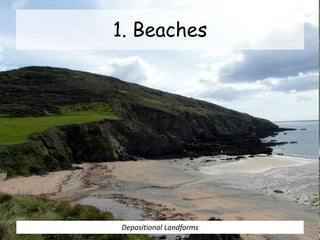
1. Beaches
Depositional Landforms
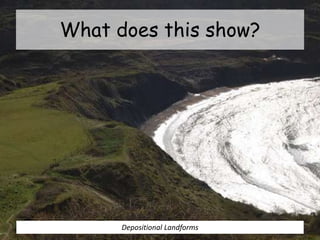
What does this show?
Depositional Landforms
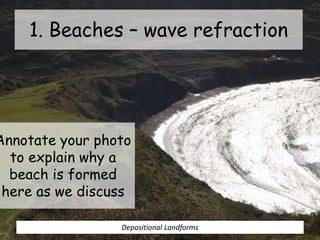
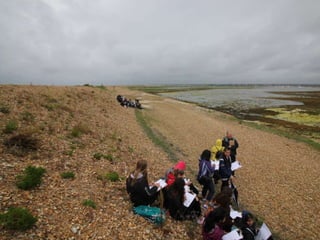
Annotate your photo
to explain why a
beach is formed
here as we discuss
Depositional Landforms
1. Beaches – wave refraction
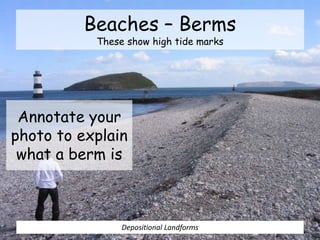
Beaches – Berms
These show high tide marks
Depositional Landforms
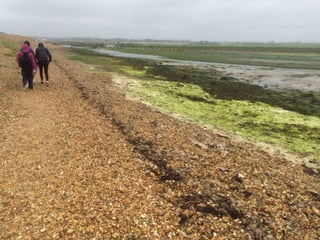
Annotate your
photo to explain
what a berm is
1. Beaches (p24)
• Complete the following sentences.
• Material is carried along the beach by
the process of ………
• The waves that form beaches are ……
• Sandy beaches are found in …
• Pebble beaches are found along …
• In a bay the waves …
• A ‘berm’ is a …….
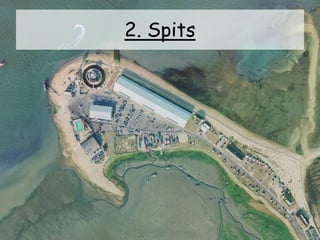
2. Spits
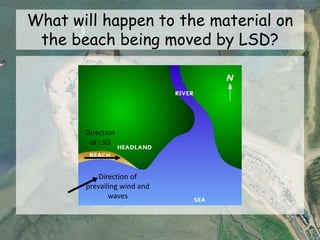
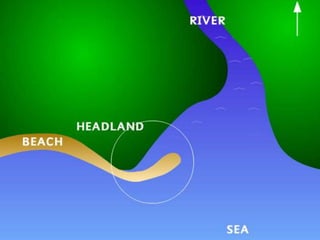
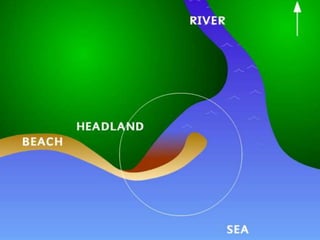
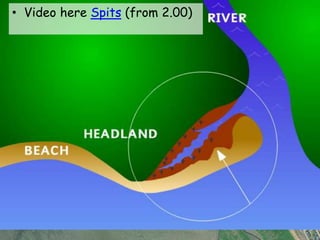
What will happen to the material on
the beach being moved by LSD?
Direction
of LSD
Direction of
prevailing wind and
waves
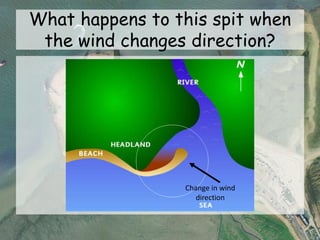
What happens to this spit when
the wind changes direction?
Change in wind
direction
• Video here Spits (from 2.00)
2. Spits
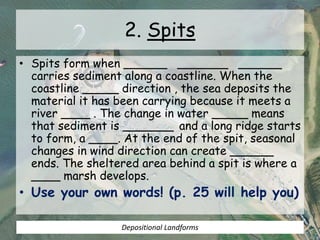
• Spits form when ______ _______ ______
carries sediment along a coastline. When the
coastline _____ direction , the sea deposits the
material it has been carrying because it meets a
river ____ . The change in water _____ means
that sediment is _______ and a long ridge starts
to form, a ____. At the end of the spit, seasonal
changes in wind direction can create ______
ends. The sheltered area behind a spit is where a
____ marsh develops.
• Use your own words! (p. 25 will help you)
Depositional Landforms
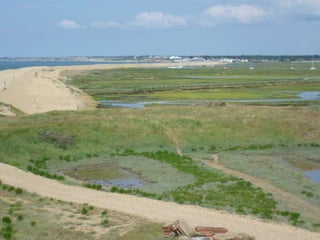
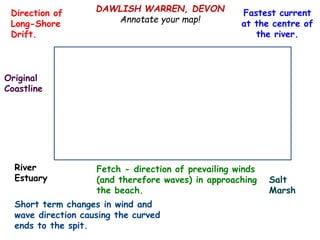
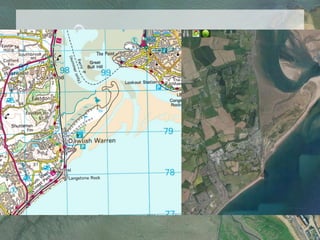
DAWLISH WARREN, DEVON
Annotate your map!
Fetch - direction of prevailing winds
(and therefore waves) in approaching
the beach.
Direction of
Long-Shore
Drift.
Short term changes in wind and
wave direction causing the curved
ends to the spit.
Original
Coastline
Salt
Marsh
Fastest current
at the centre of
the river.
River
Estuary
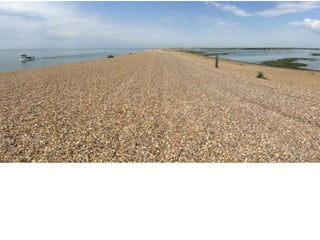
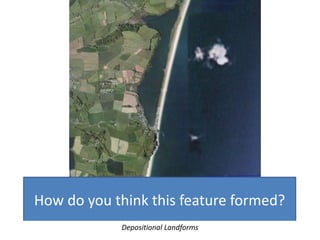
How do you think this feature formed?
Depositional Landforms
3. Bars
Depositional Landforms
3. Bars
Depositional Landforms
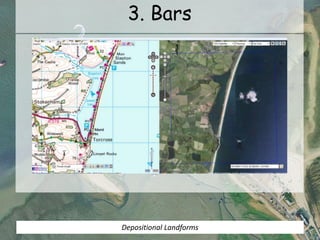
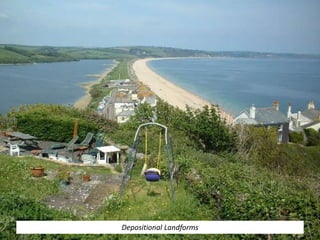
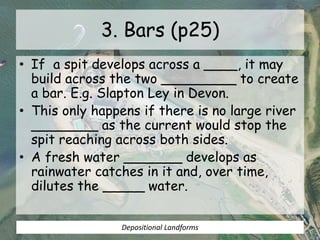
3. Bars (p25)
• If a spit develops across a ____, it may
build across the two _________ to create
a bar. E.g. Slapton Ley in Devon.
• This only happens if there is no large river
________ as the current would stop the
spit reaching across both sides.
• A fresh water _______ develops as
rainwater catches in it and, over time,
dilutes the _____ water.
Depositional Landforms
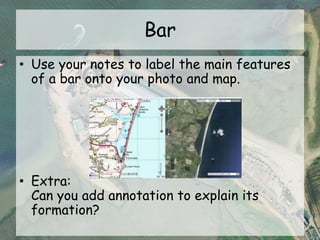
Bar
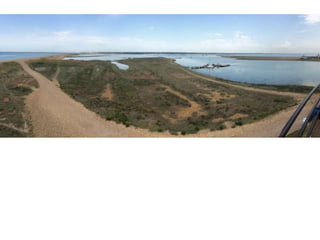
• Use your notes to label the main features
of a bar onto your photo and map.
• Extra:
Can you add annotation to explain its
formation?
Homework
• Learn all your features of erosion and
deposition for a quick test next lesson.

L4 ap coastal deposition

  • 1.
    What coastal landformsare produced by deposition?
  • 2.
    Brain teaser …what does this show? Video here
  • 3.
    Longshore Drift (LSD) Watchthis and then draw a diagram in your notes. p. 149 in your text book.
  • 5.
    Depositional Landforms (p24-25) •Video here (to 3.21) • Three main features: – Beaches – Spits – Bars Depositional Landforms
  • 6.
  • 7.
    What does thisshow? Depositional Landforms
  • 8.
    Annotate your photo toexplain why a beach is formed here as we discuss Depositional Landforms 1. Beaches – wave refraction
  • 9.
    Beaches – Berms Theseshow high tide marks Depositional Landforms Annotate your photo to explain what a berm is
  • 10.
    1. Beaches (p24) •Complete the following sentences. • Material is carried along the beach by the process of ……… • The waves that form beaches are …… • Sandy beaches are found in … • Pebble beaches are found along … • In a bay the waves … • A ‘berm’ is a …….
  • 11.
  • 12.
    What will happento the material on the beach being moved by LSD? Direction of LSD Direction of prevailing wind and waves
  • 16.
    What happens tothis spit when the wind changes direction? Change in wind direction
  • 17.
    • Video hereSpits (from 2.00)
  • 23.
    2. Spits • Spitsform when ______ _______ ______ carries sediment along a coastline. When the coastline _____ direction , the sea deposits the material it has been carrying because it meets a river ____ . The change in water _____ means that sediment is _______ and a long ridge starts to form, a ____. At the end of the spit, seasonal changes in wind direction can create ______ ends. The sheltered area behind a spit is where a ____ marsh develops. • Use your own words! (p. 25 will help you) Depositional Landforms
  • 24.
    DAWLISH WARREN, DEVON Annotateyour map! Fetch - direction of prevailing winds (and therefore waves) in approaching the beach. Direction of Long-Shore Drift. Short term changes in wind and wave direction causing the curved ends to the spit. Original Coastline Salt Marsh Fastest current at the centre of the river. River Estuary
  • 26.
    How do youthink this feature formed? Depositional Landforms
  • 27.
  • 28.
  • 29.
    3. Bars (p25) •If a spit develops across a ____, it may build across the two _________ to create a bar. E.g. Slapton Ley in Devon. • This only happens if there is no large river ________ as the current would stop the spit reaching across both sides. • A fresh water _______ develops as rainwater catches in it and, over time, dilutes the _____ water. Depositional Landforms
  • 31.
    Bar • Use yournotes to label the main features of a bar onto your photo and map. • Extra: Can you add annotation to explain its formation?
  • 32.
    Homework • Learn allyour features of erosion and deposition for a quick test next lesson.