Controlled Assessment Task 1 Due: 28 th  June Fieldwork Focus : Coastal Management
What can you remember about coasts? Erosion? Landforms? Use by people? Management?
You will need to be able to do this: Q: “With the use of a diagram, explain the process and effects of longshore drift, and how it can be managed”
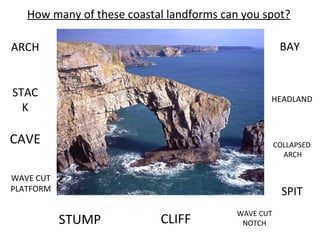
How many of these coastal landforms can you spot? ARCH STACK CAVE WAVE CUT PLATFORM STUMP CLIFF WAVE CUT NOTCH COLLAPSED  ARCH BAY HEADLAND SPIT
Types of coastal erosion
Erosion is……. the wearing away of materials by one of four processes: Corrosion  = chemical reactions of salt water weakening rocks like an acid Attrition  = Pebbles hitting into each other or into cliffs making rocks break and get smaller and rounder Abrasion  = ‘sand paper’ effect. Waves throwing small stones and pebbles at cliffs and beaches to smooth the material Hydraulic Action  = Power of the water forcing its way into cracks and weaknesses in rocks, splitting apart
Exam Q Including keywords where possible, describe and explain how erosion can influence the coast.  You may use a diagram. [3marks]
The main landforms created by erosion are…
Headlands and Bays
 
Wave cut notches and platforms
Wave erosion is greatest when waves break against the foot of the cliff.  With wave energy at a maximum, the waves undercut  the foot of the cliff to form a  wave cut notch Over time the notch enlarges and the cliff above it cannot be supported and so collapses As this is repeated, the cliff retreats (and often increases in height). The gently sloping expanse of cliff marking the foot of the retreating cliff is known as the  Wave cut platform
Does this remind you of anything?  Waterfalls and gorges – very similar ideas!
 
Wave-cut platform –Burgh Island, Devon Wave cut platform Southerndown, South Wales.
Caves Arches Stacks  and  Stumps
 
How was the arch at Durdle Door, Dorset, formed? Abrasion/Corrasion Hydraulic action Solution/Corrosion Attrition
 
1. The waves erode  FAULTS  (cracks) in the headland. 2. The waves eventually erode through the headland to form an  ARCH . 3. The arch becomes unsupported and collapses to form a  STACK . 4. A  STUMP  is formed from the collapsed stack. C D B A Match the image with the most appropriate label.
Exam Q How does geology influence the speed of erosion at the coast? [2marks]
What about waves?
If you were a wave, and you wanted to grow big and strong so you could knock the UK’s block off, which direction would you come from? Why?
Waves There are two main types of waves: Constructive vs Destructive
Exam Q 1) Describe and explain how constructive and destructive waves work. Use keywords or examples where possible. [4marks] 2) Apart from the strength of waves, name and explain another factor that can influence how quickly a coastline erodes? [2marks]
How do waves influence erosion? Longshore drift
Long-shore drift (LSD)
Longshore drift…starring Mr R. Longshore drift video explained by Mr Rogers
 
So, answer the Question: Q: “With the use of a diagram, explain the process and effects of longshore drift, and how it can be managed” [6marks]
So, the controlled assessment How does it work?
Example controlled assessments from last year Take a look at what you will be producing You will have prep time before the trip, then the trip on 11 th  May, then the analysis afterwards Key things = keywords, theory, analysis, explanation, evaluation
Example checklist
What does the markscheme look like? How will you be marked?

Coastal Controlled Assessment Prep

  • 1.
    Controlled Assessment Task1 Due: 28 th June Fieldwork Focus : Coastal Management
  • 2.
    What can youremember about coasts? Erosion? Landforms? Use by people? Management?
  • 3.
    You will needto be able to do this: Q: “With the use of a diagram, explain the process and effects of longshore drift, and how it can be managed”
  • 4.
    How many ofthese coastal landforms can you spot? ARCH STACK CAVE WAVE CUT PLATFORM STUMP CLIFF WAVE CUT NOTCH COLLAPSED ARCH BAY HEADLAND SPIT
  • 5.
  • 6.
    Erosion is……. thewearing away of materials by one of four processes: Corrosion = chemical reactions of salt water weakening rocks like an acid Attrition = Pebbles hitting into each other or into cliffs making rocks break and get smaller and rounder Abrasion = ‘sand paper’ effect. Waves throwing small stones and pebbles at cliffs and beaches to smooth the material Hydraulic Action = Power of the water forcing its way into cracks and weaknesses in rocks, splitting apart
  • 7.
    Exam Q Includingkeywords where possible, describe and explain how erosion can influence the coast. You may use a diagram. [3marks]
  • 8.
    The main landformscreated by erosion are…
  • 9.
  • 10.
  • 11.
    Wave cut notchesand platforms
  • 12.
    Wave erosion isgreatest when waves break against the foot of the cliff. With wave energy at a maximum, the waves undercut the foot of the cliff to form a wave cut notch Over time the notch enlarges and the cliff above it cannot be supported and so collapses As this is repeated, the cliff retreats (and often increases in height). The gently sloping expanse of cliff marking the foot of the retreating cliff is known as the Wave cut platform
  • 13.
    Does this remindyou of anything? Waterfalls and gorges – very similar ideas!
  • 14.
  • 15.
    Wave-cut platform –BurghIsland, Devon Wave cut platform Southerndown, South Wales.
  • 16.
  • 17.
  • 18.
    How was thearch at Durdle Door, Dorset, formed? Abrasion/Corrasion Hydraulic action Solution/Corrosion Attrition
  • 19.
  • 20.
    1. The waveserode FAULTS (cracks) in the headland. 2. The waves eventually erode through the headland to form an ARCH . 3. The arch becomes unsupported and collapses to form a STACK . 4. A STUMP is formed from the collapsed stack. C D B A Match the image with the most appropriate label.
  • 21.
    Exam Q Howdoes geology influence the speed of erosion at the coast? [2marks]
  • 22.
  • 23.
    If you werea wave, and you wanted to grow big and strong so you could knock the UK’s block off, which direction would you come from? Why?
  • 24.
    Waves There aretwo main types of waves: Constructive vs Destructive
  • 25.
    Exam Q 1)Describe and explain how constructive and destructive waves work. Use keywords or examples where possible. [4marks] 2) Apart from the strength of waves, name and explain another factor that can influence how quickly a coastline erodes? [2marks]
  • 26.
    How do wavesinfluence erosion? Longshore drift
  • 27.
  • 28.
    Longshore drift…starring MrR. Longshore drift video explained by Mr Rogers
  • 29.
  • 30.
    So, answer theQuestion: Q: “With the use of a diagram, explain the process and effects of longshore drift, and how it can be managed” [6marks]
  • 31.
    So, the controlledassessment How does it work?
  • 32.
    Example controlled assessmentsfrom last year Take a look at what you will be producing You will have prep time before the trip, then the trip on 11 th May, then the analysis afterwards Key things = keywords, theory, analysis, explanation, evaluation
  • 33.
  • 34.
    What does themarkscheme look like? How will you be marked?

Editor's Notes

  • #6 Sticky does erosion.