COASTS
ENM 142
LECTURE 6
Lecturer: ChƩ Dillon
The coast is the narrow strip of shoreline that separates the land from
the sea. Land, sea and air meet at the coast, making it a constantly-
changing environment. The coast is also affected by human activity -
over 4 billion people worldwide now live at the coast.
Coastal landforms , any of the relief features present along any coast,
are the result of a combination of processes, sediments, and the
geology of the coast itself.
Coastal Landforms
The coastal environment of the world is made up of a
wide variety of landforms manifested in a spectrum of
sizes and shapes ranging from gently sloping beaches
to high cliffs, yet coastal landforms are best considered
in two broad categories: erosional and depositional.
Coastal Landforms
In fact, the overall nature of any coast may be
described in terms of one or the other of these
categories. It should be noted, however, that each of
the two major landform types may occur on any given
reach of coast.
Coastal Landforms
The landforms that develop and persist along the coast are
the result of a combination of processes acting upon the
sediments and rocks present in the coastal zone. The most
prominent of these processes involves waves and the
currents that they generate, along with tides. Other factors
that significantly affect coastal morphology are climate and
gravity.
Factors in the Formation of Coastal
Landforms/Features
Waves get their energy from the wind. As the wind blows over the
surface of the sea, it creates friction. This frictional drag causes
water particles to rotate and their energy is transferred forward in
the form of a wave. Whilst the water moves forward, the water
particles return to their original position.
Factors in the Formation of Coastal
Landforms/Features
As a wave reaches shallow water, friction between the sea bed and
the bottom of the wave causes it to slow down. Its shape becomes
more elliptical (rather than circular). The top of the wave (called
the crest) is not affected by the friction, and it becomes steeper
until it eventually breaks. When the wave breaks, water rushes up
the beach. This is called the swash. The movement of water back
down the beach is called the backwash.
Factors in the Formation of Coastal
Landforms/Features
There are three main factors that affect the strength of a wave:
1. The strength and speed of the wind.
2. The duration of the wind - this is the length of time for which the
wind has blown.
3. The fetch - this is the distance over which the wind has blown.
Factors in the Formation of Coastal
Landforms/Features
Waves are one of the most significant forces in shaping the coastline. There are
two main types of waves - constructive waves and destructive waves.
Constructive waves are low energy waves that tend to arrive at the coast at a
rate of less than 8 waves per minute. Constructive waves are small in height.
They have a strong swash and a weak backwash. This means that constructive
waves tend to deposit material and build up a beach.
Factors in the Formation of Coastal
Landforms/Features
Destructive waves have much higher energy and tend to arrive at
the coast at a rate of more than 8 per minute. They are much larger
in height than constructive waves, often having been caused by
strong winds and a large fetch. Destructive waves have a weak
swash but a strong backwash so they erode the beach by pulling
sand and shingle down the beach as water returns to the sea. This
means that less beach is left to absorb wave energy.
Factors in the Formation of Coastal
Landforms/Features
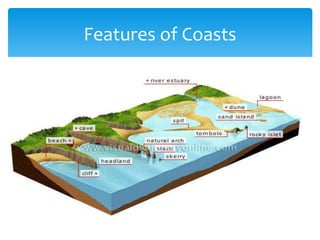
Features of Coasts
Erosional Features of Coasts
Coasts of erosion form as a result of high energy waves, large
fetch, high exposure and limited deposition. They are also
associated with drift aligned coasts that are influenced by
longshore drift. This transfer of sediment along the coast limits the
development of beaches and leads to greater cliff exposure, hence
cliff retreat. Coastlines, that are discordant in geology help create
typical headland and bay features that also erode over time to
form wave-cut platforms and arches and stacks.
Erosional Features of Coasts
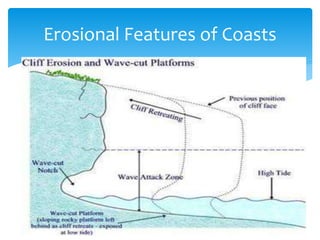
Cliffs are common features of coastal environments.
Over time cliffs retreat due to a combination of sub-
aerial weathering and coastal erosion. Wave action and
weathering create a notch at the high water mark.
Erosional Features of Coasts
Over time the wave-cut notch will develop into a cave. Eventually, the weight
of the unsupported cliff will cause it to collapse. As the cliff collapses a layer of
flat rock is left behind called a wave cut platform. The platform typically has a
slope of less than 4 degrees, which is often only fully exposed at low tide. Wave
cut platforms have a significant impact on the ability of waves to erode the
base of the cliff. This is because the waves have further to travel in very shallow
water as the platform grows. Waves tend to break earlier before they can
erode the base of the cliff.
Erosional Features of Coasts
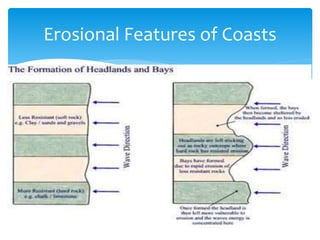
Headlands and bays
Headlands and bays most commonly form along
discordant coastlines. Discordant coastlines form where
geology alternates between bands of hard and soft rock
Erosional Features of Coasts
Due to the way waves refract around headlands,
destructive waves concentrate their energy on their
sides and over time develop unique coastal features,
such as caves, arches and stacks.
Erosional Features of Coasts
Wave refraction is the process by which waves become distorted by
differentiated rates of friction caused by shallower water ahead of coastal
features. In deep water waves are unaffected but in shallow water waves slow
down. On approaching the shoreline waves will curve in to beaches and
reducer the likelihood of drift. Waves approaching headlands slow down and
build height creating destructive waves, The waves become refracted around
the headland and so wave energy becomes concentrated on the sides of the
headland.
Erosional Features of Coasts
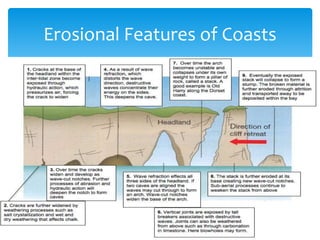
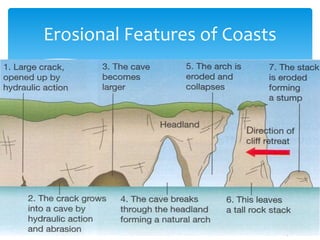
CAVES, ARCHES, STACKS AND STUMPS
Headlands, once formed, are exposed to the full force
of the sea. As a result of wave refraction, destructive
waves concentrate their energy on all three sides of the
headland and so it slowly erodes overtime. In doing so,
quite distinct features develop.
Erosional Features of Coasts
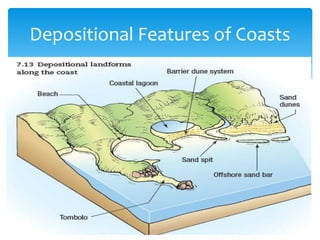
Depositional coastline features form when more
sediment is added to the beach environment than the
ocean’s energy can remove to the offshore. While
waves can redistribute the sediment, an influx of
sediment remains in the beach environment.
Depositional Features of Coasts
Movement of sediment along the coast by wave action is called LONGSHORE DRIFT;
occurs in 2 ways:
 by wind driven movement of sand along the exposed beach
 most wind waves approach the coast at an oblique angle and then refract (bend) in
shallow water to break almost parallel to shore; water will rush up the beach at a
slight angle but will return to ocean by running straight downhill due to gravity
 this causes sediment to move up the beach at an angle but retreat down the beach
straight down -- the net transport of sediment is longshore, parallel to coast and away
from the direction of approaching waves
Depositional Features of Coasts
By current-driven movement of sand in the surf zone just offshore (via
longshore currents):
when waves approach a straight coastline at an oblique angle a
longshore current is produced which flows parallel to shoreline in
nearshore region; current is produced by waves distributing a portion
of their energy away from their direction of approach; they move
sediment along the shorelines where there are gently sloping beaches
Depositional Features of Coasts
BEACHES
Created by constructive waves depositing material (sand, shingle and
pebbles) that has been transported from further along the coast.
They lie between high and low watermark and are gently sloping,
towards the sea.
A constantly changing feature, beaches may be built up at certain
times of the year, and eroded away at others, depending on the type
of waves hitting them at the time. Often this change can be seasonal.
Depositional Features of Coasts
SPITS
 A long, narrow ridge of sand attached at one end to the coast.
 Built up by long shore drift transporting material along the coast.
 At a bend or break (for an estuary) in the coastline the material being carried is dropped. However it
is deposited away from the coastline.
 As the spit builds out to sea the end is affected more by the wind and by wave currents, causing the
end to curve towards the shore, to create a hook end.
 Material often accumulates in the area of standing water that occurs behind a spit, and this can lead
to the formation of salt marshes.
 Spits can be areas where large sand dunes build up, nearer the back of it.
Depositional Features of Coasts
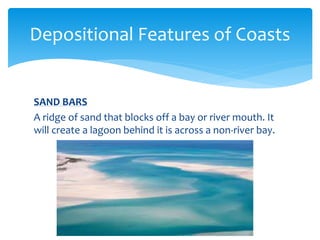
SAND BARS
A ridge of sand that blocks off a bay or river mouth. It
will create a lagoon behind it is across a non-river bay.
Depositional Features of Coasts
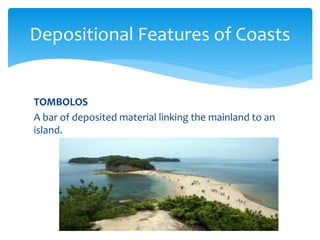
TOMBOLOS
A bar of deposited material linking the mainland to an
island.
Depositional Features of Coasts
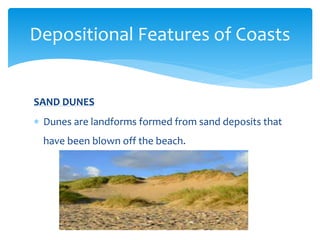
SAND DUNES
 Dunes are landforms formed from sand deposits that
have been blown off the beach.
Depositional Features of Coasts
With reference to a named coastal area or coastal areas
and with the use of diagrams describe how the coast is
being shaped by the erosion and deposition.
Past Papers
Areas close to the coast do not have extremes of
temperature that is usually common to inland areas that
are not influenced by the coast.
 Explain these phenomena using diagrams and or
examples.
 Explain ocean currents as also instrumental in
modifying the temperature of coastal areas.
Past Papers
The coastal feature of a headland can soon be
transformed into a stack by the natural erosive forces of
the Earth (water, wind, temperature etc.).
• Describe what happens to the beach or shoreline as
this occurs.
• Lagoons are sometimes natural formations during the
erosion of a headland feature. Describe how the
features of the lagoon may change as erosion
continues.
Past Papers
a. Explain what is long shore drift.
b. Describe the characteristics of destructive waves.
c. With the aid of diagrams explain the formation of the
following
Caves, arches, stumps and stacks
Past Papers
With the aid of an example and/ or diagrams explain
coastal erosion and three features formed by coastal
erosion.
Past Papers
 The coast is an area of intense erosion and
deposition. Outline the different types of wave
erosion. Identify two erosional features and one
depositional feature that can be found on the coast
ad explain how they are formed.
Past Papers
a. Describe fully constructive and destructive waves.
b. Choose any three features from the list below and explain its
formation with the aid of diagrams.
Caves, arches, stumps and stacks.
Blow holes
Bars and spits
Bays and headlands
Past Papers

COASTS ENM 142 Lecture 7.pptx

  • 1.
  • 2.
    The coast isthe narrow strip of shoreline that separates the land from the sea. Land, sea and air meet at the coast, making it a constantly- changing environment. The coast is also affected by human activity - over 4 billion people worldwide now live at the coast. Coastal landforms , any of the relief features present along any coast, are the result of a combination of processes, sediments, and the geology of the coast itself. Coastal Landforms
  • 3.
    The coastal environmentof the world is made up of a wide variety of landforms manifested in a spectrum of sizes and shapes ranging from gently sloping beaches to high cliffs, yet coastal landforms are best considered in two broad categories: erosional and depositional. Coastal Landforms
  • 4.
    In fact, theoverall nature of any coast may be described in terms of one or the other of these categories. It should be noted, however, that each of the two major landform types may occur on any given reach of coast. Coastal Landforms
  • 5.
    The landforms thatdevelop and persist along the coast are the result of a combination of processes acting upon the sediments and rocks present in the coastal zone. The most prominent of these processes involves waves and the currents that they generate, along with tides. Other factors that significantly affect coastal morphology are climate and gravity. Factors in the Formation of Coastal Landforms/Features
  • 6.
    Waves get theirenergy from the wind. As the wind blows over the surface of the sea, it creates friction. This frictional drag causes water particles to rotate and their energy is transferred forward in the form of a wave. Whilst the water moves forward, the water particles return to their original position. Factors in the Formation of Coastal Landforms/Features
  • 7.
    As a wavereaches shallow water, friction between the sea bed and the bottom of the wave causes it to slow down. Its shape becomes more elliptical (rather than circular). The top of the wave (called the crest) is not affected by the friction, and it becomes steeper until it eventually breaks. When the wave breaks, water rushes up the beach. This is called the swash. The movement of water back down the beach is called the backwash. Factors in the Formation of Coastal Landforms/Features
  • 8.
    There are threemain factors that affect the strength of a wave: 1. The strength and speed of the wind. 2. The duration of the wind - this is the length of time for which the wind has blown. 3. The fetch - this is the distance over which the wind has blown. Factors in the Formation of Coastal Landforms/Features
  • 9.
    Waves are oneof the most significant forces in shaping the coastline. There are two main types of waves - constructive waves and destructive waves. Constructive waves are low energy waves that tend to arrive at the coast at a rate of less than 8 waves per minute. Constructive waves are small in height. They have a strong swash and a weak backwash. This means that constructive waves tend to deposit material and build up a beach. Factors in the Formation of Coastal Landforms/Features
  • 10.
    Destructive waves havemuch higher energy and tend to arrive at the coast at a rate of more than 8 per minute. They are much larger in height than constructive waves, often having been caused by strong winds and a large fetch. Destructive waves have a weak swash but a strong backwash so they erode the beach by pulling sand and shingle down the beach as water returns to the sea. This means that less beach is left to absorb wave energy. Factors in the Formation of Coastal Landforms/Features
  • 11.
  • 12.
  • 13.
    Coasts of erosionform as a result of high energy waves, large fetch, high exposure and limited deposition. They are also associated with drift aligned coasts that are influenced by longshore drift. This transfer of sediment along the coast limits the development of beaches and leads to greater cliff exposure, hence cliff retreat. Coastlines, that are discordant in geology help create typical headland and bay features that also erode over time to form wave-cut platforms and arches and stacks. Erosional Features of Coasts
  • 14.
    Cliffs are commonfeatures of coastal environments. Over time cliffs retreat due to a combination of sub- aerial weathering and coastal erosion. Wave action and weathering create a notch at the high water mark. Erosional Features of Coasts
  • 15.
    Over time thewave-cut notch will develop into a cave. Eventually, the weight of the unsupported cliff will cause it to collapse. As the cliff collapses a layer of flat rock is left behind called a wave cut platform. The platform typically has a slope of less than 4 degrees, which is often only fully exposed at low tide. Wave cut platforms have a significant impact on the ability of waves to erode the base of the cliff. This is because the waves have further to travel in very shallow water as the platform grows. Waves tend to break earlier before they can erode the base of the cliff. Erosional Features of Coasts
  • 16.
    Headlands and bays Headlandsand bays most commonly form along discordant coastlines. Discordant coastlines form where geology alternates between bands of hard and soft rock Erosional Features of Coasts
  • 17.
  • 18.
    Due to theway waves refract around headlands, destructive waves concentrate their energy on their sides and over time develop unique coastal features, such as caves, arches and stacks. Erosional Features of Coasts
  • 19.
    Wave refraction isthe process by which waves become distorted by differentiated rates of friction caused by shallower water ahead of coastal features. In deep water waves are unaffected but in shallow water waves slow down. On approaching the shoreline waves will curve in to beaches and reducer the likelihood of drift. Waves approaching headlands slow down and build height creating destructive waves, The waves become refracted around the headland and so wave energy becomes concentrated on the sides of the headland. Erosional Features of Coasts
  • 20.
    CAVES, ARCHES, STACKSAND STUMPS Headlands, once formed, are exposed to the full force of the sea. As a result of wave refraction, destructive waves concentrate their energy on all three sides of the headland and so it slowly erodes overtime. In doing so, quite distinct features develop. Erosional Features of Coasts
  • 21.
  • 22.
  • 23.
    Depositional coastline featuresform when more sediment is added to the beach environment than the ocean’s energy can remove to the offshore. While waves can redistribute the sediment, an influx of sediment remains in the beach environment. Depositional Features of Coasts
  • 24.
    Movement of sedimentalong the coast by wave action is called LONGSHORE DRIFT; occurs in 2 ways:  by wind driven movement of sand along the exposed beach  most wind waves approach the coast at an oblique angle and then refract (bend) in shallow water to break almost parallel to shore; water will rush up the beach at a slight angle but will return to ocean by running straight downhill due to gravity  this causes sediment to move up the beach at an angle but retreat down the beach straight down -- the net transport of sediment is longshore, parallel to coast and away from the direction of approaching waves Depositional Features of Coasts
  • 25.
    By current-driven movementof sand in the surf zone just offshore (via longshore currents): when waves approach a straight coastline at an oblique angle a longshore current is produced which flows parallel to shoreline in nearshore region; current is produced by waves distributing a portion of their energy away from their direction of approach; they move sediment along the shorelines where there are gently sloping beaches Depositional Features of Coasts
  • 26.
  • 27.
    BEACHES Created by constructivewaves depositing material (sand, shingle and pebbles) that has been transported from further along the coast. They lie between high and low watermark and are gently sloping, towards the sea. A constantly changing feature, beaches may be built up at certain times of the year, and eroded away at others, depending on the type of waves hitting them at the time. Often this change can be seasonal. Depositional Features of Coasts
  • 28.
    SPITS  A long,narrow ridge of sand attached at one end to the coast.  Built up by long shore drift transporting material along the coast.  At a bend or break (for an estuary) in the coastline the material being carried is dropped. However it is deposited away from the coastline.  As the spit builds out to sea the end is affected more by the wind and by wave currents, causing the end to curve towards the shore, to create a hook end.  Material often accumulates in the area of standing water that occurs behind a spit, and this can lead to the formation of salt marshes.  Spits can be areas where large sand dunes build up, nearer the back of it. Depositional Features of Coasts
  • 29.
    SAND BARS A ridgeof sand that blocks off a bay or river mouth. It will create a lagoon behind it is across a non-river bay. Depositional Features of Coasts
  • 30.
    TOMBOLOS A bar ofdeposited material linking the mainland to an island. Depositional Features of Coasts
  • 31.
    SAND DUNES  Dunesare landforms formed from sand deposits that have been blown off the beach. Depositional Features of Coasts
  • 32.
    With reference toa named coastal area or coastal areas and with the use of diagrams describe how the coast is being shaped by the erosion and deposition. Past Papers
  • 33.
    Areas close tothe coast do not have extremes of temperature that is usually common to inland areas that are not influenced by the coast.  Explain these phenomena using diagrams and or examples.  Explain ocean currents as also instrumental in modifying the temperature of coastal areas. Past Papers
  • 34.
    The coastal featureof a headland can soon be transformed into a stack by the natural erosive forces of the Earth (water, wind, temperature etc.). • Describe what happens to the beach or shoreline as this occurs. • Lagoons are sometimes natural formations during the erosion of a headland feature. Describe how the features of the lagoon may change as erosion continues. Past Papers
  • 35.
    a. Explain whatis long shore drift. b. Describe the characteristics of destructive waves. c. With the aid of diagrams explain the formation of the following Caves, arches, stumps and stacks Past Papers
  • 36.
    With the aidof an example and/ or diagrams explain coastal erosion and three features formed by coastal erosion. Past Papers
  • 37.
     The coastis an area of intense erosion and deposition. Outline the different types of wave erosion. Identify two erosional features and one depositional feature that can be found on the coast ad explain how they are formed. Past Papers
  • 38.
    a. Describe fullyconstructive and destructive waves. b. Choose any three features from the list below and explain its formation with the aid of diagrams. Caves, arches, stumps and stacks. Blow holes Bars and spits Bays and headlands Past Papers