Where are all the natural
resources distributed
across the UK?
2. UK distribution of natural
resources
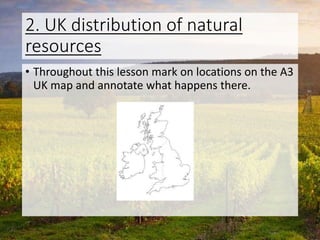
• Throughout this lesson mark on locations on the A3
UK map and annotate what happens there.
Here's one I made earlier …
A. Soil and Agriculture
• Wide variety of soils in the UK.
• This allows different types of farming (arable and
pastoral) to take place in different parts of the UK.
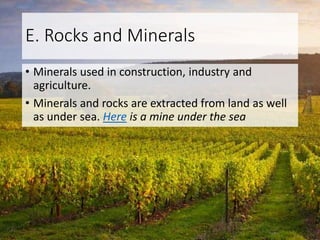
• Some farmers have diversified into growing Tea
(Cornwall) and some into wine (Denbies in Dorking)
• Suffolk and Norfolk are very productive for arable
farmers (potatoes, cereals and crops)
Dominant
soils of
the UK
Soils and farming
B. Forestry
• Currently 12% of UK covered by woodland.
Previously this figure was much higher.
• The Forestry Commission is responsible for
protecting the UK’s forests.
• The forestry industry employs 800,000 people in
the UK.
• Forestry is concentrated in the north and west
where the climate is not good for farming.
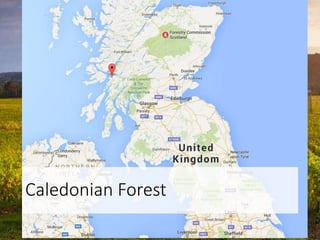
• Oldest forests remain in Scotland, the Caledonian
Forest.
Caledonian Forest
C. Fossil Fuels
• Coal, gas and oil are all found in the UK.
• Coal was mined heavily but was found in seams
underground (in places like South Wales or Country
Durham) which was hard to access.
• Oil and gas are now mainly off-shore in the UK. E.g.
Gas terminals off shore in the North Sea. However
these reserves are decreasing.
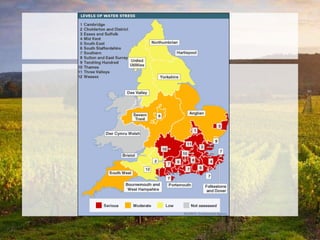
D. Water Supply
• Water supply might not always be high in the areas
that need it the most.
• Hosepipe bans are
common in the Kent
and Surrey if there
has been a dry
spring.
E. Rocks and Minerals
• Minerals used in construction, industry and
agriculture.
• Minerals and rocks are extracted from land as well
as under sea. Here is a mine under the sea
E. Rocks and Minerals
• UK has varied
rock types
Your turn
• Imagine you are a tour guide and, using your UK
map, write about all the different natural resources
that can be seen in the UK!
• E.g.
• Starting in South West England, Cornwall
is a county that boasts to have a climate
that allows Tea to be grown. Moving east
towards …

L2b uk distribution

  • 1.
    Where are allthe natural resources distributed across the UK?
  • 2.
    2. UK distributionof natural resources • Throughout this lesson mark on locations on the A3 UK map and annotate what happens there.
  • 3.
    Here's one Imade earlier …
  • 4.
    A. Soil andAgriculture • Wide variety of soils in the UK. • This allows different types of farming (arable and pastoral) to take place in different parts of the UK. • Some farmers have diversified into growing Tea (Cornwall) and some into wine (Denbies in Dorking) • Suffolk and Norfolk are very productive for arable farmers (potatoes, cereals and crops)
  • 5.
  • 7.
  • 8.
    B. Forestry • Currently12% of UK covered by woodland. Previously this figure was much higher. • The Forestry Commission is responsible for protecting the UK’s forests. • The forestry industry employs 800,000 people in the UK. • Forestry is concentrated in the north and west where the climate is not good for farming. • Oldest forests remain in Scotland, the Caledonian Forest.
  • 9.
  • 10.
    C. Fossil Fuels •Coal, gas and oil are all found in the UK. • Coal was mined heavily but was found in seams underground (in places like South Wales or Country Durham) which was hard to access. • Oil and gas are now mainly off-shore in the UK. E.g. Gas terminals off shore in the North Sea. However these reserves are decreasing.
  • 12.
    D. Water Supply •Water supply might not always be high in the areas that need it the most. • Hosepipe bans are common in the Kent and Surrey if there has been a dry spring.
  • 14.
    E. Rocks andMinerals • Minerals used in construction, industry and agriculture. • Minerals and rocks are extracted from land as well as under sea. Here is a mine under the sea
  • 15.
    E. Rocks andMinerals • UK has varied rock types
  • 16.
    Your turn • Imagineyou are a tour guide and, using your UK map, write about all the different natural resources that can be seen in the UK! • E.g. • Starting in South West England, Cornwall is a county that boasts to have a climate that allows Tea to be grown. Moving east towards …