Solving Mexico City’s problems
and improving the quality of life
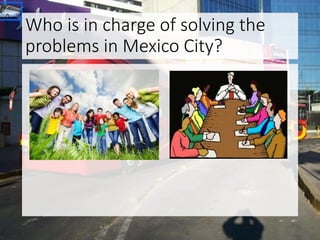
Who is in charge of solving the
problems in Mexico City?
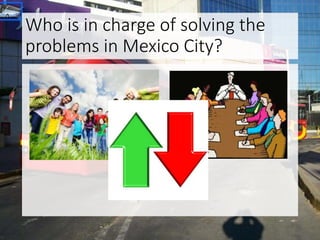
Who is in charge of solving the
problems in Mexico City?
Two different strategies for
improving a city
• Top Down
These strategies are large-
scale developments usually
government led.
The Government officiants
at the top of the decision
making process make the
decisions.
Often large scale expensive
schemes.
• Bottom Up
These strategies are small-
scale community led
developments.
People who are usually at
the bottom of the decision
making process are fully
involved to help change
their area in a way that
they want.
Often low cost strategies.
Your turn
• Read the information on the handout and establish
some of the positives and negatives of top down
and bottom up schemes in Mexico
1. Bottom-up approach in Mexico
City
Neza (SE Mexico city) grew as a squatter settlement
• Early 1970s, residents came together to demand that
the government gave them ownership of the land and
the area is now a thriving suburb.
• They then:
-raised small amounts of money to build schools and
health centre
- improved their environment through voluntary work
• Even today there is community help with neighbours
getting together to buy water from a visiting "pipa"
truck each week
• Neza is teeming with micro entrepreneurs working
from home or sharing spaces
• As a result there is less crime here than in other parts
of Mexico City
• But it is still considered to be a dangerous part of MC
and does not get named in travel guides
Top down in Mexico City
• The government set up a special housing agency (INFONAVIT) in the 1990’s to
lend money (mortgage) to people so that they could buy a home.
• It was government backed and so offered mortgages to middle class who may
not have got one from a bank.
• It lent 5 million mortgages!
• The government also gave subsidies to private developers to build large scale
housing developments on the edge of the city on greenfield sites.
• These developers (e.g. Homex) built tiny orange or blue houses, each identical,
in vast quantities.
• Sadly the government wanted homes so badly the infrastructure couldn't keep
up, e.g. water supply.
• The homes are much further away from where the inhabitants work, meaning a
longer commute.
• Not all the housing developers survived as lots of the new estates weren’t sold
and so they went bankrupt.
Advantages and Disadvantages
• Top Down
Bottom Up
Advantages Disadvantages
Your turn
• Imagine you are producing a radio script for a live
debate about who would have the biggest say in
the redevelopment of areas in Mexico City.
• Hi Welcome to the show, today we are talking about
redevelopment and I will be interviewing Juan
Paublo-Montoya first. Juan, you live in …, what do
you think about who should be in charge of the
redevelopment in Mexico City?
• Well I know that …
HOMEWORK
• Complete the handout using both your class notes
and p176-7

Ap solving mexico city problems

  • 1.
    Solving Mexico City’sproblems and improving the quality of life
  • 2.
    Who is incharge of solving the problems in Mexico City?
  • 3.
    Who is incharge of solving the problems in Mexico City?
  • 4.
    Two different strategiesfor improving a city • Top Down These strategies are large- scale developments usually government led. The Government officiants at the top of the decision making process make the decisions. Often large scale expensive schemes. • Bottom Up These strategies are small- scale community led developments. People who are usually at the bottom of the decision making process are fully involved to help change their area in a way that they want. Often low cost strategies.
  • 5.
    Your turn • Readthe information on the handout and establish some of the positives and negatives of top down and bottom up schemes in Mexico
  • 6.
    1. Bottom-up approachin Mexico City Neza (SE Mexico city) grew as a squatter settlement
  • 7.
    • Early 1970s,residents came together to demand that the government gave them ownership of the land and the area is now a thriving suburb. • They then: -raised small amounts of money to build schools and health centre - improved their environment through voluntary work • Even today there is community help with neighbours getting together to buy water from a visiting "pipa" truck each week • Neza is teeming with micro entrepreneurs working from home or sharing spaces • As a result there is less crime here than in other parts of Mexico City • But it is still considered to be a dangerous part of MC and does not get named in travel guides
  • 9.
    Top down inMexico City • The government set up a special housing agency (INFONAVIT) in the 1990’s to lend money (mortgage) to people so that they could buy a home. • It was government backed and so offered mortgages to middle class who may not have got one from a bank. • It lent 5 million mortgages! • The government also gave subsidies to private developers to build large scale housing developments on the edge of the city on greenfield sites. • These developers (e.g. Homex) built tiny orange or blue houses, each identical, in vast quantities. • Sadly the government wanted homes so badly the infrastructure couldn't keep up, e.g. water supply. • The homes are much further away from where the inhabitants work, meaning a longer commute. • Not all the housing developers survived as lots of the new estates weren’t sold and so they went bankrupt.
  • 12.
    Advantages and Disadvantages •Top Down Bottom Up Advantages Disadvantages Advantages Disadvantages
  • 13.
    Your turn • Imagineyou are producing a radio script for a live debate about who would have the biggest say in the redevelopment of areas in Mexico City. • Hi Welcome to the show, today we are talking about redevelopment and I will be interviewing Juan Paublo-Montoya first. Juan, you live in …, what do you think about who should be in charge of the redevelopment in Mexico City? • Well I know that …
  • 14.
    HOMEWORK • Complete thehandout using both your class notes and p176-7