What processes shape our
coastline?
What processes shape our coastline?
Recap on coastal erosion – its
very similar to river erosion …
What processes shape our coastline?
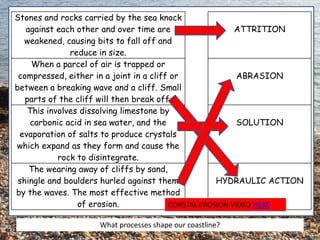
Stones and rocks carried by the sea knock
against each other and over time are
weakened, causing bits to fall off and
reduce in size.
ATTRITION
When a parcel of air is trapped or
compressed, either in a joint in a cliff or
between a breaking wave and a cliff. Small
parts of the cliff will then break off.
ABRASION
This involves dissolving limestone by
carbonic acid in sea water, and the
evaporation of salts to produce crystals
which expand as they form and cause the
rock to disintegrate.
SOLUTION
The wearing away of cliffs by sand,
shingle and boulders hurled against them
by the waves. The most effective method
of erosion.
HYDRAULIC ACTION
COASTAL EROSION VIDEO HERE
What processes shape our coastline?
B. Coastal transportation
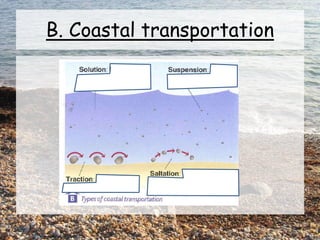
1. Solution
2. Suspension
3. Traction
4. Saltation
What processes shape our coastline?
Diagram to show transportation
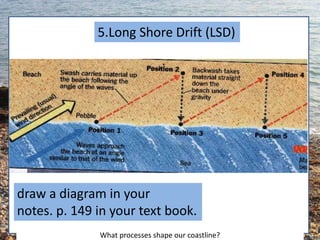
5.Long Shore Drift (LSD)
draw a diagram in your
notes. p. 149 in your text book.
What processes shape our coastline?
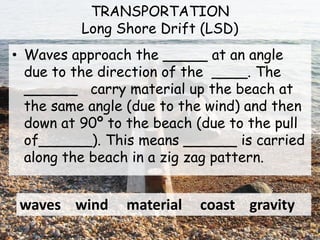
TRANSPORTATION
Long Shore Drift (LSD)
• Waves approach the _____ at an angle
due to the direction of the ____. The
______ carry material up the beach at
the same angle (due to the wind) and then
down at 90º to the beach (due to the pull
of______). This means ______ is carried
along the beach in a zig zag pattern.
waves wind material coast gravity
Diagram of Long Shore Drift (LSD)
What processes shape our coastline?
C. Coastal Deposition
What causes deposition to take place?
1. Slower flowing water
2. Sediment can no longer be carried; either too
heavy or meets an obstacle
3. Wave loses energy in a bay where there is more
shelter and less wind. This allows a beach to form.
What processes shape our coastline?
Map skills recap:p153
What features should you be
able to recognise on a map?
• Camp site
• Coniferous forest
• Visitor centre
• Foot paths
• Schools
• Different types of roads
• Train station
• And many more…..
• Make yourself a key to
ensure you will remember
them.
What are the patterns on this
map shown by the contours?
• Reference specific grid
squares and numbers.
• Describe the relief of
the land.
What processes shape our coastline?

L3.ap longshore drift and deposition

  • 1.
    What processes shapeour coastline? What processes shape our coastline?
  • 2.
    Recap on coastalerosion – its very similar to river erosion … What processes shape our coastline?
  • 3.
    Stones and rockscarried by the sea knock against each other and over time are weakened, causing bits to fall off and reduce in size. ATTRITION When a parcel of air is trapped or compressed, either in a joint in a cliff or between a breaking wave and a cliff. Small parts of the cliff will then break off. ABRASION This involves dissolving limestone by carbonic acid in sea water, and the evaporation of salts to produce crystals which expand as they form and cause the rock to disintegrate. SOLUTION The wearing away of cliffs by sand, shingle and boulders hurled against them by the waves. The most effective method of erosion. HYDRAULIC ACTION COASTAL EROSION VIDEO HERE What processes shape our coastline?
  • 4.
  • 5.
    B. Coastal transportation 1.Solution 2. Suspension 3. Traction 4. Saltation What processes shape our coastline?
  • 6.
    Diagram to showtransportation
  • 7.
    5.Long Shore Drift(LSD) draw a diagram in your notes. p. 149 in your text book. What processes shape our coastline?
  • 8.
    TRANSPORTATION Long Shore Drift(LSD) • Waves approach the _____ at an angle due to the direction of the ____. The ______ carry material up the beach at the same angle (due to the wind) and then down at 90º to the beach (due to the pull of______). This means ______ is carried along the beach in a zig zag pattern. waves wind material coast gravity
  • 9.
    Diagram of LongShore Drift (LSD) What processes shape our coastline?
  • 10.
    C. Coastal Deposition Whatcauses deposition to take place? 1. Slower flowing water 2. Sediment can no longer be carried; either too heavy or meets an obstacle 3. Wave loses energy in a bay where there is more shelter and less wind. This allows a beach to form. What processes shape our coastline?
  • 11.
    Map skills recap:p153 Whatfeatures should you be able to recognise on a map? • Camp site • Coniferous forest • Visitor centre • Foot paths • Schools • Different types of roads • Train station • And many more….. • Make yourself a key to ensure you will remember them. What are the patterns on this map shown by the contours? • Reference specific grid squares and numbers. • Describe the relief of the land. What processes shape our coastline?