ENERGY TECHNOLGY
UNIT 1- ENERGY
UNIT-1 Energy
 Introduction to energy
 Global energy scene
 Indian energy scene
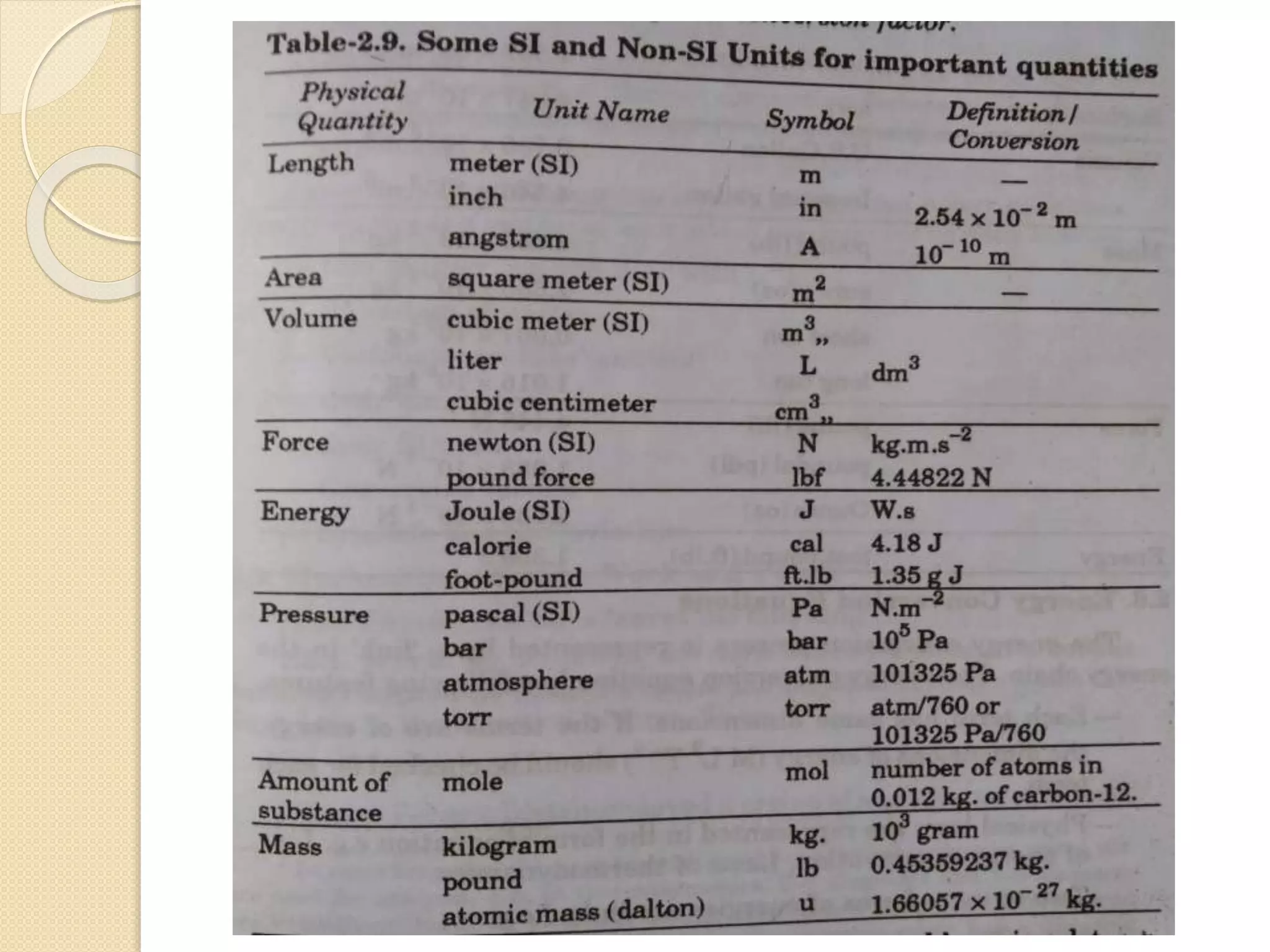
 Units of energy
 Conversion factors
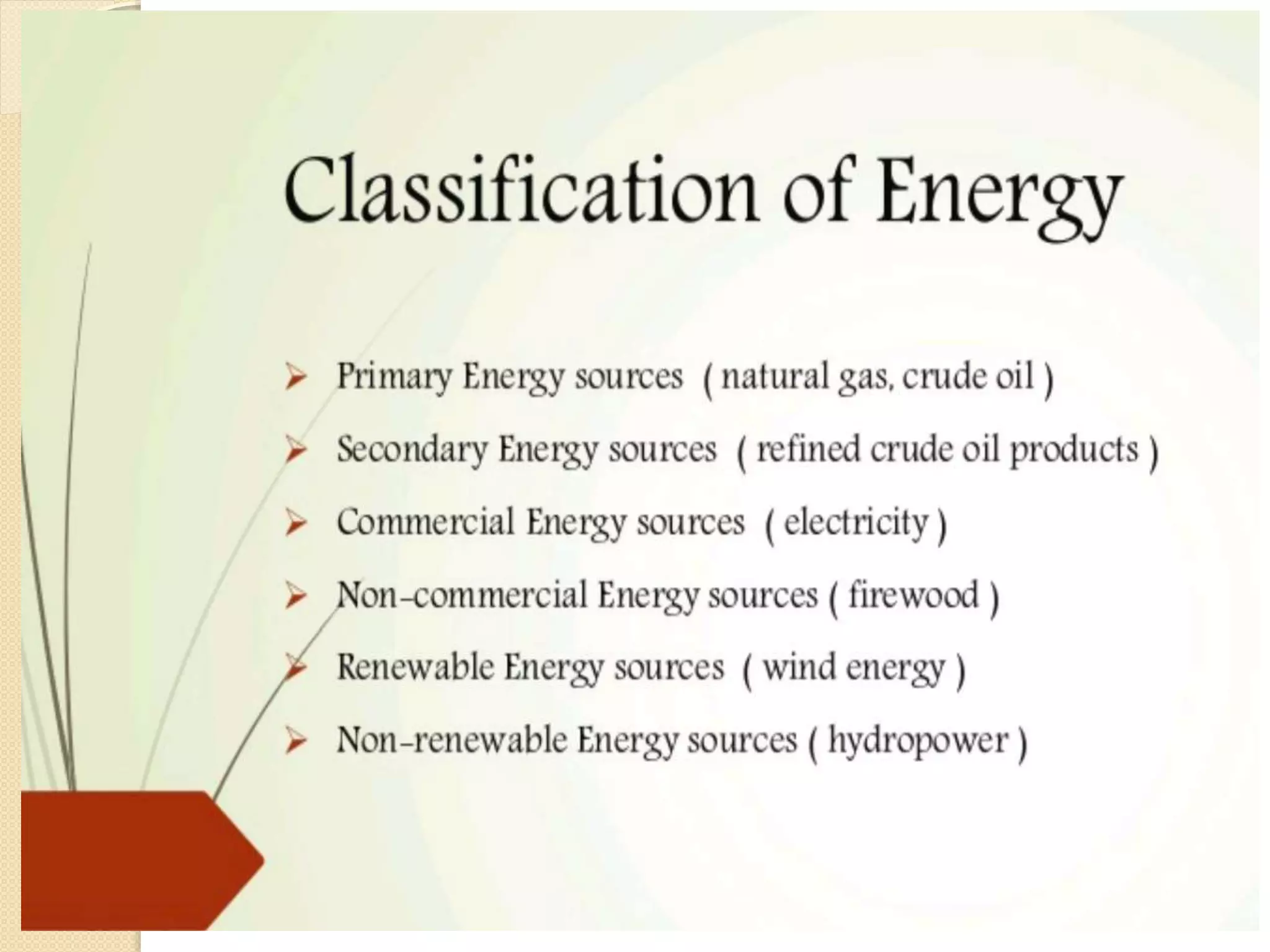
 General classification of energy
 Energy crisis
 Energy alternatives.
UNITS Of ENERGY
 1950, Several system of measurement
can be followed different countries
 In 1960, IS introduced. All forms of
energy measured in terms of same unit
Joule (J)
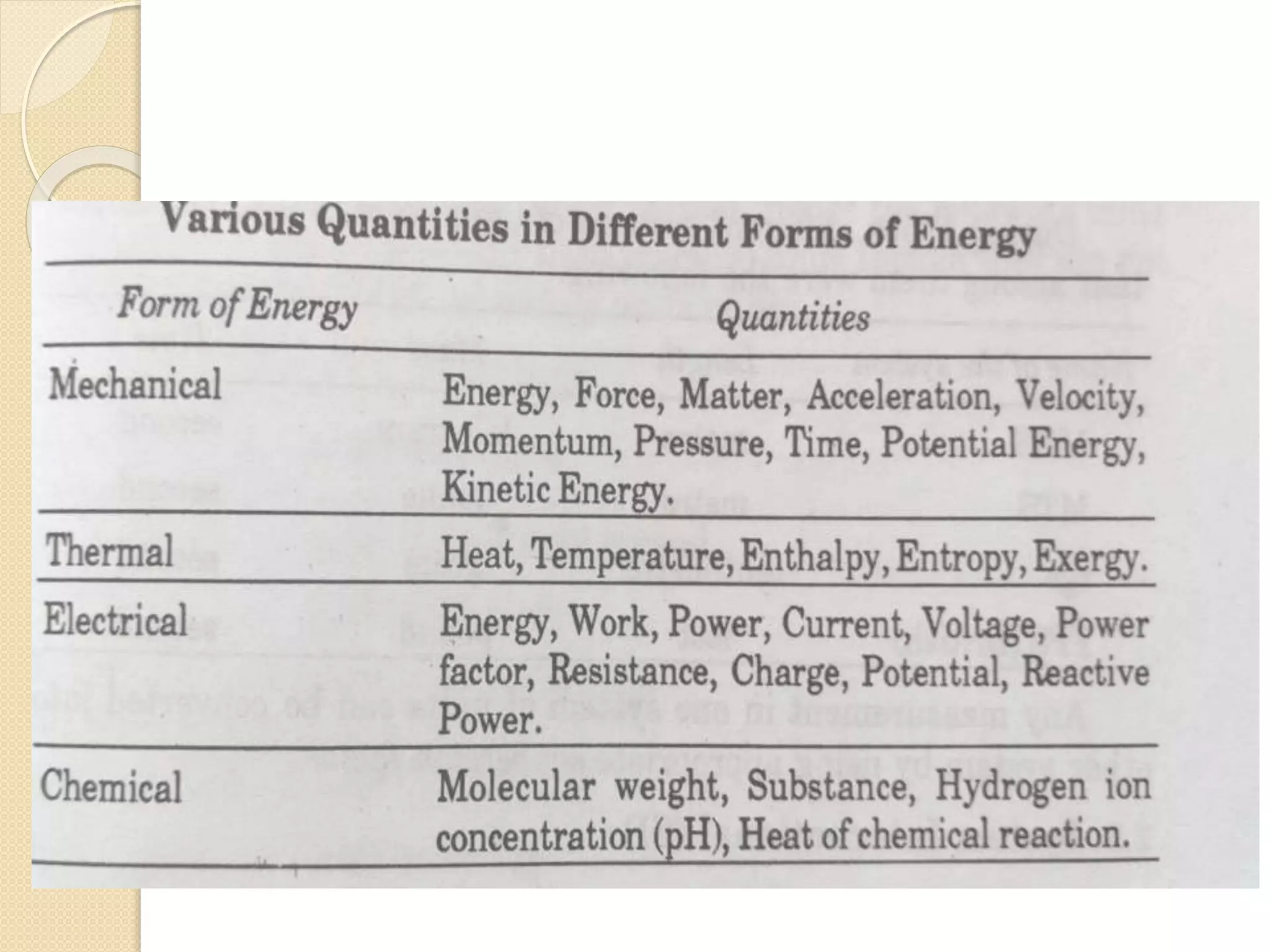
 Energy science and technology involves
several physical quantities
 Each quantity has certain basic
dimensions in terms of length (L), mass
(M) and time (T).
 Each dimension can be measured of
certain units.
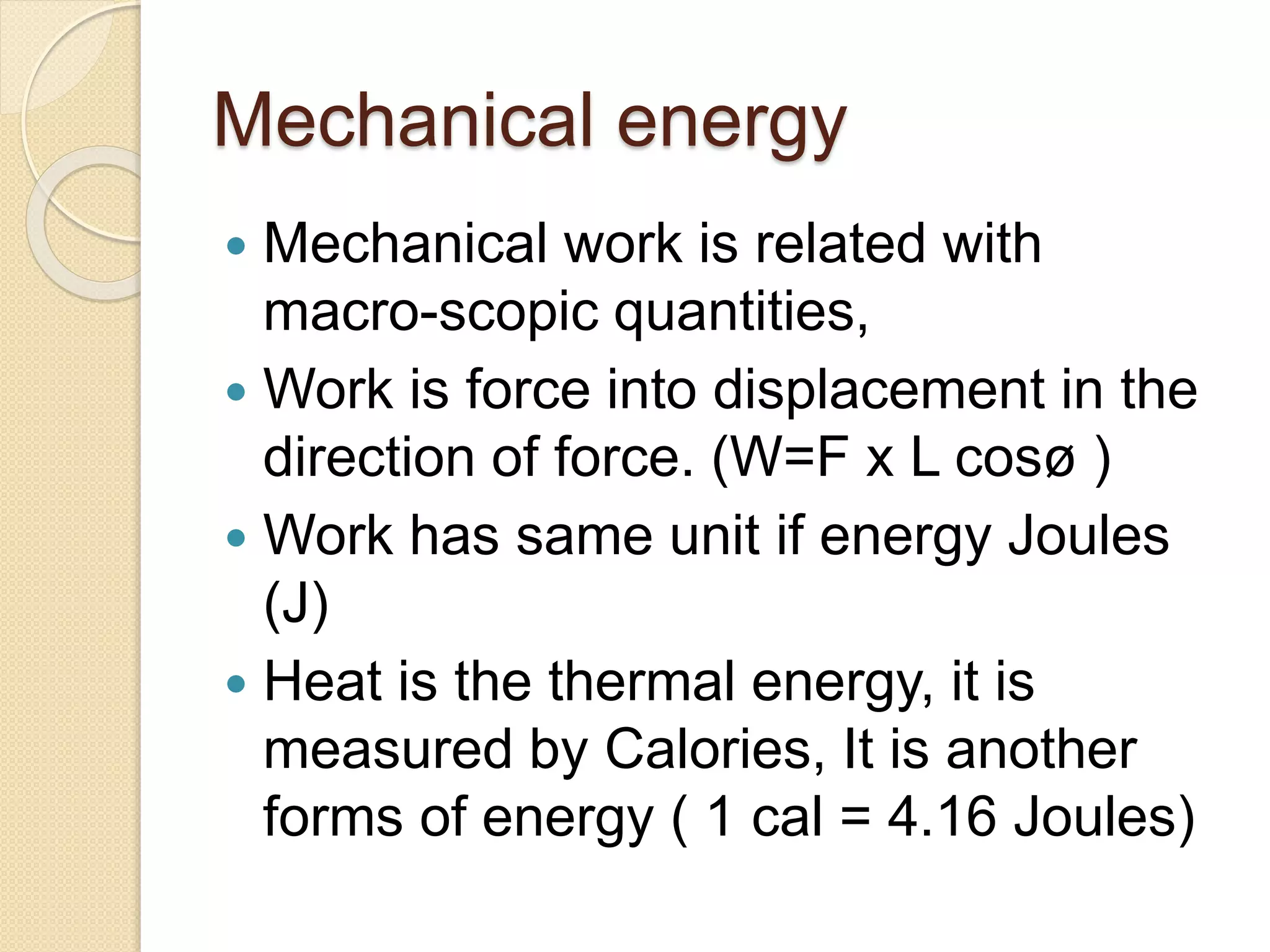
Mechanical energy
 Mechanical work is related with
macro-scopic quantities,
 Work is force into displacement in the
direction of force. (W=F x L cosø )
 Work has same unit if energy Joules
(J)
 Heat is the thermal energy, it is
measured by Calories, It is another
forms of energy ( 1 cal = 4.16 Joules)
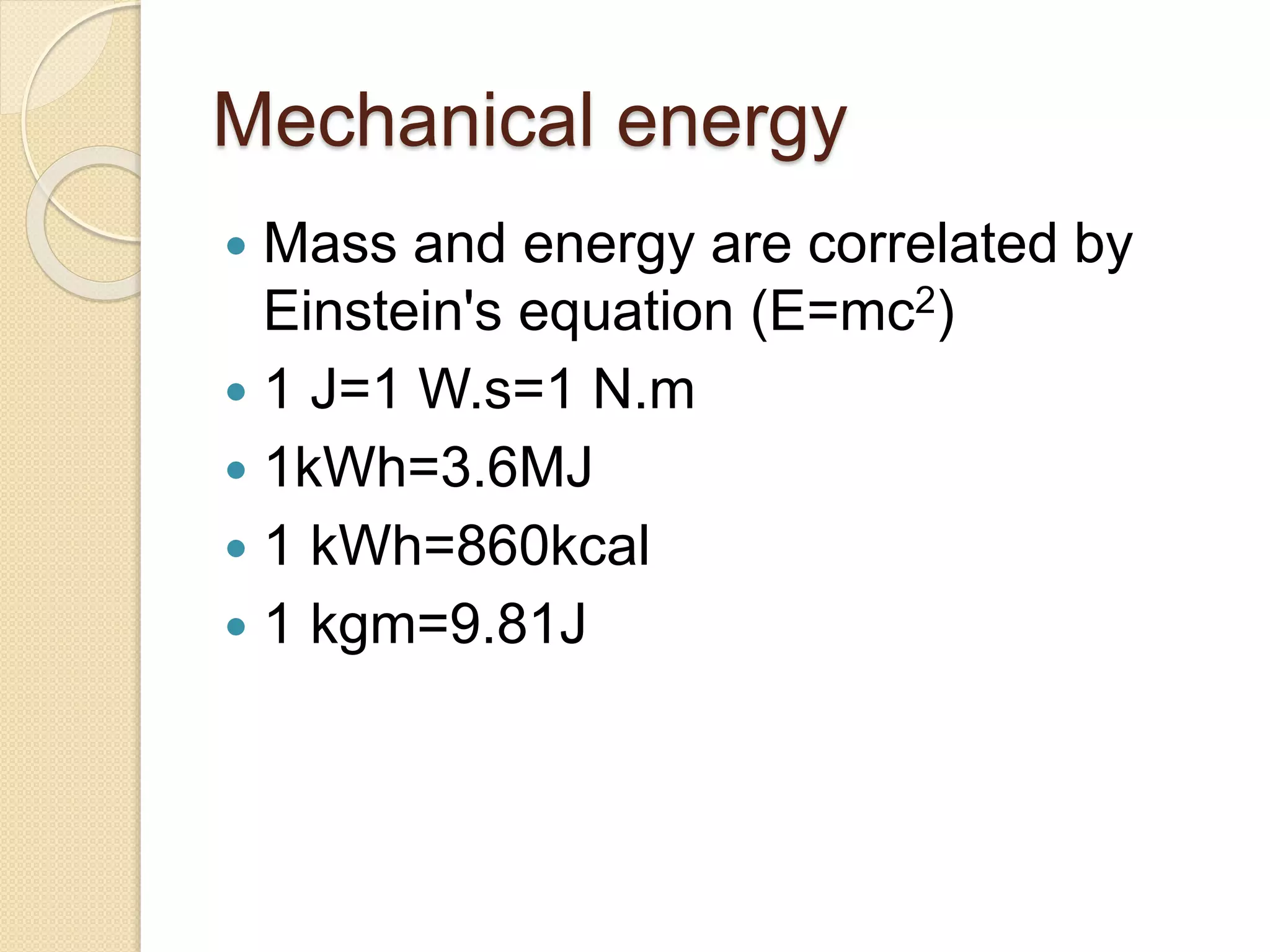
Mechanical energy
 Mass and energy are correlated by
Einstein's equation (E=mc2)
 1 J=1 W.s=1 N.m
 1kWh=3.6MJ
 1 kWh=860kcal
 1 kgm=9.81J
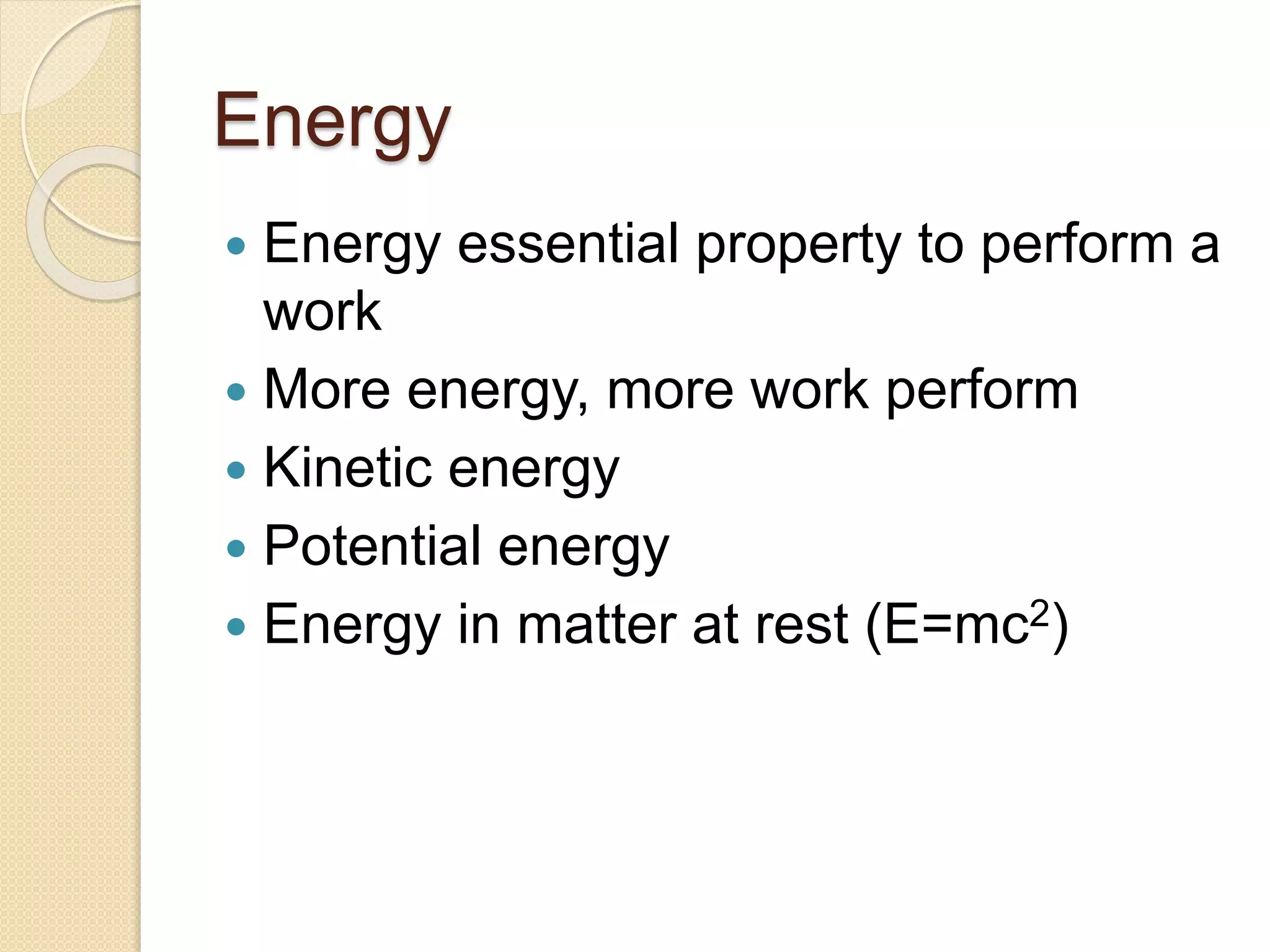
Energy
 Energy essential property to perform a
work
 More energy, more work perform
 Kinetic energy
 Potential energy
 Energy in matter at rest (E=mc2)
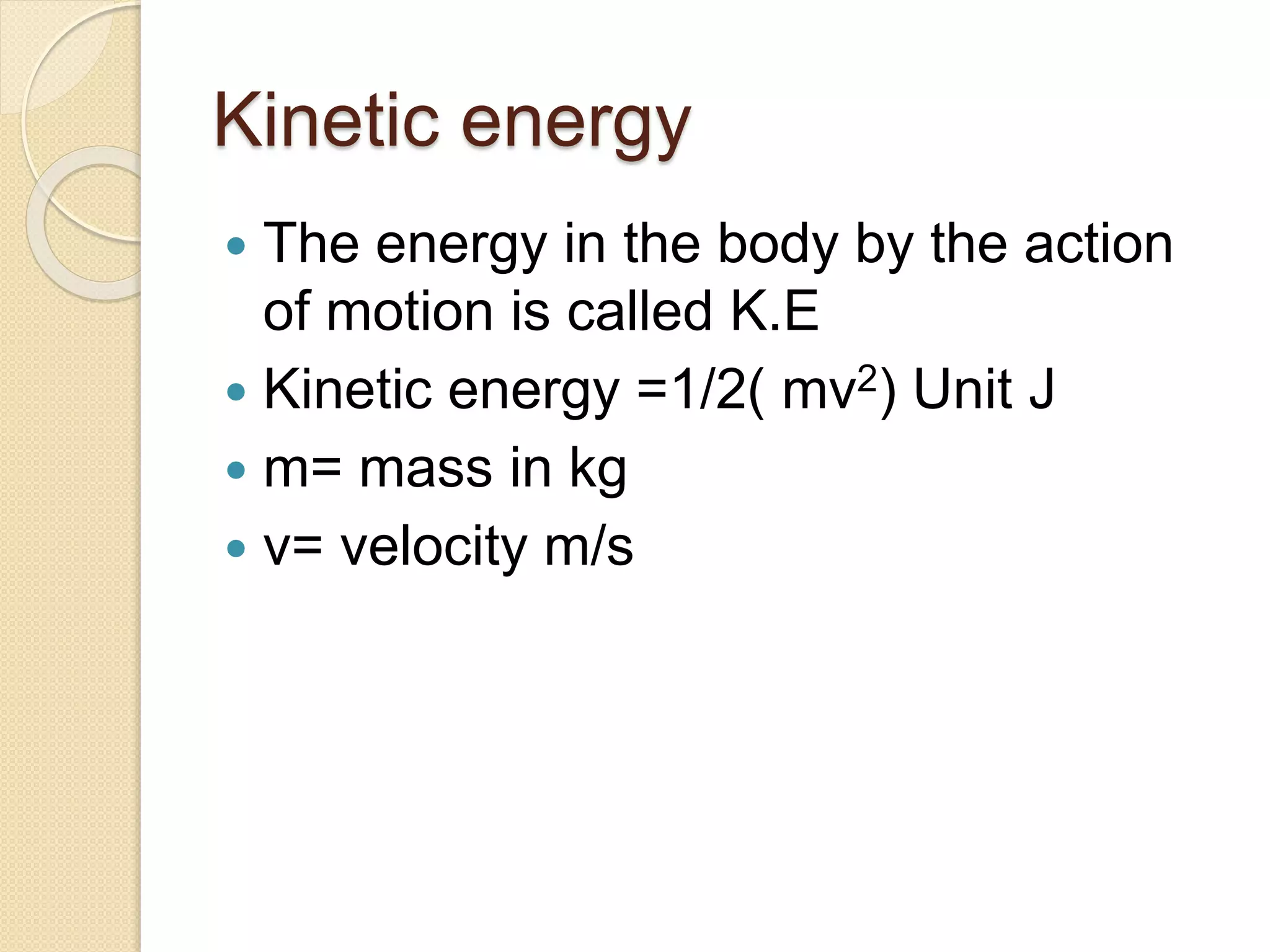
Kinetic energy
 The energy in the body by the action
of motion is called K.E
 Kinetic energy =1/2( mv2) Unit J
 m= mass in kg
 v= velocity m/s
Potential energy
 The energy in the body by the position
of object in the gravitational field is
called Gravitational potential energy
 Potential energy= mgh unit J
 m= mass in kg
 g= acceleration due to gravity m/s2
 h= Height above reference level m
Power
 Power is the time rate of work done by
the force
 Power=Work/Time ( W/J)
 1 joule=1 Watt Sec= 1 Newton meter
Joule is relatively small unit with
multiples and prefixing for expressing
large measurement.
Energy in matter at rest
 The energy in the body rest alone is
called rest energy
 The matter energy is in addition to the
kinetic energy and potential energy
enjoined with the matter
 In normal situation is not matter but
nuclear fission reaction, the matter
energy is released
Rotational energy
 Rotational energy calculations are
necessary with hydro energy, wind
energy, mechanical to electrical
energy conversion in turbine
generators, energy storage by
flywheel
 Here displacement is along circular
path (Radians or degree)
Electrical energy
 Electric current is the flow of charged
particles due potential difference.
 Electrical potential (V)
 Electric current (A)
 Electrical power (W)
 Electrical energy (J)
 Electric energy is in the form of
electric current flowing electrical
circuits and machines.
Electrical quantities
 Units of electrical energy and
mechanical energy are same (J)
 1 j=1 W.s
 Electric current I amperes A
 Electric current is rate of flow of
charge (Q/t)
 1 ampere current is equal to flow of 1
coulomb charge in 1 second (C=A.s)
Electric energy
 By definition electric potential is work
per unit electric charge
 When the charge Q moved through
the potential difference V, then we get
certain electrical work ( W=QV)
 Electric power is the time rate of floe
of electric energy
 Power = Energy/Time (Watt)
Chemical energy
 Chemical energy in substance is in the
form of bond energy caused micro-
forces between atoms, molecules in
the form of bond
 Types of fuel
 Heat of combustion of the fuel
 Quantity of fuel
 Energy utility factor
Thermal energy
 SI unit of thermal energy is J
 Heat : The energy required the
substance transformation
 Enthalpy: A measure of energy
content in the system per unit mass
 Entropy: A measure of energy content
in the system to perform work when
the system under going change
Conversion factors
 Energy cannot be newly created
 Energy cannot be destroyed
 In closed system the total mass and
energy remains unchanged
 The law does not differ useful and
wasted energy and also neglected
losses
Generalized equation for
conservation
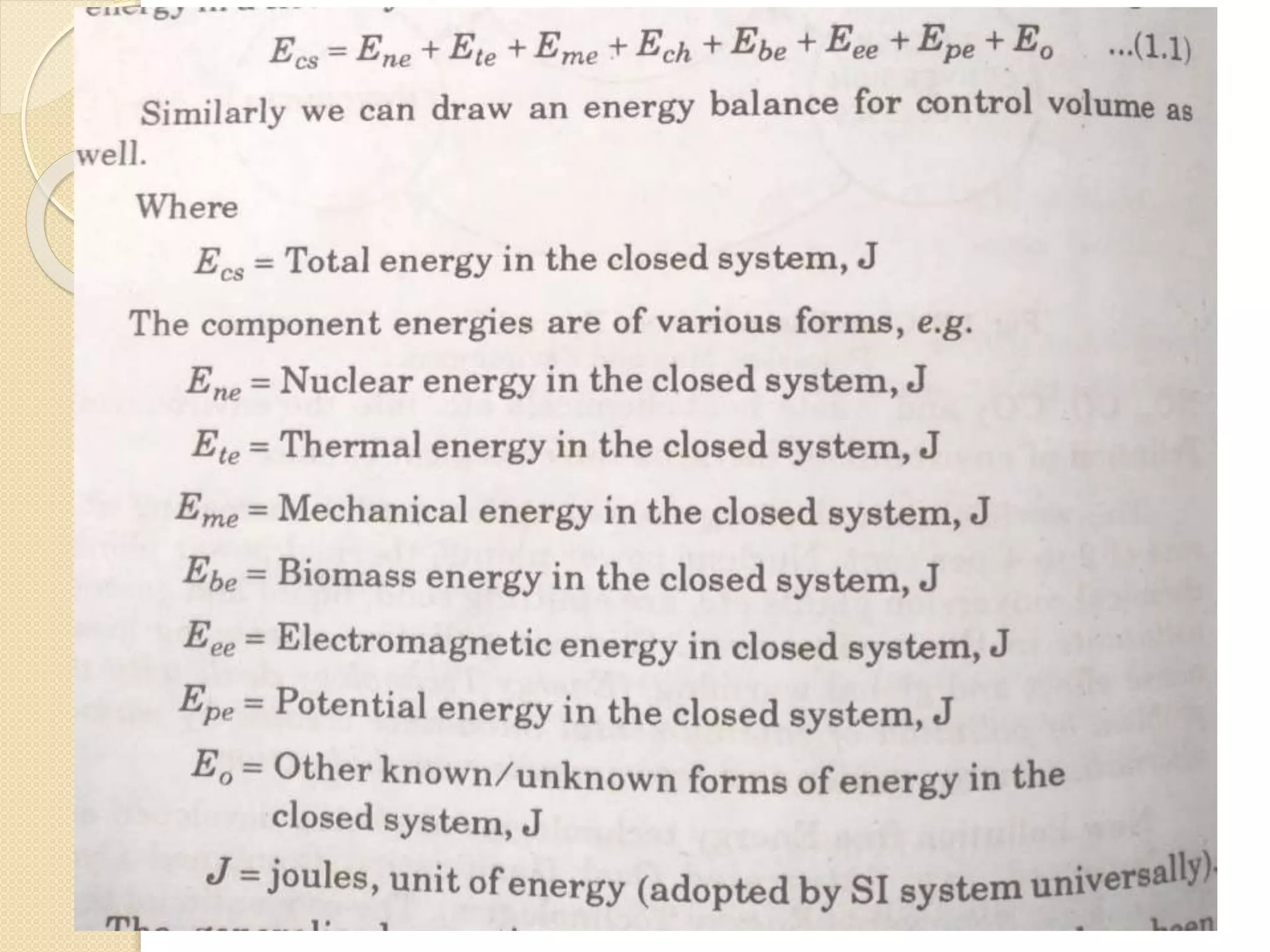
 The total energy in a closed system is
the algebraic sum of component
energies
 We need to aware following aspects
for calculations
 Law of conservation of energy
 Generalized energy equation
 Particular energy equation
First law of thermodynamics
 Energy exits many forms ( Electrical
energy, thermal energy, mechanical
energy, chemical energy)
 In a energy conversion process one
from of energy is transformation to
another
 Energy cannot be created newly,
energy cannot be destroyed
 In closed system, total energy remains
unchanged
Second law of
thermodynamics
 The second law of thermodynamics
states that form of energy possesses
certain quality.
 The quality of various forms of energy
differs.
 In an energy conversation process,
some energy is converted into useful
and worthless
Newton’s law
 First law of motion: Body at rest
continues to be rest unless a force acts on it.
Body in motion continues to be motion at
constant velocity unless a force acts on it.
 Second law of motion: Net force acting
on a body is proportional to the product of
mass and acceleration of a body
 F=m x a ( Mass x Acceleration) N
 Third law of motion: For every action there
is an equal and opposite reaction
Newton’s Law
 Third law of motion: For every action
there is an equal and opposite reaction
Dimensional equations
 A quantity can be represented by a
dimensional equation without
reference to units
 Dimensions of force f are derived as
follows
 F=mass x acceleration
◦ = mass x (change in velocity/time)
◦ [F]=[M] [L]/[T2]
◦
Energy conservation
equations
 The energy conservation process is
represented by a link in the energy
chain.
 Each term has same dimensions
 Physical law are represented in the
form of equation
 Two or more energies are formed in
link
Chemical Thermal
Mechanical
Energy conservation
equations
 Energy equation of physical quantity
should have dimensional balance in
terms of index
 Energy equation should necessary
follow basic laws of energy
conservation
 Every branch of science has certain
energy and power equation.
Part A question
1. State the difference between units and
derived units. Give example
2. State SI units for energy, temperature,
power and pressure.
3. State difference kW and kWhr
4. State Newton's law and
thermodynamics law
5. State expression K.E and P.E
6. Derive the dimensional equations of
energy and power
7. State Enthalpy, Entropy and
Temperature
Part B
 Explain briefly conservation of energy
with suitable example
 Explain briefly types of energy with
suitable example
 Write energy conservation equation,
thermodynamic law and Newton’s law
L3 unit 1 energy ( units of energy, conversion factors, classification)

L3 unit 1 energy ( units of energy, conversion factors, classification)

  • 1.
  • 2.
    UNIT-1 Energy  Introductionto energy  Global energy scene  Indian energy scene  Units of energy  Conversion factors  General classification of energy  Energy crisis  Energy alternatives.
  • 3.
    UNITS Of ENERGY 1950, Several system of measurement can be followed different countries  In 1960, IS introduced. All forms of energy measured in terms of same unit Joule (J)  Energy science and technology involves several physical quantities  Each quantity has certain basic dimensions in terms of length (L), mass (M) and time (T).  Each dimension can be measured of certain units.
  • 5.
    Mechanical energy  Mechanicalwork is related with macro-scopic quantities,  Work is force into displacement in the direction of force. (W=F x L cosø )  Work has same unit if energy Joules (J)  Heat is the thermal energy, it is measured by Calories, It is another forms of energy ( 1 cal = 4.16 Joules)
  • 6.
    Mechanical energy  Massand energy are correlated by Einstein's equation (E=mc2)  1 J=1 W.s=1 N.m  1kWh=3.6MJ  1 kWh=860kcal  1 kgm=9.81J
  • 7.
    Energy  Energy essentialproperty to perform a work  More energy, more work perform  Kinetic energy  Potential energy  Energy in matter at rest (E=mc2)
  • 8.
    Kinetic energy  Theenergy in the body by the action of motion is called K.E  Kinetic energy =1/2( mv2) Unit J  m= mass in kg  v= velocity m/s
  • 9.
    Potential energy  Theenergy in the body by the position of object in the gravitational field is called Gravitational potential energy  Potential energy= mgh unit J  m= mass in kg  g= acceleration due to gravity m/s2  h= Height above reference level m
  • 10.
    Power  Power isthe time rate of work done by the force  Power=Work/Time ( W/J)  1 joule=1 Watt Sec= 1 Newton meter Joule is relatively small unit with multiples and prefixing for expressing large measurement.
  • 11.
    Energy in matterat rest  The energy in the body rest alone is called rest energy  The matter energy is in addition to the kinetic energy and potential energy enjoined with the matter  In normal situation is not matter but nuclear fission reaction, the matter energy is released
  • 12.
    Rotational energy  Rotationalenergy calculations are necessary with hydro energy, wind energy, mechanical to electrical energy conversion in turbine generators, energy storage by flywheel  Here displacement is along circular path (Radians or degree)
  • 13.
    Electrical energy  Electriccurrent is the flow of charged particles due potential difference.  Electrical potential (V)  Electric current (A)  Electrical power (W)  Electrical energy (J)  Electric energy is in the form of electric current flowing electrical circuits and machines.
  • 14.
    Electrical quantities  Unitsof electrical energy and mechanical energy are same (J)  1 j=1 W.s  Electric current I amperes A  Electric current is rate of flow of charge (Q/t)  1 ampere current is equal to flow of 1 coulomb charge in 1 second (C=A.s)
  • 15.
    Electric energy  Bydefinition electric potential is work per unit electric charge  When the charge Q moved through the potential difference V, then we get certain electrical work ( W=QV)  Electric power is the time rate of floe of electric energy  Power = Energy/Time (Watt)
  • 16.
    Chemical energy  Chemicalenergy in substance is in the form of bond energy caused micro- forces between atoms, molecules in the form of bond  Types of fuel  Heat of combustion of the fuel  Quantity of fuel  Energy utility factor
  • 17.
    Thermal energy  SIunit of thermal energy is J  Heat : The energy required the substance transformation  Enthalpy: A measure of energy content in the system per unit mass  Entropy: A measure of energy content in the system to perform work when the system under going change
  • 18.
    Conversion factors  Energycannot be newly created  Energy cannot be destroyed  In closed system the total mass and energy remains unchanged  The law does not differ useful and wasted energy and also neglected losses
  • 19.
    Generalized equation for conservation The total energy in a closed system is the algebraic sum of component energies  We need to aware following aspects for calculations  Law of conservation of energy  Generalized energy equation  Particular energy equation
  • 21.
    First law ofthermodynamics  Energy exits many forms ( Electrical energy, thermal energy, mechanical energy, chemical energy)  In a energy conversion process one from of energy is transformation to another  Energy cannot be created newly, energy cannot be destroyed  In closed system, total energy remains unchanged
  • 22.
    Second law of thermodynamics The second law of thermodynamics states that form of energy possesses certain quality.  The quality of various forms of energy differs.  In an energy conversation process, some energy is converted into useful and worthless
  • 23.
    Newton’s law  Firstlaw of motion: Body at rest continues to be rest unless a force acts on it. Body in motion continues to be motion at constant velocity unless a force acts on it.  Second law of motion: Net force acting on a body is proportional to the product of mass and acceleration of a body  F=m x a ( Mass x Acceleration) N  Third law of motion: For every action there is an equal and opposite reaction
  • 24.
    Newton’s Law  Thirdlaw of motion: For every action there is an equal and opposite reaction
  • 25.
    Dimensional equations  Aquantity can be represented by a dimensional equation without reference to units  Dimensions of force f are derived as follows  F=mass x acceleration ◦ = mass x (change in velocity/time) ◦ [F]=[M] [L]/[T2] ◦
  • 27.
    Energy conservation equations  Theenergy conservation process is represented by a link in the energy chain.  Each term has same dimensions  Physical law are represented in the form of equation  Two or more energies are formed in link Chemical Thermal Mechanical
  • 28.
    Energy conservation equations  Energyequation of physical quantity should have dimensional balance in terms of index  Energy equation should necessary follow basic laws of energy conservation  Every branch of science has certain energy and power equation.
  • 35.
    Part A question 1.State the difference between units and derived units. Give example 2. State SI units for energy, temperature, power and pressure. 3. State difference kW and kWhr 4. State Newton's law and thermodynamics law 5. State expression K.E and P.E 6. Derive the dimensional equations of energy and power 7. State Enthalpy, Entropy and Temperature
  • 36.
    Part B  Explainbriefly conservation of energy with suitable example  Explain briefly types of energy with suitable example  Write energy conservation equation, thermodynamic law and Newton’s law