Submitted To - Mrs Ritu Sexana Submitted By - Amit Sharma and Mohineesh Sharma
 
The intuitive meaning  of  work  is  quite  Different from the scientific definition of  Work . In everyday activity  , the term  ‘ work’ is used equally for mental and  physical work involving muscular force.
In physics , the term work is used in  special technical sense and has a much more precise definition . DEFINITION When force is acted on a body and the body get displaced through a distance  then work is said to be done .
There are two  conditions that must be  satisfied in work done by a body . A  force is applied on the object . The object be displaced from its  original position.
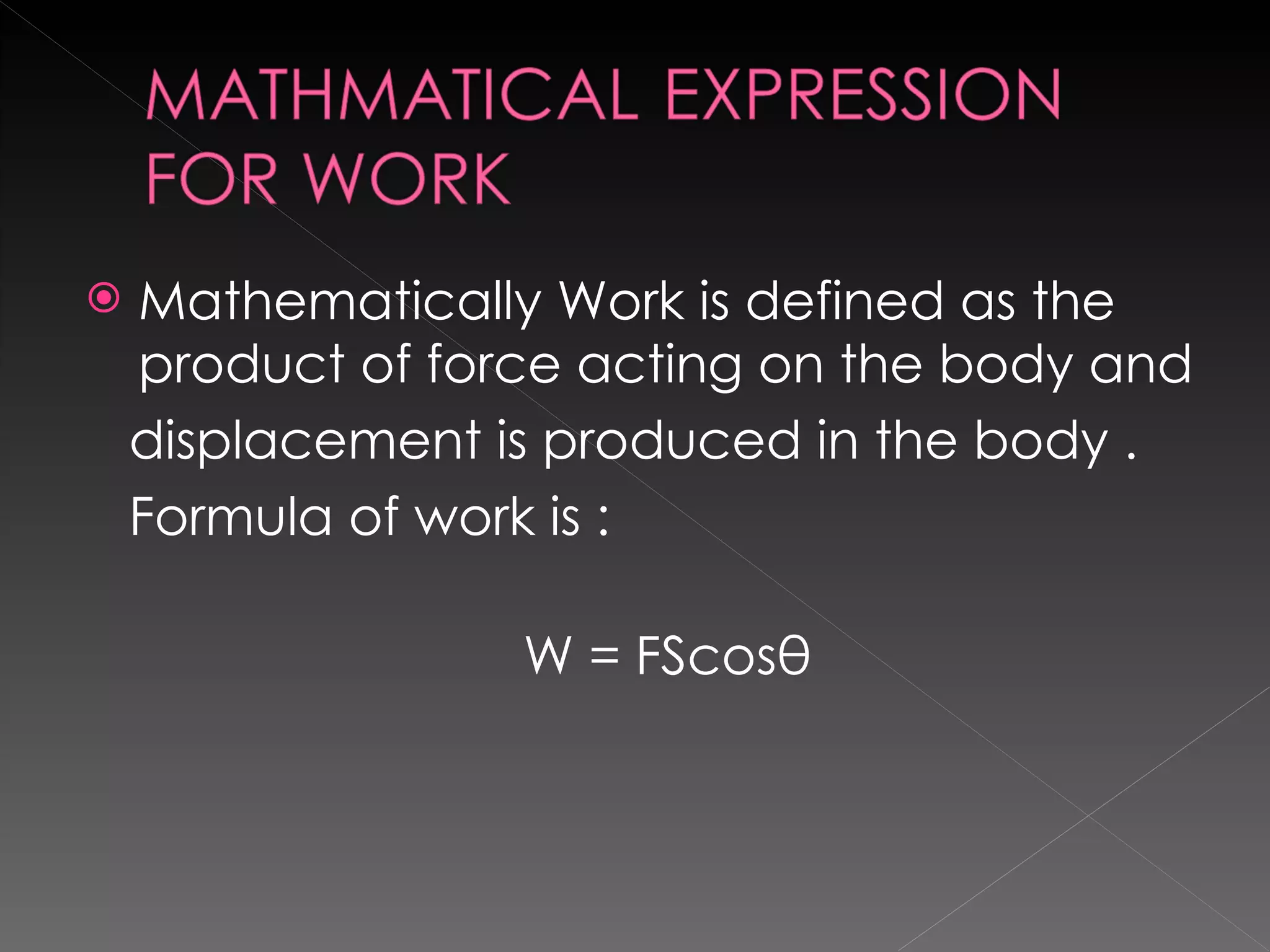
Mathematically Work is defined as the product of force acting on the body and displacement is produced in the body . Formula of work is :  W = FScosθ
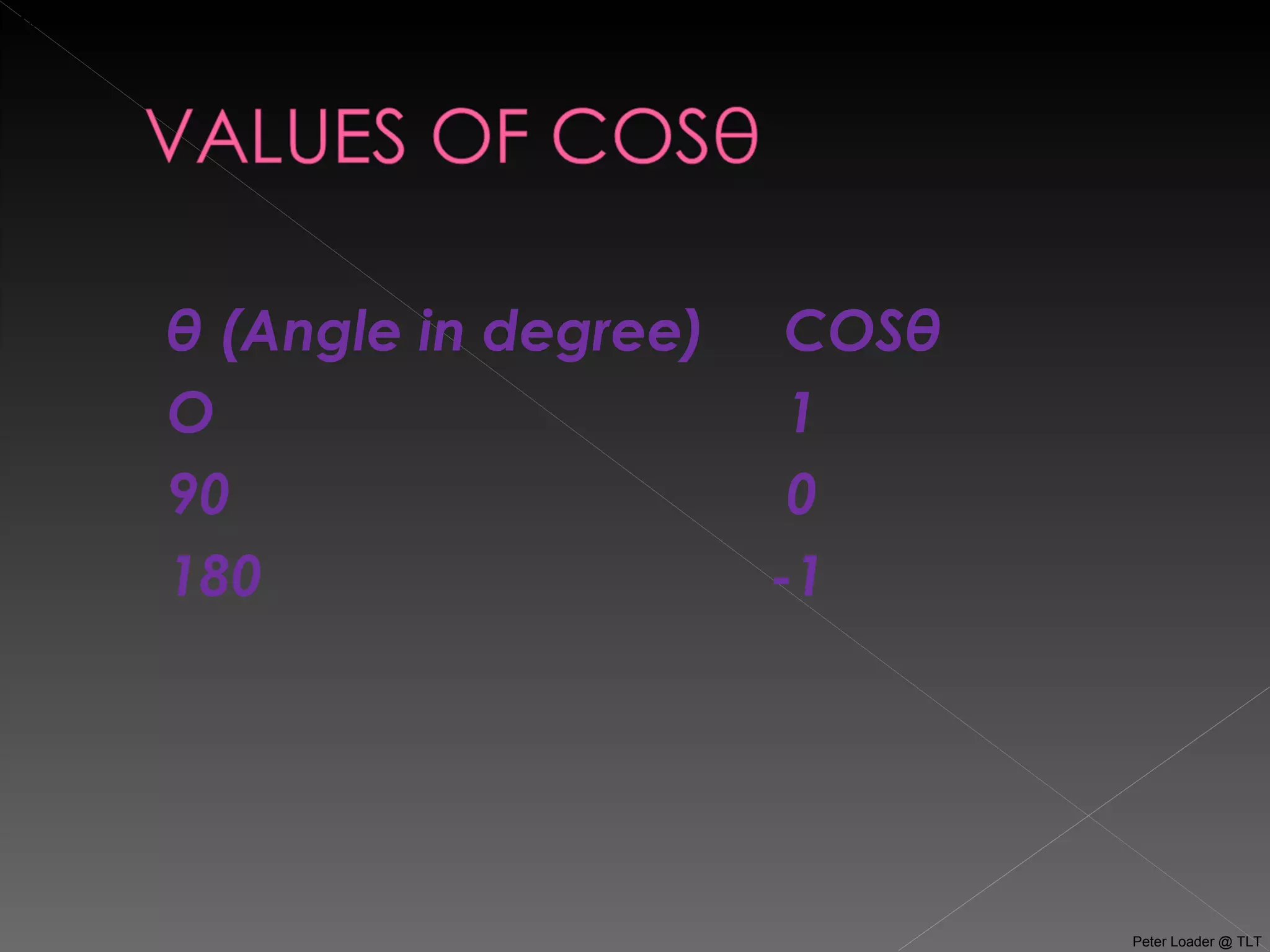
2 of 10 Peter Loader @ TLT θ (Angle in degree)  COSθ O  1 90  0 180  -1
CASE 1 When the direction  of force and displacement are same . we know  W = FScosθ  (θ = 0 [in degree] ) W =FScos180 W =FS* 1 W =FS Example-  when a body is dropped from a certain height.
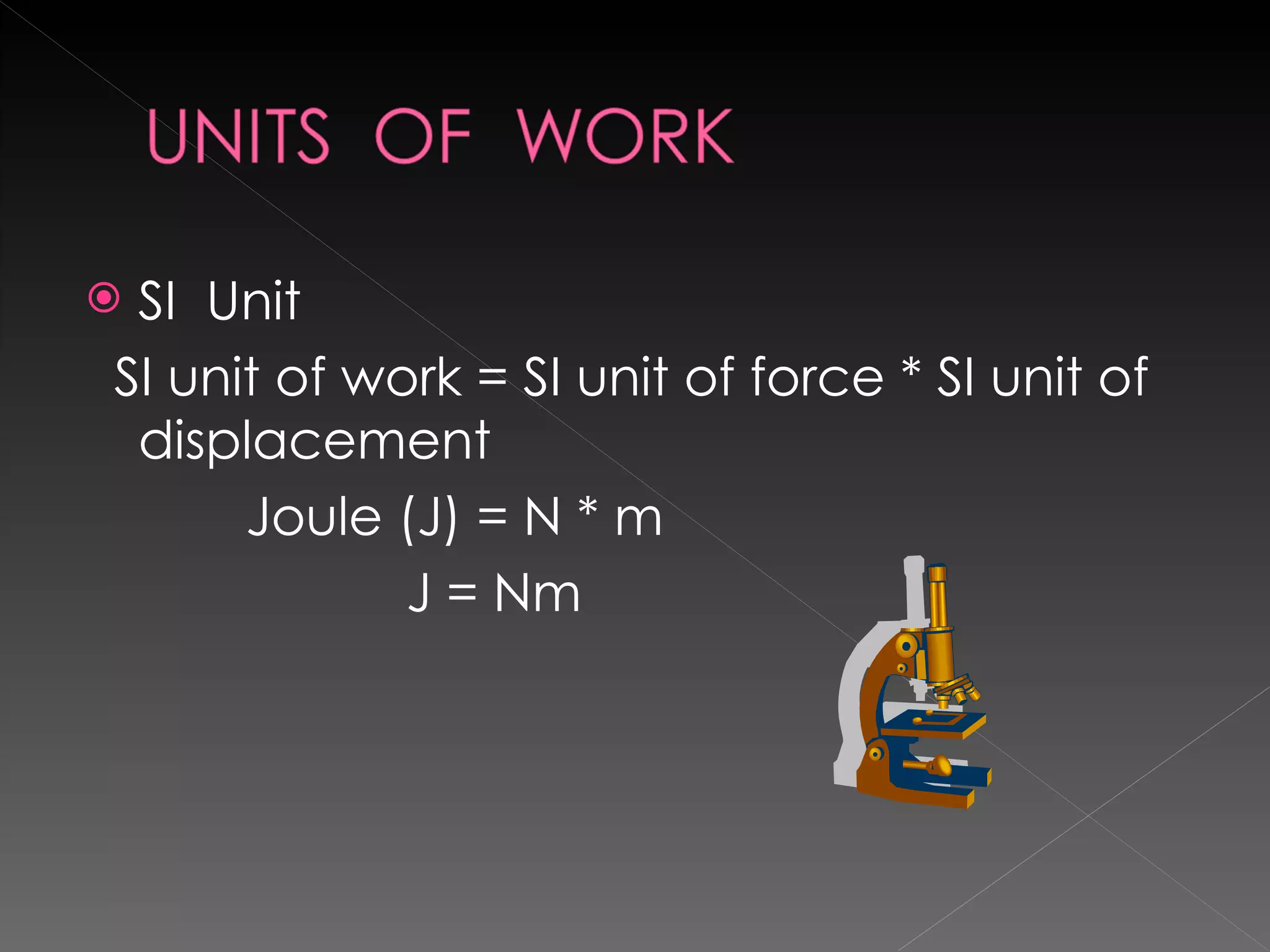
SI  Unit SI unit of work = SI unit of force * SI unit of displacement Joule (J) = N * m J = Nm
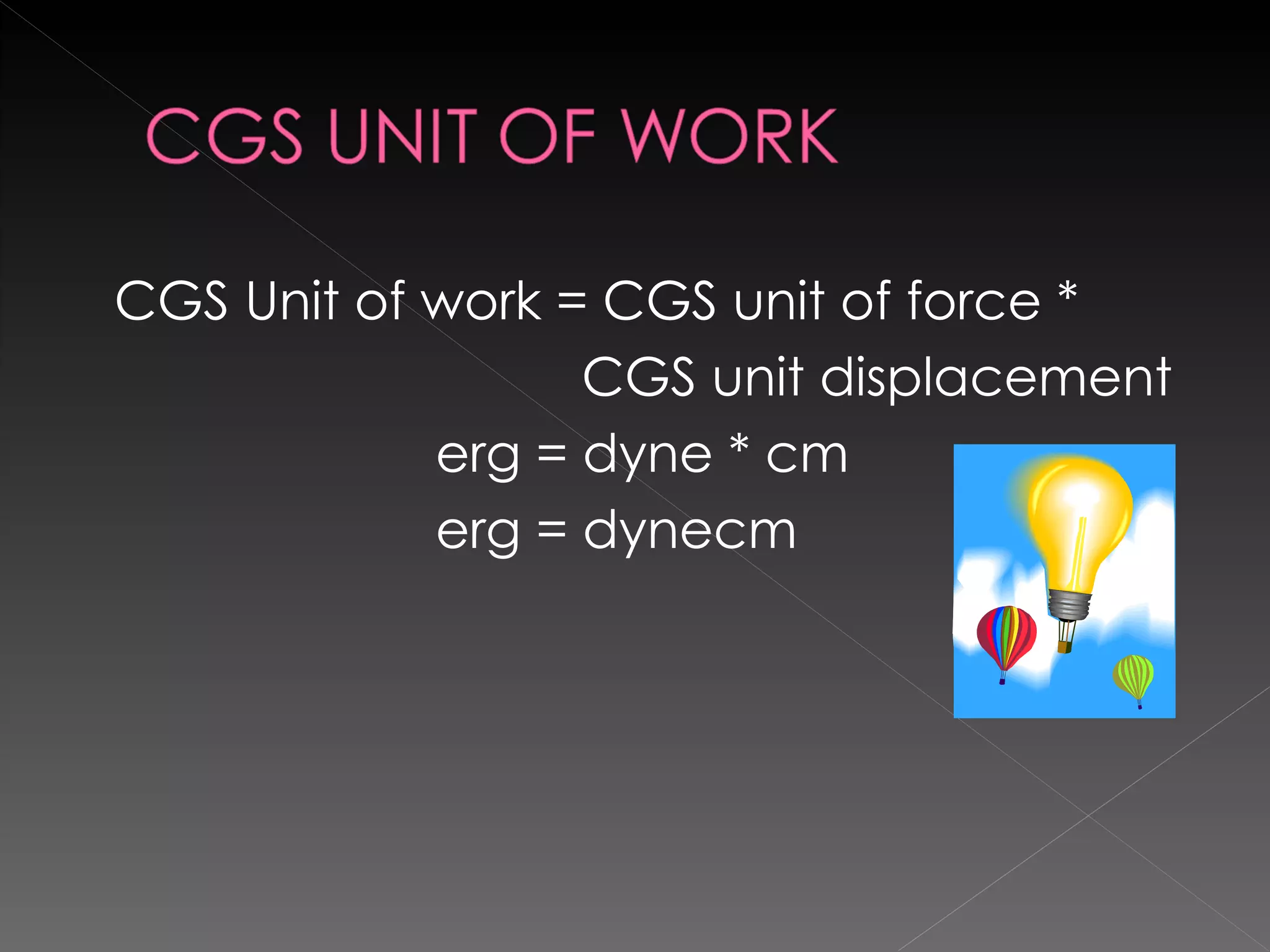
CGS Unit of work = CGS unit of force *  CGS unit displacement erg = dyne * cm erg = dynecm
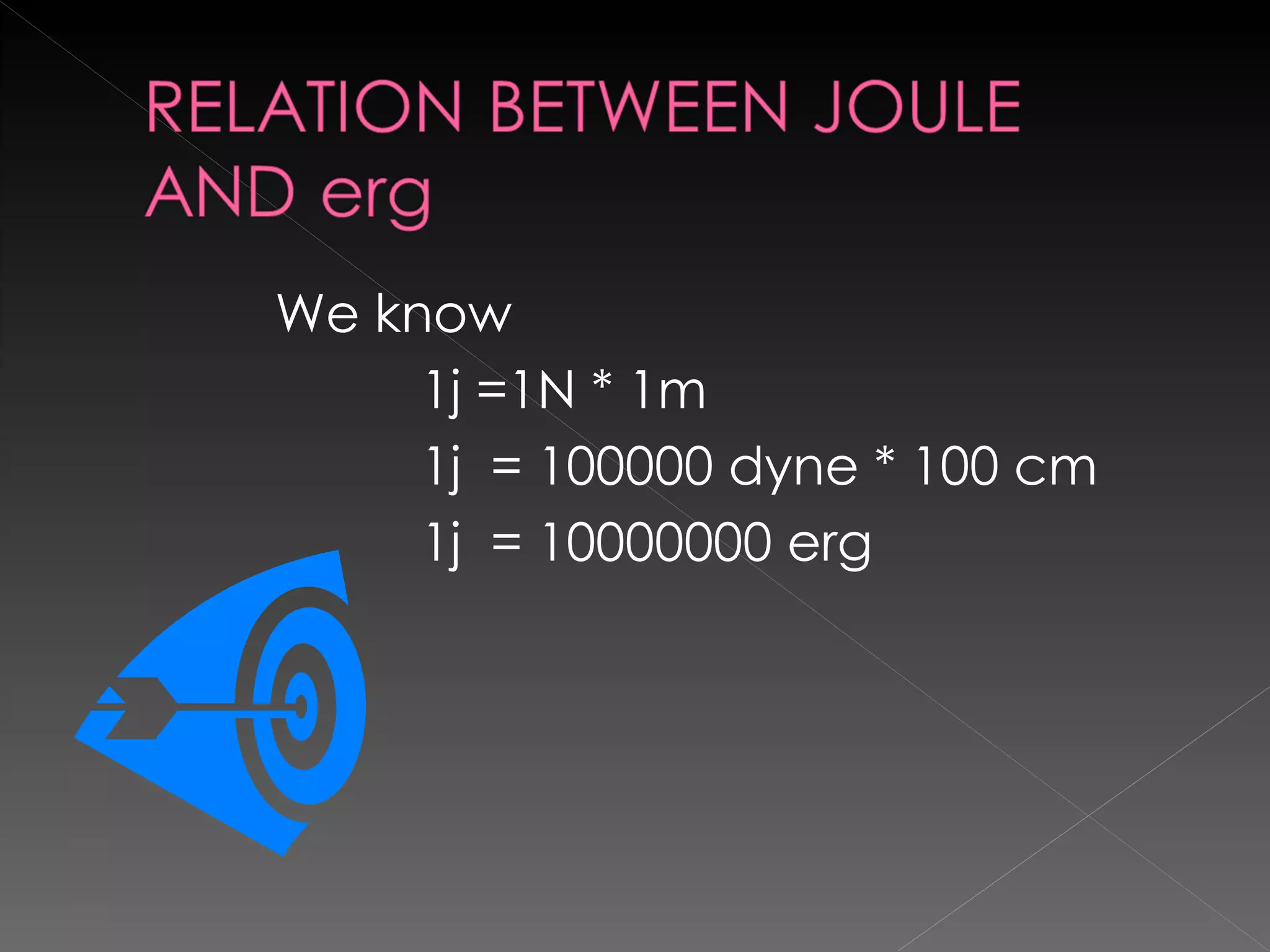
We know  1j =1N * 1m 1j  = 100000 dyne * 100 cm 1j  = 10000000 erg
1 kilo Joule = 1000 Joule 1 Mega Joule =1000000 Joule
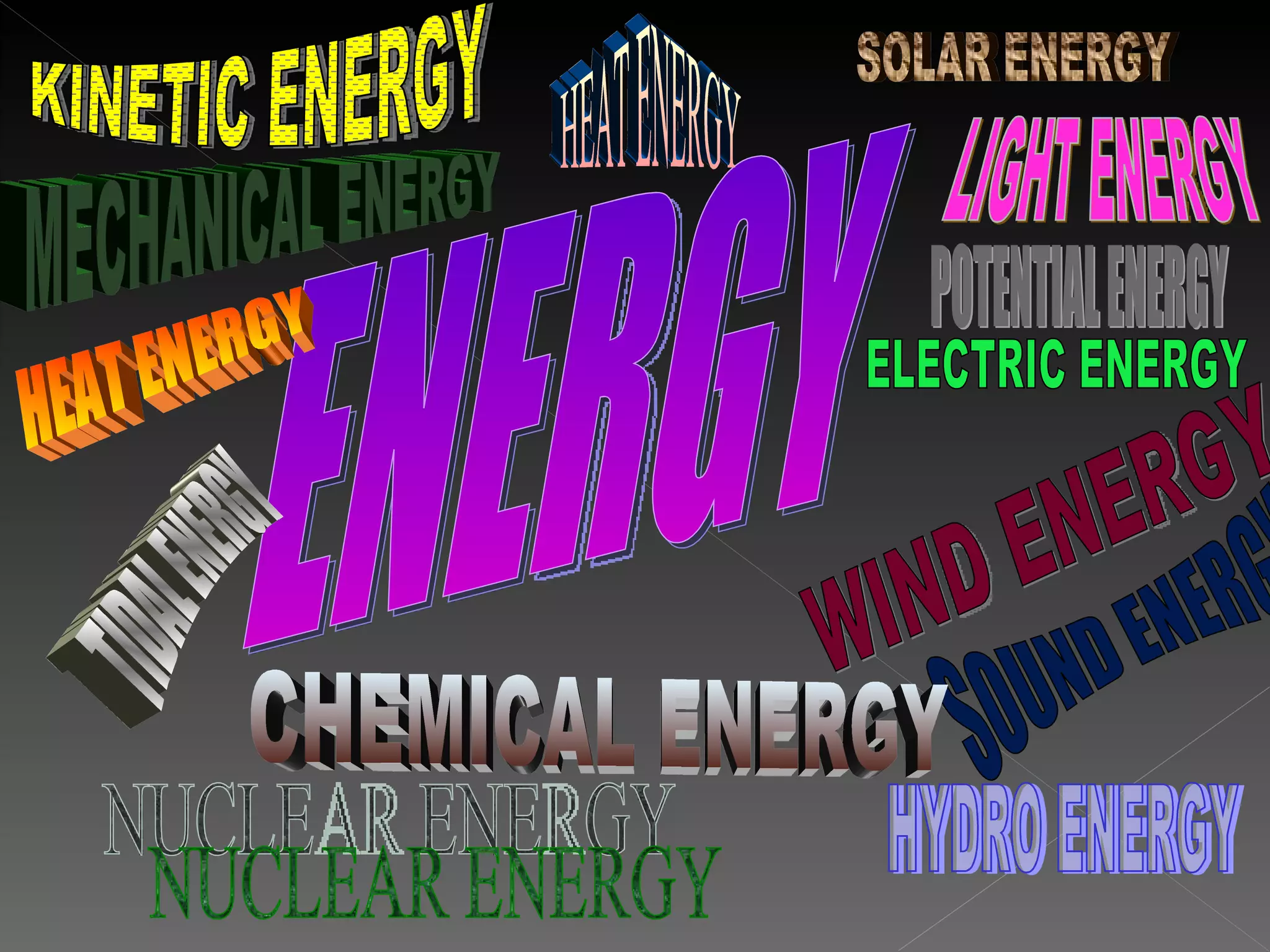
ENERGY KINETIC ENERGY POTENTIAL ENERGY MECHANICAL ENERGY LIGHT ENERGY HEAT ENERGY SOLAR ENERGY SOUND ENERGY ELECTRIC ENERGY NUCLEAR ENERGY CHEMICAL ENERGY HEAT ENERGY TIDAL ENERGY WIND ENERGY  HYDRO ENERGY
Energy of an object is defined as its capacity for  doing work and it is measured by the total quantity of work it can do. OR Ability to do work is called energy .
SI unit of energy is same as the SI unit of work. i.e. joule (J).
There are many types of energy but Kinetic energy and Potential energy  have mathematical .
Solar Energy Heat  Energy Light  Energy Chemical  Energy Wind Energy Hydro  Energy Sound Energy Electric Energy Magnetic  Energy Tidal  Energy Nuclear Energy Mechanical  Energy
Solar Energy The energy radiated by the sun is called solar energy used in photosynthesis . Heat Energy When energy released by gas , oil , petroleum products is called heat energy .
Light Energy Energy which produce sensation of vision.  Chemical Energy Energy  which is produced by fuels , chemicals etc.
Wind Energy Energy produced by moving air . Hydro Energy The energy produced by flowing water is called hydro energy.
Sound Energy Energy which  produced by the vibration of object and produced sensation of hearing . Electric Energy Energy Produced by flow of charge .
Magnetic Energy  Energy produced by magnet . Tidal Energy Energy produced by high and low tides .
Kinetic Energy The energy in a body by virtue of its motion is called  Kinetic energy . Potential Energy  The energy in an object by virtue of its position or configuration is called its potential energy .
Nuclear Energy  The energy which produced by nuclear reactions is called nuclear energy . Mechanical Energy The sum of kinetic and potential energy is called mechanical energy .
Mathematical definition of kinetic energy is equal to  half the product of mass and square of velocity .
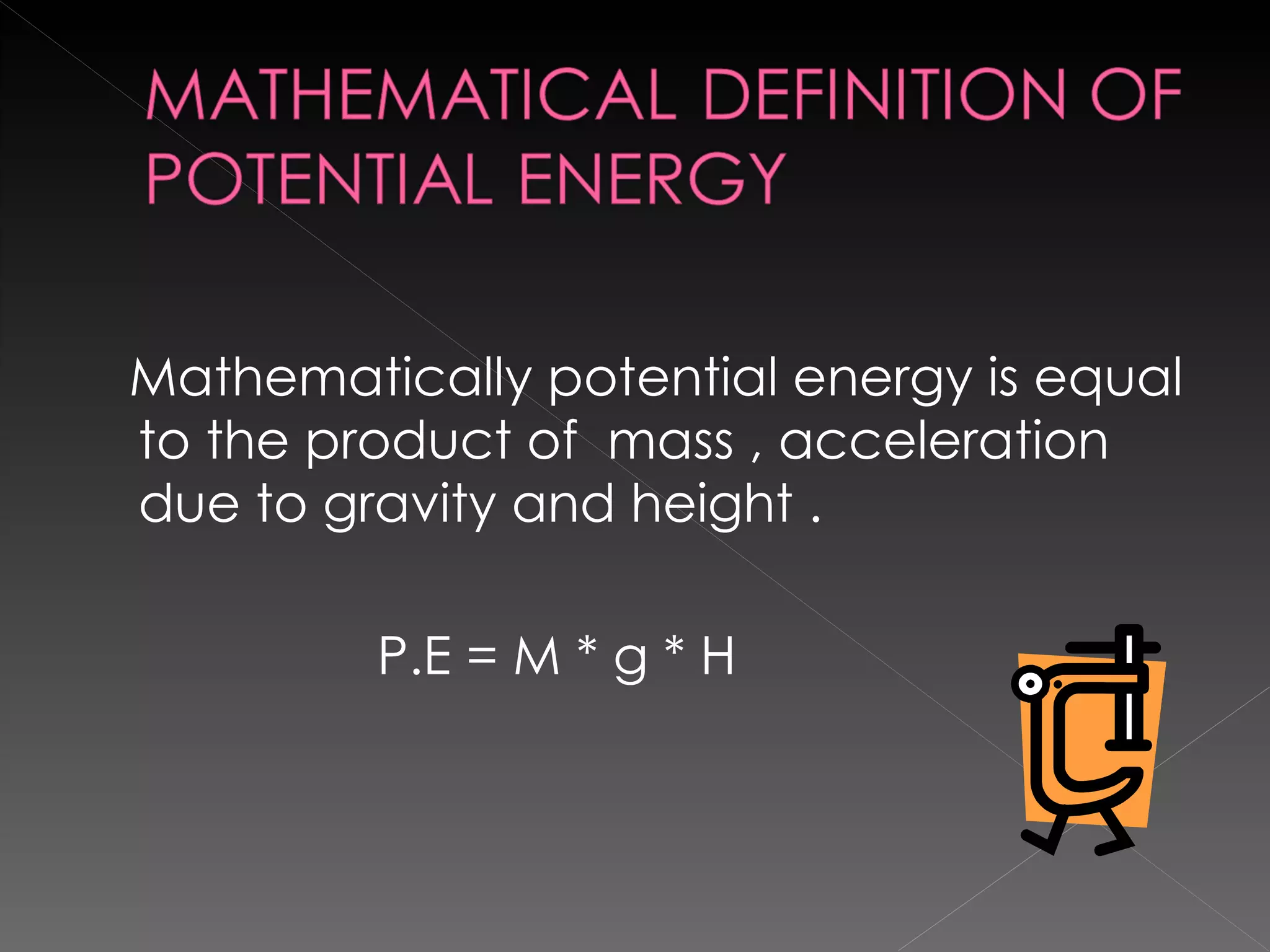
Mathematically potential energy is equal to the product of  mass , acceleration due to gravity and height . P.E = M * g * H
The conversion of energy from one form of energy to another form of energy is called energy transformation .
According to law of conservation of  energy can neither be created nor be destroyed only it can be destroyed from one form of energy to another form of energy .
POWER
Rate of doing work done is called power . OR  Work done per unit is called power . W =Work Done  T  = Time P = W / T
si unit of power = si unit of wok / si unit time  W  = J / SI Unit of power is Watt [ W] and is named in the honor of James Watt .
Practical unit of power or a unit which is exclusively used in engineering or in automobiles is  called horse power  (hp) . 1 hp = 746w
It is defined as the ratio of total workdone by the body to the total time taken by the body  AP = Total workdone / Total  time
Commercial unit of electric energy is Kilowatt-Hour (KWH). Commercial Unit of electric energy i.e. KWH is used in household industries for measuring  electric energy consumption .
THANK YOU

Amit sharma and mohineesh sharma

  • 1.
  • 2.
    Submitted To -Mrs Ritu Sexana Submitted By - Amit Sharma and Mohineesh Sharma
  • 3.
  • 4.
    The intuitive meaning of work is quite Different from the scientific definition of Work . In everyday activity , the term ‘ work’ is used equally for mental and physical work involving muscular force.
  • 5.
    In physics ,the term work is used in special technical sense and has a much more precise definition . DEFINITION When force is acted on a body and the body get displaced through a distance then work is said to be done .
  • 6.
    There are two conditions that must be satisfied in work done by a body . A force is applied on the object . The object be displaced from its original position.
  • 7.
    Mathematically Work isdefined as the product of force acting on the body and displacement is produced in the body . Formula of work is : W = FScosθ
  • 8.
    2 of 10Peter Loader @ TLT θ (Angle in degree) COSθ O 1 90 0 180 -1
  • 9.
    CASE 1 Whenthe direction of force and displacement are same . we know W = FScosθ (θ = 0 [in degree] ) W =FScos180 W =FS* 1 W =FS Example- when a body is dropped from a certain height.
  • 10.
    SI UnitSI unit of work = SI unit of force * SI unit of displacement Joule (J) = N * m J = Nm
  • 11.
    CGS Unit ofwork = CGS unit of force * CGS unit displacement erg = dyne * cm erg = dynecm
  • 12.
    We know 1j =1N * 1m 1j = 100000 dyne * 100 cm 1j = 10000000 erg
  • 13.
    1 kilo Joule= 1000 Joule 1 Mega Joule =1000000 Joule
  • 14.
    ENERGY KINETIC ENERGYPOTENTIAL ENERGY MECHANICAL ENERGY LIGHT ENERGY HEAT ENERGY SOLAR ENERGY SOUND ENERGY ELECTRIC ENERGY NUCLEAR ENERGY CHEMICAL ENERGY HEAT ENERGY TIDAL ENERGY WIND ENERGY HYDRO ENERGY
  • 15.
    Energy of anobject is defined as its capacity for doing work and it is measured by the total quantity of work it can do. OR Ability to do work is called energy .
  • 16.
    SI unit ofenergy is same as the SI unit of work. i.e. joule (J).
  • 17.
    There are manytypes of energy but Kinetic energy and Potential energy have mathematical .
  • 18.
    Solar Energy Heat Energy Light Energy Chemical Energy Wind Energy Hydro Energy Sound Energy Electric Energy Magnetic Energy Tidal Energy Nuclear Energy Mechanical Energy
  • 19.
    Solar Energy Theenergy radiated by the sun is called solar energy used in photosynthesis . Heat Energy When energy released by gas , oil , petroleum products is called heat energy .
  • 20.
    Light Energy Energywhich produce sensation of vision. Chemical Energy Energy which is produced by fuels , chemicals etc.
  • 21.
    Wind Energy Energyproduced by moving air . Hydro Energy The energy produced by flowing water is called hydro energy.
  • 22.
    Sound Energy Energywhich produced by the vibration of object and produced sensation of hearing . Electric Energy Energy Produced by flow of charge .
  • 23.
    Magnetic Energy Energy produced by magnet . Tidal Energy Energy produced by high and low tides .
  • 24.
    Kinetic Energy Theenergy in a body by virtue of its motion is called Kinetic energy . Potential Energy The energy in an object by virtue of its position or configuration is called its potential energy .
  • 25.
    Nuclear Energy The energy which produced by nuclear reactions is called nuclear energy . Mechanical Energy The sum of kinetic and potential energy is called mechanical energy .
  • 26.
    Mathematical definition ofkinetic energy is equal to half the product of mass and square of velocity .
  • 27.
    Mathematically potential energyis equal to the product of mass , acceleration due to gravity and height . P.E = M * g * H
  • 28.
    The conversion ofenergy from one form of energy to another form of energy is called energy transformation .
  • 29.
    According to lawof conservation of energy can neither be created nor be destroyed only it can be destroyed from one form of energy to another form of energy .
  • 30.
  • 31.
    Rate of doingwork done is called power . OR Work done per unit is called power . W =Work Done T = Time P = W / T
  • 32.
    si unit ofpower = si unit of wok / si unit time W = J / SI Unit of power is Watt [ W] and is named in the honor of James Watt .
  • 33.
    Practical unit ofpower or a unit which is exclusively used in engineering or in automobiles is called horse power (hp) . 1 hp = 746w
  • 34.
    It is definedas the ratio of total workdone by the body to the total time taken by the body AP = Total workdone / Total time
  • 35.
    Commercial unit ofelectric energy is Kilowatt-Hour (KWH). Commercial Unit of electric energy i.e. KWH is used in household industries for measuring electric energy consumption .
  • 36.