Solar energy can be captured and
converted into two major useful forms:
Heat
Electricity
Solar energy is collected using
solar collector and transfer energy
to a fluid passing in contact with
it.
Solar Energy Conversion and Applications
Abundant and free source of energy.
Completely non-polluting and clean
source.
Best suited for industrial applications
amongst all renewable energies.
Solar energy equipment can be easily
incorporated in the existing process.
Why Solar Energy?
• Selective surface: Absorber plate
surfaces which exhibit the characteristics
of a high value of absorptivity for incoming
solar radiation and a low value of
emissivity for outgoing re-radiation are
called selective surfaces.
• Black chrome is used as coating material.
Solar Collector
•1. Non-concentrating or flat plate type solar
collector:
•Flat Plate Collector
- - Liquid-based
- Air-based
• Evacuated Tube
2. Concentrating type solar collector
Line Focusing type and Point focusing
type
 When no optical concentration is done, the
device in which the collection is achieved
is called a flat-plate collector.
When higher temperatures are required, it
becomes necessary to concentrate the
radiation.
This is achieved using focusing or
concentrating collectors.
Solar Concentrators are devices through
which high concentration of the Sun’s rays
is achieved resulting in high temperatures.
For low temperature applications i.e.,
below 100 0C, flat plate collector is used,
while for higher temperatures,
concentrating collectors are used.
Fixed Vs Tracking
Fixed collectors are much simpler - their position or
orientation, however, may be adjusted on a seasonal
basis. They remain fixed over a day’s time
 Fixed collectors are less efficient than tracking
collectors. They are generally preferred due to less cost
to buy and maintain.
A tracking collectors are controlled to follow the sun
throughout the day.
 A tracking system is rather complicated and generally
only used for special high-temperature applications.

 The low temperature systems are systems
which operate for low temperature applications
i.e., below 100 0C,

 The basic solar device used for these
systems are the water heating collectors,
namely the Flat Plate Collector and the
Evacuated Tube Collector.
 Drying systems utilize the Air-heating
collectors.
Low Temperature
Flat-plate and Concentrating Collectors
 Flat-plate collectors may be used for water
heating and most space-heating applications.
 Concentrating collectors uses mirror or lenses to
focus the collected solar energy on smaller
areas to obtain higher working temperatures.
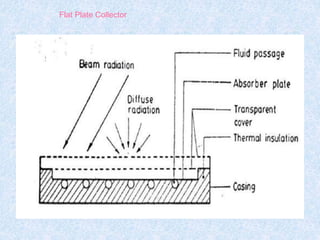
Flat plate collector
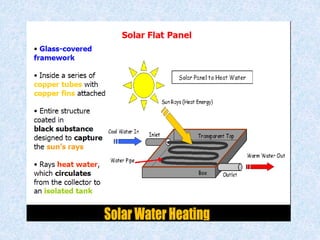
• The flat plate collector mainly consist of a casing,
absorber plate, transparent glass covers, insulating
material and fluid passage tubes.
• The transparent cover of glass or plastic allows
short-wave solar radiation (Beam, diffuse
radiation) to enter the box and fall on the black
plate, but it prevents the long-wave (thermal)
radiation emitted by the black plate from being lost.
• The radiation is absorbed by absorber plate,
which is coated with black absorber paint. The
fluid tubes, which are connected to absorber
plate, absorb the heat and transferred to the
water passing through the tubes and gets
• The hot water collected from all the tubes
flow into a storage tank.
• Insulation (paddy husk, saw dust, glass
wool.) provided to the absorber plate to
avoid loss of heat by conduction.
• Loss of heat by re-radiation is avoided by
having good absorber coating.
• The convective loss is reduced by
minimizing the air gap between the glass
covers.
Flat Plate Collector
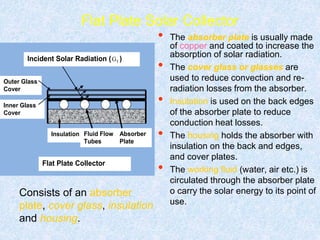
Flat Plate Solar Collector
• The absorber plate is usually made
of copper and coated to increase the
absorption of solar radiation.
• The cover glass or glasses are
used to reduce convection and re-
radiation losses from the absorber.
• Insulation is used on the back edges
of the absorber plate to reduce
conduction heat losses.
• The housing holds the absorber with
insulation on the back and edges,
and cover plates.
• The working fluid (water, air etc.) is
circulated through the absorber plate
o carry the solar energy to its point of
use.
Outer Glass
Cover
Insulation Fluid Flow
Tubes
Absorber
Plate
Inner Glass
Cover
Flat Plate Collector
Incident Solar Radiation ( tG )
Consists of an absorber
plate, cover glass, insulation
and housing.
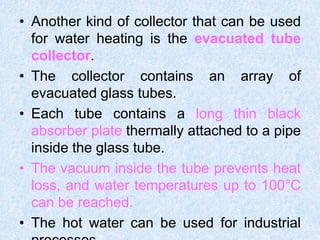
• Another kind of collector that can be used
for water heating is the evacuated tube
collector.
• The collector contains an array of
evacuated glass tubes.
• Each tube contains a long thin black
absorber plate thermally attached to a pipe
inside the glass tube.
• The vacuum inside the tube prevents heat
loss, and water temperatures up to 100°C
can be reached.
• The hot water can be used for industrial
Evacuated Tube Collector Solar Water Heaters
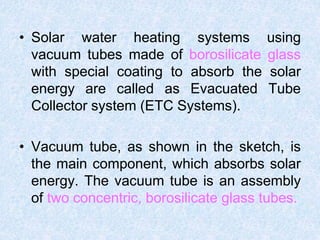
• Solar water heating systems using
vacuum tubes made of borosilicate glass
with special coating to absorb the solar
energy are called as Evacuated Tube
Collector system (ETC Systems).
• Vacuum tube, as shown in the sketch, is
the main component, which absorbs solar
energy. The vacuum tube is an assembly
of two concentric, borosilicate glass tubes.
• Air between the gap of two glass tubes is
evacuated.
• It results in high level of vacuum, which acts as
the best insulation to minimize the heat loss from
inner tube.
• The black coating on the inner tube absorbs the
solar energy and transfers it to the water. The
water on upper side of Vacuum Tube becomes
hot and thus lighter, so it starts moving upwards
in the tank.
• At the same time cold water, which is heavy,
comes downward from the tank and is stored at
the bottom.
Evacuated Tube Collector Solar Water Heater Features:
 High quality tubes made from borosilicate glass
 Long lasting
 Better performance in winter and cloudy days
 Vacuum jacket insulation
 Heats water to a very high temperature
 Makes hot water available even on partially cloudy days
 High quality insulation for maintaining high temperature
of water inside the tank
 Compact
 Easy to install, operate and maintain
 Galvanized Iron tank for hot water storage
 Safe and environment friendly
The dairy industry requires year-round hot
water between 60 to 80 deg C. Hence, flat
plate collectors are ideal.
In northern India’s Punjab state, several
hundred small (2m2) solar thermal hot
water heating systems are installed in milk
collection centres for washing purposes.
Characteristics of Flat Plate Collector
Used for moderate temperature up to 100 C
Uses both direct and diffuse radiation
Normally do not need tracking of sun
Mechanically simple
Use: water heating, building heating and air-
conditioning, industrial process heating, boiler
feed water, Pasteurization
Concentrating Solar Collector
• Focusing collector is a device to collect
solar energy with high intensity of solar
radiation on the energy absorbing surface.
Such collectors generally use optical
system in the form of reflect ors or
refractors
• Types:
• Line focusing and point focusing
• In practice, line is a collector pipe and the
point is a small volume through which hot
fluid flows.
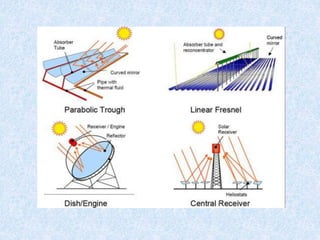
Main types of concentrating collectors are:
• Parabolic trough collector
• Mirror strip reflector
• Flat plate collector with adjustable mirrors
• Compound parabolic concentrator
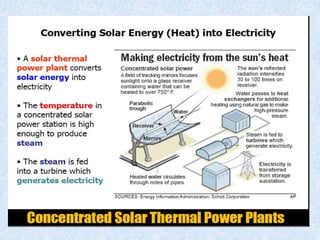
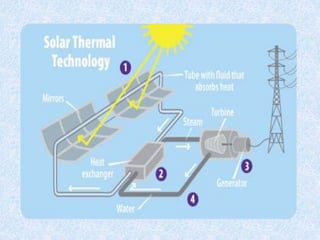
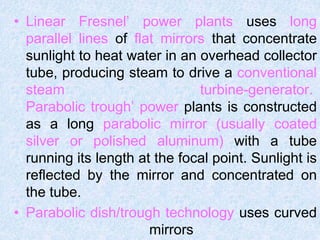
• Linear Fresnel’ power plants uses long
parallel lines of flat mirrors that concentrate
sunlight to heat water in an overhead collector
tube, producing steam to drive a conventional
steam turbine-generator.
Parabolic trough’ power plants is constructed
as a long parabolic mirror (usually coated
silver or polished aluminum) with a tube
running its length at the focal point. Sunlight is
reflected by the mirror and concentrated on
the tube.
• Parabolic dish/trough technology uses curved
mirrors
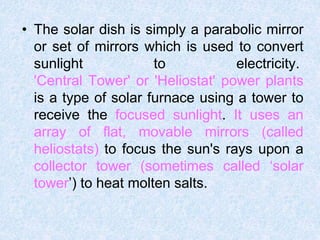
• The solar dish is simply a parabolic mirror
or set of mirrors which is used to convert
sunlight to electricity.
'Central Tower' or 'Heliostat' power plants
is a type of solar furnace using a tower to
receive the focused sunlight. It uses an
array of flat, movable mirrors (called
heliostats) to focus the sun's rays upon a
collector tower (sometimes called ‘solar
tower’) to heat molten salts.
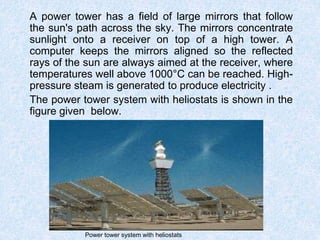
A power tower has a field of large mirrors that follow
the sun's path across the sky. The mirrors concentrate
sunlight onto a receiver on top of a high tower. A
computer keeps the mirrors aligned so the reflected
rays of the sun are always aimed at the receiver, where
temperatures well above 1000°C can be reached. High-
pressure steam is generated to produce electricity .
The power tower system with heliostats is shown in the
figure given below.
Power tower system with heliostats
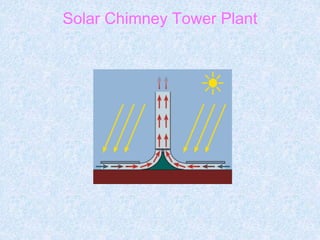
Solar Chimney Tower Plant
• Concentrating collectors have large mirror
systems to focus beam solar radiation onto a
pipe containing water (or other liquid) or onto
a small receiver.
• The mirrors must be moved mechanically to
follow the movement of the sun throughout
the day.
• These collectors produce higher
temperatures than flat plate collectors, but
they are more expensive and more difficult to
use.
• Small concentrating collectors may be used
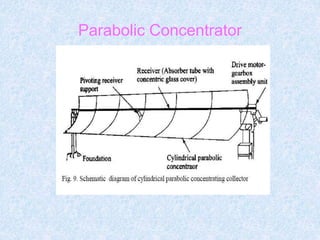
Cylindrical Parabolic Concentrating Collector
• In this type of collector, the radiation coming on
concentrator is diverted to absorber tube, which
is covered with glass tube to avoid re-radiation
loss.
• Parabolic trough reflectors are made of highly
polished aluminum or silvered glass.
• The heat from the absorber tube is transmitted
to the fluid passing and gets heated up.
• The hot liquid flows out to a storage tank for
further application.
• The direction of concentration is changed with
the sun movement by providing single axis
tracking. The temperature attained by the
Parabolic Concentrator
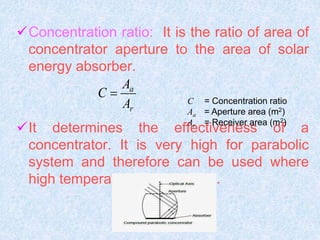
Concentration ratio: It is the ratio of area of
concentrator aperture to the area of solar
energy absorber.
It determines the effectiveness of a
concentrator. It is very high for parabolic
system and therefore can be used where
high temperature are required.
a
r
A
C
A
 C = Concentration ratio
Aa = Aperture area (m2)
Ar = Receiver area (m2)
Solar Water Heating
• Two methods of heating water: passive (no
moving parts) and active (pumps).
• In both, a flat-plate collector is used to absorb the
sun’s energy to heat the water.
• The water circulates throughout the closed system
due to convection currents.
• Tanks of hot water are used as storage.
• The first solar water heating collector appears to have
been built in the 18th Century by a Swiss scientist who
constructed a simple wooden box with a glass top and
a black base.
• It trapped solar energy, and the collector reached a
temperature of 190 degrees Fahrenheit.
• Solar water heater: Solar water heater
has been accepted for commercial,
industrial as well as domestic application
in towns and cities.
• It has very high potential for wide spread
use in rural households, livestock
production, and agro industries activities.
• A large number of small and medium scale
manufacturers are producing and
marketing natural convection flat plate
SWHs in the country.
• In general, s SWHs consists of one
absorbers, glazing cover over the
absorber, hot water tank and connecting
pipes, etc.
• Cost: 16000-22000 for 100 liter/day water
supply system.
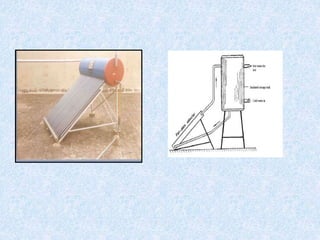
• Thermosyphon Systems: In this type
water flows through the system and when
water gets warm it rises as cooler water
sinks. The collector is installed below the
storage tank so that warm water will rise
into the tank. These systems do not
involve any pump and are more reliable.
• When a large amount of hot water is required for
supplying process heat in an industry or in a
commercial establishment, a natural circulation
system is not suitable. Large arrays of flat plate
collectors are then used and forced circulation is
maintained with a water pump.
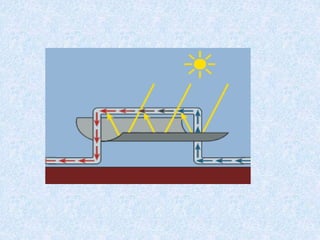
• Water from a storage tank is pumped through a
collector array where it is heated and then flows
back into the storage tank. The pump for
maintaining the forced circulation is operated by
an on-off controller which senses the difference
between the temperature of the water at the exit
of the collectors and a suitable location inside
the storage tank.
Forced Circulation Water Heating System
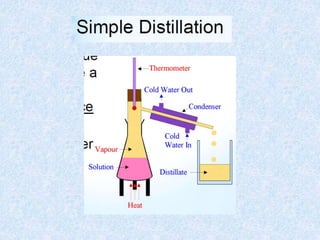
Solar Distillation
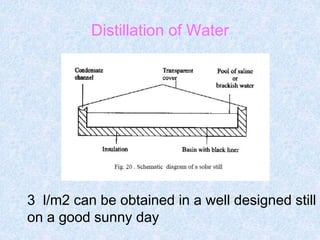
Distillation of Water
3 l/m2 can be obtained in a well designed still
on a good sunny day
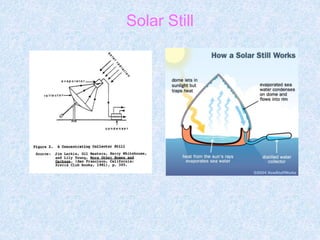
Solar Still
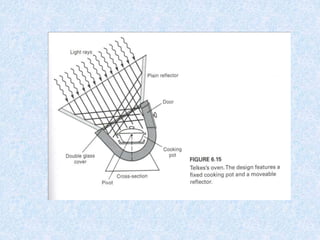
Solar Cooker
• Principle : Sunlight is converted to heat
energy that is use for cooking purpose.
• This is done as follows:
Concentrating sunlight.
Converting light to heat.
Trapping heat
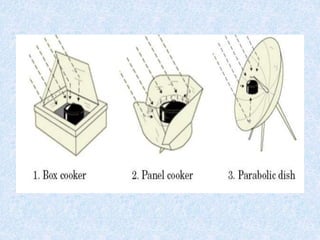
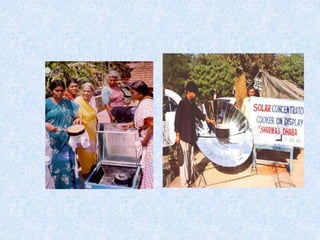
• Solar cookers: Solar cookers are devices
capable of cooking different types of food
such as rice, vegetables, pulses, chicken,
fish, etc using energy available from the
sun.
• Among different types of solar cookers,
box type solar cookers are the simplest
low cost and useful for cooking meals of a
family as well as for small community
applications.
• Normally food for a family of 3-6 members
can be cooked in box type solar cookers.
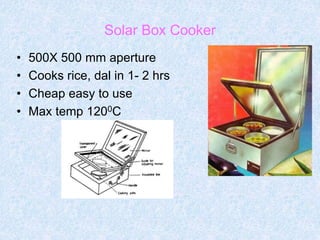
Solar Box Cooker
• 500X 500 mm aperture
• Cooks rice, dal in 1- 2 hrs
• Cheap easy to use
• Max temp 1200C
Parabolic Domestic Solar Cooker
Solar Parabolic Cooker
Merits of solar cooker
 No orientation to sun is needed.
No attention is needed during cooking.
No fuel, maintenance and recurring cost.
Simple to use and fabricate.
No pollution.
Demerits of solar cooker
Cooking can be done only when there is
sunshine.
Quick cooking is not possible.
Comparatively it takes more time.
All types of foods cannot be cooked.
Solar Space Heating
• Space heating is of particular relevance in
colder countries where a significant
amount of energy is required for the
heating.
• In India, it is of importance mainly in the
northern and north eastern regions in
winter. Space heating can be done by two
methods:
• (i) Passive methods and
• (ii) Active methods.
Passive Method Of Space Heating
• Space heating gives a fair degree of
comfort by adopting passive method.
• A passive method is one in which thermal
energy flows through a living space by
natural means without the help of a
mechanical device like a pump or blower.
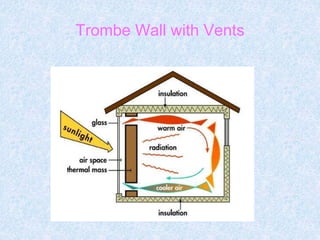
• A schematic diagram is shown in Fig.1.
• It was designed by Prof. Trombe.
• The south face of the house is to be
heated by proving a single or double
glazing.
• Behind it is a thick, black concrete wall
absorbs the solar radiation and serves as
a thermal storage.
• The whole unit consisting of the storage
wall with vents and the glazing is referred
to as a “Trombe wall”
Trombe Wall with Vents
Active Method Of Space Heating
• Space heating system mainly consists of
an array of collectors arranged on the roof
of a building, insulted storage tank,
auxiliary heater, pump/blower and heat
exchanger.
• Liquid/air gets heated up in the flat plate
collectors.
• The hot fluid passes to storage tank.
• The fluid from storage tank is transmitted
by pump/blower to heat exchanger.
• The heat exchanger blows out hot air and
heats up the surrounding living space in
the building.
• Again the cool air/water passes to the
storage tank, which supplied to flat plate
collectors for heating.
• In the absence of solar energy, an
auxiliary heater is used for space heating.
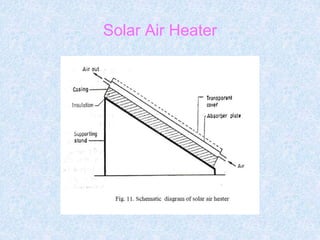
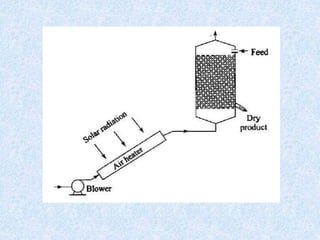
Solar Air Heater
• The heat absorbed by the absorber plate
is transmitted to the air drawn into the
collector.
• If the size of collector is large, a blower is
used to draw air into the collector and
transmit the hot air to dryer.
Solar Air Heater
Application of Solar Air Heater
• Heating building
• Drying agricultural produce
• Heating green house
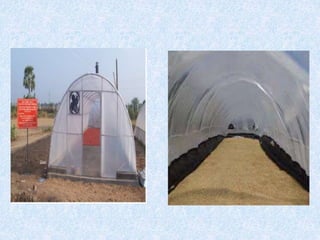
What is Solar Dryer ?
Solar dryers are devices that use solar
energy to dry substances, especially food.
There are two general types of solar dryers:
Direct and indirect.
DIRECT
Direct solar dryers expose the substance to
be dehydrated to direct sunlight. They have a
black absorbing surface which collects the
light and converts it to heat; the substance to
be dried is placed directly on this surface.
These driers may have enclosures, glass
covers and/or vents to in order to increase
efficiency.
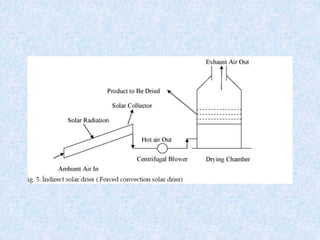
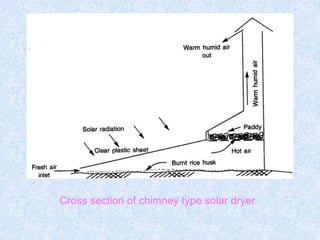
INDIRECT
In indirect solar dryers, the black surface
heats incoming air, rather than directly
heating the substance to be dried. This heated
air is then passed over the substance and exits
through a chimney, taking moisture from the
substance with it.
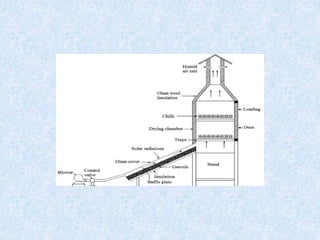
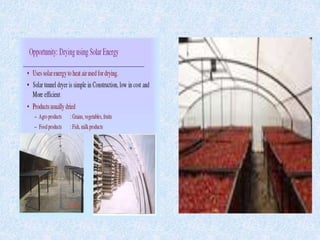
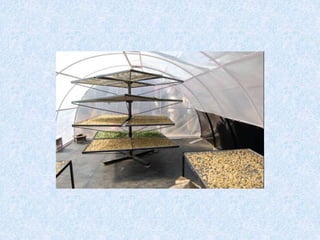
Solar Crop Dryer
 Drying crops and grains by simply exposing them to the
heat of the sun is one of the oldest and most widely used
applications of solar energy.
 Solar dryer make use of solar radiation, ambient
temperature, relative humidity. Heated air is passed
naturally or mechanically circulated to remove moisture
from material placed in side the enclosure.
 The basic components of a solar dryer are an enclosure
or shed, screened drying racks or trays, and a solar
collector.
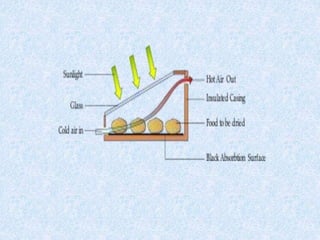
 The collector can be as simple as a glazed box with a
dark colored interior to absorb the solar energy that
heats air.
 The heated air in the collector moves, by natural
convection or a fan, up through the material to be dried.
 Drying floor can also painted black to enhance solar
heating
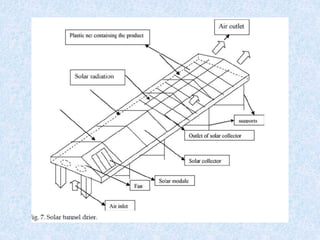
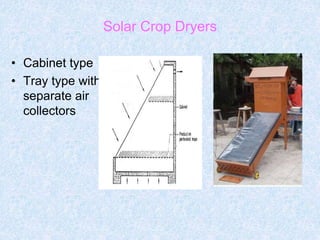
Solar Crop Dryers
• Cabinet type
• Tray type with
separate air
collectors
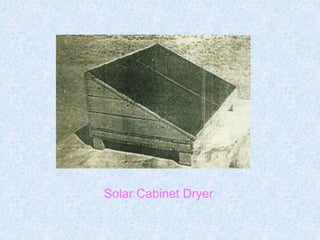
Solar Cabinet Dryer
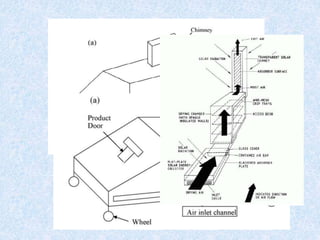
Cross section of chimney type solar dryer
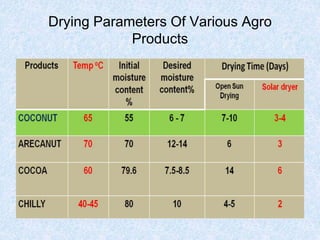
Drying Parameters Of Various Agro
Products
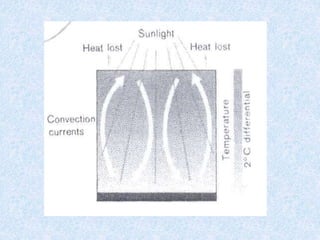
Solar Pond
• A solar pond is an artificially
constructed water pond in which
significant temperature rises are
caused in the lower regions by
preventing the occurrence of
convection currents.
• A solar pond is mass of shallow water
about 1 – 3 m deep with a large collection
area, which acts as a heat trap.
• This also called salt-gradient solar
pond or non-convecting solar pond.
• When solar radiation strikes the pond,
most of it is absorbed by the surface at
the bottom of the pond.
• If the pond contained no salt, the
bottom layer would be less dense than
the top layer as the heated water
expands.
• The less dense layer would then rise up
and the layers would mix.
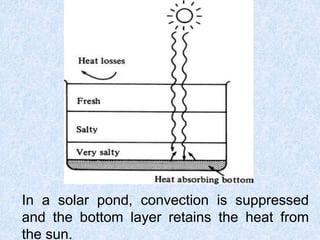
In a solar pond, convection is suppressed
and the bottom layer retains the heat from
the sun.
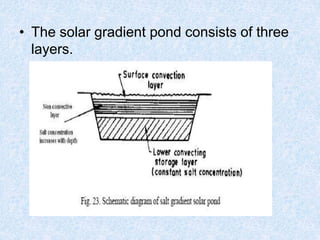
• The solar gradient pond consists of three
layers.
• The surface area of the pond affects the amount of
solar energy it can collect.
• The bottom of the pond is generally lined with a
durable plastic liner made from material such as
black polythene.
•
• This dark surface at the bottom of the pond
increases the absorption of solar radiation.
• Salts like magnesium chloride, sodium chloride or
sodium nitrate are dissolved in the water, the
concentration being densest at the bottom (20% to
30%) and gradually decreasing to almost zero at the
top.
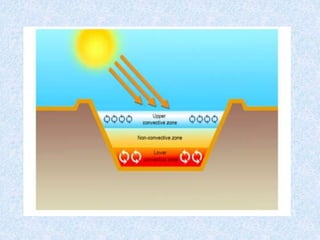
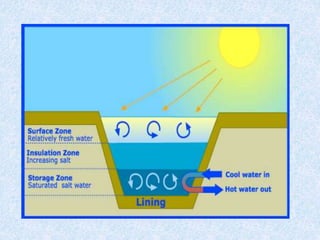
• Typically, a salt gradient solar pond consists of three
zones .
• An upper convective zone of clear fresh water
that acts as solar collector/receiver and which
is relatively the most shallow in depth and is
generally close to ambient temperature.
• A gradient which serves as the non-convective
zone which is much thicker and occupies more
than half the depth of the pond. Salt
concentration and temperature increase with
depth.
• A lower convective zone with the densest salt
concentration, serving as the heat storage
zone.
• Almost as thick as the middle non-convective
zone, salt concentration and temperatures are
nearly constant in this zone .
• But the salt density difference keeps
the ‘layers’ of the solar pond separate.
• The denser salt water at the bottom
prevents the heat being transferred to
the top layer of fresh water by natural
convection, due to which the
temperature of the lower layer may rise
to as much as 95°C .
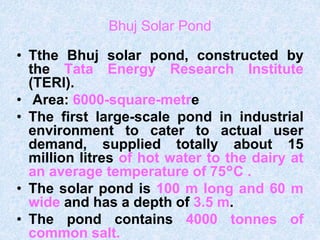
Bhuj Solar Pond
• Tthe Bhuj solar pond, constructed by
the Tata Energy Research Institute
(TERI).
• Area: 6000-square-metre
• The first large-scale pond in industrial
environment to cater to actual user
demand, supplied totally about 15
million litres of hot water to the dairy at
an average temperature of 75°C .
• The solar pond is 100 m long and 60 m
wide and has a depth of 3.5 m.
• The pond contains 4000 tonnes of
common salt.
Bhuj solar pond, constructed by the Tata Energy Research
Institute (TERI)
Applıcatıons
• Dairy industry (for example, to preheat feed water to boilers)
• Fruit and vegetable drying
• Grain industry (for grain drying)
• Water supply (for desalination)
• Solar Refrigeration
• Power generation
3 solar energy collector

3 solar energy collector

  • 1.
    Solar energy canbe captured and converted into two major useful forms: Heat Electricity Solar energy is collected using solar collector and transfer energy to a fluid passing in contact with it. Solar Energy Conversion and Applications
  • 2.
    Abundant and freesource of energy. Completely non-polluting and clean source. Best suited for industrial applications amongst all renewable energies. Solar energy equipment can be easily incorporated in the existing process. Why Solar Energy?
  • 3.
    • Selective surface:Absorber plate surfaces which exhibit the characteristics of a high value of absorptivity for incoming solar radiation and a low value of emissivity for outgoing re-radiation are called selective surfaces. • Black chrome is used as coating material.
  • 4.
    Solar Collector •1. Non-concentratingor flat plate type solar collector: •Flat Plate Collector - - Liquid-based - Air-based • Evacuated Tube 2. Concentrating type solar collector Line Focusing type and Point focusing type
  • 5.
     When nooptical concentration is done, the device in which the collection is achieved is called a flat-plate collector. When higher temperatures are required, it becomes necessary to concentrate the radiation. This is achieved using focusing or concentrating collectors.
  • 6.
    Solar Concentrators aredevices through which high concentration of the Sun’s rays is achieved resulting in high temperatures. For low temperature applications i.e., below 100 0C, flat plate collector is used, while for higher temperatures, concentrating collectors are used.
  • 7.
    Fixed Vs Tracking Fixedcollectors are much simpler - their position or orientation, however, may be adjusted on a seasonal basis. They remain fixed over a day’s time  Fixed collectors are less efficient than tracking collectors. They are generally preferred due to less cost to buy and maintain. A tracking collectors are controlled to follow the sun throughout the day.  A tracking system is rather complicated and generally only used for special high-temperature applications. 
  • 8.
     The lowtemperature systems are systems which operate for low temperature applications i.e., below 100 0C,   The basic solar device used for these systems are the water heating collectors, namely the Flat Plate Collector and the Evacuated Tube Collector.  Drying systems utilize the Air-heating collectors. Low Temperature
  • 9.
    Flat-plate and ConcentratingCollectors  Flat-plate collectors may be used for water heating and most space-heating applications.  Concentrating collectors uses mirror or lenses to focus the collected solar energy on smaller areas to obtain higher working temperatures.
  • 10.
    Flat plate collector •The flat plate collector mainly consist of a casing, absorber plate, transparent glass covers, insulating material and fluid passage tubes. • The transparent cover of glass or plastic allows short-wave solar radiation (Beam, diffuse radiation) to enter the box and fall on the black plate, but it prevents the long-wave (thermal) radiation emitted by the black plate from being lost. • The radiation is absorbed by absorber plate, which is coated with black absorber paint. The fluid tubes, which are connected to absorber plate, absorb the heat and transferred to the water passing through the tubes and gets
  • 11.
    • The hotwater collected from all the tubes flow into a storage tank. • Insulation (paddy husk, saw dust, glass wool.) provided to the absorber plate to avoid loss of heat by conduction. • Loss of heat by re-radiation is avoided by having good absorber coating. • The convective loss is reduced by minimizing the air gap between the glass covers.
  • 12.
  • 14.
    Flat Plate SolarCollector • The absorber plate is usually made of copper and coated to increase the absorption of solar radiation. • The cover glass or glasses are used to reduce convection and re- radiation losses from the absorber. • Insulation is used on the back edges of the absorber plate to reduce conduction heat losses. • The housing holds the absorber with insulation on the back and edges, and cover plates. • The working fluid (water, air etc.) is circulated through the absorber plate o carry the solar energy to its point of use. Outer Glass Cover Insulation Fluid Flow Tubes Absorber Plate Inner Glass Cover Flat Plate Collector Incident Solar Radiation ( tG ) Consists of an absorber plate, cover glass, insulation and housing.
  • 15.
    • Another kindof collector that can be used for water heating is the evacuated tube collector. • The collector contains an array of evacuated glass tubes. • Each tube contains a long thin black absorber plate thermally attached to a pipe inside the glass tube. • The vacuum inside the tube prevents heat loss, and water temperatures up to 100°C can be reached. • The hot water can be used for industrial
  • 17.
    Evacuated Tube CollectorSolar Water Heaters
  • 18.
    • Solar waterheating systems using vacuum tubes made of borosilicate glass with special coating to absorb the solar energy are called as Evacuated Tube Collector system (ETC Systems). • Vacuum tube, as shown in the sketch, is the main component, which absorbs solar energy. The vacuum tube is an assembly of two concentric, borosilicate glass tubes.
  • 19.
    • Air betweenthe gap of two glass tubes is evacuated. • It results in high level of vacuum, which acts as the best insulation to minimize the heat loss from inner tube. • The black coating on the inner tube absorbs the solar energy and transfers it to the water. The water on upper side of Vacuum Tube becomes hot and thus lighter, so it starts moving upwards in the tank. • At the same time cold water, which is heavy, comes downward from the tank and is stored at the bottom.
  • 20.
    Evacuated Tube CollectorSolar Water Heater Features:  High quality tubes made from borosilicate glass  Long lasting  Better performance in winter and cloudy days  Vacuum jacket insulation  Heats water to a very high temperature  Makes hot water available even on partially cloudy days  High quality insulation for maintaining high temperature of water inside the tank  Compact  Easy to install, operate and maintain  Galvanized Iron tank for hot water storage  Safe and environment friendly
  • 21.
    The dairy industryrequires year-round hot water between 60 to 80 deg C. Hence, flat plate collectors are ideal. In northern India’s Punjab state, several hundred small (2m2) solar thermal hot water heating systems are installed in milk collection centres for washing purposes.
  • 22.
    Characteristics of FlatPlate Collector Used for moderate temperature up to 100 C Uses both direct and diffuse radiation Normally do not need tracking of sun Mechanically simple Use: water heating, building heating and air- conditioning, industrial process heating, boiler feed water, Pasteurization
  • 23.
  • 24.
    • Focusing collectoris a device to collect solar energy with high intensity of solar radiation on the energy absorbing surface. Such collectors generally use optical system in the form of reflect ors or refractors • Types: • Line focusing and point focusing • In practice, line is a collector pipe and the point is a small volume through which hot fluid flows.
  • 25.
    Main types ofconcentrating collectors are: • Parabolic trough collector • Mirror strip reflector • Flat plate collector with adjustable mirrors • Compound parabolic concentrator
  • 29.
    • Linear Fresnel’power plants uses long parallel lines of flat mirrors that concentrate sunlight to heat water in an overhead collector tube, producing steam to drive a conventional steam turbine-generator. Parabolic trough’ power plants is constructed as a long parabolic mirror (usually coated silver or polished aluminum) with a tube running its length at the focal point. Sunlight is reflected by the mirror and concentrated on the tube. • Parabolic dish/trough technology uses curved mirrors
  • 30.
    • The solardish is simply a parabolic mirror or set of mirrors which is used to convert sunlight to electricity. 'Central Tower' or 'Heliostat' power plants is a type of solar furnace using a tower to receive the focused sunlight. It uses an array of flat, movable mirrors (called heliostats) to focus the sun's rays upon a collector tower (sometimes called ‘solar tower’) to heat molten salts.
  • 31.
    A power towerhas a field of large mirrors that follow the sun's path across the sky. The mirrors concentrate sunlight onto a receiver on top of a high tower. A computer keeps the mirrors aligned so the reflected rays of the sun are always aimed at the receiver, where temperatures well above 1000°C can be reached. High- pressure steam is generated to produce electricity . The power tower system with heliostats is shown in the figure given below. Power tower system with heliostats
  • 32.
  • 33.
    • Concentrating collectorshave large mirror systems to focus beam solar radiation onto a pipe containing water (or other liquid) or onto a small receiver. • The mirrors must be moved mechanically to follow the movement of the sun throughout the day. • These collectors produce higher temperatures than flat plate collectors, but they are more expensive and more difficult to use. • Small concentrating collectors may be used
  • 34.
    Cylindrical Parabolic ConcentratingCollector • In this type of collector, the radiation coming on concentrator is diverted to absorber tube, which is covered with glass tube to avoid re-radiation loss. • Parabolic trough reflectors are made of highly polished aluminum or silvered glass. • The heat from the absorber tube is transmitted to the fluid passing and gets heated up. • The hot liquid flows out to a storage tank for further application. • The direction of concentration is changed with the sun movement by providing single axis tracking. The temperature attained by the
  • 35.
  • 36.
    Concentration ratio: Itis the ratio of area of concentrator aperture to the area of solar energy absorber. It determines the effectiveness of a concentrator. It is very high for parabolic system and therefore can be used where high temperature are required. a r A C A  C = Concentration ratio Aa = Aperture area (m2) Ar = Receiver area (m2)
  • 37.
    Solar Water Heating •Two methods of heating water: passive (no moving parts) and active (pumps). • In both, a flat-plate collector is used to absorb the sun’s energy to heat the water. • The water circulates throughout the closed system due to convection currents. • Tanks of hot water are used as storage. • The first solar water heating collector appears to have been built in the 18th Century by a Swiss scientist who constructed a simple wooden box with a glass top and a black base. • It trapped solar energy, and the collector reached a temperature of 190 degrees Fahrenheit.
  • 38.
    • Solar waterheater: Solar water heater has been accepted for commercial, industrial as well as domestic application in towns and cities. • It has very high potential for wide spread use in rural households, livestock production, and agro industries activities. • A large number of small and medium scale manufacturers are producing and marketing natural convection flat plate SWHs in the country.
  • 39.
    • In general,s SWHs consists of one absorbers, glazing cover over the absorber, hot water tank and connecting pipes, etc. • Cost: 16000-22000 for 100 liter/day water supply system.
  • 40.
    • Thermosyphon Systems:In this type water flows through the system and when water gets warm it rises as cooler water sinks. The collector is installed below the storage tank so that warm water will rise into the tank. These systems do not involve any pump and are more reliable.
  • 42.
    • When alarge amount of hot water is required for supplying process heat in an industry or in a commercial establishment, a natural circulation system is not suitable. Large arrays of flat plate collectors are then used and forced circulation is maintained with a water pump. • Water from a storage tank is pumped through a collector array where it is heated and then flows back into the storage tank. The pump for maintaining the forced circulation is operated by an on-off controller which senses the difference between the temperature of the water at the exit of the collectors and a suitable location inside the storage tank.
  • 43.
  • 48.
  • 50.
    Distillation of Water 3l/m2 can be obtained in a well designed still on a good sunny day
  • 51.
  • 54.
    Solar Cooker • Principle: Sunlight is converted to heat energy that is use for cooking purpose. • This is done as follows: Concentrating sunlight. Converting light to heat. Trapping heat
  • 55.
    • Solar cookers:Solar cookers are devices capable of cooking different types of food such as rice, vegetables, pulses, chicken, fish, etc using energy available from the sun. • Among different types of solar cookers, box type solar cookers are the simplest low cost and useful for cooking meals of a family as well as for small community applications. • Normally food for a family of 3-6 members can be cooked in box type solar cookers.
  • 56.
    Solar Box Cooker •500X 500 mm aperture • Cooks rice, dal in 1- 2 hrs • Cheap easy to use • Max temp 1200C
  • 58.
  • 59.
  • 64.
    Merits of solarcooker  No orientation to sun is needed. No attention is needed during cooking. No fuel, maintenance and recurring cost. Simple to use and fabricate. No pollution.
  • 65.
    Demerits of solarcooker Cooking can be done only when there is sunshine. Quick cooking is not possible. Comparatively it takes more time. All types of foods cannot be cooked.
  • 66.
    Solar Space Heating •Space heating is of particular relevance in colder countries where a significant amount of energy is required for the heating. • In India, it is of importance mainly in the northern and north eastern regions in winter. Space heating can be done by two methods: • (i) Passive methods and • (ii) Active methods.
  • 67.
    Passive Method OfSpace Heating • Space heating gives a fair degree of comfort by adopting passive method. • A passive method is one in which thermal energy flows through a living space by natural means without the help of a mechanical device like a pump or blower. • A schematic diagram is shown in Fig.1. • It was designed by Prof. Trombe.
  • 68.
    • The southface of the house is to be heated by proving a single or double glazing. • Behind it is a thick, black concrete wall absorbs the solar radiation and serves as a thermal storage. • The whole unit consisting of the storage wall with vents and the glazing is referred to as a “Trombe wall”
  • 69.
  • 70.
    Active Method OfSpace Heating • Space heating system mainly consists of an array of collectors arranged on the roof of a building, insulted storage tank, auxiliary heater, pump/blower and heat exchanger. • Liquid/air gets heated up in the flat plate collectors. • The hot fluid passes to storage tank. • The fluid from storage tank is transmitted by pump/blower to heat exchanger.
  • 71.
    • The heatexchanger blows out hot air and heats up the surrounding living space in the building. • Again the cool air/water passes to the storage tank, which supplied to flat plate collectors for heating. • In the absence of solar energy, an auxiliary heater is used for space heating.
  • 73.
    Solar Air Heater •The heat absorbed by the absorber plate is transmitted to the air drawn into the collector. • If the size of collector is large, a blower is used to draw air into the collector and transmit the hot air to dryer.
  • 74.
  • 75.
    Application of SolarAir Heater • Heating building • Drying agricultural produce • Heating green house
  • 76.
    What is SolarDryer ? Solar dryers are devices that use solar energy to dry substances, especially food. There are two general types of solar dryers: Direct and indirect.
  • 77.
    DIRECT Direct solar dryersexpose the substance to be dehydrated to direct sunlight. They have a black absorbing surface which collects the light and converts it to heat; the substance to be dried is placed directly on this surface. These driers may have enclosures, glass covers and/or vents to in order to increase efficiency.
  • 78.
    INDIRECT In indirect solardryers, the black surface heats incoming air, rather than directly heating the substance to be dried. This heated air is then passed over the substance and exits through a chimney, taking moisture from the substance with it.
  • 79.
    Solar Crop Dryer Drying crops and grains by simply exposing them to the heat of the sun is one of the oldest and most widely used applications of solar energy.  Solar dryer make use of solar radiation, ambient temperature, relative humidity. Heated air is passed naturally or mechanically circulated to remove moisture from material placed in side the enclosure.  The basic components of a solar dryer are an enclosure or shed, screened drying racks or trays, and a solar collector.  The collector can be as simple as a glazed box with a dark colored interior to absorb the solar energy that heats air.  The heated air in the collector moves, by natural convection or a fan, up through the material to be dried.  Drying floor can also painted black to enhance solar heating
  • 87.
    Solar Crop Dryers •Cabinet type • Tray type with separate air collectors
  • 89.
  • 90.
    Cross section ofchimney type solar dryer
  • 95.
    Drying Parameters OfVarious Agro Products
  • 96.
    Solar Pond • Asolar pond is an artificially constructed water pond in which significant temperature rises are caused in the lower regions by preventing the occurrence of convection currents. • A solar pond is mass of shallow water about 1 – 3 m deep with a large collection area, which acts as a heat trap. • This also called salt-gradient solar pond or non-convecting solar pond.
  • 98.
    • When solarradiation strikes the pond, most of it is absorbed by the surface at the bottom of the pond. • If the pond contained no salt, the bottom layer would be less dense than the top layer as the heated water expands. • The less dense layer would then rise up and the layers would mix.
  • 100.
    In a solarpond, convection is suppressed and the bottom layer retains the heat from the sun.
  • 101.
    • The solargradient pond consists of three layers.
  • 104.
    • The surfacearea of the pond affects the amount of solar energy it can collect. • The bottom of the pond is generally lined with a durable plastic liner made from material such as black polythene. • • This dark surface at the bottom of the pond increases the absorption of solar radiation. • Salts like magnesium chloride, sodium chloride or sodium nitrate are dissolved in the water, the concentration being densest at the bottom (20% to 30%) and gradually decreasing to almost zero at the top. • Typically, a salt gradient solar pond consists of three zones .
  • 105.
    • An upperconvective zone of clear fresh water that acts as solar collector/receiver and which is relatively the most shallow in depth and is generally close to ambient temperature. • A gradient which serves as the non-convective zone which is much thicker and occupies more than half the depth of the pond. Salt concentration and temperature increase with depth. • A lower convective zone with the densest salt concentration, serving as the heat storage zone. • Almost as thick as the middle non-convective zone, salt concentration and temperatures are nearly constant in this zone .
  • 106.
    • But thesalt density difference keeps the ‘layers’ of the solar pond separate. • The denser salt water at the bottom prevents the heat being transferred to the top layer of fresh water by natural convection, due to which the temperature of the lower layer may rise to as much as 95°C .
  • 107.
    Bhuj Solar Pond •Tthe Bhuj solar pond, constructed by the Tata Energy Research Institute (TERI). • Area: 6000-square-metre • The first large-scale pond in industrial environment to cater to actual user demand, supplied totally about 15 million litres of hot water to the dairy at an average temperature of 75°C . • The solar pond is 100 m long and 60 m wide and has a depth of 3.5 m. • The pond contains 4000 tonnes of common salt.
  • 108.
    Bhuj solar pond,constructed by the Tata Energy Research Institute (TERI)
  • 109.
    Applıcatıons • Dairy industry(for example, to preheat feed water to boilers) • Fruit and vegetable drying • Grain industry (for grain drying) • Water supply (for desalination) • Solar Refrigeration • Power generation