OCH752 ENERGY TECHNOLOGY
UNIT IV BIOMASS ENERGY
Biomass origin - Resources – Biomass
estimation. Thermochemical conversion –
Biological conversion, Chemical conversion –
Hydrolysis & hydrogenation, solvolysis,
biocrude, biodiesel power generation gasifier,
biogas, integrated gasification.
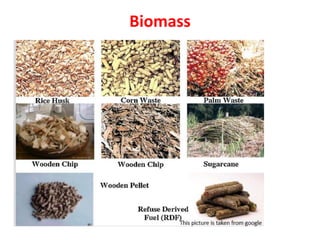
Biomass
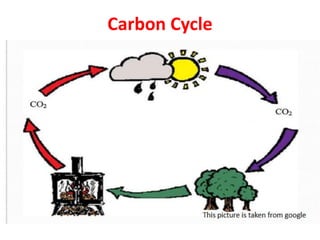
Carbon Cycle
Types of Biogas Digesters
• Fixed Dome Biogas Plants
• Floating Drum Plants
• Low-Cost Polyethylene Tube Digester
• Balloon Plants
• Horizontal Plants
• Earth-pit Plants
• Ferro-cement Plants
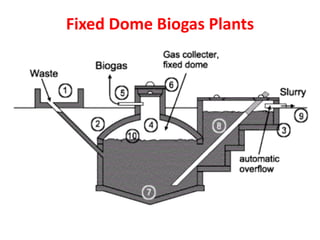
Fixed Dome Biogas Plants
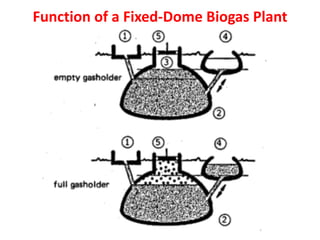
Function of a Fixed-Dome Biogas Plant
Fixed Dome Biogas Plants
• Consists of a digester with a fixed, non-movable gas
holder, which sits on top of the digester.
• When gas production starts, the slurry is displaced into
the compensation tank.
• Gas pressure increases with the volume of gas stored
and the height difference between the slurry level in
the digester and the slurry level in the compensation
tank.
• The costs of a fixed-dome biogas plant are relatively
low.
• It is simple as no moving parts exist.
Fixed Dome Biogas Plants
• No rusting steel parts and hence a long life of the plant
(20 years or more) can be expected.
• The plant is constructed underground, protecting it
from physical damage and saving space.
• While the underground digester is protected from low
temperatures at night and during cold seasons,
sunshine and warm seasons take longer to heat up the
digester.
• No day/night fluctuations of temperature in the
digester positively influence the bacteriological
processes.
Fixed Dome Biogas Plants
• The construction of fixed dome plants is labor-
intensive, thus creating local employment.
• Fixed-dome plants are not easy to build.
• They should only be built where construction
can be supervised by experienced biogas
technicians.
Working of Fixed Dome Biogas Plant
• A fixed-dome plant comprises of a closed, dome-shaped digester
with an immovable, rigid gas-holder and a displacement pit, also
named 'compensation tank'.
• The gas is stored in the upper part of the digester.
• When gas production commences, the slurry is displaced into the
compensating tank.
• Gas pressure increases with the volume of gas stored
• i.e. with the height difference between the two slurry levels.
• If there is little gas in the gas-holder, the gas pressure is low
• Digesters of fixed-dome plants are usually masonry structures
• Structures of cement and ferro-cement exist.
• The top part of a fixed-dome plant (the gas space) must be gas-
tight.
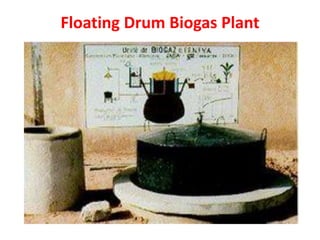
Floating Drum Biogas Plant
• Om 1956, Jashu Bhai J Patel from India designed the
first floating drum biogas plant, popularly called Gobar
gas plant.
• Floating-drum plants consist of an underground
digester (cylindrical or dome-shaped) and a
moving gas-holder.
• The gas-holder floats either directly on the
fermentation slurry or in a water jacket of its own.
• The gas is collected in the gas drum, which rises or
moves down, according to the amount of gas stored.
• The gas drum is prevented from tilting by a guiding
frame.
Floating Drum Biogas Plant
• When biogas is produced, the drum moves up adn
when it is consumed, the drum goes down.
• If the drum floats in a water jacket, it cannot get stuck,
even in substrate with high solid content.
• After the introduction of cheap Fixed-dome Chinese
model, the floating drum plants became obsolete as
they have high investment and maintenance cost
along with other design weakness
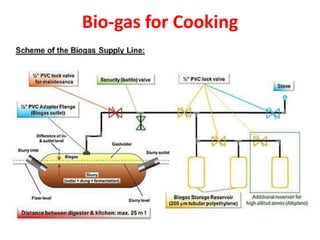
Bio-gas for Cooking
Biogas for Cooking
• Biogas production for domestic cooking depends on an
affordable appropriate digester at a suitable scale for domestic
use.
• In any digester, the waste is mixed with water to create the
right environment for the bacteria to decompose the biomass.
• As this is an anaerobic process, this has to happen without the
presence of oxygen in an airtight tank.
• The biogas accumulates at the top of the tank where it is
collected and taken by pipe to the user.
• The slurry has to be removed regularly from the tank. It can be
used further, e.g. as agricultural fertilizer.
Component of Household Digester
• Collection space: raw, liquid, slurry, semi-solid
and solid animal, human or agricultural waste
• Anaerobic digester
• Slurry storage
• Gas handling: piping; gas pump or blower; gas
meter; pressure regulator; and condensate
drain(s).
• End-use device: cooker, boiler or lighting
equipment
Component of Household Digester
• For transporting biogas from the digester to the
cooking place a tube is needed.
• Stoves for this system contain a valve to premix the
biogas with the right amount of oxygen.
• Also a burner to combust the mixture and a
structure to hold a cook-pot.
• Stoves and ovens for biogas application are similar to
those of conventional appliances.
• Most of these conventional appliances can be
adapted for the use with biogas by modification of
the burners
Advantages of Using Bio-gas
• Biogas burns very cleanly, and produces fewer pollutants
during cooking than any other fuel except electricity.
• Biogas provides instant heat upon ignition, no pre-heating or
waiting time is required.
• Most biogas burners are able to regulate the flow-rate to turn
down fire-power from high heat to small low heat for
simmering.
• Biogas can be used for lighting as well.
• The by-product (slurry) from the digester can be used as
fertilizer.
• Biogas is a renewable fuel that is ‘carbon negative’: unless
there are leakages in the system.
• Burning biogas in a cook stove releases less greenhouse gases
than if the dung was left on the ground to decompose
naturally.
Disadvantages of Using Bio-gas
• High investment costs for the digester, tubes, gas stove, and
pots.
• Biogas can increase the workload of women as it is often
made their task to run the digester.
• It is quite a physical burden to move all the biomass feedstock
and water to feed the digester.
• Slurry must be removed and taken to the field.
• It is not viable for elderly or sick people to run a biogas plant
on their own, if they don’t have labor to assist them in the
maintenance of the digester.
• Installations (depending on material and location) must be
protected against theft and damages.
Disadvantages of Using Bio-gas
• Especially metal tubes are a valuable good and often
prone to theft.
• Cultural rules might limit the acceptance of handling
dung or feces and their use as fuel for cooking.
• Cooking with biogas requires the change of
cooking habits, which might prevent the
adoption.
• Biogas is difficult to store and to transport to
other consumers.
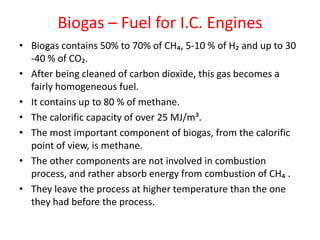
Biogas – Fuel for I.C. Engines
• Biogas contains 50% to 70% of CH₄, 5-10 % of H₂ and up to 30
-40 % of CO₂.
• After being cleaned of carbon dioxide, this gas becomes a
fairly homogeneous fuel.
• It contains up to 80 % of methane.
• The calorific capacity of over 25 MJ/m³.
• The most important component of biogas, from the calorific
point of view, is methane.
• The other components are not involved in combustion
process, and rather absorb energy from combustion of CH₄ .
• They leave the process at higher temperature than the one
they had before the process.
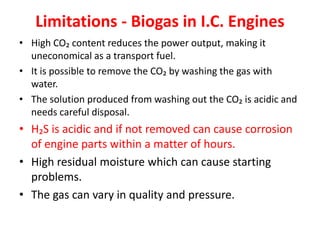
Limitations - Biogas in I.C. Engines
• High CO₂ content reduces the power output, making it
uneconomical as a transport fuel.
• It is possible to remove the CO₂ by washing the gas with
water.
• The solution produced from washing out the CO₂ is acidic and
needs careful disposal.
• H₂S is acidic and if not removed can cause corrosion
of engine parts within a matter of hours.
• High residual moisture which can cause starting
problems.
• The gas can vary in quality and pressure.
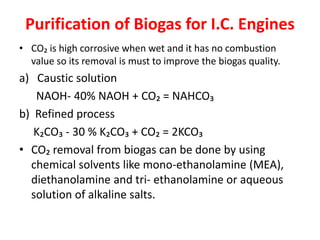
Purification of Biogas for I.C. Engines
• CO₂ is high corrosive when wet and it has no combustion
value so its removal is must to improve the biogas quality.
a) Caustic solution
NAOH- 40% NAOH + CO₂ = NAHCO₃
b) Refined process
K₂CO₃ - 30 % K₂CO₃ + CO₂ = 2KCO₃
• CO₂ removal from biogas can be done by using
chemical solvents like mono-ethanolamine (MEA),
diethanolamine and tri- ethanolamine or aqueous
solution of alkaline salts.
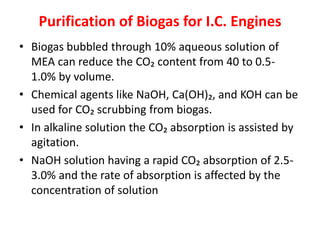
Purification of Biogas for I.C. Engines
• Biogas bubbled through 10% aqueous solution of
MEA can reduce the CO₂ content from 40 to 0.5-
1.0% by volume.
• Chemical agents like NaOH, Ca(OH)₂, and KOH can be
used for CO₂ scrubbing from biogas.
• In alkaline solution the CO₂ absorption is assisted by
agitation.
• NaOH solution having a rapid CO₂ absorption of 2.5-
3.0% and the rate of absorption is affected by the
concentration of solution
Biogas in I.C. Engine applications
• Biogas can be used in both heavy duty and light duty
vehicles.
• Light duty vehicles can normally run on biogas
without any modifications.
• Heavy duty vehicles without closed loop control may
have to be adjusted, if they run on biogas.
• Biogas provides a clean fuel for both SI (petrol) and
CI (diesel) engines.
• Diesel engines require combination of biogas and
diesel
• Petrol engines run fully on biogas.
Biogas in I.C. Engine applications
• Biogas cannot be directly used in automobiles as it contains
some other gases like CO₂, H₂S and water vapor.
• For use of biogas as a vehicle fuel, it is first upgraded by
removing impurities like CO₂, H₂S and water vapor.
• After removal of impurities it is compressed in a three or four
stage compressor up to a pressure of 20 MPa and stored in a
gas cascade.
• If the biogas is not compressed than the volume of gas
contained in the cylinder.
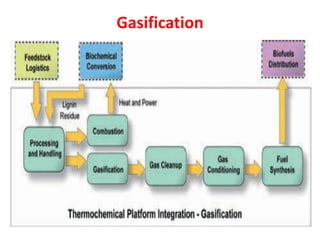
Gasification
Gasification
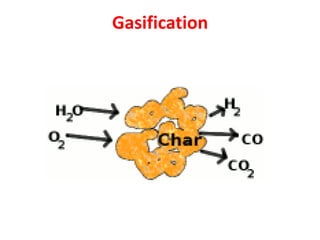
• Gasification is a process that converts biomass- or fossil fuel-
based carbonaceous materials into carbon monoxide,
hydrogen and carbon dioxide.
• Reacting the material at high temperatures (>700 °C), without
combustion, with a controlled amount of oxygen and/or
steam.
• Resulting gas mixture is called syngas(from synthesis gas) or
producer gas.
• Power derived from gasification and combustion of the
resultant gas is considered to be a source of renewable
energy(When the source used is biomass)
Gasification
Gasification
• Lignocellulosic feedstocks such as wood and forest products
are broken down to synthesis gas.
• Primarily carbon monoxide and hydrogen, using heat.
• The feedstock is then partially oxidized, or reformed with a
gasifying agent (air, oxygen, or steam).
• Synthesis gas (syngas) is produced.
• The makeup of syngas will vary due to the different types of
feedstocks, their moisture content, the type of gasifier used.
• The gasification agent, and the temperature and pressure in
the gasifier.
Advantages – Gasification
• Potentially more efficient than direct combustion of
the original fuel.
• Can be combusted at higher temperatures or even in
fuel cells.
• Can be burned directly in gas engines.
Pyrolysis
• Pyrolysis is the thermal decomposition of materials
at elevated temperatures in an inert atmosphere.
• It involves a change of chemical composition.
• The word is coined from the Greek-derived elements
pyro "fire" and lysis "separating“.
• Pyrolysis is most commonly used in the treatment of
organic materials.
• It is one of the processes involved in charring wood.
• Pyrolysis of organic substances produces volatile
products and leaves a solid residue enriched in
carbon, char.
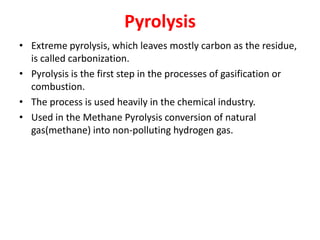
Pyrolysis
• Extreme pyrolysis, which leaves mostly carbon as the residue,
is called carbonization.
• Pyrolysis is the first step in the processes of gasification or
combustion.
• The process is used heavily in the chemical industry.
• Used in the Methane Pyrolysis conversion of natural
gas(methane) into non-polluting hydrogen gas.
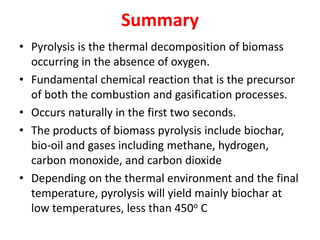
Summary
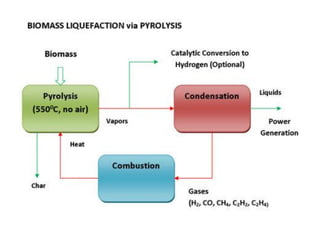
• Pyrolysis is the thermal decomposition of biomass
occurring in the absence of oxygen.
• Fundamental chemical reaction that is the precursor
of both the combustion and gasification processes.
• Occurs naturally in the first two seconds.
• The products of biomass pyrolysis include biochar,
bio-oil and gases including methane, hydrogen,
carbon monoxide, and carbon dioxide
• Depending on the thermal environment and the final
temperature, pyrolysis will yield mainly biochar at
low temperatures, less than 450o C
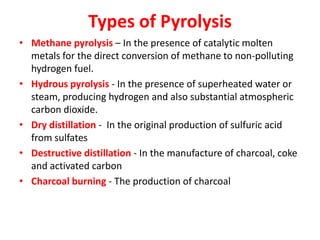
Types of Pyrolysis
• Methane pyrolysis – In the presence of catalytic molten
metals for the direct conversion of methane to non-polluting
hydrogen fuel.
• Hydrous pyrolysis - In the presence of superheated water or
steam, producing hydrogen and also substantial atmospheric
carbon dioxide.
• Dry distillation - In the original production of sulfuric acid
from sulfates
• Destructive distillation - In the manufacture of charcoal, coke
and activated carbon
• Charcoal burning - The production of charcoal
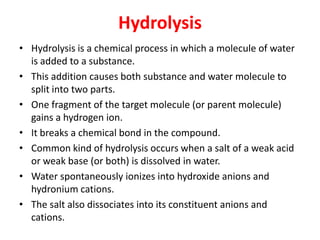
Hydrolysis
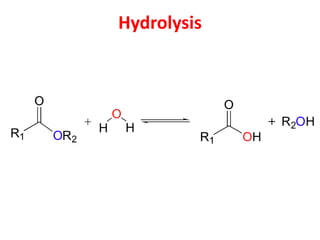
• Hydrolysis is a chemical process in which a molecule of water
is added to a substance.
• This addition causes both substance and water molecule to
split into two parts.
• One fragment of the target molecule (or parent molecule)
gains a hydrogen ion.
• It breaks a chemical bond in the compound.
• Common kind of hydrolysis occurs when a salt of a weak acid
or weak base (or both) is dissolved in water.
• Water spontaneously ionizes into hydroxide anions and
hydronium cations.
• The salt also dissociates into its constituent anions and
cations.
Hydrolysis
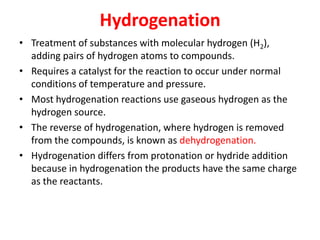
Hydrogenation
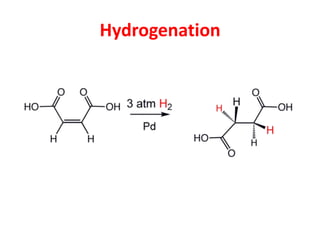
• Treatment of substances with molecular hydrogen (H2),
adding pairs of hydrogen atoms to compounds.
• Requires a catalyst for the reaction to occur under normal
conditions of temperature and pressure.
• Most hydrogenation reactions use gaseous hydrogen as the
hydrogen source.
• The reverse of hydrogenation, where hydrogen is removed
from the compounds, is known as dehydrogenation.
• Hydrogenation differs from protonation or hydride addition
because in hydrogenation the products have the same charge
as the reactants.
Hydrogenation
Hydrogenation
• Hydrogenation reactions generally require three components:
the substrate, the hydrogen source, and a catalyst.
• The reaction is carried out at varying temperatures and
pressures depending on the catalyst and substrate used.
• The hydrogenation of an alkene produces an alkane.
• Platinum, palladium, rhodium, and ruthenium are known to
be active catalysts which can operate at lower temperatures
and pressures.
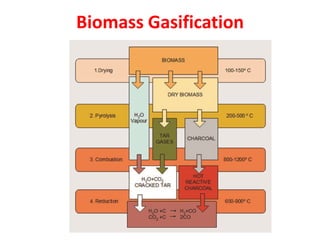
Biomass Gasification
• Biofuels are fuels produced directly or indirectly from organic
material or biomass.
• It includes plant materials and animal and human waste.
• Production of electrical energy using biomass as a fuel
involves accessing the hydrocarbon portion of the biomass
that can be converted into heat.
• Biofuels are considered renewable as they use energy from
sunlight to recycle the carbon in the atmosphere in the form
of carbon dioxide.
Gasification - Definition
A thermal process which converts organic
carbonaceous materials (such as wood waste,
shells, pellets, agricultural waste, energy crops)
into a combustible gas comprised of carbon
monoxide (CO), hydrogen (H) and carbon
dioxide (CO2)
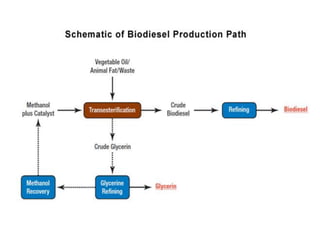
Biodiesel Production
• Produced from vegetable oils, yellow grease, used cooking
oils, or animal fats
• Produced by transesterification—a process that converts fats
and oils into biodiesel and glycerin (a byproduct)
• Approximately 100 pounds of oil or fat are reacted with 10
pounds of a short-chain alcohol (usually methanol) in the
presence of a catalyst (usually sodium hydroxide [NaOH] or
potassium hydroxide [KOH])
• 100 pounds of biodiesel and 10 pounds of glycerin (or
glycerol) will be produced.
• Glycerin, a co-product, is a sugar commonly used in the
manufacture of pharmaceuticals and cosmetics.
Thank you
Dr A R Pradeep Kumar, B.E., M.E., Ph.D.
Prof. /Mech.,
Dhanalakshmi College of Engineering,
Chennai
Email : dearpradeepkumar@gmail.com
99 41 42 43 37

Och 752 energy technology unit 4

  • 1.
    OCH752 ENERGY TECHNOLOGY UNITIV BIOMASS ENERGY Biomass origin - Resources – Biomass estimation. Thermochemical conversion – Biological conversion, Chemical conversion – Hydrolysis & hydrogenation, solvolysis, biocrude, biodiesel power generation gasifier, biogas, integrated gasification.
  • 2.
  • 3.
  • 4.
    Types of BiogasDigesters • Fixed Dome Biogas Plants • Floating Drum Plants • Low-Cost Polyethylene Tube Digester • Balloon Plants • Horizontal Plants • Earth-pit Plants • Ferro-cement Plants
  • 5.
  • 6.
    Function of aFixed-Dome Biogas Plant
  • 7.
    Fixed Dome BiogasPlants • Consists of a digester with a fixed, non-movable gas holder, which sits on top of the digester. • When gas production starts, the slurry is displaced into the compensation tank. • Gas pressure increases with the volume of gas stored and the height difference between the slurry level in the digester and the slurry level in the compensation tank. • The costs of a fixed-dome biogas plant are relatively low. • It is simple as no moving parts exist.
  • 8.
    Fixed Dome BiogasPlants • No rusting steel parts and hence a long life of the plant (20 years or more) can be expected. • The plant is constructed underground, protecting it from physical damage and saving space. • While the underground digester is protected from low temperatures at night and during cold seasons, sunshine and warm seasons take longer to heat up the digester. • No day/night fluctuations of temperature in the digester positively influence the bacteriological processes.
  • 9.
    Fixed Dome BiogasPlants • The construction of fixed dome plants is labor- intensive, thus creating local employment. • Fixed-dome plants are not easy to build. • They should only be built where construction can be supervised by experienced biogas technicians.
  • 10.
    Working of FixedDome Biogas Plant • A fixed-dome plant comprises of a closed, dome-shaped digester with an immovable, rigid gas-holder and a displacement pit, also named 'compensation tank'. • The gas is stored in the upper part of the digester. • When gas production commences, the slurry is displaced into the compensating tank. • Gas pressure increases with the volume of gas stored • i.e. with the height difference between the two slurry levels. • If there is little gas in the gas-holder, the gas pressure is low • Digesters of fixed-dome plants are usually masonry structures • Structures of cement and ferro-cement exist. • The top part of a fixed-dome plant (the gas space) must be gas- tight.
  • 11.
  • 12.
    Floating Drum BiogasPlant • Om 1956, Jashu Bhai J Patel from India designed the first floating drum biogas plant, popularly called Gobar gas plant. • Floating-drum plants consist of an underground digester (cylindrical or dome-shaped) and a moving gas-holder. • The gas-holder floats either directly on the fermentation slurry or in a water jacket of its own. • The gas is collected in the gas drum, which rises or moves down, according to the amount of gas stored. • The gas drum is prevented from tilting by a guiding frame.
  • 13.
    Floating Drum BiogasPlant • When biogas is produced, the drum moves up adn when it is consumed, the drum goes down. • If the drum floats in a water jacket, it cannot get stuck, even in substrate with high solid content. • After the introduction of cheap Fixed-dome Chinese model, the floating drum plants became obsolete as they have high investment and maintenance cost along with other design weakness
  • 14.
  • 15.
    Biogas for Cooking •Biogas production for domestic cooking depends on an affordable appropriate digester at a suitable scale for domestic use. • In any digester, the waste is mixed with water to create the right environment for the bacteria to decompose the biomass. • As this is an anaerobic process, this has to happen without the presence of oxygen in an airtight tank. • The biogas accumulates at the top of the tank where it is collected and taken by pipe to the user. • The slurry has to be removed regularly from the tank. It can be used further, e.g. as agricultural fertilizer.
  • 16.
    Component of HouseholdDigester • Collection space: raw, liquid, slurry, semi-solid and solid animal, human or agricultural waste • Anaerobic digester • Slurry storage • Gas handling: piping; gas pump or blower; gas meter; pressure regulator; and condensate drain(s). • End-use device: cooker, boiler or lighting equipment
  • 17.
    Component of HouseholdDigester • For transporting biogas from the digester to the cooking place a tube is needed. • Stoves for this system contain a valve to premix the biogas with the right amount of oxygen. • Also a burner to combust the mixture and a structure to hold a cook-pot. • Stoves and ovens for biogas application are similar to those of conventional appliances. • Most of these conventional appliances can be adapted for the use with biogas by modification of the burners
  • 18.
    Advantages of UsingBio-gas • Biogas burns very cleanly, and produces fewer pollutants during cooking than any other fuel except electricity. • Biogas provides instant heat upon ignition, no pre-heating or waiting time is required. • Most biogas burners are able to regulate the flow-rate to turn down fire-power from high heat to small low heat for simmering. • Biogas can be used for lighting as well. • The by-product (slurry) from the digester can be used as fertilizer. • Biogas is a renewable fuel that is ‘carbon negative’: unless there are leakages in the system. • Burning biogas in a cook stove releases less greenhouse gases than if the dung was left on the ground to decompose naturally.
  • 19.
    Disadvantages of UsingBio-gas • High investment costs for the digester, tubes, gas stove, and pots. • Biogas can increase the workload of women as it is often made their task to run the digester. • It is quite a physical burden to move all the biomass feedstock and water to feed the digester. • Slurry must be removed and taken to the field. • It is not viable for elderly or sick people to run a biogas plant on their own, if they don’t have labor to assist them in the maintenance of the digester. • Installations (depending on material and location) must be protected against theft and damages.
  • 20.
    Disadvantages of UsingBio-gas • Especially metal tubes are a valuable good and often prone to theft. • Cultural rules might limit the acceptance of handling dung or feces and their use as fuel for cooking. • Cooking with biogas requires the change of cooking habits, which might prevent the adoption. • Biogas is difficult to store and to transport to other consumers.
  • 21.
    Biogas – Fuelfor I.C. Engines • Biogas contains 50% to 70% of CH₄, 5-10 % of H₂ and up to 30 -40 % of CO₂. • After being cleaned of carbon dioxide, this gas becomes a fairly homogeneous fuel. • It contains up to 80 % of methane. • The calorific capacity of over 25 MJ/m³. • The most important component of biogas, from the calorific point of view, is methane. • The other components are not involved in combustion process, and rather absorb energy from combustion of CH₄ . • They leave the process at higher temperature than the one they had before the process.
  • 22.
    Limitations - Biogasin I.C. Engines • High CO₂ content reduces the power output, making it uneconomical as a transport fuel. • It is possible to remove the CO₂ by washing the gas with water. • The solution produced from washing out the CO₂ is acidic and needs careful disposal. • H₂S is acidic and if not removed can cause corrosion of engine parts within a matter of hours. • High residual moisture which can cause starting problems. • The gas can vary in quality and pressure.
  • 23.
    Purification of Biogasfor I.C. Engines • CO₂ is high corrosive when wet and it has no combustion value so its removal is must to improve the biogas quality. a) Caustic solution NAOH- 40% NAOH + CO₂ = NAHCO₃ b) Refined process K₂CO₃ - 30 % K₂CO₃ + CO₂ = 2KCO₃ • CO₂ removal from biogas can be done by using chemical solvents like mono-ethanolamine (MEA), diethanolamine and tri- ethanolamine or aqueous solution of alkaline salts.
  • 24.
    Purification of Biogasfor I.C. Engines • Biogas bubbled through 10% aqueous solution of MEA can reduce the CO₂ content from 40 to 0.5- 1.0% by volume. • Chemical agents like NaOH, Ca(OH)₂, and KOH can be used for CO₂ scrubbing from biogas. • In alkaline solution the CO₂ absorption is assisted by agitation. • NaOH solution having a rapid CO₂ absorption of 2.5- 3.0% and the rate of absorption is affected by the concentration of solution
  • 25.
    Biogas in I.C.Engine applications • Biogas can be used in both heavy duty and light duty vehicles. • Light duty vehicles can normally run on biogas without any modifications. • Heavy duty vehicles without closed loop control may have to be adjusted, if they run on biogas. • Biogas provides a clean fuel for both SI (petrol) and CI (diesel) engines. • Diesel engines require combination of biogas and diesel • Petrol engines run fully on biogas.
  • 26.
    Biogas in I.C.Engine applications • Biogas cannot be directly used in automobiles as it contains some other gases like CO₂, H₂S and water vapor. • For use of biogas as a vehicle fuel, it is first upgraded by removing impurities like CO₂, H₂S and water vapor. • After removal of impurities it is compressed in a three or four stage compressor up to a pressure of 20 MPa and stored in a gas cascade. • If the biogas is not compressed than the volume of gas contained in the cylinder.
  • 27.
  • 28.
    Gasification • Gasification isa process that converts biomass- or fossil fuel- based carbonaceous materials into carbon monoxide, hydrogen and carbon dioxide. • Reacting the material at high temperatures (>700 °C), without combustion, with a controlled amount of oxygen and/or steam. • Resulting gas mixture is called syngas(from synthesis gas) or producer gas. • Power derived from gasification and combustion of the resultant gas is considered to be a source of renewable energy(When the source used is biomass)
  • 29.
  • 30.
    Gasification • Lignocellulosic feedstockssuch as wood and forest products are broken down to synthesis gas. • Primarily carbon monoxide and hydrogen, using heat. • The feedstock is then partially oxidized, or reformed with a gasifying agent (air, oxygen, or steam). • Synthesis gas (syngas) is produced. • The makeup of syngas will vary due to the different types of feedstocks, their moisture content, the type of gasifier used. • The gasification agent, and the temperature and pressure in the gasifier.
  • 31.
    Advantages – Gasification •Potentially more efficient than direct combustion of the original fuel. • Can be combusted at higher temperatures or even in fuel cells. • Can be burned directly in gas engines.
  • 32.
    Pyrolysis • Pyrolysis isthe thermal decomposition of materials at elevated temperatures in an inert atmosphere. • It involves a change of chemical composition. • The word is coined from the Greek-derived elements pyro "fire" and lysis "separating“. • Pyrolysis is most commonly used in the treatment of organic materials. • It is one of the processes involved in charring wood. • Pyrolysis of organic substances produces volatile products and leaves a solid residue enriched in carbon, char.
  • 33.
    Pyrolysis • Extreme pyrolysis,which leaves mostly carbon as the residue, is called carbonization. • Pyrolysis is the first step in the processes of gasification or combustion. • The process is used heavily in the chemical industry. • Used in the Methane Pyrolysis conversion of natural gas(methane) into non-polluting hydrogen gas.
  • 35.
    Summary • Pyrolysis isthe thermal decomposition of biomass occurring in the absence of oxygen. • Fundamental chemical reaction that is the precursor of both the combustion and gasification processes. • Occurs naturally in the first two seconds. • The products of biomass pyrolysis include biochar, bio-oil and gases including methane, hydrogen, carbon monoxide, and carbon dioxide • Depending on the thermal environment and the final temperature, pyrolysis will yield mainly biochar at low temperatures, less than 450o C
  • 36.
    Types of Pyrolysis •Methane pyrolysis – In the presence of catalytic molten metals for the direct conversion of methane to non-polluting hydrogen fuel. • Hydrous pyrolysis - In the presence of superheated water or steam, producing hydrogen and also substantial atmospheric carbon dioxide. • Dry distillation - In the original production of sulfuric acid from sulfates • Destructive distillation - In the manufacture of charcoal, coke and activated carbon • Charcoal burning - The production of charcoal
  • 37.
    Hydrolysis • Hydrolysis isa chemical process in which a molecule of water is added to a substance. • This addition causes both substance and water molecule to split into two parts. • One fragment of the target molecule (or parent molecule) gains a hydrogen ion. • It breaks a chemical bond in the compound. • Common kind of hydrolysis occurs when a salt of a weak acid or weak base (or both) is dissolved in water. • Water spontaneously ionizes into hydroxide anions and hydronium cations. • The salt also dissociates into its constituent anions and cations.
  • 38.
  • 39.
    Hydrogenation • Treatment ofsubstances with molecular hydrogen (H2), adding pairs of hydrogen atoms to compounds. • Requires a catalyst for the reaction to occur under normal conditions of temperature and pressure. • Most hydrogenation reactions use gaseous hydrogen as the hydrogen source. • The reverse of hydrogenation, where hydrogen is removed from the compounds, is known as dehydrogenation. • Hydrogenation differs from protonation or hydride addition because in hydrogenation the products have the same charge as the reactants.
  • 40.
  • 41.
    Hydrogenation • Hydrogenation reactionsgenerally require three components: the substrate, the hydrogen source, and a catalyst. • The reaction is carried out at varying temperatures and pressures depending on the catalyst and substrate used. • The hydrogenation of an alkene produces an alkane. • Platinum, palladium, rhodium, and ruthenium are known to be active catalysts which can operate at lower temperatures and pressures.
  • 42.
  • 43.
    Biomass Gasification • Biofuelsare fuels produced directly or indirectly from organic material or biomass. • It includes plant materials and animal and human waste. • Production of electrical energy using biomass as a fuel involves accessing the hydrocarbon portion of the biomass that can be converted into heat. • Biofuels are considered renewable as they use energy from sunlight to recycle the carbon in the atmosphere in the form of carbon dioxide.
  • 44.
    Gasification - Definition Athermal process which converts organic carbonaceous materials (such as wood waste, shells, pellets, agricultural waste, energy crops) into a combustible gas comprised of carbon monoxide (CO), hydrogen (H) and carbon dioxide (CO2)
  • 46.
    Biodiesel Production • Producedfrom vegetable oils, yellow grease, used cooking oils, or animal fats • Produced by transesterification—a process that converts fats and oils into biodiesel and glycerin (a byproduct) • Approximately 100 pounds of oil or fat are reacted with 10 pounds of a short-chain alcohol (usually methanol) in the presence of a catalyst (usually sodium hydroxide [NaOH] or potassium hydroxide [KOH]) • 100 pounds of biodiesel and 10 pounds of glycerin (or glycerol) will be produced. • Glycerin, a co-product, is a sugar commonly used in the manufacture of pharmaceuticals and cosmetics.
  • 47.
    Thank you Dr AR Pradeep Kumar, B.E., M.E., Ph.D. Prof. /Mech., Dhanalakshmi College of Engineering, Chennai Email : dearpradeepkumar@gmail.com 99 41 42 43 37