MBEYA UNIVERSITY OF SCIENCE
AND TECHNOLOGY
INTRODUCTION TO POWER PLANT
• CODE: MEB 8103
• Name: Power Plants
• Number of Credits: 6
• Instructor: Emmanuel Mwangomo
SUB ENABLING OUTCOME
• Ability to determine energy
generated in power plants
• Ability to comprehend and explain
the principles of power plants
• Ability to make decisions on the
suitability of power plant for a
particular place
• Ability to inspect and specify power
production methods of facilities
3
LEARNING CONTEXT
• The module will be conducted through
lectures and tutorials and visits to
power plants providing the opportunity
for the learner to gain first hand
experience.
4
LEARNING CONTEXT
• STEAM POWER PLANTS-Essential of
steam power plant equipemnt, coal
handling, fuel burning equipement,
methods of fuel firing, pulverized coal,
water walls draught, methods of
burning fuel, oil, economizer and air
preheater, super heater, feed water
treatment, feed water heaters, types of
steam condensers, cooling towers,
steam separators, site selection, cost of
steam power plant, useful life of
components, plant layout, safety of
boiler plant.
5
LEARNING CONTEXT
• HYDRO POWER PLANTS-hydrology, water
power, essential features of hydro electric
power plant, classification of hydro-electric
power plants, draft tube, surge tanks,
hydraulic turbines, turbine governing, site
selection, comparison of hydro-electric power
plants and steam power plants, tunnels,
flumes, spillway and gates in dams, interior
gate valves, average life of various
components, hydraulic accumulators,
calculation of available hydropower. 6
LEARNING CONTEXT
• NUCLEAR POWER PLANTS- nuclear energy,
chain reaction, fertile material, unit of
radioctivity , parts of nuclear reactor,
classification of reactors, main
components of nuclear power plants,
advantages and disadvantages of nuclear
power plants, site selection
7
WORK
• Refers to an activity involving a force and
movement in the directon of the force. A force
of 20 newtons pushing an object 5 meters in
the direction of the force does 100 joules of
work.
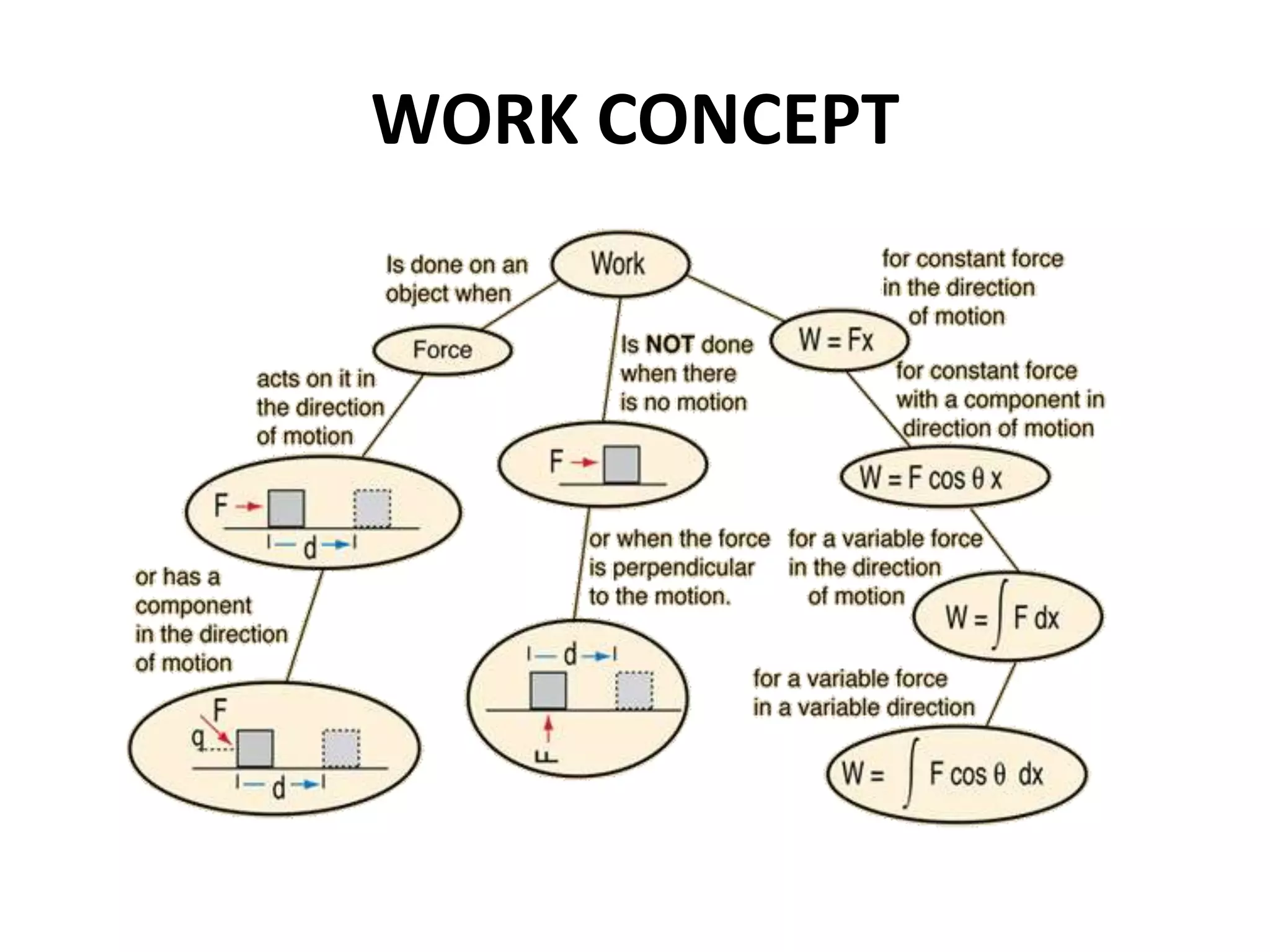
WORK CONCEPT
Mathematical Work
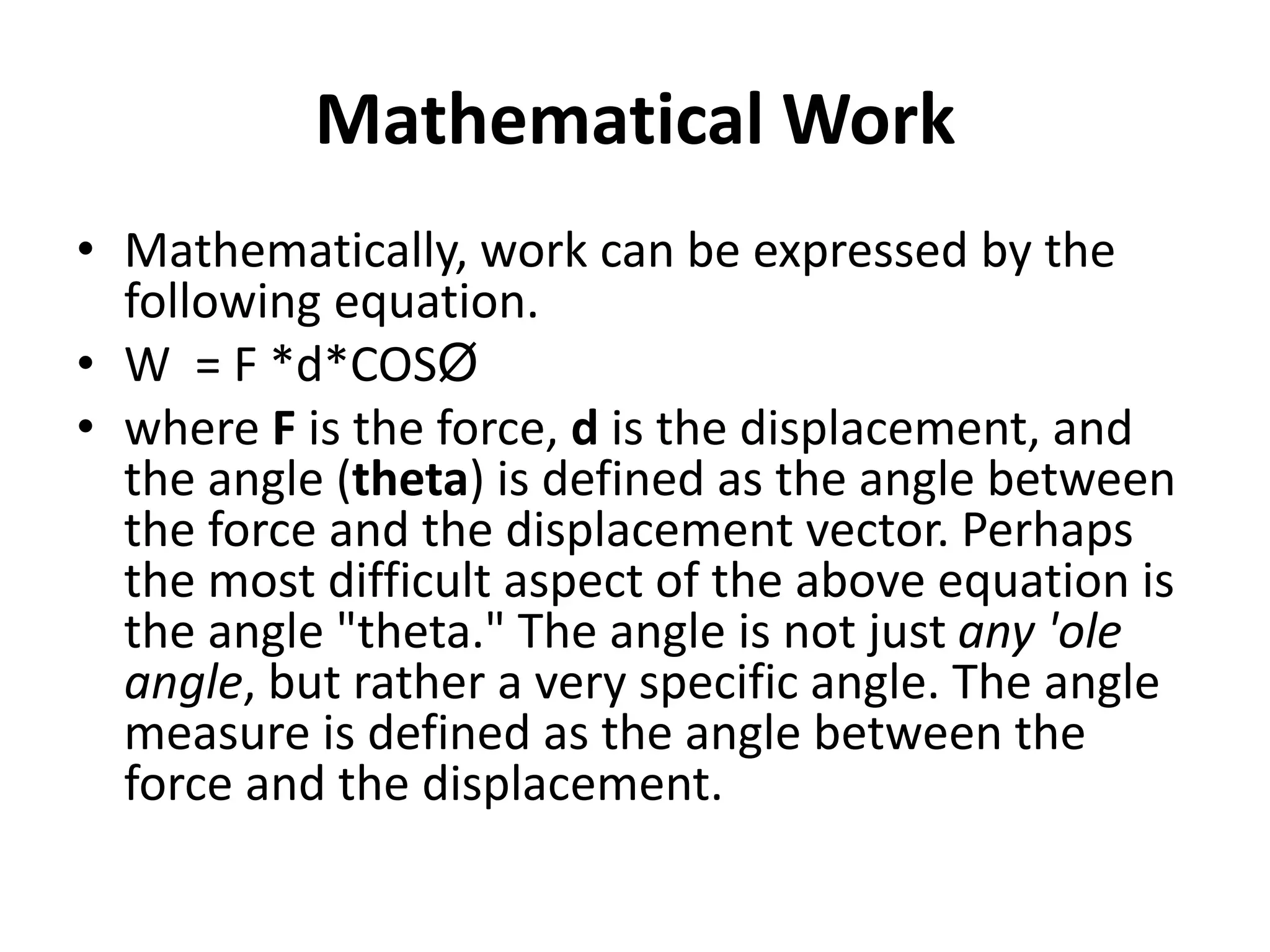
• Mathematically, work can be expressed by the
following equation.
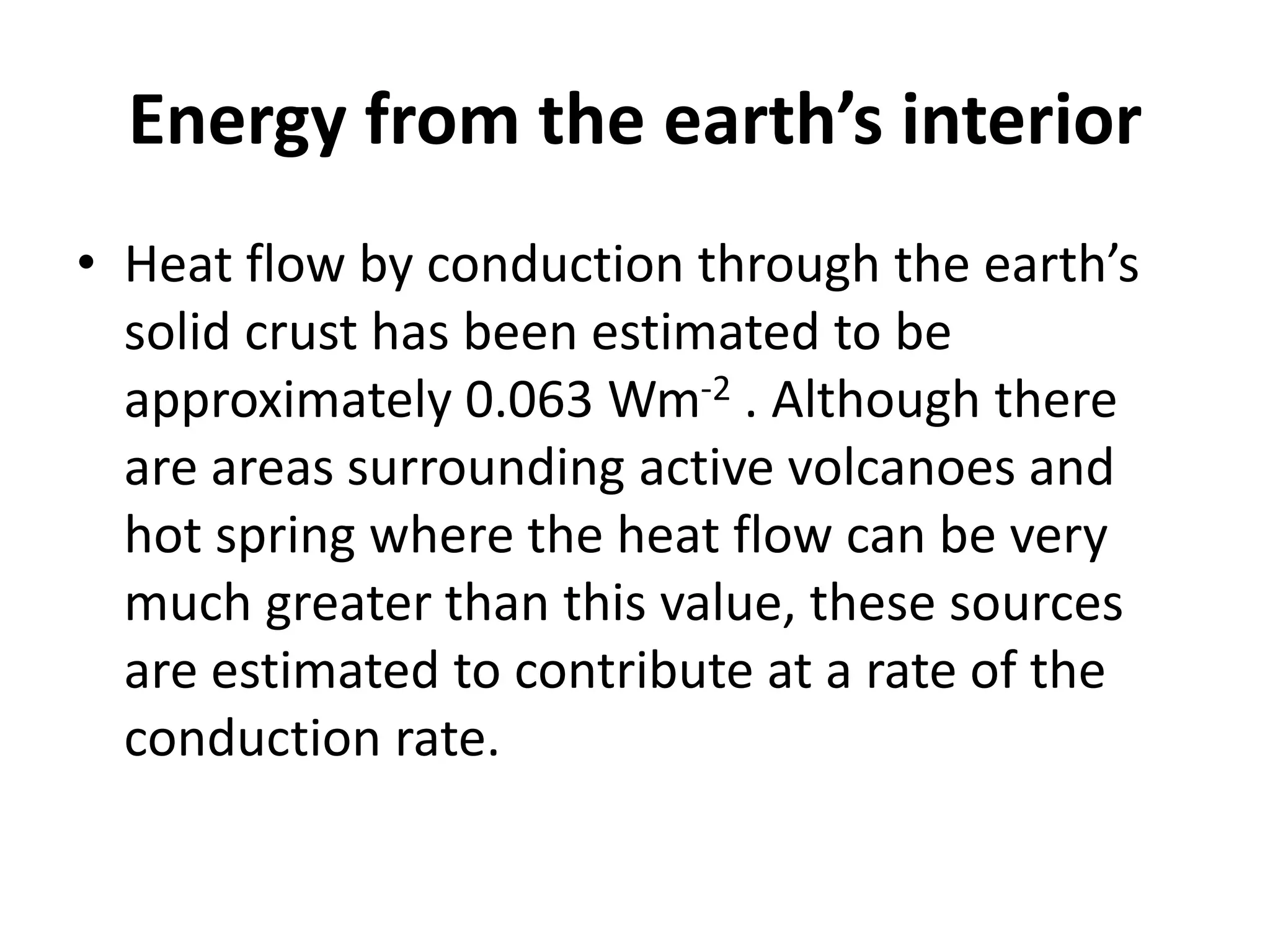
• W = F *d*COSØ
• where F is the force, d is the displacement, and
the angle (theta) is defined as the angle between
the force and the displacement vector. Perhaps
the most difficult aspect of the above equation is
the angle "theta." The angle is not just any 'ole
angle, but rather a very specific angle. The angle
measure is defined as the angle between the
force and the displacement.
Units of work
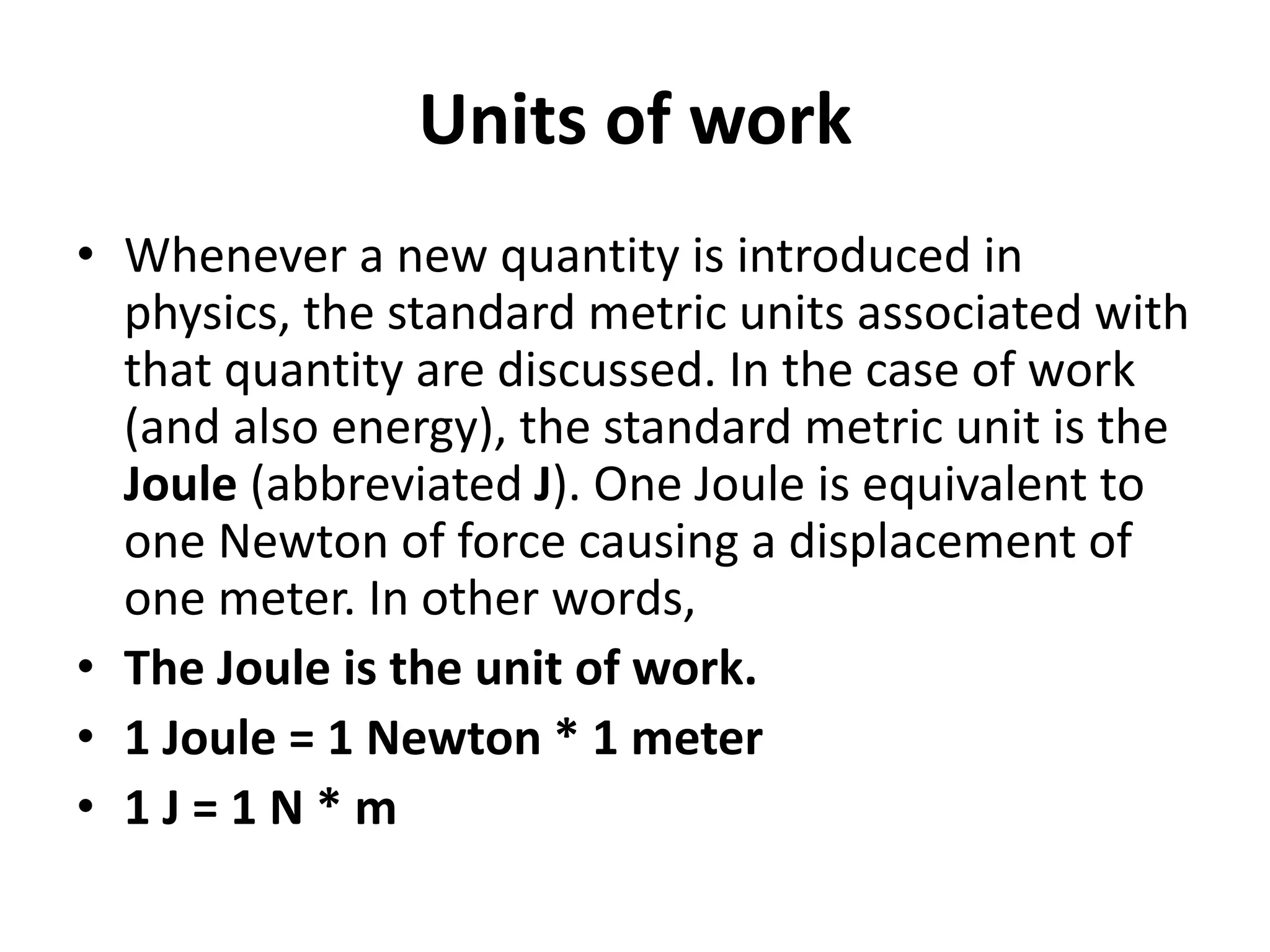
• Whenever a new quantity is introduced in
physics, the standard metric units associated with
that quantity are discussed. In the case of work
(and also energy), the standard metric unit is the
Joule (abbreviated J). One Joule is equivalent to
one Newton of force causing a displacement of
one meter. In other words,
• The Joule is the unit of work.
• 1 Joule = 1 Newton * 1 meter
• 1 J = 1 N * m
ENERGY
• is the capacity for doing work. You must have
energy to accomplish work - it is like the
"currency" for performing work. To do 100
joules of work, you must expend 100 joules of
energy.
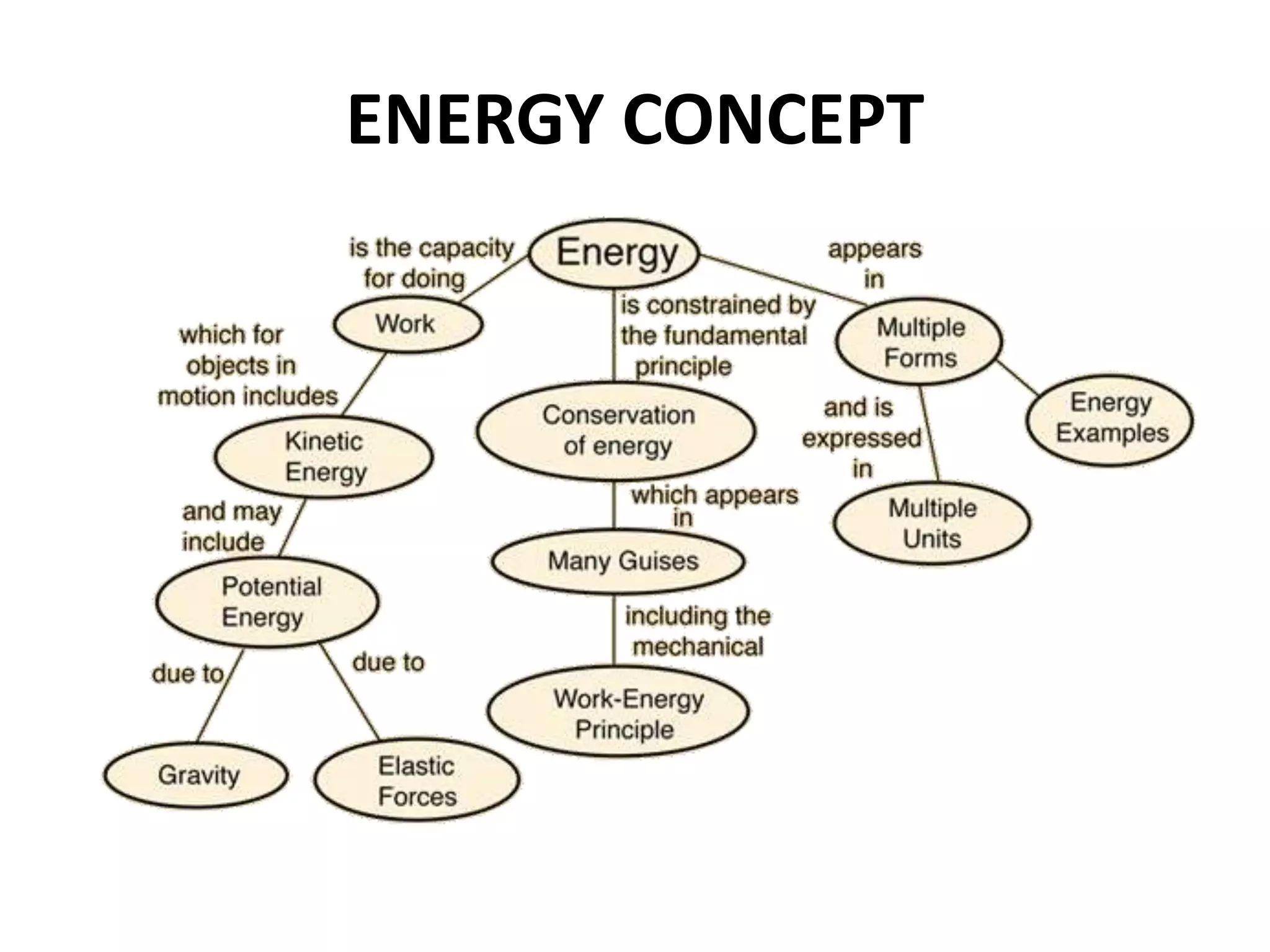
ENERGY CONCEPT
Types of Energy
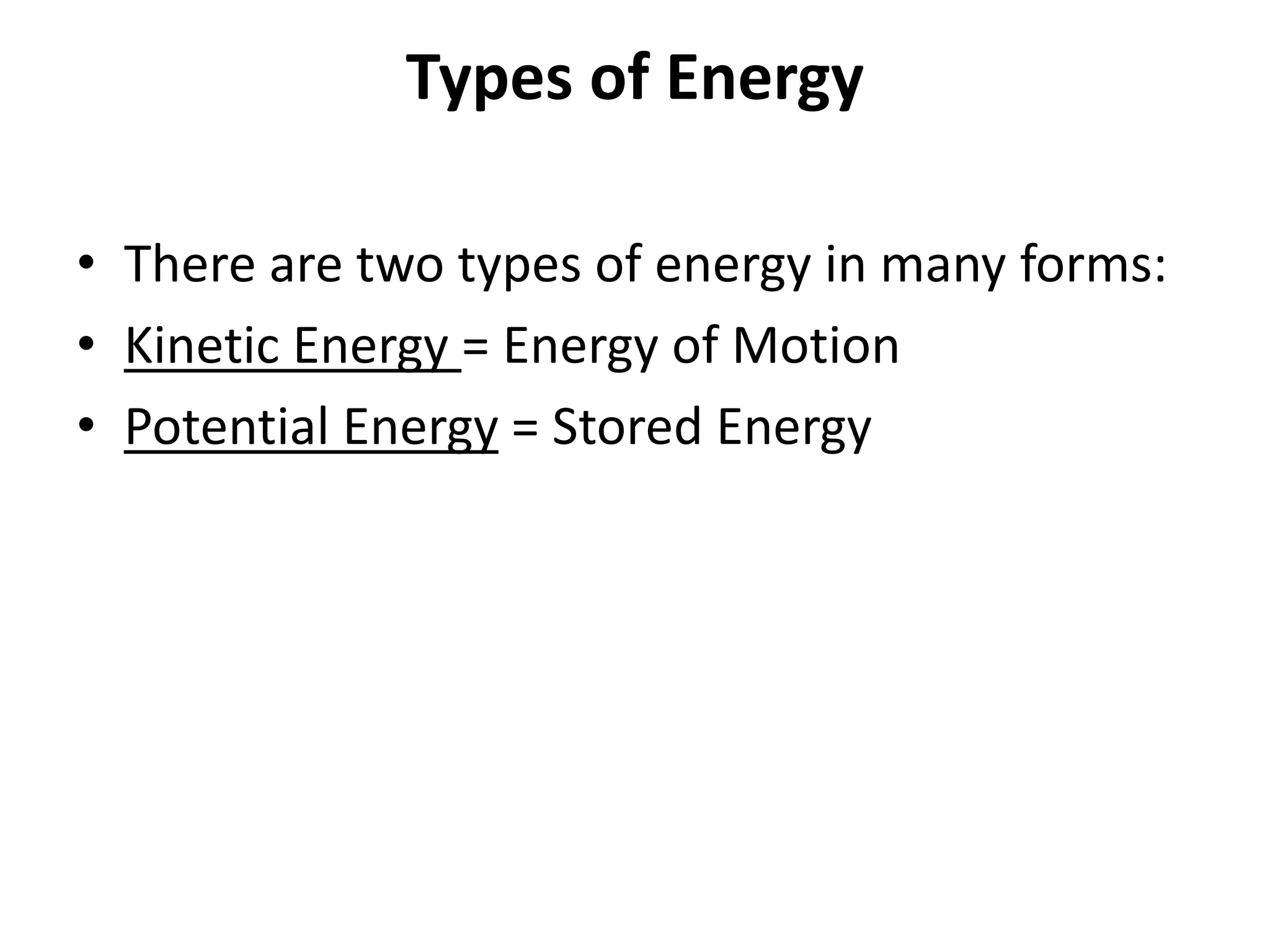
• There are two types of energy in many forms:
• Kinetic Energy = Energy of Motion
• Potential Energy = Stored Energy
Forms of Energy
• Solar Radiation -- Infrared Heat, Radio Waves, Gamma
Rays, Microwaves, Ultraviolet Light
• Atomic/Nuclear Energy -energy released in nuclear
reactions. When a neutron splits an atom's nucleus
into smaller pieces it is called fission. When two nuclei
are joined together under millions of degrees of heat it
is called fusion
• Electrical Energy --The generation or use of electric
power over a period of time expressed in kilowatt-
hours (kWh), megawatt-hours (NM) or gigawatt-hours
(GWh).
Forms of Energy
• Chemical Energy --Chemical energy is a form of
potential energy related to the breaking and
forming of chemical bonds. It is stored in food,
fuels and batteries, and is released as other forms
of energy during chemical reactions.
• Mechanical Energy -- Energy of the moving parts
of a machine. Also refers to movements in
humans
• Heat Energy -- a form of energy that is transferred
by a difference in temperature
POWER
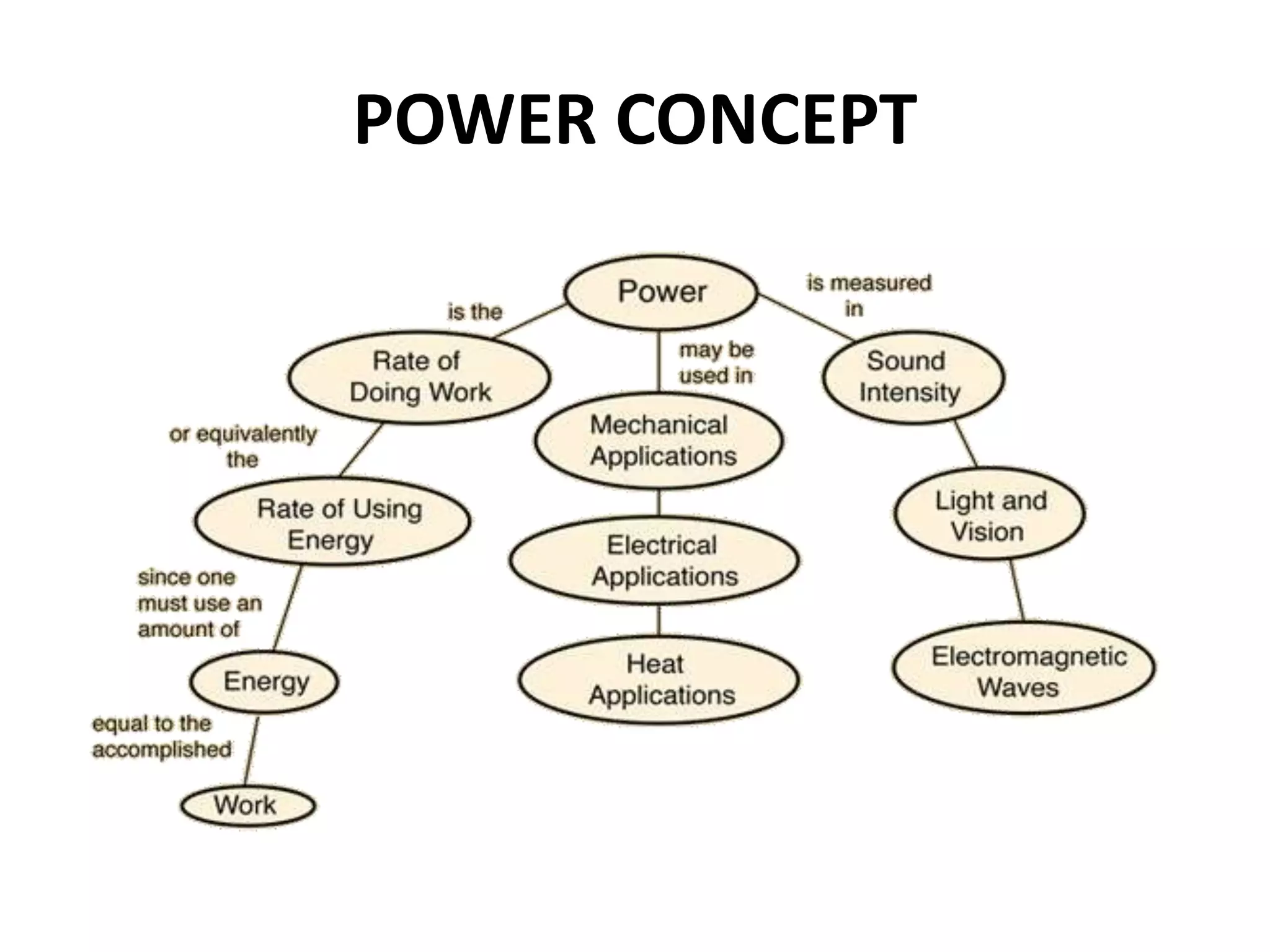
• is the rate of doing work or the rate of using
energy, which are numerically the same. If you
do 100 joules of work in one second (using
100 joules of energy), the power is 100 watts.
POWER CONCEPT
Calculating Work Energy and Power
• WORK = W=Fd
• Because energy is the capacity to do work , we
measure energy and work in the same units (N*m
or joules).
• POWER (P) is the rate of energy generation (or
absorption) over time:P = E/t
• Power's SI unit of measurement is the Watt,
representing the generation or absorption of
energy at the rate of 1 Joule/sec. Power's unit of
measurement in the English system is the
horsepower, which is equivalent to 735.7 Watts.
LAWS OF THERMODYNAMICS
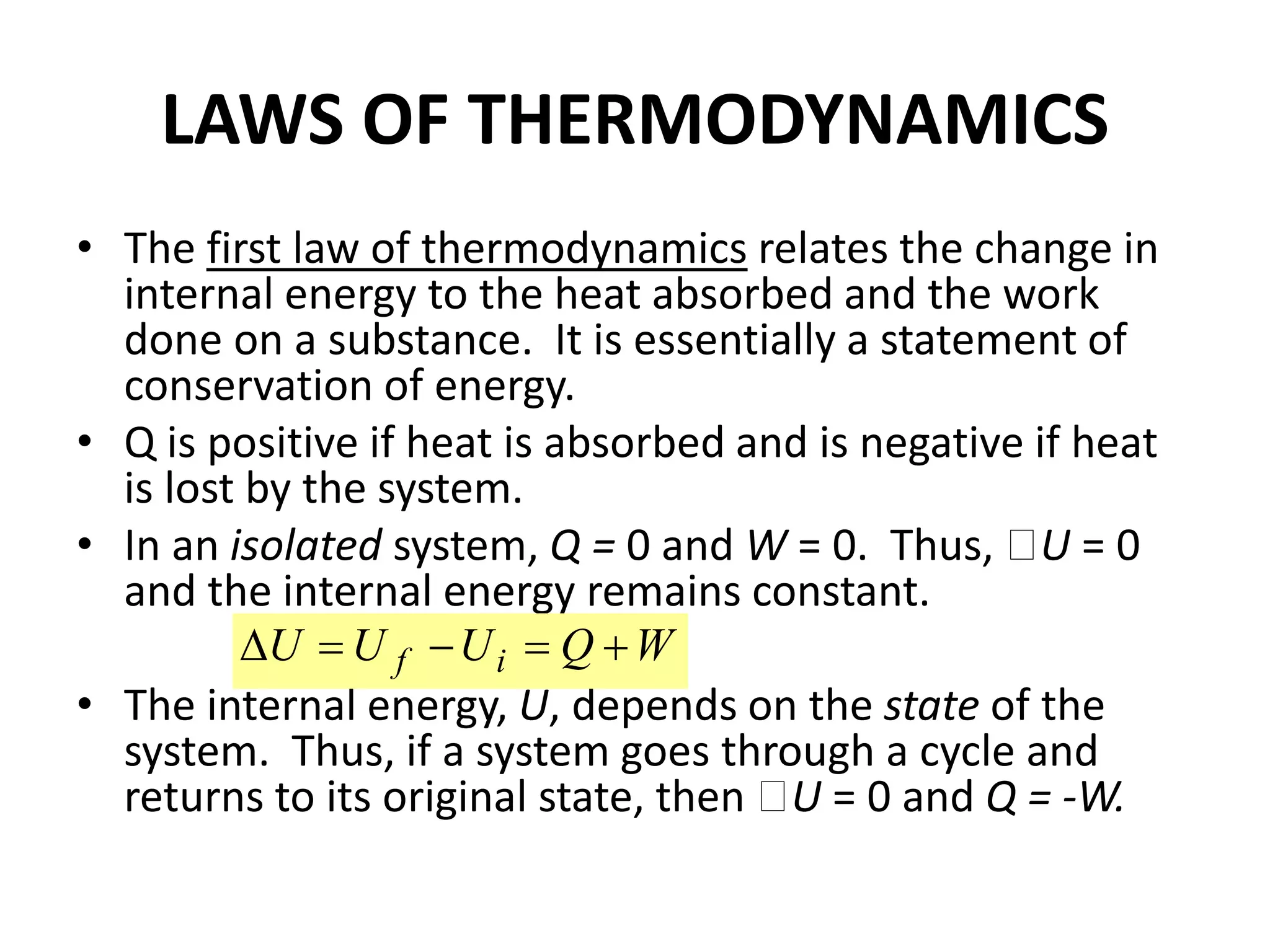
• The first law of thermodynamics relates the change in
internal energy to the heat absorbed and the work
done on a substance. It is essentially a statement of
conservation of energy.
• Q is positive if heat is absorbed and is negative if heat
is lost by the system.
• In an isolated system, Q = 0 and W = 0. Thus, U = 0
and the internal energy remains constant.
• The internal energy, U, depends on the state of the
system. Thus, if a system goes through a cycle and
returns to its original state, then U = 0 and Q = -W.
W
Q
U
U
U i
f 




Conservation of Energy
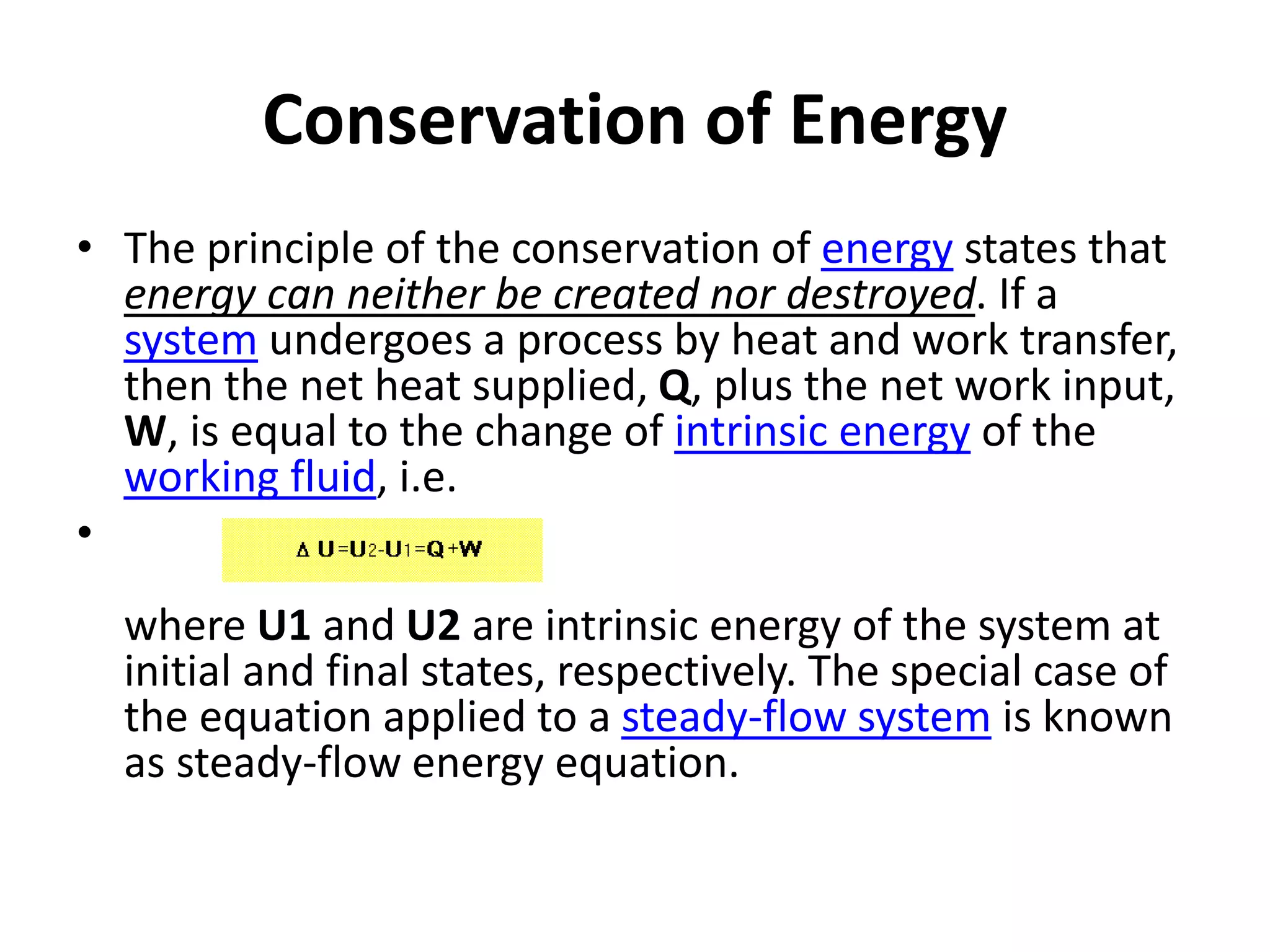
• The principle of the conservation of energy states that
energy can neither be created nor destroyed. If a
system undergoes a process by heat and work transfer,
then the net heat supplied, Q, plus the net work input,
W, is equal to the change of intrinsic energy of the
working fluid, i.e.
•
where U1 and U2 are intrinsic energy of the system at
initial and final states, respectively. The special case of
the equation applied to a steady-flow system is known
as steady-flow energy equation.
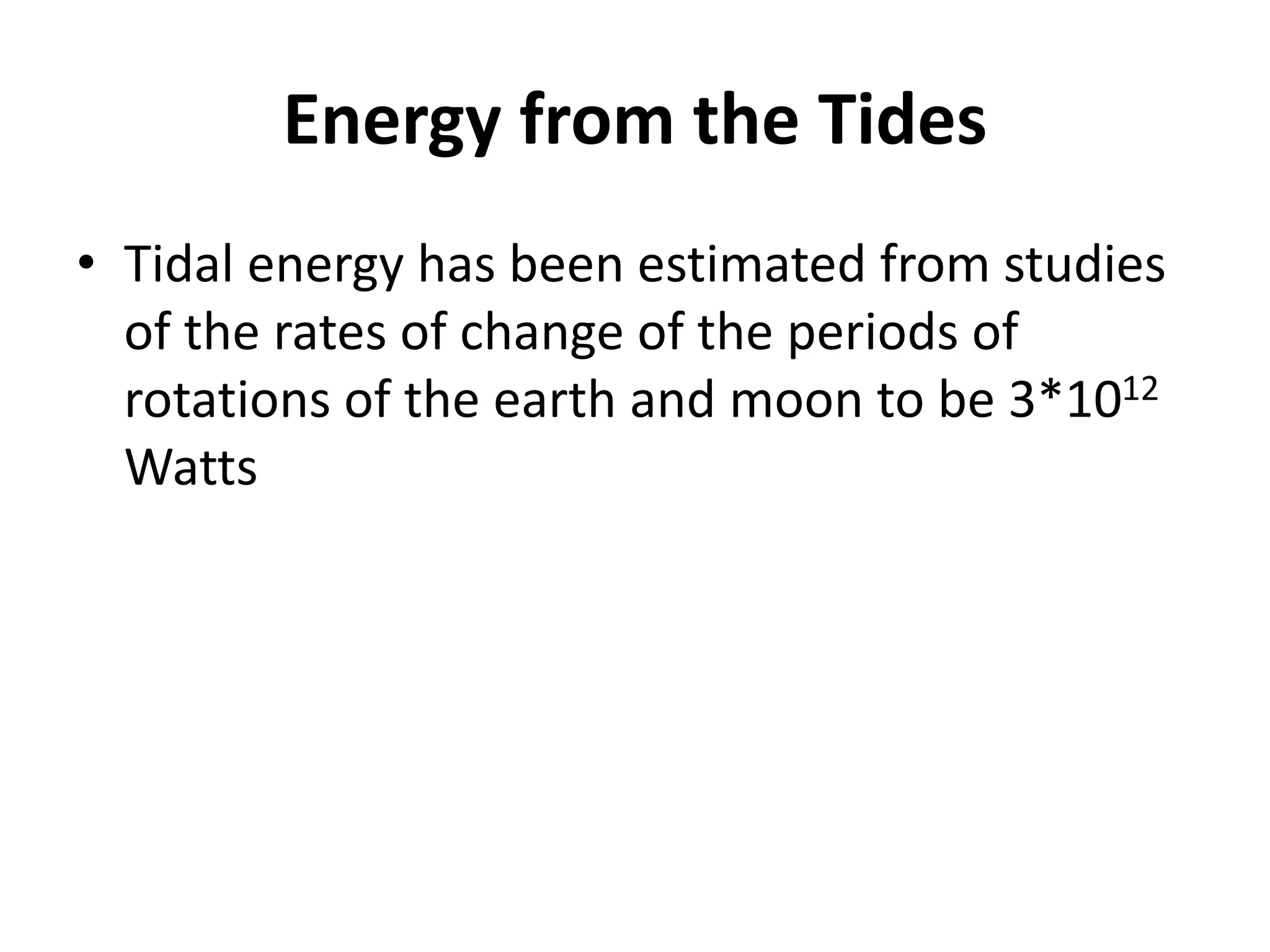
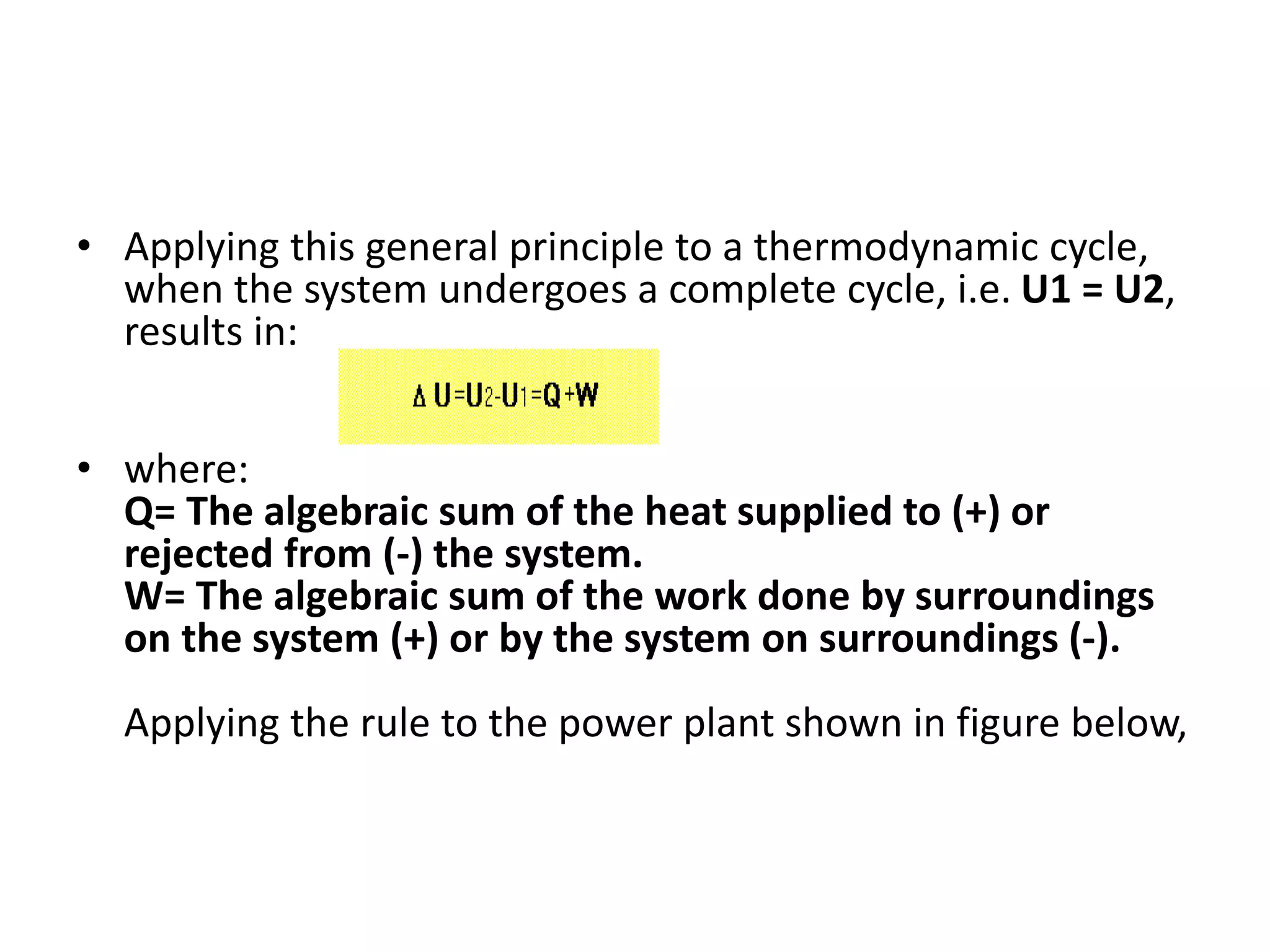
• Applying this general principle to a thermodynamic cycle,
when the system undergoes a complete cycle, i.e. U1 = U2,
results in:
• where:
Q= The algebraic sum of the heat supplied to (+) or
rejected from (-) the system.
W= The algebraic sum of the work done by surroundings
on the system (+) or by the system on surroundings (-).
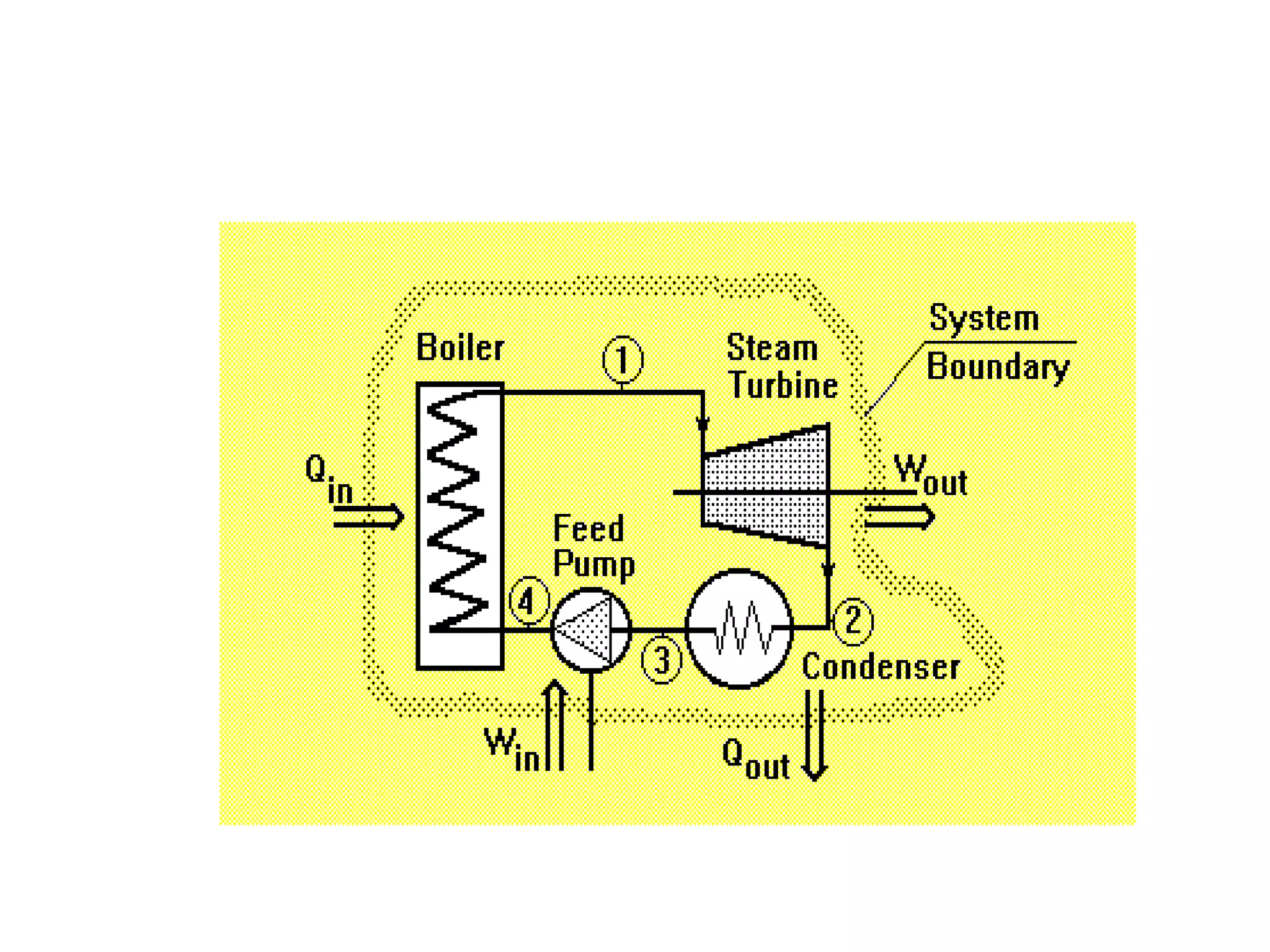
Applying the rule to the power plant shown in figure below,
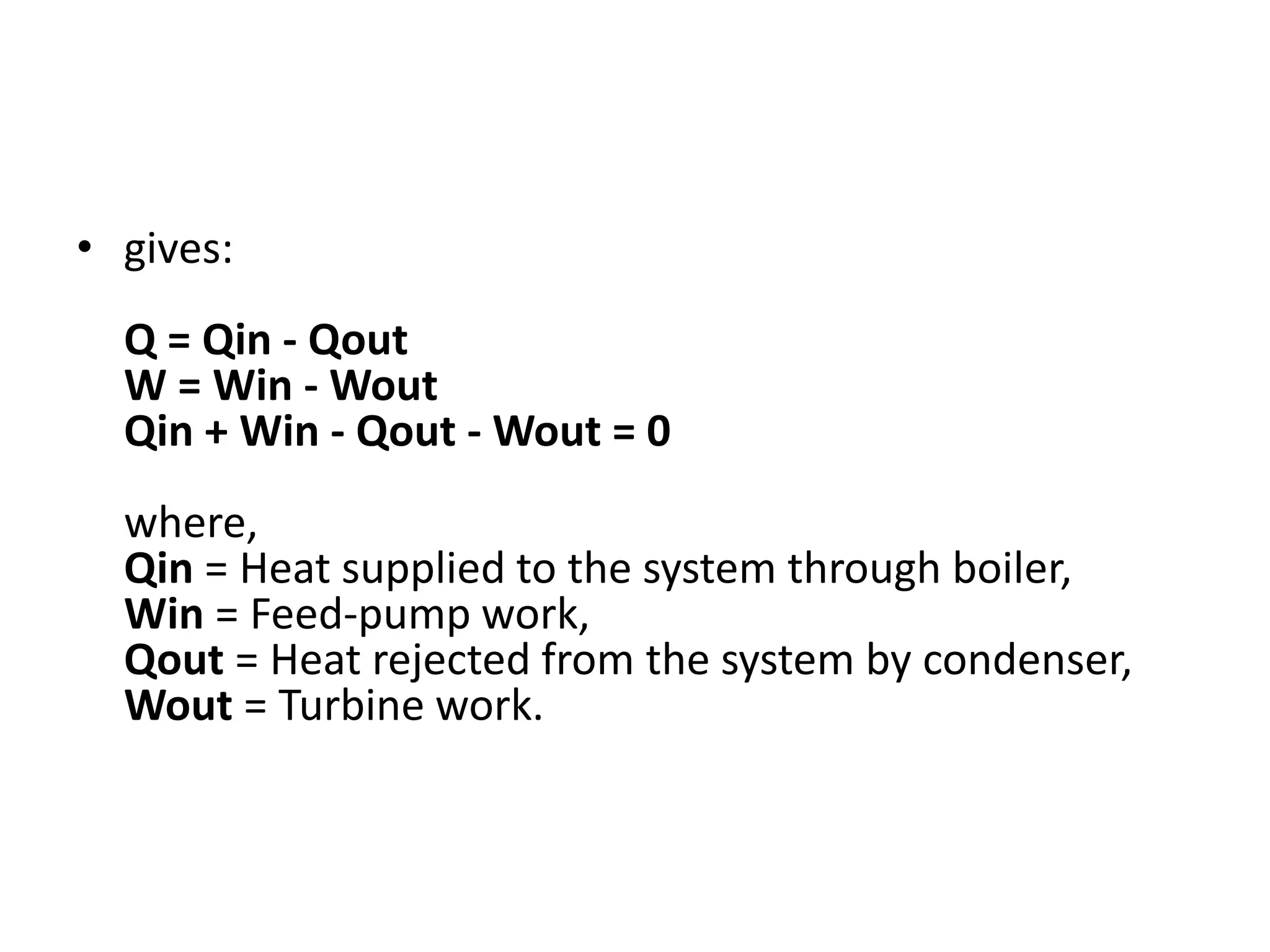
• gives:
Q = Qin - Qout
W = Win - Wout
Qin + Win - Qout - Wout = 0
where,
Qin = Heat supplied to the system through boiler,
Win = Feed-pump work,
Qout = Heat rejected from the system by condenser,
Wout = Turbine work.
Second law of Thermodyanic
• Heat always flows from high temperature (hot) to low
temperature (cold).
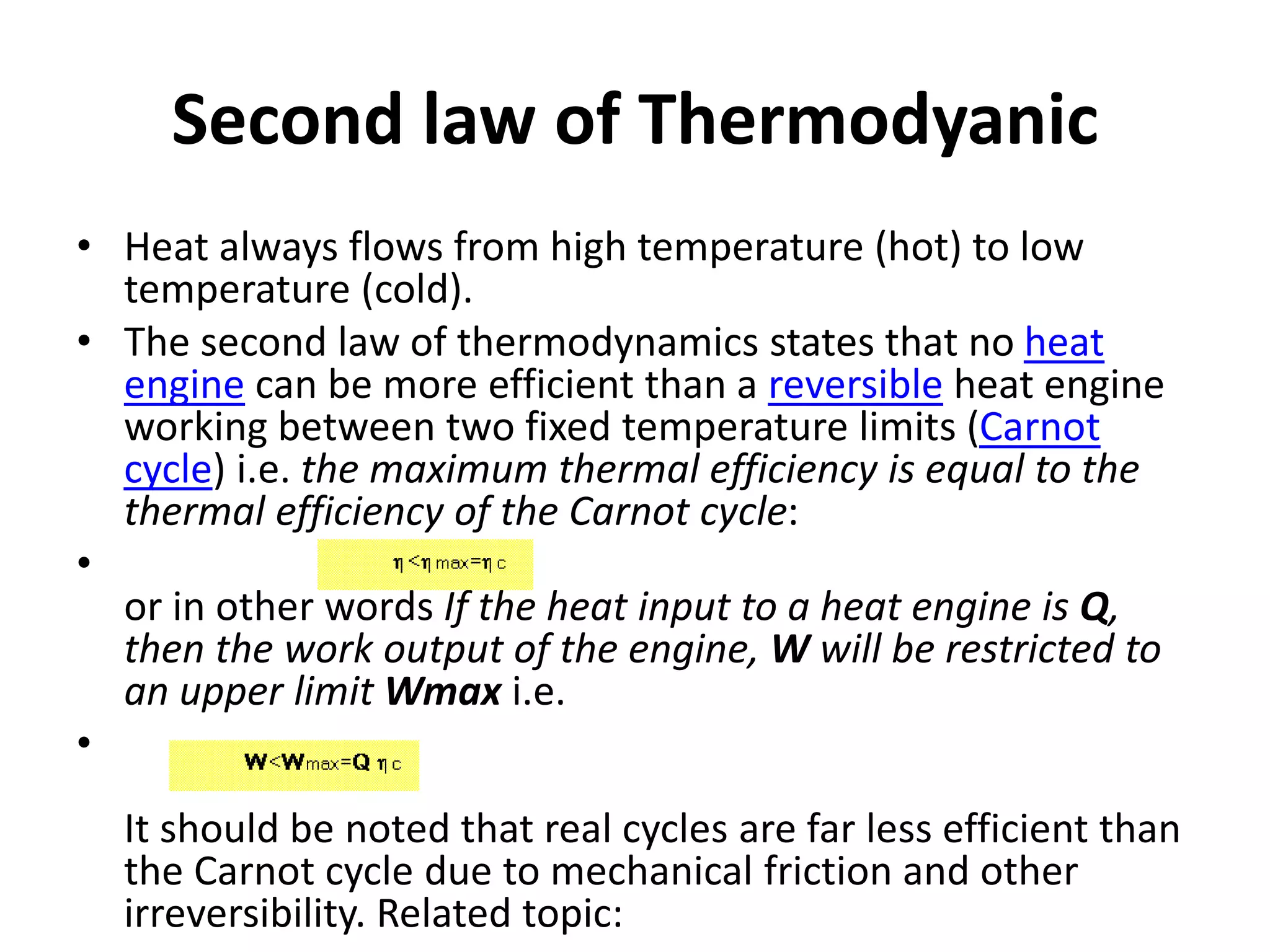
• The second law of thermodynamics states that no heat
engine can be more efficient than a reversible heat engine
working between two fixed temperature limits (Carnot
cycle) i.e. the maximum thermal efficiency is equal to the
thermal efficiency of the Carnot cycle:
•
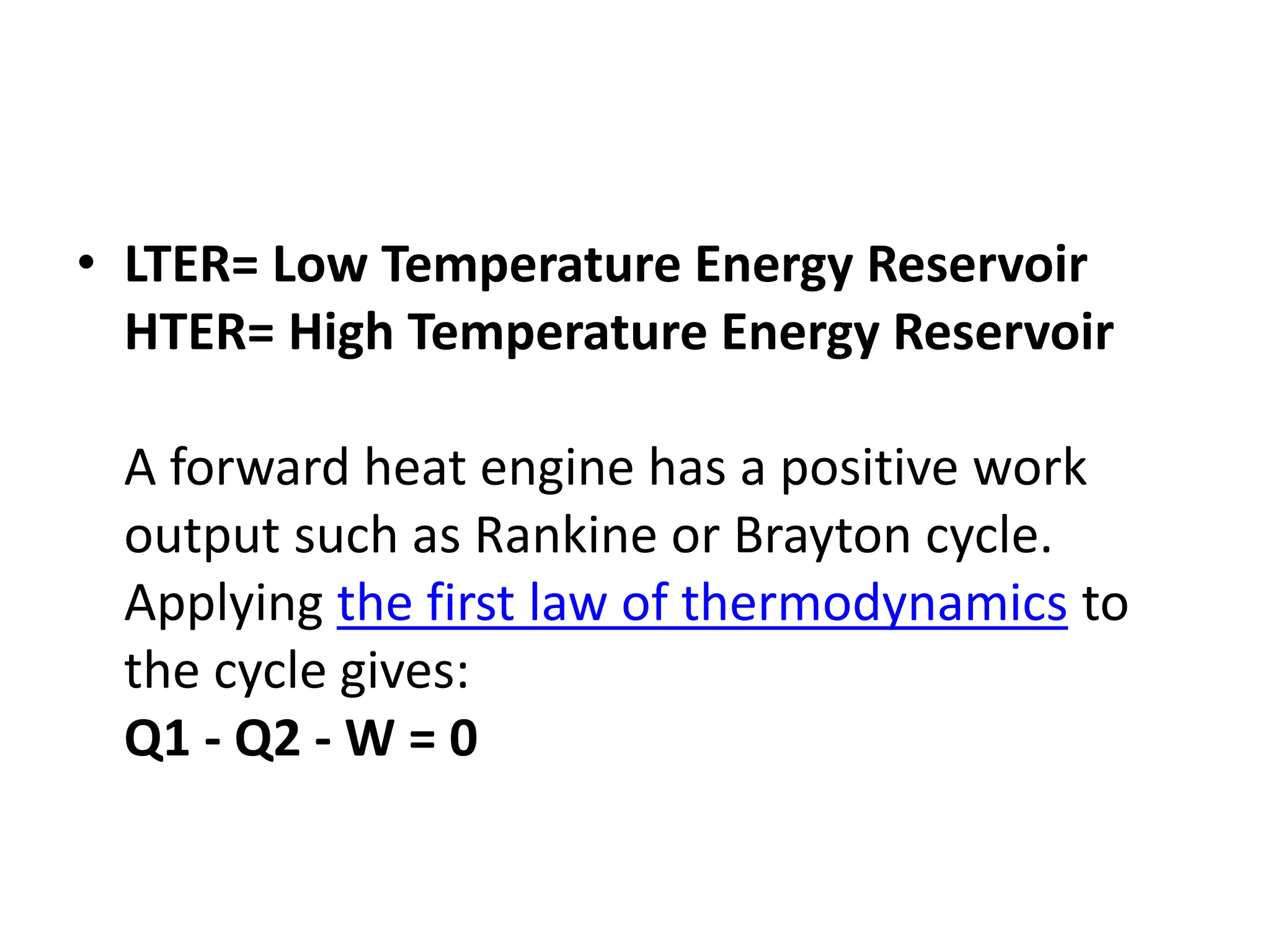
or in other words If the heat input to a heat engine is Q,
then the work output of the engine, W will be restricted to
an upper limit Wmax i.e.
•
It should be noted that real cycles are far less efficient than
the Carnot cycle due to mechanical friction and other
irreversibility. Related topic:
Heat engine
• Heat engine is defined as a device that
converts heat energy into mechanical energy
or more exactly a system which operates
continuously and only heat and work may pass
across its boundaries.
Forwad Heat Engine
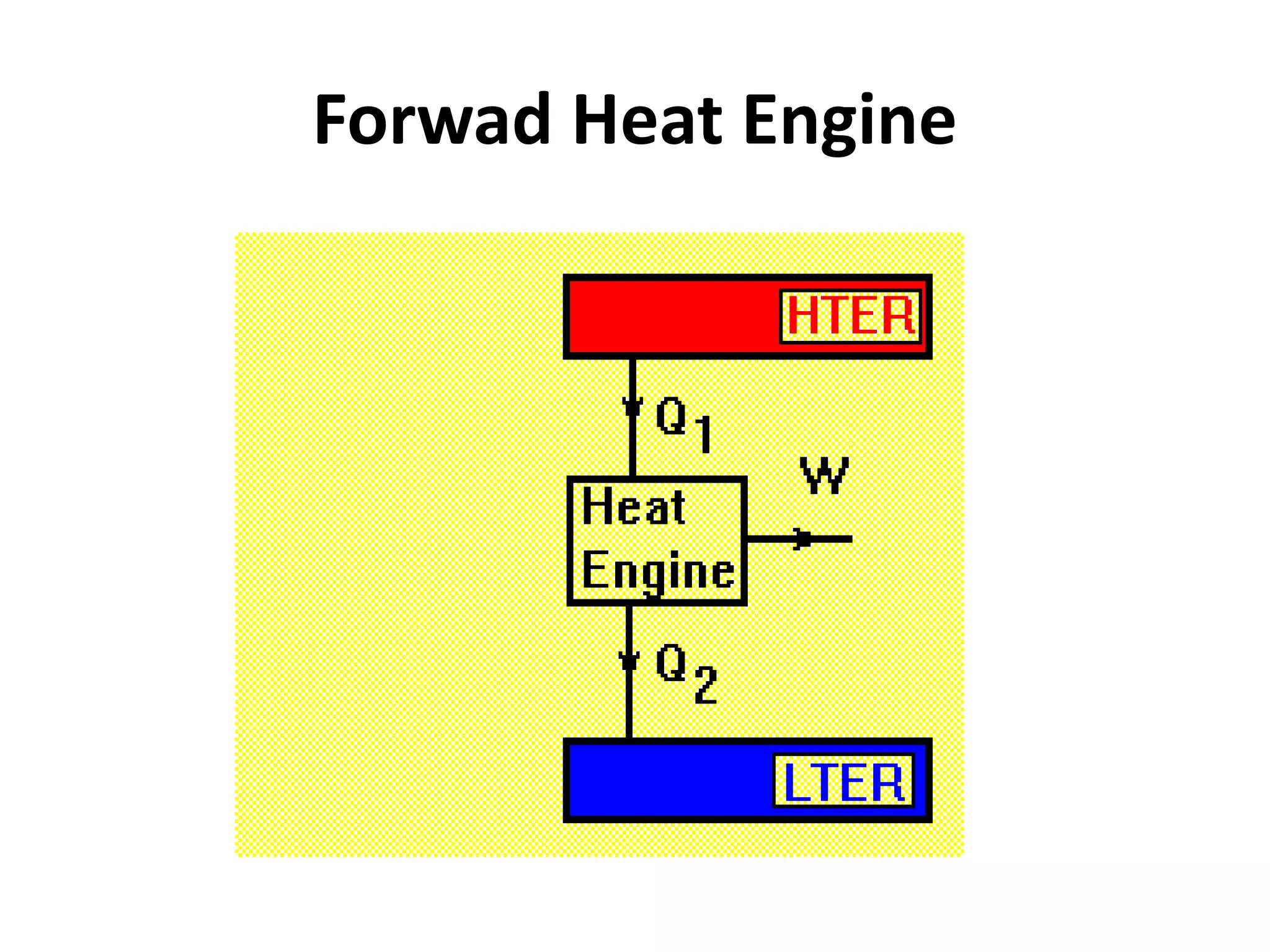
• LTER= Low Temperature Energy Reservoir
HTER= High Temperature Energy Reservoir
A forward heat engine has a positive work
output such as Rankine or Brayton cycle.
Applying the first law of thermodynamics to
the cycle gives:
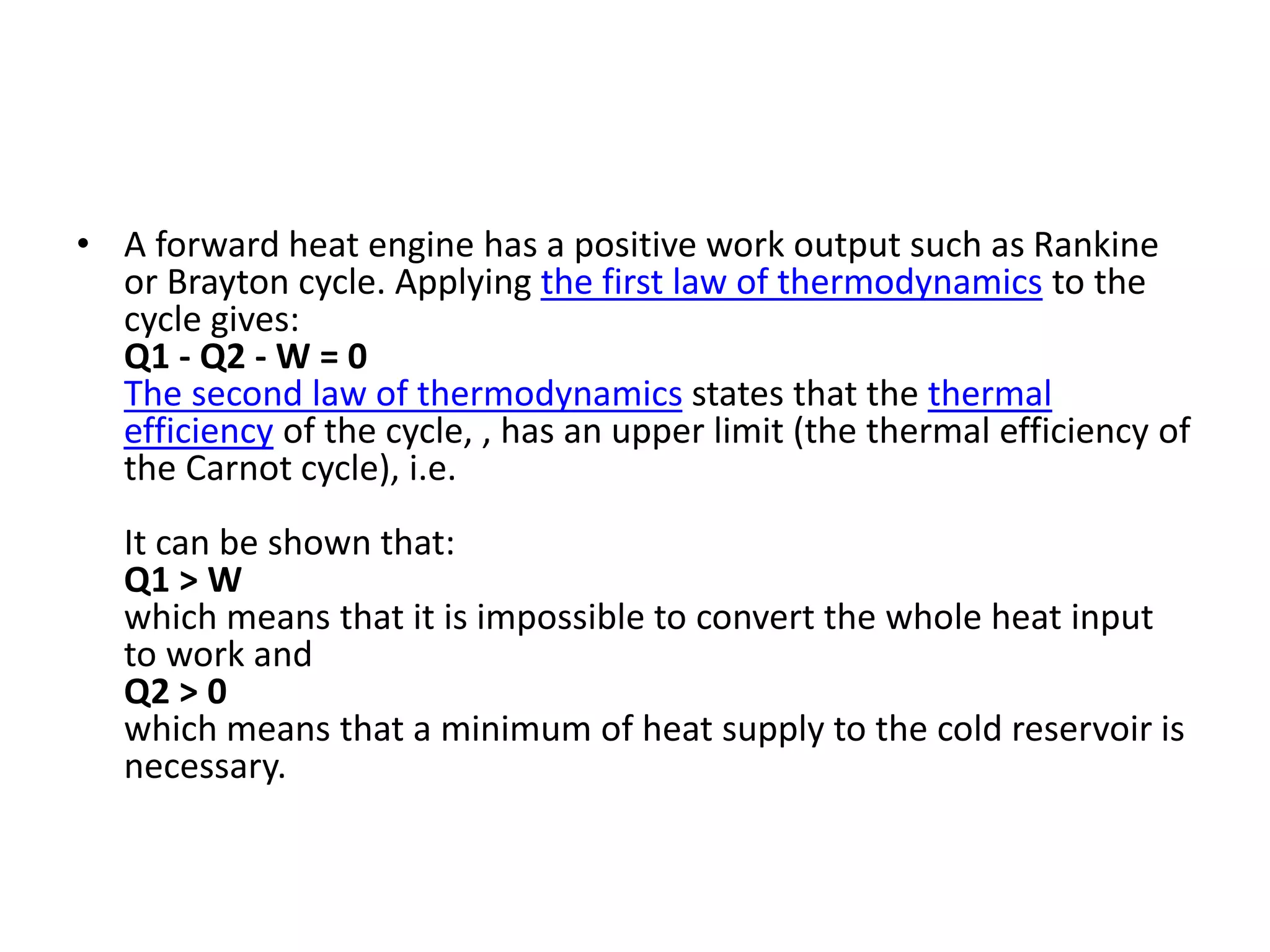
Q1 - Q2 - W = 0
• A forward heat engine has a positive work output such as Rankine
or Brayton cycle. Applying the first law of thermodynamics to the
cycle gives:
Q1 - Q2 - W = 0
The second law of thermodynamics states that the thermal
efficiency of the cycle, , has an upper limit (the thermal efficiency of
the Carnot cycle), i.e.
It can be shown that:
Q1 > W
which means that it is impossible to convert the whole heat input
to work and
Q2 > 0
which means that a minimum of heat supply to the cold reservoir is
necessary.
Reverse Heat Engine
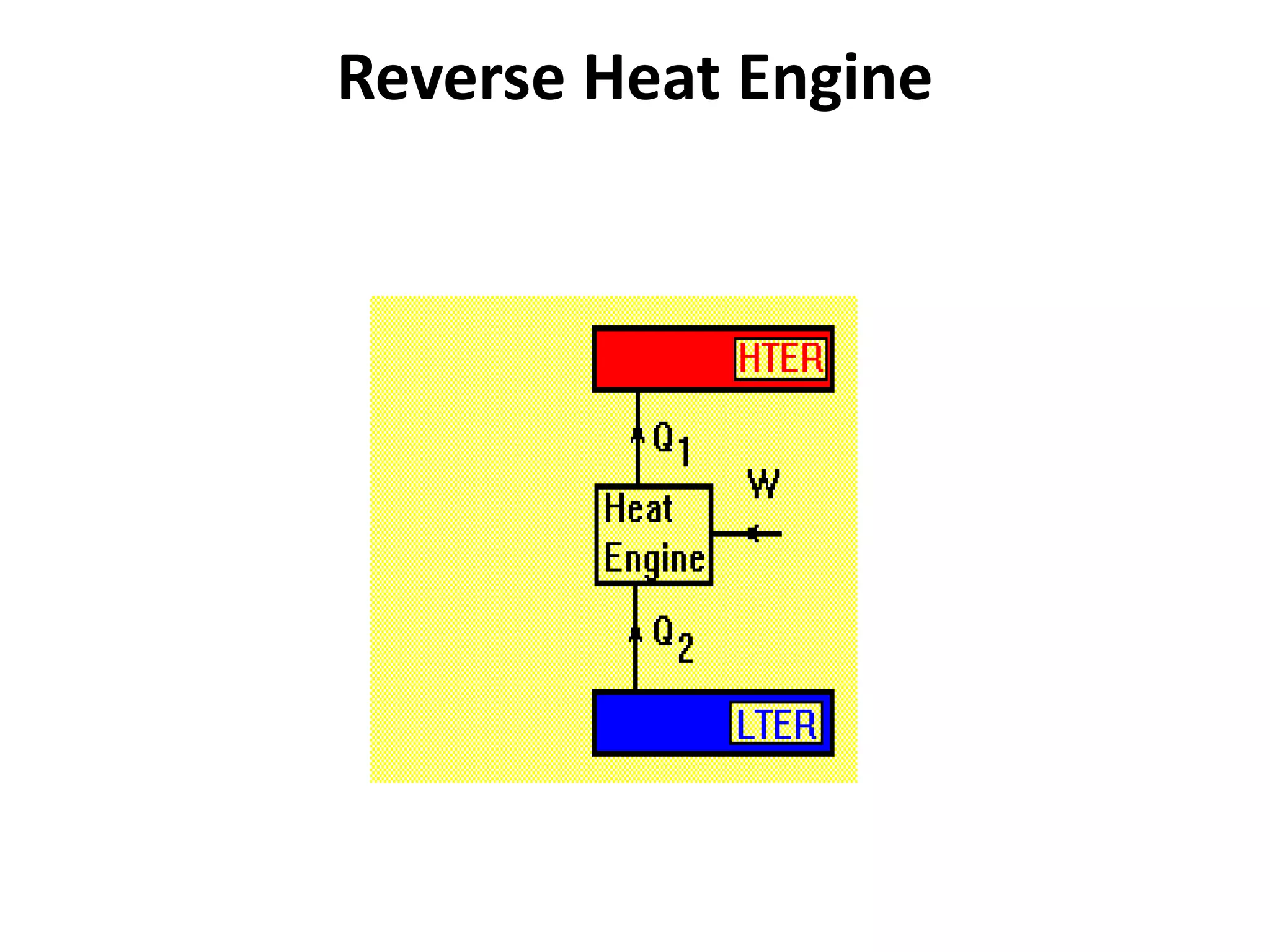
• LTER= Low Temperature Energy Reservoir
HTER= High Temperature Energy Reservoir
A reverse heat engine has a positive work input such as
heat pump and refrigerator. Applying the first law of
thermodynamics to the cycle gives:
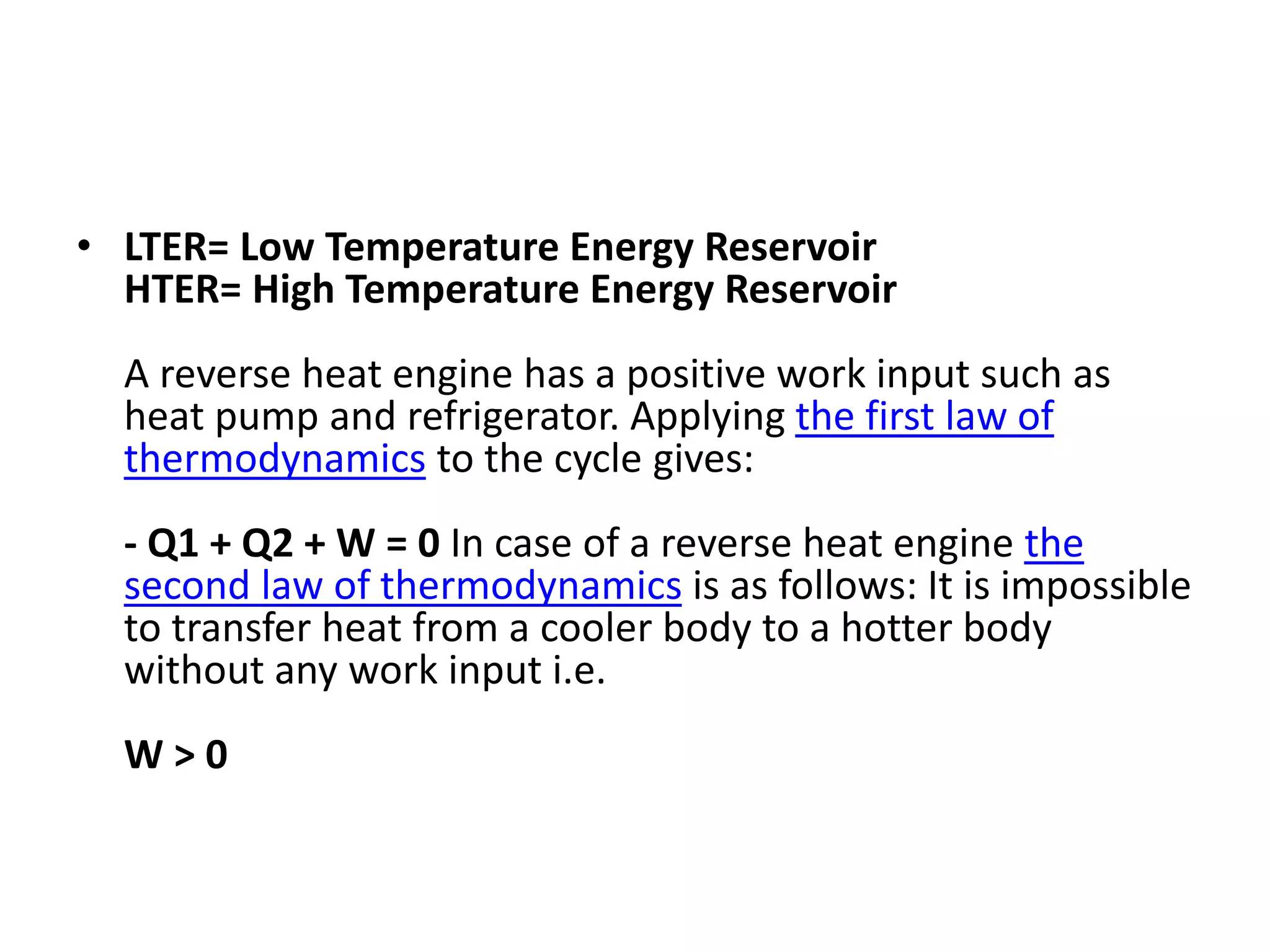
- Q1 + Q2 + W = 0 In case of a reverse heat engine the
second law of thermodynamics is as follows: It is impossible
to transfer heat from a cooler body to a hotter body
without any work input i.e.
W > 0
EARTH’S ENERGY FLOWS
• There is a continous flow of energy through the earth’s
atmosphere and surface. By far the greatest energy source is
the sun
• The other two sources,heat from earth’s interior a,d tidal
energy causes by gravitational forces of the earth-moon-sun
system , are most neglibible in comparison
Energy from Solar Radiation
• The rate at which the icoming solar radiation
intercepted at the edge of the earth’s
atmopshere is 1373Wm-2 with a probable
error of 1-2 %, this is known as the solar’s
constant defined as the energy received by a
unit surface perpendicular to the solar beam
at the earth’s mean distance from the sun.
Energy from the earth’s interior
• Heat flow by conduction through the earth’s
solid crust has been estimated to be
approximately 0.063 Wm-2 . Although there
are areas surrounding active volcanoes and
hot spring where the heat flow can be very
much greater than this value, these sources
are estimated to contribute at a rate of the
conduction rate.
Energy from the Tides
• Tidal energy has been estimated from studies
of the rates of change of the periods of
rotations of the earth and moon to be 3*1012
Watts
Introduction to power plant
• Power plant is the complex ,incuding
machinery, associated equipment and the
structure housing it, that is used in the
generation of power esp. Electrical power
• The equipment supplying power to a
particular machine or for a particular
operation or process.
Power house
• An electrical generating station or plant
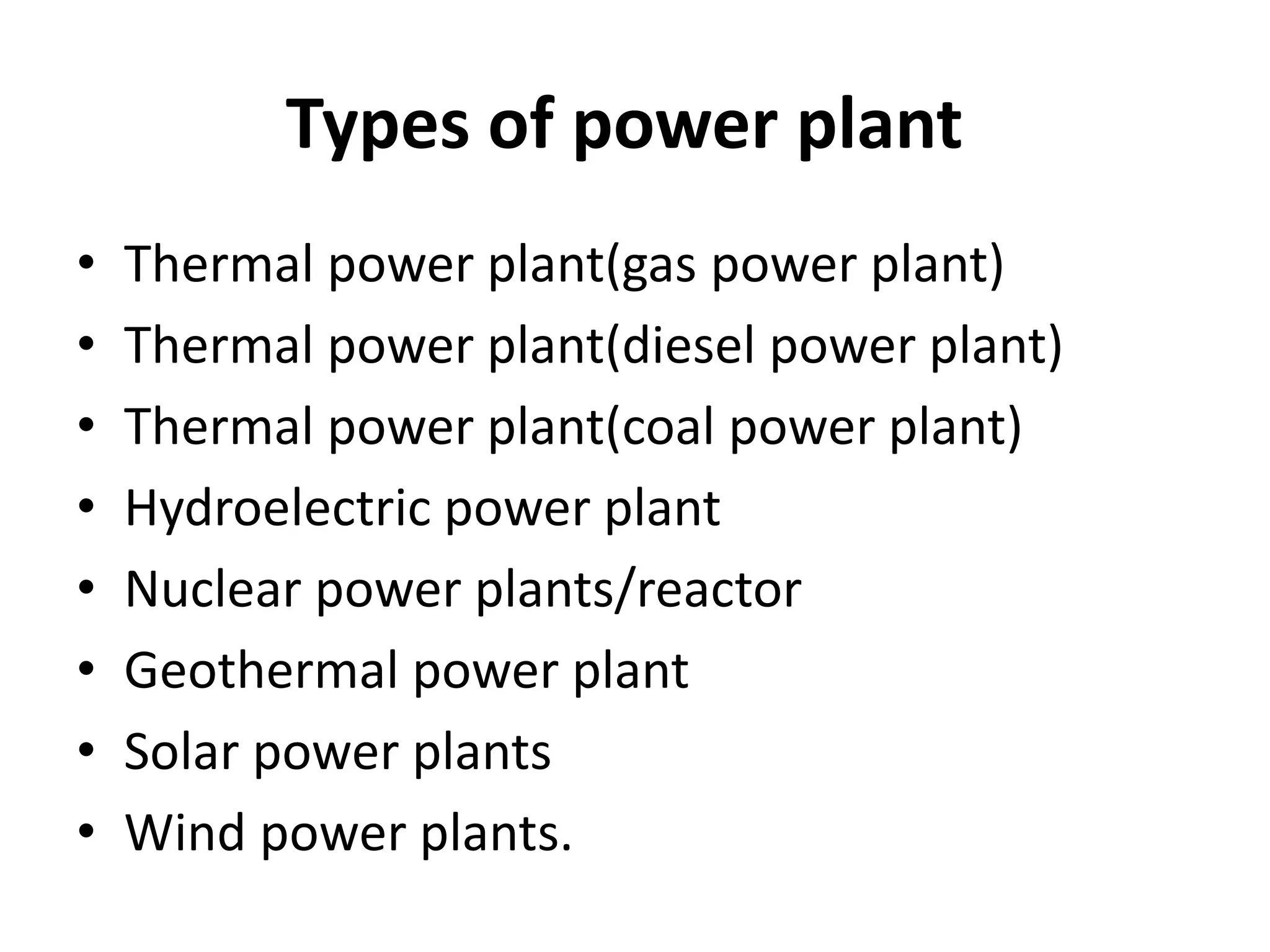
Types of power plant
• Thermal power plant(gas power plant)
• Thermal power plant(diesel power plant)
• Thermal power plant(coal power plant)
• Hydroelectric power plant
• Nuclear power plants/reactor
• Geothermal power plant
• Solar power plants
• Wind power plants.
THANKS FOR LISTENING
• END OF PRESENTATION

Lecture one power plant

  • 1.
    MBEYA UNIVERSITY OFSCIENCE AND TECHNOLOGY INTRODUCTION TO POWER PLANT
  • 2.
    INTRODUCTION TO POWERPLANT • CODE: MEB 8103 • Name: Power Plants • Number of Credits: 6 • Instructor: Emmanuel Mwangomo
  • 3.
    SUB ENABLING OUTCOME •Ability to determine energy generated in power plants • Ability to comprehend and explain the principles of power plants • Ability to make decisions on the suitability of power plant for a particular place • Ability to inspect and specify power production methods of facilities 3
  • 4.
    LEARNING CONTEXT • Themodule will be conducted through lectures and tutorials and visits to power plants providing the opportunity for the learner to gain first hand experience. 4
  • 5.
    LEARNING CONTEXT • STEAMPOWER PLANTS-Essential of steam power plant equipemnt, coal handling, fuel burning equipement, methods of fuel firing, pulverized coal, water walls draught, methods of burning fuel, oil, economizer and air preheater, super heater, feed water treatment, feed water heaters, types of steam condensers, cooling towers, steam separators, site selection, cost of steam power plant, useful life of components, plant layout, safety of boiler plant. 5
  • 6.
    LEARNING CONTEXT • HYDROPOWER PLANTS-hydrology, water power, essential features of hydro electric power plant, classification of hydro-electric power plants, draft tube, surge tanks, hydraulic turbines, turbine governing, site selection, comparison of hydro-electric power plants and steam power plants, tunnels, flumes, spillway and gates in dams, interior gate valves, average life of various components, hydraulic accumulators, calculation of available hydropower. 6
  • 7.
    LEARNING CONTEXT • NUCLEARPOWER PLANTS- nuclear energy, chain reaction, fertile material, unit of radioctivity , parts of nuclear reactor, classification of reactors, main components of nuclear power plants, advantages and disadvantages of nuclear power plants, site selection 7
  • 8.
    WORK • Refers toan activity involving a force and movement in the directon of the force. A force of 20 newtons pushing an object 5 meters in the direction of the force does 100 joules of work.
  • 9.
  • 10.
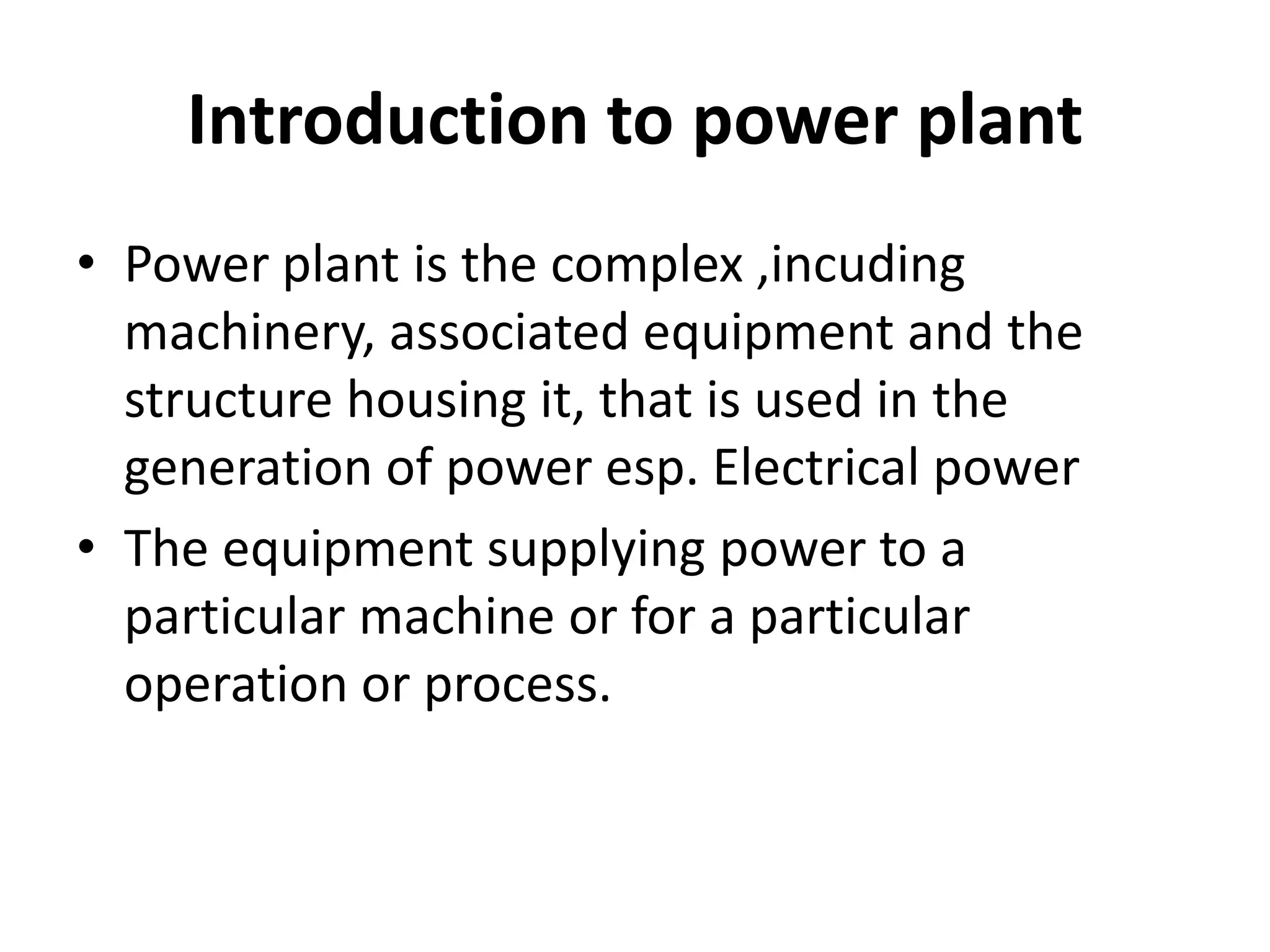
    Mathematical Work • Mathematically,work can be expressed by the following equation. • W = F *d*COSØ • where F is the force, d is the displacement, and the angle (theta) is defined as the angle between the force and the displacement vector. Perhaps the most difficult aspect of the above equation is the angle "theta." The angle is not just any 'ole angle, but rather a very specific angle. The angle measure is defined as the angle between the force and the displacement.
  • 11.
    Units of work •Whenever a new quantity is introduced in physics, the standard metric units associated with that quantity are discussed. In the case of work (and also energy), the standard metric unit is the Joule (abbreviated J). One Joule is equivalent to one Newton of force causing a displacement of one meter. In other words, • The Joule is the unit of work. • 1 Joule = 1 Newton * 1 meter • 1 J = 1 N * m
  • 12.
    ENERGY • is thecapacity for doing work. You must have energy to accomplish work - it is like the "currency" for performing work. To do 100 joules of work, you must expend 100 joules of energy.
  • 13.
  • 14.
    Types of Energy •There are two types of energy in many forms: • Kinetic Energy = Energy of Motion • Potential Energy = Stored Energy
  • 15.
    Forms of Energy •Solar Radiation -- Infrared Heat, Radio Waves, Gamma Rays, Microwaves, Ultraviolet Light • Atomic/Nuclear Energy -energy released in nuclear reactions. When a neutron splits an atom's nucleus into smaller pieces it is called fission. When two nuclei are joined together under millions of degrees of heat it is called fusion • Electrical Energy --The generation or use of electric power over a period of time expressed in kilowatt- hours (kWh), megawatt-hours (NM) or gigawatt-hours (GWh).
  • 16.
    Forms of Energy •Chemical Energy --Chemical energy is a form of potential energy related to the breaking and forming of chemical bonds. It is stored in food, fuels and batteries, and is released as other forms of energy during chemical reactions. • Mechanical Energy -- Energy of the moving parts of a machine. Also refers to movements in humans • Heat Energy -- a form of energy that is transferred by a difference in temperature
  • 17.
    POWER • is therate of doing work or the rate of using energy, which are numerically the same. If you do 100 joules of work in one second (using 100 joules of energy), the power is 100 watts.
  • 18.
  • 19.
    Calculating Work Energyand Power • WORK = W=Fd • Because energy is the capacity to do work , we measure energy and work in the same units (N*m or joules). • POWER (P) is the rate of energy generation (or absorption) over time:P = E/t • Power's SI unit of measurement is the Watt, representing the generation or absorption of energy at the rate of 1 Joule/sec. Power's unit of measurement in the English system is the horsepower, which is equivalent to 735.7 Watts.
  • 20.
    LAWS OF THERMODYNAMICS •The first law of thermodynamics relates the change in internal energy to the heat absorbed and the work done on a substance. It is essentially a statement of conservation of energy. • Q is positive if heat is absorbed and is negative if heat is lost by the system. • In an isolated system, Q = 0 and W = 0. Thus, U = 0 and the internal energy remains constant. • The internal energy, U, depends on the state of the system. Thus, if a system goes through a cycle and returns to its original state, then U = 0 and Q = -W. W Q U U U i f     
  • 21.
    Conservation of Energy •The principle of the conservation of energy states that energy can neither be created nor destroyed. If a system undergoes a process by heat and work transfer, then the net heat supplied, Q, plus the net work input, W, is equal to the change of intrinsic energy of the working fluid, i.e. • where U1 and U2 are intrinsic energy of the system at initial and final states, respectively. The special case of the equation applied to a steady-flow system is known as steady-flow energy equation.
  • 22.

    • Applying thisgeneral principle to a thermodynamic cycle, when the system undergoes a complete cycle, i.e. U1 = U2, results in: • where: Q= The algebraic sum of the heat supplied to (+) or rejected from (-) the system. W= The algebraic sum of the work done by surroundings on the system (+) or by the system on surroundings (-). Applying the rule to the power plant shown in figure below,
  • 24.
    • gives: Q =Qin - Qout W = Win - Wout Qin + Win - Qout - Wout = 0 where, Qin = Heat supplied to the system through boiler, Win = Feed-pump work, Qout = Heat rejected from the system by condenser, Wout = Turbine work.
  • 25.
    Second law ofThermodyanic • Heat always flows from high temperature (hot) to low temperature (cold). • The second law of thermodynamics states that no heat engine can be more efficient than a reversible heat engine working between two fixed temperature limits (Carnot cycle) i.e. the maximum thermal efficiency is equal to the thermal efficiency of the Carnot cycle: • or in other words If the heat input to a heat engine is Q, then the work output of the engine, W will be restricted to an upper limit Wmax i.e. • It should be noted that real cycles are far less efficient than the Carnot cycle due to mechanical friction and other irreversibility. Related topic:
  • 26.
    Heat engine • Heatengine is defined as a device that converts heat energy into mechanical energy or more exactly a system which operates continuously and only heat and work may pass across its boundaries.
  • 27.
  • 28.
    • LTER= LowTemperature Energy Reservoir HTER= High Temperature Energy Reservoir A forward heat engine has a positive work output such as Rankine or Brayton cycle. Applying the first law of thermodynamics to the cycle gives: Q1 - Q2 - W = 0
  • 29.
    • A forwardheat engine has a positive work output such as Rankine or Brayton cycle. Applying the first law of thermodynamics to the cycle gives: Q1 - Q2 - W = 0 The second law of thermodynamics states that the thermal efficiency of the cycle, , has an upper limit (the thermal efficiency of the Carnot cycle), i.e. It can be shown that: Q1 > W which means that it is impossible to convert the whole heat input to work and Q2 > 0 which means that a minimum of heat supply to the cold reservoir is necessary.
  • 30.
  • 31.
    • LTER= LowTemperature Energy Reservoir HTER= High Temperature Energy Reservoir A reverse heat engine has a positive work input such as heat pump and refrigerator. Applying the first law of thermodynamics to the cycle gives: - Q1 + Q2 + W = 0 In case of a reverse heat engine the second law of thermodynamics is as follows: It is impossible to transfer heat from a cooler body to a hotter body without any work input i.e. W > 0
  • 32.
    EARTH’S ENERGY FLOWS •There is a continous flow of energy through the earth’s atmosphere and surface. By far the greatest energy source is the sun • The other two sources,heat from earth’s interior a,d tidal energy causes by gravitational forces of the earth-moon-sun system , are most neglibible in comparison
  • 33.
    Energy from SolarRadiation • The rate at which the icoming solar radiation intercepted at the edge of the earth’s atmopshere is 1373Wm-2 with a probable error of 1-2 %, this is known as the solar’s constant defined as the energy received by a unit surface perpendicular to the solar beam at the earth’s mean distance from the sun.
  • 34.
    Energy from theearth’s interior • Heat flow by conduction through the earth’s solid crust has been estimated to be approximately 0.063 Wm-2 . Although there are areas surrounding active volcanoes and hot spring where the heat flow can be very much greater than this value, these sources are estimated to contribute at a rate of the conduction rate.
  • 35.
    Energy from theTides • Tidal energy has been estimated from studies of the rates of change of the periods of rotations of the earth and moon to be 3*1012 Watts
  • 36.
    Introduction to powerplant • Power plant is the complex ,incuding machinery, associated equipment and the structure housing it, that is used in the generation of power esp. Electrical power • The equipment supplying power to a particular machine or for a particular operation or process.
  • 37.
    Power house • Anelectrical generating station or plant
  • 38.
    Types of powerplant • Thermal power plant(gas power plant) • Thermal power plant(diesel power plant) • Thermal power plant(coal power plant) • Hydroelectric power plant • Nuclear power plants/reactor • Geothermal power plant • Solar power plants • Wind power plants.
  • 39.
    THANKS FOR LISTENING •END OF PRESENTATION