Image Enhancement
using
Artificial Neural Network
and
Fuzzy Logic Presented by,
Deona Noble
S7 ECE A
Roll No:22
VJCET
Contents
 Introduction
 Existing techniques
 Fuzzy logic
 Fuzzy logic in Image Enhancement
 Artificial Neural network
 Proposed model
 Neuro-fuzzy system
 Parameters for comparison
 Experimental results
 Conclusion
 References
22
Introduction
 Image - a picture stored digitally
 Image enhancement –
 Technique to improve quality
 Image enhancement modifies attributes of image
 Make image more suitable for specific observation
 Algorithms are used to emphasise or smoothen image
features
 Enhancement techniques are application specific.
3
Image Enhancement
4
Image 1 Image 2
Source:mathworks.com/discovery/image-enhancement.html
Why Image Enhancement ?
₪ Unnecessary noises
₪ Defects caused by image acquisition
 Illumination : non-uniform
 Lens : blurring object or background
 Motion : blurring
₪ Distortion : geometric distortion by lens
₪ Contrast enhancement
₪ Intensity, hue, and saturation transformations
₪ Density slicing
₪ Edge enhancement
5
Old Techniques
 Histogram equalization
€ Spread out grey levels in the image to evenly distribute them
across the image
 Often produces unrealistic and unlikely effects in photographs
 Arithmetic mean filters
€ Replaces each pixel by the average of all the values in the
neighbourhood
€ The size of the neighbourhood controls the amount of filtering
 Blurring effect increases with the increase in the size of mask
6
Previous Techniques
∂ Median filter
 Replaces the value of a pixel by the median of the
grey levels in the neighbourhood of that pixel
∂ Un sharp Masking & High Boost filtering
 Technique used for edge enhancement
 Also known as a high frequency emphasis filter
 The input image f(m,n) is multiplied by an amplification
 factor ‘A’ before subtracting the low pass image.
7
Fuzzy Logic
 Superset of conventional logic
 Extended to handle the concept of partial truth
 Is a way of getting computers to make human like decisions
∞ Based on fuzzy rules and fuzzy sets to model the world and make
decisions
∞ Has simpler ways to arrive at a definite conclusion based
upon vague, imprecise information
8
Traditional(Crisp) Logic
Vs
Fuzzy Logic
 A rose is either Red or Not Red
 What about this rose ?
9
Fuzzy Sets and Linguistic
Variables
₪ Each element in the fuzzy set is characterised by a Membership
function called ‘grade of membership’ fA(x)
₪ Value of membership function ranges rom 0 to 1
₪ Nearer the value of fA(x) to unity, the higher the grade of
membership of x in A
₪ Linguistic Variables
 variable whose values are words or sentences in a natural or
artificial language.
10
Fuzzy sets and Linguistic
variables
11
Source:http://wing.comp.nus.edu.sg/pris/FuzzyLogic
Fuzzy “ If -Then ” Rule
 A Fuzzy If –Then rule assumes the form :
“If x is A then y is B”
where A and B are linguistic values defined by fuzzy
sets on universe of discourse x and y,
 “x is A” is called the antecedent or precise
 “y is B” is called the consequence or conclusion.
 “IF the pixel is dark AND its neighbourhood is also dark AND
homogeneous THEN it belongs to the dark background ”
12
Fuzzy Logic
In Image Enhancement Technique
 Fuzzy image processing consists of three main steps:
o Image fuzzification
o Membership modification
o Image defuzzification
13Source : Reference 4
Image Fuzzification
 Gray level intensities are transformed to fuzzy plane
whose value range between 0 and 1
 Bright Membership Degree
BMD = intensity/255
BMD ={0,0.0039,…….,1}
 Dark Membership Degree
DMD = 1- (intensity/255)
DMD={1,0.9960,…………,0}
14
Source : reference 4
Fuzzy Membership Modification
 Modify the membership functions
 Eg: Contrast Enhancement.
 Algorithm for modifying Bright Membership degree function using
square operation:
Source : reference 4 15
Image Defuzzification
 Image defuzzification is the inverse of fuzzification
 Algorithm maps the fuzzy plane back to gray
level intensities
 Gray level intensity = BMD*255
 Gray level intensity = (1-DMD)*255
16
Artificial Neural Network
∞ Is a computational model that tries to simulate the functional
aspects of biological neural network
∞ Has human like learning ability and acquires knowledge
∞ The acquired knowledge is then stored in the internal parameters
called as weights
∞ Neural network is nonlinear statistical data modelling tools
17
Application of ANN
 Used to find patterns in data and also to model complex
relationships between inputs and outputs
Source : reference 2 18
Proposed Method
Source : reference 2 19
Neuro-Fuzzy System
 Fuzzy system which works on the algorithm derived from
neural network theory
 The neural networks operates on the information and causes
modifications in the underlying fuzzy system
 Fuzzy rules and sets are adjusted using neural network
techniques in an iterative manner
 Neural networks introduce its computational characteristics
of learning in the fuzzy systems
 Disadvantages of the fuzzy systems are compensated by the
capacities of the neural networks
20
Types of Neuro-Fuzzy Systems
 Cooperative Neuro-Fuzzy System:
 Neural networks mechanisms of learning determine some sub-
blocks of the fuzzy system.
 After the fuzzy sub-blocks are calculated the neural network
learning methods are taken away.
 Concurrent Neuro-Fuzzy model:
 Neural network and fuzzy system work simultaneously to
determine the required parameters.
 Hybrid Neuro-Fuzzy System:
 Fuzzy system uses a learning algorithm inspired by the neural
networks theory to determine its parameters through the
pattern processing.
21
ANFIS ARCHITECTURE
∞ The Adaptive Network based Fuzzy Inference
System model integrates the ANN and FIS tools into a
’compound’ . It has six layers :
∞ First layer: Transmit the external input signal to the next layer.
∞ Second layer: Determines the degree to which this signal
belongs to the neuron’s fuzzy set.
∞ Third layer : Computes the truth value of the rule.
∞ Fourth layer: Represents the contribution of a given rule to the
final result
∞ The Fifth layer : A defuzzification is performed in this stage.
∞ The sixth layer : Calculates the sum of outputs of all
defuzzification neurons in the fifth layer and produces the overall
ANFIS output
22
ANFIS model with two inputs
and one output
23
Source : reference 3
Training ANFIS Model
 Commonly used activation function is the bell-shaped function, described as :
Source : reference 3
where r, s and t are parameters that respectively control the slope, centre and
width of the bell-shaped function.
 Back propagation algorithm is the most used training algorithm
24
Source : reference 3
Comparison Parameters
₪Mean Squared Error ( MSE )
₪Root Mean Square Error ( RMSE )
₪Signal to Noise Ratio ( SNR )
₪Peak Signal to Noise Ratio ( PSNR )
25
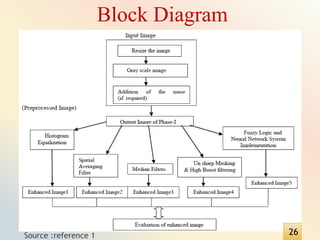
Block Diagram
Source :reference 1 26
SNR & PSNR Values
27
SNR Values for different Image enhancement techniques
PSNR Values for different Image enhancement techniques
Source: reference 1
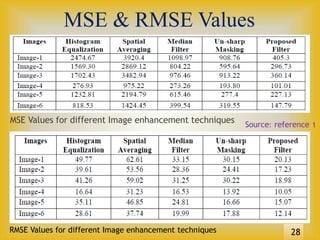
MSE & RMSE Values
MSE Values for different Image enhancement techniques
28RMSE Values for different Image enhancement techniques
Source: reference 1
Experimental Results
29Source: reference 1
Conclusion
 The new approach for image enhancement using Artificial
neural network and fuzzy logic is discussed
 The neural networks is used for identification of noise using
the statistical parameters whereas fuzzy logic is used for
enhancement purpose.
 Based on the performance parameter, it is observed that the
performance is improved using proposed method
30
References
1. Gupta, Manu, Ravinder Singh Mann, and Gagangeet Singh Aujla. "Fuzzy
Logic and Artificial Neural Network based Hybrid Technique for Image
Enhancement" International journal of Science Technology &
Management,March 2015
2. S. Narnaware and R. Khedgaonkar, "Image enhancement using artificial
neural network and fuzzy logic," Innovations in Information, Embedded and
Communication Systems (ICIIECS), 2015 International Conference on,
Coimbatore, 2015, pp. 1-5.
doi: 10.1109/ICIIECS.2015.7193203
3. Applying Fuzzy Logic to Image Processing Applications : A Review by Sushil
Narang, Research Scholar, Punjab University, Chandigarh
4. Membership Function modification for Image Enhancement using fuzzy
logic, International Journal of Emerging Trends & Technology in Computer
Science (IJETTCS), Volume 2, Issue 2, March – April 2013
31
deona

deona

  • 1.
    Image Enhancement using Artificial NeuralNetwork and Fuzzy Logic Presented by, Deona Noble S7 ECE A Roll No:22 VJCET
  • 2.
    Contents  Introduction  Existingtechniques  Fuzzy logic  Fuzzy logic in Image Enhancement  Artificial Neural network  Proposed model  Neuro-fuzzy system  Parameters for comparison  Experimental results  Conclusion  References 22
  • 3.
    Introduction  Image -a picture stored digitally  Image enhancement –  Technique to improve quality  Image enhancement modifies attributes of image  Make image more suitable for specific observation  Algorithms are used to emphasise or smoothen image features  Enhancement techniques are application specific. 3
  • 4.
    Image Enhancement 4 Image 1Image 2 Source:mathworks.com/discovery/image-enhancement.html
  • 5.
    Why Image Enhancement? ₪ Unnecessary noises ₪ Defects caused by image acquisition  Illumination : non-uniform  Lens : blurring object or background  Motion : blurring ₪ Distortion : geometric distortion by lens ₪ Contrast enhancement ₪ Intensity, hue, and saturation transformations ₪ Density slicing ₪ Edge enhancement 5
  • 6.
    Old Techniques  Histogramequalization € Spread out grey levels in the image to evenly distribute them across the image  Often produces unrealistic and unlikely effects in photographs  Arithmetic mean filters € Replaces each pixel by the average of all the values in the neighbourhood € The size of the neighbourhood controls the amount of filtering  Blurring effect increases with the increase in the size of mask 6
  • 7.
    Previous Techniques ∂ Medianfilter  Replaces the value of a pixel by the median of the grey levels in the neighbourhood of that pixel ∂ Un sharp Masking & High Boost filtering  Technique used for edge enhancement  Also known as a high frequency emphasis filter  The input image f(m,n) is multiplied by an amplification  factor ‘A’ before subtracting the low pass image. 7
  • 8.
    Fuzzy Logic  Supersetof conventional logic  Extended to handle the concept of partial truth  Is a way of getting computers to make human like decisions ∞ Based on fuzzy rules and fuzzy sets to model the world and make decisions ∞ Has simpler ways to arrive at a definite conclusion based upon vague, imprecise information 8
  • 9.
    Traditional(Crisp) Logic Vs Fuzzy Logic A rose is either Red or Not Red  What about this rose ? 9
  • 10.
    Fuzzy Sets andLinguistic Variables ₪ Each element in the fuzzy set is characterised by a Membership function called ‘grade of membership’ fA(x) ₪ Value of membership function ranges rom 0 to 1 ₪ Nearer the value of fA(x) to unity, the higher the grade of membership of x in A ₪ Linguistic Variables  variable whose values are words or sentences in a natural or artificial language. 10
  • 11.
    Fuzzy sets andLinguistic variables 11 Source:http://wing.comp.nus.edu.sg/pris/FuzzyLogic
  • 12.
    Fuzzy “ If-Then ” Rule  A Fuzzy If –Then rule assumes the form : “If x is A then y is B” where A and B are linguistic values defined by fuzzy sets on universe of discourse x and y,  “x is A” is called the antecedent or precise  “y is B” is called the consequence or conclusion.  “IF the pixel is dark AND its neighbourhood is also dark AND homogeneous THEN it belongs to the dark background ” 12
  • 13.
    Fuzzy Logic In ImageEnhancement Technique  Fuzzy image processing consists of three main steps: o Image fuzzification o Membership modification o Image defuzzification 13Source : Reference 4
  • 14.
    Image Fuzzification  Graylevel intensities are transformed to fuzzy plane whose value range between 0 and 1  Bright Membership Degree BMD = intensity/255 BMD ={0,0.0039,…….,1}  Dark Membership Degree DMD = 1- (intensity/255) DMD={1,0.9960,…………,0} 14 Source : reference 4
  • 15.
    Fuzzy Membership Modification Modify the membership functions  Eg: Contrast Enhancement.  Algorithm for modifying Bright Membership degree function using square operation: Source : reference 4 15
  • 16.
    Image Defuzzification  Imagedefuzzification is the inverse of fuzzification  Algorithm maps the fuzzy plane back to gray level intensities  Gray level intensity = BMD*255  Gray level intensity = (1-DMD)*255 16
  • 17.
    Artificial Neural Network ∞Is a computational model that tries to simulate the functional aspects of biological neural network ∞ Has human like learning ability and acquires knowledge ∞ The acquired knowledge is then stored in the internal parameters called as weights ∞ Neural network is nonlinear statistical data modelling tools 17
  • 18.
    Application of ANN Used to find patterns in data and also to model complex relationships between inputs and outputs Source : reference 2 18
  • 19.
  • 20.
    Neuro-Fuzzy System  Fuzzysystem which works on the algorithm derived from neural network theory  The neural networks operates on the information and causes modifications in the underlying fuzzy system  Fuzzy rules and sets are adjusted using neural network techniques in an iterative manner  Neural networks introduce its computational characteristics of learning in the fuzzy systems  Disadvantages of the fuzzy systems are compensated by the capacities of the neural networks 20
  • 21.
    Types of Neuro-FuzzySystems  Cooperative Neuro-Fuzzy System:  Neural networks mechanisms of learning determine some sub- blocks of the fuzzy system.  After the fuzzy sub-blocks are calculated the neural network learning methods are taken away.  Concurrent Neuro-Fuzzy model:  Neural network and fuzzy system work simultaneously to determine the required parameters.  Hybrid Neuro-Fuzzy System:  Fuzzy system uses a learning algorithm inspired by the neural networks theory to determine its parameters through the pattern processing. 21
  • 22.
    ANFIS ARCHITECTURE ∞ TheAdaptive Network based Fuzzy Inference System model integrates the ANN and FIS tools into a ’compound’ . It has six layers : ∞ First layer: Transmit the external input signal to the next layer. ∞ Second layer: Determines the degree to which this signal belongs to the neuron’s fuzzy set. ∞ Third layer : Computes the truth value of the rule. ∞ Fourth layer: Represents the contribution of a given rule to the final result ∞ The Fifth layer : A defuzzification is performed in this stage. ∞ The sixth layer : Calculates the sum of outputs of all defuzzification neurons in the fifth layer and produces the overall ANFIS output 22
  • 23.
    ANFIS model withtwo inputs and one output 23 Source : reference 3
  • 24.
    Training ANFIS Model Commonly used activation function is the bell-shaped function, described as : Source : reference 3 where r, s and t are parameters that respectively control the slope, centre and width of the bell-shaped function.  Back propagation algorithm is the most used training algorithm 24 Source : reference 3
  • 25.
    Comparison Parameters ₪Mean SquaredError ( MSE ) ₪Root Mean Square Error ( RMSE ) ₪Signal to Noise Ratio ( SNR ) ₪Peak Signal to Noise Ratio ( PSNR ) 25
  • 26.
  • 27.
    SNR & PSNRValues 27 SNR Values for different Image enhancement techniques PSNR Values for different Image enhancement techniques Source: reference 1
  • 28.
    MSE & RMSEValues MSE Values for different Image enhancement techniques 28RMSE Values for different Image enhancement techniques Source: reference 1
  • 29.
  • 30.
    Conclusion  The newapproach for image enhancement using Artificial neural network and fuzzy logic is discussed  The neural networks is used for identification of noise using the statistical parameters whereas fuzzy logic is used for enhancement purpose.  Based on the performance parameter, it is observed that the performance is improved using proposed method 30
  • 31.
    References 1. Gupta, Manu,Ravinder Singh Mann, and Gagangeet Singh Aujla. "Fuzzy Logic and Artificial Neural Network based Hybrid Technique for Image Enhancement" International journal of Science Technology & Management,March 2015 2. S. Narnaware and R. Khedgaonkar, "Image enhancement using artificial neural network and fuzzy logic," Innovations in Information, Embedded and Communication Systems (ICIIECS), 2015 International Conference on, Coimbatore, 2015, pp. 1-5. doi: 10.1109/ICIIECS.2015.7193203 3. Applying Fuzzy Logic to Image Processing Applications : A Review by Sushil Narang, Research Scholar, Punjab University, Chandigarh 4. Membership Function modification for Image Enhancement using fuzzy logic, International Journal of Emerging Trends & Technology in Computer Science (IJETTCS), Volume 2, Issue 2, March – April 2013 31