EE-646
Lecture-10
Fuzzy Knowledge Based Controller
(FKBC)
or
Fuzzy Logic Controller (FLC)
Introduction
• In conventional control, the amount of control is
determined in relation to a number of data inputs
using a set of equations to express the entire control
process
• Fuzzy logic control (FLC) has been suggested as a
promising alternative approach for control system
design, especially for those systems that are too
complex to analyze by conventional techniques
• The rationale behind FLC is that an experienced
human operator can competently control a process
without the knowledge of its underlying dynamics
(transfer function).
16-Oct-12 2EE-646, Lec-10
Contd...
• Expressing human experience in the form of a
mathematical formula is a very difficult task, if not an
impossible one. Fuzzy logic provides a simple tool to
interpret this experience into reality.
• The effective control strategies that the human
operator learns through his experience can often be
expressed as a set of condition-action rules (called
fuzzy rules) which describe conditions about the
process state using linguistic terms (i.e., fuzzy sets
such as low, medium, high, slightly positive) &
recommend control actions using linguistic terms such
as increase slightly or decrease moderately
16-Oct-12 3EE-646, Lec-10
Contd...
• An example of such a rule is as follows :
IF error is negative small and (change-of-error is
positive big or positive medium) THEN decrease the
steam flow slightly.
• Since the first successful application of fuzzy logic to
control (Mamdani, 1974), FLCs have been successfully
applied to a number of applications like heat
exchangers, activated sludge processes, cement kiln
operation, turning processes, water purification
processes, and power systems operation
• Japanese products have FLCs in washing machines,
vacuum cleaners, ACs, and camcorders
16-Oct-12 4EE-646, Lec-10
FLC Benefits
1. Developing a fuzzy logic controller is cheaper
than developing a model based or other
controller with comparable performance
2. FLCs are more robust than PID controllers
because they can cover a much wider range of
operating conditions than PID controllers
3. FLCs are customizable, because it is easier to
understand and modify their rules, which not
only mimic a human operator's strategies, but
also are expressed in linguistic terms used in
natural language.
16-Oct-12 EE-646, Lec-10 5
Structure of FKBC
• FLCs may have different structures depending upon
the type of application.
• Despite the variety of possible fuzzy controller
structures, the basic form of all common types of
controllers consists of following modules:
• Input fuzzification (Normalization & conversion of
crisp values to fuzzy values)
• Fuzzy rule base (Knowledge base)
• Inference engine (Implication)
• Output defuzzification (Denormalization & fuzzy-to-
crisp conversion)
16-Oct-12 EE-646, Lec-10 6
Structure... Contd
16-Oct-12 EE-646, Lec-10 7
Normalization
Fuzzification Inference Engine Defuzzification
Denormalization
Data Base
Rule Base
Crisp Process-State Values Crisp O/P control Values
Fuzzification Module
• Normalization: It performs a scale transformation
which maps the physical values of the current
process state variables into a normalized UoD.
Not needed when non-normalized domain in
used
• Fuzzification: It converts a point-wise (crisp),
current value of a process state variable into a
fuzzy set. This is done in order to make it
compatible with the fuzzy set representation of
the process s. v. in the rule antecedent
16-Oct-12 EE-646, Lec-10 8
Fuzzification Module...contd
• The design parameter of the fuzzification
module is the choice of fuzzification strategy
which is done according to type of inference
engine or rule firing in a particular FKBC.
• Fuzzification may be compositional based
inference or individual rule based inference
16-Oct-12 EE-646, Lec-10 9
Knowledge Base
• Data Base: Its basic function is to provide the
necessary information for the proper functioning
of the fuzzification module, the rule base, & the
defuzzification module. This info. includes:
 Fuzzy sets (MFs) representing the meaning of
the linguistic values of the process state and
control o/p variables.
 Physical domains & their normalized
counterparts together with the scaling factors
Choice of above info. constitutes the design
parameters for DB
16-Oct-12 EE-646, Lec-10 10
Knowledge Base...contd
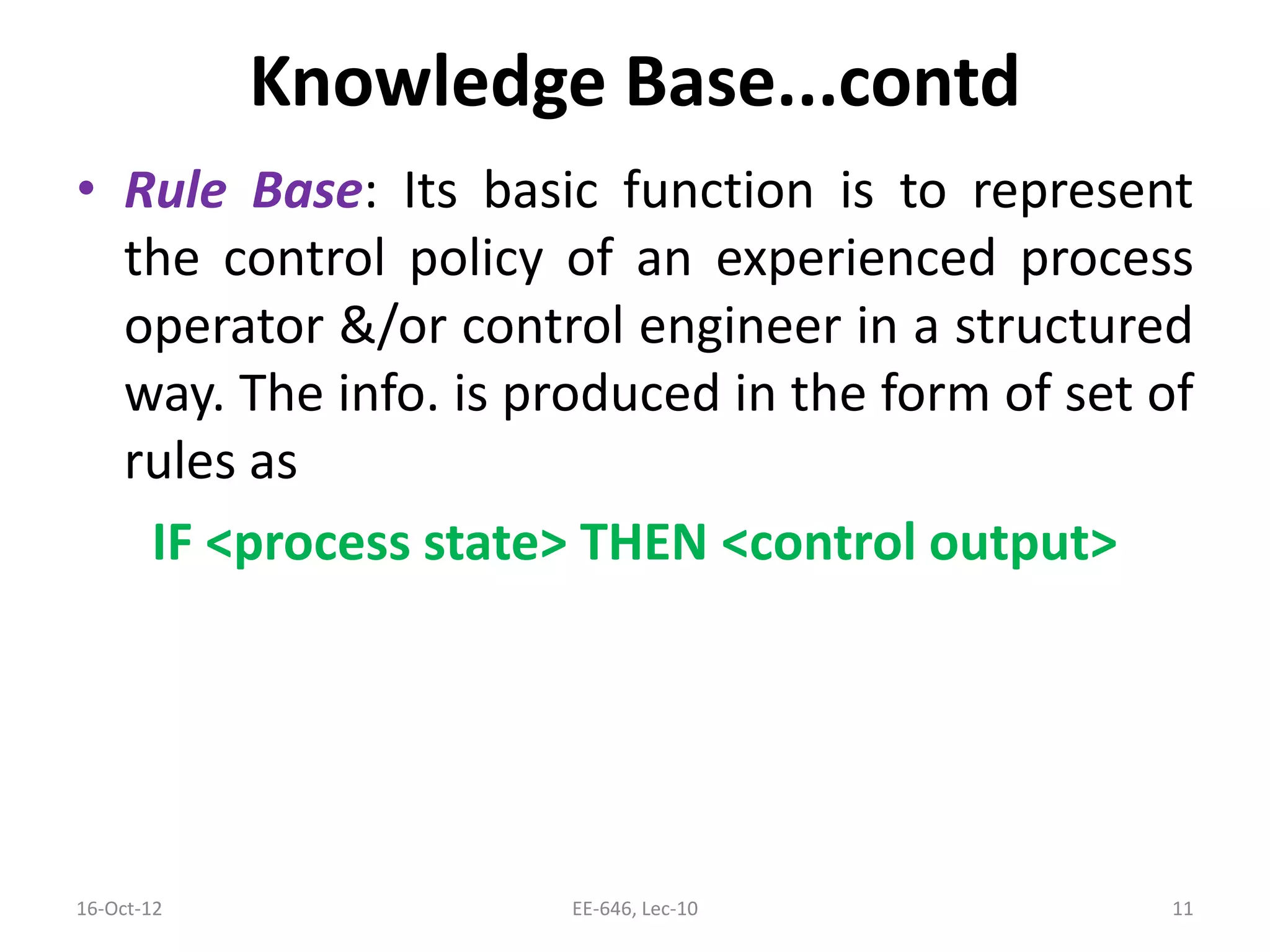
• Rule Base: Its basic function is to represent
the control policy of an experienced process
operator &/or control engineer in a structured
way. The info. is produced in the form of set of
rules as
IF <process state> THEN <control output>
16-Oct-12 EE-646, Lec-10 11
Knowledge Base...contd
The design parameters for RB are:
 Choice of process process state and control
o/p variables.
 Choice of the contents of rule-antecedent
and the rule-consequent
 Choice of term sets for the process state and
control o/p variables.
 Derivation of the set of rules
16-Oct-12 EE-646, Lec-10 12
Inference Engine
16-Oct-12 EE-646, Lec-10 13
Defuzzification Module
16-Oct-12 EE-646, Lec-10 14

L10 fkbc

  • 1.
    EE-646 Lecture-10 Fuzzy Knowledge BasedController (FKBC) or Fuzzy Logic Controller (FLC)
  • 2.
    Introduction • In conventionalcontrol, the amount of control is determined in relation to a number of data inputs using a set of equations to express the entire control process • Fuzzy logic control (FLC) has been suggested as a promising alternative approach for control system design, especially for those systems that are too complex to analyze by conventional techniques • The rationale behind FLC is that an experienced human operator can competently control a process without the knowledge of its underlying dynamics (transfer function). 16-Oct-12 2EE-646, Lec-10
  • 3.
    Contd... • Expressing humanexperience in the form of a mathematical formula is a very difficult task, if not an impossible one. Fuzzy logic provides a simple tool to interpret this experience into reality. • The effective control strategies that the human operator learns through his experience can often be expressed as a set of condition-action rules (called fuzzy rules) which describe conditions about the process state using linguistic terms (i.e., fuzzy sets such as low, medium, high, slightly positive) & recommend control actions using linguistic terms such as increase slightly or decrease moderately 16-Oct-12 3EE-646, Lec-10
  • 4.
    Contd... • An exampleof such a rule is as follows : IF error is negative small and (change-of-error is positive big or positive medium) THEN decrease the steam flow slightly. • Since the first successful application of fuzzy logic to control (Mamdani, 1974), FLCs have been successfully applied to a number of applications like heat exchangers, activated sludge processes, cement kiln operation, turning processes, water purification processes, and power systems operation • Japanese products have FLCs in washing machines, vacuum cleaners, ACs, and camcorders 16-Oct-12 4EE-646, Lec-10
  • 5.
    FLC Benefits 1. Developinga fuzzy logic controller is cheaper than developing a model based or other controller with comparable performance 2. FLCs are more robust than PID controllers because they can cover a much wider range of operating conditions than PID controllers 3. FLCs are customizable, because it is easier to understand and modify their rules, which not only mimic a human operator's strategies, but also are expressed in linguistic terms used in natural language. 16-Oct-12 EE-646, Lec-10 5
  • 6.
    Structure of FKBC •FLCs may have different structures depending upon the type of application. • Despite the variety of possible fuzzy controller structures, the basic form of all common types of controllers consists of following modules: • Input fuzzification (Normalization & conversion of crisp values to fuzzy values) • Fuzzy rule base (Knowledge base) • Inference engine (Implication) • Output defuzzification (Denormalization & fuzzy-to- crisp conversion) 16-Oct-12 EE-646, Lec-10 6
  • 7.
    Structure... Contd 16-Oct-12 EE-646,Lec-10 7 Normalization Fuzzification Inference Engine Defuzzification Denormalization Data Base Rule Base Crisp Process-State Values Crisp O/P control Values
  • 8.
    Fuzzification Module • Normalization:It performs a scale transformation which maps the physical values of the current process state variables into a normalized UoD. Not needed when non-normalized domain in used • Fuzzification: It converts a point-wise (crisp), current value of a process state variable into a fuzzy set. This is done in order to make it compatible with the fuzzy set representation of the process s. v. in the rule antecedent 16-Oct-12 EE-646, Lec-10 8
  • 9.
    Fuzzification Module...contd • Thedesign parameter of the fuzzification module is the choice of fuzzification strategy which is done according to type of inference engine or rule firing in a particular FKBC. • Fuzzification may be compositional based inference or individual rule based inference 16-Oct-12 EE-646, Lec-10 9
  • 10.
    Knowledge Base • DataBase: Its basic function is to provide the necessary information for the proper functioning of the fuzzification module, the rule base, & the defuzzification module. This info. includes:  Fuzzy sets (MFs) representing the meaning of the linguistic values of the process state and control o/p variables.  Physical domains & their normalized counterparts together with the scaling factors Choice of above info. constitutes the design parameters for DB 16-Oct-12 EE-646, Lec-10 10
  • 11.
    Knowledge Base...contd • RuleBase: Its basic function is to represent the control policy of an experienced process operator &/or control engineer in a structured way. The info. is produced in the form of set of rules as IF <process state> THEN <control output> 16-Oct-12 EE-646, Lec-10 11
  • 12.
    Knowledge Base...contd The designparameters for RB are:  Choice of process process state and control o/p variables.  Choice of the contents of rule-antecedent and the rule-consequent  Choice of term sets for the process state and control o/p variables.  Derivation of the set of rules 16-Oct-12 EE-646, Lec-10 12
  • 13.
  • 14.