INTELLIGENT CONTROL ON
FUZZY LOGIC
Presented by
N. Elakiya
M.Phil Mathematics
OVERVIEW
Introduction
Problem Statement
Methodology
Applications
Concluding
INTRODUCTION
Fuzzy sets were introduced by Zadeh in 1965 to represent
data and information possessing non-statistical uncertainties. It
was specifically designed to mathematically represent
uncertainty and vagueness and to provide formalized tools for
dealing with the imprecision intrinsic to many problems.
Fuzzy Logic is based on the theory of fuzzy sets , which is a
generalization of the classical set theory . Fuzzy Logic can be
considered as an extension of infinite-valued logic in the sense
of cooperate fuzzy sets and fuzzy relations into the system.
HISTORY OF FUZZY
In 1930s Fuzzy or multivalued logic was introduced by Jan
Lukasiewicz, a polish philosopher.
In 1937- Max Black published a paper called “Vagueness: a
exercise in logical analysis”.
In 1965 - Lotfi Zadeh published his famous paper “Fuzzy
Sets”. Zadeh extended the work on possibility theory into a
formal system of mathematical logic, and introduced a new
concept for applying natural language terms.
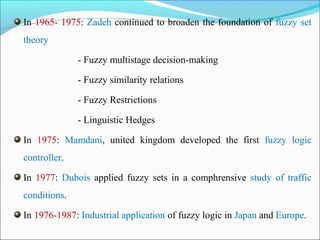
In 1965- 1975: Zadeh continued to broaden the foundation of fuzzy set
theory
- Fuzzy multistage decision-making
- Fuzzy similarity relations
- Fuzzy Restrictions
- Linguistic Hedges
In 1975: Mamdani, united kingdom developed the first fuzzy logic
controller.
In 1977: Dubois applied fuzzy sets in a comphrensive study of traffic
conditions.
In 1976-1987: Industrial application of fuzzy logic in Japan and Europe.
WHAT IS FUZZY LOGIC?
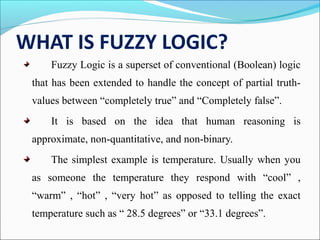
Fuzzy Logic is a superset of conventional (Boolean) logic
that has been extended to handle the concept of partial truth-
values between “completely true” and “Completely false”.
It is based on the idea that human reasoning is
approximate, non-quantitative, and non-binary.
The simplest example is temperature. Usually when you
as someone the temperature they respond with “cool” ,
“warm” , “hot” , “very hot” as opposed to telling the exact
temperature such as “ 28.5 degrees” or “33.1 degrees”.
GENERAL APPROACH TO FUZZY
LOGIC CONTOL
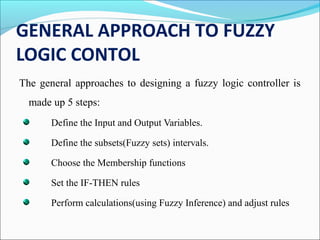
The general approaches to designing a fuzzy logic controller is
made up 5 steps:
Define the Input and Output Variables.
Define the subsets(Fuzzy sets) intervals.
Choose the Membership functions
Set the IF-THEN rules
Perform calculations(using Fuzzy Inference) and adjust rules
WHY USE FUZZY LOGIC?
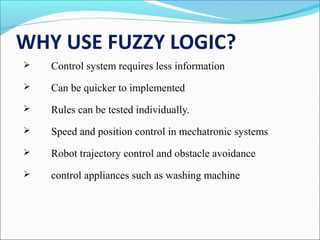
 Control system requires less information
 Can be quicker to implemented
 Rules can be tested individually.
 Speed and position control in mechatronic systems
 Robot trajectory control and obstacle avoidance
 control appliances such as washing machine
WHAT ABOUT INTELLIGENT
CONTROL?
The premise behind intelligent control is that the system to be
controlled does not have to e rigidly modelled.
This is unlike classical control and biggest distinction between the
two approaches.
Humans can perform complex tasks without knowing exactly how
they do them .Therefore, one may say that an intelligent model solves
* A difficult (non-trivial, complex, complicated) problem.
* In a non-trivial human-like way
TYPES OF INTELLIGENT CONTROL
Types of intelligent control include:
o Fuzzy logic
o Artificial neural networks
o Genetic programming
o Support vector machines
o Reinforcement learning
METHODOLOGY
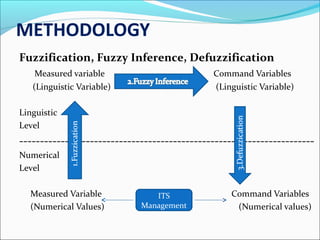
Fuzzification, Fuzzy Inference, Defuzzification
Measured variable Command Variables
(Linguistic Variable) (Linguistic Variable)
Linguistic
Level
-----------------------------------------------------------------------
Numerical
Level
Measured Variable Command Variables
(Numerical Values) (Numerical values)
ITS
Management
COMPONENTS OF INTELLIGENT
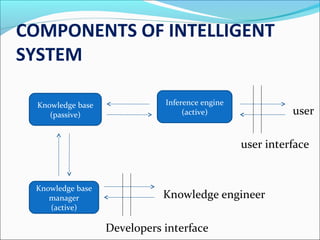
SYSTEM
user
user interface
Knowledge engineer
Developers interface
Knowledge base
(passive)
Inference engine
(active)
Knowledge base
manager
(active)
APPLICATION
TRAFFIC MANAGEMNT USING FUZZY LOGIC
CONTROLLER
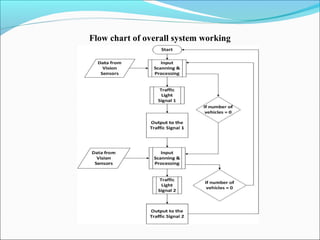
The inputs regarding the number of vehicles at each participating
signal are obtained through vision sensors.
The number of detected vehicles is sent to the controller which
acts as the brain of the system and produce a unique output for
each scenario form the basis of operation.
Their relations have been defined in the form of “if else”
statements in the fuzzy inference.
Input Fuzzy Membership Functions
Output Fuzzy Membership Functions
Fuzzy Inference System Rules
1. If ( Route-A is light) then (signal-A is +A)
2. If ( Route-A is lighter) then (signal-A is +A)
3. If ( Route-A is high) then (signal-A is +++A)
4. If ( Route-A is medium ) then (signal-A is ++A)
5. If ( Route-A is higher) then (signal-A is ++++A)
6. If ( Route-A is nothing) then (signal-A is null)
7. If (Route-A is light) and (Route-B is few) then (signal-A is +A)
8. If (Route-A is lighter) and (Route-B is fewer) then (signal-A is +A)
9. If (Route-A is high) and (Route-B is more) then (signal-A is ++A)
10. If (Route-A is medium) and (Route-B is much) then (signal-A is +++A)
11. If (Route-A is higher) and (Route-B is numerous) then (signal-A is ++++A)
12. If (Route-A is higher) and (Route-B is few) then (signal-A is +A)
13. If (Route-A is higher) and (Route-B is fewer) then (signal-A is ++A)
14. If (Route-A is higher) and (Route-B is more) then (signal-A is +++A)
15. If (Route-A is medium) and (Route-B is few) then (signal-A is ++A)
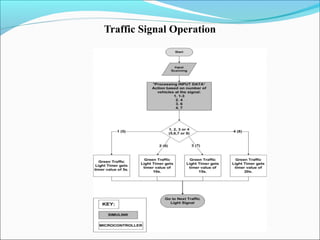
The Concept of extension of signal operation time provides longer green
light intervals for routes with a greater amount of traffic.
S.No Number of Vehicles Output Time(S)
1 1-3 5
2 4-5 10
3 6 15
4 7 20
PIC16F877A MICROCONTROLLER
The Fuzzy logic Controller is then Followed by the PIC
16F877A Microcontroller which manages the traffic lights according to
the data it receives from the controller.
The main role of the microcontroller is to serially receive and
manipulate the data from the controller and carry out particular action.
Flow chart of overall system working
Traffic Signal Operation
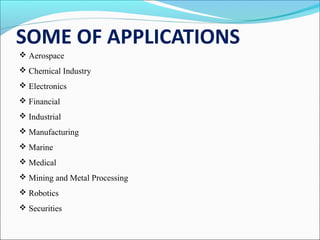
SOME OF APPLICATIONS
 Aerospace
 Chemical Industry
 Electronics
 Financial
 Industrial
 Manufacturing
 Marine
 Medical
 Mining and Metal Processing
 Robotics
 Securities
CONCLUSION
This presentation has demonstrated Intelligent
Control and an improved traffic Controller using
fuzzy logic and microcontroller.
THANK YOU

Intelligence control using fuzzy logic

  • 1.
    INTELLIGENT CONTROL ON FUZZYLOGIC Presented by N. Elakiya M.Phil Mathematics
  • 2.
  • 3.
    INTRODUCTION Fuzzy sets wereintroduced by Zadeh in 1965 to represent data and information possessing non-statistical uncertainties. It was specifically designed to mathematically represent uncertainty and vagueness and to provide formalized tools for dealing with the imprecision intrinsic to many problems. Fuzzy Logic is based on the theory of fuzzy sets , which is a generalization of the classical set theory . Fuzzy Logic can be considered as an extension of infinite-valued logic in the sense of cooperate fuzzy sets and fuzzy relations into the system.
  • 4.
    HISTORY OF FUZZY In1930s Fuzzy or multivalued logic was introduced by Jan Lukasiewicz, a polish philosopher. In 1937- Max Black published a paper called “Vagueness: a exercise in logical analysis”. In 1965 - Lotfi Zadeh published his famous paper “Fuzzy Sets”. Zadeh extended the work on possibility theory into a formal system of mathematical logic, and introduced a new concept for applying natural language terms.
  • 5.
    In 1965- 1975:Zadeh continued to broaden the foundation of fuzzy set theory - Fuzzy multistage decision-making - Fuzzy similarity relations - Fuzzy Restrictions - Linguistic Hedges In 1975: Mamdani, united kingdom developed the first fuzzy logic controller. In 1977: Dubois applied fuzzy sets in a comphrensive study of traffic conditions. In 1976-1987: Industrial application of fuzzy logic in Japan and Europe.
  • 6.
    WHAT IS FUZZYLOGIC? Fuzzy Logic is a superset of conventional (Boolean) logic that has been extended to handle the concept of partial truth- values between “completely true” and “Completely false”. It is based on the idea that human reasoning is approximate, non-quantitative, and non-binary. The simplest example is temperature. Usually when you as someone the temperature they respond with “cool” , “warm” , “hot” , “very hot” as opposed to telling the exact temperature such as “ 28.5 degrees” or “33.1 degrees”.
  • 7.
    GENERAL APPROACH TOFUZZY LOGIC CONTOL The general approaches to designing a fuzzy logic controller is made up 5 steps: Define the Input and Output Variables. Define the subsets(Fuzzy sets) intervals. Choose the Membership functions Set the IF-THEN rules Perform calculations(using Fuzzy Inference) and adjust rules
  • 8.
    WHY USE FUZZYLOGIC?  Control system requires less information  Can be quicker to implemented  Rules can be tested individually.  Speed and position control in mechatronic systems  Robot trajectory control and obstacle avoidance  control appliances such as washing machine
  • 9.
    WHAT ABOUT INTELLIGENT CONTROL? Thepremise behind intelligent control is that the system to be controlled does not have to e rigidly modelled. This is unlike classical control and biggest distinction between the two approaches. Humans can perform complex tasks without knowing exactly how they do them .Therefore, one may say that an intelligent model solves * A difficult (non-trivial, complex, complicated) problem. * In a non-trivial human-like way
  • 10.
    TYPES OF INTELLIGENTCONTROL Types of intelligent control include: o Fuzzy logic o Artificial neural networks o Genetic programming o Support vector machines o Reinforcement learning
  • 11.
    METHODOLOGY Fuzzification, Fuzzy Inference,Defuzzification Measured variable Command Variables (Linguistic Variable) (Linguistic Variable) Linguistic Level ----------------------------------------------------------------------- Numerical Level Measured Variable Command Variables (Numerical Values) (Numerical values) ITS Management
  • 12.
    COMPONENTS OF INTELLIGENT SYSTEM user userinterface Knowledge engineer Developers interface Knowledge base (passive) Inference engine (active) Knowledge base manager (active)
  • 13.
    APPLICATION TRAFFIC MANAGEMNT USINGFUZZY LOGIC CONTROLLER The inputs regarding the number of vehicles at each participating signal are obtained through vision sensors. The number of detected vehicles is sent to the controller which acts as the brain of the system and produce a unique output for each scenario form the basis of operation. Their relations have been defined in the form of “if else” statements in the fuzzy inference.
  • 14.
    Input Fuzzy MembershipFunctions Output Fuzzy Membership Functions
  • 15.
    Fuzzy Inference SystemRules 1. If ( Route-A is light) then (signal-A is +A) 2. If ( Route-A is lighter) then (signal-A is +A) 3. If ( Route-A is high) then (signal-A is +++A) 4. If ( Route-A is medium ) then (signal-A is ++A) 5. If ( Route-A is higher) then (signal-A is ++++A) 6. If ( Route-A is nothing) then (signal-A is null) 7. If (Route-A is light) and (Route-B is few) then (signal-A is +A) 8. If (Route-A is lighter) and (Route-B is fewer) then (signal-A is +A) 9. If (Route-A is high) and (Route-B is more) then (signal-A is ++A) 10. If (Route-A is medium) and (Route-B is much) then (signal-A is +++A) 11. If (Route-A is higher) and (Route-B is numerous) then (signal-A is ++++A) 12. If (Route-A is higher) and (Route-B is few) then (signal-A is +A) 13. If (Route-A is higher) and (Route-B is fewer) then (signal-A is ++A) 14. If (Route-A is higher) and (Route-B is more) then (signal-A is +++A) 15. If (Route-A is medium) and (Route-B is few) then (signal-A is ++A)
  • 16.
    The Concept ofextension of signal operation time provides longer green light intervals for routes with a greater amount of traffic. S.No Number of Vehicles Output Time(S) 1 1-3 5 2 4-5 10 3 6 15 4 7 20 PIC16F877A MICROCONTROLLER The Fuzzy logic Controller is then Followed by the PIC 16F877A Microcontroller which manages the traffic lights according to the data it receives from the controller. The main role of the microcontroller is to serially receive and manipulate the data from the controller and carry out particular action.
  • 17.
    Flow chart ofoverall system working
  • 18.
  • 19.
    SOME OF APPLICATIONS Aerospace  Chemical Industry  Electronics  Financial  Industrial  Manufacturing  Marine  Medical  Mining and Metal Processing  Robotics  Securities
  • 20.
    CONCLUSION This presentation hasdemonstrated Intelligent Control and an improved traffic Controller using fuzzy logic and microcontroller.
  • 21.