Mindfulness-Based Approaches
to Managing Chronic Pain
March 2014
Kimberly Murdoch BSW, RSW, dipl HSC, NTS, DAc
Disclosure
As a partner in For Health Wellness
Consultants Kimberly Murdoch profits from
sales of:
For Health meditation CDs and
downloads
For Health corporate seminars on
resiliency and productivity
Objectives
Learn about the neurobiology and research related to
mindfulness approaches
Understand and experience mindfulness techniques
Discuss ways to introduce mindfulness in the exam room
with complex chronic pain patients
Become aware of books and online resources for your
own learning and to support your patients in using
mindfulness for managing distress
Strong evidence that mind body‐
interventions such as mindfulness
elicit beneficial psychological and
pathophysiological effects on various
human diseases
What is Mindfulness?
• The most basic definition is the regulation of
attention through mind-body awareness skills
•Operational definition, “Mindfulness is a particular
way of paying attention, on purpose, in the present
moment, and non-judgmentally” Jon Kabat-Zinn, PhD
• Mindfulness is developed through a relaxed,
passive attention to a repetitive or absorbing
stimulus that turns off the “inner dialogue” thereby
decreasing arousal of the sympathetic nervous
system Herbert Benson, MD, Harvard Medical School
What is Mindfulness?
•Mindfulness
includes:
• the aim
• the methods
• the outcomes
J Kabat-Zinn
Pain and the Mind-Body Connection
“Pain is not just a “body” problem, it is a
whole-systems problem.” Jon Kabat-Zinn
Mindfulness-Based Chronic Pain
Management programs are
biopsychosocial interventions that
address several of the factors that
impact pain and the ability to heal
Multiple Factors Intersecting
Multiple factors impact perception of pain
and ability to heal:
thoughts, emotions, attentional biases, sleep,
nutrition, physical activity, socio-economics
and social support, life history, medical
interventions and medications, concurrent
pathologies, stress levels…
Mindfulness Skills
Breath Awareness
Guided Body Scan
3-Minute Breathing
Space
Mindful Daily Living
Breath Awareness
• Find a quiet place and consistent time for
practicing
• Attentional bias: Cultivate an attitude of
“trying easy”
• Training attention on
breathing sensations
Mindfulness Research Summary
Research suggests that mindfulness-
based therapies may be effective
adjunctive interventions for:
chronic pain, depression, anxiety, trauma,
Borderline Personality Disorder, OCD,
ADHD, addiction, stress
Currently few valid, reliable measures of
mindfulness
Research and Mindfulness-Based
Interventions in Patients with Chronic Pain
Reiner et al.: most of the reviewed chronic pain studies
(9/16) demonstrated a statistically significant decrease in
pain intensity among persons receiving mindfulness-
based interventions (MBIs)
Reductions in pain intensity were generally well
maintained in 3-month follow ups
Along with other beneficial effects of mindfulness
approaches, MBIs may help to reduce pain intensity
Reiner K, Tibi L, Lipsitz JD. Do Mindfulness-Based Interventions Reduce Pain Intensity?
A Critical Review of the Literature. Pain Med. 2013;14:230–242
Limitations of Research
Minimum threshold of 10 participants per group for study
inclusion was probably too low
Large majority of studies (13/16) included data only for
treatment completers which could bias results to favor
MBIs
Some studies involved novice meditators and other
studies focused on experienced meditators
Some of the controlled trials lacked randomization
Some studies investigated the effects of
mindfulness on other processes (e.g. emotion reactivity
or regulation) instead of the basic processes of
mindfulness itself
Reiner K, Tibi L, Lipsitz JD.(2013). Do Mindfulness-Based Interventions Reduce Pain Intensity? A Critical Review of
the Literature. Pain Med.14:230–242
Mindfulness Impact on Threat Appraisal
and Emotions
The Center for Investigating Healthy Minds
(CIHM), University of Wisconsin, Richard
Davidson, neuroscientist and team conducting
studies of “The Brain on Meditation” since 1992,
identified outcomes:
“Meditators' brains were active, particularly in the
left prefrontal cortex, the part of the brain
responsible for positive emotions” (Davidson, 2004)
What We Know About the Effects of
Mindfulness on Neurobiology
fMRI Conclusions:
Mindfulness meditation induces specific
changes in fMRI signal in several
structures, including the amygdala,
hippocampus, pons, anterior cingulate,
and intraparietal sulcus
Lazar, G. Bush, G. Fricchione, R.L. Gollub, G. Khalsa, H. Benson, H. (2000).
Functional Brain Mapping of the Relaxation Response using 3T fMRI S.W.
Neuroreport, 11, 7
What About Briefer
Mindfulness Interventions?
Moyer and colleagues at the University of Wisconsin-Stout
Random assignment to either a 5-week mindfulness
meditation group or wait list group
Meditation group meditated at home 2x/week, 25
minutes each time, on average
Meditation subjects showed same significant increase in
left hemisphere cortical activation as those who did full
intervention of earlier studies
Wait list group did not demonstrate these changes
Moyer, C. A. et al. (2011). Frontal Electroencephalographic Asymmetry Associated With
Positive Emotion Is Produced by Very Brief Meditation Training. Psychological
Science
Research Summary
75% of all illness is related to stress and
lifestyle habits. Former U.S. Surgeon General
Studies have found that regular practice
of meditation or relaxation provides
benefits to:
cardiac patients, surgery recovery,
immune function, pain relief, diabetics,
anxiety…
Physiological Benefits of Mindfulness Skills
Decrease blood pressure, heart rate, muscle tension
Reduction in serum
cholesterol
Improved immune function
Reduction in cortisol levels
Reduce pain and anxiety
Improve sleep
Changes in neurotransmitters
- ↑ serotonin, ↓ depression
Decrease inflammation
Psychological Benefits of Mindfulness Skills
More optimism and decreased depression
Greater self-awareness
Improved coping abilities
Reduced aggression
Greater efficiency and productivity
Improved learning capabilities, concentration
and memory
Promote feelings of inner calm and tolerance
Mindfulness Skills
Breath Awareness
Guided Body Scan
3-Minute Breathing
Space
Mindful Daily Living
Applications and Benefits
To alter physical symptoms such as
hypertension, IBS, nausea, insomnia etc.
To decrease pain and the use of pain
medications
To decrease anxiety and fear
To alleviate depression and anger
To prepare for and experience medical
procedures, treatments and tests
Applications and Benefits continued…
To promote healing and recovery
To enhance inner strengths, resiliency,
optimism, and self-esteem
To increase feelings of well-being, comfort and
control
To increase self-awareness
To change negative thought patterns
At end of life
Exclusion/Inclusion Recommendations
Exclusion:
Patients with cognitive impairments
Patients experiencing mental clouding
associated with their pain conditions or
medications
Inclusion:
“Patient preference and enthusiasm are a good
guide” Dr. William Marchand, George E. Wahlen
Veterans Affairs Medical Center and the
University of Utah (July 11, 2012 ScienceDaily.com)
How to Make Mindfulness Meditation
Miserable
I shouldn’t have thoughts during meditation.
My body is supposed to be relaxed.
My body should be still.
Emotions keep coming up. I shouldn’t have
feelings such as anxiety or anger. I shouldn’t cry
during meditation.
My environment should be perfectly quiet.
I can’t do this. I’m not a patient person.
Difficulties and Challenges
No time
Intrusive thoughts or body sensations (pain)
Emotions or memories come to the surface
Restlessness, can’t sit still
Falling asleep, wandering mind
Environmental noises
Anxiety about “letting go”
I’m not doing it ‘right, trying too hard = frustration
Appearance of images
Summary
Many studies have found that mindfulness-
based approaches provide benefits to:
pain management, surgery recovery, anxiety,
depression, immune function, cardiac patients,
diabetics, resiliency
Mindfulness approaches can be introduced
to patients with chronic pain in the exam
room
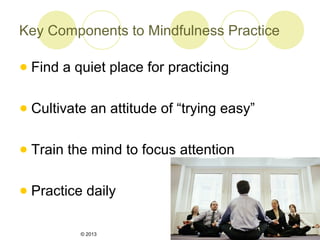
Key Components to Mindfulness Practice
● Find a quiet place for practicing
● Cultivate an attitude of “trying easy”
● Train the mind to focus attention
● Practice daily
© 2013

Session 2 murdoch mindfulness approaches

  • 1.
    Mindfulness-Based Approaches to ManagingChronic Pain March 2014 Kimberly Murdoch BSW, RSW, dipl HSC, NTS, DAc
  • 2.
    Disclosure As a partnerin For Health Wellness Consultants Kimberly Murdoch profits from sales of: For Health meditation CDs and downloads For Health corporate seminars on resiliency and productivity
  • 3.
    Objectives Learn about theneurobiology and research related to mindfulness approaches Understand and experience mindfulness techniques Discuss ways to introduce mindfulness in the exam room with complex chronic pain patients Become aware of books and online resources for your own learning and to support your patients in using mindfulness for managing distress
  • 4.
    Strong evidence thatmind body‐ interventions such as mindfulness elicit beneficial psychological and pathophysiological effects on various human diseases
  • 5.
    What is Mindfulness? •The most basic definition is the regulation of attention through mind-body awareness skills •Operational definition, “Mindfulness is a particular way of paying attention, on purpose, in the present moment, and non-judgmentally” Jon Kabat-Zinn, PhD • Mindfulness is developed through a relaxed, passive attention to a repetitive or absorbing stimulus that turns off the “inner dialogue” thereby decreasing arousal of the sympathetic nervous system Herbert Benson, MD, Harvard Medical School
  • 6.
    What is Mindfulness? •Mindfulness includes: •the aim • the methods • the outcomes J Kabat-Zinn
  • 7.
    Pain and theMind-Body Connection “Pain is not just a “body” problem, it is a whole-systems problem.” Jon Kabat-Zinn Mindfulness-Based Chronic Pain Management programs are biopsychosocial interventions that address several of the factors that impact pain and the ability to heal
  • 8.
    Multiple Factors Intersecting Multiplefactors impact perception of pain and ability to heal: thoughts, emotions, attentional biases, sleep, nutrition, physical activity, socio-economics and social support, life history, medical interventions and medications, concurrent pathologies, stress levels…
  • 9.
    Mindfulness Skills Breath Awareness GuidedBody Scan 3-Minute Breathing Space Mindful Daily Living
  • 10.
    Breath Awareness • Finda quiet place and consistent time for practicing • Attentional bias: Cultivate an attitude of “trying easy” • Training attention on breathing sensations
  • 11.
    Mindfulness Research Summary Researchsuggests that mindfulness- based therapies may be effective adjunctive interventions for: chronic pain, depression, anxiety, trauma, Borderline Personality Disorder, OCD, ADHD, addiction, stress Currently few valid, reliable measures of mindfulness
  • 12.
    Research and Mindfulness-Based Interventionsin Patients with Chronic Pain Reiner et al.: most of the reviewed chronic pain studies (9/16) demonstrated a statistically significant decrease in pain intensity among persons receiving mindfulness- based interventions (MBIs) Reductions in pain intensity were generally well maintained in 3-month follow ups Along with other beneficial effects of mindfulness approaches, MBIs may help to reduce pain intensity Reiner K, Tibi L, Lipsitz JD. Do Mindfulness-Based Interventions Reduce Pain Intensity? A Critical Review of the Literature. Pain Med. 2013;14:230–242
  • 13.
    Limitations of Research Minimumthreshold of 10 participants per group for study inclusion was probably too low Large majority of studies (13/16) included data only for treatment completers which could bias results to favor MBIs Some studies involved novice meditators and other studies focused on experienced meditators Some of the controlled trials lacked randomization Some studies investigated the effects of mindfulness on other processes (e.g. emotion reactivity or regulation) instead of the basic processes of mindfulness itself Reiner K, Tibi L, Lipsitz JD.(2013). Do Mindfulness-Based Interventions Reduce Pain Intensity? A Critical Review of the Literature. Pain Med.14:230–242
  • 14.
    Mindfulness Impact onThreat Appraisal and Emotions The Center for Investigating Healthy Minds (CIHM), University of Wisconsin, Richard Davidson, neuroscientist and team conducting studies of “The Brain on Meditation” since 1992, identified outcomes: “Meditators' brains were active, particularly in the left prefrontal cortex, the part of the brain responsible for positive emotions” (Davidson, 2004)
  • 15.
    What We KnowAbout the Effects of Mindfulness on Neurobiology fMRI Conclusions: Mindfulness meditation induces specific changes in fMRI signal in several structures, including the amygdala, hippocampus, pons, anterior cingulate, and intraparietal sulcus Lazar, G. Bush, G. Fricchione, R.L. Gollub, G. Khalsa, H. Benson, H. (2000). Functional Brain Mapping of the Relaxation Response using 3T fMRI S.W. Neuroreport, 11, 7
  • 16.
    What About Briefer MindfulnessInterventions? Moyer and colleagues at the University of Wisconsin-Stout Random assignment to either a 5-week mindfulness meditation group or wait list group Meditation group meditated at home 2x/week, 25 minutes each time, on average Meditation subjects showed same significant increase in left hemisphere cortical activation as those who did full intervention of earlier studies Wait list group did not demonstrate these changes Moyer, C. A. et al. (2011). Frontal Electroencephalographic Asymmetry Associated With Positive Emotion Is Produced by Very Brief Meditation Training. Psychological Science
  • 17.
    Research Summary 75% ofall illness is related to stress and lifestyle habits. Former U.S. Surgeon General Studies have found that regular practice of meditation or relaxation provides benefits to: cardiac patients, surgery recovery, immune function, pain relief, diabetics, anxiety…
  • 18.
    Physiological Benefits ofMindfulness Skills Decrease blood pressure, heart rate, muscle tension Reduction in serum cholesterol Improved immune function Reduction in cortisol levels Reduce pain and anxiety Improve sleep Changes in neurotransmitters - ↑ serotonin, ↓ depression Decrease inflammation
  • 19.
    Psychological Benefits ofMindfulness Skills More optimism and decreased depression Greater self-awareness Improved coping abilities Reduced aggression Greater efficiency and productivity Improved learning capabilities, concentration and memory Promote feelings of inner calm and tolerance
  • 21.
    Mindfulness Skills Breath Awareness GuidedBody Scan 3-Minute Breathing Space Mindful Daily Living
  • 22.
    Applications and Benefits Toalter physical symptoms such as hypertension, IBS, nausea, insomnia etc. To decrease pain and the use of pain medications To decrease anxiety and fear To alleviate depression and anger To prepare for and experience medical procedures, treatments and tests
  • 23.
    Applications and Benefitscontinued… To promote healing and recovery To enhance inner strengths, resiliency, optimism, and self-esteem To increase feelings of well-being, comfort and control To increase self-awareness To change negative thought patterns At end of life
  • 24.
    Exclusion/Inclusion Recommendations Exclusion: Patients withcognitive impairments Patients experiencing mental clouding associated with their pain conditions or medications Inclusion: “Patient preference and enthusiasm are a good guide” Dr. William Marchand, George E. Wahlen Veterans Affairs Medical Center and the University of Utah (July 11, 2012 ScienceDaily.com)
  • 25.
    How to MakeMindfulness Meditation Miserable I shouldn’t have thoughts during meditation. My body is supposed to be relaxed. My body should be still. Emotions keep coming up. I shouldn’t have feelings such as anxiety or anger. I shouldn’t cry during meditation. My environment should be perfectly quiet. I can’t do this. I’m not a patient person.
  • 26.
    Difficulties and Challenges Notime Intrusive thoughts or body sensations (pain) Emotions or memories come to the surface Restlessness, can’t sit still Falling asleep, wandering mind Environmental noises Anxiety about “letting go” I’m not doing it ‘right, trying too hard = frustration Appearance of images
  • 27.
    Summary Many studies havefound that mindfulness- based approaches provide benefits to: pain management, surgery recovery, anxiety, depression, immune function, cardiac patients, diabetics, resiliency Mindfulness approaches can be introduced to patients with chronic pain in the exam room
  • 28.
    Key Components toMindfulness Practice ● Find a quiet place for practicing ● Cultivate an attitude of “trying easy” ● Train the mind to focus attention ● Practice daily © 2013