
Emotional Intelligence
Emotional Intelligence:
How to Develop Skills for Success
Presented by Diana Durek, M.S.
Emotional Intelligence
Agenda
• What is Emotional Intelligence?
• The Business Case for EI
• Developing EI Skills
Emotional Intelligence
Poll
• Are you currently incorporating Emotional
Intelligence development into your work?
Emotional Intelligence
Poll
• Are you using a formal process to assess
Emotional Intelligence?
Emotional Intelligence
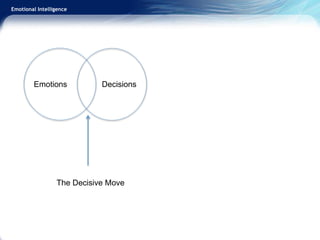
The Decisive Move
DecisionsEmotions
Emotional Intelligence
“Far from interfering with rationality, the
absence of emotion and feeling can break down
rationality and make wise decision-making
almost impossible. Most effective decisions are
assisted by emotion.”
—Antonio Damasio, Neuroscientist
Emotional Intelligence
Emotional Intelligence Is Not New
1943: David Wechsler (IQ Test Developer)
• Non-intellective abilities (affective personality
and social factors) essential for predicting
one’s ability to succeed.
1983: Howard Gardner (Multiple Intelligences)
• Personal intelligence is as important as the
intelligence measured in IQ tests.
Emotional Intelligence
Emotional Intelligence: A Definition
“The ability to monitor one’s own and others’
feelings and emotions, to discriminate among
them and to use this information to guide one’s
thinking and actions.”
Emotional Intelligence
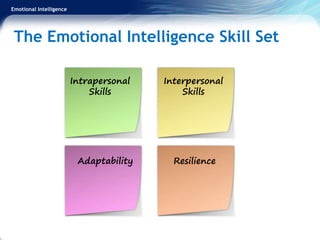
The Emotional Intelligence Skill Set
Intrapersonal
Skills
Interpersonal
Skills
Adaptability Resilience
Emotional Intelligence
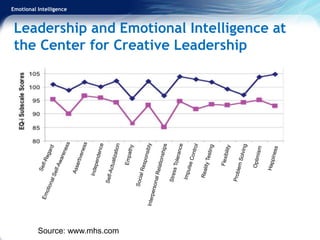
Leadership and Emotional Intelligence at
the Center for Creative Leadership
Source: www.mhs.com
Emotional Intelligence
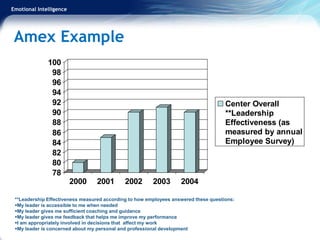
Amex Example
78
80
82
84
86
88
90
92
94
96
98
100
2000 2001 2002 2003 2004
Center Overall
**Leadership
Effectiveness (as
measured by annual
Employee Survey)
**Leadership Effectiveness measured according to how employees answered these questions:
My leader is accessible to me when needed
My leader gives me sufficient coaching and guidance
My leader gives me feedback that helps me improve my performance
I am appropriately involved in decisions that affect my work
My leader is concerned about my personal and professional development
Emotional Intelligence
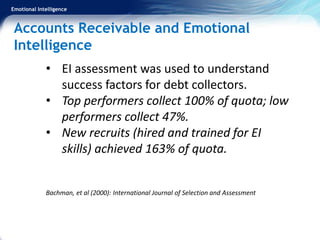
Accounts Receivable and Emotional
Intelligence
• EI assessment was used to understand
success factors for debt collectors.
• Top performers collect 100% of quota; low
performers collect 47%.
• New recruits (hired and trained for EI
skills) achieved 163% of quota.
Bachman, et al (2000): International Journal of Selection and Assessment
Emotional Intelligence
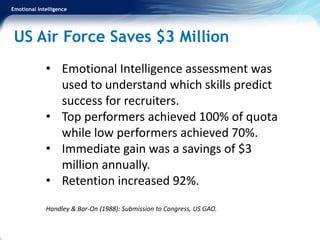
US Air Force Saves $3 Million
• Emotional Intelligence assessment was
used to understand which skills predict
success for recruiters.
• Top performers achieved 100% of quota
while low performers achieved 70%.
• Immediate gain was a savings of $3
million annually.
• Retention increased 92%.
Handley & Bar-On (1988): Submission to Congress, US GAO.
Emotional Intelligence
“No doubt emotional intelligence is more rare
than book smarts, but my experience says it is
actually more important in the making of a
leader. You just can’t ignore it.”
—Jack Welch, former CEO of General Electric
Emotional Intelligence
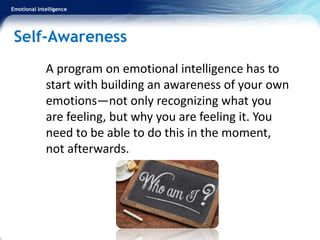
Self-Awareness
A program on emotional intelligence has to
start with building an awareness of your own
emotions—not only recognizing what you
are feeling, but why you are feeling it. You
need to be able to do this in the moment,
not afterwards.
Emotional Intelligence
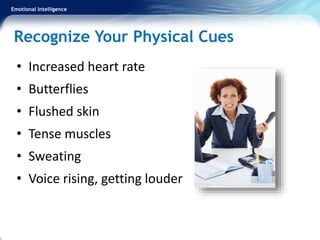
Recognize Your Physical Cues
• Increased heart rate
• Butterflies
• Flushed skin
• Tense muscles
• Sweating
• Voice rising, getting louder
Emotional Intelligence
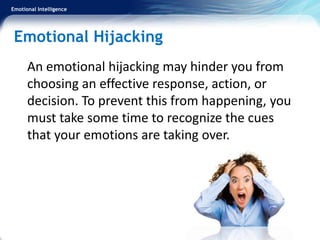
Emotional Hijacking
An emotional hijacking may hinder you from
choosing an effective response, action, or
decision. To prevent this from happening, you
must take some time to recognize the cues
that your emotions are taking over.
Emotional Intelligence
Analyze Your Thinking
• Consciously stop to
evaluate thinking.
• Ask three questions:
–“What am I feeling?”
–“What do I want to
feel?”
–“What do I need to
feel that way?”
Emotional Intelligence
Preventing Emotional Hijacking
Activity:
Quick visualization, combined with
deep breathing, will go a long way
toward giving you time to catch up
with your emotions and consciously
decide how to respond in a particular
situation.
Emotional Intelligence
Increasing Your Empathy
In addition to recognizing and managing your
own emotions, another goal of emotional
intelligence is to develop more positive
relationships with others at work.
Connecting with another person on an
emotional level allows you to develop a
meaningful, trusting relationship.
Emotional Intelligence
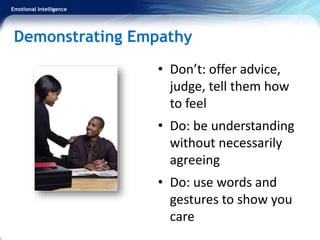
Demonstrating Empathy
• Don’t: offer advice,
judge, tell them how
to feel
• Do: be understanding
without necessarily
agreeing
• Do: use words and
gestures to show you
care
Emotional Intelligence
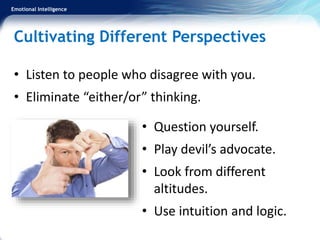
Cultivating Different Perspectives
• Listen to people who disagree with you.
• Eliminate “either/or” thinking.
• Question yourself.
• Play devil’s advocate.
• Look from different
altitudes.
• Use intuition and logic.
Emotional Intelligence
Increasing Self-Confidence
• Remind yourself of past
successes.
• Identify your strengths.
• Take a risk.
Emotional Intelligence
Increasing Self-Confidence
• Change your self-talk.
• Think positive and in the present tense.
– Change “I can’t” to “I can.”
– Change “problem” to “challenge” or opportunity.”
– Change “have to” to “want to.”
Emotional Intelligence
Develop a Positive Disposition
• Permanence: Setbacks are temporary and
positive events are permanent.
• Pervasiveness: Setbacks are
compartmentalized.
• Personalization: Positive events due to
personal ability; negative events due to
external circumstances.
Emotional Intelligence
How to Develop an Optimistic Outlook
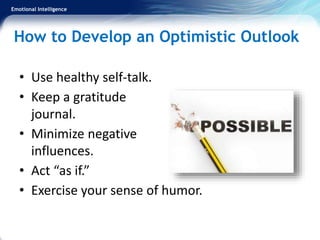
• Use healthy self-talk.
• Keep a gratitude
journal.
• Minimize negative
influences.
• Act “as if.”
• Exercise your sense of humor.
Emotional Intelligence
Thank You
Diana Durek, M.S.
Leadership and Executive Development
Consultant
diana.durek@gmail.com
Emotional Intelligence
Thank You for Participating
Shop the store:
www.HRDQstore.com
Emotional Intelligence
Includes:
• Instructor Guide
• Participant Guide
• PowerPoint presentation
• Learning Summary
• Course Overview
• Course Evaluation
Enter WebinarEI at checkout. Offer expires 2/11.

Emotional Intelligence: How to Develop Skills for Success

  • 1.
  • 2.
    Emotional Intelligence: How toDevelop Skills for Success Presented by Diana Durek, M.S.
  • 3.
    Emotional Intelligence Agenda • Whatis Emotional Intelligence? • The Business Case for EI • Developing EI Skills
  • 4.
    Emotional Intelligence Poll • Areyou currently incorporating Emotional Intelligence development into your work?
  • 5.
    Emotional Intelligence Poll • Areyou using a formal process to assess Emotional Intelligence?
  • 6.
  • 7.
    Emotional Intelligence “Far frominterfering with rationality, the absence of emotion and feeling can break down rationality and make wise decision-making almost impossible. Most effective decisions are assisted by emotion.” —Antonio Damasio, Neuroscientist
  • 8.
    Emotional Intelligence Emotional IntelligenceIs Not New 1943: David Wechsler (IQ Test Developer) • Non-intellective abilities (affective personality and social factors) essential for predicting one’s ability to succeed. 1983: Howard Gardner (Multiple Intelligences) • Personal intelligence is as important as the intelligence measured in IQ tests.
  • 9.
    Emotional Intelligence Emotional Intelligence:A Definition “The ability to monitor one’s own and others’ feelings and emotions, to discriminate among them and to use this information to guide one’s thinking and actions.”
  • 10.
    Emotional Intelligence The EmotionalIntelligence Skill Set Intrapersonal Skills Interpersonal Skills Adaptability Resilience
  • 11.
    Emotional Intelligence Leadership andEmotional Intelligence at the Center for Creative Leadership Source: www.mhs.com
  • 12.
    Emotional Intelligence Amex Example 78 80 82 84 86 88 90 92 94 96 98 100 20002001 2002 2003 2004 Center Overall **Leadership Effectiveness (as measured by annual Employee Survey) **Leadership Effectiveness measured according to how employees answered these questions: My leader is accessible to me when needed My leader gives me sufficient coaching and guidance My leader gives me feedback that helps me improve my performance I am appropriately involved in decisions that affect my work My leader is concerned about my personal and professional development
  • 13.
    Emotional Intelligence Accounts Receivableand Emotional Intelligence • EI assessment was used to understand success factors for debt collectors. • Top performers collect 100% of quota; low performers collect 47%. • New recruits (hired and trained for EI skills) achieved 163% of quota. Bachman, et al (2000): International Journal of Selection and Assessment
  • 14.
    Emotional Intelligence US AirForce Saves $3 Million • Emotional Intelligence assessment was used to understand which skills predict success for recruiters. • Top performers achieved 100% of quota while low performers achieved 70%. • Immediate gain was a savings of $3 million annually. • Retention increased 92%. Handley & Bar-On (1988): Submission to Congress, US GAO.
  • 15.
    Emotional Intelligence “No doubtemotional intelligence is more rare than book smarts, but my experience says it is actually more important in the making of a leader. You just can’t ignore it.” —Jack Welch, former CEO of General Electric
  • 16.
    Emotional Intelligence Self-Awareness A programon emotional intelligence has to start with building an awareness of your own emotions—not only recognizing what you are feeling, but why you are feeling it. You need to be able to do this in the moment, not afterwards.
  • 17.
    Emotional Intelligence Recognize YourPhysical Cues • Increased heart rate • Butterflies • Flushed skin • Tense muscles • Sweating • Voice rising, getting louder
  • 18.
    Emotional Intelligence Emotional Hijacking Anemotional hijacking may hinder you from choosing an effective response, action, or decision. To prevent this from happening, you must take some time to recognize the cues that your emotions are taking over.
  • 19.
    Emotional Intelligence Analyze YourThinking • Consciously stop to evaluate thinking. • Ask three questions: –“What am I feeling?” –“What do I want to feel?” –“What do I need to feel that way?”
  • 20.
    Emotional Intelligence Preventing EmotionalHijacking Activity: Quick visualization, combined with deep breathing, will go a long way toward giving you time to catch up with your emotions and consciously decide how to respond in a particular situation.
  • 21.
    Emotional Intelligence Increasing YourEmpathy In addition to recognizing and managing your own emotions, another goal of emotional intelligence is to develop more positive relationships with others at work. Connecting with another person on an emotional level allows you to develop a meaningful, trusting relationship.
  • 22.
    Emotional Intelligence Demonstrating Empathy •Don’t: offer advice, judge, tell them how to feel • Do: be understanding without necessarily agreeing • Do: use words and gestures to show you care
  • 23.
    Emotional Intelligence Cultivating DifferentPerspectives • Listen to people who disagree with you. • Eliminate “either/or” thinking. • Question yourself. • Play devil’s advocate. • Look from different altitudes. • Use intuition and logic.
  • 24.
  • 25.
    Emotional Intelligence Increasing Self-Confidence •Remind yourself of past successes. • Identify your strengths. • Take a risk.
  • 26.
    Emotional Intelligence Increasing Self-Confidence •Change your self-talk. • Think positive and in the present tense. – Change “I can’t” to “I can.” – Change “problem” to “challenge” or opportunity.” – Change “have to” to “want to.”
  • 27.
    Emotional Intelligence Develop aPositive Disposition • Permanence: Setbacks are temporary and positive events are permanent. • Pervasiveness: Setbacks are compartmentalized. • Personalization: Positive events due to personal ability; negative events due to external circumstances.
  • 28.
    Emotional Intelligence How toDevelop an Optimistic Outlook • Use healthy self-talk. • Keep a gratitude journal. • Minimize negative influences. • Act “as if.” • Exercise your sense of humor.
  • 29.
    Emotional Intelligence Thank You DianaDurek, M.S. Leadership and Executive Development Consultant diana.durek@gmail.com
  • 30.
    Emotional Intelligence Thank Youfor Participating Shop the store: www.HRDQstore.com Emotional Intelligence Includes: • Instructor Guide • Participant Guide • PowerPoint presentation • Learning Summary • Course Overview • Course Evaluation Enter WebinarEI at checkout. Offer expires 2/11.

Editor's Notes

  • #4 Motivated business professionals are looking for every edge to be successful in the workplace. Naturally, many develop expertise in technical or task-oriented skills in order to enhance their careers. However, those who have a high level of awareness and control over their emotions, and use their emotions to connect with others and develop positive relationships, will find even greater success in the workplace. This soft skill is known as emotional intelligence, and it is an essential element in the business world, especially in high-stress environments. If you are unable to control your emotions, they can preoccupy your thoughts and interfere with your ability to evaluate a situation objectively. On the contrary, knowing what triggers your emotional responses and understanding how to exercise self-control over them enables you to confront difficult issues and manage change with clarity and composure.
  • #7 This webinar is designed to provide you with the knowledge and tools to develop your emotional intelligence. You’ll learn how to avoid self-sabotaging outcomes by altering how you perceive and respond to emotionally-charged situations. In addition, you’ll improve your ability to resolve conflict constructively, create a productive work environment, build and mend relationships, and bounce back from setbacks and disappointment.
  • #8 Motivated business professionals are looking for every edge to be successful in the workplace. Naturally, many develop expertise in technical or task-oriented skills in order to enhance their careers. However, those who have a high level of awareness and control over their emotions, and use their emotions to connect with others and develop positive relationships, will find even greater success in the workplace. This soft skill is known as emotional intelligence, and it is an essential element in the business world, especially in high-stress environments. If you are unable to control your emotions, they can preoccupy your thoughts and interfere with your ability to evaluate a situation objectively. On the contrary, knowing what triggers your emotional responses and understanding how to exercise self-control over them enables you to confront difficult issues and manage change with clarity and composure.
  • #11 Intrapersonal Skills Self-awareness is the ability to recognize your emotions as they occur. This skill helps you gain self-control in emotional situations. Interpersonal Skills Social awareness is the ability to recognize others’ emotions. Showing empathy enables you to have more positive relationships and minimize unproductive conflict. Adaptability Flexibility is the ability to adapt to changing conditions. This enables you to problem-solve more effectively, as well as manage your stress more productively. Resilience Resilience is the ability to bounce back from setbacks. Having resilience increases your self-confidence and allows you to maintain a positive perspective even in the face of negative events or attitudes.
  • #16 This webinar is designed to provide you with the knowledge and tools to develop your emotional intelligence. You’ll learn how to avoid self-sabotaging outcomes by altering how you perceive and respond to emotionally-charged situations. In addition, you’ll improve your ability to resolve conflict constructively, create a productive work environment, build and mend relationships, and bounce back from setbacks and disappointment.
  • #18 Typical physiological changes associated with unpleasant emotions (such as anger, fear, and frustration) are…
  • #19 Take a deep breath. Silently count to ten. (An oldie, but goodie!) Train yourself to use a gesture to remind yourself to pause and breathe. For example, when you feel your emotions rising, tap your leg. Close your eyes and visualize a scene that is pleasant and calming to you.
  • #21 Stop and have participants actually close their eyes and picture a scene that is pleasant and calming.
  • #22 The definition of empathy is the ability to recognize the emotions that another person is experiencing; it is the ability to “walk a mile in another person’s shoes.” Tips: Get to know the other person. A one-time observation isn’t as likely to be as accurate as observations made over time. Pay special attention to the upper part of the face. “Primary” or true emotions are expressed in the upper half of the face. Ask for feedback. Find out whether your perceptions are correct. For instance, “It sounds like you’re worried about the upcoming budget review. Is that how you’re feeling?” Be expressive yourself. People are more likely to let their guard down and share their true emotions if you are willing to disclose your own.
  • #23 Also: Listen. Ask open-ended questions that allow the other person to talk. Respond without judging. Validate their feelings as real to them (even if they don’t make sense to you). Use words and gestures to show you care. Make eye contact, smile or nod, give a light touch, or perhaps a hug (if appropriate). Finally, ask if there is anything you can do to help. Offer advice only if they ask for it.
  • #24 Listen to people who disagree with you. Try to see the situation from their point of view. Then, find areas of agreement and use them to create a new perspective. Eliminate “either/or” thinking. Change to “both and…” Question yourself. Ask, “Why do I think this? Is there another point of view? Is there something I’m missing? Do I need to be concerned about this issue at all?" Play devil’s advocate. Evaluate your justifications, reasoning, assumptions, etc. Look at the situation from different “altitudes.” Look at the details (“ground level”) and the big picture (“birds-eye view”) to get different perspectives on the situation. Looking from the birds-eye view will inspire more options. Use your intuition and logic. If you tend to always use step-by-step reasoning, try listening to your intuition. If you always trust your gut, try creating a spreadsheet of information related to the issue or situation.