





Emotional Intelligence
       Presented by:

   Kelly Alcorn, CT, CCP

      All copyrighted slides removed
Activity


Form three teams and complete
 the word search!
Why a Word Search?


• Communication skills
• Listening skills
• Organization skills
• Cooperation
Emotional Intelligence Page 1
                 Timeline
1960’s Harper’s Magazine
1980’s Howard Gardner’s Frames of Mind:
  The Theory or Multiple Intelligences
1995 Daniel Goleman’s Emotional
  Intelligence: Why It Can Matter More Than
  IQ
2012 Emotional Intelligence 2.0
Today’s Workplace Page 2
• What skills & abilities are needed to be
             successful here?
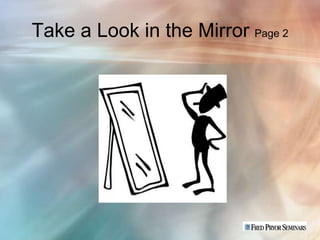
Take a Look in the Mirror Page 2
Emotional Intelligence (EI) Page 4

          What is it?
Emotional Intelligence (EI) Page 4

The capacity for recognizing our own
 feelings and those of others, for motivating
 ourselves, and for managing emotions well
 in ourselves and in our relationships.

                    Daniel Goleman
                    “Working with Emotional Intelligence”
Let’s see what more Daniel has
           to share….
  Lights, Camera…ACTION!


                        http://ht.ly/anqmf
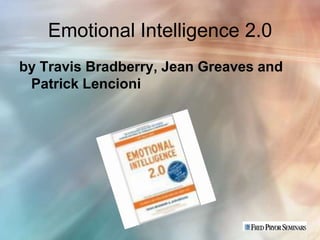
Emotional Intelligence 2.0
by Travis Bradberry, Jean Greaves and
 Patrick Lencioni
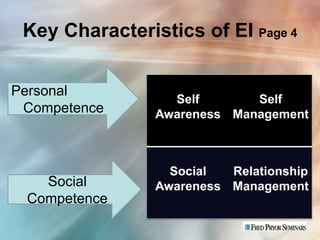
Key Characteristics of EI Page 4

Personal
                  Self       Self
 Competence     Awareness Management


                  Social  Relationship
   Social       Awareness Management
 Competence
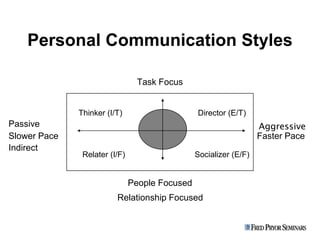
Personal Communication Styles

                                Task Focus


              Thinker (I/T)                     Director (E/T)
Passive                                                            Aggressive
Slower Pace                                                        Faster Pace
Indirect                                                Direct
               Relater (I/F)                    Socializer (E/F)


                               People Focused
                         Relationship Focused
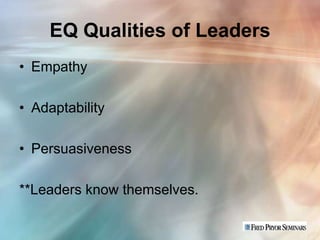
EQ Qualities of Leaders
• Empathy

• Adaptability

• Persuasiveness

**Leaders know themselves.
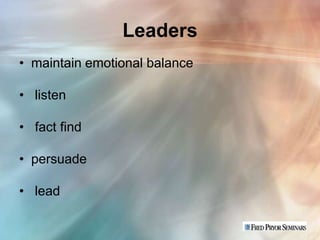
Leaders
• maintain emotional balance

• listen

• fact find

• persuade

• lead
Self-Confidence of Leader
There is a quality of self-confidence a
leader possesses that enlists trust from
those they lead.
The number one thing a leader needs to
posses to be truly a leader is the trust of
the team.
A leader can ask for great contributions
from a team only to the degree that there
is credibility.
Credibility & Trustworthy
To be deemed trustworthy, is an important
 characteristic of a person who possesses
 and exhibits EQ.

Credibility is an incredibly hard leadership
 trait to possess. It cannot be taught. It
 must be learned and earned.
Beliefs Effect Our Assumptions
• Ourselves


• About others in the world


• About how we expect things to be
Beliefs Are Our Reality
• how we think things are
• what we think is true
• what we expect as a likely consequence that will
  follow from our behavior


**What we create through our thoughts is a belief system
  and that ultimately determines success in life.
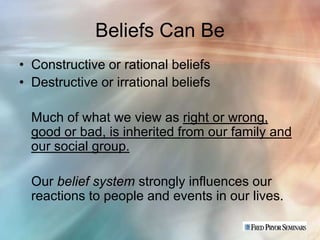
Beliefs Can Be
• Constructive or rational beliefs
• Destructive or irrational beliefs

  Much of what we view as right or wrong,
  good or bad, is inherited from our family and
  our social group.

  Our belief system strongly influences our
  reactions to people and events in our lives.
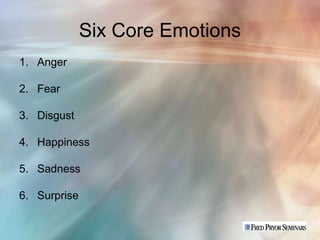
Six Core Emotions
1. Anger

2. Fear

3. Disgust

4. Happiness

5. Sadness

6. Surprise
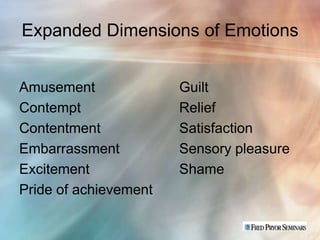
Expanded Dimensions of Emotions


Amusement              Guilt
Contempt               Relief
Contentment            Satisfaction
Embarrassment          Sensory pleasure
Excitement             Shame
Pride of achievement
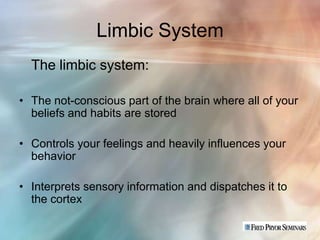
Limbic System
  The limbic system:

• The not-conscious part of the brain where all of your
  beliefs and habits are stored

• Controls your feelings and heavily influences your
  behavior

• Interprets sensory information and dispatches it to
  the cortex
Cortex

The conscious center of the brain that
hears what you are thinking and can
intellectually control behavior for
processing.

The limbic sets the emotional tone of the
information before it reaches the cortex.
Rational / Irrational Beliefs

               Rational beliefs:
     positive, constructive and adaptive

              Irrational beliefs:
lead to negative emotions like anxiety, anger,
                 and depression
Attitude
                  Attitude
 is the mental state that you have while
         carrying out your actions.

It is the way you view the world around you
   and choose to see it, either positively or
                 negatively.
Ability
                    Ability
is the quality of being able to perform; a
      quality that permits or facilitates
     achievement or accomplishment.

It is how highly skilled you are. Much of
this is genetically predetermined in IQ or
              physical ability.
Motivation

                  Motivation
is the level at which you are able to find “a
                 reason to act.”

This is the internal drive that you find that
   enable you to exercise your abilities.
Motivation Comes from Within
Motivation is an internal force that drives
individuals to act to achieve a specific goal.

Two people listen to the same inspirational
audio
-- one person is motivated to act, the other is
not.
Motivation and Goals

We attain emotional intelligence by
 managing negative emotions and
        attaining our goals.
Maslow’s Hierarchy of Needs
1. Biological and Physiological Needs

2. Safety Needs

3. Belonginess and Love Needs

4. Esteem Needs

5. Cognitive Needs

6. Aesthetic Needs

7. Self-Actualization Needs

8. Transcendence Needs
The Law of Attraction

“Whatever we think about, we bring about.”


 The Law of Attraction is considered by
 many to be the most important law of all in
 explaining both success and failure.
Pessimism
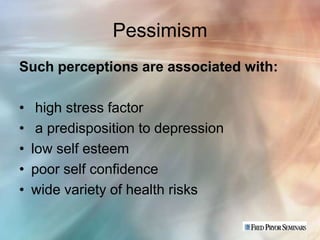
Such perceptions are associated with:

•    high stress factor
•    a predisposition to depression
•   low self esteem
•   poor self confidence
•   wide variety of health risks
Pessimism

Perceptions of helplessness and poor coping
were associated with the inability to attribute
any real meaning or purpose to a problem
situation.
Using Positive Illusion
• Acknowledge the negative feelings respectfully as
  signposts of negative thinking

• Focus your energies on a positive substitute

• Use your creativity (imagination) to rehearse a
  more productive line of thinking

• Dwell on the positives in your life
GOAL SETTING

“The world cares very little what a man or
woman knows; it is what a man or woman is
able to do that counts.”
           Booker T. Washington

    Goal Setting Gives Us Purpose!

  Self motivation + positive attitude =
                SUCCESS
Goal Setting Is A Powerful Way to
        Motivate People!

 “If you think you can do a
 thing or think you can't do a
      thing, you're right.”
          Henry Ford
SMART Goals
Specific

Measurable

Achievable

Realistic

Time-bound
Tips for Establishing Rapport
• Possessing a desire for a better relationship
• Continuously learning about human behavior
• Individualize interaction
• Adjust your communication style to the other persons’
• Let them know you want to work with them effectively
• Express your knowledge and understanding of them as a
  person
• Be truthful
• Establish trust
Establish Trust
• Mirroring--reflecting another person’s
  communication style back to them in a positive
  way. Mirror don’t mimic!
• Self-awareness
• Self-control
• Motivation: desire to show empathy
• Communication skills
• Listening
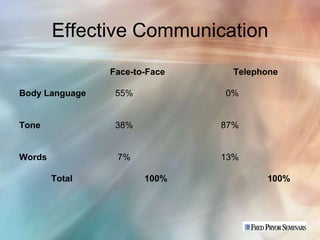
Effective Communication
                Face-to-Face     Telephone

Body Language    55%           0%


Tone             38%           87%


Words            7%            13%

        Total          100%            100%
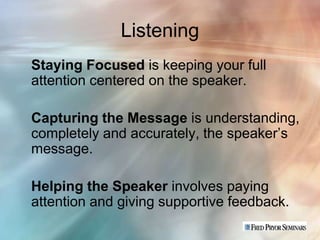
Listening
Staying Focused is keeping your full
attention centered on the speaker.

Capturing the Message is understanding,
completely and accurately, the speaker’s
message.

Helping the Speaker involves paying
attention and giving supportive feedback.
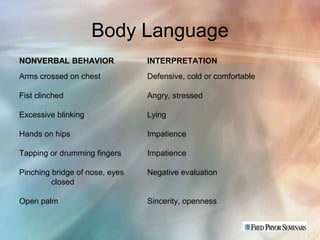
Body Language
NONVERBAL BEHAVIOR              INTERPRETATION
Arms crossed on chest           Defensive, cold or comfortable

Fist clinched                   Angry, stressed

Excessive blinking              Lying

Hands on hips                   Impatience

Tapping or drumming fingers     Impatience

Pinching bridge of nose, eyes   Negative evaluation
         closed

Open palm                       Sincerity, openness
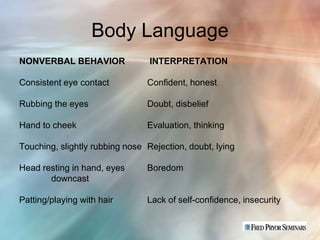
Body Language
NONVERBAL BEHAVIOR               INTERPRETATION

Consistent eye contact          Confident, honest

Rubbing the eyes                Doubt, disbelief

Hand to cheek                   Evaluation, thinking

Touching, slightly rubbing nose Rejection, doubt, lying

Head resting in hand, eyes      Boredom
       downcast

Patting/playing with hair       Lack of self-confidence, insecurity
Bonus
   Executive Intelligence

What All Great Leaders Have
     By Justin Menkes
       www.HR.com
Bonus-Executive Intelligence
Getting Tasks Done:
 Ability to evaluate data
 Define problems & determine
 obstacles
 Deliver sensible solutions
Working effectively with & through
 others
Evaluating & adapting own behavior
Fun Homework

Our friends at The Office
     demonstrate EI

http://ht.ly/ano5E
Remember:


Progress Not Perfection

 Enjoy the Journey!!!

Ei attorney general texas slideshare

  • 1.
    Emotional Intelligence Presented by: Kelly Alcorn, CT, CCP All copyrighted slides removed
  • 2.
    Activity Form three teamsand complete the word search!
  • 3.
    Why a WordSearch? • Communication skills • Listening skills • Organization skills • Cooperation
  • 4.
    Emotional Intelligence Page1 Timeline 1960’s Harper’s Magazine 1980’s Howard Gardner’s Frames of Mind: The Theory or Multiple Intelligences 1995 Daniel Goleman’s Emotional Intelligence: Why It Can Matter More Than IQ 2012 Emotional Intelligence 2.0
  • 5.
  • 6.
    Today’s Workplace Page2 • What skills & abilities are needed to be successful here?
  • 7.
    Take a Lookin the Mirror Page 2
  • 8.
    Emotional Intelligence (EI)Page 4 What is it?
  • 9.
    Emotional Intelligence (EI)Page 4 The capacity for recognizing our own feelings and those of others, for motivating ourselves, and for managing emotions well in ourselves and in our relationships. Daniel Goleman “Working with Emotional Intelligence”
  • 10.
    Let’s see whatmore Daniel has to share…. Lights, Camera…ACTION! http://ht.ly/anqmf
  • 11.
    Emotional Intelligence 2.0 byTravis Bradberry, Jean Greaves and Patrick Lencioni
  • 12.
    Key Characteristics ofEI Page 4 Personal Self Self Competence Awareness Management Social Relationship Social Awareness Management Competence
  • 13.
    Personal Communication Styles Task Focus Thinker (I/T) Director (E/T) Passive Aggressive Slower Pace Faster Pace Indirect Direct Relater (I/F) Socializer (E/F) People Focused Relationship Focused
  • 14.
    EQ Qualities ofLeaders • Empathy • Adaptability • Persuasiveness **Leaders know themselves.
  • 15.
    Leaders • maintain emotionalbalance • listen • fact find • persuade • lead
  • 16.
    Self-Confidence of Leader Thereis a quality of self-confidence a leader possesses that enlists trust from those they lead. The number one thing a leader needs to posses to be truly a leader is the trust of the team. A leader can ask for great contributions from a team only to the degree that there is credibility.
  • 17.
    Credibility & Trustworthy Tobe deemed trustworthy, is an important characteristic of a person who possesses and exhibits EQ. Credibility is an incredibly hard leadership trait to possess. It cannot be taught. It must be learned and earned.
  • 18.
    Beliefs Effect OurAssumptions • Ourselves • About others in the world • About how we expect things to be
  • 19.
    Beliefs Are OurReality • how we think things are • what we think is true • what we expect as a likely consequence that will follow from our behavior **What we create through our thoughts is a belief system and that ultimately determines success in life.
  • 20.
    Beliefs Can Be •Constructive or rational beliefs • Destructive or irrational beliefs Much of what we view as right or wrong, good or bad, is inherited from our family and our social group. Our belief system strongly influences our reactions to people and events in our lives.
  • 21.
    Six Core Emotions 1.Anger 2. Fear 3. Disgust 4. Happiness 5. Sadness 6. Surprise
  • 22.
    Expanded Dimensions ofEmotions Amusement Guilt Contempt Relief Contentment Satisfaction Embarrassment Sensory pleasure Excitement Shame Pride of achievement
  • 23.
    Limbic System The limbic system: • The not-conscious part of the brain where all of your beliefs and habits are stored • Controls your feelings and heavily influences your behavior • Interprets sensory information and dispatches it to the cortex
  • 24.
    Cortex The conscious centerof the brain that hears what you are thinking and can intellectually control behavior for processing. The limbic sets the emotional tone of the information before it reaches the cortex.
  • 25.
    Rational / IrrationalBeliefs Rational beliefs: positive, constructive and adaptive Irrational beliefs: lead to negative emotions like anxiety, anger, and depression
  • 26.
    Attitude Attitude is the mental state that you have while carrying out your actions. It is the way you view the world around you and choose to see it, either positively or negatively.
  • 27.
    Ability Ability is the quality of being able to perform; a quality that permits or facilitates achievement or accomplishment. It is how highly skilled you are. Much of this is genetically predetermined in IQ or physical ability.
  • 28.
    Motivation Motivation is the level at which you are able to find “a reason to act.” This is the internal drive that you find that enable you to exercise your abilities.
  • 29.
    Motivation Comes fromWithin Motivation is an internal force that drives individuals to act to achieve a specific goal. Two people listen to the same inspirational audio -- one person is motivated to act, the other is not.
  • 30.
    Motivation and Goals Weattain emotional intelligence by managing negative emotions and attaining our goals.
  • 31.
    Maslow’s Hierarchy ofNeeds 1. Biological and Physiological Needs 2. Safety Needs 3. Belonginess and Love Needs 4. Esteem Needs 5. Cognitive Needs 6. Aesthetic Needs 7. Self-Actualization Needs 8. Transcendence Needs
  • 32.
    The Law ofAttraction “Whatever we think about, we bring about.” The Law of Attraction is considered by many to be the most important law of all in explaining both success and failure.
  • 33.
    Pessimism Such perceptions areassociated with: • high stress factor • a predisposition to depression • low self esteem • poor self confidence • wide variety of health risks
  • 34.
    Pessimism Perceptions of helplessnessand poor coping were associated with the inability to attribute any real meaning or purpose to a problem situation.
  • 35.
    Using Positive Illusion •Acknowledge the negative feelings respectfully as signposts of negative thinking • Focus your energies on a positive substitute • Use your creativity (imagination) to rehearse a more productive line of thinking • Dwell on the positives in your life
  • 36.
    GOAL SETTING “The worldcares very little what a man or woman knows; it is what a man or woman is able to do that counts.” Booker T. Washington Goal Setting Gives Us Purpose! Self motivation + positive attitude = SUCCESS
  • 37.
    Goal Setting IsA Powerful Way to Motivate People! “If you think you can do a thing or think you can't do a thing, you're right.” Henry Ford
  • 38.
  • 39.
    Tips for EstablishingRapport • Possessing a desire for a better relationship • Continuously learning about human behavior • Individualize interaction • Adjust your communication style to the other persons’ • Let them know you want to work with them effectively • Express your knowledge and understanding of them as a person • Be truthful • Establish trust
  • 40.
    Establish Trust • Mirroring--reflectinganother person’s communication style back to them in a positive way. Mirror don’t mimic! • Self-awareness • Self-control • Motivation: desire to show empathy • Communication skills • Listening
  • 41.
    Effective Communication Face-to-Face Telephone Body Language 55% 0% Tone 38% 87% Words 7% 13% Total 100% 100%
  • 42.
    Listening Staying Focused iskeeping your full attention centered on the speaker. Capturing the Message is understanding, completely and accurately, the speaker’s message. Helping the Speaker involves paying attention and giving supportive feedback.
  • 43.
    Body Language NONVERBAL BEHAVIOR INTERPRETATION Arms crossed on chest Defensive, cold or comfortable Fist clinched Angry, stressed Excessive blinking Lying Hands on hips Impatience Tapping or drumming fingers Impatience Pinching bridge of nose, eyes Negative evaluation closed Open palm Sincerity, openness
  • 44.
    Body Language NONVERBAL BEHAVIOR INTERPRETATION Consistent eye contact Confident, honest Rubbing the eyes Doubt, disbelief Hand to cheek Evaluation, thinking Touching, slightly rubbing nose Rejection, doubt, lying Head resting in hand, eyes Boredom downcast Patting/playing with hair Lack of self-confidence, insecurity
  • 45.
    Bonus Executive Intelligence What All Great Leaders Have By Justin Menkes www.HR.com
  • 46.
    Bonus-Executive Intelligence Getting TasksDone: Ability to evaluate data Define problems & determine obstacles Deliver sensible solutions Working effectively with & through others Evaluating & adapting own behavior
  • 47.
    Fun Homework Our friendsat The Office demonstrate EI http://ht.ly/ano5E
  • 48.