
Functional Somatic
Syndromes
Chris Stewart-Patterson MD
Program Director
Harvard Medical School
No disclosures
FSS Definition
• “FSS are characterised by
patterns of persistent bodily
complaints for which adequate
examination does not reveal
sufficiently explanatory structural
or other specified pathology.”
– The Lancet, Volume 369, Issue 9565, March 2007
Clinical Features of FSS?
• Sx of CFS, FMS, MCS, IBS, Chronic
Lyme Disease…
• No defined pathophysiology
• High rate of psychiatric comorbidities
• Contribution of psycho-social factors
• Barsky & Borus, Ann Int Med 1999.130:910-
921
FSS Psychosocial Factors
1. Belief of a serious disease
2. Expectations of worsening
disease
3. “Sick Role"
–including litigation & compensation
4. Stress & distress
– Barsky & Borus, Ann Int Med 1999.130:910-
921
Difficult Encounters
• MUS & high somatic Sx counts
• 2-3 times more likely to have a
depressive or anxiety disorder
• A stepped care approach may
improve care & enhance physician
satisfaction
• Kroenke. J Clin Psychiatry 2003;5 [suppl 7]: 11–
18)
“Can you check to
see if I have
hemosiderin laden
macrophages?”
Don’t miss pathology!
Somatoform Tool Box!
• Approach
• Interview
• Focus on
function
• Screening tools
• Communication
• Treatment
review
A Very Brief History
of Somatization &
Somatic Syndromes…
Fibromyalgia…
• 1838 spa Dr. Charles Despine
–Varying “Pointes hysteric”
• 1904 BMJ Dr. William Gowers
–“fibrositis”
–On biopsy: muscle tissue inflammation
• 1970’s increased media attention
1990 ACR FMS Criteria
Wolfe, Smythe, Yunus et al
• Rheumatological & physical
emphasis
• Hx of widespread pain for at least 3
months
• In combination with at least 11/18
tender points being painful
FMS Literature Trends 1996
• If < 11 TPs may have FMS if
have widespread pain & many
other related sx
• Dx after longitudinal
observation & considering
….psychiatric symptoms
• No Dx validation in
compensation settings
– Wolfe F et al. Journal of Rheumatology 1996;23:S
FMS Literature Trends
1997-2003
• “…near epidemic proportions in
courts……mounting evidence that many
patients have major affective ,
somatization & personality disorders…”
• Wolfe F. J Rheumatology 24:7 1997
• “…By ignoring the central psychosocial
and distress …and choosing instead a
physical examination item, we allowed FM
to be seen as mostly a physical illness…”
»Wolfe F. J Rheumatology 2003; 30:8
FMS Literature Trends
2009
“Medically unexplained symptoms…
…the contention around FM should be
the extent to which it is socially
constructed and medicalized…the
extent to which psychosomatic
factors dominate.”
–Wolfe F. J. Rheumatology 2009 36:4:671-678
ACR FMS Screening 2010
• Does not require a physical or
tender point examination
• Combines 2 brief questionnaire
scales
–Symptom Severity (SS) scale
–Widespread Pain Index (WPI)
–Wolfe et al. Arthritis Care & Research
Vol. 62, No. 5, May 2010
Somatic Symptoms Scale
Muscle pain, irritable bowel syndrome, fatigue,
thinking or remembering problem, muscle
weakness, headache, pain/cramps in the
abdomen, numbness, tingling, dizziness,
insomnia, depression, constipation, pain upper
abdomen, nausea, nervousness, chest pain,
blurred vision, fever, diarrhea, dry mouth,
itching, wheezing, Raynaud’s phenomenon,
hives/welts, tinnitus, vomiting, heartburn, oral
ulcers, change in taste, seizures, dry eyes,
shortness of breath, loss of appetite, rash, sun
sensitivity, hearing difficulties, easy bruising,
hair loss, frequent or painful urination, bladder
spasms
DSM & FSS
• DSM IV TR Somatization Disorder (2000)
–“…so called functional disorders (e.g.
IBS) symptoms may count towards a Dx
of Somatization Disorder”
• DSM V Somatic Symptom Disorder (2013)
–“the Sx of IBS or FMS would not satisfy
the criterion necessary to Dx somatic
Symptom Disorder”
Current FMS Pathophysiology Theories
• Central sensitization
• Neurohumoral abnormalities
• Psychiatric comorbidity
–Ann Int Med 2007;146:762-734
• Likely FMS originates in the CNS
–IASP Pain Clinical Updates Volume XVI, Issue
4 June 2008
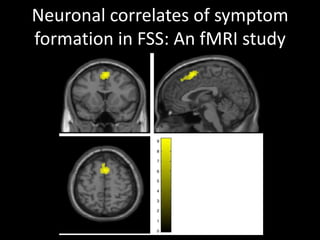
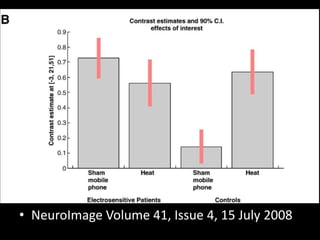
Neuronal correlates of symptom
formation in FSS: An fMRI study
• NeuroImage Volume 41, Issue 4, 15 July 2008
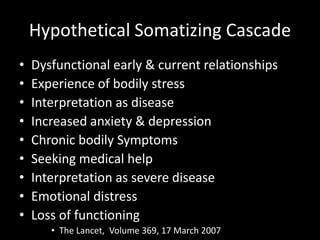
Hypothetical Somatizing Cascade
• Dysfunctional early & current relationships
• Experience of bodily stress
• Interpretation as disease
• Increased anxiety & depression
• Chronic bodily Symptoms
• Seeking medical help
• Interpretation as severe disease
• Emotional distress
• Loss of functioning
• The Lancet, Volume 369, 17 March 2007
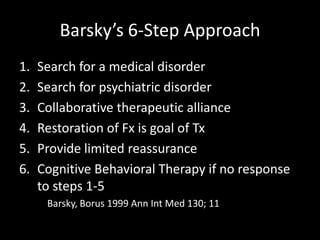
Barsky’s 6-Step Approach
1. Search for a medical disorder
2. Search for psychiatric disorder
3. Collaborative therapeutic alliance
4. Restoration of Fx is goal of Tx
5. Provide limited reassurance
6. Cognitive Behavioral Therapy if no response
to steps 1-5
Barsky, Borus 1999 Ann Int Med 130; 11
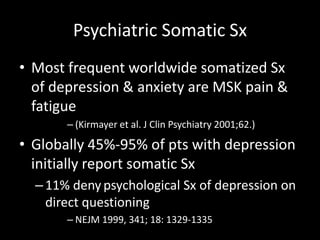
Psychiatric Somatic Sx
• Most frequent worldwide somatized Sx
of depression & anxiety are MSK pain &
fatigue
– (Kirmayer et al. J Clin Psychiatry 2001;62.)
• Globally 45%-95% of pts with depression
initially report somatic Sx
–11% deny psychological Sx of depression on
direct questioning
– NEJM 1999, 341; 18: 1329-1335
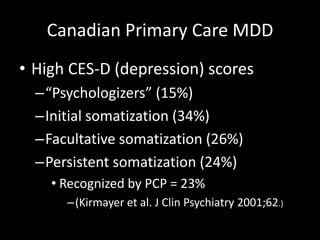
Canadian Primary Care MDD
• High CES-D (depression) scores
–“Psychologizers” (15%)
–Initial somatization (34%)
–Facultative somatization (26%)
–Persistent somatization (24%)
• Recognized by PCP = 23%
–(Kirmayer et al. J Clin Psychiatry 2001;62.)
Group Exercise
• Take a minute to remember a FSS
case and jot down a note
• Group in 2 or 3s and one of you
quickly discuss your case
History
• High # of Sx likely indicates
somatization
• Caution with AIDS, SLE, TB
• Careful with pts age >50 & “red flags”
• Change in headache?
• History of cancer?
• Nocturnal back pain?
• Unexplained weight change?
Sleep Screening
• HS Medication
• Sleep onset
• Nocturnal wakenings
• Time get up
• Refreshed
• Nap times
• +/- OSA screen
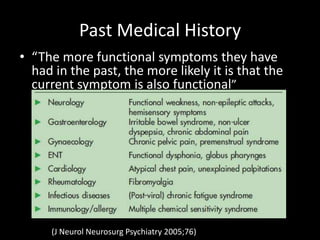
Past Medical History
• “The more functional symptoms they have
had in the past, the more likely it is that the
current symptom is also functional”
(J Neurol Neurosurg Psychiatry 2005;76)
Focus on Function!
• Change focus of treatment from
symptoms to improving functioning
• Prevent deconditioning & secondary
disability
• Assessment of capacity for
SAW/RTW
• Assessment of malingering
Focus on Function!
Functional Assessment
• Stated activity tolerances
• Current roles
• House and yard chores
• Hobbies and recreational
activities
• Functional physical examination
Disability Self Perception
• 60 pts AS, FMS, RA & 4 controls
–Pt self-rate disability with 7 activities (VAS)
–Video of same 7 activities performed
–6 OT & MDs (blinded to Dx) rate video (VAS)
• Discordance in VAS
–AS & RA not significant
–FMS is high (36%) p<0.01
• Hidding et al. J Rheumatology 1994;21:5, p 818
Physical Examination
• Full physical exam
• Functional physical exam
–Sit, arise, stand, walk, bend,
squat…
–Look for evidence of impairment
• MSE: depressed or anxious
Exam Screening for FMS
BP Cuff invoked allodynia
• Inflate 10mmHg/sec to 180
mmHg or to pain
• Say “Tell me if the cuff’s pressure
brings forth pain”
• 69% FMS report pain vs. 2% normals
–70% sensitive & 96% specific for
FMS
–J Clin Rheum 2006;6
PHQ-15 Questionnaire
PHQ-15 Severity PHQ-15 Score
Screen
• Score the 15 Sx as
• 0 “not bothered at all”
• 1 “bothered a little”
• 2 “bothered a lot”
• 5, 10, 15 are cut points for low,
medium & high somatic Sx severity
– Kroenke, Spitzer et al. Psychosomatic Medicine
64:258–266 (2002)
• www.phqscreeners.com
Disability Days in Last 3 months
• (Kroenke J Clin Psychiatry 2003;5[suppl 7]: 11–18)
When to stop the investigations?
• Reasonable workup for common
conditions
• No “red flags”
• +/- specialist consultation
• Patient is counselled & educated
• You are comfortable
• Workup is well documented
Somatization Tx Structure
• One designated physician
• Brief, regular visits not contingent on
new Sx
• Engage or lose!
• Focus on function not chronic Sx
• Provide & assess measurable goals
• Prevent secondary disability
Provide Limited Reassurance
1. Hurt vs harm
2. Care rather than cure
–“You do not have any life-threatening
illness. You do, however, have a medical
condition that is incompletely
understood. Though no treatment is
available that can cure it completely,
there are a number of interventions
that can help you deal with the
symptoms better than you have so far.”
Activity Rx: Focus on Function
–What pts should be doing for recovery
and to preserve well-being
–What pts should not do because of
medical risk (harm self or to others)
–What pts can & cannot do given their
medical condition & functional ability
–Whether or not they are willing to
tolerate the activity
Fibromyalgia & Lifestyle Physical
Activity
• Recorded daily steps & types of LPA’s
– Tx group is to Increase LPAs
– Control group education only
• LPA group increased daily steps from
3,788 to 5,837 (± 1,770) over 12/52
• LPA group reported significantly less
perceived functional deficits & pain
– Fontaine et al. Arthritis Research & Therapy 2010, 12:R55
CBT & Stress Management Resources
• Vancouver CBT
–www.vancouvercbt.ca
–www.changeways.com
• Relaxation Response Instructions
–www.massgeneral.org/bhi/basics
• Behavior treatment for insomnia
–www.cbtforinsomnia.com
Discuss your case…
• Search for a medical disorder
• Search for psychiatric disorder
• Collaborative therapeutic alliance
• Restoration of Fx is goal of Tx
• Provide limited reassurance
• CBT if no response to steps 1-5
Poor Response to Tx?
• Illness beliefs & misinformation
• Poor integration in treatment
• Personality disorders
• Opioid or other SUD
• Workplace or interpersonal
conflict
• Compensation seeking behavior
DSM-IV & V Diagnostic Criteria
• DSM-IV Somatization Disorder & Pain
Disorder
–“The Sx are not intentionally produced
or feigned (as in …Malingering)”
• DSM V Somatic Symptom Disorder
–No mention of malingering
Malingering Prevalence?
• AMA: Probable prevalence DI, PI & WCB
is 25%-30%
(Melhorn & Ackerman, 2008; Genovese & Galper, 2009)
• 33,000 neuropsychological testing cases
–Probable malingering or exaggeration
• Fibromyalgia/chronic fatigue 35%
(Mittenberg, W. et al., J Clin Exper Neuropsychology, 2002)
Focus on Function…
• Marked discrepancy between stated
disability and observations
• (DSM-IV & V)
• “Cross validation” of reported functioning
with observation
• (Rondinelli, 2007)
• One of the most common incongruencies
– Discrepancy in reported level of functioning &
observed level of functioning
• (Rogers, 2008)
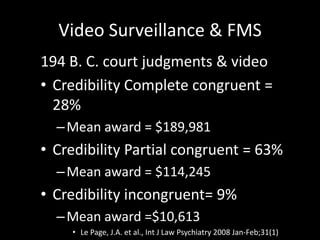
Video Surveillance & FMS
194 B. C. court judgments & video
• Credibility Complete congruent =
28%
–Mean award = $189,981
• Credibility Partial congruent = 63%
–Mean award = $114,245
• Credibility incongruent= 9%
–Mean award =$10,613
• Le Page, J.A. et al., Int J Law Psychiatry 2008 Jan-Feb;31(1)
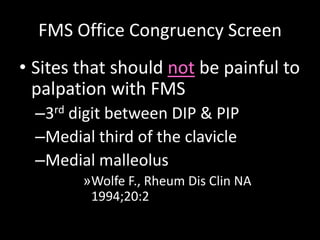
FMS Office Congruency Screen
• Sites that should not be painful to
palpation with FMS
–3rd digit between DIP & PIP
–Medial third of the clavicle
–Medial malleolus
»Wolfe F., Rheum Dis Clin NA
1994;20:2
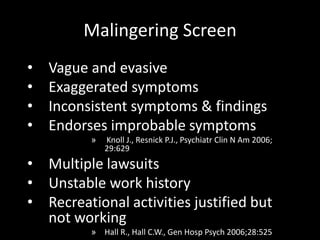
Malingering Screen
• Vague and evasive
• Exaggerated symptoms
• Inconsistent symptoms & findings
• Endorses improbable symptoms
» Knoll J., Resnick P.J., Psychiatr Clin N Am 2006;
29:629
• Multiple lawsuits
• Unstable work history
• Recreational activities justified but
not working
» Hall R., Hall C.W., Gen Hosp Psych 2006;28:525
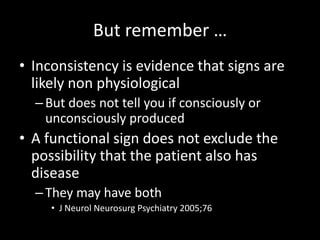
But remember …
• Inconsistency is evidence that signs are
likely non physiological
–But does not tell you if consciously or
unconsciously produced
• A functional sign does not exclude the
possibility that the patient also has
disease
–They may have both
• J Neurol Neurosurg Psychiatry 2005;76
Summary
1. Search for a medical disorder
2. Search for psychiatric disorder
3. Therapeutic alliance
4. Restoration of Fx is goal of Tx
5. Provide limited reassurance
6. CBT if no response to steps 1-5
Session 4   stewart-patterson functional somatic syndromes

Session 4 stewart-patterson functional somatic syndromes

  • 1.
    Functional Somatic Syndromes Chris Stewart-PattersonMD Program Director Harvard Medical School No disclosures
  • 2.
    FSS Definition • “FSSare characterised by patterns of persistent bodily complaints for which adequate examination does not reveal sufficiently explanatory structural or other specified pathology.” – The Lancet, Volume 369, Issue 9565, March 2007
  • 3.
    Clinical Features ofFSS? • Sx of CFS, FMS, MCS, IBS, Chronic Lyme Disease… • No defined pathophysiology • High rate of psychiatric comorbidities • Contribution of psycho-social factors • Barsky & Borus, Ann Int Med 1999.130:910- 921
  • 4.
    FSS Psychosocial Factors 1.Belief of a serious disease 2. Expectations of worsening disease 3. “Sick Role" –including litigation & compensation 4. Stress & distress – Barsky & Borus, Ann Int Med 1999.130:910- 921
  • 5.
    Difficult Encounters • MUS& high somatic Sx counts • 2-3 times more likely to have a depressive or anxiety disorder • A stepped care approach may improve care & enhance physician satisfaction • Kroenke. J Clin Psychiatry 2003;5 [suppl 7]: 11– 18)
  • 6.
    “Can you checkto see if I have hemosiderin laden macrophages?”
  • 8.
  • 9.
    Somatoform Tool Box! •Approach • Interview • Focus on function • Screening tools • Communication • Treatment review
  • 10.
    A Very BriefHistory of Somatization & Somatic Syndromes…
  • 13.
    Fibromyalgia… • 1838 spaDr. Charles Despine –Varying “Pointes hysteric” • 1904 BMJ Dr. William Gowers –“fibrositis” –On biopsy: muscle tissue inflammation • 1970’s increased media attention
  • 14.
    1990 ACR FMSCriteria Wolfe, Smythe, Yunus et al • Rheumatological & physical emphasis • Hx of widespread pain for at least 3 months • In combination with at least 11/18 tender points being painful
  • 15.
    FMS Literature Trends1996 • If < 11 TPs may have FMS if have widespread pain & many other related sx • Dx after longitudinal observation & considering ….psychiatric symptoms • No Dx validation in compensation settings – Wolfe F et al. Journal of Rheumatology 1996;23:S
  • 16.
    FMS Literature Trends 1997-2003 •“…near epidemic proportions in courts……mounting evidence that many patients have major affective , somatization & personality disorders…” • Wolfe F. J Rheumatology 24:7 1997 • “…By ignoring the central psychosocial and distress …and choosing instead a physical examination item, we allowed FM to be seen as mostly a physical illness…” »Wolfe F. J Rheumatology 2003; 30:8
  • 17.
    FMS Literature Trends 2009 “Medicallyunexplained symptoms… …the contention around FM should be the extent to which it is socially constructed and medicalized…the extent to which psychosomatic factors dominate.” –Wolfe F. J. Rheumatology 2009 36:4:671-678
  • 18.
    ACR FMS Screening2010 • Does not require a physical or tender point examination • Combines 2 brief questionnaire scales –Symptom Severity (SS) scale –Widespread Pain Index (WPI) –Wolfe et al. Arthritis Care & Research Vol. 62, No. 5, May 2010
  • 19.
    Somatic Symptoms Scale Musclepain, irritable bowel syndrome, fatigue, thinking or remembering problem, muscle weakness, headache, pain/cramps in the abdomen, numbness, tingling, dizziness, insomnia, depression, constipation, pain upper abdomen, nausea, nervousness, chest pain, blurred vision, fever, diarrhea, dry mouth, itching, wheezing, Raynaud’s phenomenon, hives/welts, tinnitus, vomiting, heartburn, oral ulcers, change in taste, seizures, dry eyes, shortness of breath, loss of appetite, rash, sun sensitivity, hearing difficulties, easy bruising, hair loss, frequent or painful urination, bladder spasms
  • 20.
    DSM & FSS •DSM IV TR Somatization Disorder (2000) –“…so called functional disorders (e.g. IBS) symptoms may count towards a Dx of Somatization Disorder” • DSM V Somatic Symptom Disorder (2013) –“the Sx of IBS or FMS would not satisfy the criterion necessary to Dx somatic Symptom Disorder”
  • 21.
    Current FMS PathophysiologyTheories • Central sensitization • Neurohumoral abnormalities • Psychiatric comorbidity –Ann Int Med 2007;146:762-734 • Likely FMS originates in the CNS –IASP Pain Clinical Updates Volume XVI, Issue 4 June 2008
  • 22.
    Neuronal correlates ofsymptom formation in FSS: An fMRI study
  • 23.
    • NeuroImage Volume41, Issue 4, 15 July 2008
  • 24.
    Hypothetical Somatizing Cascade •Dysfunctional early & current relationships • Experience of bodily stress • Interpretation as disease • Increased anxiety & depression • Chronic bodily Symptoms • Seeking medical help • Interpretation as severe disease • Emotional distress • Loss of functioning • The Lancet, Volume 369, 17 March 2007
  • 25.
    Barsky’s 6-Step Approach 1.Search for a medical disorder 2. Search for psychiatric disorder 3. Collaborative therapeutic alliance 4. Restoration of Fx is goal of Tx 5. Provide limited reassurance 6. Cognitive Behavioral Therapy if no response to steps 1-5 Barsky, Borus 1999 Ann Int Med 130; 11
  • 26.
    Psychiatric Somatic Sx •Most frequent worldwide somatized Sx of depression & anxiety are MSK pain & fatigue – (Kirmayer et al. J Clin Psychiatry 2001;62.) • Globally 45%-95% of pts with depression initially report somatic Sx –11% deny psychological Sx of depression on direct questioning – NEJM 1999, 341; 18: 1329-1335
  • 27.
    Canadian Primary CareMDD • High CES-D (depression) scores –“Psychologizers” (15%) –Initial somatization (34%) –Facultative somatization (26%) –Persistent somatization (24%) • Recognized by PCP = 23% –(Kirmayer et al. J Clin Psychiatry 2001;62.)
  • 28.
    Group Exercise • Takea minute to remember a FSS case and jot down a note • Group in 2 or 3s and one of you quickly discuss your case
  • 29.
    History • High #of Sx likely indicates somatization • Caution with AIDS, SLE, TB • Careful with pts age >50 & “red flags” • Change in headache? • History of cancer? • Nocturnal back pain? • Unexplained weight change?
  • 30.
    Sleep Screening • HSMedication • Sleep onset • Nocturnal wakenings • Time get up • Refreshed • Nap times • +/- OSA screen
  • 31.
    Past Medical History •“The more functional symptoms they have had in the past, the more likely it is that the current symptom is also functional” (J Neurol Neurosurg Psychiatry 2005;76)
  • 32.
    Focus on Function! •Change focus of treatment from symptoms to improving functioning • Prevent deconditioning & secondary disability • Assessment of capacity for SAW/RTW • Assessment of malingering
  • 33.
  • 34.
    Functional Assessment • Statedactivity tolerances • Current roles • House and yard chores • Hobbies and recreational activities • Functional physical examination
  • 35.
    Disability Self Perception •60 pts AS, FMS, RA & 4 controls –Pt self-rate disability with 7 activities (VAS) –Video of same 7 activities performed –6 OT & MDs (blinded to Dx) rate video (VAS) • Discordance in VAS –AS & RA not significant –FMS is high (36%) p<0.01 • Hidding et al. J Rheumatology 1994;21:5, p 818
  • 36.
    Physical Examination • Fullphysical exam • Functional physical exam –Sit, arise, stand, walk, bend, squat… –Look for evidence of impairment • MSE: depressed or anxious
  • 37.
    Exam Screening forFMS BP Cuff invoked allodynia • Inflate 10mmHg/sec to 180 mmHg or to pain • Say “Tell me if the cuff’s pressure brings forth pain” • 69% FMS report pain vs. 2% normals –70% sensitive & 96% specific for FMS –J Clin Rheum 2006;6
  • 38.
    PHQ-15 Questionnaire PHQ-15 SeverityPHQ-15 Score Screen • Score the 15 Sx as • 0 “not bothered at all” • 1 “bothered a little” • 2 “bothered a lot” • 5, 10, 15 are cut points for low, medium & high somatic Sx severity – Kroenke, Spitzer et al. Psychosomatic Medicine 64:258–266 (2002) • www.phqscreeners.com
  • 39.
    Disability Days inLast 3 months • (Kroenke J Clin Psychiatry 2003;5[suppl 7]: 11–18)
  • 40.
    When to stopthe investigations? • Reasonable workup for common conditions • No “red flags” • +/- specialist consultation • Patient is counselled & educated • You are comfortable • Workup is well documented
  • 41.
    Somatization Tx Structure •One designated physician • Brief, regular visits not contingent on new Sx • Engage or lose! • Focus on function not chronic Sx • Provide & assess measurable goals • Prevent secondary disability
  • 42.
    Provide Limited Reassurance 1.Hurt vs harm 2. Care rather than cure –“You do not have any life-threatening illness. You do, however, have a medical condition that is incompletely understood. Though no treatment is available that can cure it completely, there are a number of interventions that can help you deal with the symptoms better than you have so far.”
  • 43.
    Activity Rx: Focuson Function –What pts should be doing for recovery and to preserve well-being –What pts should not do because of medical risk (harm self or to others) –What pts can & cannot do given their medical condition & functional ability –Whether or not they are willing to tolerate the activity
  • 44.
    Fibromyalgia & LifestylePhysical Activity • Recorded daily steps & types of LPA’s – Tx group is to Increase LPAs – Control group education only • LPA group increased daily steps from 3,788 to 5,837 (± 1,770) over 12/52 • LPA group reported significantly less perceived functional deficits & pain – Fontaine et al. Arthritis Research & Therapy 2010, 12:R55
  • 45.
    CBT & StressManagement Resources • Vancouver CBT –www.vancouvercbt.ca –www.changeways.com • Relaxation Response Instructions –www.massgeneral.org/bhi/basics • Behavior treatment for insomnia –www.cbtforinsomnia.com
  • 46.
    Discuss your case… •Search for a medical disorder • Search for psychiatric disorder • Collaborative therapeutic alliance • Restoration of Fx is goal of Tx • Provide limited reassurance • CBT if no response to steps 1-5
  • 47.
    Poor Response toTx? • Illness beliefs & misinformation • Poor integration in treatment • Personality disorders • Opioid or other SUD • Workplace or interpersonal conflict • Compensation seeking behavior
  • 48.
    DSM-IV & VDiagnostic Criteria • DSM-IV Somatization Disorder & Pain Disorder –“The Sx are not intentionally produced or feigned (as in …Malingering)” • DSM V Somatic Symptom Disorder –No mention of malingering
  • 49.
    Malingering Prevalence? • AMA:Probable prevalence DI, PI & WCB is 25%-30% (Melhorn & Ackerman, 2008; Genovese & Galper, 2009) • 33,000 neuropsychological testing cases –Probable malingering or exaggeration • Fibromyalgia/chronic fatigue 35% (Mittenberg, W. et al., J Clin Exper Neuropsychology, 2002)
  • 50.
    Focus on Function… •Marked discrepancy between stated disability and observations • (DSM-IV & V) • “Cross validation” of reported functioning with observation • (Rondinelli, 2007) • One of the most common incongruencies – Discrepancy in reported level of functioning & observed level of functioning • (Rogers, 2008)
  • 51.
    Video Surveillance &FMS 194 B. C. court judgments & video • Credibility Complete congruent = 28% –Mean award = $189,981 • Credibility Partial congruent = 63% –Mean award = $114,245 • Credibility incongruent= 9% –Mean award =$10,613 • Le Page, J.A. et al., Int J Law Psychiatry 2008 Jan-Feb;31(1)
  • 52.
    FMS Office CongruencyScreen • Sites that should not be painful to palpation with FMS –3rd digit between DIP & PIP –Medial third of the clavicle –Medial malleolus »Wolfe F., Rheum Dis Clin NA 1994;20:2
  • 53.
    Malingering Screen • Vagueand evasive • Exaggerated symptoms • Inconsistent symptoms & findings • Endorses improbable symptoms » Knoll J., Resnick P.J., Psychiatr Clin N Am 2006; 29:629 • Multiple lawsuits • Unstable work history • Recreational activities justified but not working » Hall R., Hall C.W., Gen Hosp Psych 2006;28:525
  • 54.
    But remember … •Inconsistency is evidence that signs are likely non physiological –But does not tell you if consciously or unconsciously produced • A functional sign does not exclude the possibility that the patient also has disease –They may have both • J Neurol Neurosurg Psychiatry 2005;76
  • 55.
    Summary 1. Search fora medical disorder 2. Search for psychiatric disorder 3. Therapeutic alliance 4. Restoration of Fx is goal of Tx 5. Provide limited reassurance 6. CBT if no response to steps 1-5

Editor's Notes

  • #4 Harvard Professor of Psychiatry 108 publish incl NEJM several timesIllness vs decease Groups of co-ocurrng symptoms that are unexplained
  • #5 Read barsky The Belief That One Is SickOur suspicions about the causes of our sensations guide this filtering and appraisal process: The influence of cognitive beliefs on somatic perception is evident in studies showing that disease labeling results in decreased psychological health and increased absenteeism (116). For example, patients who did not know that they were hypertensive show a threefold increase in days of work missed after diagnosis; this effect is independent of the antihypertensive regimen (117). This was shown in a multicenter study of aspirin treatment for unstable angina (127). Patients whose informed consent forms explicitly mentioned possible gastrointestinal side effects had a significantly higher incidence of gastrointestinal symptoms (but not confirmed gastrointestinal disease) than did patients whose forms did not specifically mention these effects. Six times as many patients in the former group withdrew from the study because of gastrointestinal distress Future Expectations and the Role of Suggestion Suggestion amplifies and maintains symptoms because humans tend to perceive what they expect to perceive. The cognitive processing of current bodily sensation is guided by our expectations of what we will experience next. In a prospective study of herpes zoster (118), the persistence of pain at follow-up was predicted by the extent of the patient&apos;s conviction about the disease at inception. Sick rolethe responses of family members, employers, and physicians to a patient&apos;s illness behavior can exacerbate or alleviate chronic pain and the symptoms of somatoform disorders and the chronicity of medically unexplained symptoms has been empirically associated with such &quot;secondary gains&quot; Health-contingent litigation, monetary compensation, and disability payments all have negative effects on symptomsStress:Stress amplifies symptoms in two ways. First, because stress is widely known to be pathogenic, persons under stress are quicker to ascribe ambiguous bodily symptoms to disease rather than to attribute them to normal physiology, as they might otherwise do. Second, external stressors induce anxiety and depression, which have their own somatic and autonomic concomitants. Anxiety decreases the pain threshold and pain tolerance Depression, in addition to producing its own autonomic symptoms, amplifies and perpetuates other somatic symptoms
  • #6 Some of the most puzzling phenomena that MDs encounterIn somatization, physical Sx occur in absence of identifiable causal mechanism. But it si universal. Occurring all present an likely past societies. Recodes of it 40 centuries ago in Egyptian physicians and later in Greece.If a formal Dx of SD 9 times health care utilization and bedridden 2-7 days a month
  • #7 Is this a frequent request from your pts?Hemosiderin may deposit in diseases associated with iron overload. These diseases are typically diseases in which chronic blood loss requires frequent blood transfusions, such as sickle cell anemia and thalassemia.
  • #8 How do we recognize &amp; handle somatization? gnotes “Evaluators should always be aware of this possibility when evaluating impairments” p 353 6thedHow can you distinguish impairment from feigning dissimulation?First do no harmYou don’t want to miss someone who is truly impaired but we are being asked what are accurate limitations or restrictionsImpairment imperative!Usually notable gain WCB or personal injury claim or hates their job
  • #12 In britain Cuthbert(died 687), a Bernician hermit-monk who became bishop of Lindisfarne. Miracles begin happening at Cuthbert&apos;s coffin, Likewise, a paralytic youth brought to Lindisfarne by another monastery for attention from Lindisfarne medics, is cured only after wearing the shoes once worn by Cuthbert
  • #13 1800s Hysterical paralysis, pseudo seizures and profound bed ridden fatigue often with well to do young women
  • #21 DSM IV Somatoform disorder“so called functional disorders (e.g. IBS) may count towards a DX of SD” p 487
  • #23 Fifteensubjectively electrosensitive patients and 15 age- and gender-matchedhealthy controls were exposed to sham mobile phone radiation and heat as acontrol condition. The perceived stimulus intensities were rated on a fivepointscale. During anticipation of and exposure to sham mobile phoneradiation increased activations in anterior cingulate and insular cortex aswell as fusiform gyrus were seen in the electrosensitive group compared tocontrols, while heat stimulation led to similar activations in both groups.Symptom manifestation during sham exposure to mobile phone radiationwas accompanied by specific alterations of cortical activity in anteriorcingulate and insular cortex in subjectively electrosensitive patients furthersupporting the involvement of these areas in the perception of unpleasantnessand generation of functional somatic syndromes.
  • #25 Hypothetical model proposed in Lancet article “Management of functional somatic syndromes”Read and add tsxt form article
  • #26 Read article Functional Somatic Syndromesso as to expand on points
  • #27 pts with depression who initially reported only somatic symptomswas 45% to 95% depending on nationality, with an average global prevalence of 69%. In addition, 11% deniedpsychological symptoms of depression on direct questioning, defined as denying the following two core symptoms: depressed moodand feelings of guilt or worthlessness Simon et al. (NEJM 1999)
  • #28 Most frequent worldwide somatizedSxs of depression &amp; anxiety are MSK pain &amp; fatigue (Kirmayeret al. J Clin Psychiatry 2001;62.) Globally 45%-95% of pts with depression initially report somatic Sx11% denypsychological Sx of depression on direct questioning NEJM 1999, 341; 18: 1329-1335However, somatization occurs in almost everyone at some time and to some degree and does not itself indicate a psychiatric disorderCanadian patients may have initial somatic presentation rates as high as 85%, and persistent somatization on further interviewing occurs in approximately 20% of the same patients However, the majority of primary care patients will acknowledge a psychosocial dimension to their distress when asked; only about 20% are persistent “somatizers” who reject any connection between their somaticsymptoms and their depression or anxiety disorder.However, when the somatic presenters were asked what caused their somatic symptom (which was usually some form of bodily pain or fatigue), half reporteda potentiel psychosocial cause (e.g., stress, troubles at work or at home, emotional distress). Of those who did not report a psychosocial cause, half again agreed, when prompted, that nerves or worries could have something todo with causing their symptoms. The style of clinical presentationhad an important effect on rates of recognition of distress by clinicians the more persistently a patient rejected any link to psychosocial factors, the less likely the clinician was to recognize and treat a psychiatric disorder.
  • #29 Purpose is to bring to mind a case and see if you find any direction of value over the next little bit
  • #30 Caution with AIDS, SLE, TB Somatizers get sick too!Time intensive to r/o DxsThe more physical symptoms a patient presents with themore likely it is that the primary presenting symptom will notbe explained by disease.2 A long list of symptoms shouldtherefore be a ‘‘red flag’’ that the main symptom isfunctional. J Neurol Neurosurg Psychiatry 2005;76
  • #35 Even if not right more comprehensive assessment than anyone else= best opinion
  • #39 the prior 15 Prime MD somatic SxConclusion:High levels of somatic symptom severity using the PHQ-15 are adeterminant of prolonged sickness absence, enduring disabilitiesand health-related job loss. J Occup Rehabil (2010) 20:264–273
  • #41 . Art of medicine…Caution is advised in ordering tests and obtaining specialty consultations solely to reassure the patient—negative findings provide little reassurance to most patients with chronic, medically unexplained symptoms and often ultimately heighten rather than assuage worry and anxiety (178-180). Furthermore, extensive medical testing carries the risk for iatrogenesis and solidifies the patient&apos;s conviction that his or her distress has a biomedical cause Barsky 1999
  • #43 However, because these patients feel ill and symptomatic, it is not enough to tell them what they do not have without telling them what they do have. It is often helpful to describe the process of amplification, whereby sociocultural and psychological processes exacerbate distress and hinder recovery. Although it does not provide a definitive etiologic explanation for a patient&apos;s distress, such a discussion gives patients an explanatory model that focuses on processes and functioning rather than on structural abnormalities. barsky 1999
  • #44 What patients should be doing both at home and at work to foster their own recovery and preserve well-being. What patients should not do because of medical risk (the likelihood of biological harm or a specific hazard to other people or the public). What patients can and cannot do because of changes in their functional ability due to the medical condition. And when you have decided that an activity is medically safe and the patients are capable of doing it, whether they are willing to tolerate it (which is not a medical issue).
  • #45 Not “exercise”
  • #47 Purpose is to bring to mind a case and see if you find any direction of value over the next little bit
  • #48 PGAP? Personality disordersWorkplace or interpersonal conflictJob dissatisfactionCompensation seeking behavior Opioid dependence(J Clin Psychiatry 2003;5[suppl 7]:11–18)
  • #55 Especially true with clinical depression or anxiety
  • #56 Read article Functional Somatic Syndromesso as to expand on points
  • #57 Pause. Look at the pixThis is our work….Use our intellect to Diagnose and treat Use our compassion to help healHand to head and heart But we can have a problem sometimes in FTW assessments or IMEs some of our pts are not honest with us puase And that situation seemd to be getting worse over time