LL--44
Wastewater Flow RatesWastewater Flow Rates
Environmental Engineering-II
IntroductionIntroduction
• In order to determine the section of
the sewer, it is essential to know the
total quantity of wastewater or
sewage that would flow through the
sewer.sewer.
• The total wastewater flow can be
divided two components :
(a) Dry weather flow (D.W.F.) and
(b) Storm water flow
The dry weather flow (DWF)The dry weather flow (DWF)
• The dry weather flow is the flow
through the sewers that would
normally be available during non-
rainfall periods.rainfall periods.
It consists mainly of
(i)Domestic sewage and
(ii)Industrial wastewater
DRY WEATHER FLOWDRY WEATHER FLOW
• It is that quantity of wastewater that
flows through a sewer in dry weather
when no storm water is in the sewer.
• The dry weather flow is also• The dry weather flow is also
sometimes called as 'sanitary
sewage', and is obtained from the
following sources :
1. Domestic wastewater from
houses- WCs, Baths, urinals,
wash basins etc
2. Industrial waste water from
industriesindustries
3. Wastewater from public
facilities
4. Ground water infiltration
Wastewater Quantity EstimationWastewater Quantity Estimation
• The flow of sanitary sewage alone in
the absence of storms in dry season
is known as dry weather flow (DWF).
• Quantity= Per capita sewage contributed per
day x Population
FACTORSFACTORS AFFECTING DRYAFFECTING DRY
WEATHER FLOWWEATHER FLOW
(a) Rate of water supply.
(b) Population growth.
(c) Type of area served
(d) Infiltration of ground water
a. Rate of water supplya. Rate of water supply
• The quantity of wastewater produced from
a community would naturally depend upon
the rate of water supply per capita' per
day. The quantity of wastewater entering
the sewers would be less than the totalthe sewers would be less than the total
quantity of water supplied.
• This is because of the fact that water is
lost in domestic consumption (i.e. cooking
etc.), evaporation, lawn sprinkling, fire
fighting, industrial consumption etc.
• In general it is assumed that waste
generation quantity is 80% of rate of
water supplywater supply
b.b. Population GrowthPopulation Growth
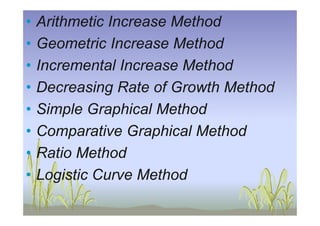
• The various methods adopted for
estimating future populations are
given below. The particular method to
be adopted for a particular case or forbe adopted for a particular case or for
a particular city depends largely on
the factors discussed in the methods,
and the selection is left to the the
designer.
• Arithmetic Increase Method
• Geometric Increase Method
• Incremental Increase Method
• Decreasing Rate of Growth Method
• Simple Graphical Method• Simple Graphical Method
• Comparative Graphical Method
• Ratio Method
• Logistic Curve Method
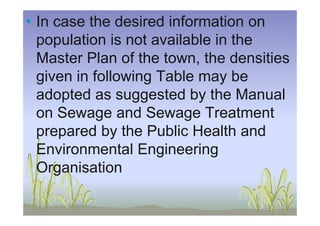
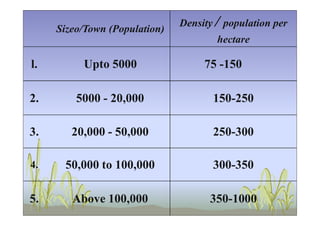
• In case the desired information on
population is not available in the
Master Plan of the town, the densities
given in following Table may be
adopted as suggested by the Manual
on Sewage and Sewage Treatmenton Sewage and Sewage Treatment
prepared by the Public Health and
Environmental Engineering
Organisation
Sizeo/Town (Population)
Density / population per
hectare
l. Upto 5000 75 -150
2. 5000 - 20,000 150-250
3. 20,000 - 50,000 250-300
4. 50,000 to 100,000 300-350
5. Above 100,000 350-1000
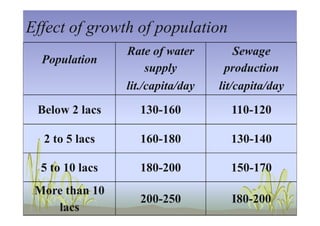
Effect of growth of populationEffect of growth of population
Population
Rate of water
supply
Sewage
production
lit./capita/day lit/capita/day
Below 2 lacs 130-160 110-120Below 2 lacs 130-160 110-120
2 to 5 lacs 160-180 130-140
5 to 10 lacs 180-200 150-170
More than 10
lacs
200-250 I80-200
Design period as per CPHEEODesign period as per CPHEEO
manualmanual
1. Branches of sewer – 30 years
2. Pumping stations – 30 years
3. The treatment plant - 30 year
4. Pumping machinery – 15 years4. Pumping machinery – 15 years
5. Effluent disposal and utilisation –
30 years
c. Type of area served.c. Type of area served.
• The quantity of wastewater produced
depends upon whether the area to be
served is
• Residential,• Residential,
• Commercial,
• Industrial.
• The wastewater from the residential
area directly depends upon the rate of
water supply. If there is no infiltration
of water in the sewers, and if there
are no private sources of supply.
• The wastewater produced from the• The wastewater produced from the
residential area may be assumed to
be equal to 70 to 80% of the water
supplied through the public supply
system
• The amount of waste water produced
from the industrial locality depends
upon the types of industries and their
corresponding industrial processes.
• The same is the case with the
commercial un-dertakings. Thecommercial un-dertakings. The
sewage flow rates can be determined
after careful study of the various
process involved.
d. Infiltration of subd. Infiltration of sub--soil watersoil water
• Ground water or subsoil water may infiltrate into
the sewers through the leaky joints. Exfiltration
is the reverse process which indicates the flow
of wastewater from the sewer into the ground.
• While due to the infiltration the quantity of flow• While due to the infiltration the quantity of flow
through sewer increases, exfiltration results in
decrease in the flow and consequent increase
in the pollution of ground water. Both infiltration
as well as exfiltration are undesirable and take
place due to imperfect joints.
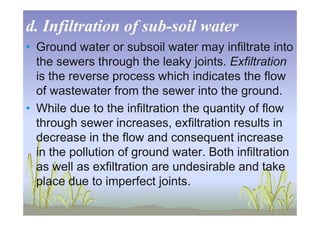
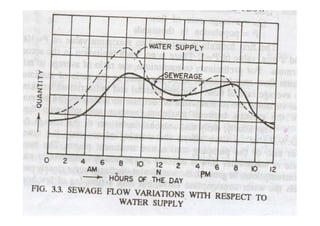
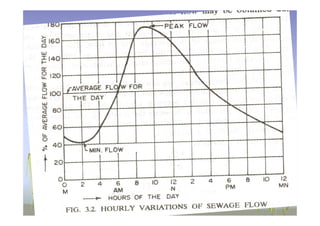
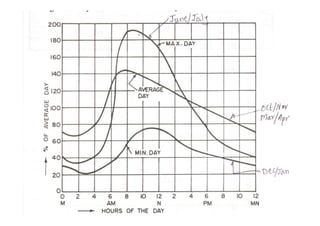
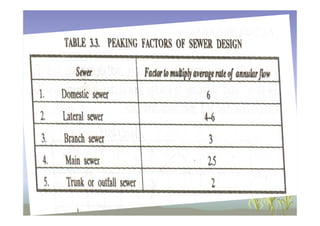
VARIATIONS IN RATEVARIATIONS IN RATE
OF SEWAGEOF SEWAGE
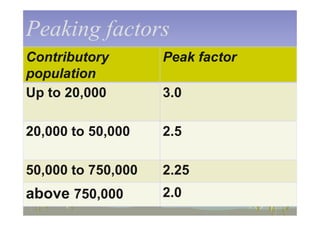
Peaking factorsPeaking factors
Contributory
population
Peak factor
Up to 20,000 3.0
20,000 to 50,000 2.5
50,000 to 750,000 2.25
above 750,000 2.0
Objective QuestionsObjective Questions
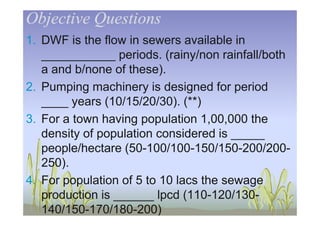
1. DWF is the flow in sewers available in
___________ periods. (rainy/non rainfall/both
a and b/none of these).
2. Pumping machinery is designed for period
____ years (10/15/20/30). (**)
3. For a town having population 1,00,000 the3. For a town having population 1,00,000 the
density of population considered is _____
people/hectare (50-100/100-150/150-200/200-
250).
4. For population of 5 to 10 lacs the sewage
production is ______ lpcd (110-120/130-
140/150-170/180-200)
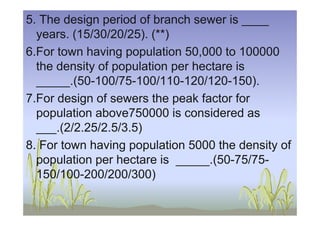
5. The design period of branch sewer is ____
years. (15/30/20/25). (**)
6.For town having population 50,000 to 100000
the density of population per hectare is
_____.(50-100/75-100/110-120/120-150).
7.For design of sewers the peak factor for
population above750000 is considered aspopulation above750000 is considered as
___.(2/2.25/2.5/3.5)
8. For town having population 5000 the density of
population per hectare is _____.(50-75/75-
150/100-200/200/300)
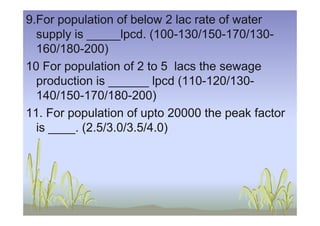
9.For population of below 2 lac rate of water
supply is _____lpcd. (100-130/150-170/130-
160/180-200)
10 For population of 2 to 5 lacs the sewage
production is ______ lpcd (110-120/130-
140/150-170/180-200)
11. For population of upto 20000 the peak factor11. For population of upto 20000 the peak factor
is ____. (2.5/3.0/3.5/4.0)
Theory QuestionsTheory Questions
Q1. Explain any two factors affecting
DWF. (Nov 2010, 5 marks)
Q2. What is DWF? Explain any four
factors affecting DWF. (Nov 2010 old,factors affecting DWF. (Nov 2010 old,
8 marks)
L 4 wastewater flow rates

L 4 wastewater flow rates

  • 1.
    LL--44 Wastewater Flow RatesWastewaterFlow Rates Environmental Engineering-II
  • 2.
    IntroductionIntroduction • In orderto determine the section of the sewer, it is essential to know the total quantity of wastewater or sewage that would flow through the sewer.sewer. • The total wastewater flow can be divided two components : (a) Dry weather flow (D.W.F.) and (b) Storm water flow
  • 3.
    The dry weatherflow (DWF)The dry weather flow (DWF) • The dry weather flow is the flow through the sewers that would normally be available during non- rainfall periods.rainfall periods. It consists mainly of (i)Domestic sewage and (ii)Industrial wastewater
  • 4.
    DRY WEATHER FLOWDRYWEATHER FLOW • It is that quantity of wastewater that flows through a sewer in dry weather when no storm water is in the sewer. • The dry weather flow is also• The dry weather flow is also sometimes called as 'sanitary sewage', and is obtained from the following sources :
  • 5.
    1. Domestic wastewaterfrom houses- WCs, Baths, urinals, wash basins etc 2. Industrial waste water from industriesindustries 3. Wastewater from public facilities 4. Ground water infiltration
  • 6.
    Wastewater Quantity EstimationWastewaterQuantity Estimation • The flow of sanitary sewage alone in the absence of storms in dry season is known as dry weather flow (DWF). • Quantity= Per capita sewage contributed per day x Population
  • 7.
    FACTORSFACTORS AFFECTING DRYAFFECTINGDRY WEATHER FLOWWEATHER FLOW (a) Rate of water supply. (b) Population growth. (c) Type of area served (d) Infiltration of ground water
  • 8.
    a. Rate ofwater supplya. Rate of water supply • The quantity of wastewater produced from a community would naturally depend upon the rate of water supply per capita' per day. The quantity of wastewater entering the sewers would be less than the totalthe sewers would be less than the total quantity of water supplied. • This is because of the fact that water is lost in domestic consumption (i.e. cooking etc.), evaporation, lawn sprinkling, fire fighting, industrial consumption etc.
  • 9.
    • In generalit is assumed that waste generation quantity is 80% of rate of water supplywater supply
  • 10.
    b.b. Population GrowthPopulationGrowth • The various methods adopted for estimating future populations are given below. The particular method to be adopted for a particular case or forbe adopted for a particular case or for a particular city depends largely on the factors discussed in the methods, and the selection is left to the the designer.
  • 11.
    • Arithmetic IncreaseMethod • Geometric Increase Method • Incremental Increase Method • Decreasing Rate of Growth Method • Simple Graphical Method• Simple Graphical Method • Comparative Graphical Method • Ratio Method • Logistic Curve Method
  • 12.
    • In casethe desired information on population is not available in the Master Plan of the town, the densities given in following Table may be adopted as suggested by the Manual on Sewage and Sewage Treatmenton Sewage and Sewage Treatment prepared by the Public Health and Environmental Engineering Organisation
  • 13.
    Sizeo/Town (Population) Density /population per hectare l. Upto 5000 75 -150 2. 5000 - 20,000 150-250 3. 20,000 - 50,000 250-300 4. 50,000 to 100,000 300-350 5. Above 100,000 350-1000
  • 14.
    Effect of growthof populationEffect of growth of population Population Rate of water supply Sewage production lit./capita/day lit/capita/day Below 2 lacs 130-160 110-120Below 2 lacs 130-160 110-120 2 to 5 lacs 160-180 130-140 5 to 10 lacs 180-200 150-170 More than 10 lacs 200-250 I80-200
  • 15.
    Design period asper CPHEEODesign period as per CPHEEO manualmanual 1. Branches of sewer – 30 years 2. Pumping stations – 30 years 3. The treatment plant - 30 year 4. Pumping machinery – 15 years4. Pumping machinery – 15 years 5. Effluent disposal and utilisation – 30 years
  • 16.
    c. Type ofarea served.c. Type of area served. • The quantity of wastewater produced depends upon whether the area to be served is • Residential,• Residential, • Commercial, • Industrial.
  • 17.
    • The wastewaterfrom the residential area directly depends upon the rate of water supply. If there is no infiltration of water in the sewers, and if there are no private sources of supply. • The wastewater produced from the• The wastewater produced from the residential area may be assumed to be equal to 70 to 80% of the water supplied through the public supply system
  • 18.
    • The amountof waste water produced from the industrial locality depends upon the types of industries and their corresponding industrial processes. • The same is the case with the commercial un-dertakings. Thecommercial un-dertakings. The sewage flow rates can be determined after careful study of the various process involved.
  • 19.
    d. Infiltration ofsubd. Infiltration of sub--soil watersoil water • Ground water or subsoil water may infiltrate into the sewers through the leaky joints. Exfiltration is the reverse process which indicates the flow of wastewater from the sewer into the ground. • While due to the infiltration the quantity of flow• While due to the infiltration the quantity of flow through sewer increases, exfiltration results in decrease in the flow and consequent increase in the pollution of ground water. Both infiltration as well as exfiltration are undesirable and take place due to imperfect joints.
  • 20.
    VARIATIONS IN RATEVARIATIONSIN RATE OF SEWAGEOF SEWAGE
  • 24.
    Peaking factorsPeaking factors Contributory population Peakfactor Up to 20,000 3.0 20,000 to 50,000 2.5 50,000 to 750,000 2.25 above 750,000 2.0
  • 26.
    Objective QuestionsObjective Questions 1.DWF is the flow in sewers available in ___________ periods. (rainy/non rainfall/both a and b/none of these). 2. Pumping machinery is designed for period ____ years (10/15/20/30). (**) 3. For a town having population 1,00,000 the3. For a town having population 1,00,000 the density of population considered is _____ people/hectare (50-100/100-150/150-200/200- 250). 4. For population of 5 to 10 lacs the sewage production is ______ lpcd (110-120/130- 140/150-170/180-200)
  • 27.
    5. The designperiod of branch sewer is ____ years. (15/30/20/25). (**) 6.For town having population 50,000 to 100000 the density of population per hectare is _____.(50-100/75-100/110-120/120-150). 7.For design of sewers the peak factor for population above750000 is considered aspopulation above750000 is considered as ___.(2/2.25/2.5/3.5) 8. For town having population 5000 the density of population per hectare is _____.(50-75/75- 150/100-200/200/300)
  • 28.
    9.For population ofbelow 2 lac rate of water supply is _____lpcd. (100-130/150-170/130- 160/180-200) 10 For population of 2 to 5 lacs the sewage production is ______ lpcd (110-120/130- 140/150-170/180-200) 11. For population of upto 20000 the peak factor11. For population of upto 20000 the peak factor is ____. (2.5/3.0/3.5/4.0)
  • 29.
    Theory QuestionsTheory Questions Q1.Explain any two factors affecting DWF. (Nov 2010, 5 marks) Q2. What is DWF? Explain any four factors affecting DWF. (Nov 2010 old,factors affecting DWF. (Nov 2010 old, 8 marks)