by Muhammad Farhan Arooj
BSc. Civil Engineering, UET Lahore - 2001
MS. Civil & Environmental Engineering, KAIST, South Korea - 2004
Editor Water Research, Top 25 Research Topics in the World, Exposure of more than
400 wastewater treatment plants and Solid Waste Management Projects in the World.
Develop the student’s knowledge of
 To plan, design wastewater collection Systems.
 To plan, design wastewater Treatment
Systems.
 To introduce Environmental Laws, EIA and Solid
Waste Management.
 Upon successful completion of the course, the student
should be able to comprehend:
 Public Health Aspect of Wastewater Collection
 Wastewater Collection Design
 Wastewater Treatment Design
 Wastewater Quality Parameters & Assessment
A. Sources of waste water; Domestic and Industrial. Estimation of sanitary
sewage and storm water quantities. Hydraulics of sewers and design of sewerage
system. Sewage pumping stations. Characteristics of Domestic and Industrial
wastewater.
B. Wastewater treatment; purpose, principles and design of various
wastewater treatment processes including screens, grit chambers,
sedimentation tanks, Activated sludge process, SBR, Trickling Filters,
wastewater stabilization ponds and Aerated Lagoons. Sludge digestion and
disposal.
C. Disposal of wastewater on land and water bodies. Waste assimilative
capacity of streams. Use of treated effluent for irrigation.
D.National Environmental Quality standards (NEQS). Introduction to
Environmental Impact Assessment. Evaluation of Environmental Impacts.
E.Solid Waste Management
2 + 1 credit hours course
Theory – 2 credit hours
● Quizzes 10 %
● Projects / Assignments 10 %
● Class Participation 10 %
● 1 x Mid term exam 20 %
● End of Semester Exam 50 %
Practical – 1 credit hour
● Lab work 60 %
● Final Viva 40 %
● Study in groups but submit work on your own
● No copying of project / assignments
● Severe penalty in case someone found cheating
● No make up quizzes or projects / assignments
● At least 80 % attendance is mandatory to appear in the exam
● Fundamental course in Civil Engineering
● Good class conduct and is very important to understand this
course
Text Book
Water Supply & Sewerage by
E.W Steel and Torence J. Mc Ghee
4th, 5th, 6th Edition (whichever Available).
REFERENCE BOOKS
•Water Supply & Sanitary Engineering
S. C. Rangwala
2. Waste water Engineering, Treatment, Disposal, reuse by
Metcalf and Eddy, 3rd Edition.
3. Water and waste water Engineering by
Fair & Geyer
4. Water and waste water Technology by
Mask J. Hammer
SOME BASIC TERMS
Sewage: It is the Liquid Waste of Wastewater produced as a result
of water use.
Sewer: It is a Pipe or Conduit for carrying sewage. It is generally
closed and flow takes place under gravity.
Sewerage: it is a comprehensive term. This term is applied to the
Art Of the collection of wastewater and conveying it to the point of
final disposal with or without treatment.
SOURCES OF WASTEWATER
1. Domestic It is waste water from residential buildings,
offices, other buildings and institutions etc.
2. Industrial It is liquid waste from industrial processes like
dying, paper making, fertilizers, chemicals, leather etc.
3. Storm water It include surface run off generated by
rainfalls and street wash.
TYPES OF SEWERS
1.Sanitary Sewer: Sewer which carries sanitary sewage i.e.,
wastewater originating from a municipality including
domestic and industrial wastewater.
2.Storm Sewer: It carries storm sewage including surface
run off and street washes.
3.Combined Sewer: It carries domestic, industrial and
storm sewage.
4. House Sewer: is a pipe conveying wastewater from
an individual structure to a common sewer or some
other point of disposal.
TYPES OF SEWERS
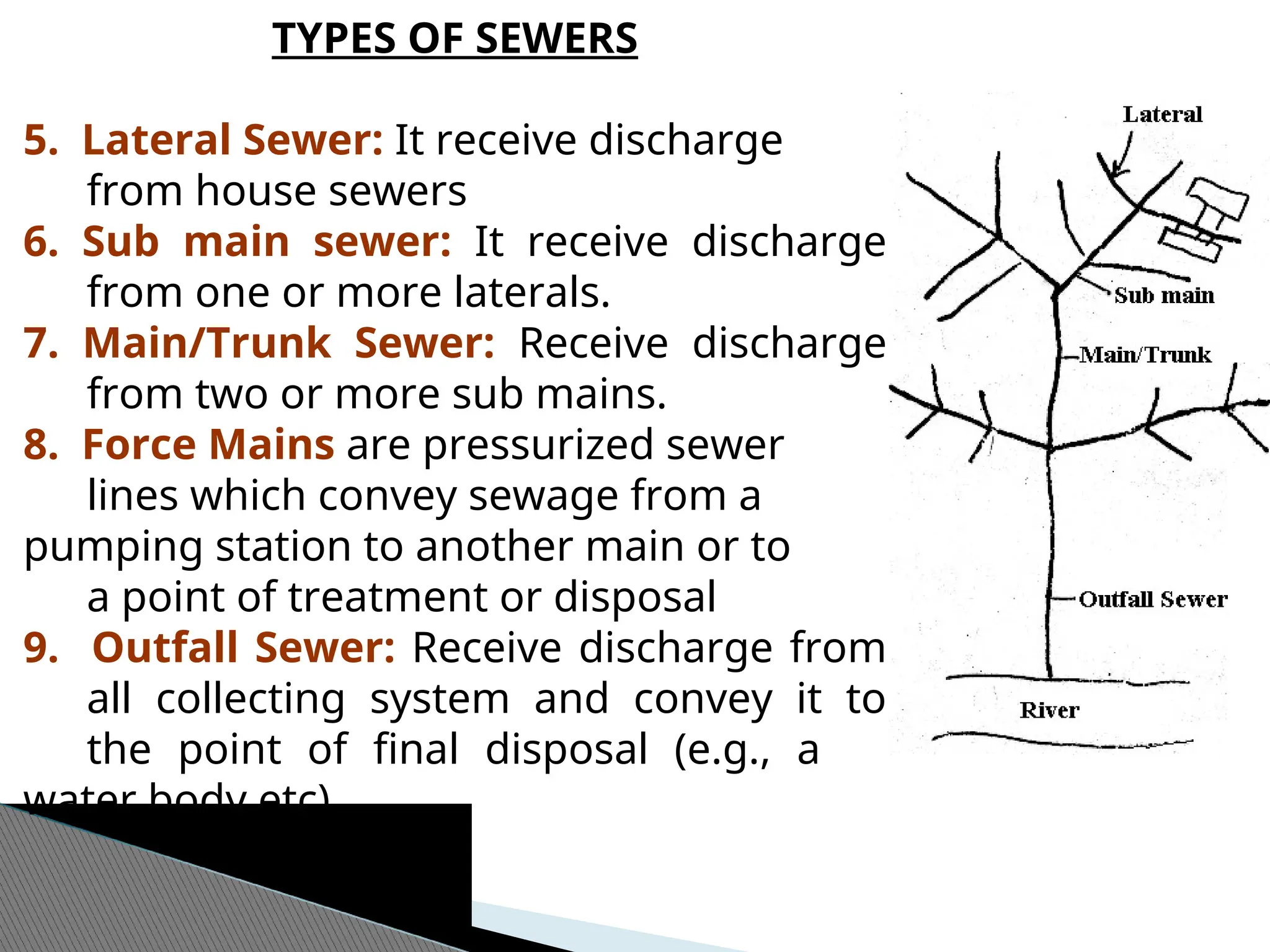
5. Lateral Sewer: It receive discharge
from house sewers
6. Sub main sewer: It receive discharge
from one or more laterals.
7. Main/Trunk Sewer: Receive discharge
from two or more sub mains.
8. Force Mains are pressurized sewer
lines which convey sewage from a
pumping station to another main or to
a point of treatment or disposal
9. Outfall Sewer: Receive discharge from
all collecting system and convey it to
the point of final disposal (e.g., a
water body etc)
Components of Wastewater Engineering
• Collection system (network of sewer pipes)
• Disposal Works (Sewage pumping stations)
• Treatment works (render treatment)
TYPES OF SEWERAGE SYSTEMS
1. Separate System If storm water is carried separately
from domestic and industrial waste, the system is called
separate system.
When favored
I) There is an immediate need for collection of sanitary
sewage but not for storm sewage.
II) Where sanitary sewage need treatment but storm
water does not
2. Combined System: A system in which sewer carry both
sanitary as well as storm sewage.
When favored
I)When combined sewage can be disposed off with out
treatment
II)When both need treatment
III)When streets are narrow and two separate sewers cannot
be laid.
3. Partially Combined: If some portion of storm or surface
run off (from roofs, roads, open spaces etc) is allowed to be
carried along with sanitary sewage, the system is known as
partially combined system.
Note: In urban areas, mostly, partially combined system is used.
Infiltration
It is the water that enters sewer through poor joints, cracked pipes and
walls and covers of manholes. Infiltration is almost non-existent in dry
weather but it will increase during rainy season.
Infiltration rates ≤ 45 lit /km of sewer/day/mm dia (E.W. Steel)
WASA: 225 mm – 610 mm, Infiltration = 5 % of Av. Sewage flow.
> 610 mm, Infiltration = 10 % of Av. Sewage flow.
SEWAGE FLOW / QUANTITY
Sanitary and industrial sewage is derived from water
supply, so it has a relationship with amount of water
consumption. Generally 80–90% of water consumption
is taken as sewage flow.
Variation In Sewage Flow
Like water supply, sewage flow varies from time to
time. Since sewers must be able to accommodate the
max flow the variation in sewage flow need to be
studied.
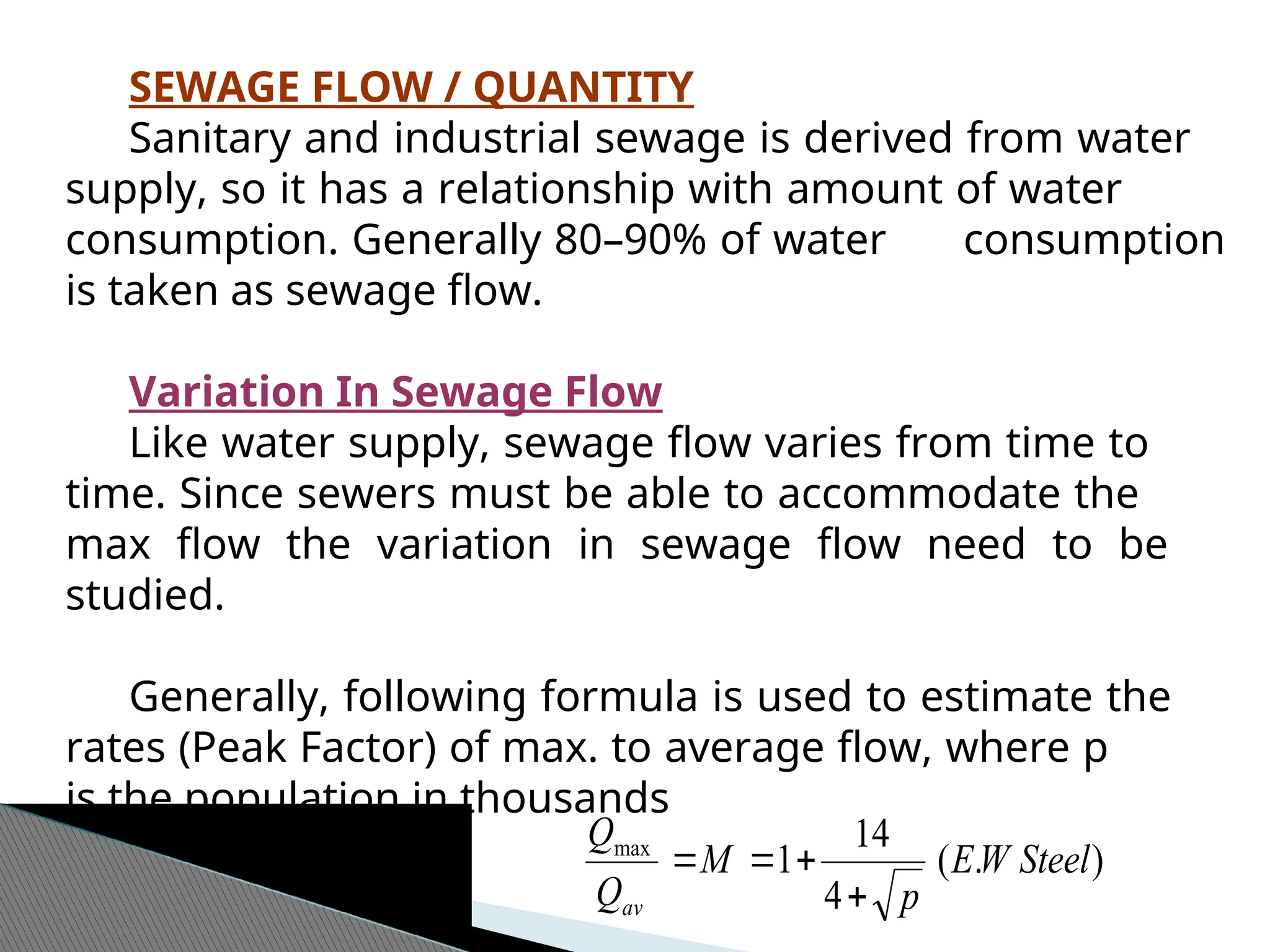
Generally, following formula is used to estimate the
rates (Peak Factor) of max. to average flow, where p
is the population in thousands
)
.
(
4
14
1
max
Steel
W
E
p
M
Q
Q
av 



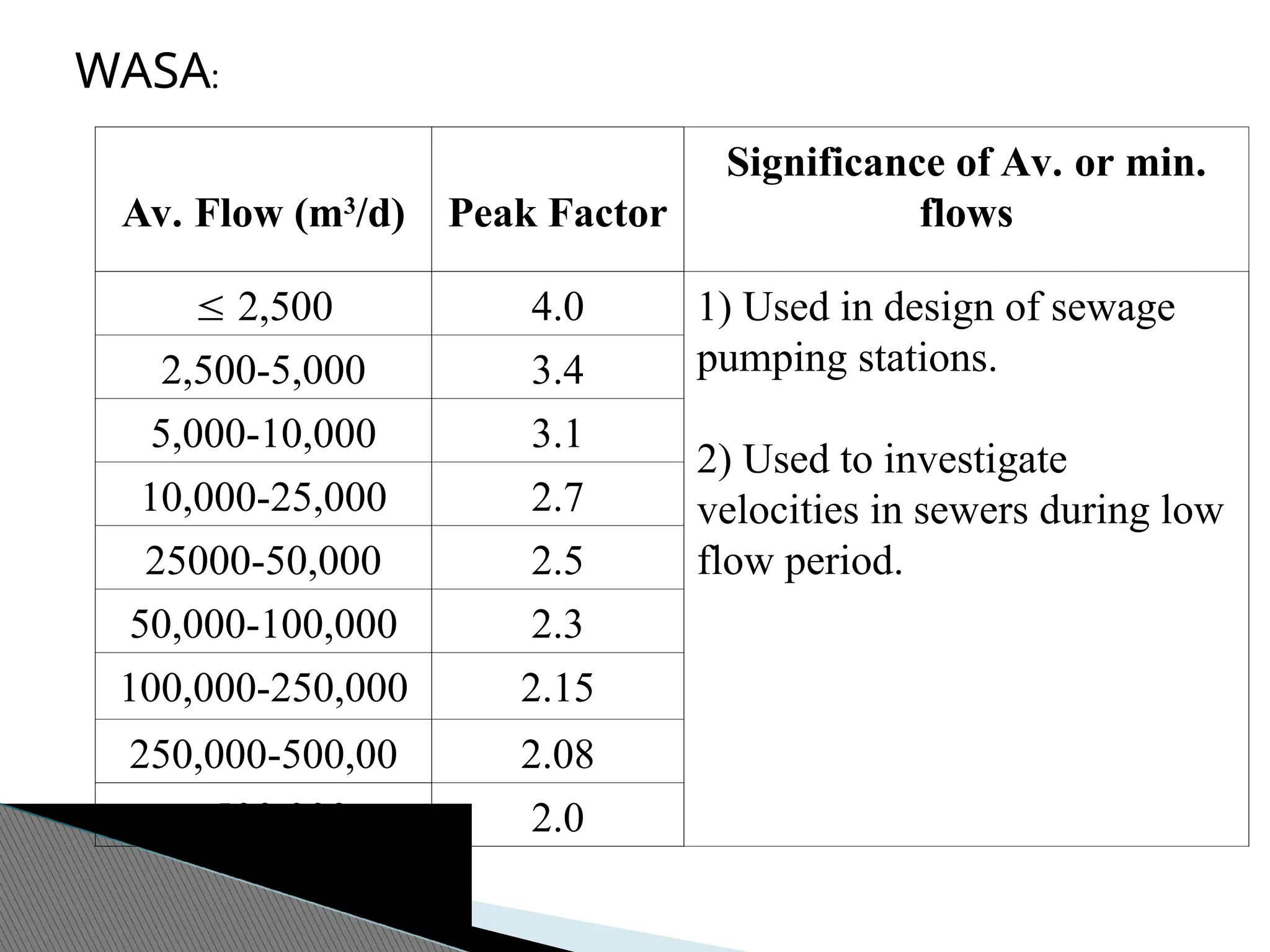
WASA:
Av. Flow (m3
/d) Peak Factor
Significance of Av. or min.
flows
 2,500 4.0 1) Used in design of sewage
pumping stations.
2) Used to investigate
velocities in sewers during low
flow period.
2,500-5,000 3.4
5,000-10,000 3.1
10,000-25,000 2.7
25000-50,000 2.5
50,000-100,000 2.3
100,000-250,000 2.15
250,000-500,00 2.08
> 500,000 2.0
17
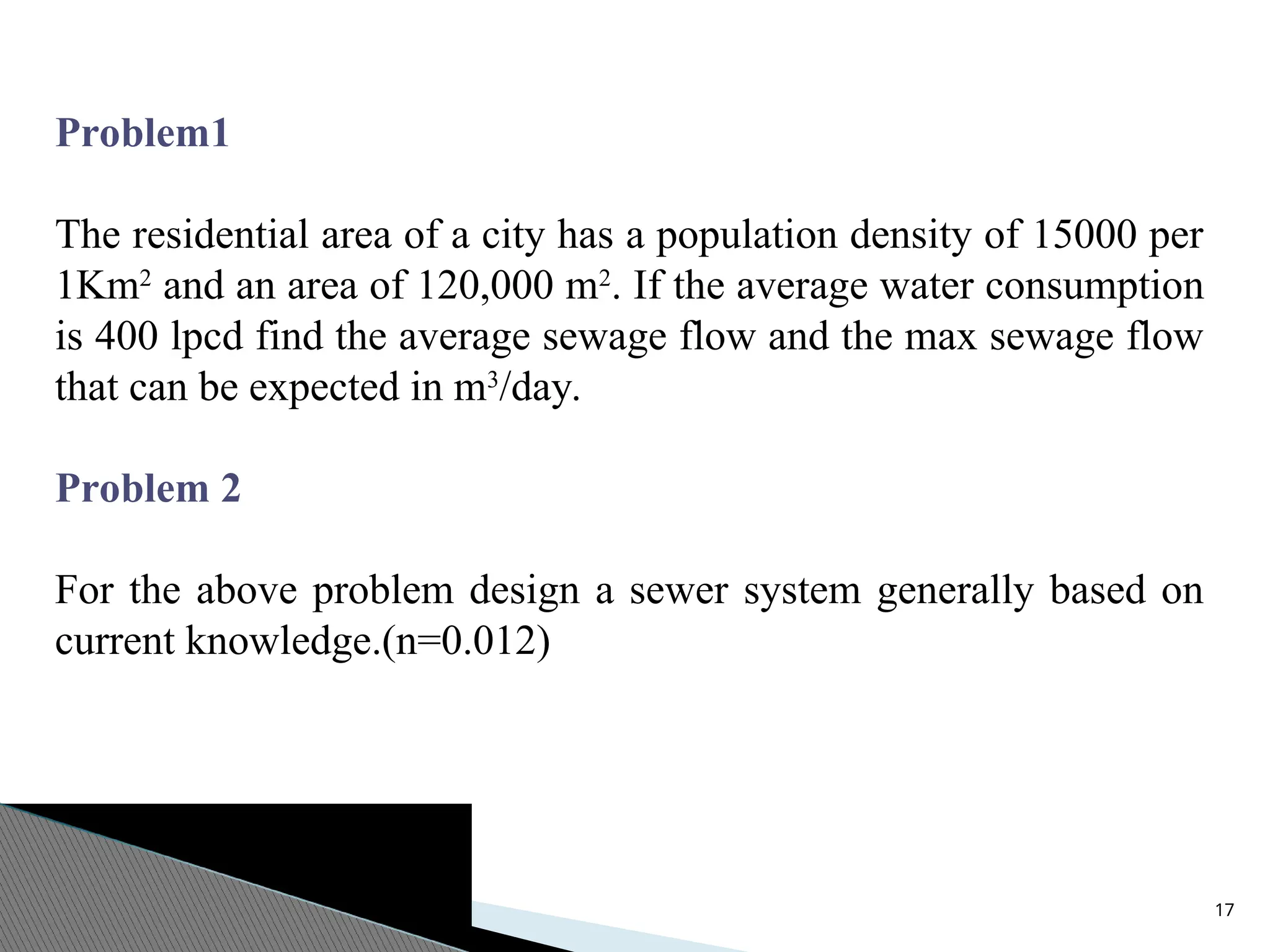
Problem1
The residential area of a city has a population density of 15000 per
1Km2
and an area of 120,000 m2
. If the average water consumption
is 400 lpcd find the average sewage flow and the max sewage flow
that can be expected in m3
/day.
Problem 2
For the above problem design a sewer system generally based on
current knowledge.(n=0.012)
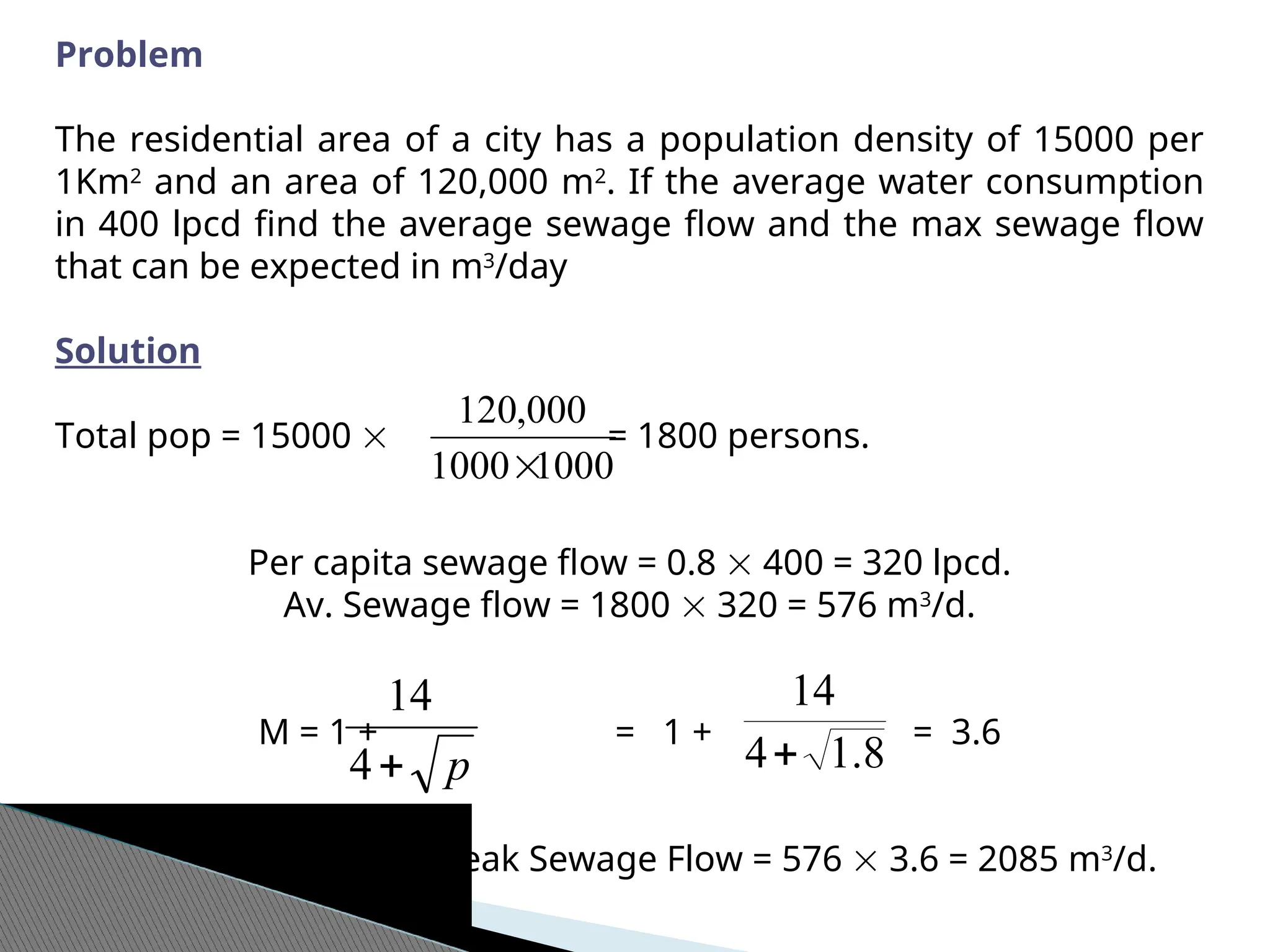
Problem
The residential area of a city has a population density of 15000 per
1Km2
and an area of 120,000 m2
. If the average water consumption
in 400 lpcd find the average sewage flow and the max sewage flow
that can be expected in m3
/day
Solution
Total pop = 15000  = 1800 persons.
Per capita sewage flow = 0.8  400 = 320 lpcd.
Av. Sewage flow = 1800  320 = 576 m3
/d.
M = 1 + = 1 + = 3.6
Max/Peak Sewage Flow = 576  3.6 = 2085 m3
/d.
1000
1000
000
,
120

p

4
14
8
.
1
4
14

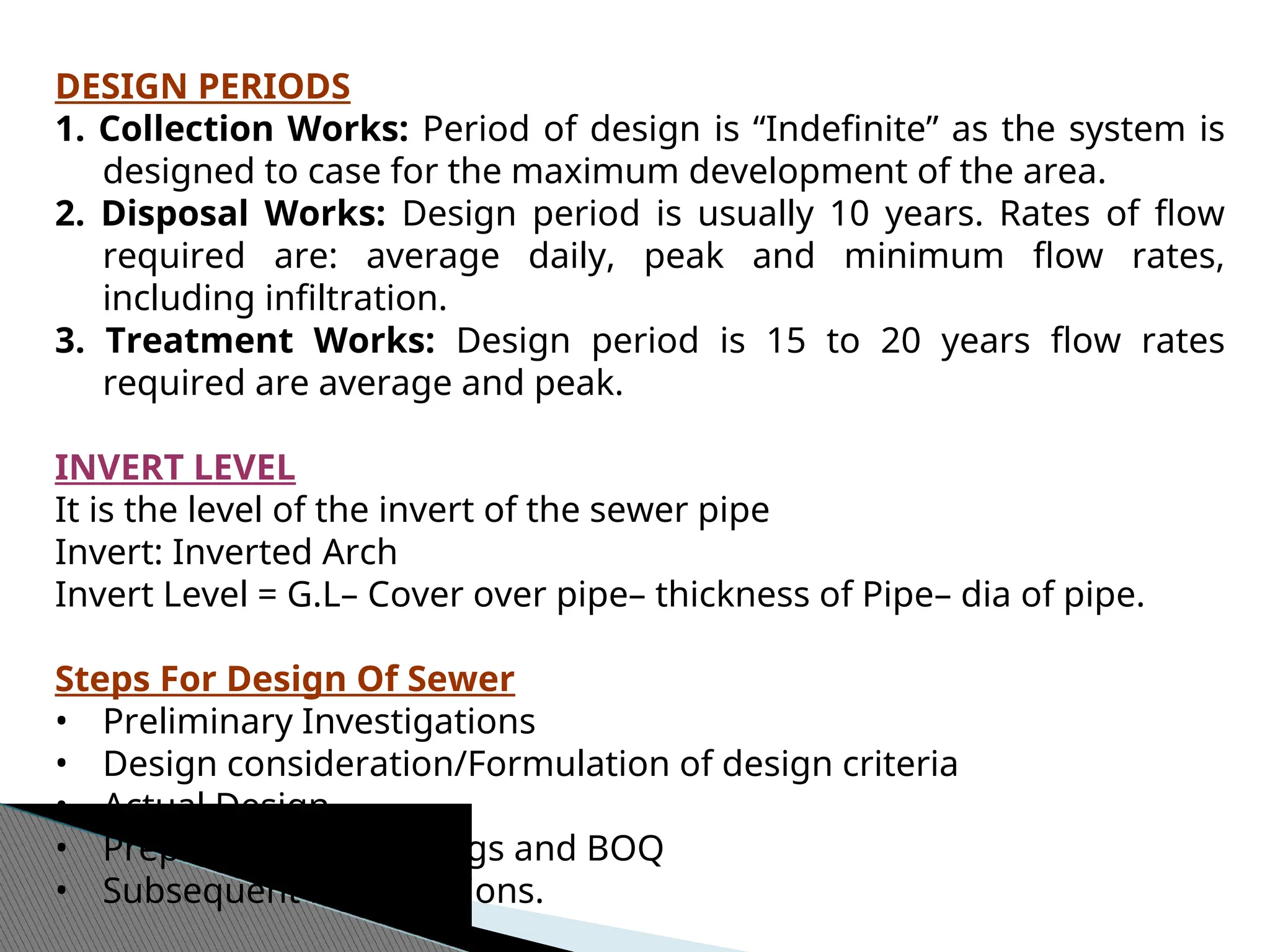
DESIGN PERIODS
1. Collection Works: Period of design is “Indefinite” as the system is
designed to case for the maximum development of the area.
2. Disposal Works: Design period is usually 10 years. Rates of flow
required are: average daily, peak and minimum flow rates,
including infiltration.
3. Treatment Works: Design period is 15 to 20 years flow rates
required are average and peak.
INVERT LEVEL
It is the level of the invert of the sewer pipe
Invert: Inverted Arch
Invert Level = G.L– Cover over pipe– thickness of Pipe– dia of pipe.
Steps For Design Of Sewer
• Preliminary Investigations
• Design consideration/Formulation of design criteria
• Actual Design
• Preparation of drawings and BOQ
• Subsequent modifications.
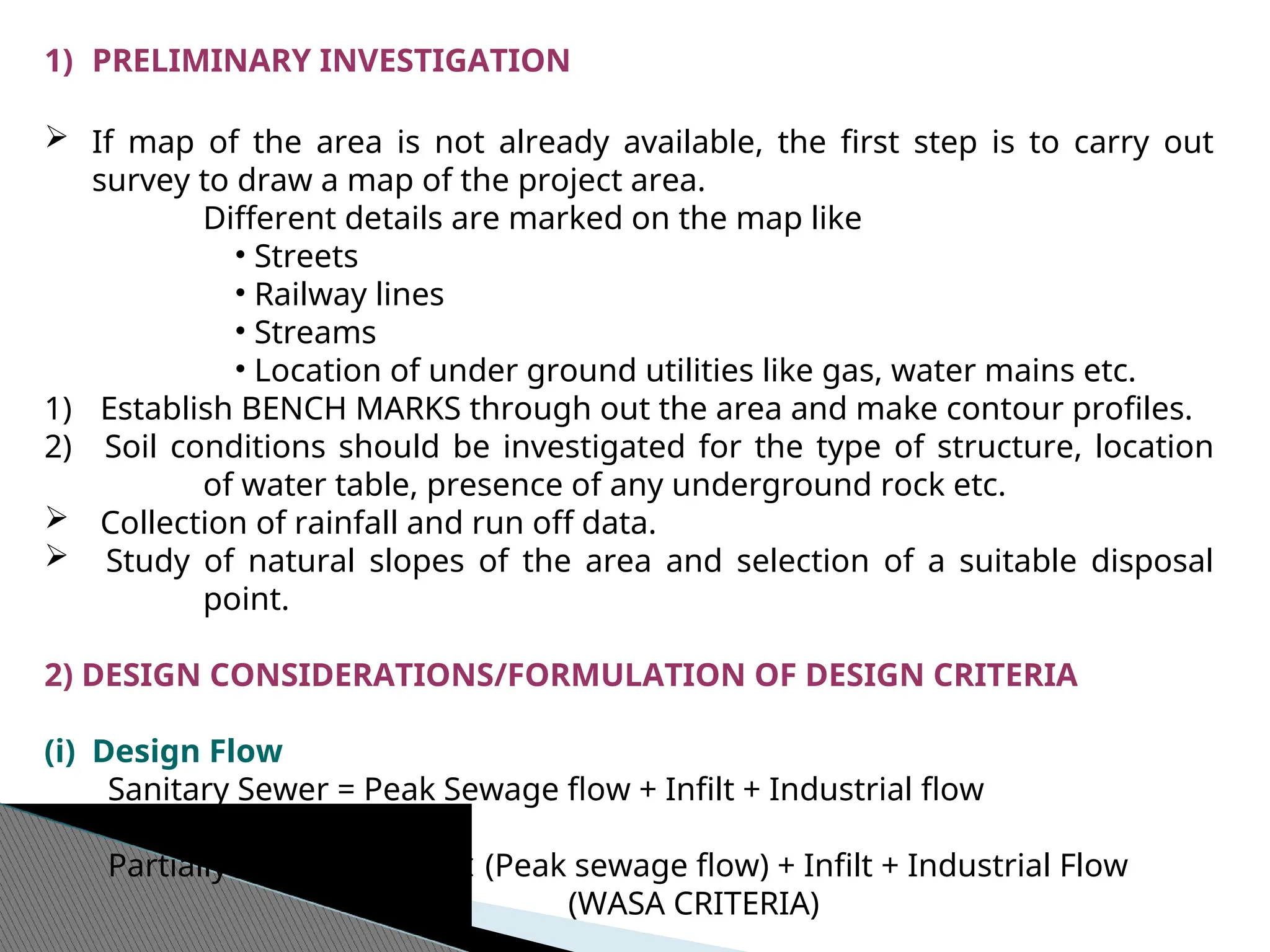
1) PRELIMINARY INVESTIGATION
 If map of the area is not already available, the first step is to carry out
survey to draw a map of the project area.
Different details are marked on the map like
• Streets
• Railway lines
• Streams
• Location of under ground utilities like gas, water mains etc.
1) Establish BENCH MARKS through out the area and make contour profiles.
2) Soil conditions should be investigated for the type of structure, location
of water table, presence of any underground rock etc.
 Collection of rainfall and run off data.
 Study of natural slopes of the area and selection of a suitable disposal
point.
2) DESIGN CONSIDERATIONS/FORMULATION OF DESIGN CRITERIA
(i) Design Flow
Sanitary Sewer = Peak Sewage flow + Infilt + Industrial flow
Partially Combined = 2  (Peak sewage flow) + Infilt + Industrial Flow
(WASA CRITERIA)
21
(ii) Design Equation
Sewers are designed on the basis of open channel flow.
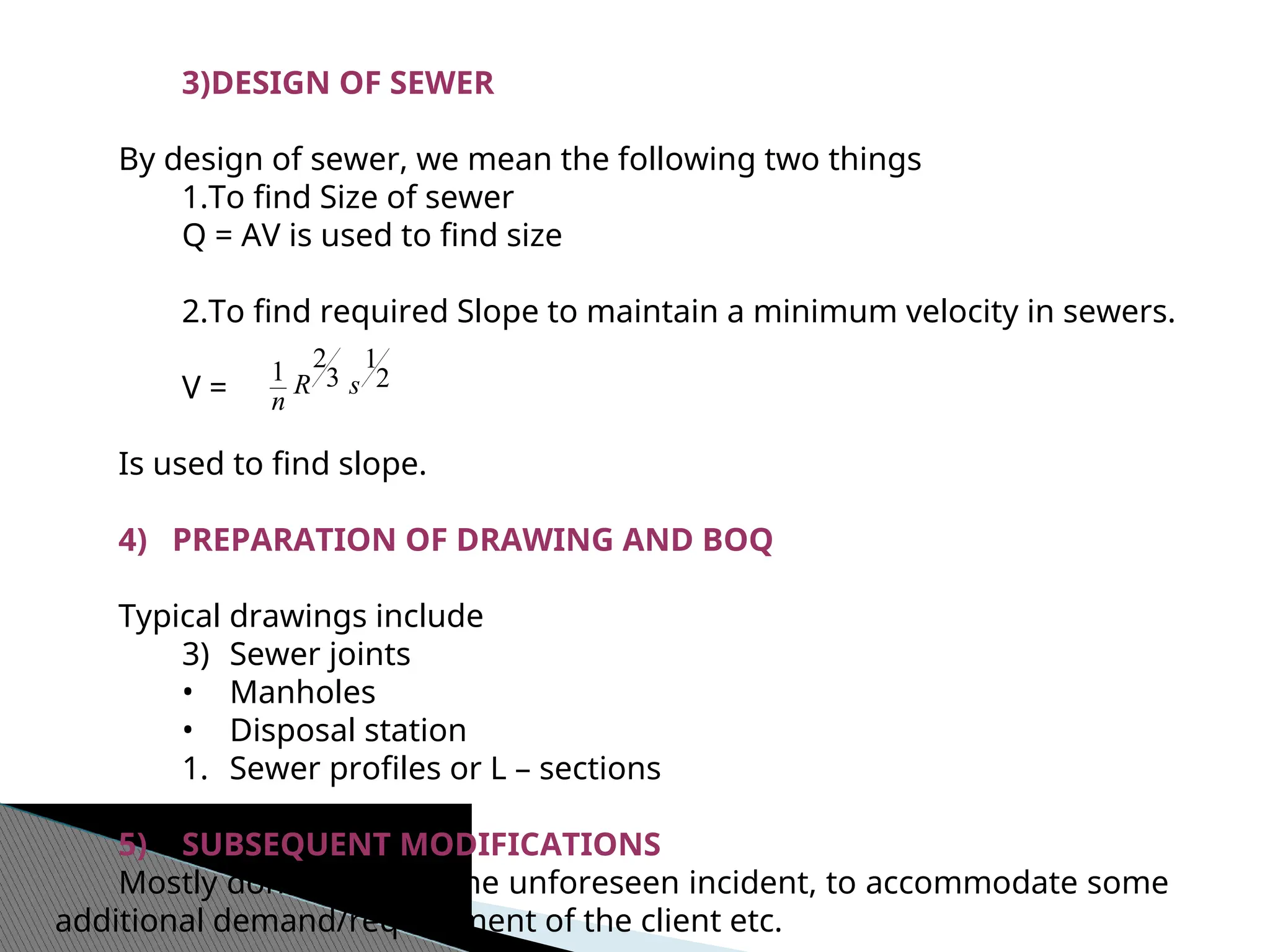
V = (Manning’s Formula)
Where
V = Velocity, m/sec
R = hydraulic mean depth =
= D/4, when pipe is flowing full or ½ full
S = slope of sewer
n = Co-efficient of roughness for pipe (0.012 for R.C.C pipes)
(see table 15.1 EW steel for more n values)
(iii) Minimum Velocities
Min velocities also called self cleansing velocities must be maintained
in sewers to avoid deposition of suspended solids and subsequent choking
of sewers.
Sanitary sewers = 0.6 m/sec [organic particle sp. gs = 1.61]
Storm sewers = 1 m/sec [inorganic particle sp. gs = 2.65]
Partially combined = 0.7 m/sec.
2
1
3
2
1
s
R
n
perimeter
wetted
Area
(iv) Maximum Velocities
2.4 m/sec (E.W Steel)
A limit on higher velocity is imposed due to abrasive character of solids
in wastewater
Scraping or wearing away.
(v) Min. Sewer Size
225 mm is taken as min sever size. [WASA, PHED]
why: choaking takes place with bigger size particles/substances
which are usually thrown into sewer through manholes etc.
[Examples: shrubs, bricks etc].
(vi) Min Cover:
1m is taken as min cover over sewers to avoid damage from live loads
coming on sewers.
(vii) Manholes
Purpose
Cleaning
Inspection
House connections
Where provided
1.At every change in direction
2.Where two different dia pipes are to be connected.
Spacing
225 mm – 350 mm spacing 100 m
460 mm – 760 mm spacing 120 m [WASA]
> 760 mm spacing 150 m
Note For plots, one manhole be provided for 2 plots
viii)Qd/Qf Ratios
WASA recommend the Qd/Qf ratios in order to provide air space in the
upper portion of sewers for ventilation purpose. Qd represent design
flow and Qf is flow when sewer is flowing full.
Sewer Size Ratio (Qd/Qf)
225 – 380 mm 0.7
460 – 1220 mm 0.75
1370 mm and larger 0.8
3)DESIGN OF SEWER
By design of sewer, we mean the following two things
1.To find Size of sewer
Q = AV is used to find size
2.To find required Slope to maintain a minimum velocity in sewers.
V =
Is used to find slope.
4) PREPARATION OF DRAWING AND BOQ
Typical drawings include
3) Sewer joints
• Manholes
• Disposal station
1. Sewer profiles or L – sections
5) SUBSEQUENT MODIFICATIONS
Mostly done due to some unforeseen incident, to accommodate some
additional demand/requirement of the client etc.
2
1
3
2
1 s
R
n
25
Problem 3
Design a partially combined sewer system with following data
Population density for residential area= 10000 per 1Km2
% age of residential area = 90%
% age of Industrial area = 10%; Peak Factor = 2
Total area = 820,000 m2
Water consumption (lpcd) = (100 + reg. number /25)
Manning roughness coefficient = 0.012
Assume suitable data as applicable
SEWERS FLOWING PARTIALLY FULL
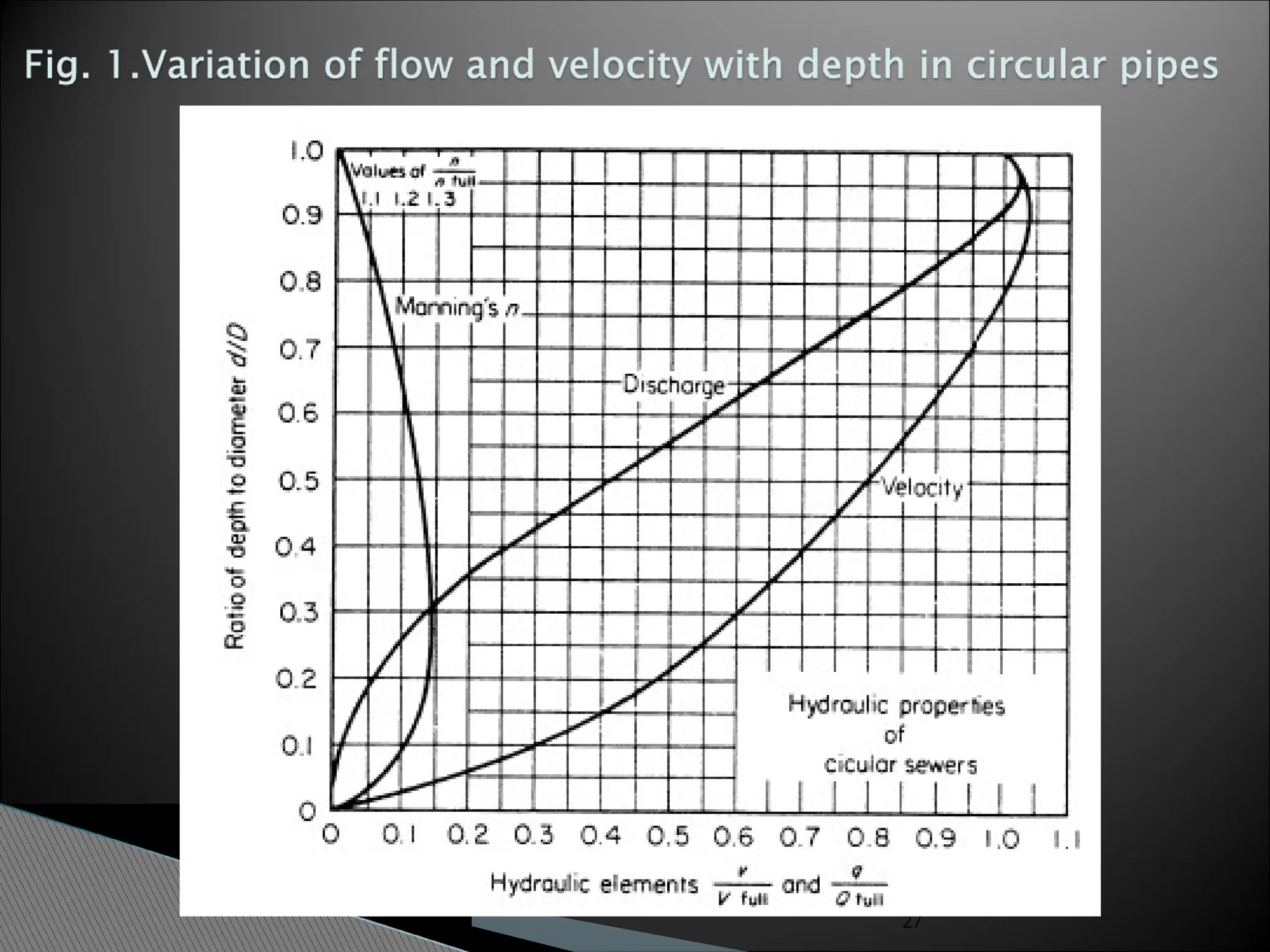
It is necessary to determine velocity and depth of sewage in a pipe
when it is flowing only partially full. For this, use of the GRAPH will
allow quick computation of the hydraulic elements of partially filled
circular sewer.
For using this graph, it is necessary to find first the conditions when a
sewer is flowing full. Then by calculating the ratio of any two known
hydraulic elements, the others can be found.
Significance Of Partial Flow Study
Conditions during partial flow, must frequently be determined in
combined / partially combined sewers due to the following reasons.
• To investigate velocities during dry weather flow to determine
possibilities of deposits occurring in pipes.
• Knowledge of depth of flow is of value in designing sewer inter
sections.
27
28
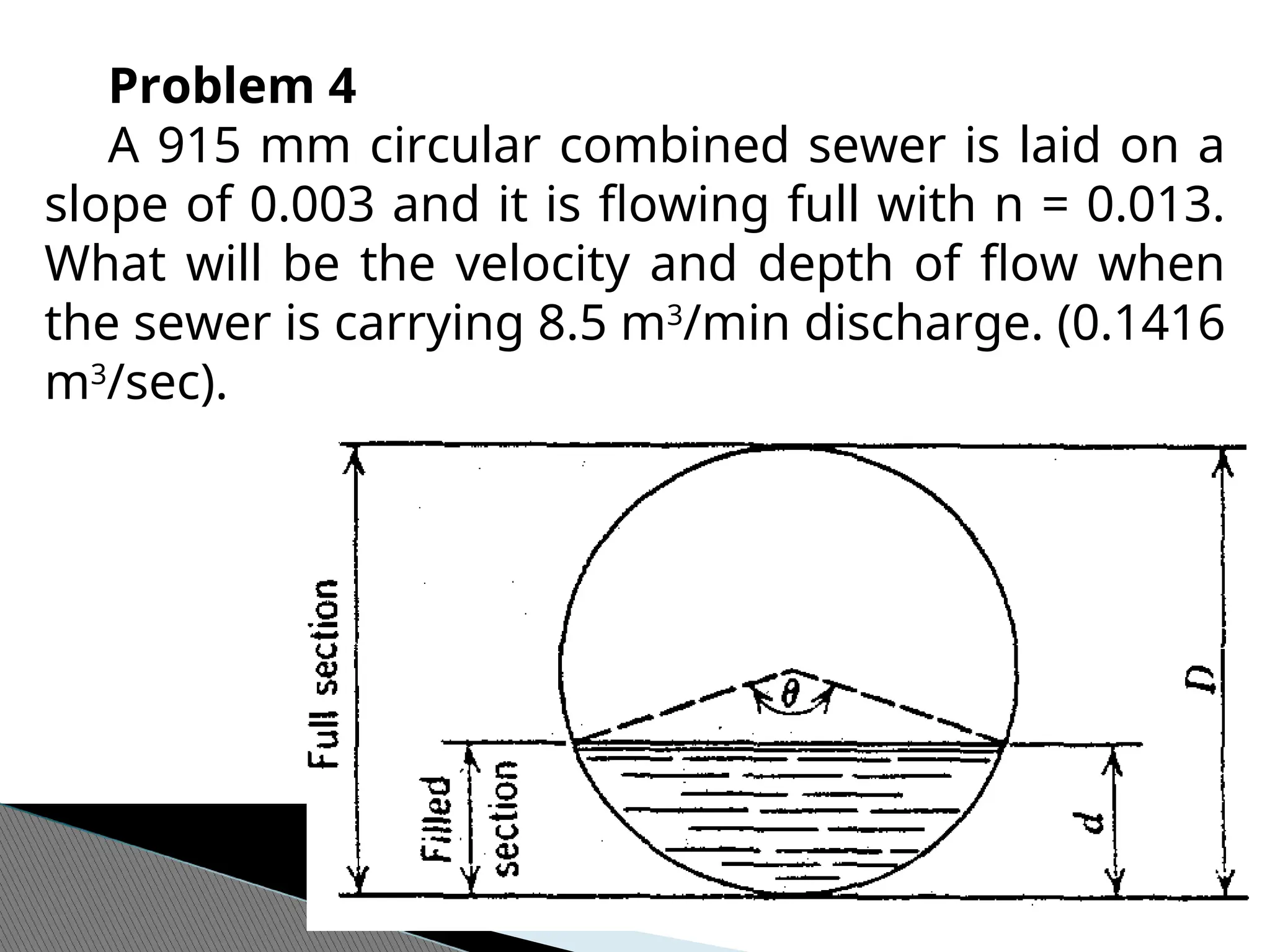
Problem 4
A 915 mm circular combined sewer is laid on a
slope of 0.003 and it is flowing full with n = 0.013.
What will be the velocity and depth of flow when
the sewer is carrying 8.5 m3
/min discharge. (0.1416
m3
/sec).
Problem 4
A 915 mm circular combined sewer is laid on a slope of 0.003 and it
is flow full with n = 0.013. What will be the velocity and depth of flow
when the sewer is carrying 8.5 m3
/min discharge. (0.1416 m3
/sec).
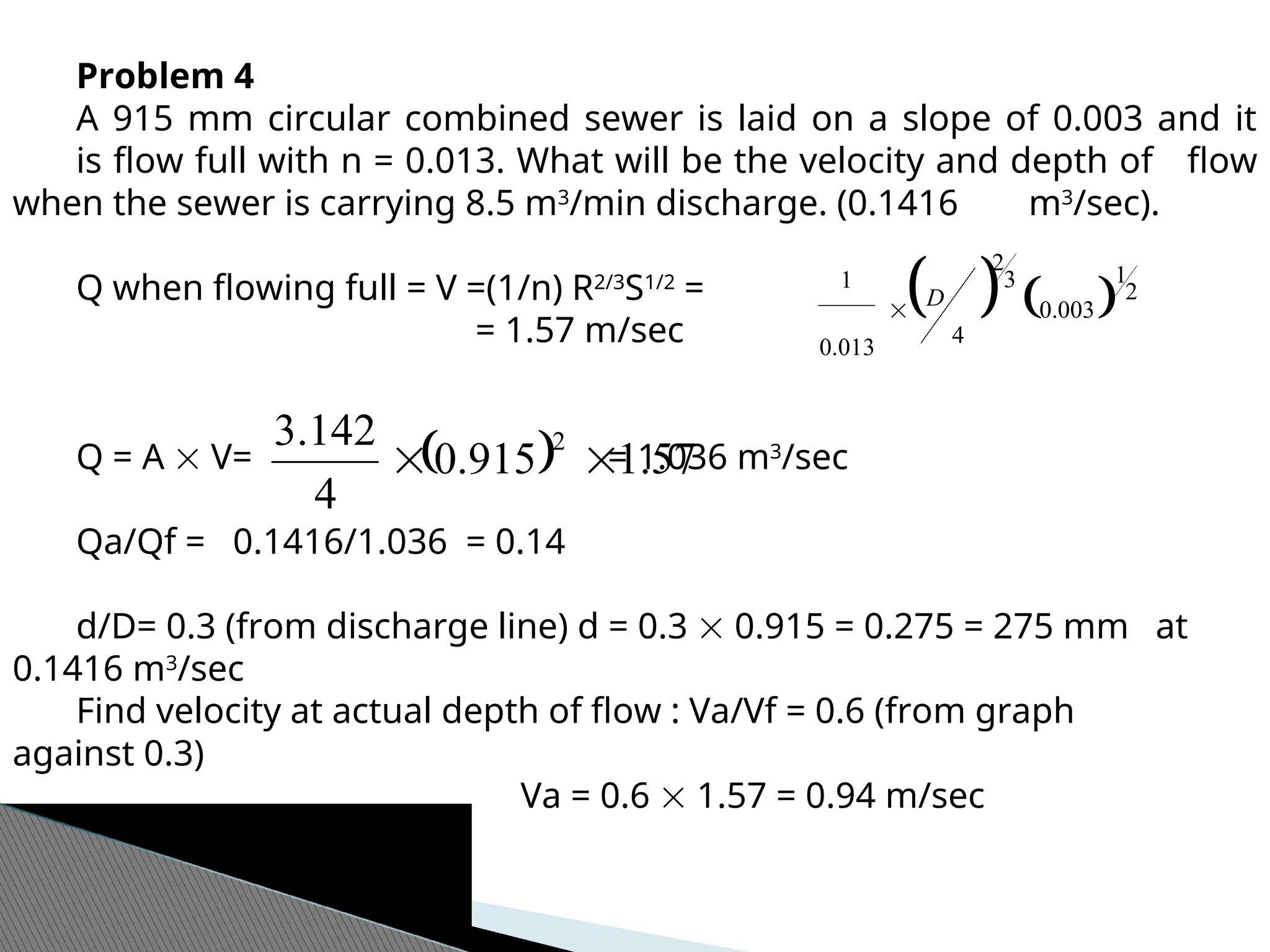
Q when flowing full = V =(1/n) R2/3
S1/2
=
= 1.57 m/sec
Q = A  V= = 1.036 m3
/sec
Qa/Qf = 0.1416/1.036 = 0.14
d/D= 0.3 (from discharge line) d = 0.3  0.915 = 0.275 = 275 mm at
0.1416 m3
/sec
Find velocity at actual depth of flow : Va/Vf = 0.6 (from graph
against 0.3)
Va = 0.6  1.57 = 0.94 m/sec
   2
1
003
.
0
3
2
4
013
.
0
1
D

  57
.
1
915
.
0
4
142
.
3 2


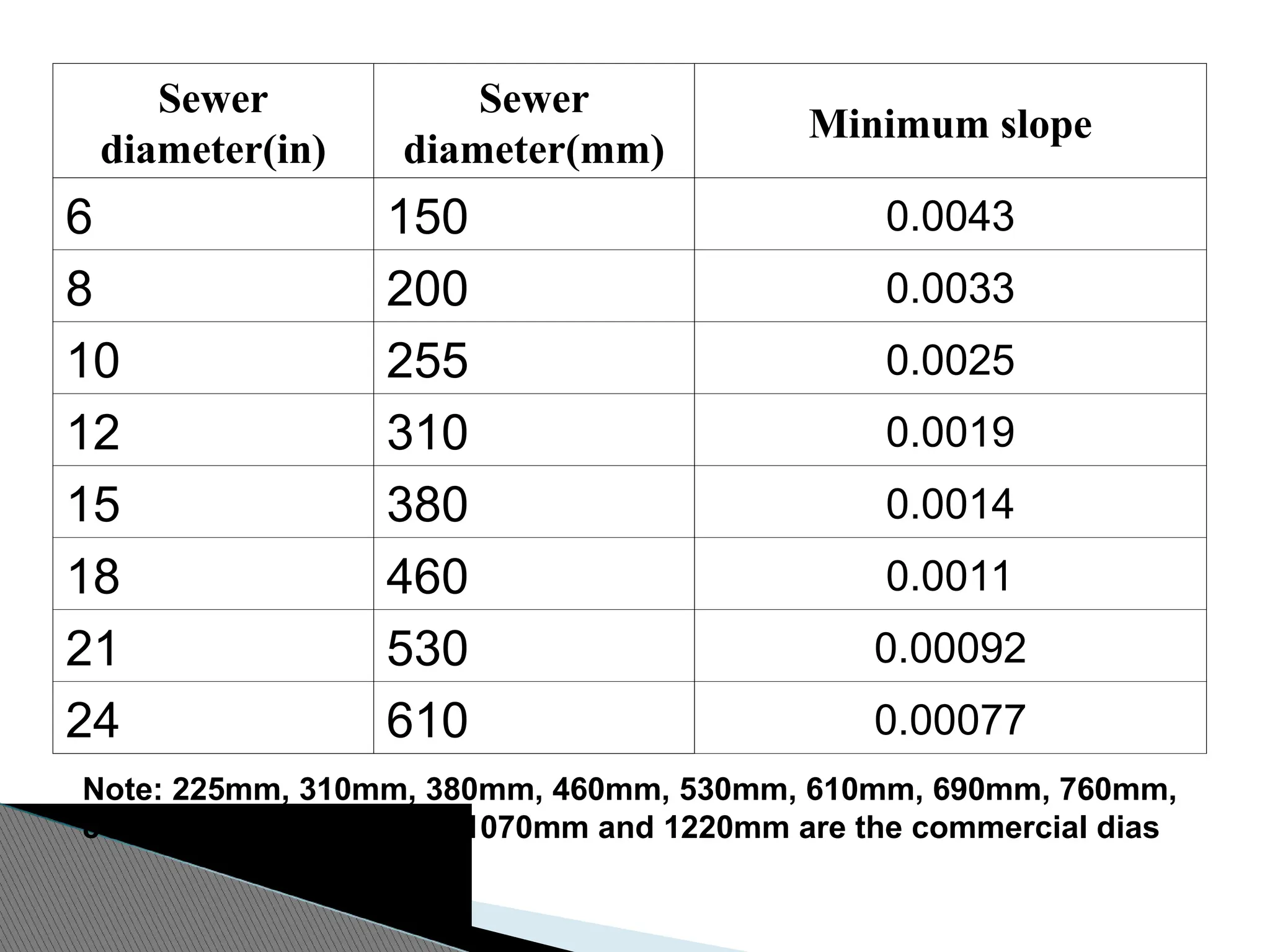
Sewer
diameter(in)
Sewer
diameter(mm)
Minimum slope
6 150 0.0043
8 200 0.0033
10 255 0.0025
12 310 0.0019
15 380 0.0014
18 460 0.0011
21 530 0.00092
24 610 0.00077
Note: 225mm, 310mm, 380mm, 460mm, 530mm, 610mm, 690mm, 760mm,
840mm, 915mm, 990mm, 1070mm and 1220mm are the commercial dias
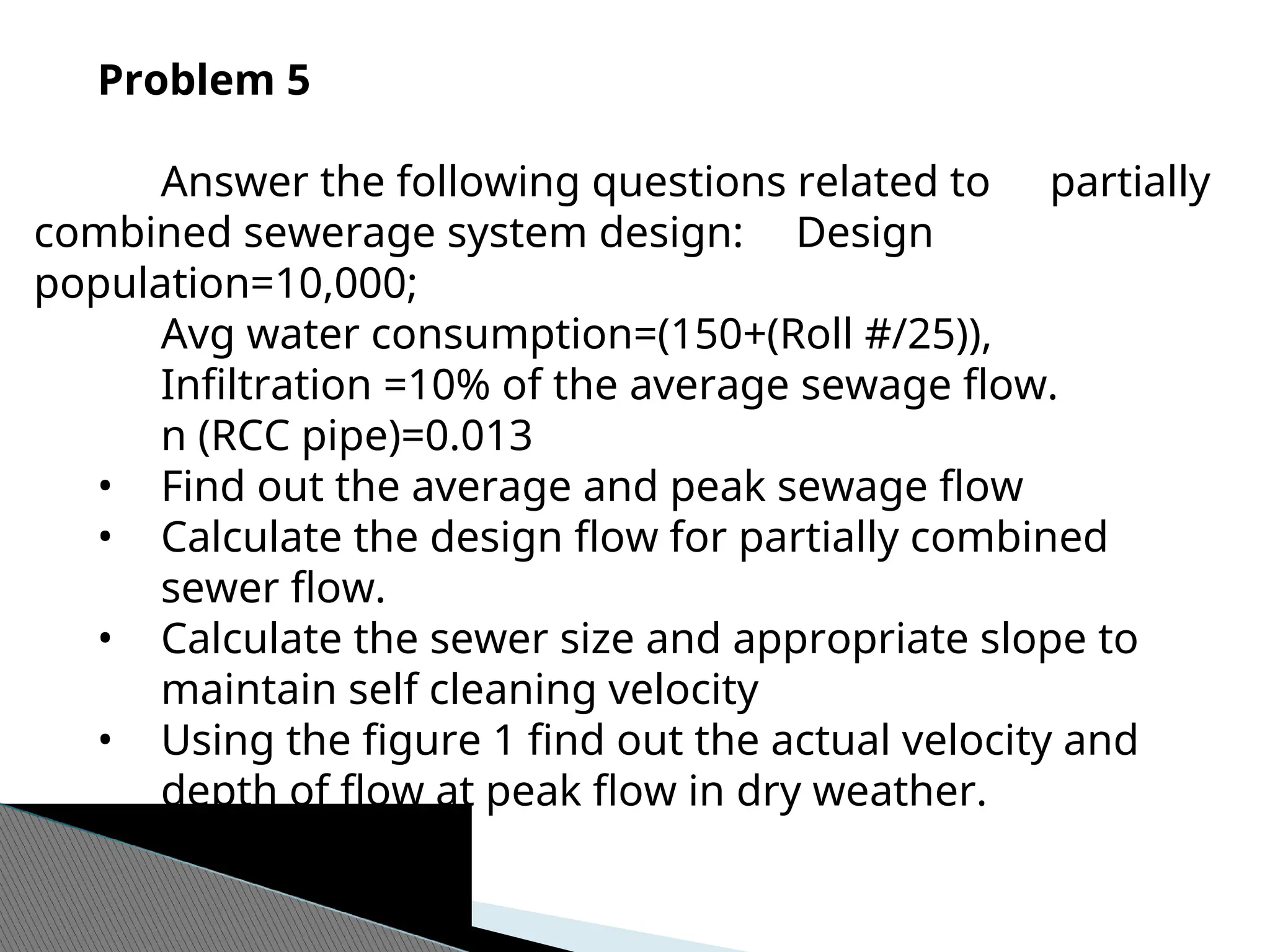
Problem 5
Answer the following questions related to partially
combined sewerage system design: Design
population=10,000;
Avg water consumption=(150+(Roll #/25)),
Infiltration =10% of the average sewage flow.
n (RCC pipe)=0.013
• Find out the average and peak sewage flow
• Calculate the design flow for partially combined
sewer flow.
• Calculate the sewer size and appropriate slope to
maintain self cleaning velocity
• Using the figure 1 find out the actual velocity and
depth of flow at peak flow in dry weather.

Module - 3 Introduction Design of Sanitary Sewers.ppt

  • 1.
    by Muhammad FarhanArooj BSc. Civil Engineering, UET Lahore - 2001 MS. Civil & Environmental Engineering, KAIST, South Korea - 2004 Editor Water Research, Top 25 Research Topics in the World, Exposure of more than 400 wastewater treatment plants and Solid Waste Management Projects in the World.
  • 2.
    Develop the student’sknowledge of  To plan, design wastewater collection Systems.  To plan, design wastewater Treatment Systems.  To introduce Environmental Laws, EIA and Solid Waste Management.
  • 3.
     Upon successfulcompletion of the course, the student should be able to comprehend:  Public Health Aspect of Wastewater Collection  Wastewater Collection Design  Wastewater Treatment Design  Wastewater Quality Parameters & Assessment
  • 4.
    A. Sources ofwaste water; Domestic and Industrial. Estimation of sanitary sewage and storm water quantities. Hydraulics of sewers and design of sewerage system. Sewage pumping stations. Characteristics of Domestic and Industrial wastewater. B. Wastewater treatment; purpose, principles and design of various wastewater treatment processes including screens, grit chambers, sedimentation tanks, Activated sludge process, SBR, Trickling Filters, wastewater stabilization ponds and Aerated Lagoons. Sludge digestion and disposal. C. Disposal of wastewater on land and water bodies. Waste assimilative capacity of streams. Use of treated effluent for irrigation. D.National Environmental Quality standards (NEQS). Introduction to Environmental Impact Assessment. Evaluation of Environmental Impacts. E.Solid Waste Management
  • 5.
    2 + 1credit hours course Theory – 2 credit hours ● Quizzes 10 % ● Projects / Assignments 10 % ● Class Participation 10 % ● 1 x Mid term exam 20 % ● End of Semester Exam 50 % Practical – 1 credit hour ● Lab work 60 % ● Final Viva 40 %
  • 6.
    ● Study ingroups but submit work on your own ● No copying of project / assignments ● Severe penalty in case someone found cheating ● No make up quizzes or projects / assignments ● At least 80 % attendance is mandatory to appear in the exam ● Fundamental course in Civil Engineering ● Good class conduct and is very important to understand this course
  • 7.
    Text Book Water Supply& Sewerage by E.W Steel and Torence J. Mc Ghee 4th, 5th, 6th Edition (whichever Available). REFERENCE BOOKS •Water Supply & Sanitary Engineering S. C. Rangwala 2. Waste water Engineering, Treatment, Disposal, reuse by Metcalf and Eddy, 3rd Edition. 3. Water and waste water Engineering by Fair & Geyer 4. Water and waste water Technology by Mask J. Hammer
  • 9.
    SOME BASIC TERMS Sewage:It is the Liquid Waste of Wastewater produced as a result of water use. Sewer: It is a Pipe or Conduit for carrying sewage. It is generally closed and flow takes place under gravity. Sewerage: it is a comprehensive term. This term is applied to the Art Of the collection of wastewater and conveying it to the point of final disposal with or without treatment. SOURCES OF WASTEWATER 1. Domestic It is waste water from residential buildings, offices, other buildings and institutions etc. 2. Industrial It is liquid waste from industrial processes like dying, paper making, fertilizers, chemicals, leather etc. 3. Storm water It include surface run off generated by rainfalls and street wash.
  • 10.
    TYPES OF SEWERS 1.SanitarySewer: Sewer which carries sanitary sewage i.e., wastewater originating from a municipality including domestic and industrial wastewater. 2.Storm Sewer: It carries storm sewage including surface run off and street washes. 3.Combined Sewer: It carries domestic, industrial and storm sewage. 4. House Sewer: is a pipe conveying wastewater from an individual structure to a common sewer or some other point of disposal.
  • 11.
    TYPES OF SEWERS 5.Lateral Sewer: It receive discharge from house sewers 6. Sub main sewer: It receive discharge from one or more laterals. 7. Main/Trunk Sewer: Receive discharge from two or more sub mains. 8. Force Mains are pressurized sewer lines which convey sewage from a pumping station to another main or to a point of treatment or disposal 9. Outfall Sewer: Receive discharge from all collecting system and convey it to the point of final disposal (e.g., a water body etc)
  • 12.
    Components of WastewaterEngineering • Collection system (network of sewer pipes) • Disposal Works (Sewage pumping stations) • Treatment works (render treatment) TYPES OF SEWERAGE SYSTEMS 1. Separate System If storm water is carried separately from domestic and industrial waste, the system is called separate system. When favored I) There is an immediate need for collection of sanitary sewage but not for storm sewage. II) Where sanitary sewage need treatment but storm water does not
  • 13.
    2. Combined System:A system in which sewer carry both sanitary as well as storm sewage. When favored I)When combined sewage can be disposed off with out treatment II)When both need treatment III)When streets are narrow and two separate sewers cannot be laid. 3. Partially Combined: If some portion of storm or surface run off (from roofs, roads, open spaces etc) is allowed to be carried along with sanitary sewage, the system is known as partially combined system. Note: In urban areas, mostly, partially combined system is used.
  • 14.
    Infiltration It is thewater that enters sewer through poor joints, cracked pipes and walls and covers of manholes. Infiltration is almost non-existent in dry weather but it will increase during rainy season. Infiltration rates ≤ 45 lit /km of sewer/day/mm dia (E.W. Steel) WASA: 225 mm – 610 mm, Infiltration = 5 % of Av. Sewage flow. > 610 mm, Infiltration = 10 % of Av. Sewage flow.
  • 15.
    SEWAGE FLOW /QUANTITY Sanitary and industrial sewage is derived from water supply, so it has a relationship with amount of water consumption. Generally 80–90% of water consumption is taken as sewage flow. Variation In Sewage Flow Like water supply, sewage flow varies from time to time. Since sewers must be able to accommodate the max flow the variation in sewage flow need to be studied. Generally, following formula is used to estimate the rates (Peak Factor) of max. to average flow, where p is the population in thousands ) . ( 4 14 1 max Steel W E p M Q Q av    
  • 16.
    WASA: Av. Flow (m3 /d)Peak Factor Significance of Av. or min. flows  2,500 4.0 1) Used in design of sewage pumping stations. 2) Used to investigate velocities in sewers during low flow period. 2,500-5,000 3.4 5,000-10,000 3.1 10,000-25,000 2.7 25000-50,000 2.5 50,000-100,000 2.3 100,000-250,000 2.15 250,000-500,00 2.08 > 500,000 2.0
  • 17.
    17 Problem1 The residential areaof a city has a population density of 15000 per 1Km2 and an area of 120,000 m2 . If the average water consumption is 400 lpcd find the average sewage flow and the max sewage flow that can be expected in m3 /day. Problem 2 For the above problem design a sewer system generally based on current knowledge.(n=0.012)
  • 18.
    Problem The residential areaof a city has a population density of 15000 per 1Km2 and an area of 120,000 m2 . If the average water consumption in 400 lpcd find the average sewage flow and the max sewage flow that can be expected in m3 /day Solution Total pop = 15000  = 1800 persons. Per capita sewage flow = 0.8  400 = 320 lpcd. Av. Sewage flow = 1800  320 = 576 m3 /d. M = 1 + = 1 + = 3.6 Max/Peak Sewage Flow = 576  3.6 = 2085 m3 /d. 1000 1000 000 , 120  p  4 14 8 . 1 4 14 
  • 19.
    DESIGN PERIODS 1. CollectionWorks: Period of design is “Indefinite” as the system is designed to case for the maximum development of the area. 2. Disposal Works: Design period is usually 10 years. Rates of flow required are: average daily, peak and minimum flow rates, including infiltration. 3. Treatment Works: Design period is 15 to 20 years flow rates required are average and peak. INVERT LEVEL It is the level of the invert of the sewer pipe Invert: Inverted Arch Invert Level = G.L– Cover over pipe– thickness of Pipe– dia of pipe. Steps For Design Of Sewer • Preliminary Investigations • Design consideration/Formulation of design criteria • Actual Design • Preparation of drawings and BOQ • Subsequent modifications.
  • 20.
    1) PRELIMINARY INVESTIGATION If map of the area is not already available, the first step is to carry out survey to draw a map of the project area. Different details are marked on the map like • Streets • Railway lines • Streams • Location of under ground utilities like gas, water mains etc. 1) Establish BENCH MARKS through out the area and make contour profiles. 2) Soil conditions should be investigated for the type of structure, location of water table, presence of any underground rock etc.  Collection of rainfall and run off data.  Study of natural slopes of the area and selection of a suitable disposal point. 2) DESIGN CONSIDERATIONS/FORMULATION OF DESIGN CRITERIA (i) Design Flow Sanitary Sewer = Peak Sewage flow + Infilt + Industrial flow Partially Combined = 2  (Peak sewage flow) + Infilt + Industrial Flow (WASA CRITERIA)
  • 21.
    21 (ii) Design Equation Sewersare designed on the basis of open channel flow. V = (Manning’s Formula) Where V = Velocity, m/sec R = hydraulic mean depth = = D/4, when pipe is flowing full or ½ full S = slope of sewer n = Co-efficient of roughness for pipe (0.012 for R.C.C pipes) (see table 15.1 EW steel for more n values) (iii) Minimum Velocities Min velocities also called self cleansing velocities must be maintained in sewers to avoid deposition of suspended solids and subsequent choking of sewers. Sanitary sewers = 0.6 m/sec [organic particle sp. gs = 1.61] Storm sewers = 1 m/sec [inorganic particle sp. gs = 2.65] Partially combined = 0.7 m/sec. 2 1 3 2 1 s R n perimeter wetted Area
  • 22.
    (iv) Maximum Velocities 2.4m/sec (E.W Steel) A limit on higher velocity is imposed due to abrasive character of solids in wastewater Scraping or wearing away. (v) Min. Sewer Size 225 mm is taken as min sever size. [WASA, PHED] why: choaking takes place with bigger size particles/substances which are usually thrown into sewer through manholes etc. [Examples: shrubs, bricks etc]. (vi) Min Cover: 1m is taken as min cover over sewers to avoid damage from live loads coming on sewers. (vii) Manholes Purpose Cleaning Inspection House connections
  • 23.
    Where provided 1.At everychange in direction 2.Where two different dia pipes are to be connected. Spacing 225 mm – 350 mm spacing 100 m 460 mm – 760 mm spacing 120 m [WASA] > 760 mm spacing 150 m Note For plots, one manhole be provided for 2 plots viii)Qd/Qf Ratios WASA recommend the Qd/Qf ratios in order to provide air space in the upper portion of sewers for ventilation purpose. Qd represent design flow and Qf is flow when sewer is flowing full. Sewer Size Ratio (Qd/Qf) 225 – 380 mm 0.7 460 – 1220 mm 0.75 1370 mm and larger 0.8
  • 24.
    3)DESIGN OF SEWER Bydesign of sewer, we mean the following two things 1.To find Size of sewer Q = AV is used to find size 2.To find required Slope to maintain a minimum velocity in sewers. V = Is used to find slope. 4) PREPARATION OF DRAWING AND BOQ Typical drawings include 3) Sewer joints • Manholes • Disposal station 1. Sewer profiles or L – sections 5) SUBSEQUENT MODIFICATIONS Mostly done due to some unforeseen incident, to accommodate some additional demand/requirement of the client etc. 2 1 3 2 1 s R n
  • 25.
    25 Problem 3 Design apartially combined sewer system with following data Population density for residential area= 10000 per 1Km2 % age of residential area = 90% % age of Industrial area = 10%; Peak Factor = 2 Total area = 820,000 m2 Water consumption (lpcd) = (100 + reg. number /25) Manning roughness coefficient = 0.012 Assume suitable data as applicable
  • 26.
    SEWERS FLOWING PARTIALLYFULL It is necessary to determine velocity and depth of sewage in a pipe when it is flowing only partially full. For this, use of the GRAPH will allow quick computation of the hydraulic elements of partially filled circular sewer. For using this graph, it is necessary to find first the conditions when a sewer is flowing full. Then by calculating the ratio of any two known hydraulic elements, the others can be found. Significance Of Partial Flow Study Conditions during partial flow, must frequently be determined in combined / partially combined sewers due to the following reasons. • To investigate velocities during dry weather flow to determine possibilities of deposits occurring in pipes. • Knowledge of depth of flow is of value in designing sewer inter sections.
  • 27.
  • 28.
    28 Problem 4 A 915mm circular combined sewer is laid on a slope of 0.003 and it is flowing full with n = 0.013. What will be the velocity and depth of flow when the sewer is carrying 8.5 m3 /min discharge. (0.1416 m3 /sec).
  • 29.
    Problem 4 A 915mm circular combined sewer is laid on a slope of 0.003 and it is flow full with n = 0.013. What will be the velocity and depth of flow when the sewer is carrying 8.5 m3 /min discharge. (0.1416 m3 /sec). Q when flowing full = V =(1/n) R2/3 S1/2 = = 1.57 m/sec Q = A  V= = 1.036 m3 /sec Qa/Qf = 0.1416/1.036 = 0.14 d/D= 0.3 (from discharge line) d = 0.3  0.915 = 0.275 = 275 mm at 0.1416 m3 /sec Find velocity at actual depth of flow : Va/Vf = 0.6 (from graph against 0.3) Va = 0.6  1.57 = 0.94 m/sec    2 1 003 . 0 3 2 4 013 . 0 1 D    57 . 1 915 . 0 4 142 . 3 2  
  • 30.
    Sewer diameter(in) Sewer diameter(mm) Minimum slope 6 1500.0043 8 200 0.0033 10 255 0.0025 12 310 0.0019 15 380 0.0014 18 460 0.0011 21 530 0.00092 24 610 0.00077 Note: 225mm, 310mm, 380mm, 460mm, 530mm, 610mm, 690mm, 760mm, 840mm, 915mm, 990mm, 1070mm and 1220mm are the commercial dias
  • 31.
    Problem 5 Answer thefollowing questions related to partially combined sewerage system design: Design population=10,000; Avg water consumption=(150+(Roll #/25)), Infiltration =10% of the average sewage flow. n (RCC pipe)=0.013 • Find out the average and peak sewage flow • Calculate the design flow for partially combined sewer flow. • Calculate the sewer size and appropriate slope to maintain self cleaning velocity • Using the figure 1 find out the actual velocity and depth of flow at peak flow in dry weather.