Erbil Polytechnic University Civil Engineering Department Saad.bilbas@epu.edu.iq 37
Erbil Polytechnic University Civil Engineering Department Saad.bilbas@epu.edu.iq 38
Design of Sewer System
Sewer system plays a vital role in the economic development of a country. Sewers are must
for the drainage of waste water. In order to have an effective sewage system the sewers should
be properly designed and more care should be taken in finding the invert levels otherwise
whole design may get wrong. Also, Sewers are designed for the drainage of waste water
coming from houses, industries, streets, runoff etc to protect the environment and people from
serious diseases, as more than 50 diseases spread from sewage. So for a good living, the
sewers should be properly designed and the sewage should be treated properly before
discharging it into the river.
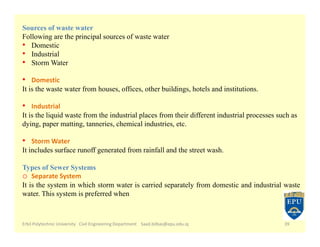
Sewer
It is the pipe or conduit for
carrying sewage. It is generally
closed and flow takes place
under gravity (Atmospheric
Pressure).
Sewerage
Sewerage is the system of collection of waste
water and conveying it to a point of final
disposal with or without treatment.
Figure 8: Sewer System
Erbil Polytechnic University Civil Engineering Department Saad.bilbas@epu.edu.iq 39
Sources of waste water
Following are the principal sources of waste water
• Domestic
• Industrial
• Storm Water
• Domestic
It is the waste water from houses, offices, other buildings, hotels and institutions.
• Industrial
It is the liquid waste from the industrial places from their different industrial processes such as
dying, paper matting, tanneries, chemical industries, etc.
• Storm Water
It includes surface runoff generated from rainfall and the street wash.
Types of Sewer Systems
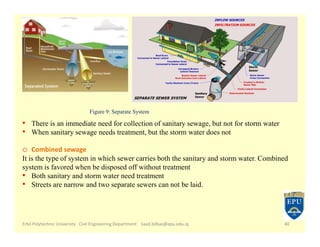
o Separate System
It is the system in which storm water is carried separately from domestic and industrial waste
water. This system is preferred when
Erbil Polytechnic University Civil Engineering Department Saad.bilbas@epu.edu.iq 40
Figure 9: Separate System
• There is an immediate need for collection of sanitary sewage, but not for storm water
• When sanitary sewage needs treatment, but the storm water does not
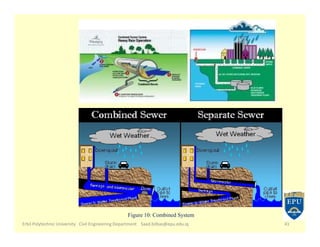
o Combined sewage
It is the type of system in which sewer carries both the sanitary and storm water. Combined
system is favored when be disposed off without treatment
• Both sanitary and storm water need treatment
• Streets are narrow and two separate sewers can not be laid.
Erbil Polytechnic University Civil Engineering Department Saad.bilbas@epu.edu.iq 41
Figure 10: Combined System
Erbil Polytechnic University Civil Engineering Department Saad.bilbas@epu.edu.iq 42
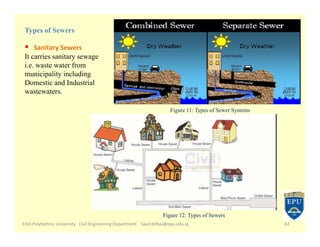
Figure 12: Types of Sewers
Types of Sewers
 Sanitary Sewers
It carries sanitary sewage
i.e. waste water from
municipality including
Domestic and Industrial
wastewaters.
Figure 11: Types of Sewer Systems
Erbil Polytechnic University Civil Engineering Department Saad.bilbas@epu.edu.iq 43
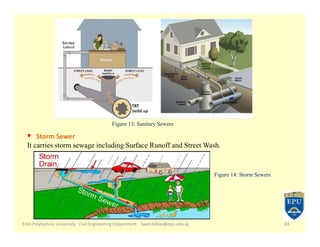
Figure 13: Sanitary Sewers
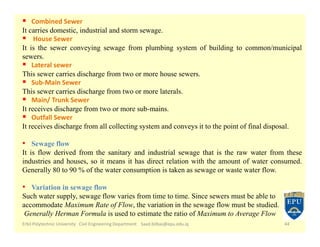
 Storm Sewer
It carries storm sewage including Surface Runoff and Street Wash.
Figure 14: Storm Sewers
Erbil Polytechnic University Civil Engineering Department Saad.bilbas@epu.edu.iq 44
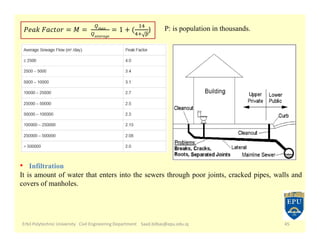
 Combined Sewer
It carries domestic, industrial and storm sewage.
 House Sewer
It is the sewer conveying sewage from plumbing system of building to common/municipal
sewers.
 Lateral sewer
This sewer carries discharge from two or more house sewers.
 Sub-Main Sewer
This sewer carries discharge from two or more laterals.
 Main/ Trunk Sewer
It receives discharge from two or more sub-mains.
 Outfall Sewer
It receives discharge from all collecting system and conveys it to the point of final disposal.
• Sewage flow
It is flow derived from the sanitary and industrial sewage that is the raw water from these
industries and houses, so it means it has direct relation with the amount of water consumed.
Generally 80 to 90 % of the water consumption is taken as sewage or waste water flow.
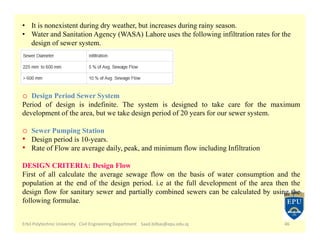
• Variation in sewage flow
Such water supply, sewage flow varies from time to time. Since sewers must be able to
accommodate Maximum Rate of Flow, the variation in the sewage flow must be studied.
Generally Herman Formula is used to estimate the ratio of Maximum to Average Flow
Erbil Polytechnic University Civil Engineering Department Saad.bilbas@epu.edu.iq 45
  ) P: is population in thousands.
• Infiltration
It is amount of water that enters into the sewers through poor joints, cracked pipes, walls and
covers of manholes.
Erbil Polytechnic University Civil Engineering Department Saad.bilbas@epu.edu.iq 46
• It is nonexistent during dry weather, but increases during rainy season.
• Water and Sanitation Agency (WASA) Lahore uses the following infiltration rates for the
design of sewer system.
o Design Period Sewer System
Period of design is indefinite. The system is designed to take care for the maximum
development of the area, but we take design period of 20 years for our sewer system.
o Sewer Pumping Station
• Design period is 10-years.
• Rate of Flow are average daily, peak, and minimum flow including Infiltration
DESIGN CRITERIA: Design Flow
First of all calculate the average sewage flow on the basis of water consumption and the
population at the end of the design period. i.e at the full development of the area then the
design flow for sanitary sewer and partially combined sewers can be calculated by using the
following formulae.
Erbil Polytechnic University Civil Engineering Department Saad.bilbas@epu.edu.iq 47
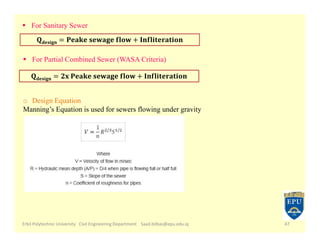
 For Sanitary Sewer
𝐝𝐞𝐬𝐢𝐠𝐧
 For Partial Combined Sewer (WASA Criteria)
𝐝𝐞𝐬𝐢𝐠𝐧
o Design Equation
Manning’s Equation is used for sewers flowing under gravity
Erbil Polytechnic University Civil Engineering Department Saad.bilbas@epu.edu.iq 48
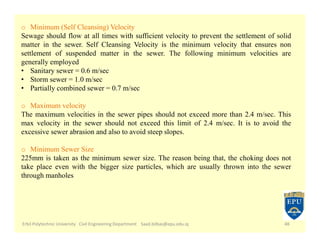
o Minimum (Self Cleansing) Velocity
Sewage should flow at all times with sufficient velocity to prevent the settlement of solid
matter in the sewer. Self Cleansing Velocity is the minimum velocity that ensures non
settlement of suspended matter in the sewer. The following minimum velocities are
generally employed
• Sanitary sewer = 0.6 m/sec
• Storm sewer = 1.0 m/sec
• Partially combined sewer = 0.7 m/sec
o Maximum velocity
The maximum velocities in the sewer pipes should not exceed more than 2.4 m/sec. This
max velocity in the sewer should not exceed this limit of 2.4 m/sec. It is to avoid the
excessive sewer abrasion and also to avoid steep slopes.
o Minimum Sewer Size
225mm is taken as the minimum sewer size. The reason being that, the choking does not
take place even with the bigger size particles, which are usually thrown into the sewer
through manholes
Erbil Polytechnic University Civil Engineering Department Saad.bilbas@epu.edu.iq 49
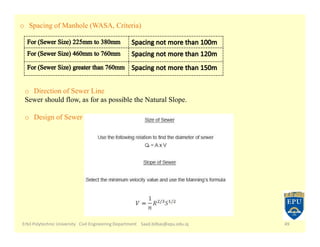
o Spacing of Manhole (WASA, Criteria)
o Direction of Sewer Line
Sewer should flow, as for as possible the Natural Slope.
o Design of Sewer
Erbil Polytechnic University Civil Engineering Department Saad.bilbas@epu.edu.iq 50
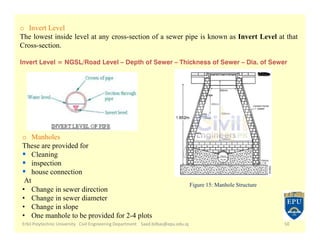
o Invert Level
The lowest inside level at any cross-section of a sewer pipe is known as Invert Level at that
Cross-section.
Invert Level = NGSL/Road Level – Depth of Sewer – Thickness of Sewer – Dia. of Sewer
o Manholes
These are provided for
 Cleaning
 inspection
 house connection
At
• Change in sewer direction
• Change in sewer diameter
• Change in slope
• One manhole to be provided for 2-4 plots
Figure 15: Manhole Structure
Erbil Polytechnic University Civil Engineering Department Saad.bilbas@epu.edu.iq 51
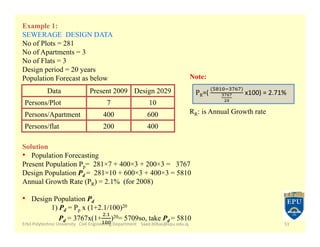
Example 1:
SEWERAGE DESIGN DATA
No of Plots = 281
No of Apartments = 3
No of Flats = 3
Design period = 20 years
Population Forecast as below
Data Present 2009 Design 2029
Persons/Plot 7 10
Persons/Apartment 400 600
Persons/flat 200 400
Solution
• Population Forecasting
Present Population Pp= 281×7 + 400×3 + 200×3 = 3767
Design Population Pd = 281×10 + 600×3 + 400×3 = 5810
Annual Growth Rate (PR) = 2.1% (for 2008)
• Design Population Pd
1) Pd = Pp x (1+2.1/100)20
Pd = 3767x(1+
.
)20= 5709so, take Pd = 5810
R=(
( )
x100) = 2.71%
Note:
RR: is Annual Growth rate
Erbil Polytechnic University Civil Engineering Department Saad.bilbas@epu.edu.iq 52
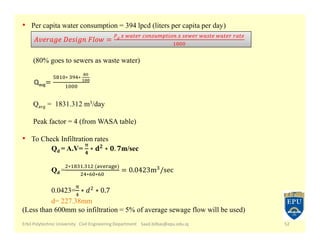
• Per capita water consumption = 394 lpcd (liters per capita per day)
(80% goes to sewers as waste water)
Qavg = 1831.312 m3/day
Peak factor = 4 (from WASA table)
• To Check Infiltration rates
Qd = A.V=
𝟒
𝟐
m/sec
Qd =
∗ . ( )
∗ ∗
0.0423=
d= 227.38mm
(Less than 600mm so infiltration = 5% of average sewage flow will be used)
Qavg
∗ ∗
Erbil Polytechnic University Civil Engineering Department Saad.bilbas@epu.edu.iq 53
Example 2:
• DESIGN OF WET WELL
Given: Qmax = 14742.1m3/day = 10.237 m3/min
Solution:
Pumping capacity
So, P = Qmax = 10.237 m3/min
 Minimum cycle time Design of Sewer System
Thus Minimum Cycle time must not be less than 5-minutes
For smaller pumps t min = 15 min
∗ ( )
]
. ∗
]= 38.39m3
• DIMENSIONS OF WET WELL
Assume Length = 3.6 m Design of Sewer System
Width = 3.6m
38.39 = 3.6*3.6*height
Hence, height = 3 m
Erbil Polytechnic University Civil Engineering Department Saad.bilbas@epu.edu.iq 54
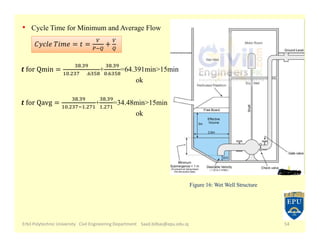
• Cycle Time for Minimum and Average Flow
.
. .
+
.
.
=64.391min>15min
ok
.
. .
+
.
.
=34.48min>15min
ok
Figure 16: Wet Well Structure

Sewage, Sewer system, and elevations Module

  • 1.
    Erbil Polytechnic UniversityCivil Engineering Department Saad.bilbas@epu.edu.iq 37
  • 2.
    Erbil Polytechnic UniversityCivil Engineering Department Saad.bilbas@epu.edu.iq 38 Design of Sewer System Sewer system plays a vital role in the economic development of a country. Sewers are must for the drainage of waste water. In order to have an effective sewage system the sewers should be properly designed and more care should be taken in finding the invert levels otherwise whole design may get wrong. Also, Sewers are designed for the drainage of waste water coming from houses, industries, streets, runoff etc to protect the environment and people from serious diseases, as more than 50 diseases spread from sewage. So for a good living, the sewers should be properly designed and the sewage should be treated properly before discharging it into the river. Sewer It is the pipe or conduit for carrying sewage. It is generally closed and flow takes place under gravity (Atmospheric Pressure). Sewerage Sewerage is the system of collection of waste water and conveying it to a point of final disposal with or without treatment. Figure 8: Sewer System
  • 3.
    Erbil Polytechnic UniversityCivil Engineering Department Saad.bilbas@epu.edu.iq 39 Sources of waste water Following are the principal sources of waste water • Domestic • Industrial • Storm Water • Domestic It is the waste water from houses, offices, other buildings, hotels and institutions. • Industrial It is the liquid waste from the industrial places from their different industrial processes such as dying, paper matting, tanneries, chemical industries, etc. • Storm Water It includes surface runoff generated from rainfall and the street wash. Types of Sewer Systems o Separate System It is the system in which storm water is carried separately from domestic and industrial waste water. This system is preferred when
  • 4.
    Erbil Polytechnic UniversityCivil Engineering Department Saad.bilbas@epu.edu.iq 40 Figure 9: Separate System • There is an immediate need for collection of sanitary sewage, but not for storm water • When sanitary sewage needs treatment, but the storm water does not o Combined sewage It is the type of system in which sewer carries both the sanitary and storm water. Combined system is favored when be disposed off without treatment • Both sanitary and storm water need treatment • Streets are narrow and two separate sewers can not be laid.
  • 5.
    Erbil Polytechnic UniversityCivil Engineering Department Saad.bilbas@epu.edu.iq 41 Figure 10: Combined System
  • 6.
    Erbil Polytechnic UniversityCivil Engineering Department Saad.bilbas@epu.edu.iq 42 Figure 12: Types of Sewers Types of Sewers  Sanitary Sewers It carries sanitary sewage i.e. waste water from municipality including Domestic and Industrial wastewaters. Figure 11: Types of Sewer Systems
  • 7.
    Erbil Polytechnic UniversityCivil Engineering Department Saad.bilbas@epu.edu.iq 43 Figure 13: Sanitary Sewers  Storm Sewer It carries storm sewage including Surface Runoff and Street Wash. Figure 14: Storm Sewers
  • 8.
    Erbil Polytechnic UniversityCivil Engineering Department Saad.bilbas@epu.edu.iq 44  Combined Sewer It carries domestic, industrial and storm sewage.  House Sewer It is the sewer conveying sewage from plumbing system of building to common/municipal sewers.  Lateral sewer This sewer carries discharge from two or more house sewers.  Sub-Main Sewer This sewer carries discharge from two or more laterals.  Main/ Trunk Sewer It receives discharge from two or more sub-mains.  Outfall Sewer It receives discharge from all collecting system and conveys it to the point of final disposal. • Sewage flow It is flow derived from the sanitary and industrial sewage that is the raw water from these industries and houses, so it means it has direct relation with the amount of water consumed. Generally 80 to 90 % of the water consumption is taken as sewage or waste water flow. • Variation in sewage flow Such water supply, sewage flow varies from time to time. Since sewers must be able to accommodate Maximum Rate of Flow, the variation in the sewage flow must be studied. Generally Herman Formula is used to estimate the ratio of Maximum to Average Flow
  • 9.
    Erbil Polytechnic UniversityCivil Engineering Department Saad.bilbas@epu.edu.iq 45   ) P: is population in thousands. • Infiltration It is amount of water that enters into the sewers through poor joints, cracked pipes, walls and covers of manholes.
  • 10.
    Erbil Polytechnic UniversityCivil Engineering Department Saad.bilbas@epu.edu.iq 46 • It is nonexistent during dry weather, but increases during rainy season. • Water and Sanitation Agency (WASA) Lahore uses the following infiltration rates for the design of sewer system. o Design Period Sewer System Period of design is indefinite. The system is designed to take care for the maximum development of the area, but we take design period of 20 years for our sewer system. o Sewer Pumping Station • Design period is 10-years. • Rate of Flow are average daily, peak, and minimum flow including Infiltration DESIGN CRITERIA: Design Flow First of all calculate the average sewage flow on the basis of water consumption and the population at the end of the design period. i.e at the full development of the area then the design flow for sanitary sewer and partially combined sewers can be calculated by using the following formulae.
  • 11.
    Erbil Polytechnic UniversityCivil Engineering Department Saad.bilbas@epu.edu.iq 47  For Sanitary Sewer 𝐝𝐞𝐬𝐢𝐠𝐧  For Partial Combined Sewer (WASA Criteria) 𝐝𝐞𝐬𝐢𝐠𝐧 o Design Equation Manning’s Equation is used for sewers flowing under gravity
  • 12.
    Erbil Polytechnic UniversityCivil Engineering Department Saad.bilbas@epu.edu.iq 48 o Minimum (Self Cleansing) Velocity Sewage should flow at all times with sufficient velocity to prevent the settlement of solid matter in the sewer. Self Cleansing Velocity is the minimum velocity that ensures non settlement of suspended matter in the sewer. The following minimum velocities are generally employed • Sanitary sewer = 0.6 m/sec • Storm sewer = 1.0 m/sec • Partially combined sewer = 0.7 m/sec o Maximum velocity The maximum velocities in the sewer pipes should not exceed more than 2.4 m/sec. This max velocity in the sewer should not exceed this limit of 2.4 m/sec. It is to avoid the excessive sewer abrasion and also to avoid steep slopes. o Minimum Sewer Size 225mm is taken as the minimum sewer size. The reason being that, the choking does not take place even with the bigger size particles, which are usually thrown into the sewer through manholes
  • 13.
    Erbil Polytechnic UniversityCivil Engineering Department Saad.bilbas@epu.edu.iq 49 o Spacing of Manhole (WASA, Criteria) o Direction of Sewer Line Sewer should flow, as for as possible the Natural Slope. o Design of Sewer
  • 14.
    Erbil Polytechnic UniversityCivil Engineering Department Saad.bilbas@epu.edu.iq 50 o Invert Level The lowest inside level at any cross-section of a sewer pipe is known as Invert Level at that Cross-section. Invert Level = NGSL/Road Level – Depth of Sewer – Thickness of Sewer – Dia. of Sewer o Manholes These are provided for  Cleaning  inspection  house connection At • Change in sewer direction • Change in sewer diameter • Change in slope • One manhole to be provided for 2-4 plots Figure 15: Manhole Structure
  • 15.
    Erbil Polytechnic UniversityCivil Engineering Department Saad.bilbas@epu.edu.iq 51 Example 1: SEWERAGE DESIGN DATA No of Plots = 281 No of Apartments = 3 No of Flats = 3 Design period = 20 years Population Forecast as below Data Present 2009 Design 2029 Persons/Plot 7 10 Persons/Apartment 400 600 Persons/flat 200 400 Solution • Population Forecasting Present Population Pp= 281×7 + 400×3 + 200×3 = 3767 Design Population Pd = 281×10 + 600×3 + 400×3 = 5810 Annual Growth Rate (PR) = 2.1% (for 2008) • Design Population Pd 1) Pd = Pp x (1+2.1/100)20 Pd = 3767x(1+ . )20= 5709so, take Pd = 5810 R=( ( ) x100) = 2.71% Note: RR: is Annual Growth rate
  • 16.
    Erbil Polytechnic UniversityCivil Engineering Department Saad.bilbas@epu.edu.iq 52 • Per capita water consumption = 394 lpcd (liters per capita per day) (80% goes to sewers as waste water) Qavg = 1831.312 m3/day Peak factor = 4 (from WASA table) • To Check Infiltration rates Qd = A.V= 𝟒 𝟐 m/sec Qd = ∗ . ( ) ∗ ∗ 0.0423= d= 227.38mm (Less than 600mm so infiltration = 5% of average sewage flow will be used) Qavg ∗ ∗
  • 17.
    Erbil Polytechnic UniversityCivil Engineering Department Saad.bilbas@epu.edu.iq 53 Example 2: • DESIGN OF WET WELL Given: Qmax = 14742.1m3/day = 10.237 m3/min Solution: Pumping capacity So, P = Qmax = 10.237 m3/min  Minimum cycle time Design of Sewer System Thus Minimum Cycle time must not be less than 5-minutes For smaller pumps t min = 15 min ∗ ( ) ] . ∗ ]= 38.39m3 • DIMENSIONS OF WET WELL Assume Length = 3.6 m Design of Sewer System Width = 3.6m 38.39 = 3.6*3.6*height Hence, height = 3 m
  • 18.
    Erbil Polytechnic UniversityCivil Engineering Department Saad.bilbas@epu.edu.iq 54 • Cycle Time for Minimum and Average Flow . . . + . . =64.391min>15min ok . . . + . . =34.48min>15min ok Figure 16: Wet Well Structure