Topic: Kurt Lewin’s- Force Field
Theory
Purpose
• To Analyze the factors found in complex
Problems
• It works as a Tool for Managing Change
• It helps to identify those factors that must be
addressed and monitored if change is to be
successful.
Procedure
Step 1:Defining the Problem
• What is the nature of our current situation that
is unacceptable and needs modification?
• It is useful to separate the specific problem from
those things that are working well.
Procedure continue……
Step 2: Defining the Change Objective
• What is the desired situation that would be
worth working toward?
• Be as Specific as possible.
Procedure continue……
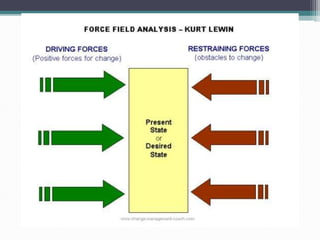
Step 3: Identifying the Driving Forces
• What are the factors or pressures that support
change in the desired direction?
• What are the relative strengths of these forces?
• What are the inter-relationships among the
driving forces?
Procedure continue……
Step 4: Identifying the Restraining Forces
• What are the factors or pressures that resist the
proposed change and Maintain the status quo?
• What are the inter-relationships among the
Restraining forces?
Procedure continue……
Step 5: Developing the Comprehensive
Change Strategy
• Strengthening any of the driving forces.
• Adding new driving forces (possibly by
transforming a former restraining force)
• - Removing or reducing any of the restraining
forces
Procedure continue……
Step 6: should also include some
consideration of some of the possible
unintended
• consequences when equilibrium forces are
altered (e.g. Increase resistance, new alliances,
fear etc.
Lewin’s change model
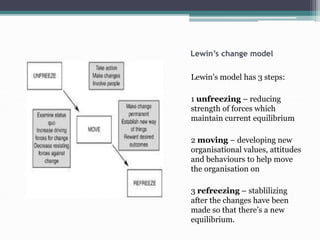
Lewin’s model has 3 steps:
1 unfreezing – reducing
strength of forces which
maintain current equilibrium
2 moving – developing new
organisational values, attitudes
and behaviours to help move
the organisation on
3 refreezing – stablilizing
after the changes have been
made so that there’s a new
equilibrium.
Kurt lewin’s  force field theory

Kurt lewin’s force field theory

  • 1.
    Topic: Kurt Lewin’s-Force Field Theory
  • 2.
    Purpose • To Analyzethe factors found in complex Problems • It works as a Tool for Managing Change • It helps to identify those factors that must be addressed and monitored if change is to be successful.
  • 3.
    Procedure Step 1:Defining theProblem • What is the nature of our current situation that is unacceptable and needs modification? • It is useful to separate the specific problem from those things that are working well.
  • 4.
    Procedure continue…… Step 2:Defining the Change Objective • What is the desired situation that would be worth working toward? • Be as Specific as possible.
  • 5.
    Procedure continue…… Step 3:Identifying the Driving Forces • What are the factors or pressures that support change in the desired direction? • What are the relative strengths of these forces? • What are the inter-relationships among the driving forces?
  • 6.
    Procedure continue…… Step 4:Identifying the Restraining Forces • What are the factors or pressures that resist the proposed change and Maintain the status quo? • What are the inter-relationships among the Restraining forces?
  • 7.
    Procedure continue…… Step 5:Developing the Comprehensive Change Strategy • Strengthening any of the driving forces. • Adding new driving forces (possibly by transforming a former restraining force) • - Removing or reducing any of the restraining forces
  • 8.
    Procedure continue…… Step 6:should also include some consideration of some of the possible unintended • consequences when equilibrium forces are altered (e.g. Increase resistance, new alliances, fear etc.
  • 10.
    Lewin’s change model Lewin’smodel has 3 steps: 1 unfreezing – reducing strength of forces which maintain current equilibrium 2 moving – developing new organisational values, attitudes and behaviours to help move the organisation on 3 refreezing – stablilizing after the changes have been made so that there’s a new equilibrium.