1
SUZUKI CROSS-COUPLING REACTION
Dr. Shahid Rasool Suzuki Cross-coupling reaction CHEM5128
Advanced Named Reactions
2
Key Concepts
• Suzuki Cross-Coupling reactions
• Discussion of reacting species, catalysts, solvents
• Mechanism of reaction
• Explanation of mechanism step by step
• Synthetic applications
3
Suzuki Cross-coupling Reaction:
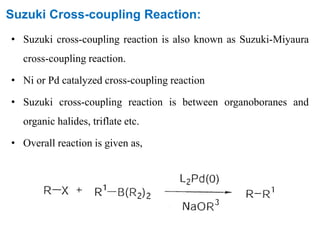
• Suzuki cross-coupling reaction is also known as Suzuki-Miyaura
cross-coupling reaction.
• Ni or Pd catalyzed cross-coupling reaction
• Suzuki cross-coupling reaction is between organoboranes and
organic halides, triflate etc.
• Overall reaction is given as,
Similar Cross-coupling Reactions:
• This reaction is similar to following reactions also using Ni or Pd,
• Negishi cross-coupling reaction (Organozinc reagents, RZnX)
• Stille cross-coupling reaction (Organostannanes reagents, R4Sn)
• Hiyama cross-coupling reaction (Organosilicons, RSiF3)
• Kumada cross-coupling reaction (Grignard reagent, RMgX)
Alkyl halides (R-X):
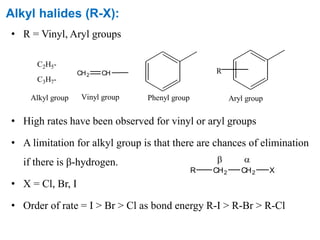
• R = Vinyl, Aryl groups
• High rates have been observed for vinyl or aryl groups
• A limitation for alkyl group is that there are chances of elimination
if there is β-hydrogen.
• X = Cl, Br, I
• Order of rate = I > Br > Cl as bond energy R-I > R-Br > R-Cl
C2H5-
C3H7-
Alkyl group
CH2 CH
Vinyl group Phenyl group Aryl group
R
R CH2 CH2 X

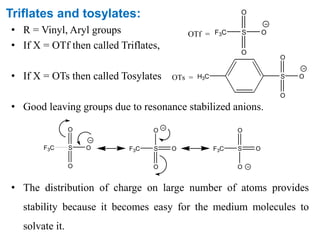
Triflates and tosylates:
• R = Vinyl, Aryl groups
• If X = OTf then called Triflates,
• If X = OTs then called Tosylates
• Good leaving groups due to resonance stabilized anions.
• The distribution of charge on large number of atoms provides
stability because it becomes easy for the medium molecules to
solvate it.
OTf = F3C S
O
O
O
OTs = S
O
O
OH3C
F3C S
O
O
O F3C S
O
O
O F3C S
O
O
O
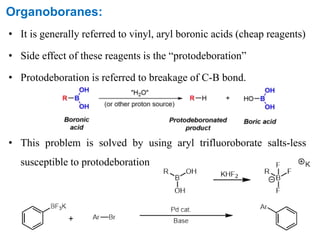
Organoboranes:
• It is generally referred to vinyl, aryl boronic acids (cheap reagents)
• Side effect of these reagents is the “protodeboration”
• Protodeboration is referred to breakage of C-B bond.
• This problem is solved by using aryl trifluoroborate salts-less
susceptible to protodeboration
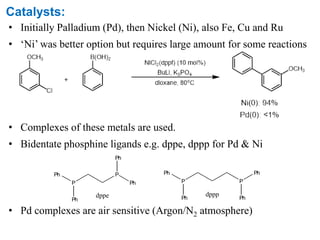
Catalysts:
• Initially Palladium (Pd), then Nickel (Ni), also Fe, Cu and Ru
• ‘Ni’ was better option but requires large amount for some reactions
• Complexes of these metals are used.
• Bidentate phosphine ligands e.g. dppe, dppp for Pd & Ni
• Pd complexes are air sensitive (Argon/N2 atmosphere)
P
P
Ph
Ph
Ph
Ph
P P
Ph
Ph
Ph
Phdppe dppp
Solvent:
• Reaction can run in biphasic (organic & aqueous), only aqueous or
without solvent.
• Water more economical and safe
• Other solvents include Toluene, THF (tetrahydrofuran), dioxane,
DMF (dimethylformamide) etc
Base:
• A number of bases have been employed including
• K2CO3, KOtBu, Cs2CO3, K3PO4, NaOH, NEt3
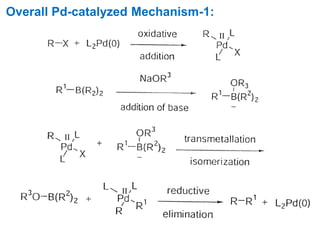
Overall Pd-catalyzed Mechanism-1:
II
II
II
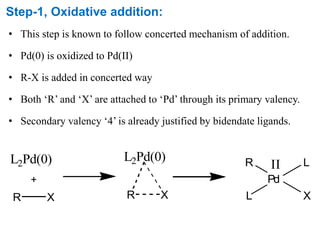
Step-1, Oxidative addition:
• This step is known to follow concerted mechanism of addition.
• Pd(0) is oxidized to Pd(II)
• R-X is added in concerted way
• Both ‘R’ and ‘X’ are attached to ‘Pd’ through its primary valency.
• Secondary valency ‘4’ is already justified by bidendate ligands.
Pd
L X
L2Pd(0)
R X
L2Pd(0)
R X
R LII
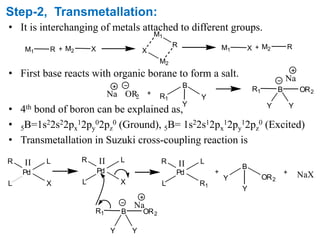
Step-2, Transmetallation:
• It is interchanging of metals attached to different groups.
• First base reacts with organic borane to form a salt.
• 4th bond of boron can be explained as,
• 5B=1s22s22px
12py
02pz
0 (Ground), 5B= 1s22s12px
12py
12pz
0 (Excited)
• Transmetallation in Suzuki cross-coupling reaction is
M1 R M2 X M1 X M2 R
M1
R
X
M2
Pd
L X
R LII
Pd
L X
R LII
BR1
Y
Pd
L R1
R LII
OR2
Y
Na
B
Y
OR2Y NaX
BR1
Y
OR2
Y
Na
B
R1 Y
Y
Na OR2
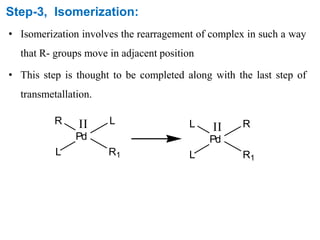
Step-3, Isomerization:
• Isomerization involves the rearragement of complex in such a way
that R- groups move in adjacent position
• This step is thought to be completed along with the last step of
transmetallation.
Pd
L R1
R LII
Pd
L R1
L RII
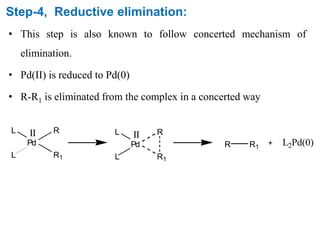
Step-4, Reductive elimination:
• This step is also known to follow concerted mechanism of
elimination.
• Pd(II) is reduced to Pd(0)
• R-R1 is eliminated from the complex in a concerted way
Pd
L R1
L RII
Pd
L R1
L RII
L2Pd(0)R R1
16
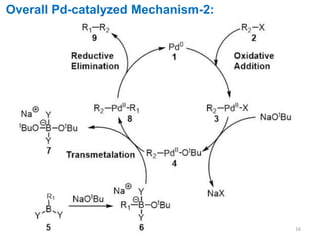
Overall Pd-catalyzed Mechanism-2:
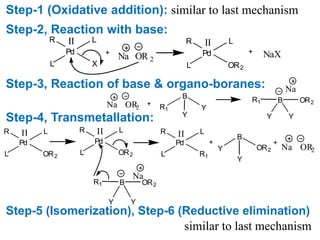
Step-1 (Oxidative addition): similar to last mechanism
Step-3, Reaction of base & organo-boranes:
Pd
L X
R LII
NaXNa OR 2
Pd
L OR2
R LII
BR1
Y
OR2
Y
Na
B
R1 Y
Y
Na OR2
Step-2, Reaction with base:
Step-4, Transmetallation:
Pd
L OR2
R LII
Pd
L OR2
R LII
BR1
Y
Pd
L R1
R LII
OR2
Y
Na
B
Y
OR2Y Na OR2
Step-5 (Isomerization), Step-6 (Reductive elimination)
similar to last mechanism
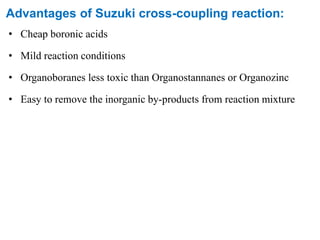
Advantages of Suzuki cross-coupling reaction:
• Cheap boronic acids
• Mild reaction conditions
• Organoboranes less toxic than Organostannanes or Organozinc
• Easy to remove the inorganic by-products from reaction mixture
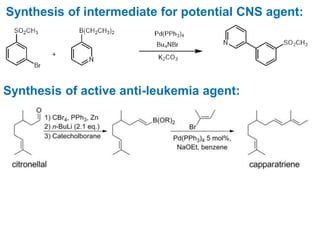
Synthesis of intermediate for potential CNS agent:
Synthesis of active anti-leukemia agent:

Suzuki cross coupling reaction

  • 1.
  • 2.
    SUZUKI CROSS-COUPLING REACTION Dr.Shahid Rasool Suzuki Cross-coupling reaction CHEM5128 Advanced Named Reactions 2
  • 3.
    Key Concepts • SuzukiCross-Coupling reactions • Discussion of reacting species, catalysts, solvents • Mechanism of reaction • Explanation of mechanism step by step • Synthetic applications 3
  • 4.
    Suzuki Cross-coupling Reaction: •Suzuki cross-coupling reaction is also known as Suzuki-Miyaura cross-coupling reaction. • Ni or Pd catalyzed cross-coupling reaction • Suzuki cross-coupling reaction is between organoboranes and organic halides, triflate etc. • Overall reaction is given as,
  • 5.
    Similar Cross-coupling Reactions: •This reaction is similar to following reactions also using Ni or Pd, • Negishi cross-coupling reaction (Organozinc reagents, RZnX) • Stille cross-coupling reaction (Organostannanes reagents, R4Sn) • Hiyama cross-coupling reaction (Organosilicons, RSiF3) • Kumada cross-coupling reaction (Grignard reagent, RMgX)
  • 6.
    Alkyl halides (R-X): •R = Vinyl, Aryl groups • High rates have been observed for vinyl or aryl groups • A limitation for alkyl group is that there are chances of elimination if there is β-hydrogen. • X = Cl, Br, I • Order of rate = I > Br > Cl as bond energy R-I > R-Br > R-Cl C2H5- C3H7- Alkyl group CH2 CH Vinyl group Phenyl group Aryl group R R CH2 CH2 X 
  • 7.
    Triflates and tosylates: •R = Vinyl, Aryl groups • If X = OTf then called Triflates, • If X = OTs then called Tosylates • Good leaving groups due to resonance stabilized anions. • The distribution of charge on large number of atoms provides stability because it becomes easy for the medium molecules to solvate it. OTf = F3C S O O O OTs = S O O OH3C F3C S O O O F3C S O O O F3C S O O O
  • 8.
    Organoboranes: • It isgenerally referred to vinyl, aryl boronic acids (cheap reagents) • Side effect of these reagents is the “protodeboration” • Protodeboration is referred to breakage of C-B bond. • This problem is solved by using aryl trifluoroborate salts-less susceptible to protodeboration
  • 9.
    Catalysts: • Initially Palladium(Pd), then Nickel (Ni), also Fe, Cu and Ru • ‘Ni’ was better option but requires large amount for some reactions • Complexes of these metals are used. • Bidentate phosphine ligands e.g. dppe, dppp for Pd & Ni • Pd complexes are air sensitive (Argon/N2 atmosphere) P P Ph Ph Ph Ph P P Ph Ph Ph Phdppe dppp
  • 10.
    Solvent: • Reaction canrun in biphasic (organic & aqueous), only aqueous or without solvent. • Water more economical and safe • Other solvents include Toluene, THF (tetrahydrofuran), dioxane, DMF (dimethylformamide) etc Base: • A number of bases have been employed including • K2CO3, KOtBu, Cs2CO3, K3PO4, NaOH, NEt3
  • 11.
  • 12.
    Step-1, Oxidative addition: •This step is known to follow concerted mechanism of addition. • Pd(0) is oxidized to Pd(II) • R-X is added in concerted way • Both ‘R’ and ‘X’ are attached to ‘Pd’ through its primary valency. • Secondary valency ‘4’ is already justified by bidendate ligands. Pd L X L2Pd(0) R X L2Pd(0) R X R LII
  • 13.
    Step-2, Transmetallation: • Itis interchanging of metals attached to different groups. • First base reacts with organic borane to form a salt. • 4th bond of boron can be explained as, • 5B=1s22s22px 12py 02pz 0 (Ground), 5B= 1s22s12px 12py 12pz 0 (Excited) • Transmetallation in Suzuki cross-coupling reaction is M1 R M2 X M1 X M2 R M1 R X M2 Pd L X R LII Pd L X R LII BR1 Y Pd L R1 R LII OR2 Y Na B Y OR2Y NaX BR1 Y OR2 Y Na B R1 Y Y Na OR2
  • 14.
    Step-3, Isomerization: • Isomerizationinvolves the rearragement of complex in such a way that R- groups move in adjacent position • This step is thought to be completed along with the last step of transmetallation. Pd L R1 R LII Pd L R1 L RII
  • 15.
    Step-4, Reductive elimination: •This step is also known to follow concerted mechanism of elimination. • Pd(II) is reduced to Pd(0) • R-R1 is eliminated from the complex in a concerted way Pd L R1 L RII Pd L R1 L RII L2Pd(0)R R1
  • 16.
  • 17.
    Step-1 (Oxidative addition):similar to last mechanism Step-3, Reaction of base & organo-boranes: Pd L X R LII NaXNa OR 2 Pd L OR2 R LII BR1 Y OR2 Y Na B R1 Y Y Na OR2 Step-2, Reaction with base: Step-4, Transmetallation: Pd L OR2 R LII Pd L OR2 R LII BR1 Y Pd L R1 R LII OR2 Y Na B Y OR2Y Na OR2 Step-5 (Isomerization), Step-6 (Reductive elimination) similar to last mechanism
  • 18.
    Advantages of Suzukicross-coupling reaction: • Cheap boronic acids • Mild reaction conditions • Organoboranes less toxic than Organostannanes or Organozinc • Easy to remove the inorganic by-products from reaction mixture
  • 19.
    Synthesis of intermediatefor potential CNS agent: Synthesis of active anti-leukemia agent: