Paladium Catalysed Transformations in 
Organic Synthesis 
Paul Docherty, 
2005 
Palladium-Catalyzed Cross-Coupling Reactions in Total Synthesis 
K. C. Nicolaou, Paul G. Bulger, David Sarlah 
Angewandte Chemie International Edition 
Volume 44, Issue 29, 2005. Pages 4442-4489
Introduction 
• Since Mizoroki[1] developed the first palladium catalysed reaction, research in this area has 
developed exponentially, with each new issue of Angewandte Chemie or JACS highlighting the 
latest techniques and processes. 
• These reactions show a breadth of applications, not just in the type of transformation, but in the 
target structure and scale of the process. Indeed, it is common to see the retrosynthesis of 
industrial targets hinge upon a crucial palladium-mediated reaction. 
Pd 
1. T. Mizoroki, K. Mori, A. Ozaki, Bull. Chem. Soc. Jpn. 1971, 44, 581 
(There is still some debate as to which coupling was developed first; many claim that the Kumada coupling of sp2 grignard reagents with 
aryl, vinyl or alkyl halides was the first. However, the intrinsic reactivity of grignard reagents with other common functionalities mean that 
this coupling is seldom used.)
Why Palladium? 
• Why is palladium such an adept catalyst centre? Why not sodium? 
• The reason seems to be based around its electronegativity, which leads to relatively strong Pd-H 
and Pd-C bonds, and also develops a polarised Pd-X bond. 
• It allows easy access to the Pd (II) and Pd (0) oxidation states, essential for processes such as 
oxidative addition, transmetalation and reductive elimination, 
• Pd (I), Pd (III) and Pd (IV)[2] complexes are also known, though less thoroughly, with Pd (IV) 
species essential in C-H activation mechanisms. 
2. Pd (VI) complexes has also been proposed (W. Chen, S. Shimada, M. Tanaka, Science, 2002, 295, 308), but theoretical articles 
counter-argue this (E. C. Sherer, C. R. Kinsinger, B. L. Kormos, J.D. Thompson, C. J. Cramer Angew. Chem., Int. Ed. 2002, 41, 1953). 
The debate is ongoing.
The Heck Reaction 
• Broadly defined as the palladium-catalyzed coupling of alkenyl or aryl 
(sp2) halides or triflates with alkenes to yield products which formally 
result from the substitution of a hydrogen atom in the alkene coupling 
partner. 
• First discovered by Mizoroki, though developed and applied more 
thoroughly by Richard F. Heck in the early 1970s.[3] 
• Generally thought of as the original palladium catalysed cross-coupling, 
and probably the best evolved, including a multitude of 
asymmetric varients.[4] 
H 
R1 
R2 
R3 
cat. [Pd0Ln] 
R4 X R4 
R1 
R2 
R3 
base 
R4 = aryl, benzyl, vinyl 
X = Cl, Br, I, OTf 
3. R. F. Heck, J. P. Nolley, Jr., J. O rg . Che m . 1972, 3 7 , 2320 
4. Review on asymmetric Heck reactions: A. B. Dounay, L. E. Overman, Che m . Re v. 2003, 1 0 3 , 2945 – 2963
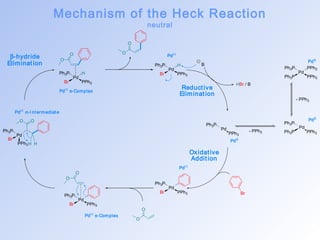
Mechanism of the Heck Reaction 
neutral 
PdI I s-I nt ermediat e 
PPh3 
Ph3P PPh3 
Pd 
Ph3P PPh3 
Ph3P 
Pd 
Ph3P PPh3 
Pd 
Ph3P 
PPh3 
- PPh3 
- PPh3 
Pd0 
Pd0 
Pd0 
Br 
Ph3P H 
Br PPh3 
Ph3P 
Pd 
Br PPh3 
PdI I 
O 
O 
Ph3P H 
Br PPh3 
Ph3P 
Pd 
Br PPh3 
O 
O 
PdI I p-Complex 
Pd 
Ph3P 
Br 
O O 
H H 
Pd 
O 
O 
PdI I p-Complex 
Pd 
B 
HBr / B 
O 
O PdI I 
Oxidat ive 
Addit ion 
b-hydride 
Eliminat ion 
Reduct ive 
Eliminat ion
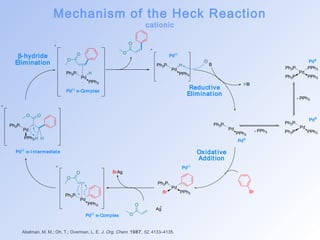
Mechanism of the Heck Reaction 
cationic 
PPh3 
Ph3P PPh3 
Pd 
Ph3P PPh3 
Ph3P 
Pd 
Ph3P PPh3 
Pd 
Ph3P 
PPh3 
- PPh3 
- PPh3 
Pd0 
Pd0 
Pd0 
Br 
Ph3P H 
Ph3P 
Pd 
Br PPh3 
PdI I 
O 
O 
O 
Ph3P H 
Pd 
Ph3P 
PPh3 
O 
O 
PdI I p-Complex 
Pd 
Ph3P 
O O 
H H 
PdI I s-I nt ermediat e 
Pd 
PPh3 
O 
O 
PdI I p-Complex 
Pd 
PPh3 
B 
O PdI I 
Oxidat ive 
Addit ion 
b-hydride 
Eliminat ion 
Reduct ive 
Eliminat ion 
BrAg 
HB 
Ag 
Abelman, M. M.; Oh, T.; Overman, L. E. J. Org. Chem. 1987, 52, 4133–4135.
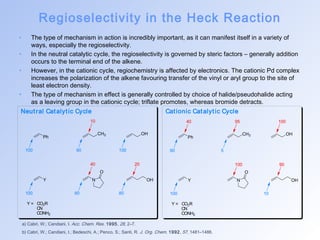
Regioselectivity in the Heck Reaction 
• The type of mechanism in action is incredibly important, as it can manifest itself in a variety of 
Neut ral Catalyt ic Cycle Cat ionic Catalyt ic Cycle 
Ph 
10 
100 90 100 
40 20 
Y N 
CH3 OH 
O 
OH 
100 60 80 
Y = CO2R 
CN 
CONH2 
40 100 
Ph 
100 90 
Y N 
a) Cabri, W.; Candiani, I. Acc. Chem. Res. 1995, 28, 2–7. 
b) Cabri, W.; Candiani, I.; Bedeschi, A.; Penco, S.; Santi, R. J. Org. Chem. 1992, 57, 1481–1486. 
CH3 OH 
O 
OH 
60 5 
95 
100 10 
Y = CO2R 
CN 
CONH2 
ways, especially the regioselectivity. 
• In the neutral catalytic cycle, the regioselectivity is governed by steric factors – generally addition 
occurs to the terminal end of the alkene. 
• However, in the cationic cycle, regiochemistry is affected by electronics. The cationic Pd complex 
increases the polarization of the alkene favouring transfer of the vinyl or aryl group to the site of 
least electron density. 
• The type of mechanism in effect is generally controlled by choice of halide/pseudohalide acting 
as a leaving group in the cationic cycle; triflate promotes, whereas bromide detracts.
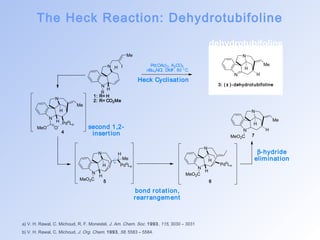
The Heck Reaction: Dehydrotubifoline 
N 
R 
N I 
H 
Me 
H 
Me 
H 
Pd(OAc)2, K2CO3 
nBu4NCl, DMF, 60 °C 
a) V. H. Rawal, C. Michoud, R. F. Monestel, J. Am. Chem. Soc. 1993, 115, 3030 – 3031 
b) V. H. Rawal, C. Michoud, J. Org. Chem. 1993, 58, 5583 – 5584. 
dehydrotubifoline 
N 
N 
Me 
H 
H 
N 
N 
Me 
H PdIILn 
MeO O 
H 
N 
N 
H 
H 
MeO2C 
PdIILn 
N 
N 
H 
H 
MeO2C 
PdIILn 
second 1,2- 
insert ion 
b-hydride 
eliminat ion 
bond rotat ion, 
rearrangement 
N 
N 
Me 
H 
H 
MeO2C 
Heck Cyclisat ion 
3: (± )-dehydrotubifoline 
1: R= H 
2: R= CO2Me 
4 
5 6 
7
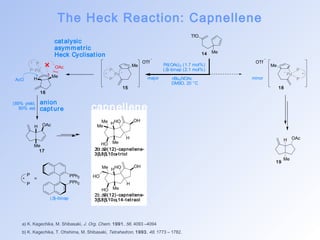
The Heck Reaction: Capnellene 
OTf OTf 
major minor 
* 
Pd 
16 
capnellene 
Me H OH 
20: D9(12) -capnellene- 
3b,8b,10a-t riol 
H OH 
a) K. Kagechika, M. Shibasaki, J. Org. Chem. 1991, 56, 4093 –4094 
b) K. Kagechika, T. Ohshima, M. Shibasaki, Tetrahedron, 1993, 49, 1773 – 1782. 
TfO 
Me 
Me 
Pd 
P 
P 
* 
Me 
Pd 
P 
P 
* 
Pd(OAc)2 (1.7 mol%) 
(S)-binap (2.1 mol%) 
nBu4NOAc 
DMSO, 20 °C 
14 
15 18 
cat alysic 
asymmet ric 
Heck Cyclisat ion 
P 
P 
H Me 
AcO 
OAc 
(89% yield, 
80% ee) 
anion 
capt ure 
H 
Me 
OAc 
17 
HO Me 
H 
Me HO 
HO Me 
H 
Me HO 
HO 
21: D9(12) -capnellene- 
3b,8b,10a,14-tet raol 
H 
Me 
OAc 
19 
PPh2 
PPh2 
P 
P 
* = 
(S)-binap
The Heck Reaction: Taxol 
OTf 
O 
O 
O 
Me 
OTBS 
Me 
H 
BnO 
O 
[Pd(PPh3)4] (110 mol%) 
I nt ramolecular 
Heck React ion 
O 
O 
O 
M. S. (4 A) 
K2CO3, MeCN, 90 °C 
(49%) 
Me 
OTBS 
Me 
H 
BnO 
O 
22 
AcO 
O 
HO 
BzO 
Me 
OH 
Me 
H 
AcO 
O 
O 
O 
taxol 
BzHN 
Ph 
OH 
23 
24: t axol 
a) S. J. Danishefsky, J. J. Masters, W. B. Young, J. T. Link, L. B. Snyder, T. V. Magee, D. K. Jung, R. C. A. Isaacs, W. G. Bornmann, C. A. 
Alaimo, C. A. Coburn, M. J. Di Grandi, J. Am. Chem. Soc. 1996, 118, 2843 – 2859 
b) J. J. Masters, J. T. Link, L. B. Snyder, W. B. Young, S. J. Danishefsky, Angew. Chem. Int. Ed. Engl. 1995, 34, 1723 – 1726.
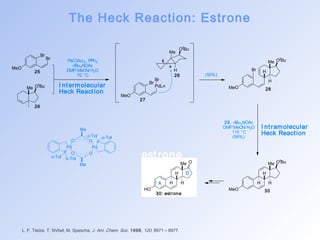
The Heck Reaction: Estrone 
Br 
o-Tol o-Tol 
O 
O P 
P O 
est rone 
L. F. Tietze, T. NVbel, M. Spescha, J. Am. Chem. Soc. 1998, 120, 8971 – 8977. 
MeO 
Br 
Br 
Me OtBu 
Pd(OAc)2, PPh3 
nBu4NOAc 
DMF/MeCN/H2O 
70 °C 
I ntermolecular 
Heck React ion MeO 
Br 
PdLn 
Me OtBu 
H 
5 
4 
MeO 
Br H 
Me OtBu 
H 
MeO 
H 
Me OtBu 
H H 
HO 
H 
Me O 
A H H 
D 
29, nBu4NOAc 
DMF/MeCN/H2O 
115 °C 
(99%) 
(50%) 
I nt ramolecular 
Heck React ion 
25 
26 
27 
26 
28 
30: est rone 30 
Pd 
o-Tol o-Tol 
Pd 
O 
Me 
Me
Domino Heck Reactions 
Me 
EtO2C 
EtO2C 
I 
Me 
EtO2C 
EtO2C 
I 
Y. Zhang, G.Wu, G. Angel, E. Negishi, J. Am. Chem. Soc. 1990, 112, 8590 – 8592. 
Me 
EtO2C 
EtO2C 
[Pd(PPh3)4] (3 mol%) 
Et3N (2 eq.) 
MeCN, 85 °C 
(76%) 
I nt ramolecular 
Domino Heck 
32 Cyclisat ion 33
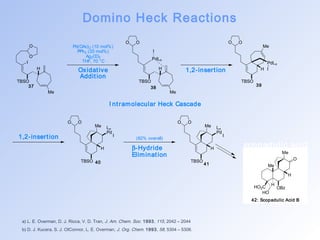
Domino Heck Reactions 
O 
O 
I 
TBSO 
O O 
37 38 39 
Me 
H 
Pd(OAc)2 (10 mol%) 
PPh3 (20 mol%) 
Ag2CO3 
THF, 70 °C 
Oxidat ive 
Addit ion 
I 
PdLn 
TBSO 
Me 
H 
1,2-insert ion 
I nt ramolecular Heck Cascade 
(82% overall) 
a) L. E. Overman, D. J. Ricca, V. D. Tran, J. Am. Chem. Soc. 1993, 115, 2042 – 2044 
b) D. J. Kucera, S. J. OIConnor, L. E. Overman, J. Org. Chem. 1993, 58, 5304 – 5306. 
O O 
TBSO 
Me 
H 
PdLn 
I 
1,2-insert ion 
TBSO 
Me Ln 
Pd 
H 
O O 
I 
TBSO 
Me Ln 
Pd 
H 
O O 
I 
Me 
OBz 
H 
b-Hydride 
Eliminat ion 
scopadulic acid 
O 
HO2C 
Me 
H 
HO 
42: Scopadulic Acid B 
40 41
The Stille Coupling 
• Originally discovered by Kosugi et al[5] in the late 1970s, the Stille Coupling was later developed 
as a tool for organic transformations by the late Professor J. K. Stille.[6] 
• Milder than the older Heck reaction, and more functional-group tolerant, the Stille coupling 
remains popular in organic synthesis. 
R1 R2 X cat. [Pd0Ln] 
SnR3 R1 R3 
base 
R1 = alkyl, alkynyl, aryl, vinyl 
R2 = acyl, alkynyl, allyl, aryl, benzyl, vinyl 
X = Br, Cl, I, OAc, OP(=O)(OR)2, OTf 
5. Original Report; a) M. Kosugi, K. Sasazawa, Y. Shimizu, T. Migita, Chem. Lett. 1977, 301 – 302; b) M. Kosugi, K. Sasazawa, T. Migita, 
Chem. Lett. 1977, 1423 – 1424. 
• 6. A a) close D. Milstein, relative J. K. Stille, of the J. Am. Stille Chem. coupling Soc. 1978, is 100the , 3636 Hiyama; – 3638; b) this D. Milstein, involves J. K. the Stille, palladium J. Am. Chem. catalysed Soc. 1979, 101reaction 
, 4992 – 
4998; c) For a review of Stille Reactions, see; V. Farina, V. Krishnamurthy,W. J. Scott, Org. React. 1997, 50, 1 – 652 
of a organosilicon with organic halides/triflates et c., but requires activation with fluoride (TBAF) 
or hydroxide.[7] 
7. T. Hiyama, Y. Hatanaka, Pure Appl. Chem. 1994, 66, 1471 
8. T. R. Kelly, Tetrahedron Lett. 1990, 31, 161 
• It is possible to couple bis-aryl halides using R3Sn-SnR3, in a varient known as a Stille-Kelly 
reaction, but the toxicity of these species is a somewhat limiting factor.[8]
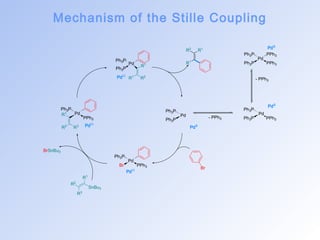
Mechanism of the Stille Coupling 
Ph3P PPh3 
Pd 
Ph3P PPh3 
Ph3P 
Pd 
Ph3P PPh3 
Pd 
Ph3P 
Ph3P 
- PPh3 
- PPh3 
Pd0 
Pd0 
Pd0 
Br 
R1 
R1 
Ph3P 
Pd 
Br PPh3 
PdI I 
Pd 
Ph3P 
PPh3 
Pd 
Ph3P 
Ph3P 
BrSnBu3 
SnBu3 
R2 R3 
R2 
R1 
R3 
R1 
R2 
PdI I 
PdI I 
R2 R1 
R1
The Stille Coupling: Rapamycin 
O 
Me 
O 
O N 
Me 
I 
I 
O 
Me 
O 
H 
O 
O 
H 
OH 
Bu3Snn 
Me 
O 
Me 
O 
Me 
72 74 
O 
"St it ching Cyclisat ion" 
a) K. C. Nicolaou, T. K. Chakraborty, A. D. Piscopio, N. Minowa, P. Bertinato, J. Am. Chem. Soc. 1993, 115, 4419 – 4420; K. C. Nicolaou, A. D. 
Piscopio, P. Bertinato, T. K. Chakraborty, , N. Minowa, K. Koide, Chem. Eur. J. 1995, 1, 318 –333. 
b) A. B. Smith III, S. M. Condon, J. A. McCauley, J. L. Leazer, Jr.,J. W. Leahy, R. E. Maleczka, Jr., J. Am. Chem. Soc. 1995, 117, 5407 – 5408. 
Me 
Me 
OH 
OMe Me 
Me 
H OH 
OMe 
OMe 
SnnBu3 
[PdCl2(MeCN)2] 
(20 mol%) 
iPr2NEt, DMF, 
THF, 25°C 
I ntermolecular 
St ille Coupling 
O 
O 
O N 
I 
O 
Me 
O 
O 
H 
OH 
H 
Me 
Me 
OH 
OMe Me 
Me 
H OH 
OMe 
OMe 
SnnBu3 
I nt ramolecular 
St ille Coupling 
O 
O 
O N 
Me 
O 
Me 
O 
O 
H 
OH 
H 
Me 
Me 
OH 
OMe Me 
Me 
H OH 
OMe 
OMe 
O 
O 
O N 
Me 
O 
Me 
O 
O 
H 
OTIPS 
H 
Me 
Me 
OTBS 
OMe Me 
Me 
H TESO 
Me 
OMe 
OMe 
SnnBu3 
I 
1. [PdCl2(MeCN)2] (20 mol%) 
iPr2NEt, DMF, THF, 25°C (74%) 
2. Deprotection (61%) 
I nt ramolecular 
St ille Coupling 
27% 
Overall 
rapamycin 
75 76: Rapamycin
The Stille Coupling: Dynamycin 
TeocN 
I 
I 
O 
OH 
OH 
Me 
H 
OTBS 
Me3Sn SnMe3 
[Pd(PPh3)4] (5 mol%) 
DMF, 75 °C 
81% 
Tandem 
I nt ermolecular 
St ille Coupling 
TeocN 
O 
OH 
OH 
Me 
H 
OTBS 
dynemicin 
HN 
O 
CO2H 
OMe 
Me 
H 
OH 
O 
O 
OH 
OH 
77 81: (± ) Dynamycin 
79 
Teoc = 2-(trimethylsilyl)ethoxycarbonyl 
a) M. D. Shair, T.-Y. Yoon, K. K. Mosny, T. C. Chou, S. J. Danishefsky, J. Am. Chem. Soc. 1996, 118, 9509 – 9525; 
b) M. D. Shair, T.-Y. Yoon, S. J. Danishefsky, Angew. Chem. 1995, 107, 1883 – 1885; Angew. Chem. Int. Ed. Engl. 1995, 34, 1721 – 1723; 
c) M. D. Shair, T. Yoon, S. J. Danishefsky, J. Org. Chem. 1994, 59, 3755 – 3757.
The Stille Coupling: Sanglifehrin 
Me 
O O 
NH 
N 
O 
O 
NH 
SnnBu3 
Me 
HN 
Me 
OH 
O Me 
O 
Me 
O 
O O 
NH 
O 
HN 
O O 
NH 
O 
HN 
sanglifehrin 
O 
86 87 
O 
a) K. C. Nicolaou, J. Xu, F. Murphy, S. Barluenga, O. Baudoin, H.-X.Wei, D. L. F. Gray, T. Ohshima, Angew. Chem. Int. Ed. 1999, 38, 2447 – 
2451; 
b) K. C. Nicolaou, F. Murphy, S. Barluenga, T. Ohshima, H. Wei, J. Xu, D. L. F. Gray, O. Baudoin, J. Am. Chem. Soc. 2000, 122, 3830 – 3838. 
I 
I 
[Pd2(dba)3]•CHCl3 
AsPh3, iPr2NEt 
DMF, 25 °C, 62% 
Chemoselect ive 
I nt ramolecular 
St ille macrocyclisat ion 
N 
O 
NH 
OH 
O 
Me 
Me 
O 
Me 
O Me 
Me 
I 
1. [Pd2(dba)3] •CHCl3 
AsPh3, iPr2NEt 
DMF, 40°C, 45% 
2. aq. H2SO4 
THF/H2O 
(33%) 
I nt ermolecular 
St ille Coupling 
N 
O 
NH 
OH 
O 
Me 
Me 
O 
Me 
O Me 
Me Me 
NH 
O 
Me 
OH 
Me 
Me 
Me 
Me 
Me 
NH 
O 
Me 
OH 
Me 
Me 
Me 
Me 88 
87: sanglifehrin A 
SnnBu3 
23 
22
The Stille Coupling: Manzamine A 
CO2Me 
NBoc 
OTBDPS 
O 
N 
Br 
TBDPSO 
SnnBu3 
[Pd(PPh3)4)] (4 mol%) 
toluene, 120 °C 
I nt ermolecular 
St ille Coupling 
109 
CO2Me 
NBoc 
OTBDPS 
O 
N 
TBDPSO 
N 
O 
OTBDPS 
TBDPSO 
N 
H Boc E 
110 
N 
O 
H 
H 
OTBDPS 
OTBDPS 
CO2Me 
NBoc 
111 
endo -int ramolecular 
Diels-Alder React ion 
(68% Overall) 
manzamine 
N NH 
N 
H 
A B 
C 
D 
N 
H 
H 
OH 
112: Manzamine A 
a) S. F. Martin, J. M. Humphrey, A. Ali, M. C. Hillier, J. Am. Chem. Soc. 1999, 121, 866 – 867; 
b) J. M. Humphrey, Y. Liao, A. Ali, T. Rein, Y.-L. Wong, H.-J. Chen, A. K. Courtney, S. F. Martin, J. Am. Chem. Soc. 2002, 124, 8584 – 8592.
The Carbonylative Stille Coupling: 
Jatrophone 
O Me 
O 
Me 
82 83 
j at rophone 
O Me 
O 
Me O 
Me 
Me 
Me 
Me O 
Me 
Me 
Me 
Me 
A. C. Gyorkos, J. K. Stille, L. S. Hegedus, J. Am. Chem. Soc. 1990, 112, 8465 – 8472. 
O Me 
Me 
Me 
Me 
[PdCl2(MeCN)2] 
LiCl, CO (50 psi) 
DMF, 25 °C 
I ntermolecular 
Carbonylat ive 
SnnBu3 St ille Coupling 
OTf 
SnnBu3 
PdLn 
Cl 
O Me 
O 
Me 
Me 
Me 
SnnBu3 
53% Overall 
Cl 
PdLn 
O 
85: (± )-2-epi-jatrophone 84 
Carbonyl 
I nsert ion
The Suzuki Coupling 
• The Suzuki reaction was formally developed by Suzuki Group in 
1979[9], although the inspiration for this work can be traced back 
to publications by Heck[10] and Negishi,[11] and their earlier 
presentation of these papers at conferences. 
• The popularity of this reaction can be partially attributed to the 
ease of preparation of the organoboron reagents required, their 
general stability, and the lack of toxic by-products. 
• Progress in the last quarter-century has shown that the Suzuki 
reaction is incredibly powerful, with examples of C(sp2)–C(sp3) 
and even C(sp3)–C(sp3) now well documented.[12] 
R1 R2 X cat. [Pd0Ln] 
BY2 R1 R2 
base 
R1 = alkyl, alkynyl, aryl, vinyl 
R2 = alkyl, alkynyl, aryl, benzyl, vinyl 
X = Br, Cl, I, OAc, OP(=O)(OR)2, OTf 
9. Original Report; a) N. Miyaura, K. Yamada, A. Suzuki, Tetrahedron Lett. 1979, 20, 3437 – 3440; b) N. Miyaura, A. Suzuki, J. Chem. 
Soc. Chem. Commun. 1979, 866 – 867 
10. a) R. F. Heck in Proceedings of the Robert A. Welch Foundation Conferences on Chemical Research XVII. Organic-Inorganic Reagents 
in Synthetic Chemistry (Ed.W. O. Milligan), 1974, p. 53–98; b) H. A. Dieck, R. F. Heck, J. Org. Chem. 1975, 40, 1083 – 1090. 
11. E. Negishi in Aspects of Mechanism and Organometallic Chemistry (Ed.: J. H. Brewster), Plenum, New York, 1978, p. 285. 
12. a) T. Ishiyama, S. Abe, N. Miyaura, A. Suzuki, Chem. Lett. 1992, 691 – 694. b) J. Zhou, G.C. Fu, J. Am. Chem. Soc. 2004, 126, 1340 – 
1341, and references therein. c) A. C. Frisch, M. Beller, Angew. Chem. Int. Ed. 2005, 44, 674 – 688. d) For a relatively recent review, 
see N. Miyaura, A. Suzuki, Chem. Rev. 1995, 95, 2457.
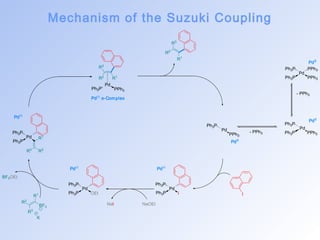
Mechanism of the Suzuki Coupling 
Ph3P PPh3 
Pd 
Ph3P PPh3 
Ph3P 
Pd 
Ph3P PPh3 
Pd 
Ph3P 
PPh3 
- PPh3 
- PPh3 
Pd0 
Pd0 
Pd0 
I 
Ph3P 
Pd 
Ph3P I 
PdI I 
Pd 
Ph3P PPh3 
PdI I p-Complex 
NaI NaOEt 
Ph3P 
Pd 
Ph3P OEt 
PdI I 
R1 
PdI I 
R2 
R1 
BF3 
R3 
K 
BF3OEt 
Pd 
Ph3P 
Ph3P 
R3 R2 
R3 
R2 R1 
R3 
R2 
R1
The Suzuki Coupling: Palytoxin 
O 
O 
OTBS 
NHTeoc 
Me 
O Me 
O 
TBSO OTBS 
TBSO OTBS 
OTBS 
B 
OTBS 
TBSO 
TBSO 
OTBS 
HO 
OH 
O 
OAc I 
OTBS 
TBSO OTBS 
OTBS 
OTBS 
O OTBS 
CO2Me 
TBSO 
TBSO 
H 
OTBS 
I ntermolecular 
Suzuki Coupling 
[Pd(PPh3)4] (40 mol%) 
TlOH, THF/H2O, 25 °C 
(70%) 
O 
O 
OTBS 
TeocHN 
O 
Me 
Me 
O 
TBSO 
TBSO 
OTBS 
TBSO OTBS OTBS 
OTBS 
TBSO OTBS 
O 
OAc 
OTBS 
OTBS 
OTBS 
OTBS 
TBSO 
O 
MeO2C 
TBSO H 
OTBS 
OTBS OTBS 
a) R.W. Armstrong, J.-M. Beau, S. H. Cheon, W. J. Christ, H. Fujioka, W.-H. Ham, L. D. Hawkins, H. Jin, S. H. Kang, Y. Kishi, M. J. Martinelli, 
W. J. McWhorter, Jr., M. Mizuno, M. Nakata, A. E. Stutz, F. X. Talamas, M. Taniguchi, J. A. Tino, K. Ueda, J.-I. Uenishi, J. B. White, M. 
Yonaga, J. Am. Chem. Soc. 1989, 111, 7525 – 7530; 
b) R.W. Armstrong, J.-M. Beau, S. H.Cheon,W. J. Christ, H. Fujioka,W.-H. Ham, L. D. Hawkins, H. Jin, S. H. Kang, Y. Kishi, M. J. Martinelli,W. 
J. McWhorter, Jr.,M. Mizuno, M. Nakata, A. E. Stutz, F. X. Talamas, M. Taniguchi, J. A. Tino, K. Ueda, J.-I. Uenishi, J. B. White, 
M.Yonaga, J. Am. Chem. Soc. 1989, 111, 7530 – 7533; 
c) E. M. Suh, Y. Kishi, J. Am. Chem. Soc. 1994, 116, 11205 – 11206.
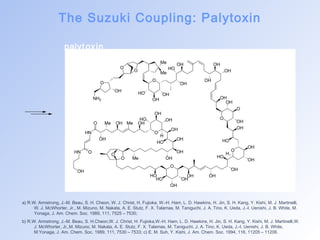
The Suzuki Coupling: Palytoxin 
palyt oxin 
O 
O 
OH 
NH2 
Me 
O Me 
O 
HO 
HO OH 
OH 
OH OH 
OH 
OH 
OH 
OH 
O 
O 
OH 
OH 
OH 
HO 
O 
OH 
OH 
OH 
H 
HO 
OH 
OH 
HO OH 
O 
H 
HO 
OH 
Me OH Me OH 
Me OH 
O 
OH 
HO 
HO 
OH 
OH 
OH 
OH 
O 
O 
HN 
OH 
O 
HN O 
OH 
a) R.W. Armstrong, J.-M. Beau, S. H. Cheon, W. J. Christ, H. Fujioka, W.-H. Ham, L. D. Hawkins, H. Jin, S. H. Kang, Y. Kishi, M. J. Martinelli, 
W. J. McWhorter, Jr., M. Mizuno, M. Nakata, A. E. Stutz, F. X. Talamas, M. Taniguchi, J. A. Tino, K. Ueda, J.-I. Uenishi, J. B. White, M. 
Yonaga, J. Am. Chem. Soc. 1989, 111, 7525 – 7530; 
b) R.W. Armstrong, J.-M. Beau, S. H.Cheon,W. J. Christ, H. Fujioka,W.-H. Ham, L. D. Hawkins, H. Jin, S. H. Kang, Y. Kishi, M. J. Martinelli,W. 
J. McWhorter, Jr.,M. Mizuno, M. Nakata, A. E. Stutz, F. X. Talamas, M. Taniguchi, J. A. Tino, K. Ueda, J.-I. Uenishi, J. B. White, 
M.Yonaga, J. Am. Chem. Soc. 1989, 111, 7530 – 7533; c) E. M. Suh, Y. Kishi, J. Am. Chem. Soc. 1994, 116, 11205 – 11206.
The Suzuki Coupling: FR182887 
MeO 
O 
Me 
Br 
OTBS 
Me Me Br 
126 127 
O 
OTBS 
HO 
H Me 
HO 
[PdCl2(dppf))] (10 mol%) 
Cs2CO3, DMF/H2O, 100 °C 
O Me 
B 
HO 
H Me 
HO 
HO 
H Me 
O 
O 
130 129 
a) D. A. Evans, J. T. Starr, J. Am. Chem. Soc. 2003, 125, 13531 –13540 
b) D. A. Evans, J. T. Starr, Angew. Chem. 2002, 114, 1865 – 1868; Angew. Chem. Int. Ed. 2002, 41, 1787 – 1790. 
TBDPSO 
B 
OTBS 
Me 
OTBS 
HO 
OH 
[Pd(PPh3)4)] (5 mol%) 
Tl2CO3, THF/H2O, 23 °C 
(84%) 
I ntermolecular 
Suzuki Coupling 
TBDPSO 
OTBS 
Me 
OTBS 
MeO 
Me 
Me Me Br 
O 
OH 
Br 
H H 
H 
CO2Et 
H 
Me 
Me 
H 
B 
O 
B 
O 
Me 
Me 
(71%) 
O 
OH 
Me 
H H 
H 
CO2Et 
H 
Me 
Me 
H O 
OH 
Me 
H H 
H 
H 
Me 
Me 
H 
fr182887 
131 132: FR182887 
128 
I ntermolecular 
Suzuki Coupling
The Suzuki Coupling: Dragmacidin Me 
TBSO 
HO 
Br 
O N SEM 
[Pd(PPh3)4] (10 mol%) 
toluene/MeOH/H2O, 23 °C 
I ntermolecular 
Heck React ion 
Me 
TBSO 
HO 
PdOAc 
O N SEM 
162 164 
TBSO 
HO 
O 
(74%) 
N SEM 
H 
TBSO 
MeO 
H 
O 
O N SEM 
B O 
166 165 
[Pd(PPh3)4] (10 mol%) 
161, toluene/MeOH/H2O 
NaCO3, 50 °C, 77% 
I ntermolecular 
Suzuki React ion 
TBSO 
MeO 
H 
O N SEM 
NTs 
Br 
N 
N 
OMe 
167 
dragmacidin 
HO 
Me NH 
H 
O NH 
N 
HO N 
159 160 
N 
Br OMe 
a) N. K. Garg, D. D. Capsi, B. M. Stoltz, J. Am. Chem. Soc. 2004, 126, 9552 – 9553. 
b) For a failed alternative route without Pd Catalysis: N. K. Garg, R. Sarpong, B. M. Stoltz, J. Am. Chem. Soc. 2002, 124, 13179 – 13184. 
Br 
NH 
O 
N 
N 
H2N 
168: dragmacidin 
Ts 
N 
B 
Br 
OH 
N I 
Br OMe 
[Pd(PPh3)4] (10 mol%) 
toluene/MeOH/H2O, 23 °C 
(71%) 
I ntermolecular 
Suzuki 
Coupling 
NTs 
Br 
N 
161
The Suzuki-Miyaura B-Alkyl Coupling: CP-236,114 
O 
TBS I 
169 170 
173 171 CP-263,114 
13) a) N. Miyaura, T. Ishiyama, M. Ishikawa, A. Suzuki, Tetrahedron Lett. 1986, 27, 6369 – 6372; b) not to be confused with the Miyaura 
boration, in which an aryl halide is converted to an aryl boronate via palladium catalysis and a diboron reagent. However, this is a useful 
preparation of the organoboron reagents required for the Suzuki reaction. See: T. Ishiyama, M. Murata, N. Miyuara. J. Org. Chem. 
1995, 60, 7508. 
14) Review of the development, mechanistic background, and applications of the B-alkyl Suzuki-Miyaura cross-coupling reaction, see S. R. 
Chemler, D. Trauner, S. J. Danishefsky, Angew. Chem. Int. Ed. 2001, 40, 4544 – 4568. 
15) Q. Tan, S. J. Danishefsky, Angew. Chem. Int. Ed. 2000, 39, 4509 – 4511. 
O 
TBSO 
H 
O 
TBS 
O 
H 
OTBS 
O 
TBS 
OTBS 
H 
OTBS 
I 
O 
TBS 
OTBS 
H 
OTBS 
OBn 
6 
O 
O 
O 
O O 
O 
CO2H 
H 
Me 
O 
H 
Me 
[Pd(OAc)2(PPh3)2] 
Et3N, THF, 65 °C 
(92%) 
I nt ermolecular 
Heck React ion 
B{ (CH2)6OBn} 3 
[PdCl2(dppf)] 
CsCO3, AsPh3, H2O, 25 °C 
(70%) 
Suzuki-Miyaura 
B-Alkyl React ion 
174: CP-263,114 
• An important trend in Suzuki 
chemistry is the development of a 
C(sp3)–C(sp2) methodology, which 
has become known as the Suzuki- 
Miyaura B-Alkyl varient.[13-15] 
• Often used as an alternative to 
RCM, leaving a single isolated 
double bond, rather than the 
conjugated systems produced by a 
regular Suzuki coupling.
The Suzuki Coupling: Phomactin A 
O 
OTMS 
O 
H 
Me 
Me 
OTES 
Me 
I 
9-BBN 
THF, 40 °C 
phomact in 
O 
a) P. J. Mohr, R. L. Halcomb, J. Am. Chem. So c. 2003, 125, 1712 – 1713 
b) N. C. Callan, R. L. Halcomb, Org. Lett. 2000, 2, 2687 – 2690. 
O 
Me OTMS 
O 
H 
Me 
OTES 
Me 
I 
B 
O 
O 
Me H 
OTMS 
OTES 
Me 
Me 
Me 
O 
Me H 
OH 
OH 
Me 
Me 
Me 
TBAF 
(78%) 
Suzuki-Miyaura 
B-Alkyl 
Macrocyclisat ion 
[PdCl2(dppf)] (100 mol%) 
AsPh3(200 mol%), Tl2CO3 
THF/DMF/H2O, 25 °C 
(37%) 
200: phomact in A
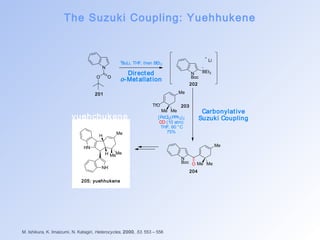
The Suzuki Coupling: Yuehhukene 
tBuLi, THF, then BEt3 
N 
O O Directed 
o -Met allat ion 
yuehchukene 
M. Ishikura, K. Imaizumi, N. Katagiri, Heterocycles, 2000, 53, 553 – 556 
N Boc 
Li 
BEt3 
Me 
TfO 
Me Me 
[PdCl2(PPh3)2 
CO (10 atm) 
THF, 60 °C 
75% 
Carbonylat ive 
Suzuki Coupling 
202 
N Boc O 
Me 
Me Me 
HN 
Me 
H 
H 
MeMe 
NH 
205: yuehhukene 
204 
201 
203
The Sonogashira Coupling 
• The coupling of terminal alkynes with vinyl or aryl halides via palladium catalysis was first 
reported independently and simultaneously by the groups of Cassar[16] and Heck[17] in 1975. 
• A few months later, Sonogashira and co-workers demonstrated that, in many cases, this cross-coupling 
reaction could be accelerated by the addition of cocatalytic CuI salts to the reaction 
mixture.[18,19] 
• This protocol, which has become known as the Sonogashira reaction, can be viewed as both an 
alkyne version of the Heck reaction and an application of palladium catalysis to the venerable 
Stephens–Castro reaction (the coupling of vinyl or aryl halides with stoichiometric amounts of 
copper(I) acetylides).[20] 
• Interestingly, the utility of the “copperfree” Sonogashira protocol (i.e. the original Cassar–Heck 
version of this reaction) has subsequently been “rediscovered” independently by a number of 
other researchers in recent years.[21] 
R2 X 
cat. [Pd0Ln] 
R1 H R2 R2 
16. L. Cassar, J. Organomet. Chem. 1975, 93, 253 – 259. 
17. H. A. Dieck, F. R. Heck, J. Organomet. Chem. 1975, 93, 259 – 263. 
18. K. Sonogashira, Y. Tohda, N. Hagihara, Tetrahedron Lett. 1975, 16, 4467 – 4470. 
19. For a brief historical overview of the development of the Sonogashira reaction, see: K. Sonogashira, J. Organomet. Chem. 2002, 653, 
46 – 49. 
20. R. D. Stephens, C. E. Castro, J. Org. Chem. 1963, 28, 3313 – 3315. 
21. a) M. Alami, F. Ferri, G. Linstrumelle, Tetrahedron Lett. 1993, 34, 6403 – 6406; b) J.-P. Genet, E. Blart, M. Savignac, Synlett 1992, 715 
– 717; c) C. Xu, E. Negishi, Tetrahedron Lett. 1999, 40, 431 – 434; 
base 
R1 = alkyl, aryl, vinyl 
R2 = alkyl, benzyl, vinyl 
X = Br, Cl, I, OTf
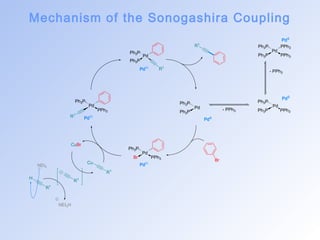
Mechanism of the Sonogashira Coupling 
Ph3P PPh3 
Pd 
Ph3P PPh3 
Ph3P 
Pd 
Ph3P PPh3 
Pd 
Ph3P 
Ph3P 
- PPh3 
- PPh3 
Pd0 
Pd0 
Pd0 
Br 
PdI I 
Ph3P 
Pd 
Br PPh3 
Pd 
Ph3P 
PPh3 
R1 
R1 
Cu 
CuBr 
H 
NEt3 
R1 
Pd 
Ph3P 
Ph3P 
R1 
R1 
R1 
NEt3H 
PdI I 
PdI I
The Sonogashira Coupling: Eicosanoid 212 
Br Me 
OTBS 
TMS 
[Pd(PPh3)4] (4 mol%) 
CuI (16 mol%) 
nPrNH2, C6H6, 25 °C 
Sonogashira 
Coupling 
K. C. Nicolaou, S. E. Webber, J. Am. Chem. Soc. 1984, 106, 5734 – 5736 
R 
Me 
OTBS 
AgNO3, 
KCN 
208: R = TMS 
209: R = H 
210, [Pd(PPh3)4] (4 mol%) 
CuI (16 mol%) 
nPrNH2, C6H6, 25 °C 
76% Overall from 208 
Br 
CO2Me 
OTBS 
Me 
OTBS 
CO2Me 
OTBS 
Me 
OH 
CO2H 
OH 
Sonogashira 
Coupling 
206 
207 
210 
212 211
The Sonogashira Coupling: Disorazole C1 
PMBO 
OH 
PMBO 
OH 
218 
[Pd(PPh3)2Cl2] (4 mol%) 
CuI (30 mol%), Et3N 
MeCN, -20 °C, 94% 
217 219 
O 
O OMe 
N 
N 
O 
Me Me 
P. Wipf, T. H. Graham, J. Am. Chem. Soc. 2004, 126, 15346 –15347. 
Me 
Me 
Me 
Me 
Me 
Me 
N 
CO2Me 
MeO O 
Sonogashira 
Coupling 
220, DCC, DMAP 
80% 
PMBO 
Me 
O 
Me 
Me 
OMe 
N 
CO2Me 
N 
O 
MeO O 
O 
I 
218 
[Pd(PPh3)2Cl2] (5 mol%) 
CuI (20 mol%), Et3N 
MeCN, -20 °C, 94% 
Sonogashira 
Coupling 
PMBO 
Me 
O 
Me 
Me 
O OMe 
N 
Me Me 
CO2Me 
N 
O 
MeO O 
OH 
Me 
OPMB 
Me 
OH 
Me 
Me 
MeO O 
O 
OH 
Me 
O 
disorazole 
N 
O 
RO 
O 
I 
OMe 
218: R = Me 
220: R = H 
221 
223: Disorazole C1 222
The Sonogashira Coupling: Dynemicin 
MeO2CN 
OMe 
Me 
O 
O 
Br 
MeO2CN 
OMe 
Me 
O 
[Pd(PPh3)4] (2 mol%) 
CuI (20 mol%) 
toluene, 25 °C 
I nt ramolecular O 
Sonogashira 
Coupling 
243 244 
MeO2CN 
OMe 
Me 
O 
O 
H 
H 
244 
H 
H 
MeO2CN 
OMe 
Me 
OH 
246 
Br 
1) CO2Me 
[Pd(PPh3)4] (2 mol %) 
CuI (20 mol %) 
toluene, 25 °C 
2) LiOH, THF/H2O 
65% overall 
Sonogashira 
Coupling 
MeO2CN 
2,4,6-Cl3C2H2COCl 
DMAP, toluene, 25 °C 
OMe 
Me 
Diels- 
Alder 
CO2H 
OH 
50% 
248 
247 
Yamaguchi 
Macrolactonisat ion/ 
Diels-Alder 
HN 
OMe 
Me 
H 
O 
O 
O 
OMe 
OMe 
CO2Me 
OMe 
dynemicin 
249: t ri-O- methyl dynemicin A 
met hyl est er 
a) J. Taunton, J. L. Wood, S. L. Schreiber, J. Am. Chem. Soc. 1993, 115, 10 378 – 10379 
b) J. L. Wood, J. A. Porco, Jr., J. Taunton, A. Y. Lee, J. Clardy, S. L. Schreiber, J. Am. Chem. Soc. 
1992, 114, 5898 – 5900 
c) H. Chikashita, J. A. Porco, Jr., T. J. Stout, J. Clardy, S. L. Schreiber, J. Org. Chem. 1991, 56, 1692 – 1694 
d) J. A. Porco, Jr., F. J. Schoenen, T. J. Stout, J. Clardy, S. L. Schreiber, J. Am. Chem. Soc. 1990, 112, 7410 – 7411.
The Tsuji-Trost Reaction 
• The palladium catalysed nucleophilic substitution of allylic 
compounds was discovered independently by Trost and Tsuji, and 
represents the first example of a metalated species acting as an 
electrophile.[22] 
• Originally developed as a stoichiometric process, Trost succeeded in 
transforming the allylation of enolates with p-allyl–palladium 
complexes into the catalytic process of renown.[23,24] 
• A wide range of allylic substrates undergo this reaction with a 
correspondingly wide range of carbanions, making this a versatile 
and important process for the formation of carbon–carbon bonds. 
• Whilst the most commonly employed substrates for palladium-catalyzed 
allylic alkylation are allylic acetates, a variety of leaving 
groups also function effectively—these include halides, sulfonates, 
carbonates, carbamates, epoxides, and phosphates. 
cat. [Pd0Ln] 
X NuH Nu 
base 
X = Br, Cl, OCOR, OCO2R, CO2R, P(=O)(OR)2 
NuH = b-dicarbonyls, b-ketosulfones, enamines, enolates 
22. For early reviews of the Tsuji-Trost reaction, see a) B. M. Trost, Acc. Chem. Res. 1980, 13, 385 – 393; b) J. Tsuji, Tetrahedron 1986, 
42, 4361 – 4401. 
23. J. Tsuji, H. Takahashi, Tetrahedron Lett. 1965, 6, 4387 – 4388. 
24. For recent reviews of the palladium-catalyzed asymmetric alkylation reaction, see: a) B. M. Trost, M. L. Crawley, Chem. Rev. 2003, 
103, 2921 – 2943; b) B. M. Trost, J. Org. Chem. 2004, 69, 5813 – 5837.
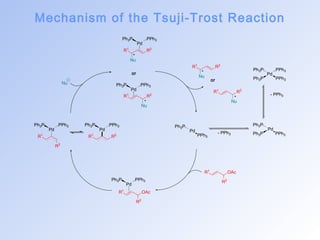
Mechanism of the Tsuji-Trost Reaction 
Ph3P PPh3 
Pd 
Ph3P PPh3 
Ph3P 
Pd 
Ph3P PPh3 
Pd 
Ph3P 
* 
PPh3 
- PPh3 
- PPh3 
Ph3P PPh3 
Ph3P PPh3 
R1 R2 
Ph3P PPh3 
R1 R2 
Ph3P PPh3 
Pd 
R1 OAc 
R2 
R1 OAc 
R2 
Pd 
Ph3P PPh3 
Pd 
R1 
R2 
Pd 
Pd 
R1 R2 
Nu 
Nu 
Nu 
* 
* 
R1 R2 
Nu 
R1 R2 
Nu * 
or 
or
The Tsuji-Trost Reaction: Strychnine 
O 
PdL AcO O OMe n 
O 
tBuO CO2Et 
[Pd2(dba)3] (1 mol%) 
PPh3 (15 mol%) 
NaH, THF, 23 °C 
[-CO2, -MeO ] 
Tsuj i-Trost 
React ion 
AcO 
O 
tBuO CO2Et 
Me 
N 
O 
st rychnine 
H 
H 
H 
H 
a) S. D. Knight, L. E. Overman, G. Pairaudeau, J. Am. Chem. Soc. 1993, 115, 9293 – 9294 
b) S. D. Knight, L. E. Overman, G. Pairaudeau, J. Am. Chem. Soc. 1995, 117, 5776 – 5788. 
AcO 
OtBu 
O 
H 
CO2Et 
91% 
Me3Sn 
TIPSO 
OtBu 
[Pd2(dba)3] (3 mol%) 
AsPh3 (22 mol%), CO (50 psi) 
LiCl, NMP, 70 °C 
80% 
Carbonylat ive 
St ille Coupling 
TIPSO 
OtBu 
O 
N 
MeN 
N 
O O 
250 
251 
252 
253 
MeN 
N 
NMe 
O 
I 
256: St rychnine 255 254
OTBS 
O 
PhO2S 
MeO2C 
The Tsuji-Trost Reaction: Roseophilin 
[Pd2(dba)3] (1 mol%) 
PPh3 (15 mol%) 
NaH, THF, 23 °C 
Tsuj i-Trost 
Macrocyclisat ion 
LnPd O 
TBSO 
PhO2S 
MeO2C 
LnPd OH 
TBSO 
PhO2S 
MeO2C 
263 264 265 
PhO2S PhO2S 
O O 
O 
MeO2C HO 
OTBS 
-[Pd0Ln] 
85% 
BnNH2 
[Pd(PPh3)4] (15 %) 
THF, 35 °C, 70% 
Tsuj i-Trost 
O React ion 
PhO2S 
NBn 
HO 
268 267 266 
Roseophilin 
N 
Me 
O 
Me 
MeO 
Cl NH 
269: Roseophilin 
a) A. Fürstner, H. Weintritt, J. Am. Chem. Soc. 1998, 120, 2817 – 2825; 
b) A. Fürstner, T. Gastner, H. Weintritt, J. Org. Chem. 1999, 64, 2361 – 2366.
The Tsuji-Trost Reaction: Hamigeran B 
Pd 
Me 
P P 
b 
Me 
B. M. Trost, C. Pissot-Soldermann, I. Chen, G.M. Schroeder, J. Am. Chem. Soc. 2004, 126, 4480 – 4481. 
O 
OtBu 
OAc 
[{h3-C3H5PdCl} 2] (1 mol%) 
ligand 285 (2 mol%) 
LDA, tBuOH, Me3SnCl 
DME, 25 °C 
O 
Asymmet ric 
Allylic Alkylat ion Me 
tBuO 
P P 
Pd 
a 
* 
* 
O 
OtBu 
77%, 93% ee 
OMe O 
Me OTf 
Me 
Me Me 
Pd(OAc) (10 mol%) 
dppb (20 mol%) 
K2CO3 
toluene, 110 °C, 58% 
I nt ramolecular 
Heck React ion 
OMe O 
Me H 
Me 
Me 
Me 
OMe O 
Me H 
Me 
Me 
Me 
NH 
O 
P 
Ph 
Ph 
HN 
O 
P 
Ph 
Ph 
hamigeran B 
285 
284 
286 
287 
288 
290: hamigeran 289
The Tsuji-Trost Reaction: (+)-g-lycorane 
* 66%, 54% ee 
OBz 
BzO OBz 
NH 
291 
MeO2C 
O 
O 
O Br 
[Pd2(OAc)3] (5 mol%) 
293 (10 mol%) 
LDA 
THF/MeCN, 0 °C 
Asymmet ric 
Allylic Alkylat ion 
O 
O 
Br 
NH 
O 
MeO2C 
P P 
Pd 
294 295 
O PdLn 
O 
H 
H 
H 
O H 
lycorane 
O 
H H H 
H. Yoshizaki, H. Satoh, Y. Sato, S. Nukui, M. Shibasaki, M. Mori, J. Org. Chem. 1995, 60, 2016 – 2021. 
O 
O 
Br 
NH 
O 
MeO2C 
OBz 
Pd(OAc) (5 mol%) 
dppb (20 mol%) 
NaH 
DMF, 50 °C 
I nt ramolecular 
Allylic Alkylat ion/ 
Heck React ion 
Cascade 
O 
O 
Br 
N 
MeO2C 
O O 
Br 
N 
MeO2C 
H 
iPr2NEt, 100 °C 
O O 
N 
CO2Me 
O 
N 
299: (+ ) -g-lycorane 
298 
297 296 
292 
O 
O 
PPh2 
PPh2 
293
The Negishi Coupling 
• The use of organozinc reagents as the nucleophilic component in 
palladium-catalyzed cross-coupling reactions, known as the Negishi 
coupling, actually predates both the Stille and Suzuki processes, 
with the first examples published in the 1970s.[25] 
• However, the stunning progress in the latter procedures left the 
Negishi process behind, underappreciated and underutilised. 
• Organozinc reagents exhibit a very high intrinsic reactivity in 
palladium-catalyzed cross-coupling reactions, which combined with 
the availability of a number of procedures for their preparation and 
their relatively low toxicity, makes the Negishi coupling an 
exceedingly useful alternative to other cross-coupling procedures, as 
well as constituting an important method for carbon–carbon bond 
formation in its own right.[26] 
ZnR2 R1 R3 
25. a) E. Negishi, A. O. King, N. Okukado, J. Org. Chem. 1977, 42, 1821 – 1823; for a discussion, see: b) E. Negishi, Acc. Chem. Res. 
1982, 15, 340 – 348. 
26. a) E. Erdik, Tetrahedron 1992, 48, 9577 – 9648; b) E. Negishi, T. Takahashi, S. Babu,D. E. Van Horn, N. Okukado, J. Am. Chem. Soc. 
1987, 109, 2393 – 2401. 
R1 R3 X 
cat. [Pd0Ln] 
R1 = alkyl, alkynyl, aryl, vinyl 
R3 = acyl, aryl, benzyl, vinyl 
X = Br, I, OTf, OTs
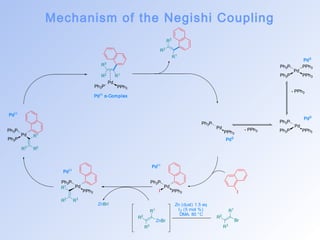
Mechanism of the Negishi Coupling 
Ph3P PPh3 
Pd 
Ph3P PPh3 
Ph3P 
Pd 
Ph3P PPh3 
Pd 
Ph3P 
PPh3 
- PPh3 
- PPh3 
Pd0 
Pd0 
Pd0 
I 
Pd 
PdI I 
Ph3P 
I PPh3 
Pd 
Ph3P PPh3 
PdI I p-Complex 
R1 
R2 
ZnBr 
R3 
Pd 
PdI I 
Ph3P 
Ph3P 
R1 
R3 R2 
R3 
R2 R1 
R3 
R2 
R1 
Zn (dust) 1.5 eq 
I2 (5 mol %) 
DMA, 80 °C 
ZnBrI 
R1 
R2 
Br 
R3 
Pd 
PdI I 
Ph3P 
PPh3 
R1 
R2 R3
The Negishi Coupling: Discodermolide 
Me 
Me 
Me 
Me 
309 310 312 
Me 
discodermolide 
Me 
O O 
O 
HO 
a) A. B. Smith III, T. J. Beauchamp, M. J. LaMarche, M. D. Kaufman, Y. Qiu, H. Arimoto, D. R. Jones, K. Kobayashi, J. Am. Chem. Soc. 2000, 
122, 8654 – 8664; 
b) A. B. Smith III, M. D. Kaufman, T. J. Beauchamp,M. J. LaMarche, H. Arimoto, Org. Lett. 1999, 1, 1823 – 1826. 
c) For a review of the chemistry and biology of discodermolide, see: M. Kalesse, ChemBioChem 2000, 1, 171 – 175 
d) For examples of other approaches to discodermolide, see: I. Paterson, G. J. Florence, Eur. J. Org. Chem. 2003, 2193 – 2208. 
e) In the synthesis of discodermolide by the Marshall group, a B-alkyl Suzuki–Miyarua fragment-coupling strategy was employed to form the 
C14C15 bond, in which 2.2 equivalents of an alkyl iodide structurally related to 309 was required: J. A. Marshall, B. A. Johns, J. Org. 
Chem. 1998, 63, 7885 – 7892. 
I 
Me Me 
TBSO O O 
PMP 
tBuLi, ZnCl2 
Et2O 
-78 °C Zn 
Me Me 
TBSO O O 
PMP 
[Pd(PPh3)4] (5 mol%) 
311 
Et2O, 25 °C, 66% 
Negishi Coupling 
Me Me 
OTBS O O 
PMP 
Me 
PMBO 
Me 
OTBS 
I 
PMBO 
Me 
OTBS 
Me 
= 311 
Me Me 
OH O 
Me 
Me Me 
OH 
NH2 
HO 
Me 
HO 
313: discodermolide 
15 15 
15 
14 
14 
15 
14
The Negishi Coupling: Amphidinolide T1 
Cl O 
Me 
O 
O 
Me 
TBDPSO Me 
O 
Me 
OMOM 
R 
314: R = ZnI 
(315: R = I) 
(316: R = H) 
[Pd2(dba)3] (3 mol%) 
285 
P(2-furyl)3 (6 mol %) 
toluene/DMA, 25 °C, 50% 
Negishi Coupling 
Me O 
amphidinolide 
a) C. Aïssa, R. Riveiros, J. Ragot, A. Fürstner, J. Am. Chem. Soc. 2003, 125, 15 512 – 15520. 
OMOM 
TBDPSO Me 
Me 
O 
O 
Me 
O 
Me O 
OMOM 
TBDPSO Me 
O 
Me Me 
O 
O 
317 
318 
319: Amphidinolide T1
The Fukuyama Coupling 
• The Fukuyama Coupling is a 
modification of the Negishi 
Coupling, in which the electrophilic 
component is a thioester. 
• The product of the coupling with a 
Negishi-type organozinc reagent is 
carbonyl compound, thus negating 
the need for a carbon monoxide 
atmosphere. 
O 
SR4 
R1 R3 cat. [Pd0Ln] 
ZnR2 R1 R3 
R1 = alkyl, alkynyl, aryl, vinyl 
R3 = acyl, aryl, benzyl, vinyl 
R4 = Me, Et, et c. 
O ZnI [PdCl2(PPh3)2] (10 mol%) 
27) H. Tokuyama, S. Yokoshima, T. Yamashita, S.-C. Lin, L. Li, T. Fukuyama, J. Braz. Chem. Soc., 1998, 9, 381-387. 
O 
MeO 
SEt 
toluene, 25 °C, 5 min, 87% 
Fukuyama Coupling MeO 
O
Palladium Catalysis: Outlook And Summary 
• This review has highlighted only a small number of applications of palladium catalysis in organic 
synthesis, but new examples are published every month. 
• Each example pushes the field forwards, towards universal conditions, where application of them 
results in a useful yield without prior optimisation. 
• However, palladium is only one metal; the breadth of catalysis available from rhodium,[28] 
ruthenium[29] and platinum based systems extend far further, and into the realms of metathesis.[30] 
Fürstner has shown analogous procedures using Iron catalysts,[31] with obvious economic and 
toxicity benefits. 
28) For an example of palladium-mimicking rhodium catalysis, see: M. Lautens and J. Mancuso, Org. Lett. 2002, 4, 2105 
29) For a recent review of "atom ecconomic" ruthenium catalysis, see: B. M. Trost, M. U. Frederiksen, M. T. Rudd, Angew. Chem. Int. Ed., 
2005, 41, 6630 – 6666. 
30) For the complementary review on Metathesis Reactions in Total Synthesis, see: K. C. Nicolaou, P. G. Bulger, D. Sarlah , Angew. Chem. Int. 
Ed., 2005, 41, 4490-4527. 
31) A. Fürstner, R. Martin, Chem. Lett. 2005, 34, 624-629.

Palladium catalysed reactions in synthesis

  • 1.
    Paladium Catalysed Transformationsin Organic Synthesis Paul Docherty, 2005 Palladium-Catalyzed Cross-Coupling Reactions in Total Synthesis K. C. Nicolaou, Paul G. Bulger, David Sarlah Angewandte Chemie International Edition Volume 44, Issue 29, 2005. Pages 4442-4489
  • 2.
    Introduction • SinceMizoroki[1] developed the first palladium catalysed reaction, research in this area has developed exponentially, with each new issue of Angewandte Chemie or JACS highlighting the latest techniques and processes. • These reactions show a breadth of applications, not just in the type of transformation, but in the target structure and scale of the process. Indeed, it is common to see the retrosynthesis of industrial targets hinge upon a crucial palladium-mediated reaction. Pd 1. T. Mizoroki, K. Mori, A. Ozaki, Bull. Chem. Soc. Jpn. 1971, 44, 581 (There is still some debate as to which coupling was developed first; many claim that the Kumada coupling of sp2 grignard reagents with aryl, vinyl or alkyl halides was the first. However, the intrinsic reactivity of grignard reagents with other common functionalities mean that this coupling is seldom used.)
  • 3.
    Why Palladium? •Why is palladium such an adept catalyst centre? Why not sodium? • The reason seems to be based around its electronegativity, which leads to relatively strong Pd-H and Pd-C bonds, and also develops a polarised Pd-X bond. • It allows easy access to the Pd (II) and Pd (0) oxidation states, essential for processes such as oxidative addition, transmetalation and reductive elimination, • Pd (I), Pd (III) and Pd (IV)[2] complexes are also known, though less thoroughly, with Pd (IV) species essential in C-H activation mechanisms. 2. Pd (VI) complexes has also been proposed (W. Chen, S. Shimada, M. Tanaka, Science, 2002, 295, 308), but theoretical articles counter-argue this (E. C. Sherer, C. R. Kinsinger, B. L. Kormos, J.D. Thompson, C. J. Cramer Angew. Chem., Int. Ed. 2002, 41, 1953). The debate is ongoing.
  • 4.
    The Heck Reaction • Broadly defined as the palladium-catalyzed coupling of alkenyl or aryl (sp2) halides or triflates with alkenes to yield products which formally result from the substitution of a hydrogen atom in the alkene coupling partner. • First discovered by Mizoroki, though developed and applied more thoroughly by Richard F. Heck in the early 1970s.[3] • Generally thought of as the original palladium catalysed cross-coupling, and probably the best evolved, including a multitude of asymmetric varients.[4] H R1 R2 R3 cat. [Pd0Ln] R4 X R4 R1 R2 R3 base R4 = aryl, benzyl, vinyl X = Cl, Br, I, OTf 3. R. F. Heck, J. P. Nolley, Jr., J. O rg . Che m . 1972, 3 7 , 2320 4. Review on asymmetric Heck reactions: A. B. Dounay, L. E. Overman, Che m . Re v. 2003, 1 0 3 , 2945 – 2963
  • 5.
    Mechanism of theHeck Reaction neutral PdI I s-I nt ermediat e PPh3 Ph3P PPh3 Pd Ph3P PPh3 Ph3P Pd Ph3P PPh3 Pd Ph3P PPh3 - PPh3 - PPh3 Pd0 Pd0 Pd0 Br Ph3P H Br PPh3 Ph3P Pd Br PPh3 PdI I O O Ph3P H Br PPh3 Ph3P Pd Br PPh3 O O PdI I p-Complex Pd Ph3P Br O O H H Pd O O PdI I p-Complex Pd B HBr / B O O PdI I Oxidat ive Addit ion b-hydride Eliminat ion Reduct ive Eliminat ion
  • 6.
    Mechanism of theHeck Reaction cationic PPh3 Ph3P PPh3 Pd Ph3P PPh3 Ph3P Pd Ph3P PPh3 Pd Ph3P PPh3 - PPh3 - PPh3 Pd0 Pd0 Pd0 Br Ph3P H Ph3P Pd Br PPh3 PdI I O O O Ph3P H Pd Ph3P PPh3 O O PdI I p-Complex Pd Ph3P O O H H PdI I s-I nt ermediat e Pd PPh3 O O PdI I p-Complex Pd PPh3 B O PdI I Oxidat ive Addit ion b-hydride Eliminat ion Reduct ive Eliminat ion BrAg HB Ag Abelman, M. M.; Oh, T.; Overman, L. E. J. Org. Chem. 1987, 52, 4133–4135.
  • 7.
    Regioselectivity in theHeck Reaction • The type of mechanism in action is incredibly important, as it can manifest itself in a variety of Neut ral Catalyt ic Cycle Cat ionic Catalyt ic Cycle Ph 10 100 90 100 40 20 Y N CH3 OH O OH 100 60 80 Y = CO2R CN CONH2 40 100 Ph 100 90 Y N a) Cabri, W.; Candiani, I. Acc. Chem. Res. 1995, 28, 2–7. b) Cabri, W.; Candiani, I.; Bedeschi, A.; Penco, S.; Santi, R. J. Org. Chem. 1992, 57, 1481–1486. CH3 OH O OH 60 5 95 100 10 Y = CO2R CN CONH2 ways, especially the regioselectivity. • In the neutral catalytic cycle, the regioselectivity is governed by steric factors – generally addition occurs to the terminal end of the alkene. • However, in the cationic cycle, regiochemistry is affected by electronics. The cationic Pd complex increases the polarization of the alkene favouring transfer of the vinyl or aryl group to the site of least electron density. • The type of mechanism in effect is generally controlled by choice of halide/pseudohalide acting as a leaving group in the cationic cycle; triflate promotes, whereas bromide detracts.
  • 8.
    The Heck Reaction:Dehydrotubifoline N R N I H Me H Me H Pd(OAc)2, K2CO3 nBu4NCl, DMF, 60 °C a) V. H. Rawal, C. Michoud, R. F. Monestel, J. Am. Chem. Soc. 1993, 115, 3030 – 3031 b) V. H. Rawal, C. Michoud, J. Org. Chem. 1993, 58, 5583 – 5584. dehydrotubifoline N N Me H H N N Me H PdIILn MeO O H N N H H MeO2C PdIILn N N H H MeO2C PdIILn second 1,2- insert ion b-hydride eliminat ion bond rotat ion, rearrangement N N Me H H MeO2C Heck Cyclisat ion 3: (± )-dehydrotubifoline 1: R= H 2: R= CO2Me 4 5 6 7
  • 9.
    The Heck Reaction:Capnellene OTf OTf major minor * Pd 16 capnellene Me H OH 20: D9(12) -capnellene- 3b,8b,10a-t riol H OH a) K. Kagechika, M. Shibasaki, J. Org. Chem. 1991, 56, 4093 –4094 b) K. Kagechika, T. Ohshima, M. Shibasaki, Tetrahedron, 1993, 49, 1773 – 1782. TfO Me Me Pd P P * Me Pd P P * Pd(OAc)2 (1.7 mol%) (S)-binap (2.1 mol%) nBu4NOAc DMSO, 20 °C 14 15 18 cat alysic asymmet ric Heck Cyclisat ion P P H Me AcO OAc (89% yield, 80% ee) anion capt ure H Me OAc 17 HO Me H Me HO HO Me H Me HO HO 21: D9(12) -capnellene- 3b,8b,10a,14-tet raol H Me OAc 19 PPh2 PPh2 P P * = (S)-binap
  • 10.
    The Heck Reaction:Taxol OTf O O O Me OTBS Me H BnO O [Pd(PPh3)4] (110 mol%) I nt ramolecular Heck React ion O O O M. S. (4 A) K2CO3, MeCN, 90 °C (49%) Me OTBS Me H BnO O 22 AcO O HO BzO Me OH Me H AcO O O O taxol BzHN Ph OH 23 24: t axol a) S. J. Danishefsky, J. J. Masters, W. B. Young, J. T. Link, L. B. Snyder, T. V. Magee, D. K. Jung, R. C. A. Isaacs, W. G. Bornmann, C. A. Alaimo, C. A. Coburn, M. J. Di Grandi, J. Am. Chem. Soc. 1996, 118, 2843 – 2859 b) J. J. Masters, J. T. Link, L. B. Snyder, W. B. Young, S. J. Danishefsky, Angew. Chem. Int. Ed. Engl. 1995, 34, 1723 – 1726.
  • 11.
    The Heck Reaction:Estrone Br o-Tol o-Tol O O P P O est rone L. F. Tietze, T. NVbel, M. Spescha, J. Am. Chem. Soc. 1998, 120, 8971 – 8977. MeO Br Br Me OtBu Pd(OAc)2, PPh3 nBu4NOAc DMF/MeCN/H2O 70 °C I ntermolecular Heck React ion MeO Br PdLn Me OtBu H 5 4 MeO Br H Me OtBu H MeO H Me OtBu H H HO H Me O A H H D 29, nBu4NOAc DMF/MeCN/H2O 115 °C (99%) (50%) I nt ramolecular Heck React ion 25 26 27 26 28 30: est rone 30 Pd o-Tol o-Tol Pd O Me Me
  • 12.
    Domino Heck Reactions Me EtO2C EtO2C I Me EtO2C EtO2C I Y. Zhang, G.Wu, G. Angel, E. Negishi, J. Am. Chem. Soc. 1990, 112, 8590 – 8592. Me EtO2C EtO2C [Pd(PPh3)4] (3 mol%) Et3N (2 eq.) MeCN, 85 °C (76%) I nt ramolecular Domino Heck 32 Cyclisat ion 33
  • 13.
    Domino Heck Reactions O O I TBSO O O 37 38 39 Me H Pd(OAc)2 (10 mol%) PPh3 (20 mol%) Ag2CO3 THF, 70 °C Oxidat ive Addit ion I PdLn TBSO Me H 1,2-insert ion I nt ramolecular Heck Cascade (82% overall) a) L. E. Overman, D. J. Ricca, V. D. Tran, J. Am. Chem. Soc. 1993, 115, 2042 – 2044 b) D. J. Kucera, S. J. OIConnor, L. E. Overman, J. Org. Chem. 1993, 58, 5304 – 5306. O O TBSO Me H PdLn I 1,2-insert ion TBSO Me Ln Pd H O O I TBSO Me Ln Pd H O O I Me OBz H b-Hydride Eliminat ion scopadulic acid O HO2C Me H HO 42: Scopadulic Acid B 40 41
  • 14.
    The Stille Coupling • Originally discovered by Kosugi et al[5] in the late 1970s, the Stille Coupling was later developed as a tool for organic transformations by the late Professor J. K. Stille.[6] • Milder than the older Heck reaction, and more functional-group tolerant, the Stille coupling remains popular in organic synthesis. R1 R2 X cat. [Pd0Ln] SnR3 R1 R3 base R1 = alkyl, alkynyl, aryl, vinyl R2 = acyl, alkynyl, allyl, aryl, benzyl, vinyl X = Br, Cl, I, OAc, OP(=O)(OR)2, OTf 5. Original Report; a) M. Kosugi, K. Sasazawa, Y. Shimizu, T. Migita, Chem. Lett. 1977, 301 – 302; b) M. Kosugi, K. Sasazawa, T. Migita, Chem. Lett. 1977, 1423 – 1424. • 6. A a) close D. Milstein, relative J. K. Stille, of the J. Am. Stille Chem. coupling Soc. 1978, is 100the , 3636 Hiyama; – 3638; b) this D. Milstein, involves J. K. the Stille, palladium J. Am. Chem. catalysed Soc. 1979, 101reaction , 4992 – 4998; c) For a review of Stille Reactions, see; V. Farina, V. Krishnamurthy,W. J. Scott, Org. React. 1997, 50, 1 – 652 of a organosilicon with organic halides/triflates et c., but requires activation with fluoride (TBAF) or hydroxide.[7] 7. T. Hiyama, Y. Hatanaka, Pure Appl. Chem. 1994, 66, 1471 8. T. R. Kelly, Tetrahedron Lett. 1990, 31, 161 • It is possible to couple bis-aryl halides using R3Sn-SnR3, in a varient known as a Stille-Kelly reaction, but the toxicity of these species is a somewhat limiting factor.[8]
  • 15.
    Mechanism of theStille Coupling Ph3P PPh3 Pd Ph3P PPh3 Ph3P Pd Ph3P PPh3 Pd Ph3P Ph3P - PPh3 - PPh3 Pd0 Pd0 Pd0 Br R1 R1 Ph3P Pd Br PPh3 PdI I Pd Ph3P PPh3 Pd Ph3P Ph3P BrSnBu3 SnBu3 R2 R3 R2 R1 R3 R1 R2 PdI I PdI I R2 R1 R1
  • 16.
    The Stille Coupling:Rapamycin O Me O O N Me I I O Me O H O O H OH Bu3Snn Me O Me O Me 72 74 O "St it ching Cyclisat ion" a) K. C. Nicolaou, T. K. Chakraborty, A. D. Piscopio, N. Minowa, P. Bertinato, J. Am. Chem. Soc. 1993, 115, 4419 – 4420; K. C. Nicolaou, A. D. Piscopio, P. Bertinato, T. K. Chakraborty, , N. Minowa, K. Koide, Chem. Eur. J. 1995, 1, 318 –333. b) A. B. Smith III, S. M. Condon, J. A. McCauley, J. L. Leazer, Jr.,J. W. Leahy, R. E. Maleczka, Jr., J. Am. Chem. Soc. 1995, 117, 5407 – 5408. Me Me OH OMe Me Me H OH OMe OMe SnnBu3 [PdCl2(MeCN)2] (20 mol%) iPr2NEt, DMF, THF, 25°C I ntermolecular St ille Coupling O O O N I O Me O O H OH H Me Me OH OMe Me Me H OH OMe OMe SnnBu3 I nt ramolecular St ille Coupling O O O N Me O Me O O H OH H Me Me OH OMe Me Me H OH OMe OMe O O O N Me O Me O O H OTIPS H Me Me OTBS OMe Me Me H TESO Me OMe OMe SnnBu3 I 1. [PdCl2(MeCN)2] (20 mol%) iPr2NEt, DMF, THF, 25°C (74%) 2. Deprotection (61%) I nt ramolecular St ille Coupling 27% Overall rapamycin 75 76: Rapamycin
  • 17.
    The Stille Coupling:Dynamycin TeocN I I O OH OH Me H OTBS Me3Sn SnMe3 [Pd(PPh3)4] (5 mol%) DMF, 75 °C 81% Tandem I nt ermolecular St ille Coupling TeocN O OH OH Me H OTBS dynemicin HN O CO2H OMe Me H OH O O OH OH 77 81: (± ) Dynamycin 79 Teoc = 2-(trimethylsilyl)ethoxycarbonyl a) M. D. Shair, T.-Y. Yoon, K. K. Mosny, T. C. Chou, S. J. Danishefsky, J. Am. Chem. Soc. 1996, 118, 9509 – 9525; b) M. D. Shair, T.-Y. Yoon, S. J. Danishefsky, Angew. Chem. 1995, 107, 1883 – 1885; Angew. Chem. Int. Ed. Engl. 1995, 34, 1721 – 1723; c) M. D. Shair, T. Yoon, S. J. Danishefsky, J. Org. Chem. 1994, 59, 3755 – 3757.
  • 18.
    The Stille Coupling:Sanglifehrin Me O O NH N O O NH SnnBu3 Me HN Me OH O Me O Me O O O NH O HN O O NH O HN sanglifehrin O 86 87 O a) K. C. Nicolaou, J. Xu, F. Murphy, S. Barluenga, O. Baudoin, H.-X.Wei, D. L. F. Gray, T. Ohshima, Angew. Chem. Int. Ed. 1999, 38, 2447 – 2451; b) K. C. Nicolaou, F. Murphy, S. Barluenga, T. Ohshima, H. Wei, J. Xu, D. L. F. Gray, O. Baudoin, J. Am. Chem. Soc. 2000, 122, 3830 – 3838. I I [Pd2(dba)3]•CHCl3 AsPh3, iPr2NEt DMF, 25 °C, 62% Chemoselect ive I nt ramolecular St ille macrocyclisat ion N O NH OH O Me Me O Me O Me Me I 1. [Pd2(dba)3] •CHCl3 AsPh3, iPr2NEt DMF, 40°C, 45% 2. aq. H2SO4 THF/H2O (33%) I nt ermolecular St ille Coupling N O NH OH O Me Me O Me O Me Me Me NH O Me OH Me Me Me Me Me NH O Me OH Me Me Me Me 88 87: sanglifehrin A SnnBu3 23 22
  • 19.
    The Stille Coupling:Manzamine A CO2Me NBoc OTBDPS O N Br TBDPSO SnnBu3 [Pd(PPh3)4)] (4 mol%) toluene, 120 °C I nt ermolecular St ille Coupling 109 CO2Me NBoc OTBDPS O N TBDPSO N O OTBDPS TBDPSO N H Boc E 110 N O H H OTBDPS OTBDPS CO2Me NBoc 111 endo -int ramolecular Diels-Alder React ion (68% Overall) manzamine N NH N H A B C D N H H OH 112: Manzamine A a) S. F. Martin, J. M. Humphrey, A. Ali, M. C. Hillier, J. Am. Chem. Soc. 1999, 121, 866 – 867; b) J. M. Humphrey, Y. Liao, A. Ali, T. Rein, Y.-L. Wong, H.-J. Chen, A. K. Courtney, S. F. Martin, J. Am. Chem. Soc. 2002, 124, 8584 – 8592.
  • 20.
    The Carbonylative StilleCoupling: Jatrophone O Me O Me 82 83 j at rophone O Me O Me O Me Me Me Me O Me Me Me Me A. C. Gyorkos, J. K. Stille, L. S. Hegedus, J. Am. Chem. Soc. 1990, 112, 8465 – 8472. O Me Me Me Me [PdCl2(MeCN)2] LiCl, CO (50 psi) DMF, 25 °C I ntermolecular Carbonylat ive SnnBu3 St ille Coupling OTf SnnBu3 PdLn Cl O Me O Me Me Me SnnBu3 53% Overall Cl PdLn O 85: (± )-2-epi-jatrophone 84 Carbonyl I nsert ion
  • 21.
    The Suzuki Coupling • The Suzuki reaction was formally developed by Suzuki Group in 1979[9], although the inspiration for this work can be traced back to publications by Heck[10] and Negishi,[11] and their earlier presentation of these papers at conferences. • The popularity of this reaction can be partially attributed to the ease of preparation of the organoboron reagents required, their general stability, and the lack of toxic by-products. • Progress in the last quarter-century has shown that the Suzuki reaction is incredibly powerful, with examples of C(sp2)–C(sp3) and even C(sp3)–C(sp3) now well documented.[12] R1 R2 X cat. [Pd0Ln] BY2 R1 R2 base R1 = alkyl, alkynyl, aryl, vinyl R2 = alkyl, alkynyl, aryl, benzyl, vinyl X = Br, Cl, I, OAc, OP(=O)(OR)2, OTf 9. Original Report; a) N. Miyaura, K. Yamada, A. Suzuki, Tetrahedron Lett. 1979, 20, 3437 – 3440; b) N. Miyaura, A. Suzuki, J. Chem. Soc. Chem. Commun. 1979, 866 – 867 10. a) R. F. Heck in Proceedings of the Robert A. Welch Foundation Conferences on Chemical Research XVII. Organic-Inorganic Reagents in Synthetic Chemistry (Ed.W. O. Milligan), 1974, p. 53–98; b) H. A. Dieck, R. F. Heck, J. Org. Chem. 1975, 40, 1083 – 1090. 11. E. Negishi in Aspects of Mechanism and Organometallic Chemistry (Ed.: J. H. Brewster), Plenum, New York, 1978, p. 285. 12. a) T. Ishiyama, S. Abe, N. Miyaura, A. Suzuki, Chem. Lett. 1992, 691 – 694. b) J. Zhou, G.C. Fu, J. Am. Chem. Soc. 2004, 126, 1340 – 1341, and references therein. c) A. C. Frisch, M. Beller, Angew. Chem. Int. Ed. 2005, 44, 674 – 688. d) For a relatively recent review, see N. Miyaura, A. Suzuki, Chem. Rev. 1995, 95, 2457.
  • 22.
    Mechanism of theSuzuki Coupling Ph3P PPh3 Pd Ph3P PPh3 Ph3P Pd Ph3P PPh3 Pd Ph3P PPh3 - PPh3 - PPh3 Pd0 Pd0 Pd0 I Ph3P Pd Ph3P I PdI I Pd Ph3P PPh3 PdI I p-Complex NaI NaOEt Ph3P Pd Ph3P OEt PdI I R1 PdI I R2 R1 BF3 R3 K BF3OEt Pd Ph3P Ph3P R3 R2 R3 R2 R1 R3 R2 R1
  • 23.
    The Suzuki Coupling:Palytoxin O O OTBS NHTeoc Me O Me O TBSO OTBS TBSO OTBS OTBS B OTBS TBSO TBSO OTBS HO OH O OAc I OTBS TBSO OTBS OTBS OTBS O OTBS CO2Me TBSO TBSO H OTBS I ntermolecular Suzuki Coupling [Pd(PPh3)4] (40 mol%) TlOH, THF/H2O, 25 °C (70%) O O OTBS TeocHN O Me Me O TBSO TBSO OTBS TBSO OTBS OTBS OTBS TBSO OTBS O OAc OTBS OTBS OTBS OTBS TBSO O MeO2C TBSO H OTBS OTBS OTBS a) R.W. Armstrong, J.-M. Beau, S. H. Cheon, W. J. Christ, H. Fujioka, W.-H. Ham, L. D. Hawkins, H. Jin, S. H. Kang, Y. Kishi, M. J. Martinelli, W. J. McWhorter, Jr., M. Mizuno, M. Nakata, A. E. Stutz, F. X. Talamas, M. Taniguchi, J. A. Tino, K. Ueda, J.-I. Uenishi, J. B. White, M. Yonaga, J. Am. Chem. Soc. 1989, 111, 7525 – 7530; b) R.W. Armstrong, J.-M. Beau, S. H.Cheon,W. J. Christ, H. Fujioka,W.-H. Ham, L. D. Hawkins, H. Jin, S. H. Kang, Y. Kishi, M. J. Martinelli,W. J. McWhorter, Jr.,M. Mizuno, M. Nakata, A. E. Stutz, F. X. Talamas, M. Taniguchi, J. A. Tino, K. Ueda, J.-I. Uenishi, J. B. White, M.Yonaga, J. Am. Chem. Soc. 1989, 111, 7530 – 7533; c) E. M. Suh, Y. Kishi, J. Am. Chem. Soc. 1994, 116, 11205 – 11206.
  • 24.
    The Suzuki Coupling:Palytoxin palyt oxin O O OH NH2 Me O Me O HO HO OH OH OH OH OH OH OH OH O O OH OH OH HO O OH OH OH H HO OH OH HO OH O H HO OH Me OH Me OH Me OH O OH HO HO OH OH OH OH O O HN OH O HN O OH a) R.W. Armstrong, J.-M. Beau, S. H. Cheon, W. J. Christ, H. Fujioka, W.-H. Ham, L. D. Hawkins, H. Jin, S. H. Kang, Y. Kishi, M. J. Martinelli, W. J. McWhorter, Jr., M. Mizuno, M. Nakata, A. E. Stutz, F. X. Talamas, M. Taniguchi, J. A. Tino, K. Ueda, J.-I. Uenishi, J. B. White, M. Yonaga, J. Am. Chem. Soc. 1989, 111, 7525 – 7530; b) R.W. Armstrong, J.-M. Beau, S. H.Cheon,W. J. Christ, H. Fujioka,W.-H. Ham, L. D. Hawkins, H. Jin, S. H. Kang, Y. Kishi, M. J. Martinelli,W. J. McWhorter, Jr.,M. Mizuno, M. Nakata, A. E. Stutz, F. X. Talamas, M. Taniguchi, J. A. Tino, K. Ueda, J.-I. Uenishi, J. B. White, M.Yonaga, J. Am. Chem. Soc. 1989, 111, 7530 – 7533; c) E. M. Suh, Y. Kishi, J. Am. Chem. Soc. 1994, 116, 11205 – 11206.
  • 25.
    The Suzuki Coupling:FR182887 MeO O Me Br OTBS Me Me Br 126 127 O OTBS HO H Me HO [PdCl2(dppf))] (10 mol%) Cs2CO3, DMF/H2O, 100 °C O Me B HO H Me HO HO H Me O O 130 129 a) D. A. Evans, J. T. Starr, J. Am. Chem. Soc. 2003, 125, 13531 –13540 b) D. A. Evans, J. T. Starr, Angew. Chem. 2002, 114, 1865 – 1868; Angew. Chem. Int. Ed. 2002, 41, 1787 – 1790. TBDPSO B OTBS Me OTBS HO OH [Pd(PPh3)4)] (5 mol%) Tl2CO3, THF/H2O, 23 °C (84%) I ntermolecular Suzuki Coupling TBDPSO OTBS Me OTBS MeO Me Me Me Br O OH Br H H H CO2Et H Me Me H B O B O Me Me (71%) O OH Me H H H CO2Et H Me Me H O OH Me H H H H Me Me H fr182887 131 132: FR182887 128 I ntermolecular Suzuki Coupling
  • 26.
    The Suzuki Coupling:Dragmacidin Me TBSO HO Br O N SEM [Pd(PPh3)4] (10 mol%) toluene/MeOH/H2O, 23 °C I ntermolecular Heck React ion Me TBSO HO PdOAc O N SEM 162 164 TBSO HO O (74%) N SEM H TBSO MeO H O O N SEM B O 166 165 [Pd(PPh3)4] (10 mol%) 161, toluene/MeOH/H2O NaCO3, 50 °C, 77% I ntermolecular Suzuki React ion TBSO MeO H O N SEM NTs Br N N OMe 167 dragmacidin HO Me NH H O NH N HO N 159 160 N Br OMe a) N. K. Garg, D. D. Capsi, B. M. Stoltz, J. Am. Chem. Soc. 2004, 126, 9552 – 9553. b) For a failed alternative route without Pd Catalysis: N. K. Garg, R. Sarpong, B. M. Stoltz, J. Am. Chem. Soc. 2002, 124, 13179 – 13184. Br NH O N N H2N 168: dragmacidin Ts N B Br OH N I Br OMe [Pd(PPh3)4] (10 mol%) toluene/MeOH/H2O, 23 °C (71%) I ntermolecular Suzuki Coupling NTs Br N 161
  • 27.
    The Suzuki-Miyaura B-AlkylCoupling: CP-236,114 O TBS I 169 170 173 171 CP-263,114 13) a) N. Miyaura, T. Ishiyama, M. Ishikawa, A. Suzuki, Tetrahedron Lett. 1986, 27, 6369 – 6372; b) not to be confused with the Miyaura boration, in which an aryl halide is converted to an aryl boronate via palladium catalysis and a diboron reagent. However, this is a useful preparation of the organoboron reagents required for the Suzuki reaction. See: T. Ishiyama, M. Murata, N. Miyuara. J. Org. Chem. 1995, 60, 7508. 14) Review of the development, mechanistic background, and applications of the B-alkyl Suzuki-Miyaura cross-coupling reaction, see S. R. Chemler, D. Trauner, S. J. Danishefsky, Angew. Chem. Int. Ed. 2001, 40, 4544 – 4568. 15) Q. Tan, S. J. Danishefsky, Angew. Chem. Int. Ed. 2000, 39, 4509 – 4511. O TBSO H O TBS O H OTBS O TBS OTBS H OTBS I O TBS OTBS H OTBS OBn 6 O O O O O O CO2H H Me O H Me [Pd(OAc)2(PPh3)2] Et3N, THF, 65 °C (92%) I nt ermolecular Heck React ion B{ (CH2)6OBn} 3 [PdCl2(dppf)] CsCO3, AsPh3, H2O, 25 °C (70%) Suzuki-Miyaura B-Alkyl React ion 174: CP-263,114 • An important trend in Suzuki chemistry is the development of a C(sp3)–C(sp2) methodology, which has become known as the Suzuki- Miyaura B-Alkyl varient.[13-15] • Often used as an alternative to RCM, leaving a single isolated double bond, rather than the conjugated systems produced by a regular Suzuki coupling.
  • 28.
    The Suzuki Coupling:Phomactin A O OTMS O H Me Me OTES Me I 9-BBN THF, 40 °C phomact in O a) P. J. Mohr, R. L. Halcomb, J. Am. Chem. So c. 2003, 125, 1712 – 1713 b) N. C. Callan, R. L. Halcomb, Org. Lett. 2000, 2, 2687 – 2690. O Me OTMS O H Me OTES Me I B O O Me H OTMS OTES Me Me Me O Me H OH OH Me Me Me TBAF (78%) Suzuki-Miyaura B-Alkyl Macrocyclisat ion [PdCl2(dppf)] (100 mol%) AsPh3(200 mol%), Tl2CO3 THF/DMF/H2O, 25 °C (37%) 200: phomact in A
  • 29.
    The Suzuki Coupling:Yuehhukene tBuLi, THF, then BEt3 N O O Directed o -Met allat ion yuehchukene M. Ishikura, K. Imaizumi, N. Katagiri, Heterocycles, 2000, 53, 553 – 556 N Boc Li BEt3 Me TfO Me Me [PdCl2(PPh3)2 CO (10 atm) THF, 60 °C 75% Carbonylat ive Suzuki Coupling 202 N Boc O Me Me Me HN Me H H MeMe NH 205: yuehhukene 204 201 203
  • 30.
    The Sonogashira Coupling • The coupling of terminal alkynes with vinyl or aryl halides via palladium catalysis was first reported independently and simultaneously by the groups of Cassar[16] and Heck[17] in 1975. • A few months later, Sonogashira and co-workers demonstrated that, in many cases, this cross-coupling reaction could be accelerated by the addition of cocatalytic CuI salts to the reaction mixture.[18,19] • This protocol, which has become known as the Sonogashira reaction, can be viewed as both an alkyne version of the Heck reaction and an application of palladium catalysis to the venerable Stephens–Castro reaction (the coupling of vinyl or aryl halides with stoichiometric amounts of copper(I) acetylides).[20] • Interestingly, the utility of the “copperfree” Sonogashira protocol (i.e. the original Cassar–Heck version of this reaction) has subsequently been “rediscovered” independently by a number of other researchers in recent years.[21] R2 X cat. [Pd0Ln] R1 H R2 R2 16. L. Cassar, J. Organomet. Chem. 1975, 93, 253 – 259. 17. H. A. Dieck, F. R. Heck, J. Organomet. Chem. 1975, 93, 259 – 263. 18. K. Sonogashira, Y. Tohda, N. Hagihara, Tetrahedron Lett. 1975, 16, 4467 – 4470. 19. For a brief historical overview of the development of the Sonogashira reaction, see: K. Sonogashira, J. Organomet. Chem. 2002, 653, 46 – 49. 20. R. D. Stephens, C. E. Castro, J. Org. Chem. 1963, 28, 3313 – 3315. 21. a) M. Alami, F. Ferri, G. Linstrumelle, Tetrahedron Lett. 1993, 34, 6403 – 6406; b) J.-P. Genet, E. Blart, M. Savignac, Synlett 1992, 715 – 717; c) C. Xu, E. Negishi, Tetrahedron Lett. 1999, 40, 431 – 434; base R1 = alkyl, aryl, vinyl R2 = alkyl, benzyl, vinyl X = Br, Cl, I, OTf
  • 31.
    Mechanism of theSonogashira Coupling Ph3P PPh3 Pd Ph3P PPh3 Ph3P Pd Ph3P PPh3 Pd Ph3P Ph3P - PPh3 - PPh3 Pd0 Pd0 Pd0 Br PdI I Ph3P Pd Br PPh3 Pd Ph3P PPh3 R1 R1 Cu CuBr H NEt3 R1 Pd Ph3P Ph3P R1 R1 R1 NEt3H PdI I PdI I
  • 32.
    The Sonogashira Coupling:Eicosanoid 212 Br Me OTBS TMS [Pd(PPh3)4] (4 mol%) CuI (16 mol%) nPrNH2, C6H6, 25 °C Sonogashira Coupling K. C. Nicolaou, S. E. Webber, J. Am. Chem. Soc. 1984, 106, 5734 – 5736 R Me OTBS AgNO3, KCN 208: R = TMS 209: R = H 210, [Pd(PPh3)4] (4 mol%) CuI (16 mol%) nPrNH2, C6H6, 25 °C 76% Overall from 208 Br CO2Me OTBS Me OTBS CO2Me OTBS Me OH CO2H OH Sonogashira Coupling 206 207 210 212 211
  • 33.
    The Sonogashira Coupling:Disorazole C1 PMBO OH PMBO OH 218 [Pd(PPh3)2Cl2] (4 mol%) CuI (30 mol%), Et3N MeCN, -20 °C, 94% 217 219 O O OMe N N O Me Me P. Wipf, T. H. Graham, J. Am. Chem. Soc. 2004, 126, 15346 –15347. Me Me Me Me Me Me N CO2Me MeO O Sonogashira Coupling 220, DCC, DMAP 80% PMBO Me O Me Me OMe N CO2Me N O MeO O O I 218 [Pd(PPh3)2Cl2] (5 mol%) CuI (20 mol%), Et3N MeCN, -20 °C, 94% Sonogashira Coupling PMBO Me O Me Me O OMe N Me Me CO2Me N O MeO O OH Me OPMB Me OH Me Me MeO O O OH Me O disorazole N O RO O I OMe 218: R = Me 220: R = H 221 223: Disorazole C1 222
  • 34.
    The Sonogashira Coupling:Dynemicin MeO2CN OMe Me O O Br MeO2CN OMe Me O [Pd(PPh3)4] (2 mol%) CuI (20 mol%) toluene, 25 °C I nt ramolecular O Sonogashira Coupling 243 244 MeO2CN OMe Me O O H H 244 H H MeO2CN OMe Me OH 246 Br 1) CO2Me [Pd(PPh3)4] (2 mol %) CuI (20 mol %) toluene, 25 °C 2) LiOH, THF/H2O 65% overall Sonogashira Coupling MeO2CN 2,4,6-Cl3C2H2COCl DMAP, toluene, 25 °C OMe Me Diels- Alder CO2H OH 50% 248 247 Yamaguchi Macrolactonisat ion/ Diels-Alder HN OMe Me H O O O OMe OMe CO2Me OMe dynemicin 249: t ri-O- methyl dynemicin A met hyl est er a) J. Taunton, J. L. Wood, S. L. Schreiber, J. Am. Chem. Soc. 1993, 115, 10 378 – 10379 b) J. L. Wood, J. A. Porco, Jr., J. Taunton, A. Y. Lee, J. Clardy, S. L. Schreiber, J. Am. Chem. Soc. 1992, 114, 5898 – 5900 c) H. Chikashita, J. A. Porco, Jr., T. J. Stout, J. Clardy, S. L. Schreiber, J. Org. Chem. 1991, 56, 1692 – 1694 d) J. A. Porco, Jr., F. J. Schoenen, T. J. Stout, J. Clardy, S. L. Schreiber, J. Am. Chem. Soc. 1990, 112, 7410 – 7411.
  • 35.
    The Tsuji-Trost Reaction • The palladium catalysed nucleophilic substitution of allylic compounds was discovered independently by Trost and Tsuji, and represents the first example of a metalated species acting as an electrophile.[22] • Originally developed as a stoichiometric process, Trost succeeded in transforming the allylation of enolates with p-allyl–palladium complexes into the catalytic process of renown.[23,24] • A wide range of allylic substrates undergo this reaction with a correspondingly wide range of carbanions, making this a versatile and important process for the formation of carbon–carbon bonds. • Whilst the most commonly employed substrates for palladium-catalyzed allylic alkylation are allylic acetates, a variety of leaving groups also function effectively—these include halides, sulfonates, carbonates, carbamates, epoxides, and phosphates. cat. [Pd0Ln] X NuH Nu base X = Br, Cl, OCOR, OCO2R, CO2R, P(=O)(OR)2 NuH = b-dicarbonyls, b-ketosulfones, enamines, enolates 22. For early reviews of the Tsuji-Trost reaction, see a) B. M. Trost, Acc. Chem. Res. 1980, 13, 385 – 393; b) J. Tsuji, Tetrahedron 1986, 42, 4361 – 4401. 23. J. Tsuji, H. Takahashi, Tetrahedron Lett. 1965, 6, 4387 – 4388. 24. For recent reviews of the palladium-catalyzed asymmetric alkylation reaction, see: a) B. M. Trost, M. L. Crawley, Chem. Rev. 2003, 103, 2921 – 2943; b) B. M. Trost, J. Org. Chem. 2004, 69, 5813 – 5837.
  • 36.
    Mechanism of theTsuji-Trost Reaction Ph3P PPh3 Pd Ph3P PPh3 Ph3P Pd Ph3P PPh3 Pd Ph3P * PPh3 - PPh3 - PPh3 Ph3P PPh3 Ph3P PPh3 R1 R2 Ph3P PPh3 R1 R2 Ph3P PPh3 Pd R1 OAc R2 R1 OAc R2 Pd Ph3P PPh3 Pd R1 R2 Pd Pd R1 R2 Nu Nu Nu * * R1 R2 Nu R1 R2 Nu * or or
  • 37.
    The Tsuji-Trost Reaction:Strychnine O PdL AcO O OMe n O tBuO CO2Et [Pd2(dba)3] (1 mol%) PPh3 (15 mol%) NaH, THF, 23 °C [-CO2, -MeO ] Tsuj i-Trost React ion AcO O tBuO CO2Et Me N O st rychnine H H H H a) S. D. Knight, L. E. Overman, G. Pairaudeau, J. Am. Chem. Soc. 1993, 115, 9293 – 9294 b) S. D. Knight, L. E. Overman, G. Pairaudeau, J. Am. Chem. Soc. 1995, 117, 5776 – 5788. AcO OtBu O H CO2Et 91% Me3Sn TIPSO OtBu [Pd2(dba)3] (3 mol%) AsPh3 (22 mol%), CO (50 psi) LiCl, NMP, 70 °C 80% Carbonylat ive St ille Coupling TIPSO OtBu O N MeN N O O 250 251 252 253 MeN N NMe O I 256: St rychnine 255 254
  • 38.
    OTBS O PhO2S MeO2C The Tsuji-Trost Reaction: Roseophilin [Pd2(dba)3] (1 mol%) PPh3 (15 mol%) NaH, THF, 23 °C Tsuj i-Trost Macrocyclisat ion LnPd O TBSO PhO2S MeO2C LnPd OH TBSO PhO2S MeO2C 263 264 265 PhO2S PhO2S O O O MeO2C HO OTBS -[Pd0Ln] 85% BnNH2 [Pd(PPh3)4] (15 %) THF, 35 °C, 70% Tsuj i-Trost O React ion PhO2S NBn HO 268 267 266 Roseophilin N Me O Me MeO Cl NH 269: Roseophilin a) A. Fürstner, H. Weintritt, J. Am. Chem. Soc. 1998, 120, 2817 – 2825; b) A. Fürstner, T. Gastner, H. Weintritt, J. Org. Chem. 1999, 64, 2361 – 2366.
  • 39.
    The Tsuji-Trost Reaction:Hamigeran B Pd Me P P b Me B. M. Trost, C. Pissot-Soldermann, I. Chen, G.M. Schroeder, J. Am. Chem. Soc. 2004, 126, 4480 – 4481. O OtBu OAc [{h3-C3H5PdCl} 2] (1 mol%) ligand 285 (2 mol%) LDA, tBuOH, Me3SnCl DME, 25 °C O Asymmet ric Allylic Alkylat ion Me tBuO P P Pd a * * O OtBu 77%, 93% ee OMe O Me OTf Me Me Me Pd(OAc) (10 mol%) dppb (20 mol%) K2CO3 toluene, 110 °C, 58% I nt ramolecular Heck React ion OMe O Me H Me Me Me OMe O Me H Me Me Me NH O P Ph Ph HN O P Ph Ph hamigeran B 285 284 286 287 288 290: hamigeran 289
  • 40.
    The Tsuji-Trost Reaction:(+)-g-lycorane * 66%, 54% ee OBz BzO OBz NH 291 MeO2C O O O Br [Pd2(OAc)3] (5 mol%) 293 (10 mol%) LDA THF/MeCN, 0 °C Asymmet ric Allylic Alkylat ion O O Br NH O MeO2C P P Pd 294 295 O PdLn O H H H O H lycorane O H H H H. Yoshizaki, H. Satoh, Y. Sato, S. Nukui, M. Shibasaki, M. Mori, J. Org. Chem. 1995, 60, 2016 – 2021. O O Br NH O MeO2C OBz Pd(OAc) (5 mol%) dppb (20 mol%) NaH DMF, 50 °C I nt ramolecular Allylic Alkylat ion/ Heck React ion Cascade O O Br N MeO2C O O Br N MeO2C H iPr2NEt, 100 °C O O N CO2Me O N 299: (+ ) -g-lycorane 298 297 296 292 O O PPh2 PPh2 293
  • 41.
    The Negishi Coupling • The use of organozinc reagents as the nucleophilic component in palladium-catalyzed cross-coupling reactions, known as the Negishi coupling, actually predates both the Stille and Suzuki processes, with the first examples published in the 1970s.[25] • However, the stunning progress in the latter procedures left the Negishi process behind, underappreciated and underutilised. • Organozinc reagents exhibit a very high intrinsic reactivity in palladium-catalyzed cross-coupling reactions, which combined with the availability of a number of procedures for their preparation and their relatively low toxicity, makes the Negishi coupling an exceedingly useful alternative to other cross-coupling procedures, as well as constituting an important method for carbon–carbon bond formation in its own right.[26] ZnR2 R1 R3 25. a) E. Negishi, A. O. King, N. Okukado, J. Org. Chem. 1977, 42, 1821 – 1823; for a discussion, see: b) E. Negishi, Acc. Chem. Res. 1982, 15, 340 – 348. 26. a) E. Erdik, Tetrahedron 1992, 48, 9577 – 9648; b) E. Negishi, T. Takahashi, S. Babu,D. E. Van Horn, N. Okukado, J. Am. Chem. Soc. 1987, 109, 2393 – 2401. R1 R3 X cat. [Pd0Ln] R1 = alkyl, alkynyl, aryl, vinyl R3 = acyl, aryl, benzyl, vinyl X = Br, I, OTf, OTs
  • 42.
    Mechanism of theNegishi Coupling Ph3P PPh3 Pd Ph3P PPh3 Ph3P Pd Ph3P PPh3 Pd Ph3P PPh3 - PPh3 - PPh3 Pd0 Pd0 Pd0 I Pd PdI I Ph3P I PPh3 Pd Ph3P PPh3 PdI I p-Complex R1 R2 ZnBr R3 Pd PdI I Ph3P Ph3P R1 R3 R2 R3 R2 R1 R3 R2 R1 Zn (dust) 1.5 eq I2 (5 mol %) DMA, 80 °C ZnBrI R1 R2 Br R3 Pd PdI I Ph3P PPh3 R1 R2 R3
  • 43.
    The Negishi Coupling:Discodermolide Me Me Me Me 309 310 312 Me discodermolide Me O O O HO a) A. B. Smith III, T. J. Beauchamp, M. J. LaMarche, M. D. Kaufman, Y. Qiu, H. Arimoto, D. R. Jones, K. Kobayashi, J. Am. Chem. Soc. 2000, 122, 8654 – 8664; b) A. B. Smith III, M. D. Kaufman, T. J. Beauchamp,M. J. LaMarche, H. Arimoto, Org. Lett. 1999, 1, 1823 – 1826. c) For a review of the chemistry and biology of discodermolide, see: M. Kalesse, ChemBioChem 2000, 1, 171 – 175 d) For examples of other approaches to discodermolide, see: I. Paterson, G. J. Florence, Eur. J. Org. Chem. 2003, 2193 – 2208. e) In the synthesis of discodermolide by the Marshall group, a B-alkyl Suzuki–Miyarua fragment-coupling strategy was employed to form the C14C15 bond, in which 2.2 equivalents of an alkyl iodide structurally related to 309 was required: J. A. Marshall, B. A. Johns, J. Org. Chem. 1998, 63, 7885 – 7892. I Me Me TBSO O O PMP tBuLi, ZnCl2 Et2O -78 °C Zn Me Me TBSO O O PMP [Pd(PPh3)4] (5 mol%) 311 Et2O, 25 °C, 66% Negishi Coupling Me Me OTBS O O PMP Me PMBO Me OTBS I PMBO Me OTBS Me = 311 Me Me OH O Me Me Me OH NH2 HO Me HO 313: discodermolide 15 15 15 14 14 15 14
  • 44.
    The Negishi Coupling:Amphidinolide T1 Cl O Me O O Me TBDPSO Me O Me OMOM R 314: R = ZnI (315: R = I) (316: R = H) [Pd2(dba)3] (3 mol%) 285 P(2-furyl)3 (6 mol %) toluene/DMA, 25 °C, 50% Negishi Coupling Me O amphidinolide a) C. Aïssa, R. Riveiros, J. Ragot, A. Fürstner, J. Am. Chem. Soc. 2003, 125, 15 512 – 15520. OMOM TBDPSO Me Me O O Me O Me O OMOM TBDPSO Me O Me Me O O 317 318 319: Amphidinolide T1
  • 45.
    The Fukuyama Coupling • The Fukuyama Coupling is a modification of the Negishi Coupling, in which the electrophilic component is a thioester. • The product of the coupling with a Negishi-type organozinc reagent is carbonyl compound, thus negating the need for a carbon monoxide atmosphere. O SR4 R1 R3 cat. [Pd0Ln] ZnR2 R1 R3 R1 = alkyl, alkynyl, aryl, vinyl R3 = acyl, aryl, benzyl, vinyl R4 = Me, Et, et c. O ZnI [PdCl2(PPh3)2] (10 mol%) 27) H. Tokuyama, S. Yokoshima, T. Yamashita, S.-C. Lin, L. Li, T. Fukuyama, J. Braz. Chem. Soc., 1998, 9, 381-387. O MeO SEt toluene, 25 °C, 5 min, 87% Fukuyama Coupling MeO O
  • 46.
    Palladium Catalysis: OutlookAnd Summary • This review has highlighted only a small number of applications of palladium catalysis in organic synthesis, but new examples are published every month. • Each example pushes the field forwards, towards universal conditions, where application of them results in a useful yield without prior optimisation. • However, palladium is only one metal; the breadth of catalysis available from rhodium,[28] ruthenium[29] and platinum based systems extend far further, and into the realms of metathesis.[30] Fürstner has shown analogous procedures using Iron catalysts,[31] with obvious economic and toxicity benefits. 28) For an example of palladium-mimicking rhodium catalysis, see: M. Lautens and J. Mancuso, Org. Lett. 2002, 4, 2105 29) For a recent review of "atom ecconomic" ruthenium catalysis, see: B. M. Trost, M. U. Frederiksen, M. T. Rudd, Angew. Chem. Int. Ed., 2005, 41, 6630 – 6666. 30) For the complementary review on Metathesis Reactions in Total Synthesis, see: K. C. Nicolaou, P. G. Bulger, D. Sarlah , Angew. Chem. Int. Ed., 2005, 41, 4490-4527. 31) A. Fürstner, R. Martin, Chem. Lett. 2005, 34, 624-629.