What is Knowledge?
•Knowledge is neither data nor information, though it is
related to both
• Knowledge is a fluid mix of framed experience, values,
contextual information, and expert insight that provides a
framework for evaluating and incorporating new
framework for evaluating and incorporating new
experiences and information.
• It originates and is applied in the minds of knower. In
organizations, it often becomes embedded not only in
documents or repositories but also in organizational
routines, processes, practices and norms
7.
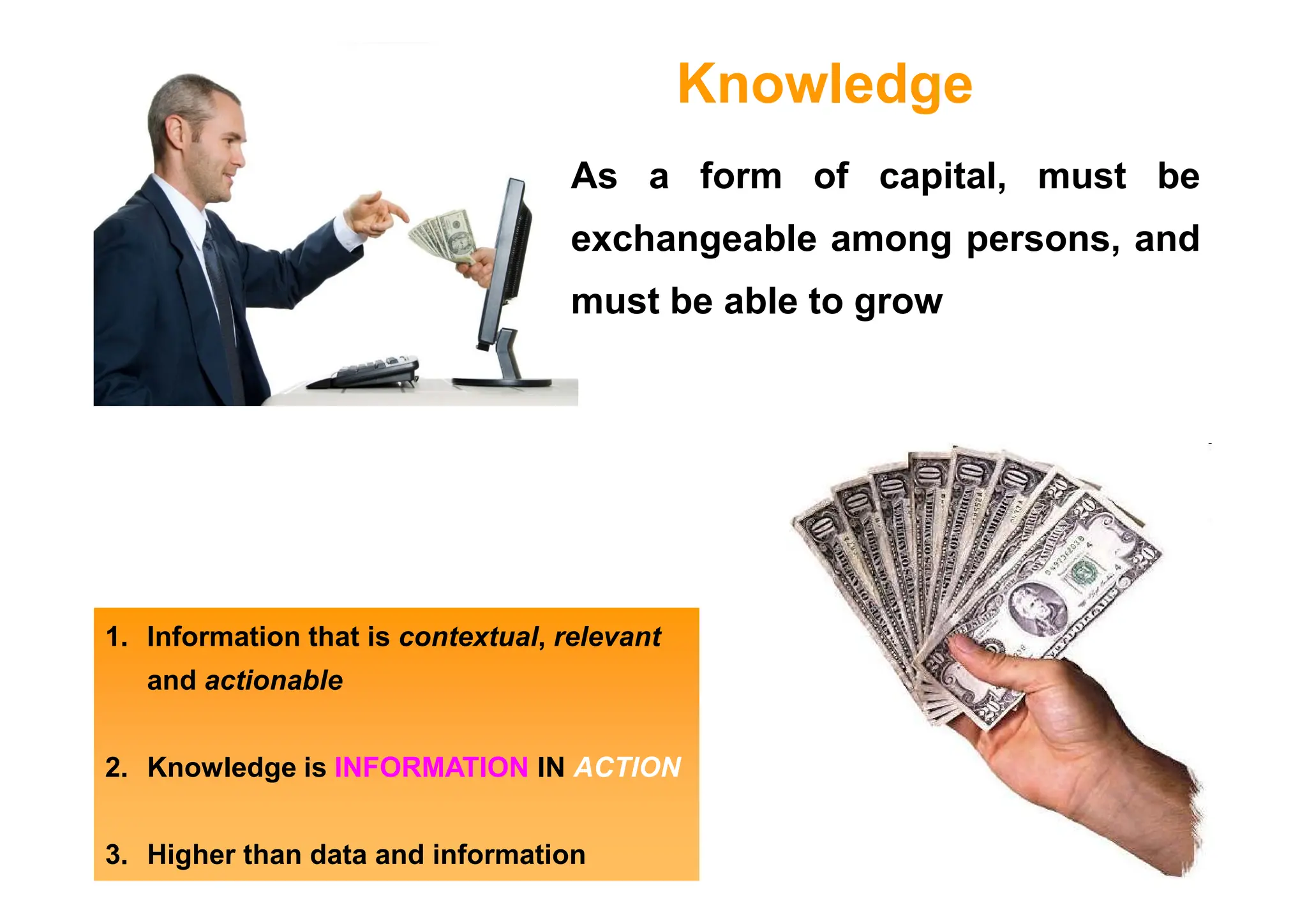
As a formof capital, must be
exchangeable among persons, and
must be able to grow
Knowledge
1. Information that is contextual, relevant
and actionable
2. Knowledge is INFORMATION IN ACTION
3. Higher than data and information
8.
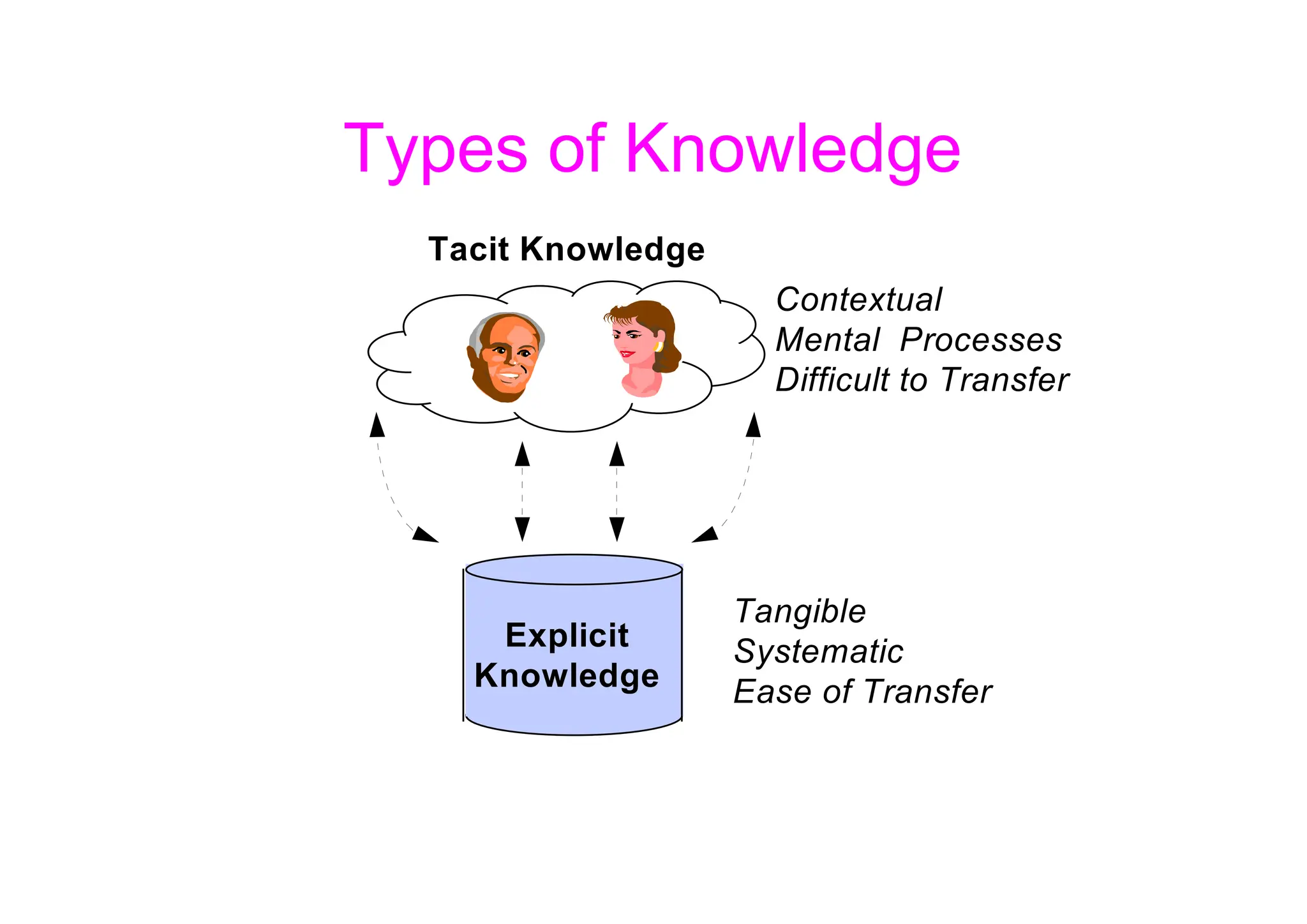
Types of Knowledge
TacitKnowledge
Contextual
Mental Processes
Difficult to Transfer
Explicit
Knowledge
Tangible
Systematic
Ease of Transfer
9.
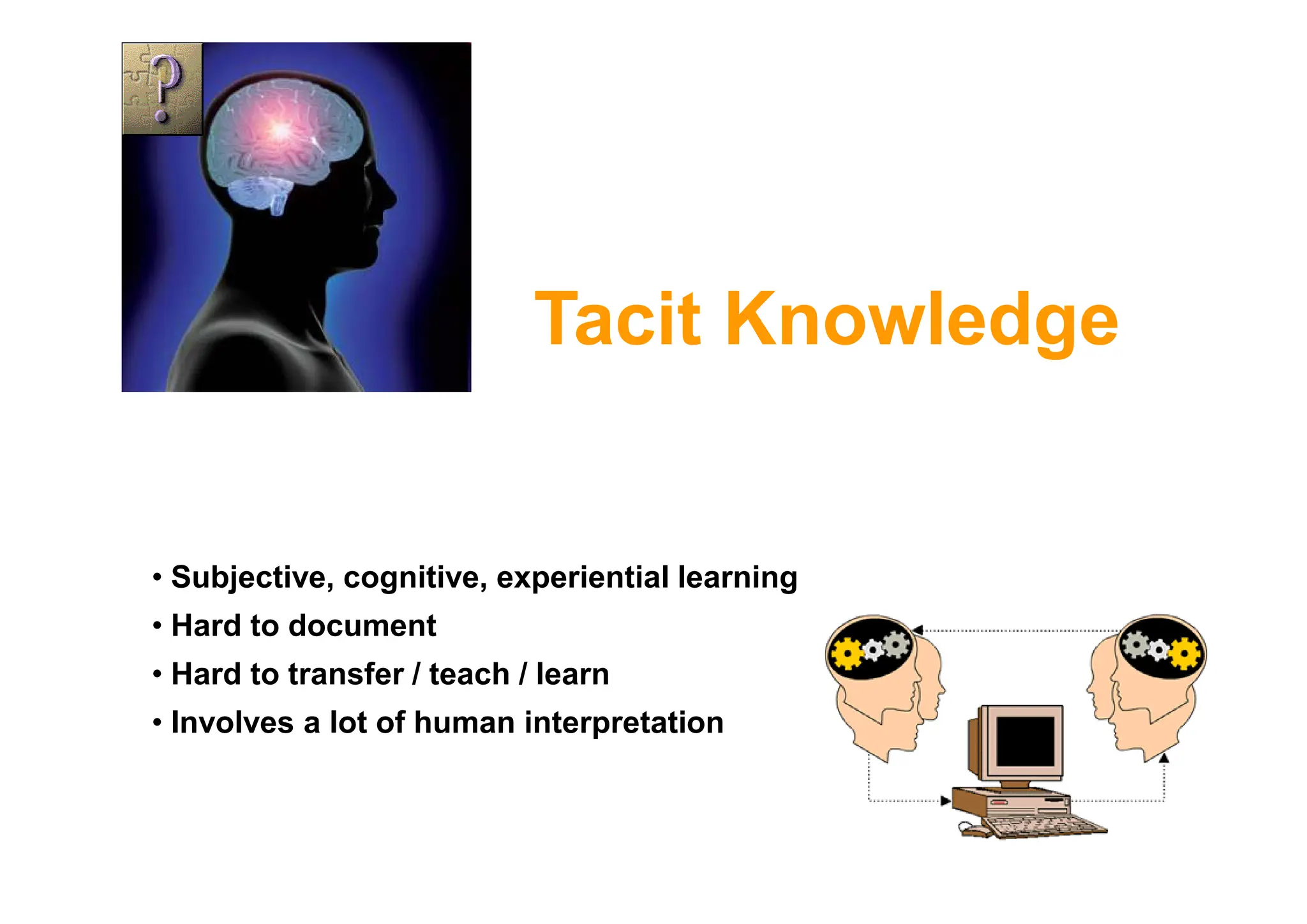
Tacit Knowledge
• Subjective,cognitive, experiential learning
• Hard to document
• Hard to transfer / teach / learn
• Involves a lot of human interpretation
10.
Tacit Knowledge –Cntd.
With tacit knowledge, people are not often aware of the knowledge they possess
or how it can be valuable to others. Tacit knowledge is considered more valuable
because it provides context for people, places, ideas, and experiences. Effective
transfer of tacit knowledge generally requires extensive personal contact and trust.
We know more than we can tell. Tacit knowledge consists often of habits and
culture that we do not recognize in ourselves. In the field of knowledge
management the concept of tacit knowledge refers to a knowledge which is only
known by an individual and that is difficult to communicate to the rest of an
organization. Knowledge that is easy to communicate is called explicit knowledge.
The process of transforming tacit knowledge into explicit knowledge is known as
codification or articulation.
11.
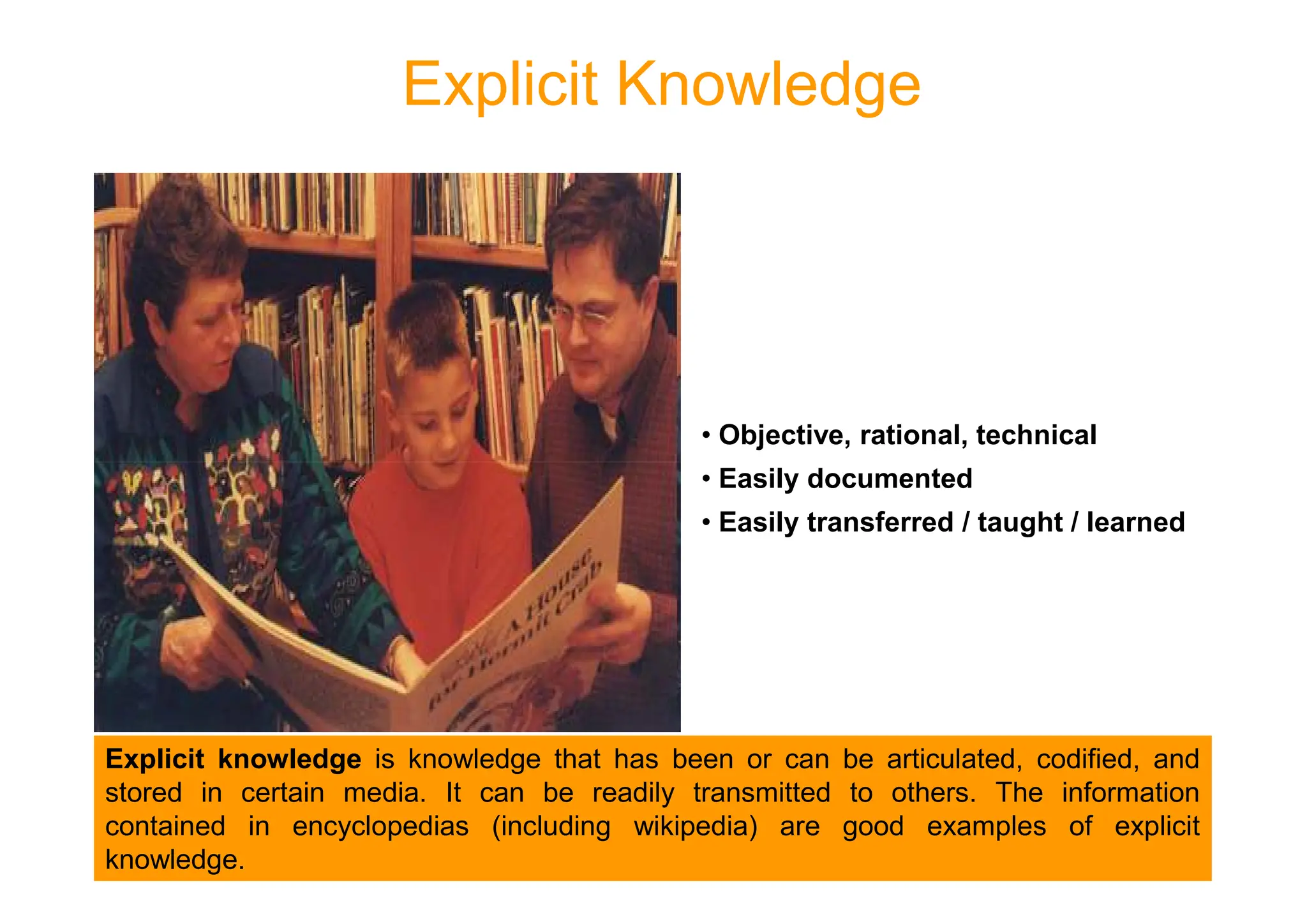
Explicit Knowledge
• Objective,rational, technical
• Easily documented
• Easily transferred / taught / learned
Explicit knowledge is knowledge that has been or can be articulated, codified, and
stored in certain media. It can be readily transmitted to others. The information
contained in encyclopedias (including wikipedia) are good examples of explicit
knowledge.
12.
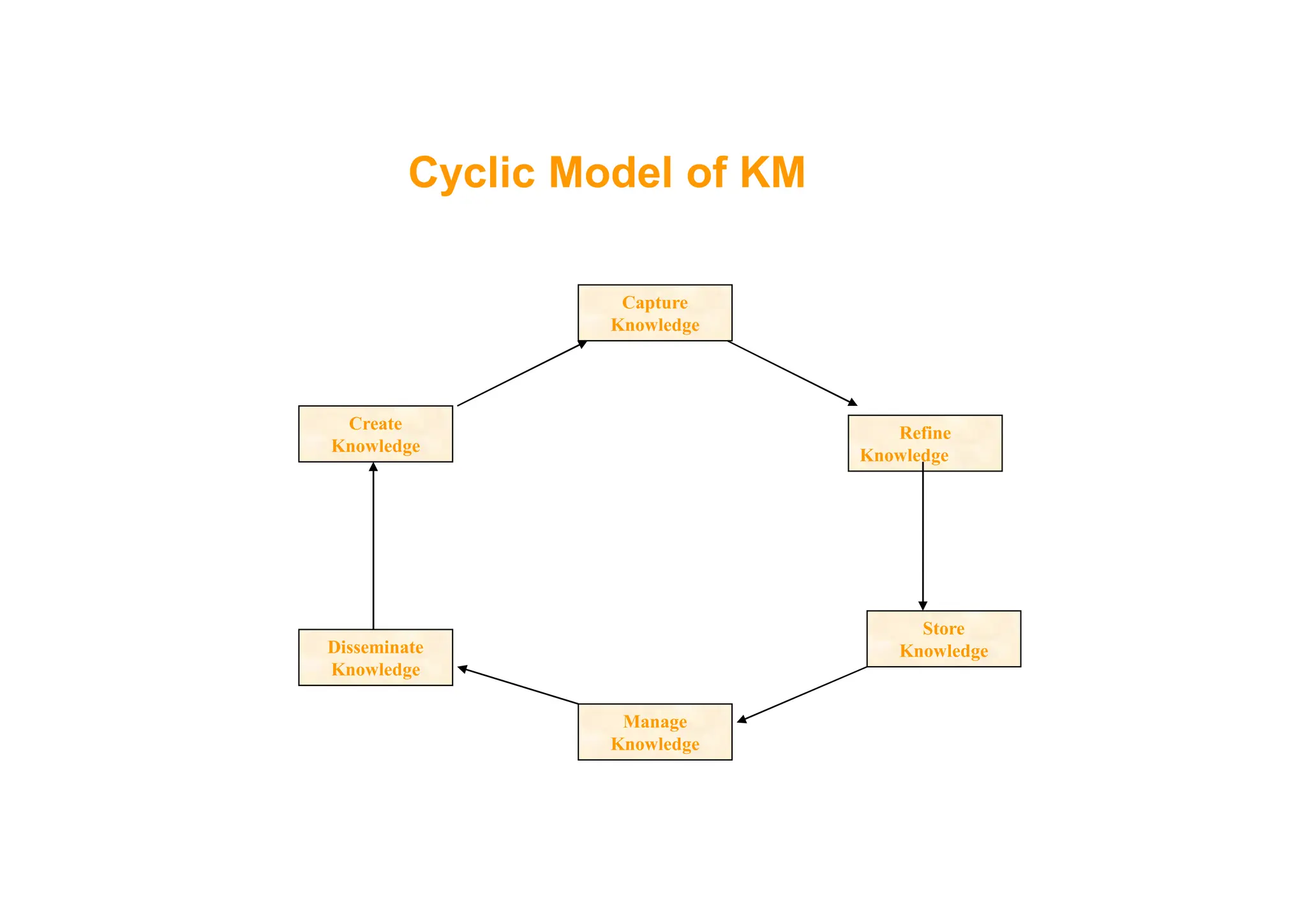
What is KM?
KnowledgeManagement has been referred to
as efforts to capture, store, and deploy
knowledge using a combination of information
technology and business processes.
Knowledge management is a discipline that promotes an integrated approach to
identifying, managing and sharing all of an enterprise’s information needs. These
information assets may include databases, documents, policies and procedures
as well as previously unarticulated expertise and experience resident in individual
workers.”
13.
KM focuses on:
–people who create and use knowledge.
– processes and technologies by which knowledge is
created, maintained and accessed.
– artifacts in which knowledge is stored (manuals,
– artifacts in which knowledge is stored (manuals,
databases, intranets, books, heads).
Requires a major transformation in organizational culture to create a
desire to share
14.
Purposes of KM
•Maintain, preserve and improve our distinctive competency
• Translate tacit knowledge to organizational knowledge
• Make knowledge available to all
• Create a learning Culture
• Promote culture of sharing knowledge
• Create an application of knowledge delivery
• Create an application of knowledge delivery
• Go for higher and broader levels of knowledge competency
• Identify appropriate knowledge
• Create appropriate systems
• Create measures for knowledge
• Link Knowledge Management to Idea Management
• Develop output measurements
Knowledge Asset Managementthat identifies some of the
specific business factors, including:
– Marketplaces are increasingly competitive and the rate of innovation is rising.
– Reductions in staffing create a need to replace informal knowledge with formal
methods.
– Competitive pressures reduce the size of the work force that holds valuable
business knowledge.
– The amount of time available to experience and acquire knowledge has
– The amount of time available to experience and acquire knowledge has
diminished.
– Early retirements and increasing mobility of the work force lead to loss of
knowledge.
– There is a need to manage increasing complexity as small operating
companies are trans-national sourcing operations.
– Changes in strategic direction may result in the loss of knowledge in a specific
area
We are ina knowledge-base
society!
• Most of our work is information based
• Organizations compete on the basis of
knowledge
knowledge
• Products and services available in the
society are increasingly complex
• Life-long learning is inevitable needed
21.
Why KM inknowledge-base
business economy?
• Foster innovation
– By encouraging the free flow of ideas
• Improve customer service
– By streamlining response time
• Boost revenues
– By getting products and services to market faster
• Enhance employee retention rates
– By recognizing the value of employees’ knowledge and rewarding them for it
• Streamline operations and reduce costs
– By eliminating redundant or unnecessary processes
22.
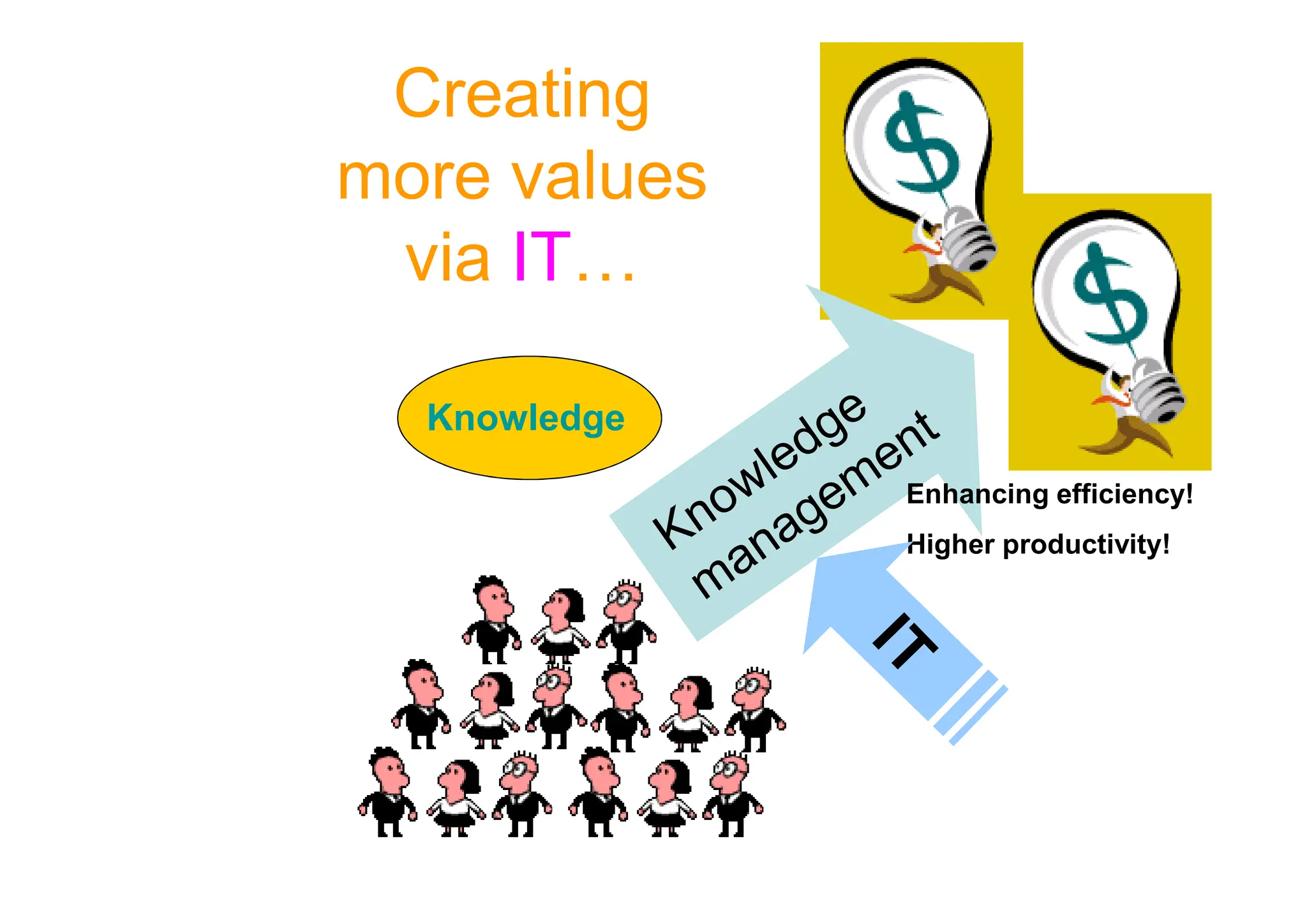
The role ofIT in KM
• Information technology, by itself is not KM
• However,
– KM is often facilitated by IT
– IT provides solutions to KM
– IT provides solutions to KM
– IT is a tool to increase the “efficiency” and “capability” of KM
• facilitates document management, data storage, access of
information, the dissemination, exchange and sharing of
ideas
IT, as a facilitator of KM
The Role ofKnowledge
In summary
The creation, diffusion and use of knowledge
have become the vital ingredient in economic
growth and change. The innovation-driven
economy builds upon these processes.
25.
The creative processthrough
which additional economic
Redefining Business Innovation
which additional economic
value is extracted from the
stock of knowledge
26.
Paradoxes of Knowledge
Usingknowledge does not consume it but it
does get obsolete.
• Transferring knowledge does not lose it but
market mechanisms allow ownership.
market mechanisms allow ownership.
• Knowledge is abundant, but the ability to use it
is scarce.
• Producing knowledge resists organisation.
• Much of it walks out the door at the end of the
day.
The Challenge ofKnowledge
Management
Not only of how to develop new knowledge, BUT
• how to locate and acquire others’ knowledge
• how to diffuse knowledge in your organisation
• how to recognize knowledge interconnections
• how to embody knowledge in products
• how to get access to the learning experiences of
customers
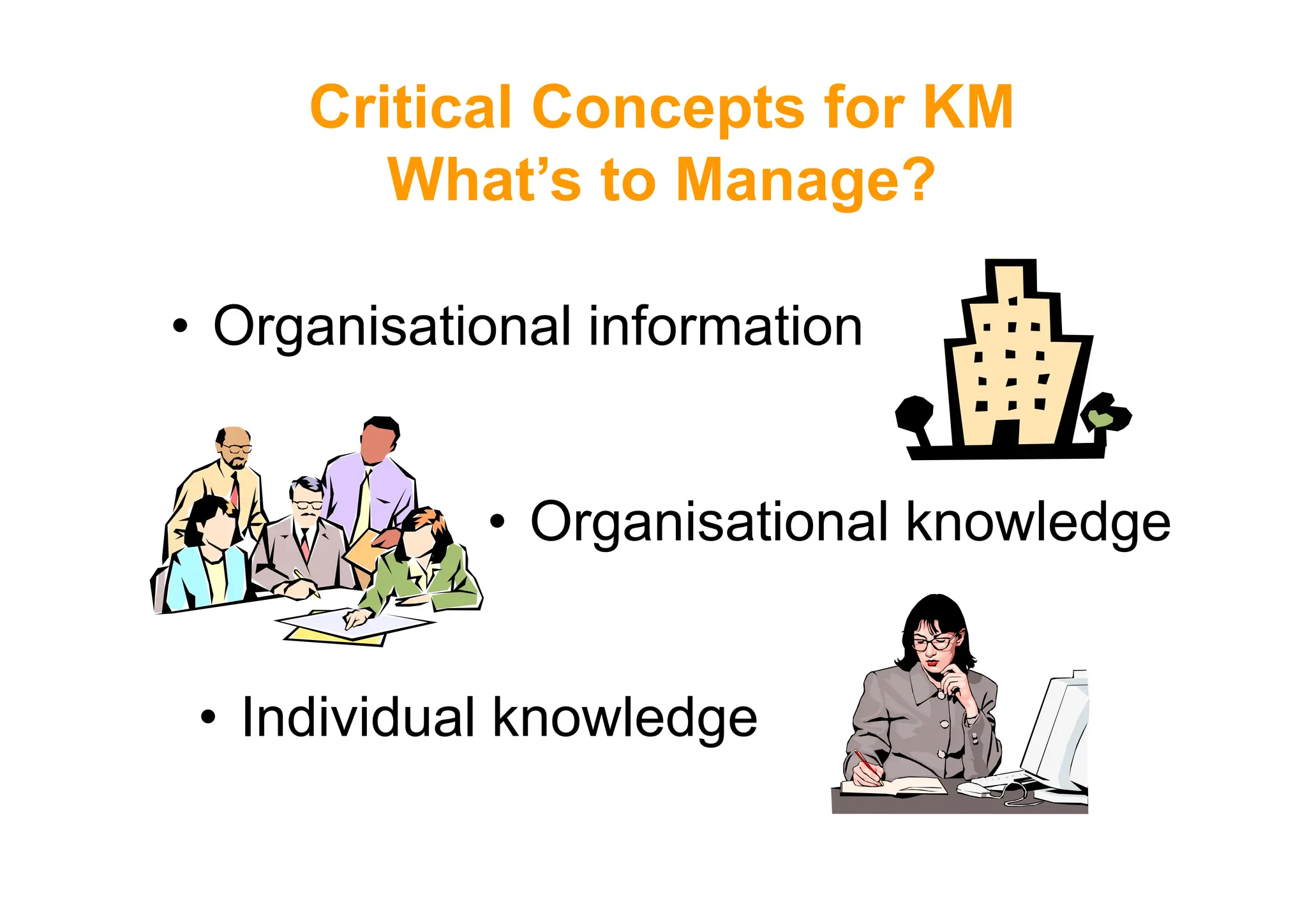
Critical Concepts forKM
What’s to Manage?
• Organisational information
• Organisational knowledge
• Individual knowledge
31.
Establish effective informationcapture and
management systems processes
The KM Journey - the Fivefold
Way
• Identify/map organisational individual knowledge
capabilities – your knowledge asset register
• Codify knowledge where possible, but don’t discard
non-codifiable (tacit) components
non-codifiable (tacit) components
• Nourish a culture that supports and rewards
knowledge sharing
• Promote individual knowledge development
A rapid change-for what?
• A news reporter sitting on a railway track
• Question was asked to him why is he sitting like this.
• He replied that he would like to report the derail and claim the pride that
his is the first news channel flashing the news of this derail.
• Morel – Social Vs Functional
37.
What is changeManagement?
• A common definition used for change management is a set
of processes that is employed to ensure that significant
changes are implemented in an orderly, controlled and
systematic fashion to effect organizational change.
• One of the goals of change management is with regards to
the human aspects of overcoming resistance to change in
order for organizational members to buy into change and
achieve the organization's goal of an orderly and effective
transformation.
38.
Knowledge Management
• Definitions
•Do you really need KM?
• Do you need a CKO?
• What’s the strategy?
• What’s the strategy?
• Types of knowledge management systems
• Organizational changes to expect
• KM software tools
39.
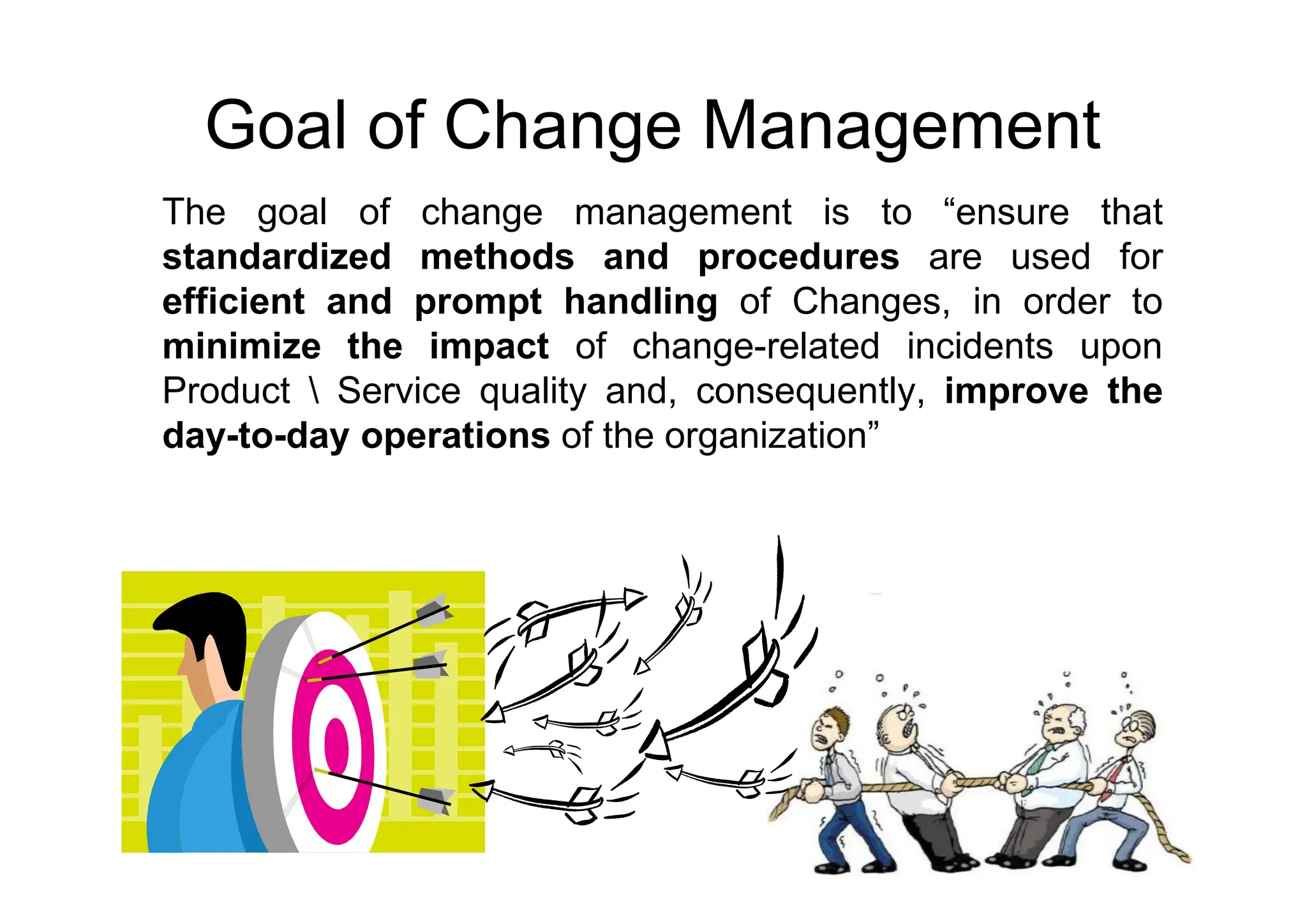
Goal of ChangeManagement
The goal of change management is to “ensure that
standardized methods and procedures are used for
efficient and prompt handling of Changes, in order to
minimize the impact of change-related incidents upon
Product Service quality and, consequently, improve the
day-to-day operations of the organization”
39
40.
Knowledge Management
The movefrom an industrially-based
economy to a knowledge or information-
based one in the 21st Century demands a
based one in the 21st Century demands a
top-notch knowledge management system
to secure a competitive edge and a capacity
for learning.
41.
Knowledge Management
• Thenew source of wealth is knowledge, and
not labor, land, or financial capital. It is the
intangible, intellectual assets that must be
managed.
managed.
• The key challenge of the knowledge-based
economy is to foster innovation.
42.
The Knowledge Economy
Forseveral decades the world's best-known
forecasters of societal change have
predicted the emergence of a new economy
in which brainpower, not machine power, is
in which brainpower, not machine power, is
the critical resource. But the future has
already turned into the present, and the era
of knowledge has arrived.
--The Learning Organization, Economist Intelligence
Unit
43.
The Knowledge Economy
Theknowledge economy rests on three
pillars:
• The role that knowledge plays in
transactions: it is what is being bought and
sold; both the raw material and the finished
sold; both the raw material and the finished
goods
• The concurrent rise in importance of
knowledge assets, which transform and add
value to knowledge products
• The emergence of ways to manage these
materials and assets, or KM
44.
Two Kinds ofKnowledge
Knowledge is intangible, dynamic, and
difficult to measure, but without it no
organization can survive.
• Tacit: or unarticulated knowledge is more
personal, experiential, context specific, and
hard to formalize; is difficult to communicate
or share with others; and is generally in the
heads of individuals and teams.
• Explicit: explicit knowledge can easily be
written down and codified.
45.
Definitions
• Designing andinstalling techniques and
processes to create, protect, and use
known knowledge.
• Designing and creating environments and
activities to discover and release
activities to discover and release
knowledge that is not known, or tacit
knowledge.
• Articulating the purpose and nature of
managing knowledge as a resource and
embodying it in other initiatives and
programs.
46.
Do You ReallyNeed KM?
• Competitive success will be based on how
strategically intellectual capital is managed
• Capturing the knowledge residing in the
• Capturing the knowledge residing in the
minds of employees so that it can be
easily shared across the enterprise
• Leveraging organizational knowledge is
emerging as the solution to an increasingly
fragmented and globally-dispersed
workplace
47.
Do You ReallyNeed KM?
• Instead of constantly reengineering and
downsizing: talented people are assets to be
developed for a global 21st Century
• If you are interested in the Knowledge Grid
• If you are interested in the Knowledge Grid
• The reuse of knowledge saves work, reduces
communications costs, and allows a
company to take on more projects.
48.
Does a KMSystem Need a
Chief Knowledge Officer?
• Economic realities and and competitive
edge factors play a large role
• Only if your organization is serious about
implementing a knowledge management
program
49.
What’s the Strategy?
Thereare two very different knowledge
management strategies:
• Codification Strategy
• Codification Strategy
• Personalization Strategy
The Successful Managingof
Knowledge
Focus on five tasks:
• Generating knowledge
• Accessing knowledge
• Accessing knowledge
• Representing and embedding knowledge
• Facilitating knowledge
• Transferring knowledge
• It is a process of instilling the culture and
helping the people in it find ways to share
and utilize their collective knowledge.
More on theImportance of
Corporate Culture
• Changing the culture is imperative.
• To create a climate in which employees
volunteer their creativity and expertise,
managers need to look beyond the traditional
managers need to look beyond the traditional
tools at their disposal: finding ways to build
trust and develop fair process.
• That means getting the gatekeepers to
facilitate the flow of information rather than
hoard it.
• And offering rewards and incentives
54.
The Technological Divide
•Generating organizational knowledge
invariably means converting the tacit
knowledge of the individual into explicit
knowledge accessible by all. Information
technology is most effective when it
technology is most effective when it
enables this social process.
• Companies must think through their
technological systems.
• Technology such as Intranets and
advanced collaborative software have
made Knowledge Management possible.
55.
Organizational Changes
• Linesbetween departments and operating
divisions blur
• Knowledge management even completely
collapses boundaries
collapses boundaries
• A knowledge management system cannot
work through hierarchies
• Individual and team learning process must
become the true driver of organizational
learning
56.
Organizational Knowledge:
Why IsIt Important?
• Knowledge can be embedded in processes,
products, systems, and controls
• Knowledge can be accessed as it is needed
• Knowledge can be accessed as it is needed
from sources inside or outside the firm
• It is versatile and can be transferred
formally, through training, or informally, by
way of workplace socialization
• It is the essence of the competitive edge!
57.
Why KM? What’sthe Big
Deal?
• By instituting a learning organization (KM-
intensive), there is an increase in employee
satisfaction due to greater personal
development and empowerment.
development and empowerment.
• Keep your employees longer and thereby,
reduce the loss of intellectual capital from
people leaving the company.
• Save money by not reinventing the wheel for
each new project
58.
Why KM? What’sthe Big
Deal?
• Reduce costs by decreasing and achieving
economies of scale in obtaining information
from external providers.
from external providers.
• Increase productivity by making knowledge
available more quickly and easily.
• Provides workers with a more democratic
place to work by allowing everyone access to
knowledge.
59.
Why KM? What’sthe Big Deal?
• Learning Faster With KM
• Learning fast to stay competitive
• Learning fast to stay competitive
• KM software and technological
infrastructures allow for global access to
an organization’s knowledge, at a
keystroke
60.
Successful KM Programs
•Information is widely disseminated throughout
the organization. Wherever it is needed, it is
accessible.
• Accessible at a fast rate of speed.
• Virtual communities of practice share what is
• Virtual communities of practice share what is
known in a global fashion, independent of time
zones and other geographic limitations.
• Business without boundaries broad, often
virtual in nature.
• Collaboration to support continuous innovation
and new knowledge creation.
61.
Symptoms of KMDiffusion
Challenges
• No internal learning communities
• Lack of psychological safety
• Lack of workplace trust
• Arrogance of people who believe they
• Arrogance of people who believe they
know everything, so why try?
• Lack of communication within an
organization made evident by reinventing
the same wheel
• Negativity and unrealistic expectations
62.
KM and FutureScenarios
• Where are we going? What are we here
for?
• People need awareness of the whole: in
what direction is the organization going?
• To have a goal to reach in the future can
• To have a goal to reach in the future can
provide great incentive for a KM initiative.
• Effective leveraging lies within an
organization’s capacity for rethinking and
recreating. Scenario thinking can help to us
to see the blind spots, and help us to create
the future we want.
63.
Sustainability of aKM
Endeavor
There are three fundamental processes
that sustain profound changes such as the
introduction of a KM system:
• developing networks of committed people
• developing networks of committed people
• improving business results
• enhancing personal results
For achieve sustainability, there must be a
focus on learning and learning how to
harness the learning capabilities that lead
to innovation.
64.
Sustainability of aKM
Endeavor
• For significant change to lead to
sustainability, hierarchical control must be
put aside.
• The emergence and development of
• The emergence and development of
informal networks must be supported so
that people can share their tacit knowledge
and help one another.
• Managers need to surrender control.
• And mental models need to be examined.
65.
Knowledge Management?
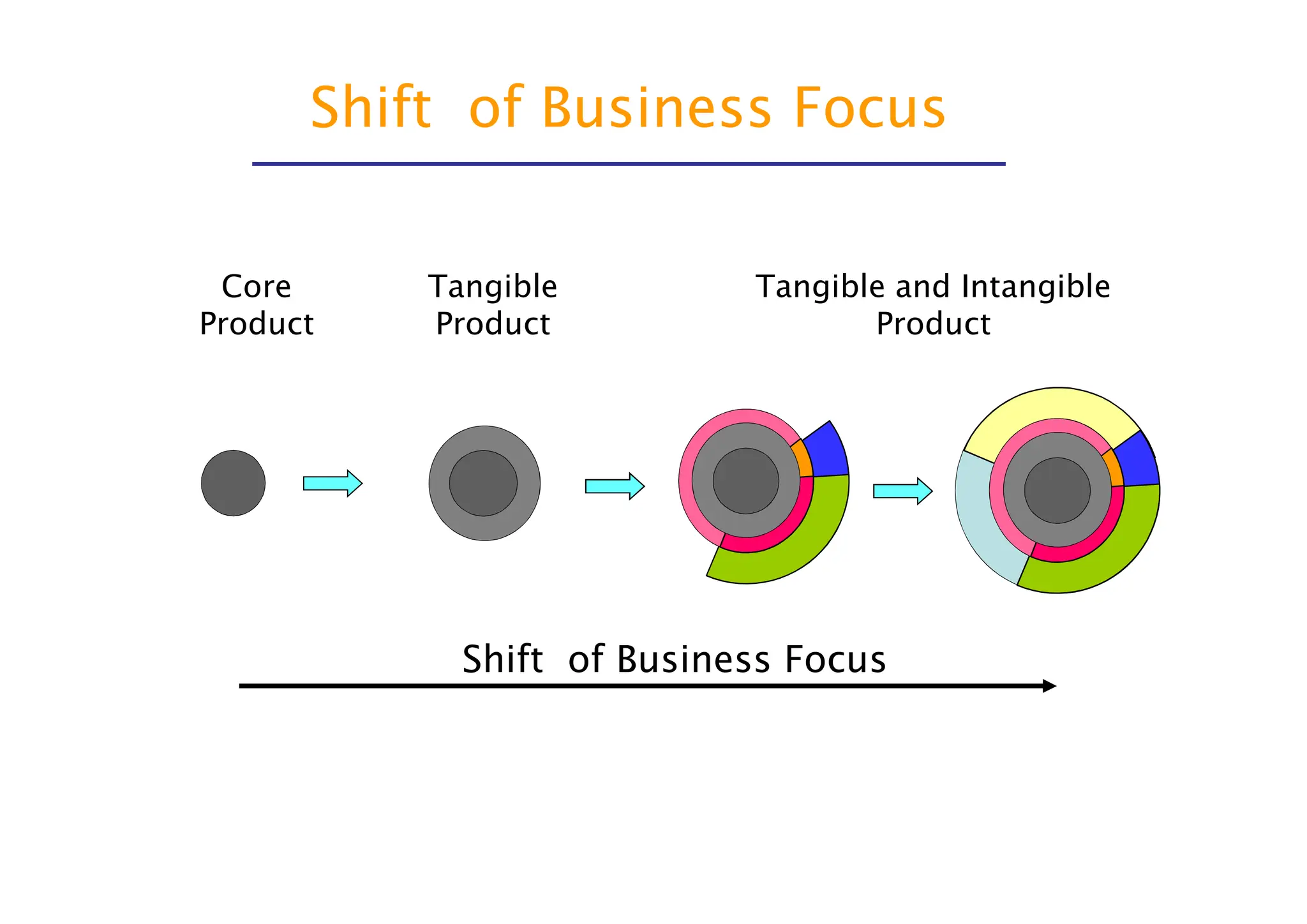
• Theessence of knowledge management is
understanding and valuing intangible assets
over tangible.
• Understanding that human and intellectual
capital are the greatest resources
capital are the greatest resources
• Managing the skills and competencies that
lie within an organization, and allowing
them to blossom
• Allowing people to be the best that they can
be; optimizing performance.
Why is itImportant to Adapt to
Change?
• Individuals, teams, or organizations that
do not adapt to change in timely ways are
unlikely to survive.
unlikely to survive.
68.
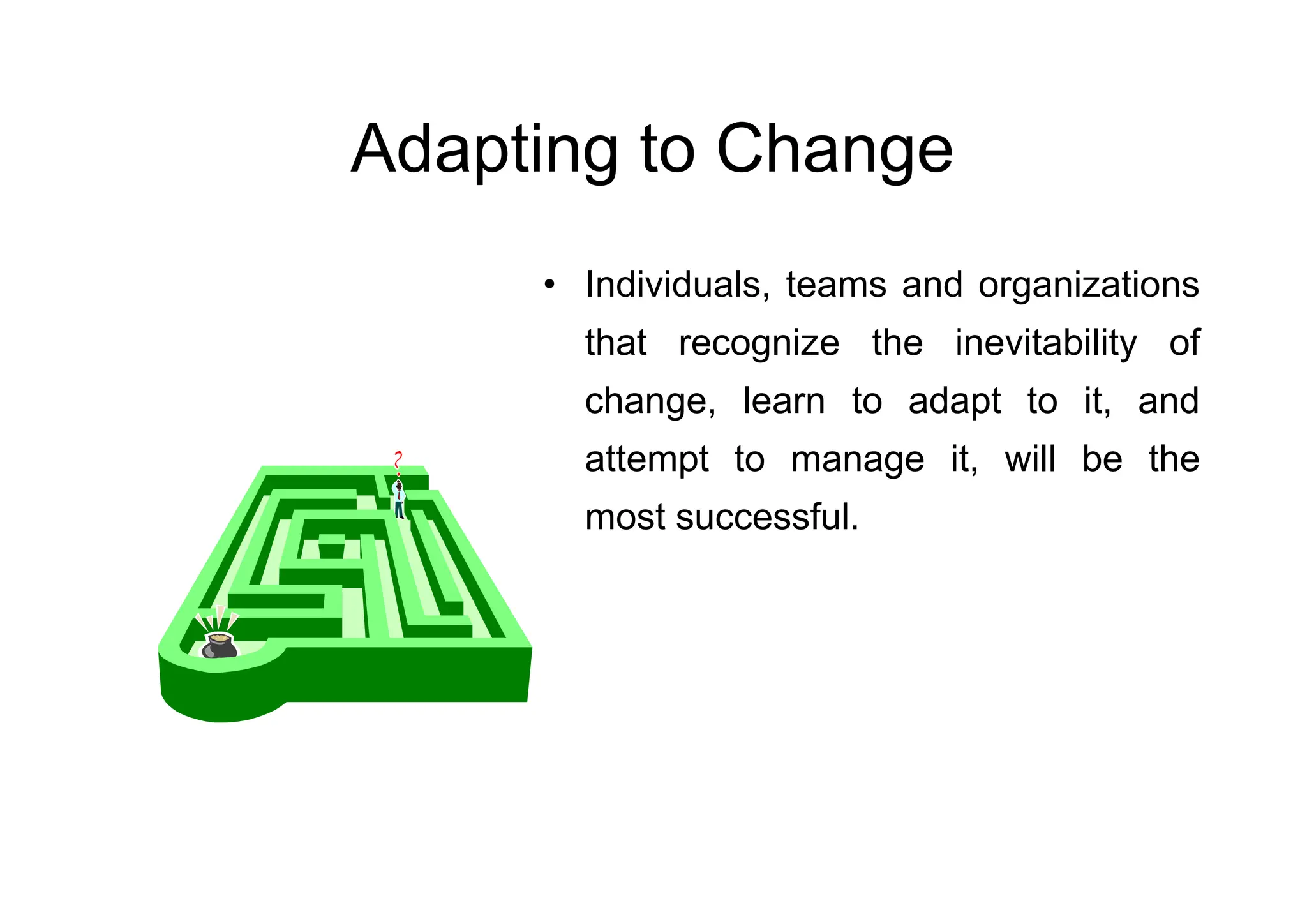
Adapting to Change
•Individuals, teams and organizations
that recognize the inevitability of
change, learn to adapt to it, and
attempt to manage it, will be the
attempt to manage it, will be the
most successful.
69.
What is Change?
•Coping process of moving from a
unsatisfactory present state to a desired
state
Managing the PlannedChange
Process
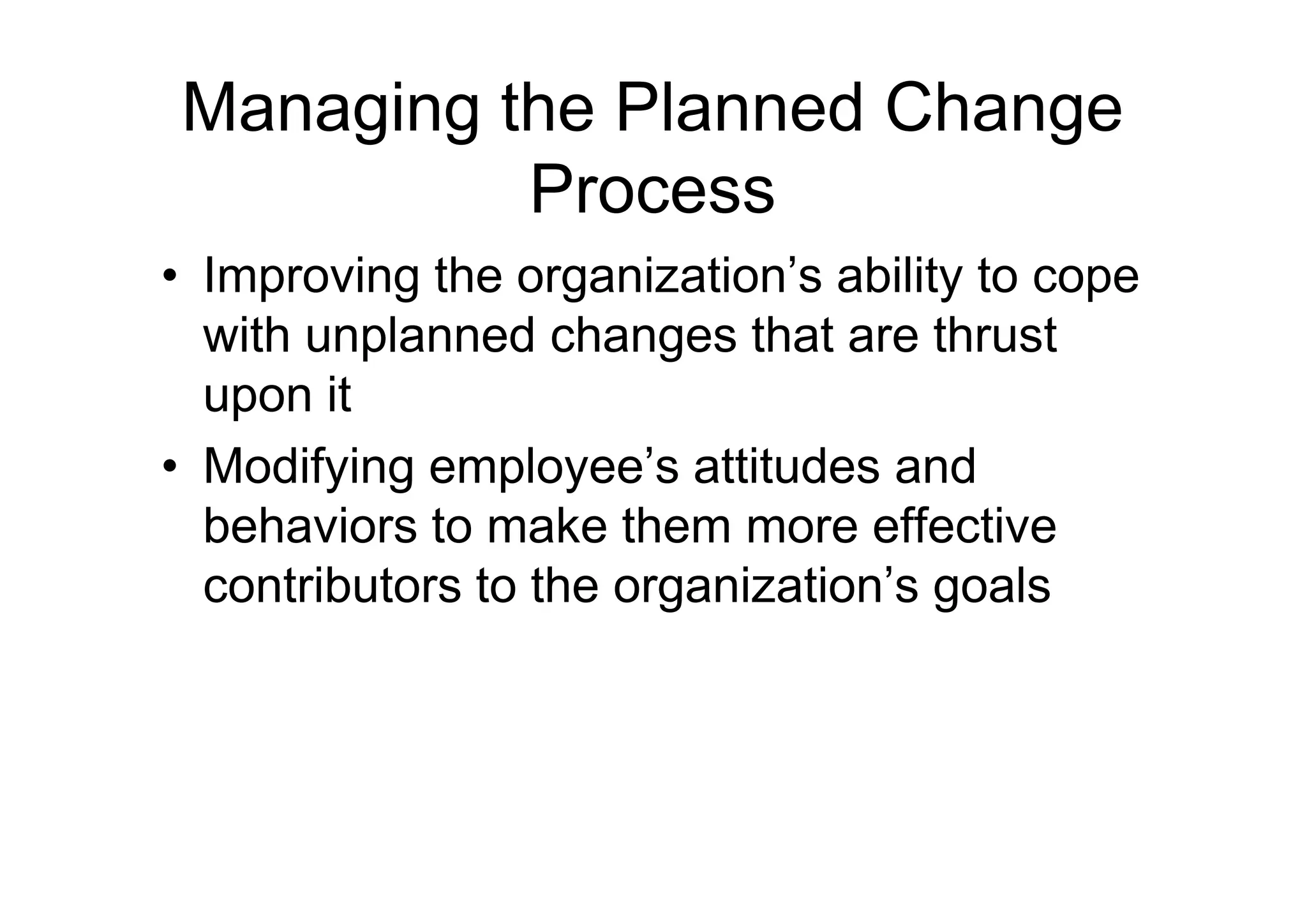
• Improving the organization’s ability to cope
with unplanned changes that are thrust
upon it
• Modifying employee’s attitudes and
• Modifying employee’s attitudes and
behaviors to make them more effective
contributors to the organization’s goals
77.
Steps in thePlanned Change
Process
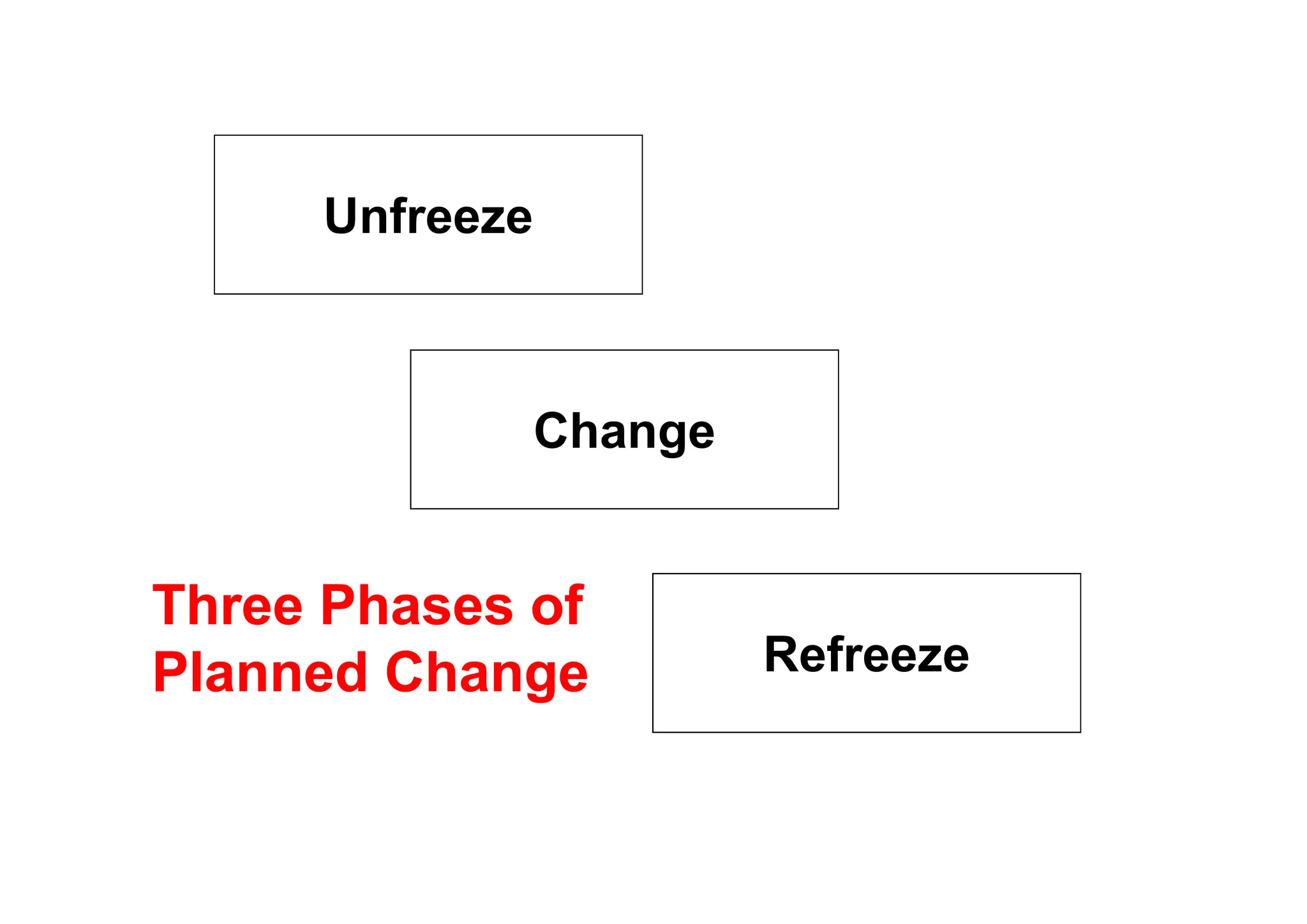
Recognize the need
for change
Diagnose and
plan change
plan change
Manage the
transition
Measure results
Maintain change
78.
Initiating the PlannedChange
Process
• Recognize the need for change
• Diagnose and plan change
• Formulate Goals
• Determine stakeholders’ needs
• Determine stakeholders’ needs
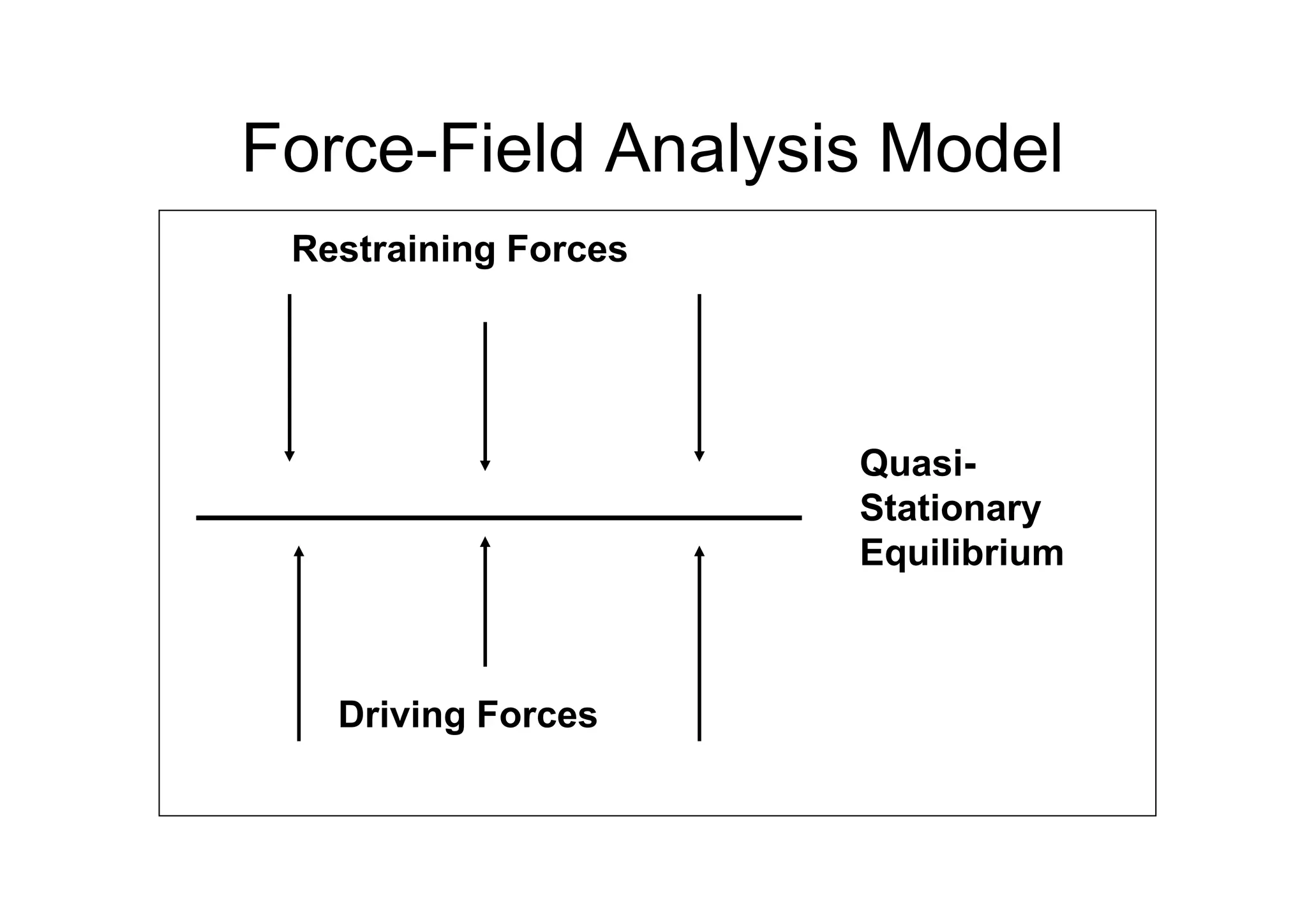
• Examine driving and restraining forces
Managing the PlannedChange
Process
• Consider contingencies to determine the
best interventions
• Manage the transition
• Measure results
• Measure results
• Maintain change
84.
Targets for OrganizationalChange
• Strategy – Develop new visions, missions,
strategic plans
• Structure – Add a new department or
division, or consolidate two existing ones
• People – Replace a person or change
• People – Replace a person or change
knowledge, skills, attitudes, or behaviors
• Technology – upgrade a data processing
system
• Management –Encourage participation by
those involved in solution of problems
85.
Reasons for Resistanceto
Change
• Selective Perception
• Lack of Information
• Fear of the Unknown
• Habit
• Resentment Toward
the Initiator
• Sub-Optimization
• Structural Stability
• Habit • Structural Stability
86.
Overcoming Resistance to
Change
•Education and Communication
• Participation and Involvement
• Facilitation and Support
• Negotiation and Agreement
• Negotiation and Agreement
• Manipulation and Co-optation
• Coercion
• Promote Positive Attitudes Toward Change
87.
Leading Organizational Change
•Establish a Sense of Urgency
• Form a Powerful Guiding Coalition
• Develop a Compelling Vision and Strategy
• Communicate Widely
• Empower Others to Act on the Vision
• Empower Others to Act on the Vision
• Generate Short-term Wins
• Consolidate Gains and Create Greater
Change
• Institutionalize Changes in the Organizational
Culture













![[MU630] 007. Knowledge Management](https://cdn.slidesharecdn.com/ss_thumbnails/007-190422040227-thumbnail.jpg?width=640&height=640&fit=bounds)


