Felix Zappe23.03.2017Kurs: Thema | Fakultät | Institution
Disclaimer
Conducting an Innovation
and Creativity Audit
as held in IOT 5029 –
Innovation in organisations
at the Edward de Bono Institute
on 10th January 2017
23.03.2017
IOT 5029: Innovation in organisations: Innovation & creativity audit at MFCC
Edward de Bono Institute | University of Malta
Disclaimer
2
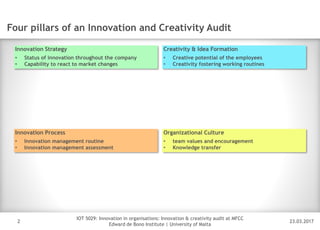
Four pillars of an Innovation and Creativity Audit
Innovation Strategy
• Status of innovation throughout the company
• Capability to react to market changes
Creativity & Idea Formation
• Creative potential of the employees
• Creativity fostering working routines
Innovation Process
• Innovation management routine
• Innovation management assessment
Organizational Culture
• team values and encouragement
• Knowledge transfer
23.03.2017
IOT 5029: Innovation in organisations: Innovation & creativity audit at MFCC
Edward de Bono Institute | University of Malta
Disclaimer
3
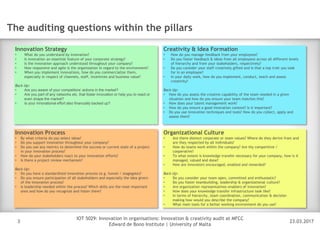
The auditing questions within the pillars
Innovation Strategy
• What do you understand by innovation?
• Is innovation an essential feature of your corporate strategy?
• Is the innovation approach understood throughout your company?
• How responsive and agile is the organization in regard to the environment?
• When you implement innovations, how do you commercialize them,
especially in respect of channels, staff, incentives and business value?
Back-Up:
• Are you aware of your competitors’ actions in the market?
• Are you part of any networks etc. that foster innovation or help you to react or
even shape the market?
• Is your innovational effort also financially backed up?
Creativity & Idea Formation
• How do you manage feedback from your employees?
• Do you foster feedback & ideas from all employees across all different levels
of hierarchy and from your stakeholders, respectively?
• Do you consider your staff creatively gifted and Is that a top trait you look
for in an employee?
• In your daily work, how do you implement, conduct, teach and assess
creativity?
Back-Up:
• How do you assess the creative capability of the team needed in a given
situation and how do you ensure your team matches this?
• How does your talent management work?
• How do you ensure a good innovation context? Is it important?
• Do you use innovation techniques and tools? How do you collect, apply and
assess them?
Innovation Process
• By what criteria do you select ideas?
• Do you support innovation throughout your company?
• Do you use any metrics to determine the success or current state of a project
in your innovation process?
• How do your stakeholders react to your innovation efforts?
• Is there a project review mechanism?
Back-Up:
• Do you have a standardized innovation process (e.g. funnel / stagegate)?
• Do you ensure participation of all stakeholders and especially the idea givers
of the innovation process?
• Is leadership needed within the process? Which skills are the most important
ones and how do you recognize and foster them?
Organizational Culture
• Are there distinct corporate or team values? Where do they derive from and
are they respected by all individuals?
• How do teams work within the company? Are thy competitive /
cooperative?
• To what extent is knowledge transfer necessary for your company, how is it
managed, valued and done?
• How are innovators encouraged, enabled and rewarded?
Back-Up:
• Do you consider your team open, committed and enthusiastic?
• Do you foster teambuilding, leadership & organizational culture?
• Are organization representatives enablers of innovation?
• How does your knowledge transfer infrastructure look like?
• In terms of hierarchy, team coordination, communication & decision
making how would you describe the company?
• What main tools for a better working environment do you use?
23.03.2017
IOT 5029: Innovation in organisations: Innovation & creativity audit at MFCC
Edward de Bono Institute | University of Malta
Disclaimer
4
The theoretical background of the Innovation and Creativity Audit
Mediterranean
Innovation Alliance:
Handbook on
Innovation Audit
Cooper & Mills:
Innovation Diamond
McKinsey: 7 S FrameworkMobbs: Innovation for Growth Audit
23.03.2017
IOT 5029: Innovation in organisations: Innovation & creativity audit at MFCC
Edward de Bono Institute | University of Malta
Disclaimer
 Cooper, R. G. and Mills, M., 2005. Succeeding at new product the P&G way: A key
element is the ‘Innovation Diamond’. PDMA Visions, 29 (4), pp. 9-13.
 Mediterranean Innovation Alliance, 2008. Handbook on Innovation Audit. [pdf]
Medinnoall. Available at: http://www.medinnoall.eu/sites/medinnoall.eu/
files/Handbook%20on%20Innovation%20Audit%20(web).pdf [Accessed 3 January 2017].
 Mobbs, C. W., 2011. What are Innovation Audits. [pdf] Innovation for Growth. Available
at: http://www.innovationforgrowth.co.uk/resources/What-are-innovation-audits.pdf
[Accessed 3 January 2017].
 Waterman, R. H., Peters, T. J. and Phillips, J. R., 1980. Structure is not organization.
McKinsey Quarterly, in-house journal. New York: McKinsey & Co.
References

Innovation and Creativity Audit

  • 1.
    Felix Zappe23.03.2017Kurs: Thema| Fakultät | Institution Disclaimer Conducting an Innovation and Creativity Audit as held in IOT 5029 – Innovation in organisations at the Edward de Bono Institute on 10th January 2017
  • 2.
    23.03.2017 IOT 5029: Innovationin organisations: Innovation & creativity audit at MFCC Edward de Bono Institute | University of Malta Disclaimer 2 Four pillars of an Innovation and Creativity Audit Innovation Strategy • Status of innovation throughout the company • Capability to react to market changes Creativity & Idea Formation • Creative potential of the employees • Creativity fostering working routines Innovation Process • Innovation management routine • Innovation management assessment Organizational Culture • team values and encouragement • Knowledge transfer
  • 3.
    23.03.2017 IOT 5029: Innovationin organisations: Innovation & creativity audit at MFCC Edward de Bono Institute | University of Malta Disclaimer 3 The auditing questions within the pillars Innovation Strategy • What do you understand by innovation? • Is innovation an essential feature of your corporate strategy? • Is the innovation approach understood throughout your company? • How responsive and agile is the organization in regard to the environment? • When you implement innovations, how do you commercialize them, especially in respect of channels, staff, incentives and business value? Back-Up: • Are you aware of your competitors’ actions in the market? • Are you part of any networks etc. that foster innovation or help you to react or even shape the market? • Is your innovational effort also financially backed up? Creativity & Idea Formation • How do you manage feedback from your employees? • Do you foster feedback & ideas from all employees across all different levels of hierarchy and from your stakeholders, respectively? • Do you consider your staff creatively gifted and Is that a top trait you look for in an employee? • In your daily work, how do you implement, conduct, teach and assess creativity? Back-Up: • How do you assess the creative capability of the team needed in a given situation and how do you ensure your team matches this? • How does your talent management work? • How do you ensure a good innovation context? Is it important? • Do you use innovation techniques and tools? How do you collect, apply and assess them? Innovation Process • By what criteria do you select ideas? • Do you support innovation throughout your company? • Do you use any metrics to determine the success or current state of a project in your innovation process? • How do your stakeholders react to your innovation efforts? • Is there a project review mechanism? Back-Up: • Do you have a standardized innovation process (e.g. funnel / stagegate)? • Do you ensure participation of all stakeholders and especially the idea givers of the innovation process? • Is leadership needed within the process? Which skills are the most important ones and how do you recognize and foster them? Organizational Culture • Are there distinct corporate or team values? Where do they derive from and are they respected by all individuals? • How do teams work within the company? Are thy competitive / cooperative? • To what extent is knowledge transfer necessary for your company, how is it managed, valued and done? • How are innovators encouraged, enabled and rewarded? Back-Up: • Do you consider your team open, committed and enthusiastic? • Do you foster teambuilding, leadership & organizational culture? • Are organization representatives enablers of innovation? • How does your knowledge transfer infrastructure look like? • In terms of hierarchy, team coordination, communication & decision making how would you describe the company? • What main tools for a better working environment do you use?
  • 4.
    23.03.2017 IOT 5029: Innovationin organisations: Innovation & creativity audit at MFCC Edward de Bono Institute | University of Malta Disclaimer 4 The theoretical background of the Innovation and Creativity Audit Mediterranean Innovation Alliance: Handbook on Innovation Audit Cooper & Mills: Innovation Diamond McKinsey: 7 S FrameworkMobbs: Innovation for Growth Audit
  • 5.
    23.03.2017 IOT 5029: Innovationin organisations: Innovation & creativity audit at MFCC Edward de Bono Institute | University of Malta Disclaimer  Cooper, R. G. and Mills, M., 2005. Succeeding at new product the P&G way: A key element is the ‘Innovation Diamond’. PDMA Visions, 29 (4), pp. 9-13.  Mediterranean Innovation Alliance, 2008. Handbook on Innovation Audit. [pdf] Medinnoall. Available at: http://www.medinnoall.eu/sites/medinnoall.eu/ files/Handbook%20on%20Innovation%20Audit%20(web).pdf [Accessed 3 January 2017].  Mobbs, C. W., 2011. What are Innovation Audits. [pdf] Innovation for Growth. Available at: http://www.innovationforgrowth.co.uk/resources/What-are-innovation-audits.pdf [Accessed 3 January 2017].  Waterman, R. H., Peters, T. J. and Phillips, J. R., 1980. Structure is not organization. McKinsey Quarterly, in-house journal. New York: McKinsey & Co. References