




WAVES OF CHANGE
Prof.Dr.Aung Tun Thet
WAVES OF CHANGE
Prof.Dr.Aung Tun Thet
Oceans of
Opportunities
Introduction
The world has
changed, and
Companies must
change with it.
Future Thrusts of Business
• Developing Better Products/Services
• Serving Customers Better
• Creating Better World
Future Thrusts of Business
• Corporate Centric
• Customer Centric
• Stakeholder Centric
Future Thrusts of Business
• Segmenting
• Targeting
• Positioning
Future Thrusts of Business
• Core Competencies
• Customer Focus
• Collaborative Network
Future Thrusts of Business
• Changing Mindsets
• Addressing Mandate for Change
• Crafting Operating Models
• Driving Social Movements
New Business Environment
• Shift focus
• From commodity
• To customer
• Customer-centric transformation
• Strategic advantage
Fundamental New Direction
• New Business Model
• Consistently put customer at heart of all activities
• “Customer Centricity”
Customer
Centricity
Customer-centric Organization
• Recognizing market segments
• Implementing segment-specific strategies
• Expanding market share
Customer-centric Organization
• Match capacity, cost structure, and business
conditions to right customer at right time
• Identify opportunities
• Drive profitability and growth
Customer Centricity
• Enhance customer satisfaction
• Achieve sustainable growth
Customer Centricity
• Close relationship with customers
• Understand actual needs
• Tailored products and services
• Gain trust
• “Hearts and minds” of customers
Customer Centricity
• Customer pride of place
• Leveraging social media
• Redefining business concept
• Targeting specific segments
Customer Centricity
• Delight customers
• Create deep trust and loyalty
• Putting users at center of product universe – Apple
• Delegating ownership of customer experience to
front line – Disney
Customer-centric Organization
• Marketing campaigns and selective improvements
not enough
• Radically change perspective
• Aligning entire business model towards Customer
• Weaves into DNA
• Implement at all levels of organization
Holistic Customer Centricity
• Translating deep customer insights into tailor-made
products/services
• Segment-specific differentiation strategies
• Aligned Organizational Structure
Four Areas
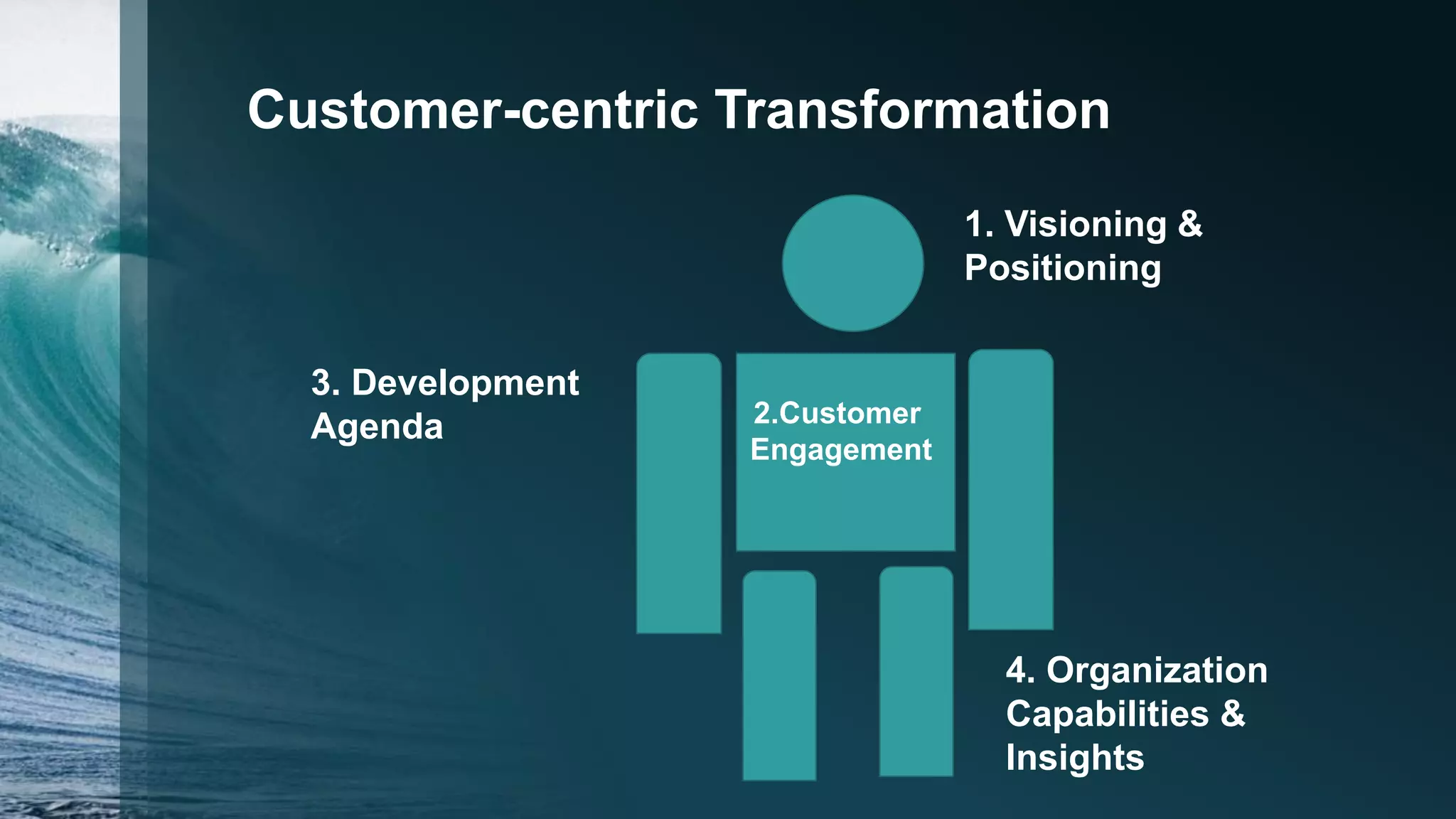
Customer-centric Transformation
1. Visioning &
Positioning
4. Organization
Capabilities &
Insights
3. Development
Agenda 2.Customer
Engagement
Four Areas
1. Vision and positioning: “Create institution customers
want to do business with and employees feel proud of”
2. Customer engagement model: “Delivers exceptional
customer service where customers expect it, and excites
them where they do not”
Four Areas
3. Development agenda: “Integrated to drive short-term
gains and long-term growth”
4. Organization, capabilities, and insights: “Build insights,
organizational capabilities, and governance to sustain
momentum”
1. Visioning &
Positioning
Living and Breathing
Customer
Living and
breathing
Customer
Clear-cut Vision
• Starting point of every transformation
• Strategic direction
• Shape image of company
Clear-cut Vision
• Guide employee mind-set – code of behaviour
• Translated into balanced scorecard and “go-to-
market” model
• Bonus payments tied to level of customer loyalty
Clear-cut Vision
• Not just promise
• Framework for activities
• Give employees purpose they identify with
• Staff proud
Clear-cut Vision
• Positive energy leads to better performance
• Motivate employees
• Live customer centricity
Test 1
• Are brand and vision built around customer promise?
• Is company-wide vision translated into clear promises
for all stakeholders?
• Do brand and vision relate to one another?
• Is brand proposition built on insights into customer
needs/behaviour?
Test 1
• Are brand and vision visible for everyone, and do they
guide behaviour?
• Has proposition translated into visible statements to
customers?
• Do internal communication embed customer-centric
idea?
Test 1
• Do customers and employees know and understand
vision?
• Do they like it?
• Is there platform to engage employees?
• Are balanced scorecards linked to vision, proof points
and incentive mechanisms?
2. Customer
Engagement
Exciting
customers and
curbing costs
Customer Engagement
• New communication strategies
• Establish customer focus internally
• Surface it externally
Customer Engagement
• Communication not enough
• Company thinks and acts from customer perspective
• Purchasing more products/services
• Recommend to others
Customer Engagement
• Creating outstanding customer experience
• Systematic process shape customer touch points –
service or product offerings
“Customer Journey”
• Throughout entire purchasing process
• Identify customer archetypes
• Determine specific elements of purchasing process
for each archetype
• Offers tailored
Test 2
• Does company have clear understanding of customer
insights?
• Is there clear understanding of customer experiences
across customer journey?
• Is process in place to keep customer insights fresh
and up to date?
• Do insights come synthesized in digestible format?
Test 2
• Does company invest intelligently in superior
customer experience?
• Is there thoughtful profit optimization of customer
experiences (balancing revenues vs. cost increases)?
• Are investments focused on highest return on
customer centricity?
• Do actions dovetail with brand proposition?
Test 2
• Can customers interact in engaging way?
• Is customer experience centered around superior
customer experience?
• Is there clear understanding of tangible and intangible
levers to create “wow” experience for customers?
• Does company have process in place to systematically
generate and update touch points?
3. Development
Agenda
Increasing sales
and profit by
focusing on
customer needs
Development Agenda
• Customer-centric means not ends
• Develop existing clients
• Acquire new ones
• Increase satisfaction and loyalty of customers
• Strengthen growth and profitability
Development Agenda
• Translate customer activities into clear actions that
boost revenues
• Priority to customer segments with greatest profit
potential
• “Niche” segments
Development Agenda
• Brand management
• Agile sales staff
• Identifying attractive segments
Test 3
• Are customer-oriented activities rooted in economic
goals, not just satisfaction?
• Does company distinguish between different
customer segments based on value and needs?
• Does it have understanding of profit dynamics and
actionable levers for different customer segments?
Test 3
• Do insights describe where future sales come from?
• Does company target “hearts and minds” to drive
loyalty and wallet to drive share?
• Is there structured approach that stimulates loyalty?
Test 3
• Does company have customer value metric in terms of
acquisition, loyalty, and cross- and up-selling?
• Is it being applied?
• Do staff know and act on it?
• Does company coordinate initiatives across functions
and leverage marketing and sales?
Test 3
• Are cross-functional teams focused on single
development agenda?
• Are revenue initiatives orchestrated top down?
• Does each function have assigned roles and end
products?
4.Organization,
capabilities, and
insights
Anchoring customer
centricity deep within
company
Customer Centricity
• Anchor within organization
• Install core functions
• Align governance
• Adapt incentive systems
• Customer Insights Unit
• CRM
Test No. 4
• Does company have organizational structure that
enables customer centricity?
• Does company have customer insight unit/customer
insight owners?
• Is well-structured process in which customer insights
required inputs?
Test No. 4
• Have employees developed mindsets and
capabilities?
• Is there evidence that mindsets and behavior support
customer centricity?
• Are supporting tools and processes enabling
customer delivery?
• Are reinforcing coordination practices ensuring
constant customer focus?
7 Secrets Of
Building Customer-
Centric Culture
Building Customer-Centric Culture
1. Articulate central philosophy in meaningful words
2. Elaborate central philosophy with core values
3. Reinforce commitment to values continually
4. Make it visual
5. Make philosophy focus of orientation
6. Train, support, hire, and use discipline
7. Include wider world
Conclusion
Customer Centricity
• Core functions represent customer focus
• Implement solutions to customer’s benefit
• Overarching customer and product management
• “Voice” of customer integrated in all business
processes
Customer Centricity
• Anchoring in employees’ hearts and minds crucial
• Staff live and breathe dedication to customers
• Balanced scorecard and incentive systems for each
employee
Customer Centricity
• Implements transformation consistently
• From vision and operational processes
• To individual targets for every employee
• Greater loyalty, higher cross-selling, less attrition,
and higher sales and profits
Journey Towards Customer Centricity
• Golden opportunity
• New trust-based bond with customers
• More than “Marketing”
• Implement multiple changes
• Challenge foundations of traditional business
Thank You!

BFBM(13-2015) Waves of change bfbm-13

  • 1.
  • 2.
    WAVES OF CHANGE Prof.Dr.AungTun Thet Oceans of Opportunities
  • 3.
  • 9.
    The world has changed,and Companies must change with it.
  • 10.
    Future Thrusts ofBusiness • Developing Better Products/Services • Serving Customers Better • Creating Better World
  • 11.
    Future Thrusts ofBusiness • Corporate Centric • Customer Centric • Stakeholder Centric
  • 12.
    Future Thrusts ofBusiness • Segmenting • Targeting • Positioning
  • 13.
    Future Thrusts ofBusiness • Core Competencies • Customer Focus • Collaborative Network
  • 14.
    Future Thrusts ofBusiness • Changing Mindsets • Addressing Mandate for Change • Crafting Operating Models • Driving Social Movements
  • 15.
    New Business Environment •Shift focus • From commodity • To customer • Customer-centric transformation • Strategic advantage
  • 16.
    Fundamental New Direction •New Business Model • Consistently put customer at heart of all activities • “Customer Centricity”
  • 17.
  • 18.
    Customer-centric Organization • Recognizingmarket segments • Implementing segment-specific strategies • Expanding market share
  • 19.
    Customer-centric Organization • Matchcapacity, cost structure, and business conditions to right customer at right time • Identify opportunities • Drive profitability and growth
  • 20.
    Customer Centricity • Enhancecustomer satisfaction • Achieve sustainable growth
  • 21.
    Customer Centricity • Closerelationship with customers • Understand actual needs • Tailored products and services • Gain trust • “Hearts and minds” of customers
  • 22.
    Customer Centricity • Customerpride of place • Leveraging social media • Redefining business concept • Targeting specific segments
  • 23.
    Customer Centricity • Delightcustomers • Create deep trust and loyalty • Putting users at center of product universe – Apple • Delegating ownership of customer experience to front line – Disney
  • 24.
    Customer-centric Organization • Marketingcampaigns and selective improvements not enough • Radically change perspective • Aligning entire business model towards Customer • Weaves into DNA • Implement at all levels of organization
  • 25.
    Holistic Customer Centricity •Translating deep customer insights into tailor-made products/services • Segment-specific differentiation strategies • Aligned Organizational Structure
  • 26.
  • 27.
    Customer-centric Transformation 1. Visioning& Positioning 4. Organization Capabilities & Insights 3. Development Agenda 2.Customer Engagement
  • 28.
    Four Areas 1. Visionand positioning: “Create institution customers want to do business with and employees feel proud of” 2. Customer engagement model: “Delivers exceptional customer service where customers expect it, and excites them where they do not”
  • 29.
    Four Areas 3. Developmentagenda: “Integrated to drive short-term gains and long-term growth” 4. Organization, capabilities, and insights: “Build insights, organizational capabilities, and governance to sustain momentum”
  • 30.
    1. Visioning & Positioning Livingand Breathing Customer Living and breathing Customer
  • 31.
    Clear-cut Vision • Startingpoint of every transformation • Strategic direction • Shape image of company
  • 32.
    Clear-cut Vision • Guideemployee mind-set – code of behaviour • Translated into balanced scorecard and “go-to- market” model • Bonus payments tied to level of customer loyalty
  • 33.
    Clear-cut Vision • Notjust promise • Framework for activities • Give employees purpose they identify with • Staff proud
  • 34.
    Clear-cut Vision • Positiveenergy leads to better performance • Motivate employees • Live customer centricity
  • 35.
    Test 1 • Arebrand and vision built around customer promise? • Is company-wide vision translated into clear promises for all stakeholders? • Do brand and vision relate to one another? • Is brand proposition built on insights into customer needs/behaviour?
  • 36.
    Test 1 • Arebrand and vision visible for everyone, and do they guide behaviour? • Has proposition translated into visible statements to customers? • Do internal communication embed customer-centric idea?
  • 37.
    Test 1 • Docustomers and employees know and understand vision? • Do they like it? • Is there platform to engage employees? • Are balanced scorecards linked to vision, proof points and incentive mechanisms?
  • 38.
  • 39.
    Customer Engagement • Newcommunication strategies • Establish customer focus internally • Surface it externally
  • 40.
    Customer Engagement • Communicationnot enough • Company thinks and acts from customer perspective • Purchasing more products/services • Recommend to others
  • 41.
    Customer Engagement • Creatingoutstanding customer experience • Systematic process shape customer touch points – service or product offerings
  • 42.
    “Customer Journey” • Throughoutentire purchasing process • Identify customer archetypes • Determine specific elements of purchasing process for each archetype • Offers tailored
  • 43.
    Test 2 • Doescompany have clear understanding of customer insights? • Is there clear understanding of customer experiences across customer journey? • Is process in place to keep customer insights fresh and up to date? • Do insights come synthesized in digestible format?
  • 44.
    Test 2 • Doescompany invest intelligently in superior customer experience? • Is there thoughtful profit optimization of customer experiences (balancing revenues vs. cost increases)? • Are investments focused on highest return on customer centricity? • Do actions dovetail with brand proposition?
  • 45.
    Test 2 • Cancustomers interact in engaging way? • Is customer experience centered around superior customer experience? • Is there clear understanding of tangible and intangible levers to create “wow” experience for customers? • Does company have process in place to systematically generate and update touch points?
  • 46.
    3. Development Agenda Increasing sales andprofit by focusing on customer needs
  • 47.
    Development Agenda • Customer-centricmeans not ends • Develop existing clients • Acquire new ones • Increase satisfaction and loyalty of customers • Strengthen growth and profitability
  • 48.
    Development Agenda • Translatecustomer activities into clear actions that boost revenues • Priority to customer segments with greatest profit potential • “Niche” segments
  • 49.
    Development Agenda • Brandmanagement • Agile sales staff • Identifying attractive segments
  • 50.
    Test 3 • Arecustomer-oriented activities rooted in economic goals, not just satisfaction? • Does company distinguish between different customer segments based on value and needs? • Does it have understanding of profit dynamics and actionable levers for different customer segments?
  • 51.
    Test 3 • Doinsights describe where future sales come from? • Does company target “hearts and minds” to drive loyalty and wallet to drive share? • Is there structured approach that stimulates loyalty?
  • 52.
    Test 3 • Doescompany have customer value metric in terms of acquisition, loyalty, and cross- and up-selling? • Is it being applied? • Do staff know and act on it? • Does company coordinate initiatives across functions and leverage marketing and sales?
  • 53.
    Test 3 • Arecross-functional teams focused on single development agenda? • Are revenue initiatives orchestrated top down? • Does each function have assigned roles and end products?
  • 54.
  • 55.
    Customer Centricity • Anchorwithin organization • Install core functions • Align governance • Adapt incentive systems • Customer Insights Unit • CRM
  • 56.
    Test No. 4 •Does company have organizational structure that enables customer centricity? • Does company have customer insight unit/customer insight owners? • Is well-structured process in which customer insights required inputs?
  • 57.
    Test No. 4 •Have employees developed mindsets and capabilities? • Is there evidence that mindsets and behavior support customer centricity? • Are supporting tools and processes enabling customer delivery? • Are reinforcing coordination practices ensuring constant customer focus?
  • 58.
    7 Secrets Of BuildingCustomer- Centric Culture
  • 59.
    Building Customer-Centric Culture 1.Articulate central philosophy in meaningful words 2. Elaborate central philosophy with core values 3. Reinforce commitment to values continually 4. Make it visual 5. Make philosophy focus of orientation 6. Train, support, hire, and use discipline 7. Include wider world
  • 60.
  • 61.
    Customer Centricity • Corefunctions represent customer focus • Implement solutions to customer’s benefit • Overarching customer and product management • “Voice” of customer integrated in all business processes
  • 62.
    Customer Centricity • Anchoringin employees’ hearts and minds crucial • Staff live and breathe dedication to customers • Balanced scorecard and incentive systems for each employee
  • 63.
    Customer Centricity • Implementstransformation consistently • From vision and operational processes • To individual targets for every employee • Greater loyalty, higher cross-selling, less attrition, and higher sales and profits
  • 64.
    Journey Towards CustomerCentricity • Golden opportunity • New trust-based bond with customers • More than “Marketing” • Implement multiple changes • Challenge foundations of traditional business
  • 67.