
Internal 
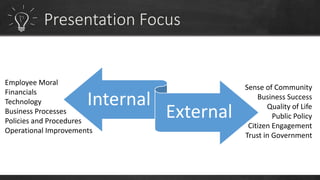
External 
Employee Moral 
Financials 
Technology 
Business Processes 
Policies and Procedures 
Operational Improvements 
Sense of Community 
Business Success 
Quality of Life 
Public Policy 
Citizen Engagement 
Trust in Government
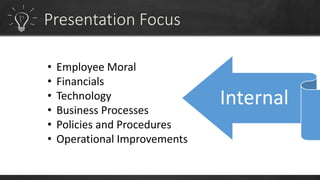
Internal 
• Employee Moral 
• Financials 
• Technology 
• Business Processes 
• Policies and Procedures 
• Operational Improvements
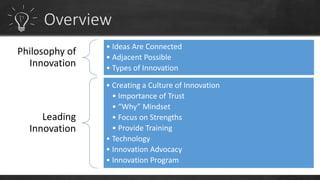
Philosophy of 
Innovation 
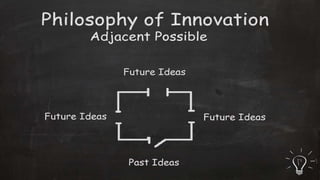
• Ideas Are Connected 
• Adjacent Possible 
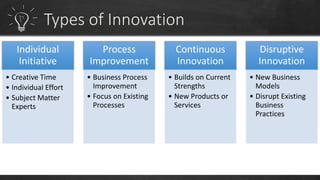
• Types of Innovation 
Leading 
Innovation 
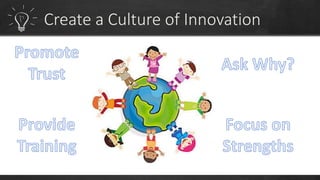
• Creating a Culture of Innovation 
• Importance of Trust 
• “Why” Mindset 
• Focus on Strengths 
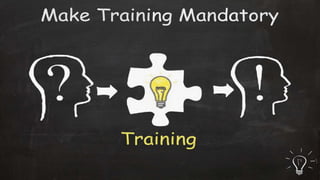
• Provide Training 
• Technology 
• Innovation Advocacy 
• Innovation Program
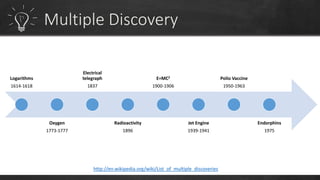
Logarithms 
1614-1618 
Oxygen 
1773-1777 
Electrical 
telegraph 
1837 
Radioactivity 
1896 
E=MC2 
1900-1906 
Jet Engine 
1939-1941 
Polio Vaccine 
1950-1963 
Endorphins 
1975 
http://en.wikipedia.org/wiki/List_of_multiple_discoveries
Individual 
Initiative 
• Creative Time 
• Individual Effort 
• Subject Matter 
Experts 
Process 
Improvement 
• Business Process 
Improvement 
• Focus on Existing 
Processes 
Continuous 
Innovation 
• Builds on Current 
Strengths 
• New Products or 
Services 
Disruptive 
Innovation 
• New Business 
Models 
• Disrupt Existing 
Business 
Practices
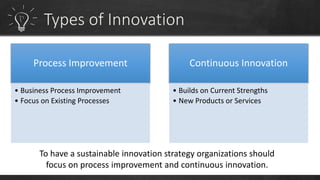
Process Improvement 
• Business Process Improvement 
• Focus on Existing Processes 
Continuous Innovation 
• Builds on Current Strengths 
• New Products or Services 
To have a sustainable innovation strategy organizations should 
focus on process improvement and continuous innovation.
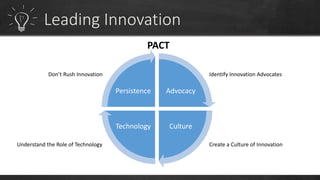
Advocacy 
Persistence 
Technology Culture 
Don’t Rush Innovation 
Understand the Role of Technology 
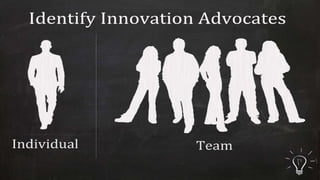
Identify Innovation Advocates 
Create a Culture of Innovation 
PACT
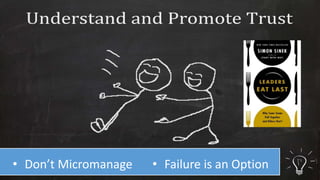
• Don’t Micromanage • Failure is an Option
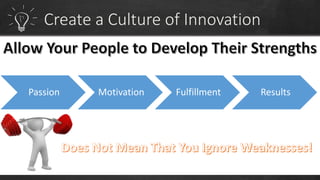
Passion Motivation Fulfillment Results
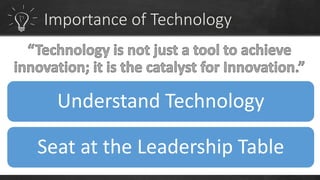
Understand Technology 
Seat at the Leadership Table
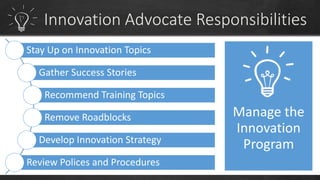
Stay Up on Innovation Topics 
Gather Success Stories 
Recommend Training Topics 
Remove Roadblocks 
Develop Innovation Strategy 
Review Polices and Procedures 
Manage the 
Innovation 
Program
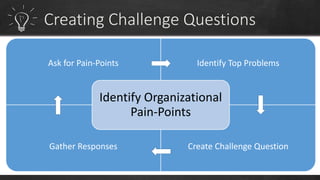
Ask for Pain-Points Identify Top Problems 
Identify Organizational 
Pain-Points 
Gather Responses Create Challenge Question
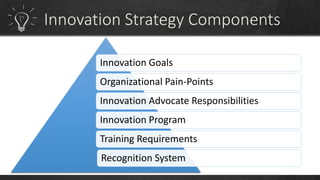
Innovation Goals 
Organizational Pain-Points 
Innovation Advocate Responsibilities 
Innovation Program 
Training Requirements 
Recognition System
Leading Innovation
Leading Innovation

Leading Innovation

  • 4.
    Internal External EmployeeMoral Financials Technology Business Processes Policies and Procedures Operational Improvements Sense of Community Business Success Quality of Life Public Policy Citizen Engagement Trust in Government
  • 5.
    Internal • EmployeeMoral • Financials • Technology • Business Processes • Policies and Procedures • Operational Improvements
  • 6.
    Philosophy of Innovation • Ideas Are Connected • Adjacent Possible • Types of Innovation Leading Innovation • Creating a Culture of Innovation • Importance of Trust • “Why” Mindset • Focus on Strengths • Provide Training • Technology • Innovation Advocacy • Innovation Program
  • 9.
    Logarithms 1614-1618 Oxygen 1773-1777 Electrical telegraph 1837 Radioactivity 1896 E=MC2 1900-1906 Jet Engine 1939-1941 Polio Vaccine 1950-1963 Endorphins 1975 http://en.wikipedia.org/wiki/List_of_multiple_discoveries
  • 10.
    Individual Initiative •Creative Time • Individual Effort • Subject Matter Experts Process Improvement • Business Process Improvement • Focus on Existing Processes Continuous Innovation • Builds on Current Strengths • New Products or Services Disruptive Innovation • New Business Models • Disrupt Existing Business Practices
  • 11.
    Process Improvement •Business Process Improvement • Focus on Existing Processes Continuous Innovation • Builds on Current Strengths • New Products or Services To have a sustainable innovation strategy organizations should focus on process improvement and continuous innovation.
  • 12.
    Advocacy Persistence TechnologyCulture Don’t Rush Innovation Understand the Role of Technology Identify Innovation Advocates Create a Culture of Innovation PACT
  • 14.
    • Don’t Micromanage• Failure is an Option
  • 16.
  • 19.
    Understand Technology Seatat the Leadership Table
  • 21.
    Stay Up onInnovation Topics Gather Success Stories Recommend Training Topics Remove Roadblocks Develop Innovation Strategy Review Polices and Procedures Manage the Innovation Program
  • 22.
    Ask for Pain-PointsIdentify Top Problems Identify Organizational Pain-Points Gather Responses Create Challenge Question
  • 24.
    Innovation Goals OrganizationalPain-Points Innovation Advocate Responsibilities Innovation Program Training Requirements Recognition System

Editor's Notes

  • #3 Fundamental to Leading Sustainable Innovation: If you want to lead sustainable innovation, this idea that innovation is not about big ideas and instead about persistently pursuing small changes is fundamental. This is huge because it looks at creativity through a new organizational wide lens, instead of an individual focus. This means leaders have significant influence into how much innovation takes place within an organization or community. Innovation is about persistence Organizational Focus not Individual Focus Leaders can influence
  • #4 How do we Lead Innovation: Under this definition there is no such thing as too much innovation and therefore, every organization no matter how innovative they currently are, can improve. So as leaders how do we “Lead Innovation”
  • #5 Internal Focus: To set the tone for this presentation, I want to be clear that the focus is on internal innovation. A lot of the concepts apply to external innovation but because of limited time, I chose to focus on internal. I feel that we talk a lot about external and internal innovation is often overlooked.
  • #6 Internal Components: This is what you have control over and typically where innovation will be focused. Employee Moral: Government is a service organization and therefore, people are extremely important. Being creative around how you reward and incentivize your staff is important. Financials: Innovation around finances usually equals some type of fraud. So we are not talking about finances that way but instead using innovation as a tool to decrease finances. Also, it is important to note that financial constraints are a great way to induce innovation. Technology: Technology and innovation often run hand-and-hand. Therefore, understanding what role technology plays in your innovation program is crucial for long term success. Business Processes: Going back to the opening quote. Modifying, adding or removing steps in a business process are typically how we approach sustainable and persistence innovation. Policies and Procedures: Policies and procedures can often inhibit and promote innovation. Looking at your policies and procedures is key to creating a culture of innovation. Operational Improvements: Typically this refers to purchasing new tools where business processes focus on existing resources.
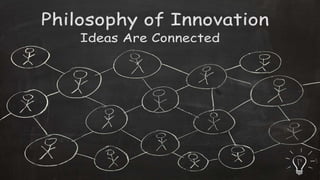
  • #8 Ideas are Connected: Ideas are Fluid and Must Connect to Other Ideas to Develop. More innovation happens in the break room, meeting rooms and the water color than in solitude. Independent Work: Must be able to connect but also be developed in solitude.
  • #9 Adjacent Possible Defined: Ideas are incremental. Room example Explore the Adjacent Possible: Constantly explore new possibilities just beyond the current possibilities. Sustainable Low risk Break Innovation Into Small Chunks Start Slow and Let Innovation Snowball
  • #10 Multiple Discovery Defined: The concept of multiple discovery is the hypothesis that most scientific discoveries and inventions are made independently and more or less simultaneously by multiple scientists and inventors. Logarithms – John Napier (Scotland, 1614) and Joost Bürgi (Switzerland, 1618). Oxygen – Carl Wilhelm Scheele (Uppsala, 1773), Joseph Priestley (Wiltshire, 1774). The term was coined by Antoine Lavoisier (1777). Electrical telegraph – Charles Wheatstone (England), 1837, Samuel F.B. Morse (United States), 1837. Discovery of radioactivity (1896) independently by Henri Becquerel and Silvanus Thompson. E = mc2, though only Einstein provided the accepted interpretation – Henri Poincaré, 1900; Olinto De Pretto, 1903; Albert Einstein, 1905; Paul Langevin, 1906. The jet engine, independently invented by them, was used in working aircraft by Hans von Ohain (1939), Secondo Campini (1940) and Frank Whittle (1941). Polio vaccine (1950–63): Hilary Koprowski, Jonas Salk, Albert Sabin. Endorphins were discovered independently in Scotland and the US in 1975.
  • #11 Different Types of Innovation: Individual Initiative – Individuals submit ideas or have the freedom to spend time focusing on innovation through individual effort. Process Improvement (Introspective and Collective) – Improvement to business process and removing unnecessary processes. Continuous Innovation (Government Needs to Focus on Strengths) – Builds on current strengths by identifying new programs, products and/or services that expand overall value provided. Disruptive Innovation (High-Risk) – The creation of new programs, products or services that did not exist before that aim to disrupt current business practices. Government Focus: We want to focus on the middle two.
  • #12 We want to focus on the middle two: This is where sustainable innovation happens. Disruptive innovation is expensive and high-risk. Individual initiative is not sustainable because if the individual leaves, so does the creativity. *End of Philosophy Section*
  • #13 Create and Innovation Pact: Persistence, Advocacy, Culture and Technology (Not in Order). No Specific Order
  • #14 Overview: Creating a culture of innovation is the biggest component to sustainable innovation and can be broken down into four components.
  • #15 Reading: Leaders Eat Last: Why Some Teams Pull Together and Others Don’t. By Simon Sinek Trust: Trust it the most important aspect of a solid innovation strategy. People have to feel like they are able to do what they feel is right. Micro-management does not have a place in innovation. Fail Faster: Failure should be an option for employees. If we learn to recognize that it is a part of the process we can learn and grow from it, instead of try to cover it up and letting it grow. The goal is to fail faster and recover and learn.
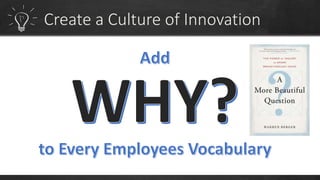
  • #16 Reading: A More Beautiful Question. By Warren Berger Challenges the Status Quo: By encouraging people to ask why we are constantly exploring new possibilities. Asking good, persistent “Why?” questions uncovers root causes below your everyday radar. It will also reveal automatic pilot, busywork and unproductive comfort zones. It may reveal your possibility robbers, or give you the aha! moment which fuels another idea. Creates Dialog: Asking good, persistent “Why?” questions creates higher quality dialog in the workplace because it’s much more inclusive. Constantly challenge people to answer and ask Why? Acknowledge it when people do.
  • #17 Channels Passion Increases Motivation Brings Fulfillment Creates Results Skills are Interconnected Performance Based Job Descriptions – Ask What People Like and what they are good at. How to improve weaknesses Find a way to interconnect passion with weaknesses.
  • #18 Importance of Training: The mort people know, the more innovative they can be. Providing cross training or training in to new areas provides a new perspective. During this process you must have established trust and communication so that trainees can give feedback. *End of Culture (C)*
  • #19 Empower Employees to Innovate: By removing roadblocks it sets up employees with the components to implement an innovation program. Get Out of the Way: Leadership should then get out of the way. You have put in the right components to promote innovation so now you have to let it happen. Do not try to force it or control it, let it just happen. Let innovation become ingrained in your organizational culture. *End of Persistent (P)*
  • #20 Types of Managers Support Technology for the Sake of Technology Does not Support Technology Is Educated on Technology and supports it for the RIGHT reasons Understand Technology: Effective Organizational Leaders make an effort to understand technology and keep up with the latest trends. Seat at the Leadership Table: The executive team must be bought in on the innovation strategy because there will be times where it is easy to except the status quo instead of continue down the innovation path. *End of Technology (T)*
  • #21 Advocacy Overview: Your innovation advocate or innovation team will be the face of your innovation strategy. They will be in charge of implementing your innovation program and tracking the process. Individual: This can be an individual such as a Chief Innovation Officer or even a part-time role for an existing employee that wants to take on the challenge. Team: I prefer a team because it creates some backup and allows for a more balanced approach.
  • #22 Responsibilities: Review submitted ideas Stay up to date on innovation topics Gather Success Stories Recommend Training Remove Roadblocks Develop a Strategy Manage the Innovation Program Review Polices and Procedures Innovation Program: The Innovation Program is a more formal and focused component of your innovation strategy. This gives leadership some opportunity to focus innovation.
  • #23 Identify Organizational Pain-Points: The biggest mistake that many organizations make when implementing an innovation program is that they do not focus their strategy. Just like any other initiative, it needs to be focused. This starts with Identifying Organizational Pain-Points. Ask for Pain-Points Identify Top Problems Create Challenge Question Gather Responses Enable Innovators: It is not the innovations teams responsibility to implement innovation. It is their job to enable it. After you have identified possible solutions you would enable the correct people to implement it.
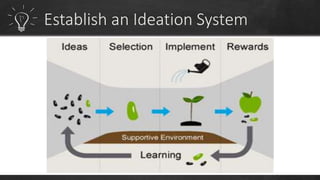
  • #24 Ideation System: Idea gathering and selection process
  • #25 Strategy Overview: Your innovation strategy will formalize many of the components we have discussed so far. Your innovation strategy should include: Innovation Goals Organizational Pain-Points Innovation Advocate Responsibilities Innovation Program Training Requirements Recognition System *End of Advocacy (A)*
  • #26 Tie back to Charles Babbage: Charles Babbage had a big idea but big ideas are not where innovation happens. Innovation takes place at the PACT.