Antiemetics and
Prokinetics
PRAVEEN KUMAR .S
M.PHARM 2ND SEMESTER.
DEPARTMENT OF PHARMACOLOGY
PSG COLLEGE OF PHARMACY
1
CONTENTS
 Physiology of vomiting
 Stimuli pathways and centres mediating emetic
reflex.
 Antiemetics
 Classification of antiemetics drugs
 Prokinetics
 Mechanism of action
 Diarrhoea .
2
Physiology of vomiting
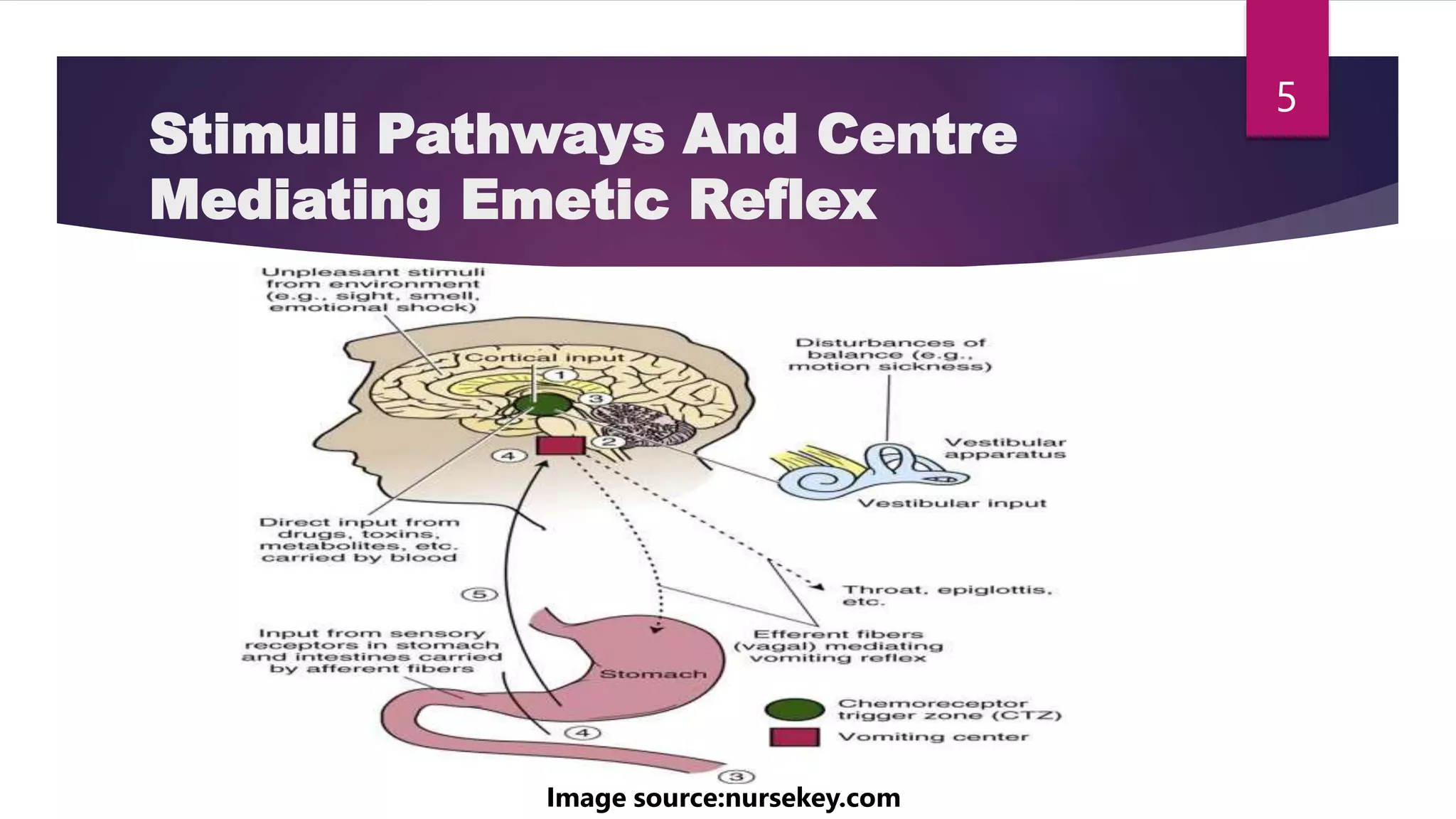
 stimulation of vomiting centre in the medulla oblongata
results in vomiting.
 Vomiting centre receives afferent from chemoreceptor
trigger zone(CTZ), vestibular apparatus ,GI tract and higher
centres in brain.
 CTZ is not protected by blood brain barrier and is
stimulated by various drugs,chemicals and radiation
3
4
• Cytotoxic drugs/radiation
• Damage cells,irritate the gut mucosa
• Release mediators from gut mucosa
• Activation of vagal affarents in the gut
• Emetogenic impulses to NTS ,CTZ
• Stimulate emetic centre
• Vomiting.
Stimuli Pathways And Centre
Mediating Emetic Reflex
5
Image source:nursekey.com
Antiemetics
 Antiemetics are the drugs used in the prevention and
treatment of vomiting .
 Vomiting is protective mechanism aimed at eliminating
unwanted harmful material from stomach.
 But in some situation vomiting ,may not serve any useful
purpose and may only troublesome .
 It can cause dehydration ,weakness,and electrolyte
imbalance.In such conditions,vomiting needs to suppressed with
drugs .
6
Classification
7
1.Dopamine D2 antagonists
Metaclopromide,domperidone,
trimethobenzamide
2.5-HT3 antagonists
Ondansetron,granisetron,dolasetron,
tropisetron, palanosetron
3. Antimuscarinics
Hyoscine,promethazine,cyclizine,
Diphenhydramine.
4. Neuroleptics
Chlorpromazine,prochlorperazine,
Haloperidol
5. Neurokinin receptor antagonists
Aprepitant,fosaprepitant
6. Other agents
Glucocorticoids,cannabinoids- dronabinol,
nabilone
Dopamine D2 Antagonist
 Metoclopromide and domeperidone act centrally by blocking dopamine
D2 receptor in CTZ and there by prevent vomiting .
 Metoclopromide acts in the GIT as well as CNS.
GIT:
 It has more prominent effect on upper g.i .tract. ;increase the gastric
peristalsis while relaxing the pylorus and first part of duodenum.and
speed up the gastric emptying.
CNS:
 Is an effective antiemetic,acting onn CTZ blocks to prevent vomiting.
 TRIMETHOBENZAMIDE has antihistaminic activity in addition to
dopamine blockade.
8
5 HT3 Antagonists
Ondansetran :
 5-hydroxytryptamine released in the gut is important inducer of emesis
and nerve endings including vagal afferents in the gut aree rich 5HT3
receptors
 In anticancer drugs ,radiation therapy and infection of the
gastrointestinal mucosa induce release of 5HT in gut which initiates emetic
reflex through 5HT3 receptor present in gut ,nucleus tractus solitarius(NTS)
and area of postrema in the brain.
 Ondansetron blocks 5-HT3 receptors in gi tract ,CTZ and nucleus tractus
solitarius and prevents vomiting.
9
Pharmacokinetics:
Are well absorbed from the gut .and metabolized by liver by
microsomal enzymes and are excreted by kidneys and partly through the
gut .
Adverse effects :
 headache
 constipation
 abdominal discomfort and rashes.
 Dolasetron may prolong QT interval and should avoided in patients
with prolonged QT interval.
10
Antimuscarinics
Hyosine – Anticholinergic drug.
 Is a labyrinthine sedative very effective in motion
sickness.
 Motion sickness or travelling sickness due to over
stimulation of vestibular apparatus along with psychological and
environmental factor Hyosine also relax gastro intestinal smooth
muscle .
 Taken 30 minutes before journey (0.4-0.6mg oral)acts for
six hours and dose should repeated ,if journey is longer than that.
 a transdermal patch delivers hyoscine constantly over 3
days and its applied behind the ear.
11
Dicyclomine
 Is used to control vomiting in morning sickness and motion
Sickness.
 Orally in the dose of 10-20 mg.
12
H1 antihistamines
 Like promethazine, diphenhydramine, doxylamine,
cyclizine and cinnerazine have anticholinergic properties.
 Antihistamines block H1 receptor in the area of postrema
as well as muscarinic receptor in the CNS.
 Probably also act on GI tract.
 They are useful in motion sickness and postoperative
vomiting.
13
Promethazine,
Diphenhydramine,Dimenhydrinate
 These drugs afford protection from motion sickness for 4-6hrs,but
produce sedation and dryness of mouth.
 Central anticholinergic action they block the extrapyrimidal side-
effects of metaclopromide while supplementing its antiemetic action.
 Combination of these antihistamines with other antiemetics has been
used in CINV.
14
Doxylamine
 It is a sedative H1 antihistaminic with prominent anticholinergic
activity.
 Marketed In combination with pyridoxine,it is specifically promoted in
india for “morning sickness”(vomiting of early pregnancy)
 Oral absorption of doxylamine is slow and t1/2 is 10 hr.
Side effects:
 Drowsiness, dry mouth
 Vertigo
 Abdominal upset.
15
16
 Motion sickness
 Antiemetics with anticholinergic-
antihistaminic property are the with
first choice drugs for motion sickness.
 Antidopa minergic and anti-HT, drugs
are less effective.
 All antimotion sickness drugs act
better when taken ½-1 hour before
commencing journey.
 Morning sickness
 The antihistaminics are suspected
to have teratogenic potential, but
there is no conclusive proof.
 Most cases of morning sickness
can be man aged by reassurance
and dietary adjustment.
Neuroleptics
 Neuroleptics also block D2 receptors in the CTZ and are useful in vomiting
Causes except motion sickness.
 Prochlorperazineis mainly used in vomiting and also effective in vertigo
associated with vomiting.
They have broad spectrum antiemetic action effective in:
(a) Drug induced and postoperative naus vomiting (PONV)
(b) Disease induced vomiting: gastroenteritis,uraemia, liver disease, migraine,
etc.
(C) Malignancy associated and cancer chemote rapy (mildly emetogenic) induced
vomiting
(d) Radiation sickness vomiting (less effective)
(e )Morning sickness: should not be used exceps in hyperemesis gravidarum.
17
Other Antiemetics
1. Glucocorticoids (dexamethasone)
2. Pyridoxine (vitamin B6)
3. Cannabinoids-dronabinol, nabilone
4. Sedative and hypnotics- barbiturates and benzodiazepine
5. Propofol
Antiemetic combinations
Severe retching and vomiting like that induced by anticancer drugs are treated
with combination of antiemetics including ondansetron, metoclopramide,
glucocorticoids and sedative-Hypnotics.
18
Prokinetic agents
 Drugs that enhance gastroduodenal motility and hasten gastric emptying are called
prokinetic agents.
Prokinetics
1. Dopamine D2 antagonists
 Metaclopromide, domperidone.
2. Others
 Cisapride,mosapride,itopride
 Cholinomimetics- bethanechol
 Anticholinesterases-neostigmine
3. Motilin receptor agonists – erythromycin.
19
Mechanism of action Of prokinetic
drugs
20
Image source: pharmacy 180.com
Actions
 GIT:
Metaclopromide promotes forward movement of contents of the upper GI
tract-increase esophagal and gastric peristalsis.
It raises lower oesophagal pressure speed up gastric emptying and prevent
s the reflux of stomach content into oesophagus.
Prokinetics no significant effects on motility of small intestine and colon.
 CNS:
Act as an antiemetic by blocking the D2receptors on CTZ,the effect on gut
speeding up the gastric emptying.
21
Uses
1. Gastr-oesophageal reflux disease( GERD)
2. Antiemetic in postoperative period of anticancer drugs.
3. Preanaesthetic medication
4. Delayed gastric emptying.
Adverse effects:
 Sedation, restlessness
 Anxiety,diarrhoea
 Gynaecomastia and extrapyrimidal symptoms with dystonia
 Tardive Dyskinesia
22
 Cisapride
Enhances gastric motility by promoting the release of
acetylcholine in the gut wall.
It is now banned because it can cause cardiac arrhythmias.
 Mosapride and renzapride
Simliar to cisapride but do not produce cardiac
arrhythmias and do not prolong QT interval hence preferred.
23
Cholinomimetic drugs
 Like bethanechol, enhance gastrointestinal motility by activating M3muscarnic
receptor in the gut.
 Earlier used in gastroparesis but not preferred due to Cholinergic side effects.
 Neostigmine enhances gastrointestinal motility.
 Is used in dose of 2mg IV in acute colonic pseudoobstruction (ogilvie’s
syndrome) to empty the colon.
24
Motilin receptor Agonists
 Motilin is a peptide hormone which promotes motility in the upper
gastrointestinal tract.
 Erythromycin is a motilin receptor agonist and promotes gastric
and intestinal motility.
 It has been tried in diabetic gastroparesis and in decreased
small bowel motility.
25
References
 Medical pharmacology by padmaja udaykumar Fifth edition. Pg.no
410-416.
 Essentials of medical pharmacology kd Tripathi 8th
edition.pg.no.710-719
26
27
Thank you

Anti emetics PowerPoint Presentation.pptx

  • 1.
    Antiemetics and Prokinetics PRAVEEN KUMAR.S M.PHARM 2ND SEMESTER. DEPARTMENT OF PHARMACOLOGY PSG COLLEGE OF PHARMACY 1
  • 2.
    CONTENTS  Physiology ofvomiting  Stimuli pathways and centres mediating emetic reflex.  Antiemetics  Classification of antiemetics drugs  Prokinetics  Mechanism of action  Diarrhoea . 2
  • 3.
    Physiology of vomiting stimulation of vomiting centre in the medulla oblongata results in vomiting.  Vomiting centre receives afferent from chemoreceptor trigger zone(CTZ), vestibular apparatus ,GI tract and higher centres in brain.  CTZ is not protected by blood brain barrier and is stimulated by various drugs,chemicals and radiation 3
  • 4.
    4 • Cytotoxic drugs/radiation •Damage cells,irritate the gut mucosa • Release mediators from gut mucosa • Activation of vagal affarents in the gut • Emetogenic impulses to NTS ,CTZ • Stimulate emetic centre • Vomiting.
  • 5.
    Stimuli Pathways AndCentre Mediating Emetic Reflex 5 Image source:nursekey.com
  • 6.
    Antiemetics  Antiemetics arethe drugs used in the prevention and treatment of vomiting .  Vomiting is protective mechanism aimed at eliminating unwanted harmful material from stomach.  But in some situation vomiting ,may not serve any useful purpose and may only troublesome .  It can cause dehydration ,weakness,and electrolyte imbalance.In such conditions,vomiting needs to suppressed with drugs . 6
  • 7.
    Classification 7 1.Dopamine D2 antagonists Metaclopromide,domperidone, trimethobenzamide 2.5-HT3antagonists Ondansetron,granisetron,dolasetron, tropisetron, palanosetron 3. Antimuscarinics Hyoscine,promethazine,cyclizine, Diphenhydramine. 4. Neuroleptics Chlorpromazine,prochlorperazine, Haloperidol 5. Neurokinin receptor antagonists Aprepitant,fosaprepitant 6. Other agents Glucocorticoids,cannabinoids- dronabinol, nabilone
  • 8.
    Dopamine D2 Antagonist Metoclopromide and domeperidone act centrally by blocking dopamine D2 receptor in CTZ and there by prevent vomiting .  Metoclopromide acts in the GIT as well as CNS. GIT:  It has more prominent effect on upper g.i .tract. ;increase the gastric peristalsis while relaxing the pylorus and first part of duodenum.and speed up the gastric emptying. CNS:  Is an effective antiemetic,acting onn CTZ blocks to prevent vomiting.  TRIMETHOBENZAMIDE has antihistaminic activity in addition to dopamine blockade. 8
  • 9.
    5 HT3 Antagonists Ondansetran:  5-hydroxytryptamine released in the gut is important inducer of emesis and nerve endings including vagal afferents in the gut aree rich 5HT3 receptors  In anticancer drugs ,radiation therapy and infection of the gastrointestinal mucosa induce release of 5HT in gut which initiates emetic reflex through 5HT3 receptor present in gut ,nucleus tractus solitarius(NTS) and area of postrema in the brain.  Ondansetron blocks 5-HT3 receptors in gi tract ,CTZ and nucleus tractus solitarius and prevents vomiting. 9
  • 10.
    Pharmacokinetics: Are well absorbedfrom the gut .and metabolized by liver by microsomal enzymes and are excreted by kidneys and partly through the gut . Adverse effects :  headache  constipation  abdominal discomfort and rashes.  Dolasetron may prolong QT interval and should avoided in patients with prolonged QT interval. 10
  • 11.
    Antimuscarinics Hyosine – Anticholinergicdrug.  Is a labyrinthine sedative very effective in motion sickness.  Motion sickness or travelling sickness due to over stimulation of vestibular apparatus along with psychological and environmental factor Hyosine also relax gastro intestinal smooth muscle .  Taken 30 minutes before journey (0.4-0.6mg oral)acts for six hours and dose should repeated ,if journey is longer than that.  a transdermal patch delivers hyoscine constantly over 3 days and its applied behind the ear. 11
  • 12.
    Dicyclomine  Is usedto control vomiting in morning sickness and motion Sickness.  Orally in the dose of 10-20 mg. 12
  • 13.
    H1 antihistamines  Likepromethazine, diphenhydramine, doxylamine, cyclizine and cinnerazine have anticholinergic properties.  Antihistamines block H1 receptor in the area of postrema as well as muscarinic receptor in the CNS.  Probably also act on GI tract.  They are useful in motion sickness and postoperative vomiting. 13
  • 14.
    Promethazine, Diphenhydramine,Dimenhydrinate  These drugsafford protection from motion sickness for 4-6hrs,but produce sedation and dryness of mouth.  Central anticholinergic action they block the extrapyrimidal side- effects of metaclopromide while supplementing its antiemetic action.  Combination of these antihistamines with other antiemetics has been used in CINV. 14
  • 15.
    Doxylamine  It isa sedative H1 antihistaminic with prominent anticholinergic activity.  Marketed In combination with pyridoxine,it is specifically promoted in india for “morning sickness”(vomiting of early pregnancy)  Oral absorption of doxylamine is slow and t1/2 is 10 hr. Side effects:  Drowsiness, dry mouth  Vertigo  Abdominal upset. 15
  • 16.
    16  Motion sickness Antiemetics with anticholinergic- antihistaminic property are the with first choice drugs for motion sickness.  Antidopa minergic and anti-HT, drugs are less effective.  All antimotion sickness drugs act better when taken ½-1 hour before commencing journey.  Morning sickness  The antihistaminics are suspected to have teratogenic potential, but there is no conclusive proof.  Most cases of morning sickness can be man aged by reassurance and dietary adjustment.
  • 17.
    Neuroleptics  Neuroleptics alsoblock D2 receptors in the CTZ and are useful in vomiting Causes except motion sickness.  Prochlorperazineis mainly used in vomiting and also effective in vertigo associated with vomiting. They have broad spectrum antiemetic action effective in: (a) Drug induced and postoperative naus vomiting (PONV) (b) Disease induced vomiting: gastroenteritis,uraemia, liver disease, migraine, etc. (C) Malignancy associated and cancer chemote rapy (mildly emetogenic) induced vomiting (d) Radiation sickness vomiting (less effective) (e )Morning sickness: should not be used exceps in hyperemesis gravidarum. 17
  • 18.
    Other Antiemetics 1. Glucocorticoids(dexamethasone) 2. Pyridoxine (vitamin B6) 3. Cannabinoids-dronabinol, nabilone 4. Sedative and hypnotics- barbiturates and benzodiazepine 5. Propofol Antiemetic combinations Severe retching and vomiting like that induced by anticancer drugs are treated with combination of antiemetics including ondansetron, metoclopramide, glucocorticoids and sedative-Hypnotics. 18
  • 19.
    Prokinetic agents  Drugsthat enhance gastroduodenal motility and hasten gastric emptying are called prokinetic agents. Prokinetics 1. Dopamine D2 antagonists  Metaclopromide, domperidone. 2. Others  Cisapride,mosapride,itopride  Cholinomimetics- bethanechol  Anticholinesterases-neostigmine 3. Motilin receptor agonists – erythromycin. 19
  • 20.
    Mechanism of actionOf prokinetic drugs 20 Image source: pharmacy 180.com
  • 21.
    Actions  GIT: Metaclopromide promotesforward movement of contents of the upper GI tract-increase esophagal and gastric peristalsis. It raises lower oesophagal pressure speed up gastric emptying and prevent s the reflux of stomach content into oesophagus. Prokinetics no significant effects on motility of small intestine and colon.  CNS: Act as an antiemetic by blocking the D2receptors on CTZ,the effect on gut speeding up the gastric emptying. 21
  • 22.
    Uses 1. Gastr-oesophageal refluxdisease( GERD) 2. Antiemetic in postoperative period of anticancer drugs. 3. Preanaesthetic medication 4. Delayed gastric emptying. Adverse effects:  Sedation, restlessness  Anxiety,diarrhoea  Gynaecomastia and extrapyrimidal symptoms with dystonia  Tardive Dyskinesia 22
  • 23.
     Cisapride Enhances gastricmotility by promoting the release of acetylcholine in the gut wall. It is now banned because it can cause cardiac arrhythmias.  Mosapride and renzapride Simliar to cisapride but do not produce cardiac arrhythmias and do not prolong QT interval hence preferred. 23
  • 24.
    Cholinomimetic drugs  Likebethanechol, enhance gastrointestinal motility by activating M3muscarnic receptor in the gut.  Earlier used in gastroparesis but not preferred due to Cholinergic side effects.  Neostigmine enhances gastrointestinal motility.  Is used in dose of 2mg IV in acute colonic pseudoobstruction (ogilvie’s syndrome) to empty the colon. 24
  • 25.
    Motilin receptor Agonists Motilin is a peptide hormone which promotes motility in the upper gastrointestinal tract.  Erythromycin is a motilin receptor agonist and promotes gastric and intestinal motility.  It has been tried in diabetic gastroparesis and in decreased small bowel motility. 25
  • 26.
    References  Medical pharmacologyby padmaja udaykumar Fifth edition. Pg.no 410-416.  Essentials of medical pharmacology kd Tripathi 8th edition.pg.no.710-719 26
  • 27.