Solubility
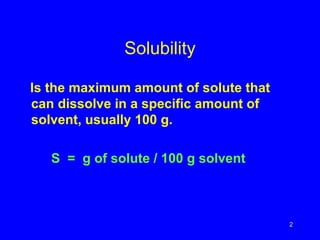
Solubility Is the maximum amount of solute that can dissolve in a specific amount of solvent, usually 100 g. S  =  g of solute / 100 g solvent
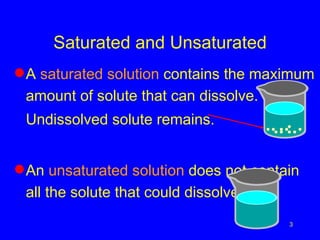
Saturated and Unsaturated A  saturated solution  contains the maximum amount of solute that can dissolve. Undissolved solute remains. An  unsaturated solution  does not contain all the solute that could dissolve
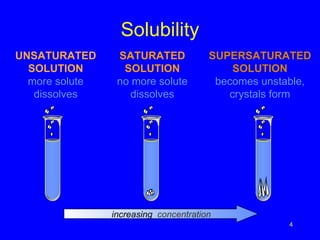
Solubility increasing  concentration SATURATED SOLUTION no more solute dissolves UNSATURATED SOLUTION more solute dissolves SUPERSATURATED SOLUTION becomes unstable, crystals form
Learning Check S1 At 40  C, the solubility of KBr is 80 g/100 g H 2 O.  Indicate if the following solutions are  (1) saturated or (2) unsaturated A.  __ 60 g KBr in 100 g of water at 40  C B.  __ 200 g KBr in 200 g of water at 40  C C.  __ 25 KBr in 50 g of water at 40  C
Solution S1 At 40  C, the solubility of KBr is 80 g/100 g H 2 O.  Indicate if the following solutions are (1) saturated or (2) unsaturated A.  2  Less than 80 g/100 g H 2 O B.  1  Same as 100 g KBr in 100 g of water at 40  C,  which is greater than its solubility C.  2  Same as 50 g KBr in 100 g of water,   which is less than its solubility
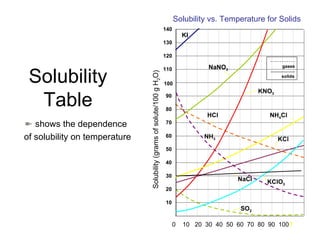
Solubility Table 0  10  20  30  40  50  60  70  80  90  100 Solubility vs. Temperature for Solids Solubility (grams of solute/100 g H 2 O) KI KCl 20 10 30 40 50 60 70 80 90 110 120 130 140 100 NaNO 3 KNO 3 HCl NH 4 Cl NH 3 NaCl KClO 3 SO 2 shows the dependence  of solubility on temperature gases solids
Temperature and Solubility of Solids Temperature Solubility  (g/100 g H 2 O)  KCl(s) NaNO 3 (s) 0° 27.6   74 20°C 34.0   88 50°C 42.6 114 100°C  57.6 182 The solubility of most solids ( decreases or increases  ) with an increase in the  temperature.
Temperature and Solubility of Solids Temperature Solubility  (g/100 g H 2 O)  KCl(s) NaNO 3 (s) 0° 27.6   74 20°C 34.0   88 50°C 42.6 114 100°C  57.6 182 The solubility of most solids  increases  with an increase in the  temperature.
Temperature and Solubility of Gases Temperature Solubility (g/100 g H 2 O)  CO 2 (g) O 2 (g)   0°C 0.34 0.0070 20°C 0.17 0.0043 50°C 0.076 0.0026 The solubility of gases  (decreases or increases)  with an increase in temperature.
Temperature and Solubility of Gases Temperature Solubility (g/100 g H 2 O)  CO 2 (g) O 2 (g)   0°C 0.34 0.0070 20°C 0.17 0.0043 50°C 0.076 0.0026 The solubility of gases  decreases  with an increase in temperature.
Learning Check S2 A. Why would a bottle of carbonated drink possibly burst (explode) when it is left out in the hot sun ? B.   Why would fish die in water that gets too warm?
Solution S2 A.  Gas in the bottle builds up as the gas becomes less soluble in water at high temperatures, which may cause the bottle to explode. B. Because O 2  gas is less soluble in warm water, the fish may not obtain the needed amount of O 2  for their survival.

Solubility for 3rd bilingual

  • 1.
  • 2.
    Solubility Is themaximum amount of solute that can dissolve in a specific amount of solvent, usually 100 g. S = g of solute / 100 g solvent
  • 3.
    Saturated and UnsaturatedA saturated solution contains the maximum amount of solute that can dissolve. Undissolved solute remains. An unsaturated solution does not contain all the solute that could dissolve
  • 4.
    Solubility increasing concentration SATURATED SOLUTION no more solute dissolves UNSATURATED SOLUTION more solute dissolves SUPERSATURATED SOLUTION becomes unstable, crystals form
  • 5.
    Learning Check S1At 40  C, the solubility of KBr is 80 g/100 g H 2 O. Indicate if the following solutions are (1) saturated or (2) unsaturated A. __ 60 g KBr in 100 g of water at 40  C B. __ 200 g KBr in 200 g of water at 40  C C. __ 25 KBr in 50 g of water at 40  C
  • 6.
    Solution S1 At40  C, the solubility of KBr is 80 g/100 g H 2 O. Indicate if the following solutions are (1) saturated or (2) unsaturated A. 2 Less than 80 g/100 g H 2 O B. 1 Same as 100 g KBr in 100 g of water at 40  C, which is greater than its solubility C. 2 Same as 50 g KBr in 100 g of water, which is less than its solubility
  • 7.
    Solubility Table 0 10 20 30 40 50 60 70 80 90 100 Solubility vs. Temperature for Solids Solubility (grams of solute/100 g H 2 O) KI KCl 20 10 30 40 50 60 70 80 90 110 120 130 140 100 NaNO 3 KNO 3 HCl NH 4 Cl NH 3 NaCl KClO 3 SO 2 shows the dependence of solubility on temperature gases solids
  • 8.
    Temperature and Solubilityof Solids Temperature Solubility (g/100 g H 2 O) KCl(s) NaNO 3 (s) 0° 27.6 74 20°C 34.0 88 50°C 42.6 114 100°C 57.6 182 The solubility of most solids ( decreases or increases ) with an increase in the temperature.
  • 9.
    Temperature and Solubilityof Solids Temperature Solubility (g/100 g H 2 O) KCl(s) NaNO 3 (s) 0° 27.6 74 20°C 34.0 88 50°C 42.6 114 100°C 57.6 182 The solubility of most solids increases with an increase in the temperature.
  • 10.
    Temperature and Solubilityof Gases Temperature Solubility (g/100 g H 2 O) CO 2 (g) O 2 (g) 0°C 0.34 0.0070 20°C 0.17 0.0043 50°C 0.076 0.0026 The solubility of gases (decreases or increases) with an increase in temperature.
  • 11.
    Temperature and Solubilityof Gases Temperature Solubility (g/100 g H 2 O) CO 2 (g) O 2 (g) 0°C 0.34 0.0070 20°C 0.17 0.0043 50°C 0.076 0.0026 The solubility of gases decreases with an increase in temperature.
  • 12.
    Learning Check S2A. Why would a bottle of carbonated drink possibly burst (explode) when it is left out in the hot sun ? B. Why would fish die in water that gets too warm?
  • 13.
    Solution S2 A. Gas in the bottle builds up as the gas becomes less soluble in water at high temperatures, which may cause the bottle to explode. B. Because O 2 gas is less soluble in warm water, the fish may not obtain the needed amount of O 2 for their survival.

Editor's Notes

  • #8 “ Solubility Curves for Selected Solutes”   Description : This slide is a graph of solubility curves for 10 solutes. It shows the number of grams of solute that will dissolve in 100 grams of water over a temperature range of 0 c C to 10 c C.   Basic Concepts The maximum amount of solute that will dissolve at a given temperature in 100 grams of water is given by the solubility curve for that substance. When the temperature of a saturated solution decreases, a precipitate forms. Most solids become more soluble in water as temperature increases, whereas gases become less soluble as temperature increases.   Teaching Suggestions Use this slide to teach students how to use solubility curves to determine the solubilities of various substances at different temperatures. Direct their attention to the dashed lines; these can be used to find the solubility of KClO 3 at 50 c C (about 21 g per 100 g of H 2 O). Make sure students understand that a point on a solubility curve represents the maximum quantity of a particular solute that can be dissolved in a specified quantity of solvent or solution at a particular temperature. Point out that the solubility curve for a particular solute does not depend on whether other solutes also are present in the solution (unless there is a common-ion effect; this subject usually is covered at a later stage in a chemistry course).   Questions Determine the solubilities (in water) of the following substance at the indicated temperatures: NH 3 at 50 o C; KCl at 90 o C; and NaNO 3 at 0 o C. Which of the substances shown on the graph is most soluble in water at 20 o C? Which is lease soluble at that temperature? For which substance is the solubility lease affected by changes in temperature? Why do you think solubilities are only shown between 0 o C and 100 o C? In a flask, you heat a mixture of 120 grams of KClO 3 and 300 grams of water until all of the KClO 3 has just been dissolved. At what temperature does this occur? You then allow the flask to cool. When you examine it later, the temperature is 64 o C and you notice a white powder in the solution. What has happened? What is the mass of the white powder? Compare the solubility curves for the gases HCl, NH 3 , and SO 2 ) with the solubility curves for the solid solutes. What generalizations(s) can you make about the relationship between solubility and temperature? According to an article in an engineering journal, there is a salt whose solubility in water increases as the water temperature increases from 0 o C to 65 o C. The salt’s solubility then decreases at temperatures above 65 o C, the article states. In your opinion, is such a salt likely to exist? Explain your answer. What could you do to verify the claims of the article?