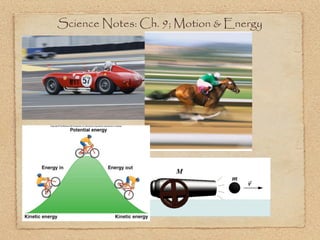
Science Notes: Ch. 9; Motion & Energy
Position & Motion
An object’s position is defined by a reference
point and a reference direction.
A reference point is something used for
comparison to determine if an object is in
motion.
An object is in motion If the object changes
position relative to a reference point.
Reference Point
Distance
Distance is the length of a path between two
points.
Displacement
Displacement is the length and direction an
object has moved from its starting point.
Don’t confuse distance with Displacement.
Speed
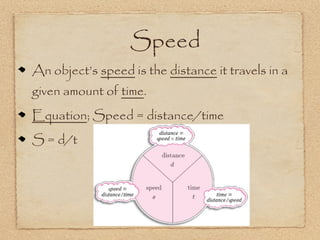
An object’s speed is the distance it travels in a
given amount of time.
Equation; Speed = distance/time
S = d/t
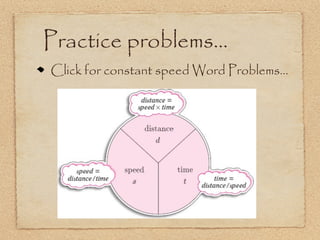
Practice problems...
Click for constant speed Word Problems...
Average speed Equation
In most real-world situations, speed is not constant but
changes, requiring several calculations.
Average speed = Total distance/Total time.
Average S = total d/total t
Sa = Dt /Tt
Dt = 32km + 13km = 45km
T t = 2hr + 1hr = 3hr
Sa = 45km/3hr, = 15km/hr
Instantaneous Speed
The speed at which an object is moving at a
particular point in time.
Graphing speed
Constant speeda...   Increasing speeda...
Slope...
The slope of a d vs. t (d-t) graph is the rise over
the run (y over x). Active art Here
The slope of a d-t graph represents the speed.
Graphing speed, cont...
Reducing speeda   Final speeda
More d-t graphs...
Which graphs are impossible?
Vectors
A Vector is a quantity that has both a
magnitude and a direction. Example: 45
mph Northwest.
Velocity
Velocity and speed are different!
Velocity is speed in a given direction.
IMPORTANT; Changes in velocity may be
due to change in speed, change in direction, or
both!!
Velocity equation
Velocity is change in speed or direction so...
Initial speed minus final speed...
V = S1 - S 2    = meters/sec = change in m/s.
If S1 - S2 is positive its speeding up.
If S1 - S2 is negative its slowing down.
A velocity always has a direction with it:
“3m/s in a N-W direction”
D-T graphs, slope, & velocity...
Acceleration...
Change in speed or direction is called acceleration.
Increase in speed is acceleration, decrease in speed is
deceleration.
***An object can still be accelerating even if its speed
is constant if it changes direction. For example the
seats in a Ferris wheel are accelerating even though
the speed may be constant because they are moving in
Here’s what acceleration looks like...
Acceleration equation...

So... acceleration is change in velocity per unit of
time. Here’s the formula...
A = V1 - V 2    = meters/sec = m/s      2


   T 1 - T2          sec
V1 is the initial velocity and V2 is the final.
and...
Acceleration equation...

T1 - T2 is the total elapsed time...
T1 - T2 is always positive (can’t go back in time
if V1 - V2 is positive the object is accelerating
if V1 - V2 is negative the object is decelerating.
(note this is not how the book presents it...
Graphing Acceleration
If there is a curved line on a d-t graph the object
is either accelerating or decelerating.
Smile = accelerating
Frown = decelerating
This is acceleration on a d-t graph

Smile up = accelerating, smile down
decelerating.
This is acceleration
Graphing Acceleration on a v-t graph

A sloped line (either positive or negative) on a v-t
graph represents acceleration.
Equation for graphing acceleration on a V-T graph...


Only sloped portion is accelerating
V-T versus D-T graphs
D-T Graph...          V-T Graph...


slope = velocity   Straight slope = accel.
Speed vs. time graph...
On an s-t graph, acceleration is always present
when there is a sloped line (the graph below shows
constant acceleration not deceleration).
Acceleration is also...
Related to mass and force (Einstein)(Ch. 10)
Force equals mass X acceleration:
F = (m)X(a)
So... Acceleration equals Force/Mass:
A = (f)/(m)

Keynote; ch. 9; speed & accelerations

  • 1.
    Science Notes: Ch.9; Motion & Energy
  • 2.
    Science Notes: Ch.9; Motion & Energy
  • 3.
    Position & Motion Anobject’s position is defined by a reference point and a reference direction. A reference point is something used for comparison to determine if an object is in motion. An object is in motion If the object changes position relative to a reference point.
  • 4.
  • 5.
    Distance Distance is thelength of a path between two points.
  • 6.
    Displacement Displacement is thelength and direction an object has moved from its starting point. Don’t confuse distance with Displacement.
  • 7.
    Speed An object’s speedis the distance it travels in a given amount of time. Equation; Speed = distance/time S = d/t
  • 8.
    Practice problems... Click forconstant speed Word Problems...
  • 9.
    Average speed Equation Inmost real-world situations, speed is not constant but changes, requiring several calculations. Average speed = Total distance/Total time. Average S = total d/total t Sa = Dt /Tt Dt = 32km + 13km = 45km T t = 2hr + 1hr = 3hr Sa = 45km/3hr, = 15km/hr
  • 10.
    Instantaneous Speed The speedat which an object is moving at a particular point in time.
  • 11.
    Graphing speed Constant speeda... Increasing speeda...
  • 12.
    Slope... The slope ofa d vs. t (d-t) graph is the rise over the run (y over x). Active art Here The slope of a d-t graph represents the speed.
  • 13.
  • 14.
  • 15.
    Which graphs areimpossible?
  • 16.
    Vectors A Vector isa quantity that has both a magnitude and a direction. Example: 45 mph Northwest.
  • 17.
    Velocity Velocity and speedare different! Velocity is speed in a given direction. IMPORTANT; Changes in velocity may be due to change in speed, change in direction, or both!!
  • 18.
    Velocity equation Velocity ischange in speed or direction so... Initial speed minus final speed... V = S1 - S 2 = meters/sec = change in m/s. If S1 - S2 is positive its speeding up. If S1 - S2 is negative its slowing down. A velocity always has a direction with it: “3m/s in a N-W direction”
  • 19.
    D-T graphs, slope,& velocity...
  • 20.
    Acceleration... Change in speedor direction is called acceleration. Increase in speed is acceleration, decrease in speed is deceleration. ***An object can still be accelerating even if its speed is constant if it changes direction. For example the seats in a Ferris wheel are accelerating even though the speed may be constant because they are moving in
  • 21.
  • 22.
    Acceleration equation... So... accelerationis change in velocity per unit of time. Here’s the formula... A = V1 - V 2 = meters/sec = m/s 2 T 1 - T2 sec V1 is the initial velocity and V2 is the final. and...
  • 23.
    Acceleration equation... T1 -T2 is the total elapsed time... T1 - T2 is always positive (can’t go back in time if V1 - V2 is positive the object is accelerating if V1 - V2 is negative the object is decelerating. (note this is not how the book presents it...
  • 24.
    Graphing Acceleration If thereis a curved line on a d-t graph the object is either accelerating or decelerating. Smile = accelerating Frown = decelerating
  • 25.
    This is accelerationon a d-t graph Smile up = accelerating, smile down decelerating.
  • 26.
  • 27.
    Graphing Acceleration ona v-t graph A sloped line (either positive or negative) on a v-t graph represents acceleration.
  • 28.
    Equation for graphingacceleration on a V-T graph... Only sloped portion is accelerating
  • 29.
    V-T versus D-Tgraphs D-T Graph... V-T Graph... slope = velocity Straight slope = accel.
  • 30.
    Speed vs. timegraph... On an s-t graph, acceleration is always present when there is a sloped line (the graph below shows constant acceleration not deceleration).
  • 31.
    Acceleration is also... Relatedto mass and force (Einstein)(Ch. 10) Force equals mass X acceleration: F = (m)X(a) So... Acceleration equals Force/Mass: A = (f)/(m)