© ABCC Australia 2015 www.new-physics.com
LAWS OF MOTION
Newton’s
© ABCC Australia 2015 www.new-physics.com
On the Shoulder of Giants
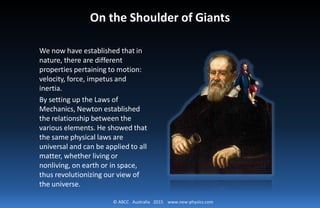
We now have established that in
nature, there are different
properties pertaining to motion:
velocity, force, impetus and
inertia.
By setting up the Laws of
Mechanics, Newton established
the relationship between the
various elements. He showed that
the same physical laws are
universal and can be applied to all
matter, whether living or
nonliving, on earth or in space,
thus revolutionizing our view of
the universe.
© ABCC Australia 2015 www.new-physics.com
Newton’s ‘Three Laws’
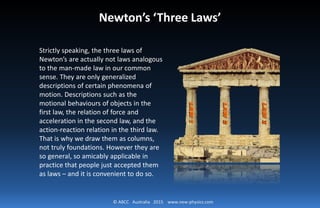
Strictly speaking, the three laws of
Newton’s are actually not laws analogous
to the man-made law in our common
sense. They are only generalized
descriptions of certain phenomena of
motion. Descriptions such as the
motional behaviours of objects in the
first law, the relation of force and
acceleration in the second law, and the
action-reaction relation in the third law.
That is why we draw them as columns,
not truly foundations. However they are
so general, so amicably applicable in
practice that people just accepted them
as laws – and it is convenient to do so.
© ABCC Australia 2015 www.new-physics.com
Need to Re-examine the Laws
On the surface, they seem to have settled the millennia old problem of
motion. But at a closer look, they are not quite what them seem to be
appropriate for our discussion. Although they have created a concrete body
to embrace almost all problems about motion, they have not provided an
answer to the basic question – “what is impetus or momentum?”. So we
have to subject the laws to a closer examination.
© ABCC Australia 2015 www.new-physics.com
1ST LAWS OF MOTION
Newton’s
© ABCC Australia 2015 www.new-physics.com
[and] a particle in uniform rectilinear motion will
continue to move on forever at constant speed in
the same manner.
Newton’s First Law in 3 Parts
A particle in rest will remain forever at rest
It will change its state of motion only and only
when it is compelled to do so by forces impressed
on it.
Law No. 1 can be more conveniently studied in three parts I , II, & III.
© ABCC Australia 2015 www.new-physics.com
Newton’s First Law : Part 1
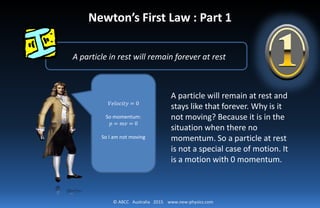
A particle will remain at rest and
stays like that forever. Why is it
not moving? Because it is in the
situation when there no
momentum. So a particle at rest
is not a special case of motion. It
is a motion with 0 momentum.
A particle in rest will remain forever at rest
𝑉𝑉𝑉𝑉𝑉𝑉𝑉𝑉𝑉𝑉𝑉𝑉𝑉𝑉𝑉𝑉 = 0
So momentum:
𝑝𝑝 = 𝑚𝑚𝑚𝑚 = 0
So I am not moving
© ABCC Australia 2015 www.new-physics.com
[and] a particle in uniform rectilinear motion will continue
to move on forever at constant speed in the same manner.
Newton’s First Law : Part 2
This is the old description
of impetus and
conservation familiar to
John Philoponus, Jean
Buridan, Descartes and
Galileo Galilee. This will be
studied in the coming
sections.
© ABCC Australia 2015 www.new-physics.com
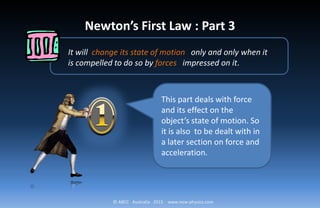
Newton’s First Law : Part 3
It will change its state of motion only and only when it
is compelled to do so by forces impressed on it.
This part deals with force
and its effect on the
object’s state of motion. So
it is also to be dealt with in
a later section on force and
acceleration.
© ABCC Australia 2015 www.new-physics.com
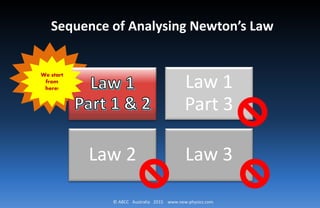
Law 1
Part 3
Law 2 Law 3
We start
from
here!
Sequence of Analysing Newton’s Law
© ABCC Australia 2015 www.new-physics.com
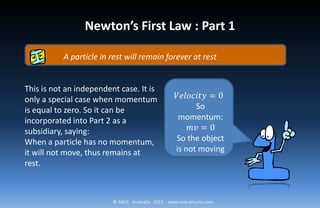
Newton’s First Law : Part 1
A particle in rest will remain forever at rest
This is not an independent case. It is
only a special case when momentum
is equal to zero. So it can be
incorporated into Part 2 as a
subsidiary, saying:
When a particle has no momentum,
it will not move, thus remains at
rest.
𝑉𝑉𝑉𝑉𝑉𝑉𝑉𝑉𝑉𝑉𝑉𝑉𝑉𝑉𝑉𝑉 = 0
So
momentum:
𝑚𝑚𝑚𝑚 = 0
So the object
is not moving
© ABCC Australia 2015 www.new-physics.com
[and] a particle in uniform rectilinear motion will continue
to move on forever at constant speed in the same manner.
Newton’s First Law : Part 2
This phenomenon had been
demonstrated by Galileo before in
his ramp experiment. When there is
no friction and air resistance, the ball
will move on forever.
© ABCC Australia 2015 www.new-physics.com
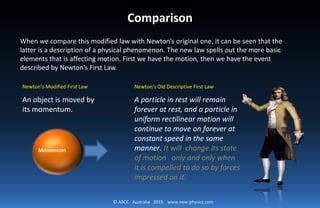
Comparison
When we compare this modified law with Newton’s original one, it can be seen that the
latter is a description of a physical phenomenon. The new law spells out the more basic
elements that is affecting motion. First we have the motion, then we have the event
described by Newton’s First Law.
Momentum
A particle in rest will remain
forever at rest, and a particle in
uniform rectilinear motion will
continue to move on forever at
constant speed in the same
manner. It will change its state
of motion only and only when
it is compelled to do so by forces
impressed on it.
An object is moved by
its momentum.
Newton’s Modified First Law Newton’s Old Descriptive First Law
© ABCC Australia 2015 www.new-physics.com
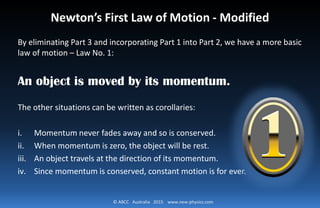
Newton’s First Law of Motion - Modified
By eliminating Part 3 and incorporating Part 1 into Part 2, we have a more basic
law of motion – Law No. 1:
An object is moved by its momentum.
The other situations can be written as corollaries:
i. Momentum never fades away and so is conserved.
ii. When momentum is zero, the object will be rest.
iii. An object travels at the direction of its momentum.
iv. Since momentum is conserved, constant motion is for ever.
© ABCC Australia 2015 www.new-physics.com
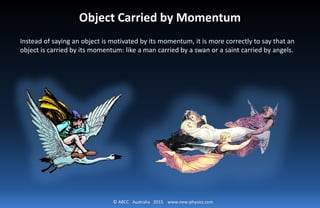
Object Carried by Momentum
Instead of saying an object is motivated by its momentum, it is more correctly to say that an
object is carried by its momentum: like a man carried by a swan or a saint carried by angels.
© ABCC Australia 2015 www.new-physics.com
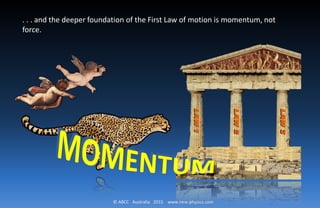
. . . and the deeper foundation of the First Law of motion is momentum, not
force.
© ABCC Australia 2015 www.new-physics.com
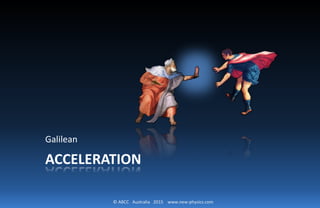
ACCELERATION
Galilean
© ABCC Australia 2015 www.new-physics.com
. . . it will change its state of motion only and only when
it is compelled to do so by forces impressed on it.
Part 3 of Newton’s First Law
Part 3 of Newton’s First Law spells the relation between state of motion and
force:
The right place for this part should be a part of the second law where it would
probably read:
Force changes the state of motion [of a particle].
However, this is enough for us to start to discuss on a new state of motion.
© ABCC Australia 2015 www.new-physics.com
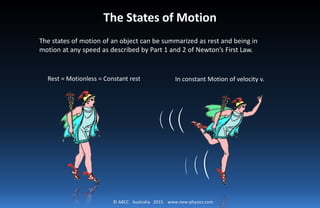
The States of Motion
Rest = Motionless = Constant rest In constant Motion of velocity v.
The states of motion of an object can be summarized as rest and being in
motion at any speed as described by Part 1 and 2 of Newton’s First Law.
© ABCC Australia 2015 www.new-physics.com
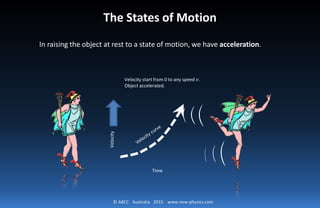
The States of Motion
Velocity start from 0 to any speed 𝑣𝑣.
Object accelerated.
In raising the object at rest to a state of motion, we have acceleration.
Time
Velocity
© ABCC Australia 2015 www.new-physics.com
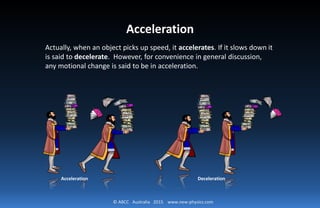
Acceleration
Actually, when an object picks up speed, it accelerates. If it slows down it
is said to decelerate. However, for convenience in general discussion,
any motional change is said to be in acceleration.
Acceleration Deceleration
© ABCC Australia 2015 www.new-physics.com
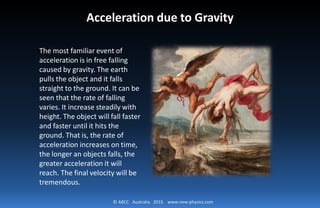
Acceleration due to Gravity
The most familiar event of
acceleration is in free falling
caused by gravity. The earth
pulls the object and it falls
straight to the ground. It can be
seen that the rate of falling
varies. It increase steadily with
height. The object will fall faster
and faster until it hits the
ground. That is, the rate of
acceleration increases on time,
the longer an objects falls, the
greater acceleration it will
reach. The final velocity will be
tremendous.
© ABCC Australia 2015 www.new-physics.com
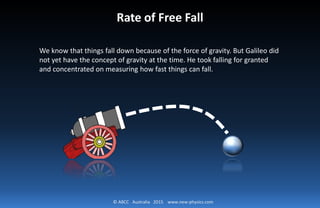
Rate of Free Fall
We know that things fall down because of the force of gravity. But Galileo did
not yet have the concept of gravity at the time. He took falling for granted
and concentrated on measuring how fast things can fall.
© ABCC Australia 2015 www.new-physics.com
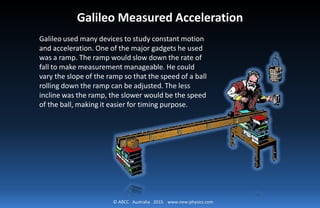
Galileo Measured Acceleration
Galileo used many devices to study constant motion
and acceleration. One of the major gadgets he used
was a ramp. The ramp would slow down the rate of
fall to make measurement manageable. He could
vary the slope of the ramp so that the speed of a ball
rolling down the ramp can be adjusted. The less
incline was the ramp, the slower would be the speed
of the ball, making it easier for timing purpose.
© ABCC Australia 2015 www.new-physics.com
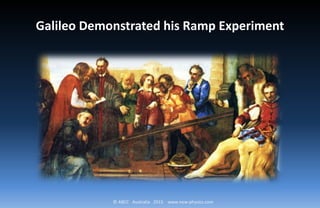
Galileo Demonstrated his Ramp Experiment
© ABCC Australia 2015 www.new-physics.com
Equation for Acceleration
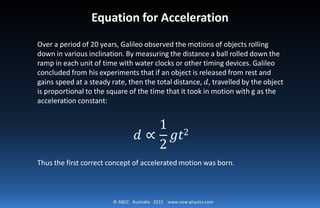
Over a period of 20 years, Galileo observed the motions of objects rolling
down in various inclination. By measuring the distance a ball rolled down the
ramp in each unit of time with water clocks or other timing devices. Galileo
concluded from his experiments that if an object is released from rest and
gains speed at a steady rate, then the total distance, 𝑑𝑑, travelled by the object
is proportional to the square of the time that it took in motion with g as the
acceleration constant:
𝑑𝑑 ∝
1
2
𝑔𝑔𝑔𝑔2
Thus the first correct concept of accelerated motion was born.
© ABCC Australia 2015 www.new-physics.com
Geometric Representation of Acceleration
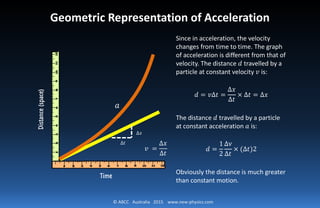
Since in acceleration, the velocity
changes from time to time. The graph
of acceleration is different from that of
velocity. The distance 𝑑𝑑 travelled by a
particle at constant velocity 𝑣𝑣 is:
𝑑𝑑 = 𝑣𝑣Δ𝑡𝑡 =
Δ𝑥𝑥
Δ𝑡𝑡
× Δ𝑡𝑡 = Δ𝑥𝑥
The distance 𝑑𝑑 travelled by a particle
at constant acceleration 𝑎𝑎 is:
𝑑𝑑 =
1
2
Δv
Δ𝑡𝑡
× (Δ𝑡𝑡)2
Obviously the distance is much greater
than constant motion.
Distance(space)
Time
Δ𝑥𝑥
Δ𝑡𝑡
𝑣𝑣 =
Δ𝑥𝑥
Δ𝑡𝑡
𝑎𝑎

Part 3. newton's principia

  • 1.
    © ABCC Australia2015 www.new-physics.com LAWS OF MOTION Newton’s
  • 2.
    © ABCC Australia2015 www.new-physics.com On the Shoulder of Giants We now have established that in nature, there are different properties pertaining to motion: velocity, force, impetus and inertia. By setting up the Laws of Mechanics, Newton established the relationship between the various elements. He showed that the same physical laws are universal and can be applied to all matter, whether living or nonliving, on earth or in space, thus revolutionizing our view of the universe.
  • 3.
    © ABCC Australia2015 www.new-physics.com Newton’s ‘Three Laws’ Strictly speaking, the three laws of Newton’s are actually not laws analogous to the man-made law in our common sense. They are only generalized descriptions of certain phenomena of motion. Descriptions such as the motional behaviours of objects in the first law, the relation of force and acceleration in the second law, and the action-reaction relation in the third law. That is why we draw them as columns, not truly foundations. However they are so general, so amicably applicable in practice that people just accepted them as laws – and it is convenient to do so.
  • 4.
    © ABCC Australia2015 www.new-physics.com Need to Re-examine the Laws On the surface, they seem to have settled the millennia old problem of motion. But at a closer look, they are not quite what them seem to be appropriate for our discussion. Although they have created a concrete body to embrace almost all problems about motion, they have not provided an answer to the basic question – “what is impetus or momentum?”. So we have to subject the laws to a closer examination.
  • 5.
    © ABCC Australia2015 www.new-physics.com 1ST LAWS OF MOTION Newton’s
  • 6.
    © ABCC Australia2015 www.new-physics.com [and] a particle in uniform rectilinear motion will continue to move on forever at constant speed in the same manner. Newton’s First Law in 3 Parts A particle in rest will remain forever at rest It will change its state of motion only and only when it is compelled to do so by forces impressed on it. Law No. 1 can be more conveniently studied in three parts I , II, & III.
  • 7.
    © ABCC Australia2015 www.new-physics.com Newton’s First Law : Part 1 A particle will remain at rest and stays like that forever. Why is it not moving? Because it is in the situation when there no momentum. So a particle at rest is not a special case of motion. It is a motion with 0 momentum. A particle in rest will remain forever at rest 𝑉𝑉𝑉𝑉𝑉𝑉𝑉𝑉𝑉𝑉𝑉𝑉𝑉𝑉𝑉𝑉 = 0 So momentum: 𝑝𝑝 = 𝑚𝑚𝑚𝑚 = 0 So I am not moving
  • 8.
    © ABCC Australia2015 www.new-physics.com [and] a particle in uniform rectilinear motion will continue to move on forever at constant speed in the same manner. Newton’s First Law : Part 2 This is the old description of impetus and conservation familiar to John Philoponus, Jean Buridan, Descartes and Galileo Galilee. This will be studied in the coming sections.
  • 9.
    © ABCC Australia2015 www.new-physics.com Newton’s First Law : Part 3 It will change its state of motion only and only when it is compelled to do so by forces impressed on it. This part deals with force and its effect on the object’s state of motion. So it is also to be dealt with in a later section on force and acceleration.
  • 10.
    © ABCC Australia2015 www.new-physics.com Law 1 Part 3 Law 2 Law 3 We start from here! Sequence of Analysing Newton’s Law
  • 11.
    © ABCC Australia2015 www.new-physics.com Newton’s First Law : Part 1 A particle in rest will remain forever at rest This is not an independent case. It is only a special case when momentum is equal to zero. So it can be incorporated into Part 2 as a subsidiary, saying: When a particle has no momentum, it will not move, thus remains at rest. 𝑉𝑉𝑉𝑉𝑉𝑉𝑉𝑉𝑉𝑉𝑉𝑉𝑉𝑉𝑉𝑉 = 0 So momentum: 𝑚𝑚𝑚𝑚 = 0 So the object is not moving
  • 12.
    © ABCC Australia2015 www.new-physics.com [and] a particle in uniform rectilinear motion will continue to move on forever at constant speed in the same manner. Newton’s First Law : Part 2 This phenomenon had been demonstrated by Galileo before in his ramp experiment. When there is no friction and air resistance, the ball will move on forever.
  • 13.
    © ABCC Australia2015 www.new-physics.com Comparison When we compare this modified law with Newton’s original one, it can be seen that the latter is a description of a physical phenomenon. The new law spells out the more basic elements that is affecting motion. First we have the motion, then we have the event described by Newton’s First Law. Momentum A particle in rest will remain forever at rest, and a particle in uniform rectilinear motion will continue to move on forever at constant speed in the same manner. It will change its state of motion only and only when it is compelled to do so by forces impressed on it. An object is moved by its momentum. Newton’s Modified First Law Newton’s Old Descriptive First Law
  • 14.
    © ABCC Australia2015 www.new-physics.com Newton’s First Law of Motion - Modified By eliminating Part 3 and incorporating Part 1 into Part 2, we have a more basic law of motion – Law No. 1: An object is moved by its momentum. The other situations can be written as corollaries: i. Momentum never fades away and so is conserved. ii. When momentum is zero, the object will be rest. iii. An object travels at the direction of its momentum. iv. Since momentum is conserved, constant motion is for ever.
  • 15.
    © ABCC Australia2015 www.new-physics.com Object Carried by Momentum Instead of saying an object is motivated by its momentum, it is more correctly to say that an object is carried by its momentum: like a man carried by a swan or a saint carried by angels.
  • 16.
    © ABCC Australia2015 www.new-physics.com . . . and the deeper foundation of the First Law of motion is momentum, not force.
  • 17.
    © ABCC Australia2015 www.new-physics.com ACCELERATION Galilean
  • 18.
    © ABCC Australia2015 www.new-physics.com . . . it will change its state of motion only and only when it is compelled to do so by forces impressed on it. Part 3 of Newton’s First Law Part 3 of Newton’s First Law spells the relation between state of motion and force: The right place for this part should be a part of the second law where it would probably read: Force changes the state of motion [of a particle]. However, this is enough for us to start to discuss on a new state of motion.
  • 19.
    © ABCC Australia2015 www.new-physics.com The States of Motion Rest = Motionless = Constant rest In constant Motion of velocity v. The states of motion of an object can be summarized as rest and being in motion at any speed as described by Part 1 and 2 of Newton’s First Law.
  • 20.
    © ABCC Australia2015 www.new-physics.com The States of Motion Velocity start from 0 to any speed 𝑣𝑣. Object accelerated. In raising the object at rest to a state of motion, we have acceleration. Time Velocity
  • 21.
    © ABCC Australia2015 www.new-physics.com Acceleration Actually, when an object picks up speed, it accelerates. If it slows down it is said to decelerate. However, for convenience in general discussion, any motional change is said to be in acceleration. Acceleration Deceleration
  • 22.
    © ABCC Australia2015 www.new-physics.com Acceleration due to Gravity The most familiar event of acceleration is in free falling caused by gravity. The earth pulls the object and it falls straight to the ground. It can be seen that the rate of falling varies. It increase steadily with height. The object will fall faster and faster until it hits the ground. That is, the rate of acceleration increases on time, the longer an objects falls, the greater acceleration it will reach. The final velocity will be tremendous.
  • 23.
    © ABCC Australia2015 www.new-physics.com Rate of Free Fall We know that things fall down because of the force of gravity. But Galileo did not yet have the concept of gravity at the time. He took falling for granted and concentrated on measuring how fast things can fall.
  • 24.
    © ABCC Australia2015 www.new-physics.com Galileo Measured Acceleration Galileo used many devices to study constant motion and acceleration. One of the major gadgets he used was a ramp. The ramp would slow down the rate of fall to make measurement manageable. He could vary the slope of the ramp so that the speed of a ball rolling down the ramp can be adjusted. The less incline was the ramp, the slower would be the speed of the ball, making it easier for timing purpose.
  • 25.
    © ABCC Australia2015 www.new-physics.com Galileo Demonstrated his Ramp Experiment
  • 26.
    © ABCC Australia2015 www.new-physics.com Equation for Acceleration Over a period of 20 years, Galileo observed the motions of objects rolling down in various inclination. By measuring the distance a ball rolled down the ramp in each unit of time with water clocks or other timing devices. Galileo concluded from his experiments that if an object is released from rest and gains speed at a steady rate, then the total distance, 𝑑𝑑, travelled by the object is proportional to the square of the time that it took in motion with g as the acceleration constant: 𝑑𝑑 ∝ 1 2 𝑔𝑔𝑔𝑔2 Thus the first correct concept of accelerated motion was born.
  • 27.
    © ABCC Australia2015 www.new-physics.com Geometric Representation of Acceleration Since in acceleration, the velocity changes from time to time. The graph of acceleration is different from that of velocity. The distance 𝑑𝑑 travelled by a particle at constant velocity 𝑣𝑣 is: 𝑑𝑑 = 𝑣𝑣Δ𝑡𝑡 = Δ𝑥𝑥 Δ𝑡𝑡 × Δ𝑡𝑡 = Δ𝑥𝑥 The distance 𝑑𝑑 travelled by a particle at constant acceleration 𝑎𝑎 is: 𝑑𝑑 = 1 2 Δv Δ𝑡𝑡 × (Δ𝑡𝑡)2 Obviously the distance is much greater than constant motion. Distance(space) Time Δ𝑥𝑥 Δ𝑡𝑡 𝑣𝑣 = Δ𝑥𝑥 Δ𝑡𝑡 𝑎𝑎