Power pointPower point
presentation ofpresentation of
science onscience on
Uniform andUniform and
Non UniformNon Uniform
motion of anmotion of an
UniformUniform
MotionMotion
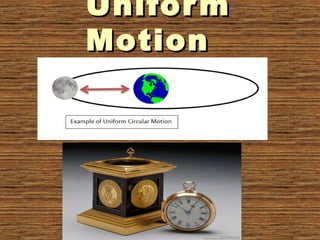
Uniform MotionUniform Motion
 If an object moves equal distance inIf an object moves equal distance in
equal interval of time.equal interval of time.
 SpeedSpeed: can not be speeding up or: can not be speeding up or
slowing down.slowing down.
 Uniform = “Constant”Uniform = “Constant”
 Ex :- If an object go to Delhi from PanipatEx :- If an object go to Delhi from Panipat
on a traffic less road. It reaches there inon a traffic less road. It reaches there in
2 hours by moving with constant speed2 hours by moving with constant speed
of 30 km/h. n this case object coversof 30 km/h. n this case object covers
equal distance in equal interval of time.equal distance in equal interval of time.
Non uniformNon uniform
motionmotion
Non uniformNon uniform
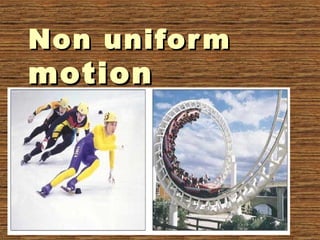
motionmotion•If an object covers unequalIf an object covers unequal
distance in equal interval of timedistance in equal interval of time
•SpeedSpeed: speed varies.: speed varies.
•Non uniform =“variable”Non uniform =“variable”
•Ex:- if an object go to Panipat fromEx:- if an object go to Panipat from
Delhi. In first hour it is moving with aDelhi. In first hour it is moving with a
speed of 50 km/h and in secondspeed of 50 km/h and in second
hour their was to much traffic and ithour their was to much traffic and it
moves with a speed of 10km/h. Inmoves with a speed of 10km/h. In
this case object cover unequalthis case object cover unequal
distance in equal interval of time.distance in equal interval of time.
SpeedSpeed
 Rate of change of distance is calledRate of change of distance is called
speedspeed
 Average speedAverage speed is ratio of total distanceis ratio of total distance
and total time taken .and total time taken .
 Speed = distance ÷ timeSpeed = distance ÷ time
 Speed is a scalar quantity so it has onlySpeed is a scalar quantity so it has only
magnitude (a number and units) andmagnitude (a number and units) and
does not include direction.does not include direction.
 Instantaneous speedInstantaneous speed is the speed at ais the speed at a
specific instant in time.specific instant in time.
VelocityVelocity
 Rate of change of displacement is calledRate of change of displacement is called
velocity .velocity .
 Velocity is a vector quantity.Velocity is a vector quantity.
 Velocity has both magnitude andVelocity has both magnitude and
direction.direction.
 Ex. 56 km/h West OR -9.8 m/sEx. 56 km/h West OR -9.8 m/s
Constant and AverageConstant and Average
VelocityVelocity
 When an object travels at the sameWhen an object travels at the same
speed and the same direction for a timespeed and the same direction for a time
interval, it hasinterval, it has constant velocity.constant velocity.
 Average velocity:Average velocity: the displacement of
an object divided by the time interval it
takes to travel the displacement.
Speed GraphSpeed Graph
 Also called Distance-Time GraphAlso called Distance-Time Graph
 Distance is on the “y” axis.Distance is on the “y” axis.
 Time is on the “x” axis.Time is on the “x” axis.
 The slope of the line (how steepThe slope of the line (how steep
it is) is the speed.it is) is the speed.
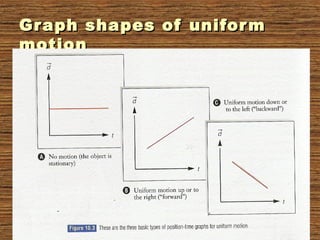
Graph shapes of uniformGraph shapes of uniform
motionmotion
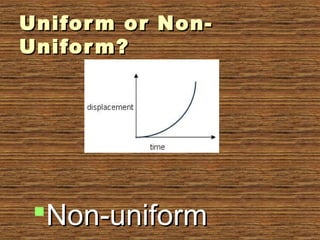
Uniform or Non-Uniform or Non-
Uniform?Uniform?
Non-uniformNon-uniform
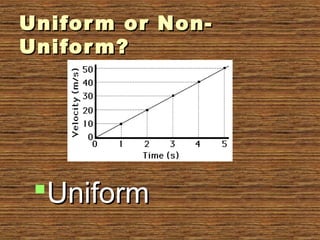
Uniform or Non-Uniform or Non-
Uniform?Uniform?
UniformUniform
UnderstanUnderstan
d types ofd types of
motion bymotion by
given videogiven video
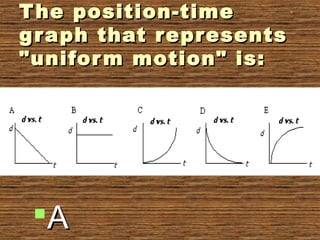
The position-timeThe position-time
graph that representsgraph that represents
"uniform motion" is:"uniform motion" is:
AA
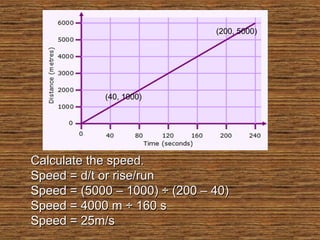
Calculate the speed.Calculate the speed.
Speed = d/t or rise/runSpeed = d/t or rise/run
Speed = (5000 – 1000) ÷ (200 – 40)Speed = (5000 – 1000) ÷ (200 – 40)
Speed = 4000 m ÷ 160 sSpeed = 4000 m ÷ 160 s
Speed = 25m/sSpeed = 25m/s
(40, 1000)
(200, 5000)
ThankThank
youyou

PPT on uniforma and non-uniform motion

  • 1.
    Power pointPower point presentationofpresentation of science onscience on Uniform andUniform and Non UniformNon Uniform motion of anmotion of an
  • 2.
  • 3.
    Uniform MotionUniform Motion If an object moves equal distance inIf an object moves equal distance in equal interval of time.equal interval of time.  SpeedSpeed: can not be speeding up or: can not be speeding up or slowing down.slowing down.  Uniform = “Constant”Uniform = “Constant”  Ex :- If an object go to Delhi from PanipatEx :- If an object go to Delhi from Panipat on a traffic less road. It reaches there inon a traffic less road. It reaches there in 2 hours by moving with constant speed2 hours by moving with constant speed of 30 km/h. n this case object coversof 30 km/h. n this case object covers equal distance in equal interval of time.equal distance in equal interval of time.
  • 4.
  • 5.
    Non uniformNon uniform motionmotion•Ifan object covers unequalIf an object covers unequal distance in equal interval of timedistance in equal interval of time •SpeedSpeed: speed varies.: speed varies. •Non uniform =“variable”Non uniform =“variable” •Ex:- if an object go to Panipat fromEx:- if an object go to Panipat from Delhi. In first hour it is moving with aDelhi. In first hour it is moving with a speed of 50 km/h and in secondspeed of 50 km/h and in second hour their was to much traffic and ithour their was to much traffic and it moves with a speed of 10km/h. Inmoves with a speed of 10km/h. In this case object cover unequalthis case object cover unequal distance in equal interval of time.distance in equal interval of time.
  • 6.
    SpeedSpeed  Rate ofchange of distance is calledRate of change of distance is called speedspeed  Average speedAverage speed is ratio of total distanceis ratio of total distance and total time taken .and total time taken .  Speed = distance ÷ timeSpeed = distance ÷ time  Speed is a scalar quantity so it has onlySpeed is a scalar quantity so it has only magnitude (a number and units) andmagnitude (a number and units) and does not include direction.does not include direction.  Instantaneous speedInstantaneous speed is the speed at ais the speed at a specific instant in time.specific instant in time.
  • 7.
    VelocityVelocity  Rate ofchange of displacement is calledRate of change of displacement is called velocity .velocity .  Velocity is a vector quantity.Velocity is a vector quantity.  Velocity has both magnitude andVelocity has both magnitude and direction.direction.  Ex. 56 km/h West OR -9.8 m/sEx. 56 km/h West OR -9.8 m/s
  • 8.
    Constant and AverageConstantand Average VelocityVelocity  When an object travels at the sameWhen an object travels at the same speed and the same direction for a timespeed and the same direction for a time interval, it hasinterval, it has constant velocity.constant velocity.  Average velocity:Average velocity: the displacement of an object divided by the time interval it takes to travel the displacement.
  • 9.
    Speed GraphSpeed Graph Also called Distance-Time GraphAlso called Distance-Time Graph  Distance is on the “y” axis.Distance is on the “y” axis.  Time is on the “x” axis.Time is on the “x” axis.  The slope of the line (how steepThe slope of the line (how steep it is) is the speed.it is) is the speed.
  • 10.
    Graph shapes ofuniformGraph shapes of uniform motionmotion
  • 11.
    Uniform or Non-Uniformor Non- Uniform?Uniform? Non-uniformNon-uniform
  • 12.
    Uniform or Non-Uniformor Non- Uniform?Uniform? UniformUniform
  • 13.
    UnderstanUnderstan d types ofdtypes of motion bymotion by given videogiven video
  • 14.
    The position-timeThe position-time graphthat representsgraph that represents "uniform motion" is:"uniform motion" is: AA
  • 15.
    Calculate the speed.Calculatethe speed. Speed = d/t or rise/runSpeed = d/t or rise/run Speed = (5000 – 1000) ÷ (200 – 40)Speed = (5000 – 1000) ÷ (200 – 40) Speed = 4000 m ÷ 160 sSpeed = 4000 m ÷ 160 s Speed = 25m/sSpeed = 25m/s (40, 1000) (200, 5000)
  • 16.