Made BY :- Sanchit
Class 9th- C
Describing Motion
• Motion :- Motion is the change in position
of a body with time.
• Motion can be described in terms of the (i)
distance moved or the (ii)displacement
(i)Distance moved is the actual length of the
path travelled by a body.
(ii)Displacement is the length of the shortest
path travelled by a body from initial
position to it’s final position.
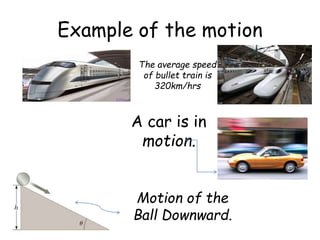
Example of the motion
The average speed
of bullet train is
320km/hrs
A car is in
motion.
Motion of the
Ball Downward.
• i) Uniform motion :- If a body
travels equal distances in equal
intervals of time, it is said to be in
uniform motion.
• ii) Non uniform motion :- If a
body travels unequal distances in
equal intervals of time, it is said to
be in non uniform motion.
Uniform motion and Non
uniform motion
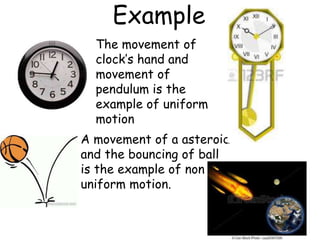
Example
A movement of a asteroid
and the bouncing of ball
is the example of non
uniform motion.
The movement of
clock’s hand and
movement of
pendulum is the
example of uniform
motion
• Speed :- of a body is the distance travelled
by the body in unit time.
Speed = Distance/Time
• If a body travels a distance s in time t
then its speed v is v= s/t
• The SI unit of speed is meter per second
m/s or ms -1 . Since speed has only
magnitude it is a scalar quantity.
Example
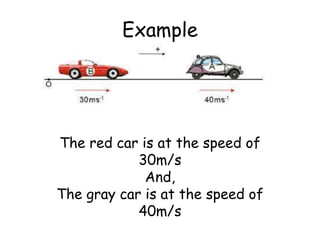
The red car is at the speed of
30m/s
And,
The gray car is at the speed of
40m/s
Average speed
Average speed :- is the
ratio of the total distance
travelled to the total time
taken.
Example Problems
Q. A car travels 85km from point A to B , then 45km
from point B to C . The total time took was 1.3 hrs.
What was the average speed of the Car?
Solution of the problem
Total distance=Distance covered i)A to B + ii)B to C
85km + 45km= 130km
Total Time = 1.3 hrs
Average speed = Total Distance Covered/Total time
=> 130/1.3 km/hrs
=> 100km/hrs
The quantity which specifies both
the direction of motion and speed
is velocity.
• Velocity of a body is the
displacement of the body per unit time.
Velocity =Displacement/time taken
•Since velocity has both magnitude and
direction, it is a vector quantity.
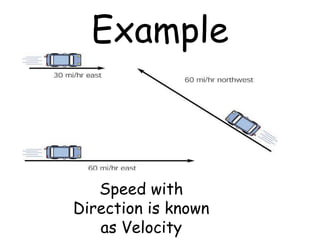
Example
Speed with
Direction is known
as Velocity
Average Velocity
• Average velocity :- is the ratio of the
total displacement to the total time taken.
• Average velocity =Total Displacement/Total
Time.
• Average velocity is also the mean of the
initial velocity u and final velocity v.
• Average velocity= (initial velocity + finial
velocity)/2
or
(u+v)/2
• Speed and velocity have the same units m/s
or ms -1
Example Problem
Q. If a car changes its speed from 10m/s to
20m/s in just 5 sec. What is the average
velocity of the car?
Sol. u = 10m/s time taken
v = 20m/s = 5sec
Average velocity = (u + v)/2
(20m/s + 10m/s)/2
30m/s/2
15m/s
The quantity which specifies changes
in velocity is acceleration.
• Acceleration :- is the rate of
change of velocity.
• Acceleration = (Final velocity –
initial velocity) / 2
• If the velocity of a body changes
from initial value u to final value v
in time t, then acceleration a is
a = (v-u) /2
• The SI unit of acceleration is ms - 2
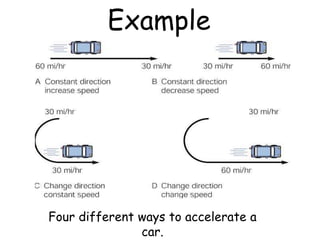
Example
Four different ways to accelerate a
car.
Distance –Time Graph
• Motion can be represented on the
distance time graph.
• In the graph distance is taken on the y –
axis and time is taken on the x – axis.
• The distance time graph for uniform
speed is a straight line.
• This is because in uniform speed a body
travels equal distances in equal intervals
of time.
Example
Uniform Motion
Derivation of three formula of
motion
• Let a body is moving with initial velocity ‘u’
with uniform acceleration ‘a’ it’s velocity
become ‘v’ in time ‘t’ sec. In the meantime it
covers the distance ‘s’
• The term would be in
1. Acceleration -> m/s2
2. Initial and final velocity -> m/s
3. Time -> sec
4. Distance -> m
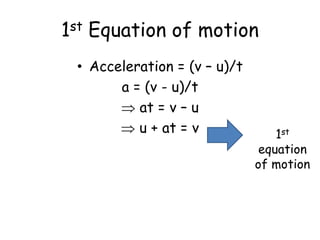
1st Equation of motion
• Acceleration = (v – u)/t
a = (v - u)/t
 at = v – u
 u + at = v 1st
equation
of motion
2nd Equation of motion
• Average velocity = (v + u)/2
• Distance Travelled = Av. Velocity + time
s = (v + u)/2 x t
Put v = u + at
 s = (u + at + u)/2 x t
 s = (2u+at)/2 x t
 s = (2ut + at2) /2
s = ut + ½ at2 2nd
Equation of
motion
3rd Equation of motion
• We know that v = u + at
v – u = at
(v - u)/a = t
• Put t = (v – u)/a in eq. s = ut + ½ at2
s = u{(v – u)/a} + ½a {(v-u)/2} 2
s = (uv - u2)/a + ½a{(v2 + u2 -2uv)/a2}
 s = (uv - u2)/a + ½(v2 + u2 -2uv)/a
 s = (uv - u2)/a + (v2 + u2 -2uv)/2a
s = (2uv - 2u2 + v2 + u2 -2uv)/2a
s = (v2 - u2 )/2a
2as = v2 - u2 3rd
Equation
of motion
Circular motion
• The motion of a body in a circular path is called
circular motion.
• Uniform circular motion :- If a body
moves in a circular path with uniform speed, its
motion is called uniform circular motion.
• Uniform circular motion is accelerated motion
because in a circular motion a body continuously
changes its direction.
• The circumference of a circle of radius r is
given by 2лr. If a body takes time t to go once
around the circular path, then the velocity v is
given by
v = 2лr/2
Example

Motion for class 9th

  • 1.
    Made BY :-Sanchit Class 9th- C
  • 2.
    Describing Motion • Motion:- Motion is the change in position of a body with time. • Motion can be described in terms of the (i) distance moved or the (ii)displacement (i)Distance moved is the actual length of the path travelled by a body. (ii)Displacement is the length of the shortest path travelled by a body from initial position to it’s final position.
  • 3.
    Example of themotion The average speed of bullet train is 320km/hrs A car is in motion. Motion of the Ball Downward.
  • 4.
    • i) Uniformmotion :- If a body travels equal distances in equal intervals of time, it is said to be in uniform motion. • ii) Non uniform motion :- If a body travels unequal distances in equal intervals of time, it is said to be in non uniform motion. Uniform motion and Non uniform motion
  • 5.
    Example A movement ofa asteroid and the bouncing of ball is the example of non uniform motion. The movement of clock’s hand and movement of pendulum is the example of uniform motion
  • 6.
    • Speed :-of a body is the distance travelled by the body in unit time. Speed = Distance/Time • If a body travels a distance s in time t then its speed v is v= s/t • The SI unit of speed is meter per second m/s or ms -1 . Since speed has only magnitude it is a scalar quantity.
  • 7.
    Example The red caris at the speed of 30m/s And, The gray car is at the speed of 40m/s
  • 8.
    Average speed Average speed:- is the ratio of the total distance travelled to the total time taken.
  • 9.
    Example Problems Q. Acar travels 85km from point A to B , then 45km from point B to C . The total time took was 1.3 hrs. What was the average speed of the Car? Solution of the problem Total distance=Distance covered i)A to B + ii)B to C 85km + 45km= 130km Total Time = 1.3 hrs Average speed = Total Distance Covered/Total time => 130/1.3 km/hrs => 100km/hrs
  • 10.
    The quantity whichspecifies both the direction of motion and speed is velocity. • Velocity of a body is the displacement of the body per unit time. Velocity =Displacement/time taken •Since velocity has both magnitude and direction, it is a vector quantity.
  • 11.
  • 12.
    Average Velocity • Averagevelocity :- is the ratio of the total displacement to the total time taken. • Average velocity =Total Displacement/Total Time. • Average velocity is also the mean of the initial velocity u and final velocity v. • Average velocity= (initial velocity + finial velocity)/2 or (u+v)/2 • Speed and velocity have the same units m/s or ms -1
  • 13.
    Example Problem Q. Ifa car changes its speed from 10m/s to 20m/s in just 5 sec. What is the average velocity of the car? Sol. u = 10m/s time taken v = 20m/s = 5sec Average velocity = (u + v)/2 (20m/s + 10m/s)/2 30m/s/2 15m/s
  • 14.
    The quantity whichspecifies changes in velocity is acceleration. • Acceleration :- is the rate of change of velocity. • Acceleration = (Final velocity – initial velocity) / 2 • If the velocity of a body changes from initial value u to final value v in time t, then acceleration a is a = (v-u) /2 • The SI unit of acceleration is ms - 2
  • 15.
    Example Four different waysto accelerate a car.
  • 16.
    Distance –Time Graph •Motion can be represented on the distance time graph. • In the graph distance is taken on the y – axis and time is taken on the x – axis. • The distance time graph for uniform speed is a straight line. • This is because in uniform speed a body travels equal distances in equal intervals of time.
  • 17.
  • 18.
    Derivation of threeformula of motion • Let a body is moving with initial velocity ‘u’ with uniform acceleration ‘a’ it’s velocity become ‘v’ in time ‘t’ sec. In the meantime it covers the distance ‘s’ • The term would be in 1. Acceleration -> m/s2 2. Initial and final velocity -> m/s 3. Time -> sec 4. Distance -> m
  • 19.
    1st Equation ofmotion • Acceleration = (v – u)/t a = (v - u)/t  at = v – u  u + at = v 1st equation of motion
  • 20.
    2nd Equation ofmotion • Average velocity = (v + u)/2 • Distance Travelled = Av. Velocity + time s = (v + u)/2 x t Put v = u + at  s = (u + at + u)/2 x t  s = (2u+at)/2 x t  s = (2ut + at2) /2 s = ut + ½ at2 2nd Equation of motion
  • 21.
    3rd Equation ofmotion • We know that v = u + at v – u = at (v - u)/a = t • Put t = (v – u)/a in eq. s = ut + ½ at2 s = u{(v – u)/a} + ½a {(v-u)/2} 2 s = (uv - u2)/a + ½a{(v2 + u2 -2uv)/a2}  s = (uv - u2)/a + ½(v2 + u2 -2uv)/a  s = (uv - u2)/a + (v2 + u2 -2uv)/2a s = (2uv - 2u2 + v2 + u2 -2uv)/2a s = (v2 - u2 )/2a 2as = v2 - u2 3rd Equation of motion
  • 22.
    Circular motion • Themotion of a body in a circular path is called circular motion. • Uniform circular motion :- If a body moves in a circular path with uniform speed, its motion is called uniform circular motion. • Uniform circular motion is accelerated motion because in a circular motion a body continuously changes its direction. • The circumference of a circle of radius r is given by 2лr. If a body takes time t to go once around the circular path, then the velocity v is given by v = 2лr/2
  • 23.