Chapter 2
The Nature of Matter
Danielle and Ian
Summary
Chapter 2 – The Nature of Matter


                     Describing Matter
   Item 1

                      Changes in Matter
    Item 2            Analyzing Data: Is matter conserved?


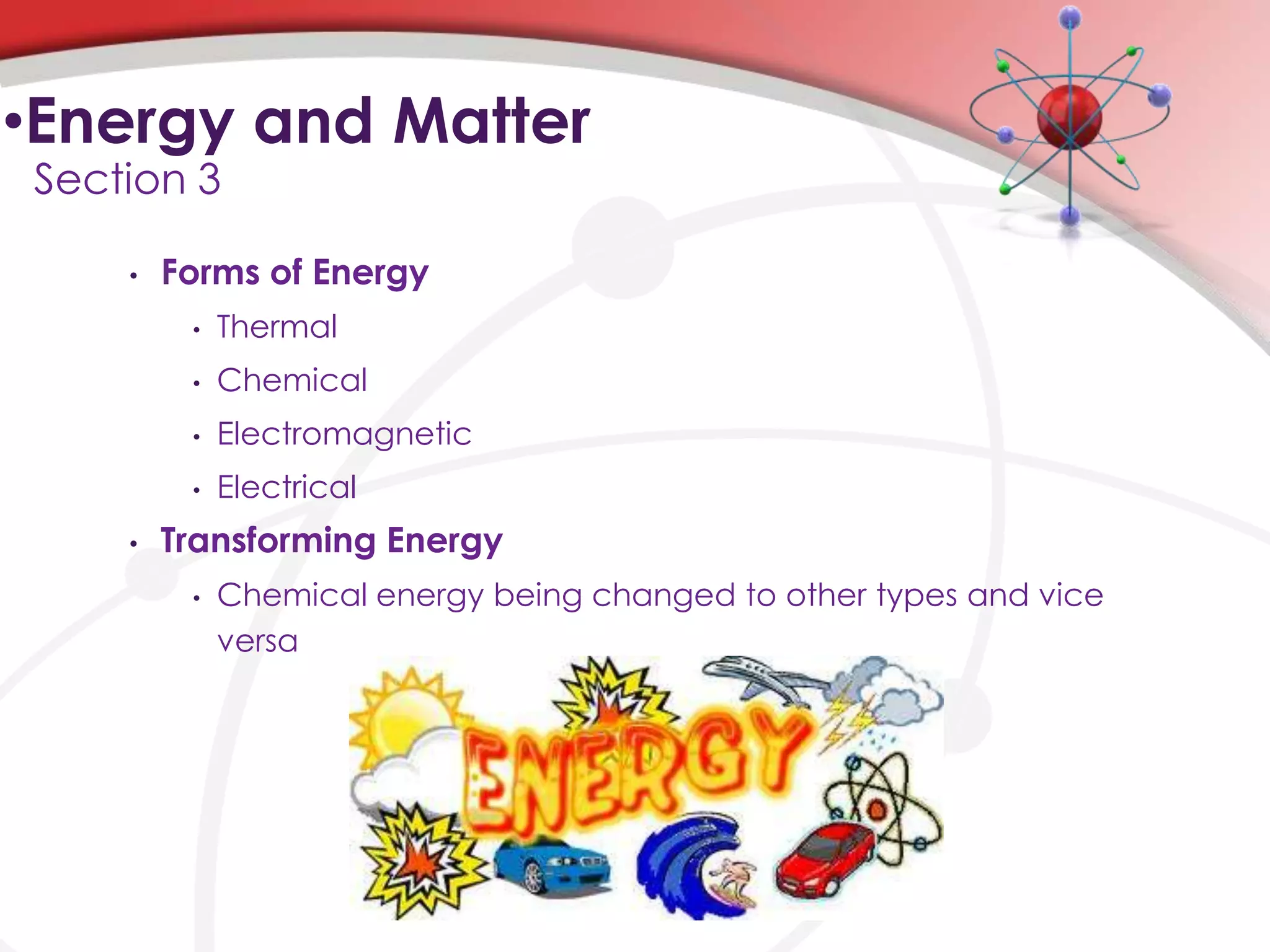
                        Energy and Matter
      Item 3            Analyzing Data: Comparing Energy Changes


                         Review of Key Concepts
       Item 4

                           Review of Key Terms
            Item 5
•Describing Matter
 Section 1

  •   Properties of Matter
       •   Two kinds: Physical and Chemical
            •   Physical can be observed without changing to another
                substance
            •   Chemical is the ability to change into other substances
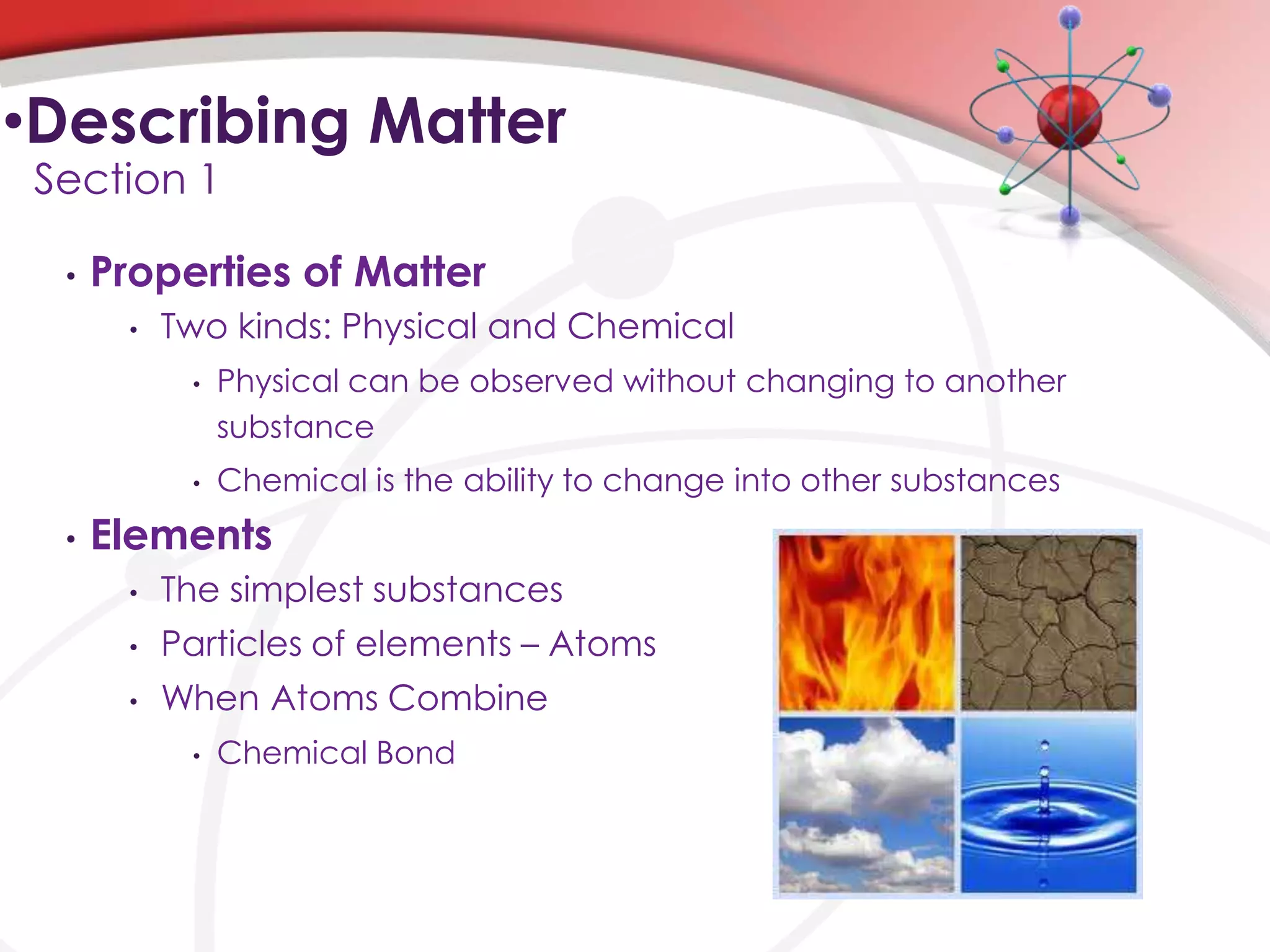
  •   Elements
       •   The simplest substances
       •   Particles of elements – Atoms
       •   When Atoms Combine
            •   Chemical Bond
•Describing Matter
 Section 1

  •   Compounds
       •   Two or more elements chemically combined
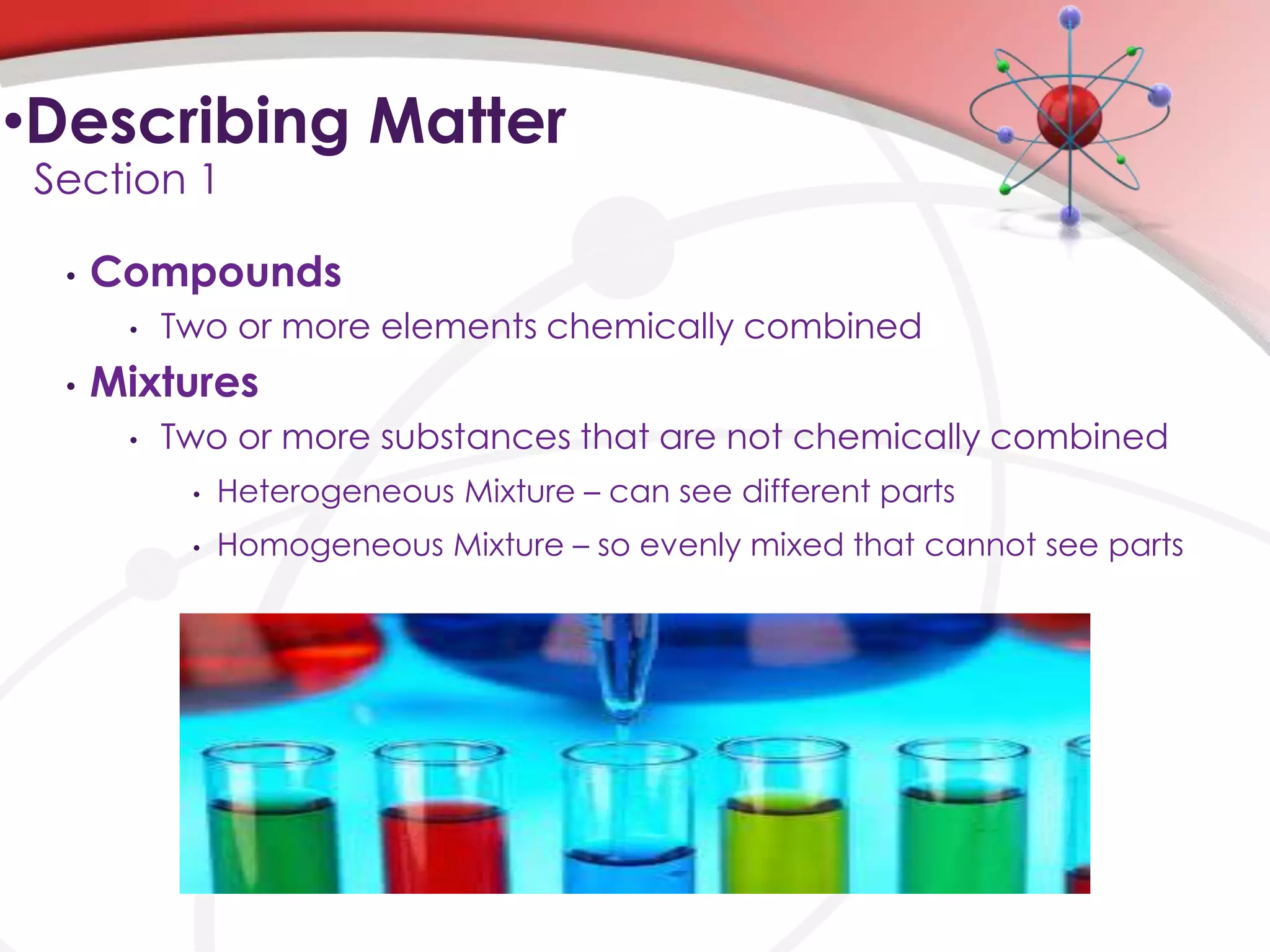
  •   Mixtures
       •   Two or more substances that are not chemically combined
            •   Heterogeneous Mixture – can see different parts
            •   Homogeneous Mixture – so evenly mixed that cannot see parts
•Changes in Matter
Section 2

    •   Physical Change
         •   Changes in state
               •   Solid, liquid, gas
         •   Changes in Shape or form
               •   Dissolving, blending, crushing, bending, chopping
    •   Chemical Change
         •   Produces one or more new substances
    •   Conservation of Matter
         •   Matter is not created or destroyed in any physical or chemical
             change
•Energy and Matter
Section 3

    •   Forms of Energy
         •   Thermal
         •   Chemical
         •   Electromagnetic
         •   Electrical
    •   Transforming Energy
         •   Chemical energy being changed to other types and vice
             versa
•Key Concepts
 •   Every form of matter has chemical and physical properties.
 •   Elements are the simplest substances.
 •   When elements are chemically combined, they form compounds having
     properties that are different from those of the uncombined elements.
 •   Each substance in a mixture keeps its individual properties.
 •   A substance that undergoes a physical change is still the same substance
     after the change.
 •   A chemical change produces new substances with properties different
     from those of the original substances.
 •   Forms of energy related to changes in matter include: thermal energy,
     chemical energy , electromagnetic energy, and electrical energy.
 •   During chemical change, chemical energy may be changed to other
     forms of energy. Other forms of energy can also be changed to chemical
     energy.
•Key Terms
 •   Substance: A single kind of matter that is pure
 •   Physical Property: A characteristic that can be observed without changing
     it into another substance
 •   Chemical Property: A characteristic that describes its ability to change into
     different substances
 •   Element: A pure substance that can not be broken down
 •   Chemical Bond: Force of attraction between two atoms
 •   Atom: The basic particle from which all elements are made
 •   Molecule: Groups of two or more atoms held together by chemical bonds
 •   Compound: pure substance made of two or more elements chemically
     combined in a set ratio
 •   Chemical Formula: Shows the elements in the compound and the ratio of
     atoms
•Key Terms
 •   Mixture: Two or more substances that are together but not chemically
     combined
 •   Physical Change: Any change that alters the from or appearance of
     matter
 •   Chemical Change: A change in matter that produces one or more
     substances
 •   Law of Conservation of Matter: The fact that matter is not created or
     destroyed in any chemical or physical change
 •   Energy: The ability to do work or cause change
 •   Temperature: The measure of average energy of particles of matter
 •   Thermal Energy: The total energy of all the particles in an object
 •   Endothermic Change: A change in which energy is taken
 •   Exothermic Change: Releases Energy
 •   Chemical Energy: Energy stored in the chemical bonds between atoms
•Key Terms
 •   Electromagnetic Energy: A form of energy that travels
     through space waves
 •   Electrical Energy: Is the energy of electrically charged
     particles moving from one place to another
 •   Electrodes: Two metal strips that are placed in a solution but
     don’t touch
8th; chapter 2; the nature of matter

8th; chapter 2; the nature of matter

  • 1.
    Chapter 2 The Natureof Matter Danielle and Ian
  • 2.
    Summary Chapter 2 –The Nature of Matter Describing Matter Item 1 Changes in Matter Item 2 Analyzing Data: Is matter conserved? Energy and Matter Item 3 Analyzing Data: Comparing Energy Changes Review of Key Concepts Item 4 Review of Key Terms Item 5
  • 3.
    •Describing Matter Section1 • Properties of Matter • Two kinds: Physical and Chemical • Physical can be observed without changing to another substance • Chemical is the ability to change into other substances • Elements • The simplest substances • Particles of elements – Atoms • When Atoms Combine • Chemical Bond
  • 4.
    •Describing Matter Section1 • Compounds • Two or more elements chemically combined • Mixtures • Two or more substances that are not chemically combined • Heterogeneous Mixture – can see different parts • Homogeneous Mixture – so evenly mixed that cannot see parts
  • 5.
    •Changes in Matter Section2 • Physical Change • Changes in state • Solid, liquid, gas • Changes in Shape or form • Dissolving, blending, crushing, bending, chopping • Chemical Change • Produces one or more new substances • Conservation of Matter • Matter is not created or destroyed in any physical or chemical change
  • 6.
    •Energy and Matter Section3 • Forms of Energy • Thermal • Chemical • Electromagnetic • Electrical • Transforming Energy • Chemical energy being changed to other types and vice versa
  • 7.
    •Key Concepts • Every form of matter has chemical and physical properties. • Elements are the simplest substances. • When elements are chemically combined, they form compounds having properties that are different from those of the uncombined elements. • Each substance in a mixture keeps its individual properties. • A substance that undergoes a physical change is still the same substance after the change. • A chemical change produces new substances with properties different from those of the original substances. • Forms of energy related to changes in matter include: thermal energy, chemical energy , electromagnetic energy, and electrical energy. • During chemical change, chemical energy may be changed to other forms of energy. Other forms of energy can also be changed to chemical energy.
  • 8.
    •Key Terms • Substance: A single kind of matter that is pure • Physical Property: A characteristic that can be observed without changing it into another substance • Chemical Property: A characteristic that describes its ability to change into different substances • Element: A pure substance that can not be broken down • Chemical Bond: Force of attraction between two atoms • Atom: The basic particle from which all elements are made • Molecule: Groups of two or more atoms held together by chemical bonds • Compound: pure substance made of two or more elements chemically combined in a set ratio • Chemical Formula: Shows the elements in the compound and the ratio of atoms
  • 9.
    •Key Terms • Mixture: Two or more substances that are together but not chemically combined • Physical Change: Any change that alters the from or appearance of matter • Chemical Change: A change in matter that produces one or more substances • Law of Conservation of Matter: The fact that matter is not created or destroyed in any chemical or physical change • Energy: The ability to do work or cause change • Temperature: The measure of average energy of particles of matter • Thermal Energy: The total energy of all the particles in an object • Endothermic Change: A change in which energy is taken • Exothermic Change: Releases Energy • Chemical Energy: Energy stored in the chemical bonds between atoms
  • 10.
    •Key Terms • Electromagnetic Energy: A form of energy that travels through space waves • Electrical Energy: Is the energy of electrically charged particles moving from one place to another • Electrodes: Two metal strips that are placed in a solution but don’t touch

Editor's Notes

  • #2 We are doing an overview of Chapter 2, The Nature of Matter.
  • #3 These are the main topics that we will cover in our presentation today. We will first describe what matter is. Then we will talk about the changes in matter. The third item we will talk about is energy and matter. We will end by reviewing key concepts and key terms from chapter 2.
  • #4 Matter is anything that has mass and takes up space. Every kind of matter has two kinds of properties, physical and chemical properties. When a physical change happens, a change is observed, but the substance remains the same. An example of this is water, a liquid, that can change into ice when it freezes, but it is still considered water. A chemical change results in a substance change. An example of this is when methane burns and combines with oxygen forming water and carbon dioxide.Elements make up matter and are composed of atoms that are combined by a chemical bond.
  • #5 Compounds are two or more elements chemically combined in a set ratio.A mixture is made up of two or more substances that are not chemically combined. Mixtures are either heterogeneous or homogenous. For example a heterogeneous mixture would be a pizza or a tossed green salad. A homogenous mixture would be a glass of chocolate milk orjello.
  • #6 Matter changes. A physical change in matter can alter the form or look of the matter, but does not change the substance. An example of this would be taking sand at a beach and making the sand into a castle – the castle is still sand. Matter occurs as a solid, liquid or gas. Matter may change between these states. An ice cube, which is a solid, may melt into a liquid. Boiling water, a liquid, may evaporate into water vapor, which is a gas.You change the shape of matter by dissolving, blending, crushing, bending or chopping – these are all physical changes.A chemical change is different because the matter becomes a new substance. One common chemical change is the act of burning something - forming a new substance. Conservation of matter deals with a chemical change where in reality atoms do not disappear they just get rearranged.
  • #7 There are four forms of energy which can change from one form of energy to anotherThermal energy is the energy of all the particles of matter in an object, the flow of warmer matter to cooler matter.Chemical energy is the energy formed by the chemical bonds of atoms – the food you eat, fuels your body, this is chemical energy. Electromagnetic energy is the form of energy that travels through space as waves. The best example of this is physical light.Electrical energy is electrically charged particles moving from one place to another.
  • #8 Take turns with Ian reading bullets
  • #9 Chapter two has many important key terms that you should know and understand. Most of these terms were covered in our presentation.
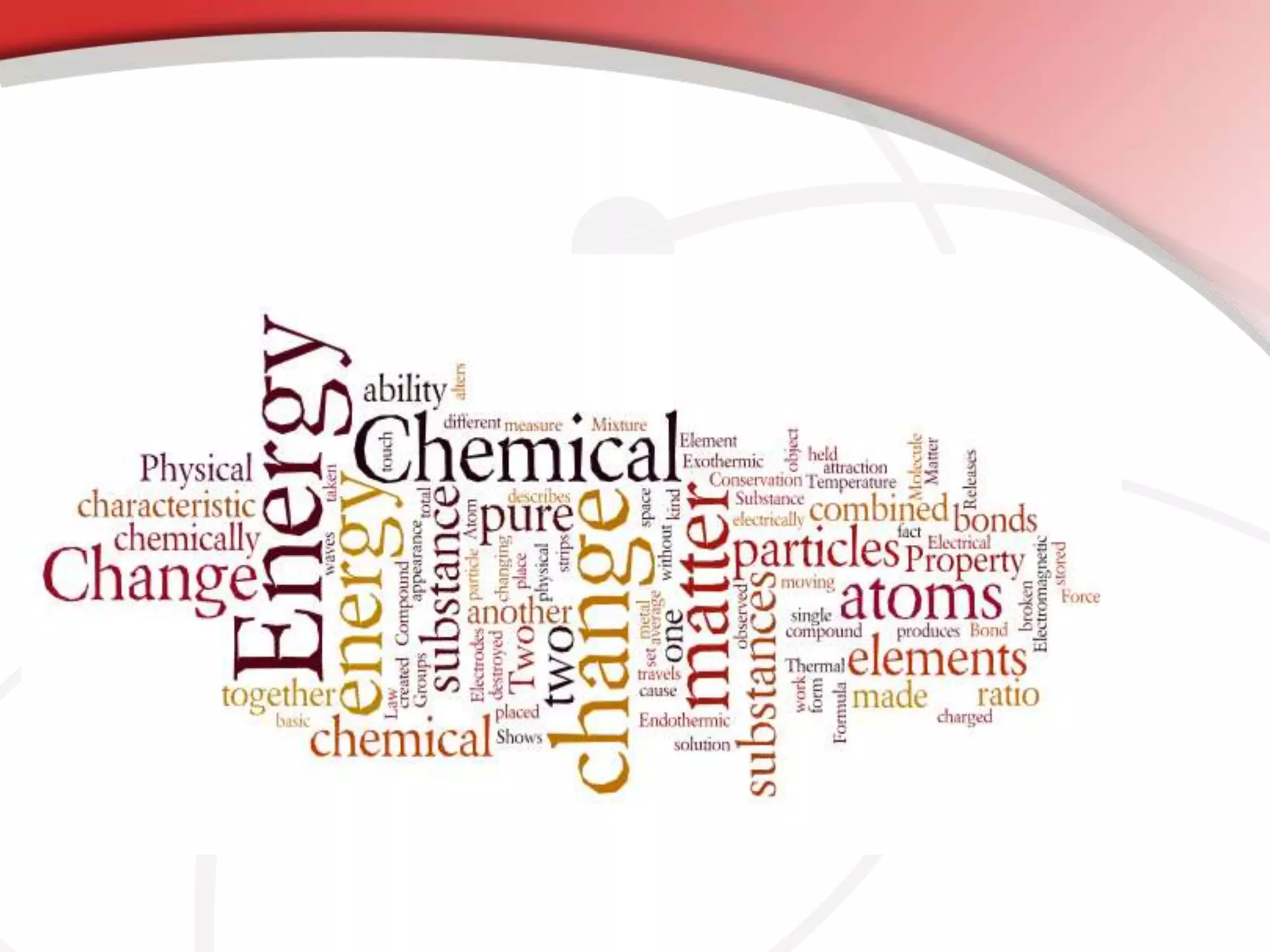
  • #12 We created a wordle with the terms and definitions. The words that are biggest are the terms or definitions that are most common in the chapter about matter.