Dr .ShahadaBaloch + Google.com
WHAT IS KPI
1.
‘ A set of quantifiable (countable )measures that a
company or industry uses to gauge or compare
performance in terms of meeting their strategic and
operational goals.
KPIs vary between companies and industries,
depending on their priorities or performance criteria.
Also referred to as "key success indicators (KSI)".
HOW IT CAN HELP
• It helps to measure both the financial and operational goals of a
company.
• Improve operations.
• Increase project flexibility.
• Better job costing processes.
• KPIs focus employees attention on the tasks and processes.
•
ADVANTAGES
Identifies everything that is easy to measure and count.
Visibility on performance and strategic goal
Agility in decision making
Efficient management
A team work on the basis of shared and measurable
objectives.
KPI’s do not give answers, rather they raise questions and
direct once attention.
TYPES OF KPI
1. Process KPIs
• - measure the efficiency or productivity of a business process.
• Examples - Days to deliver an order.
2. Input KPIs - measure assets and resources invested in or used to generate business
results.
• Examples - Dollars spent on research and development, Funding for employee training,
Quality of raw materials.
3. Output KPIs - measure the financial and nonfinancial results of business activities.
• Examples - Revenues, Number of new customers acquired.
4. Leading KPI measure activities that have a significant effect on future performance.
5. Drive the performance of the outcome measure, being predictor of success or failure.
TYPE OF KPI
• Lagging KPI is a type of indicator that reflect the success or failure after an event has been consumed
• Such as most financial KPIs, measure the output of past activity.
• Outcome KPI - Reflects overall results or impact of the business activity in terms of generated benefits, as a quantification of
performance.
• Examples are customer retention, brand awareness.
• Qualitative KPI - A descriptive characteristic, an opinion, a property or a trait
• Examples are employee satisfaction through surveys which gives a qualitative report.
• Quantitative KPI - A measurable characteristic, resulted by counting, adding, or averaging numbers. Quantitative data is most
common in measurement and therefore forms the backbone of most KPIs
• Examples are Units per man-hour.
• Characteristics of a good KP
• KPI is always connected with the corporate goals.
• A KPI are decided by the management
• They are the leading indicators of performance desired by the organization
• Easy to understand
KPI NEED TO BE
• Specific
• Measurable
• Achievable
• Result-oriented or
Relevant
• Time-bound
‫مخصوص‬
‫پیمائش‬ ‫قابل‬
‫حصول‬
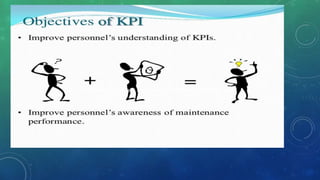
• Improve personnel’s awareness of maintenance performance.
WHY USE KPI
• Performance effectiveness.
• For the accuracy,
• actual reflection of the process,
• efficacy in delivering the outcome.
• The effects of a change can be monitored reliably, repeatedly and accurately by KPI.
• A KPI can be used to closely monitor the results of actions.
• Detect potential problems and it can drive improvement.
• It is reasonable to use the KPI as a tool to improve ongoing process performance.
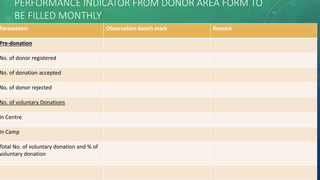
PERFORMANCE INDICATOR FROM DONOR AREA FORM TO
BE FILLED MONTHLY
Parameters Observation bench mark Remark
Pre-donation
No. of donor registered
No. of donation accepted
No. of donor rejected
No. of voluntary Donations
In Centre
In Camp
Total No. of voluntary donation and % of
voluntary donation
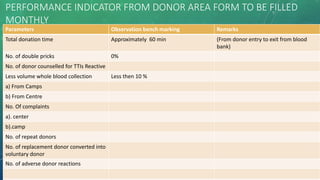
PERFORMANCE INDICATOR FROM DONOR AREA FORM TO BE FILLED
MONTHLY
Parameters Observation bench marking Remarks
Total donation time Approximately 60 min (From donor entry to exit from blood
bank)
No. of double pricks 0%
No. of donor counselled for TTIs Reactive
Less volume whole blood collection Less then 10 %
a) From Camps
b) From Centre
No. Of complaints
a). center
b).camp
No. of repeat donors
No. of replacement donor converted into
voluntary donor
No. of adverse donor reactions
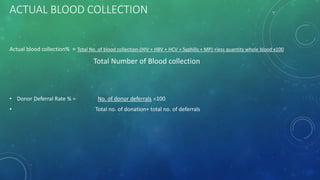
ACTUAL BLOOD COLLECTION
Actual blood collection% = Total No. of blood collection-(HIV + HBV + HCV + Syphilis + MP) +less quantity whole blood x100
Total Number of Blood collection
• Donor Deferral Rate % = No. of donor deferrals 100
• Total no. of donation+ total no. of deferrals
ACTUAL VOLUNTARY BLOOD DONATION
• Actual Voluntary blood donation% = Total No. of blood collection-Replacement donation + x100
Total Number of Blood collection
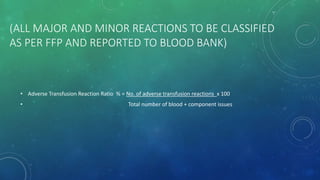
(ALL MAJOR AND MINOR REACTIONS TO BE CLASSIFIED
AS PER FFP AND REPORTED TO BLOOD BANK)
• Adverse Transfusion Reaction Ratio % = No. of adverse transfusion reactions x 100
• Total number of blood + component issues
LABORATORY
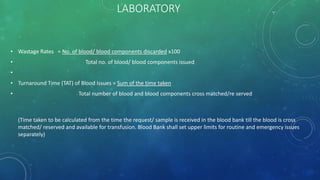
• Wastage Rates = No. of blood/ blood components discarded x100
• Total no. of blood/ blood components issued
•
• Turnaround Time (TAT) of Blood Issues = Sum of the time taken
• Total number of blood and blood components cross matched/re served
(Time taken to be calculated from the time the request/ sample is received in the blood bank till the blood is cross
matched/ reserved and available for transfusion. Blood Bank shall set upper limits for routine and emergency issues
separately)
LABORATORY
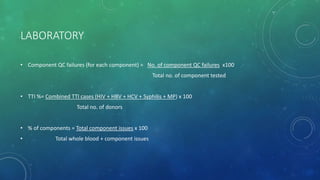
• Component QC failures (for each component) = No. of component QC failures x100
Total no. of component tested
• TTI %= Combined TTI cases (HIV + HBV + HCV + Syphilis + MP) x 100
Total no. of donors
• % of components = Total component issues x 100
• Total whole blood + component issues
HOW ARE KPIS EVALUATED
A KPIs status and score
are determined by
comparing its actual value
against the thresholds that
you define.
The performance status of
a KPI is represented by the
status icon that you assign
to each range.

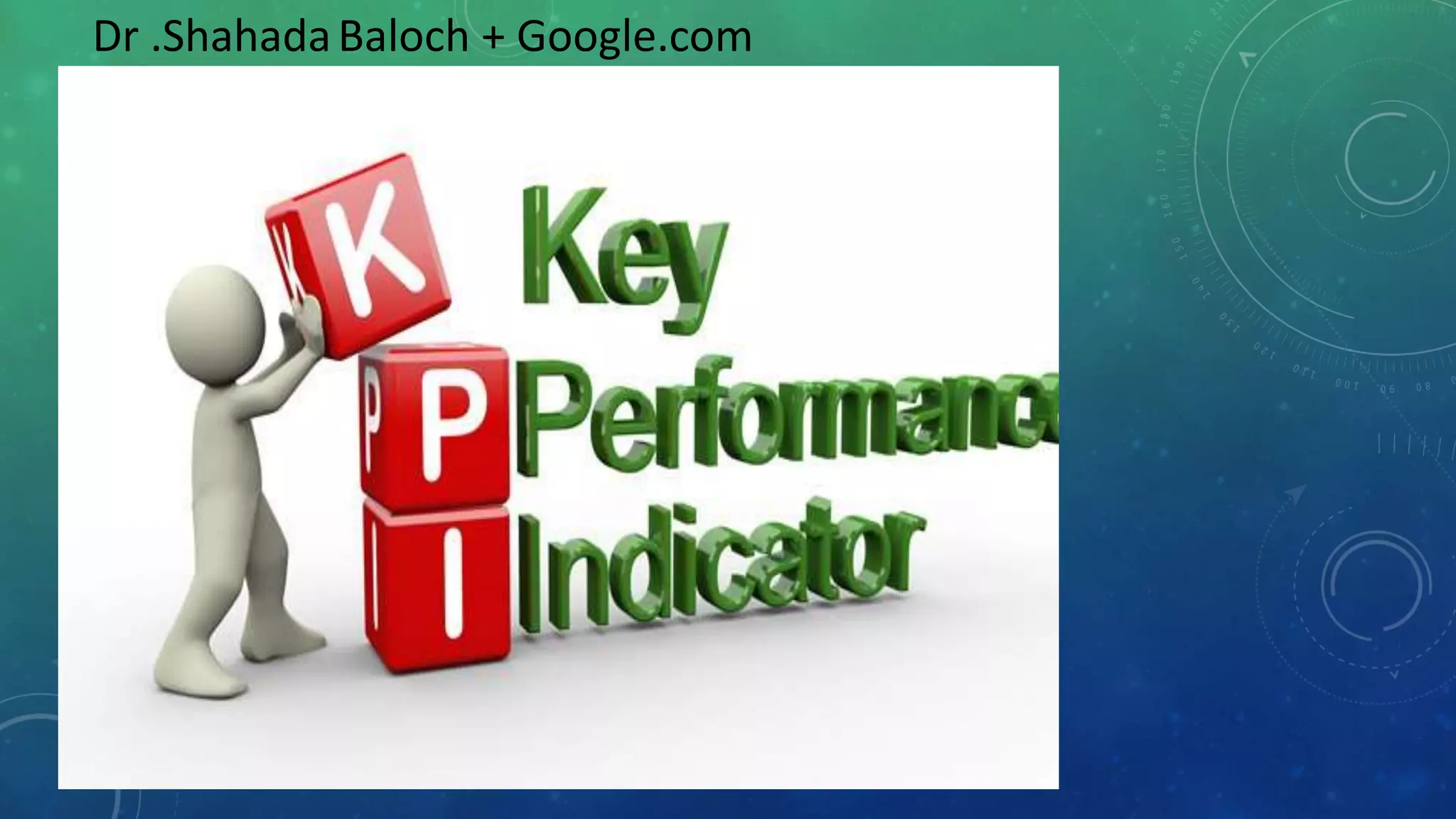
key performance indicator

  • 1.
  • 2.
    WHAT IS KPI 1. ‘A set of quantifiable (countable )measures that a company or industry uses to gauge or compare performance in terms of meeting their strategic and operational goals. KPIs vary between companies and industries, depending on their priorities or performance criteria. Also referred to as "key success indicators (KSI)".
  • 3.
    HOW IT CANHELP • It helps to measure both the financial and operational goals of a company. • Improve operations. • Increase project flexibility. • Better job costing processes. • KPIs focus employees attention on the tasks and processes. •
  • 4.
    ADVANTAGES Identifies everything thatis easy to measure and count. Visibility on performance and strategic goal Agility in decision making Efficient management A team work on the basis of shared and measurable objectives. KPI’s do not give answers, rather they raise questions and direct once attention.
  • 5.
    TYPES OF KPI 1.Process KPIs • - measure the efficiency or productivity of a business process. • Examples - Days to deliver an order. 2. Input KPIs - measure assets and resources invested in or used to generate business results. • Examples - Dollars spent on research and development, Funding for employee training, Quality of raw materials. 3. Output KPIs - measure the financial and nonfinancial results of business activities. • Examples - Revenues, Number of new customers acquired. 4. Leading KPI measure activities that have a significant effect on future performance. 5. Drive the performance of the outcome measure, being predictor of success or failure.
  • 6.
    TYPE OF KPI •Lagging KPI is a type of indicator that reflect the success or failure after an event has been consumed • Such as most financial KPIs, measure the output of past activity. • Outcome KPI - Reflects overall results or impact of the business activity in terms of generated benefits, as a quantification of performance. • Examples are customer retention, brand awareness. • Qualitative KPI - A descriptive characteristic, an opinion, a property or a trait • Examples are employee satisfaction through surveys which gives a qualitative report. • Quantitative KPI - A measurable characteristic, resulted by counting, adding, or averaging numbers. Quantitative data is most common in measurement and therefore forms the backbone of most KPIs • Examples are Units per man-hour. • Characteristics of a good KP • KPI is always connected with the corporate goals. • A KPI are decided by the management • They are the leading indicators of performance desired by the organization • Easy to understand
  • 7.
    KPI NEED TOBE • Specific • Measurable • Achievable • Result-oriented or Relevant • Time-bound ‫مخصوص‬ ‫پیمائش‬ ‫قابل‬ ‫حصول‬
  • 8.
    • Improve personnel’sawareness of maintenance performance.
  • 9.
    WHY USE KPI •Performance effectiveness. • For the accuracy, • actual reflection of the process, • efficacy in delivering the outcome. • The effects of a change can be monitored reliably, repeatedly and accurately by KPI. • A KPI can be used to closely monitor the results of actions. • Detect potential problems and it can drive improvement. • It is reasonable to use the KPI as a tool to improve ongoing process performance.
  • 10.
    PERFORMANCE INDICATOR FROMDONOR AREA FORM TO BE FILLED MONTHLY Parameters Observation bench mark Remark Pre-donation No. of donor registered No. of donation accepted No. of donor rejected No. of voluntary Donations In Centre In Camp Total No. of voluntary donation and % of voluntary donation
  • 11.
    PERFORMANCE INDICATOR FROMDONOR AREA FORM TO BE FILLED MONTHLY Parameters Observation bench marking Remarks Total donation time Approximately 60 min (From donor entry to exit from blood bank) No. of double pricks 0% No. of donor counselled for TTIs Reactive Less volume whole blood collection Less then 10 % a) From Camps b) From Centre No. Of complaints a). center b).camp No. of repeat donors No. of replacement donor converted into voluntary donor No. of adverse donor reactions
  • 12.
    ACTUAL BLOOD COLLECTION Actualblood collection% = Total No. of blood collection-(HIV + HBV + HCV + Syphilis + MP) +less quantity whole blood x100 Total Number of Blood collection • Donor Deferral Rate % = No. of donor deferrals 100 • Total no. of donation+ total no. of deferrals
  • 13.
    ACTUAL VOLUNTARY BLOODDONATION • Actual Voluntary blood donation% = Total No. of blood collection-Replacement donation + x100 Total Number of Blood collection
  • 14.
    (ALL MAJOR ANDMINOR REACTIONS TO BE CLASSIFIED AS PER FFP AND REPORTED TO BLOOD BANK) • Adverse Transfusion Reaction Ratio % = No. of adverse transfusion reactions x 100 • Total number of blood + component issues
  • 15.
    LABORATORY • Wastage Rates= No. of blood/ blood components discarded x100 • Total no. of blood/ blood components issued • • Turnaround Time (TAT) of Blood Issues = Sum of the time taken • Total number of blood and blood components cross matched/re served (Time taken to be calculated from the time the request/ sample is received in the blood bank till the blood is cross matched/ reserved and available for transfusion. Blood Bank shall set upper limits for routine and emergency issues separately)
  • 16.
    LABORATORY • Component QCfailures (for each component) = No. of component QC failures x100 Total no. of component tested • TTI %= Combined TTI cases (HIV + HBV + HCV + Syphilis + MP) x 100 Total no. of donors • % of components = Total component issues x 100 • Total whole blood + component issues
  • 17.
    HOW ARE KPISEVALUATED A KPIs status and score are determined by comparing its actual value against the thresholds that you define. The performance status of a KPI is represented by the status icon that you assign to each range.