What is KPI
 Definition of 'Key Performance Indicators - KPI‘


     A set of quantifiable measures that a company or
 industry uses to gauge or compare performance in
 terms of meeting their strategic and operational goals.
 KPIs vary between companies and industries,
 depending on their priorities or performance criteria.
 Also referred to as "key success indicators (KSI)".
Objectives of KPI
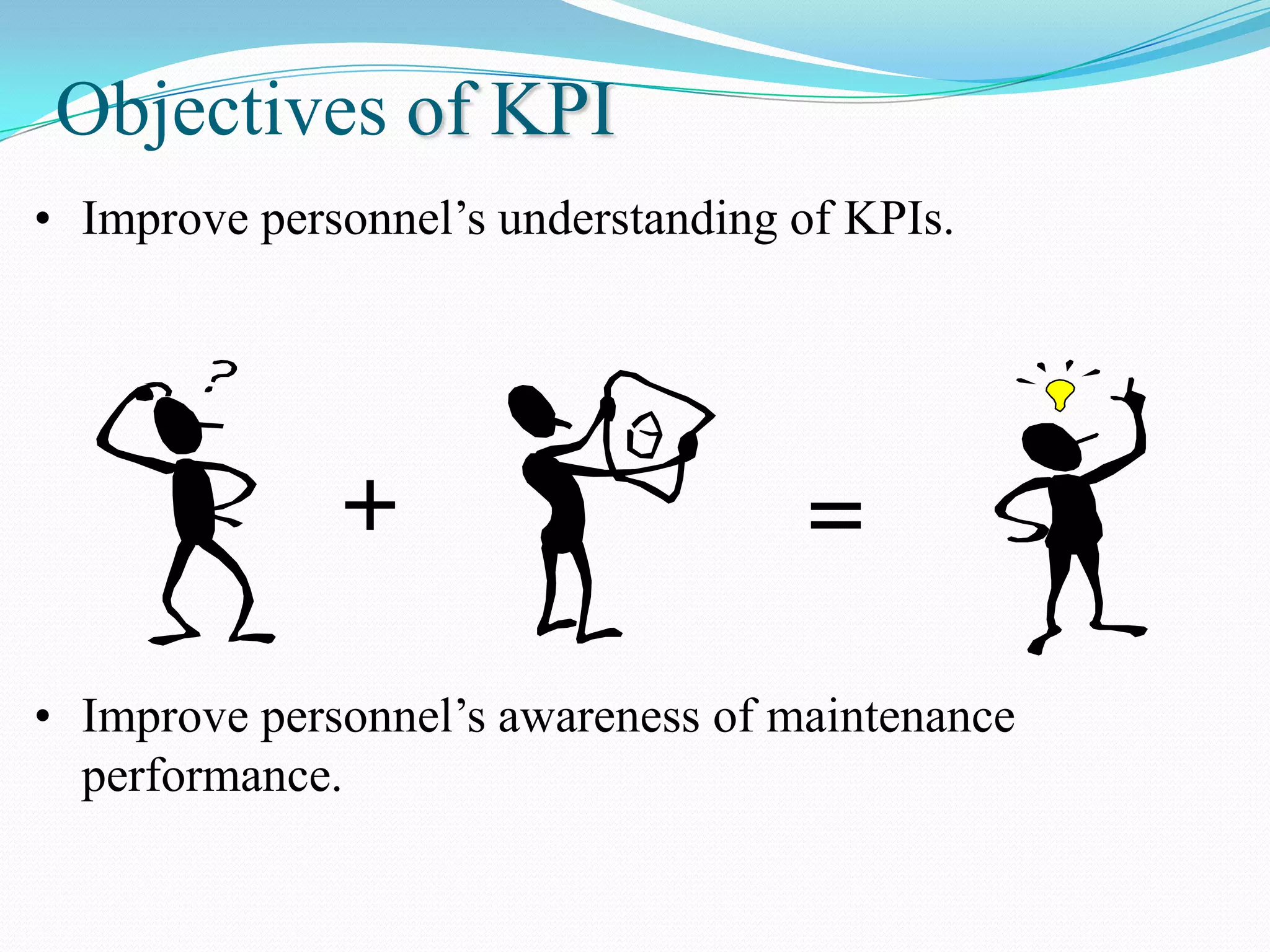
• Improve personnel’s understanding of KPIs.


              +                     =
• Improve personnel’s awareness of maintenance
  performance.
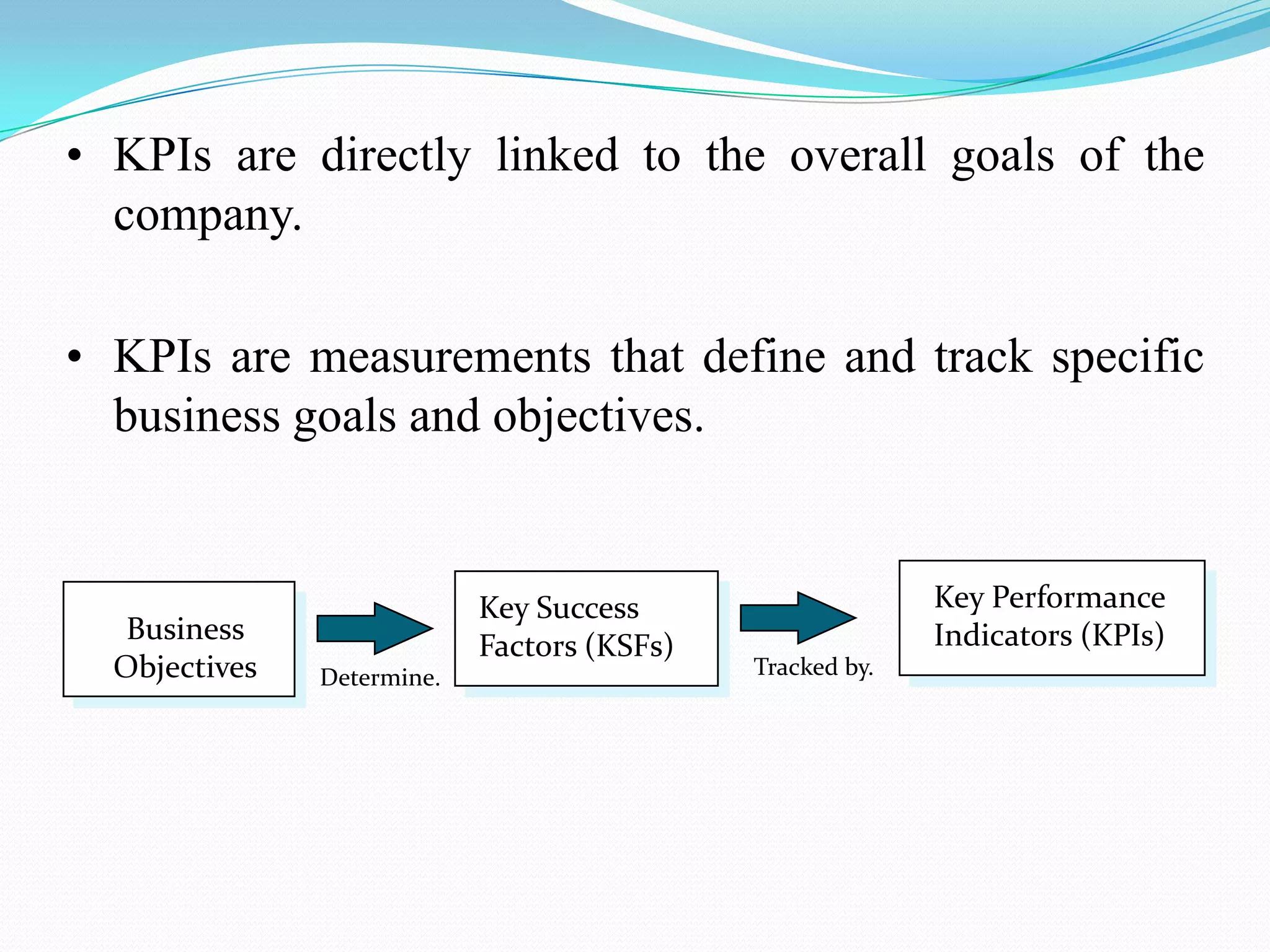
• KPIs are directly linked to the overall goals of the
  company.

• KPIs are measurements that define and track specific
  business goals and objectives.


                            Key Success                    Key Performance
   Business                                                Indicators (KPIs)
                            Factors (KSFs)
  Objectives   Determine.                    Tracked by.
 The larger or smaller organizational strategies require
  monitoring, improvement, and evaluation.

 Once an organization has analyzed its mission,
  identified all its stakeholders, and defined its goals, it
  needs a way to measure progress toward those goals.

 KPIs are utilized to track or measure actual
  performance against key success factors.
• Key Success Factors (KSFs) only change if there is a
  fundamental shift in business objectives.


• Key Performance Indicators (KPIs) change as
  objectives are met, or management focus shifts.
Why Use KPI’s
 Performance effectiveness.


 For the accuracy, actual reflection of the process,
  efficacy in delivering the outcome.

 The effects of a change can be monitored reliably,
  repeatedly and accurately by KPI.
 A KPI can be used to closely monitor the results of
  actions.

 Detect potential   problems    and   it   can   drive
  improvement.

 It is reasonable to use the KPI as a tool to improve
  ongoing process performance.
Uses of KPI
 A key performance indicator (KPI) or performance
 indicator is used to measure the performance.

 To make the decision making process easier.


 Key Performance Indicators (KPIs) help
  organizations to understand how well they are
 performing in relation to their strategic goals and
 objectives.
 They are used by an organization to evaluate its
  success or the success of a particular activity in the
  organization.

 To analyze the operational details of the organization.


 It helps to focus on the facts clearly.


 Key performance indicators are used periodically
  assess the performances of organizations, business
  units, and their division, departments and employees.
How to design KPI’s
 KPIs should be clearly linked to the strategy, i.e. the
  things that matter the most.

 KPIs have to provide the answers to our most
  important questions.

 KPIs should be primarily designed to empower
 employees and provide them with the relevant
 information to learn.
Identifying the KPI’s
 Related to strategic aims.
 Identify what makes the organization success or
  failures.
 Controllable and accountable.
 Qualitative and quantitative.
 Long term and short term.
 Consider Stakeholder needs.

 Identify important aspects.

 Establish Company Goals and KPIs.

 Select Performance Indicators and Metrics.

 Set Targets and Track Performance.
How Are KPIs Evaluated
 A KPI's status and score are determined by comparing
  its actual value against the thresholds that you define.

 The performance status of a KPI is represented by the
 status icon that you assign to each range.
Advantages
 Identifies everything that is easy to measure and
  count.
 Visibility on performance and strategic goal
 Agility in decision making
 Efficient management
 A team work on the basis of shared and measurable
  objectives.
 KPI’s do not give answers, rather they raise questions
  and direct once attention.
 It helps to measure both the financial and operational
  goals of a company.

 Improve operations.

 Increase project flexibility.

 Better job costing processes.

 KPIs focus employees' attention on the tasks and
  processes.
Disadvantages
 The KPI’s is intended to simply improve future
  results without reference to external parties and
  benchmarks.
 In that case one must develop KPI’s which use
  existing data available to the organization.
 Frequency of Data Collection.
 Should be measured frequently.
 No connection with the external database.
 Short – termist.

 Backward looking.

 Used to punish rather than to motivate and equip.

 Too many measurements.

 Limits are to be set by the company itself.
Types of KPI
 Process KPIs - measure the efficiency or
  productivity of a business process.
 Examples - Days to deliver an order.


 Input KPIs - measure assets and resources invested
  in or used to generate business results.
 Examples - Dollars spent on research and
  development, Funding for employee training, Quality
  of raw materials.
 Output KPIs -            measure the financial   and
  nonfinancial results of business activities.
 Examples - Revenues, Number of new customers
  acquired.

 Leading KPI measure activities that         have a
  significant effect on future performance.
 Drive the performance of the outcome measure, being
  predictor of success or failure.
 Lagging KPI is a type of indicator that reflect the
  success or failure after an event has been consumed.
 Such as most financial KPIs, measure the output of
  past activity.

 Outcome KPI - Reflects overall results or impact of
  the business activity in terms of generated benefits, as
  a quantification of performance.
 Examples are customer retention, brand awareness.
 Qualitative KPI - A descriptive characteristic, an
  opinion, a property or a trait.
 Examples are employee satisfaction through surveys
  which gives a qualitative report.

 Quantitative KPI - A measurable characteristic,
  resulted by counting, adding, or averaging numbers.
  Quantitative data is most common in measurement
  and therefore forms the backbone of most KPIs.
 Examples are Units per man-hour.
Characteristics of a good KPI
 KPI is always connected with the corporate goals.


 A KPI are decided by the management.


 They are the leading indicators of performance
  desired by the organization.

 Easy to understand
A KPI need to be:

 Specific

 Measurable

 Achievable

 Result-oriented or Relevant

 Time-bound
Shipping and Logistics
The main five KPI’s in shipping and logistic industries
  are:
 Sales forecasts.
 Inventory.
 Procurement and suppliers.
 Warehousing.
 Transportation.
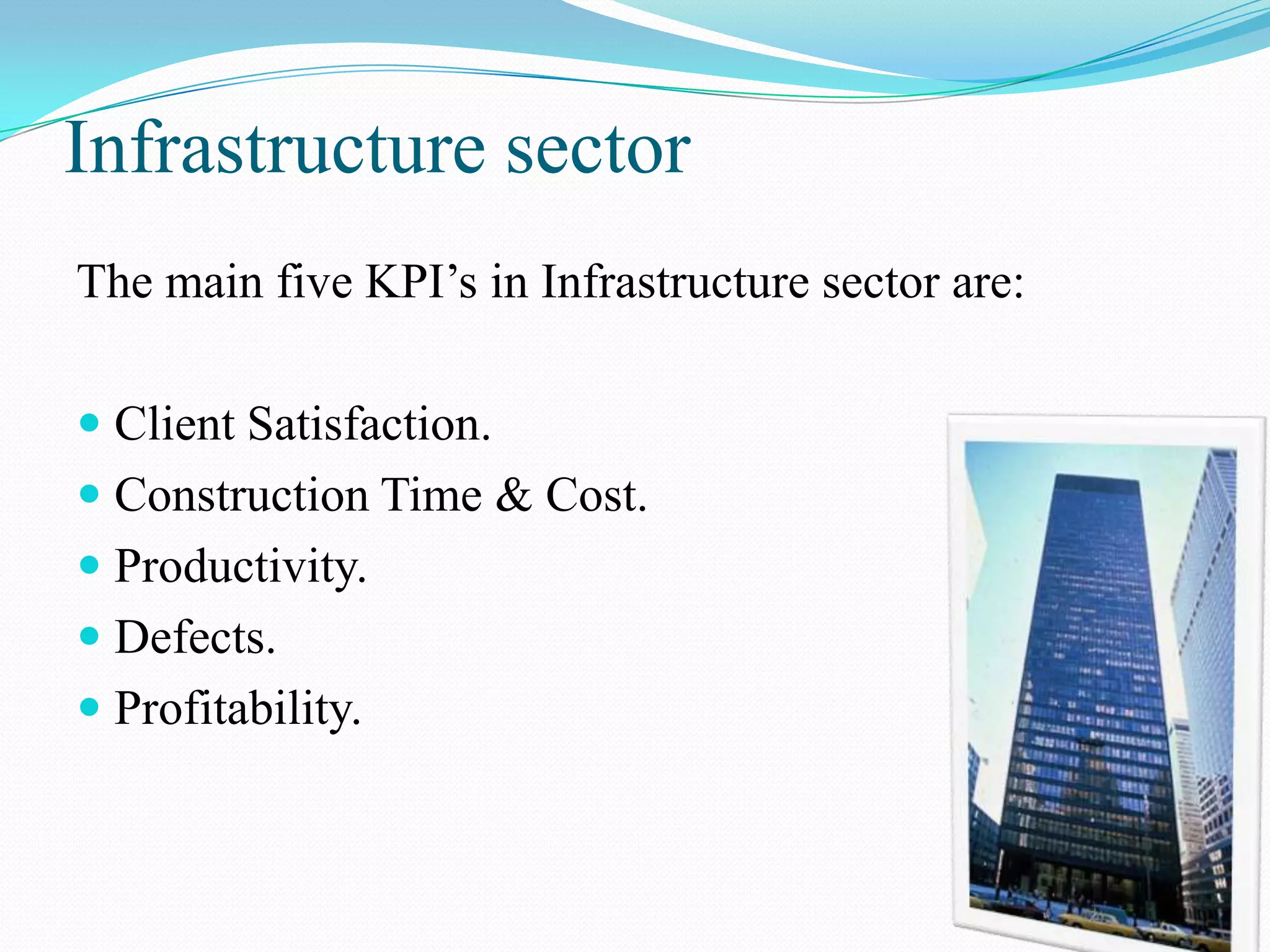
Infrastructure sector
The main five KPI’s in Infrastructure sector are:

 Client Satisfaction.
 Construction Time & Cost.
 Productivity.
 Defects.
 Profitability.
Bibliography
 en.wikipedia.org/wiki/Performance_indicator
 www.investopedia.com/terms/k/kpi.asp
 kpilibrary.com/
 www.smartkpis.com/
Thank you

KEY PERFORMANCE INDICATOR

  • 2.
    What is KPI Definition of 'Key Performance Indicators - KPI‘ A set of quantifiable measures that a company or industry uses to gauge or compare performance in terms of meeting their strategic and operational goals. KPIs vary between companies and industries, depending on their priorities or performance criteria. Also referred to as "key success indicators (KSI)".
  • 3.
    Objectives of KPI •Improve personnel’s understanding of KPIs. + = • Improve personnel’s awareness of maintenance performance.
  • 4.
    • KPIs aredirectly linked to the overall goals of the company. • KPIs are measurements that define and track specific business goals and objectives. Key Success Key Performance Business Indicators (KPIs) Factors (KSFs) Objectives Determine. Tracked by.
  • 5.
     The largeror smaller organizational strategies require monitoring, improvement, and evaluation.  Once an organization has analyzed its mission, identified all its stakeholders, and defined its goals, it needs a way to measure progress toward those goals.  KPIs are utilized to track or measure actual performance against key success factors.
  • 6.
    • Key SuccessFactors (KSFs) only change if there is a fundamental shift in business objectives. • Key Performance Indicators (KPIs) change as objectives are met, or management focus shifts.
  • 7.
    Why Use KPI’s Performance effectiveness.  For the accuracy, actual reflection of the process, efficacy in delivering the outcome.  The effects of a change can be monitored reliably, repeatedly and accurately by KPI.
  • 8.
     A KPIcan be used to closely monitor the results of actions.  Detect potential problems and it can drive improvement.  It is reasonable to use the KPI as a tool to improve ongoing process performance.
  • 9.
    Uses of KPI A key performance indicator (KPI) or performance indicator is used to measure the performance.  To make the decision making process easier.  Key Performance Indicators (KPIs) help organizations to understand how well they are performing in relation to their strategic goals and objectives.
  • 10.
     They areused by an organization to evaluate its success or the success of a particular activity in the organization.  To analyze the operational details of the organization.  It helps to focus on the facts clearly.  Key performance indicators are used periodically assess the performances of organizations, business units, and their division, departments and employees.
  • 11.
    How to designKPI’s  KPIs should be clearly linked to the strategy, i.e. the things that matter the most.  KPIs have to provide the answers to our most important questions.  KPIs should be primarily designed to empower employees and provide them with the relevant information to learn.
  • 13.
    Identifying the KPI’s Related to strategic aims.  Identify what makes the organization success or failures.  Controllable and accountable.  Qualitative and quantitative.  Long term and short term.
  • 14.
     Consider Stakeholderneeds.  Identify important aspects.  Establish Company Goals and KPIs.  Select Performance Indicators and Metrics.  Set Targets and Track Performance.
  • 15.
    How Are KPIsEvaluated  A KPI's status and score are determined by comparing its actual value against the thresholds that you define.  The performance status of a KPI is represented by the status icon that you assign to each range.
  • 16.
    Advantages  Identifies everythingthat is easy to measure and count.  Visibility on performance and strategic goal  Agility in decision making  Efficient management  A team work on the basis of shared and measurable objectives.  KPI’s do not give answers, rather they raise questions and direct once attention.
  • 17.
     It helpsto measure both the financial and operational goals of a company.  Improve operations.  Increase project flexibility.  Better job costing processes.  KPIs focus employees' attention on the tasks and processes.
  • 18.
    Disadvantages  The KPI’sis intended to simply improve future results without reference to external parties and benchmarks.  In that case one must develop KPI’s which use existing data available to the organization.  Frequency of Data Collection.  Should be measured frequently.  No connection with the external database.
  • 19.
     Short –termist.  Backward looking.  Used to punish rather than to motivate and equip.  Too many measurements.  Limits are to be set by the company itself.
  • 20.
    Types of KPI Process KPIs - measure the efficiency or productivity of a business process.  Examples - Days to deliver an order.  Input KPIs - measure assets and resources invested in or used to generate business results.  Examples - Dollars spent on research and development, Funding for employee training, Quality of raw materials.
  • 21.
     Output KPIs- measure the financial and nonfinancial results of business activities.  Examples - Revenues, Number of new customers acquired.  Leading KPI measure activities that have a significant effect on future performance.  Drive the performance of the outcome measure, being predictor of success or failure.
  • 22.
     Lagging KPIis a type of indicator that reflect the success or failure after an event has been consumed.  Such as most financial KPIs, measure the output of past activity.  Outcome KPI - Reflects overall results or impact of the business activity in terms of generated benefits, as a quantification of performance.  Examples are customer retention, brand awareness.
  • 23.
     Qualitative KPI- A descriptive characteristic, an opinion, a property or a trait.  Examples are employee satisfaction through surveys which gives a qualitative report.  Quantitative KPI - A measurable characteristic, resulted by counting, adding, or averaging numbers. Quantitative data is most common in measurement and therefore forms the backbone of most KPIs.  Examples are Units per man-hour.
  • 24.
    Characteristics of agood KPI  KPI is always connected with the corporate goals.  A KPI are decided by the management.  They are the leading indicators of performance desired by the organization.  Easy to understand
  • 25.
    A KPI needto be:  Specific  Measurable  Achievable  Result-oriented or Relevant  Time-bound
  • 26.
    Shipping and Logistics Themain five KPI’s in shipping and logistic industries are:  Sales forecasts.  Inventory.  Procurement and suppliers.  Warehousing.  Transportation.
  • 27.
    Infrastructure sector The mainfive KPI’s in Infrastructure sector are:  Client Satisfaction.  Construction Time & Cost.  Productivity.  Defects.  Profitability.
  • 28.
  • 29.