 Blood Donor Criteria & Deferral Criteria
by
Dr.Shahida Baloch
Who is Blood Donors
1.Voluntary Donors
Donate Blood on their own
From within the patient’s own family
or community
Are patients who donate their
own blood for self
Donate blood components through
the process of cell separation
Means a person who donates blood for a
valuable consideration, in cash or kind, for
any source, on behalf of the recipient
patient includes a paid donor or a
commercial donor.
 are the low risk donors for
 • Safe blood
 • Sustainable blood Supply Replacement Donors-not a
preferred system
 • Risks of professional Donors
 .• Risk of hidden information
 Donor Recruitment
 Donor Retention
 Donor Selection
 Blood Collection
 Donor Counseling
 An adequate supply of low risk donors requires
 A donor recruitment program
 A dedicated recruitment section with trained
staff
 The quality of the BTS is influenced by the quality
of each of the links Blood donors Collection
Processing Screening and testing Transfusion
Policy for blood Collection
 The first & the most important step, in ensuring that blood
and its products for transfusion do not have any pathogenic
virus /bacteria, is the
 .Donor selection should be done carefully
 .The donor should be in good health to avoid any untoward effect
to the donor or to the recipient.
 Pre Donation Information
 Documents to give information to donors
 General advice Pre- and post- donation Information about giving
blood
 Deferral information Self- deferral on the basis of medical
condition Self- deferral on the basis of risk behavior
 • Registration, consent of the donor &demographic information.•
Medical history• Physical examination.• Laboratory test
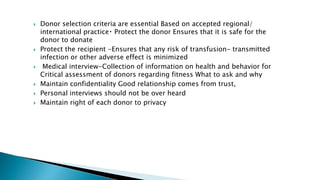
 Donor selection criteria are essential Based on accepted regional/
international practice Protect the donor Ensures that it is safe for the
donor to donate
 Protect the recipient -Ensures that any risk of transfusion- transmitted
infection or other adverse effect is minimized
 Medical interview-Collection of information on health and behavior for
Critical assessment of donors regarding fitness What to ask and why
 Maintain confidentiality Good relationship comes from trust,
 Personal interviews should not be over heard
 Maintain right of each donor to privacy
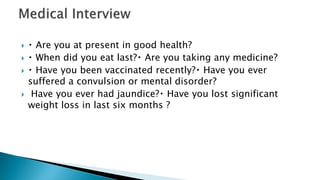
 Are you at present in good health?
 When did you eat last? Are you taking any medicine?
 Have you been vaccinated recently? Have you ever
suffered a convulsion or mental disorder?
 Have you ever had jaundice? Have you lost significant
weight loss in last six months ?
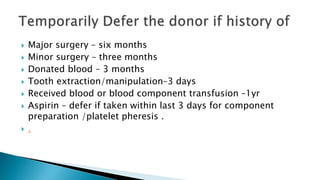
 Major surgery – six months
 Minor surgery – three months
 Donated blood – 3 months
 Tooth extraction/manipulation–3 days
 Received blood or blood component transfusion –1yr
 Aspirin – defer if taken within last 3 days for component
preparation /platelet pheresis .
 .
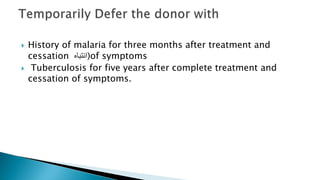
 History of malaria for three months after treatment and
cessation ‫)انتباہ‬of symptoms
 Tuberculosis for five years after complete treatment and
cessation of symptoms.
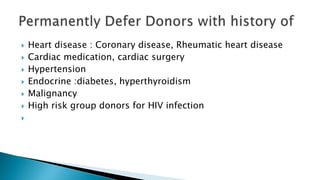
 Heart disease : Coronary disease, Rheumatic heart disease
 Cardiac medication, cardiac surgery
 Hypertension
 Endocrine :diabetes, hyperthyroidism
 Malignancy
 High risk group donors for HIV infection

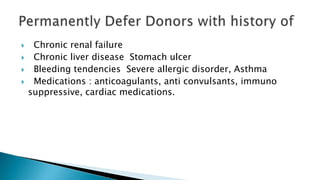
 Chronic renal failure
 Chronic liver disease Stomach ulcer
 Bleeding tendencies Severe allergic disorder, Asthma
 Medications : anticoagulants, anti convulsants, immuno
suppressive, cardiac medications.
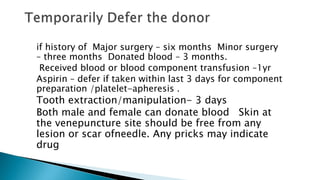
if history of Major surgery – six months Minor surgery
– three months Donated blood – 3 months.
Received blood or blood component transfusion –1yr
Aspirin – defer if taken within last 3 days for component
preparation /platelet-apheresis .
Tooth extraction/manipulation- 3 days
Both male and female can donate blood Skin at
the venepuncture site should be free from any
lesion or scar ofneedle. Any pricks may indicate
drug
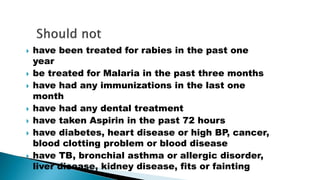
 have been treated for rabies in the past one
year
 be treated for Malaria in the past three months
 have had any immunizations in the last one
month
 have had any dental treatment
 have taken Aspirin in the past 72 hours
 have diabetes, heart disease or high BP, cancer,
blood clotting problem or blood disease
 have TB, bronchial asthma or allergic disorder,
liver disease, kidney disease, fits or fainting
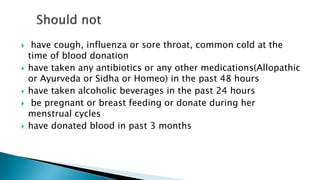
 have cough, influenza or sore throat, common cold at the
time of blood donation
 have taken any antibiotics or any other medications(Allopathic
or Ayurveda or Sidha or Homeo) in the past 48 hours
 have taken alcoholic beverages in the past 24 hours
 be pregnant or breast feeding or donate during her
menstrual cycles
 have donated blood in past 3 months
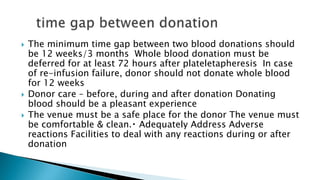
 The minimum time gap between two blood donations should
be 12 weeks/3 months Whole blood donation must be
deferred for at least 72 hours after plateletapheresis In case
of re-infusion failure, donor should not donate whole blood
for 12 weeks
 Donor care – before, during and after donation Donating
blood should be a pleasant experience
 The venue must be a safe place for the donor The venue must
be comfortable & clean. Adequately Address Adverse
reactions Facilities to deal with any reactions during or after
donation
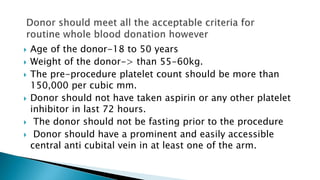
 Age of the donor-18 to 50 years
 Weight of the donor-> than 55-60kg.
 The pre-procedure platelet count should be more than
150,000 per cubic mm.
 Donor should not have taken aspirin or any other platelet
inhibitor in last 72 hours.
 The donor should not be fasting prior to the procedure
 Donor should have a prominent and easily accessible
central anti cubital vein in at least one of the arm.
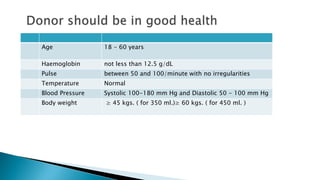
Age 18 - 60 years
Haemoglobin not less than 12.5 g/dL
Pulse between 50 and 100/minute with no irregularities
Temperature Normal
Blood Pressure Systolic 100-180 mm Hg and Diastolic 50 - 100 mm Hg
Body weight ≥ 45 kgs. ( for 350 ml.)≥ 60 kgs. ( for 450 ml. )
 Everyone involved in interviewing & counselling should
develop a friendly & tactful approach that encourages
donors to be honest & accurate in their answers to questions
about their medical history. The health check should always
be handled professionally so that the donors feel they are in
good hands Be sensitive to the donors feelings of fear
&embarrassment No chatting with other staff & ignoring the
donor
 DONOR CARE-DURINGDONATION Staff must be trained in
interpersonal skills and should always be smart & clean in
appearance with high standard of personal hygiene Staff
should have pleasant manners & be capable of conversing
freely with donors at the time of donation. An act of
carelessness or lack of professionalism by staff during or
after donation can be detrimental to the donors coming
back again to donate blood.
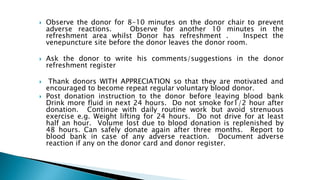
 Observe the donor for 8-10 minutes on the donor chair to prevent
adverse reactions. Observe for another 10 minutes in the
refreshment area whilst Donor has refreshment . Inspect the
venepuncture site before the donor leaves the donor room.
 Ask the donor to write his comments/suggestions in the donor
refreshment register
 Thank donors WITH APPRECIATION so that they are motivated and
encouraged to become repeat regular voluntary blood donor.
 Post donation instruction to the donor before leaving blood bank
Drink more fluid in next 24 hours. Do not smoke for1/2 hour after
donation. Continue with daily routine work but avoid strenuous
exercise e.g. Weight lifting for 24 hours. Do not drive for at least
half an hour. Volume lost due to blood donation is replenished by
48 hours. Can safely donate again after three months. Report to
blood bank in case of any adverse reaction. Document adverse
reaction if any on the donor card and donor register.
thanks

Donor selection and type ss

  • 1.
     Blood DonorCriteria & Deferral Criteria by Dr.Shahida Baloch
  • 3.
    Who is BloodDonors 1.Voluntary Donors Donate Blood on their own
  • 4.
    From within thepatient’s own family or community
  • 5.
    Are patients whodonate their own blood for self
  • 6.
    Donate blood componentsthrough the process of cell separation
  • 7.
    Means a personwho donates blood for a valuable consideration, in cash or kind, for any source, on behalf of the recipient patient includes a paid donor or a commercial donor.
  • 8.
     are thelow risk donors for  • Safe blood  • Sustainable blood Supply Replacement Donors-not a preferred system  • Risks of professional Donors  .• Risk of hidden information
  • 9.
     Donor Recruitment Donor Retention  Donor Selection  Blood Collection  Donor Counseling  An adequate supply of low risk donors requires  A donor recruitment program  A dedicated recruitment section with trained staff  The quality of the BTS is influenced by the quality of each of the links Blood donors Collection Processing Screening and testing Transfusion Policy for blood Collection
  • 10.
     The first& the most important step, in ensuring that blood and its products for transfusion do not have any pathogenic virus /bacteria, is the
  • 11.
     .Donor selectionshould be done carefully  .The donor should be in good health to avoid any untoward effect to the donor or to the recipient.  Pre Donation Information  Documents to give information to donors  General advice Pre- and post- donation Information about giving blood  Deferral information Self- deferral on the basis of medical condition Self- deferral on the basis of risk behavior  • Registration, consent of the donor &demographic information.• Medical history• Physical examination.• Laboratory test
  • 12.
     Donor selectioncriteria are essential Based on accepted regional/ international practice Protect the donor Ensures that it is safe for the donor to donate  Protect the recipient -Ensures that any risk of transfusion- transmitted infection or other adverse effect is minimized  Medical interview-Collection of information on health and behavior for Critical assessment of donors regarding fitness What to ask and why  Maintain confidentiality Good relationship comes from trust,  Personal interviews should not be over heard  Maintain right of each donor to privacy
  • 13.
     Are youat present in good health?  When did you eat last? Are you taking any medicine?  Have you been vaccinated recently? Have you ever suffered a convulsion or mental disorder?  Have you ever had jaundice? Have you lost significant weight loss in last six months ?
  • 14.
     Major surgery– six months  Minor surgery – three months  Donated blood – 3 months  Tooth extraction/manipulation–3 days  Received blood or blood component transfusion –1yr  Aspirin – defer if taken within last 3 days for component preparation /platelet pheresis .  .
  • 15.
     History ofmalaria for three months after treatment and cessation ‫)انتباہ‬of symptoms  Tuberculosis for five years after complete treatment and cessation of symptoms.
  • 16.
     Heart disease: Coronary disease, Rheumatic heart disease  Cardiac medication, cardiac surgery  Hypertension  Endocrine :diabetes, hyperthyroidism  Malignancy  High risk group donors for HIV infection 
  • 17.
     Chronic renalfailure  Chronic liver disease Stomach ulcer  Bleeding tendencies Severe allergic disorder, Asthma  Medications : anticoagulants, anti convulsants, immuno suppressive, cardiac medications.
  • 18.
    if history ofMajor surgery – six months Minor surgery – three months Donated blood – 3 months. Received blood or blood component transfusion –1yr Aspirin – defer if taken within last 3 days for component preparation /platelet-apheresis . Tooth extraction/manipulation- 3 days Both male and female can donate blood Skin at the venepuncture site should be free from any lesion or scar ofneedle. Any pricks may indicate drug
  • 19.
     have beentreated for rabies in the past one year  be treated for Malaria in the past three months  have had any immunizations in the last one month  have had any dental treatment  have taken Aspirin in the past 72 hours  have diabetes, heart disease or high BP, cancer, blood clotting problem or blood disease  have TB, bronchial asthma or allergic disorder, liver disease, kidney disease, fits or fainting
  • 20.
     have cough,influenza or sore throat, common cold at the time of blood donation  have taken any antibiotics or any other medications(Allopathic or Ayurveda or Sidha or Homeo) in the past 48 hours  have taken alcoholic beverages in the past 24 hours  be pregnant or breast feeding or donate during her menstrual cycles  have donated blood in past 3 months
  • 21.
     The minimumtime gap between two blood donations should be 12 weeks/3 months Whole blood donation must be deferred for at least 72 hours after plateletapheresis In case of re-infusion failure, donor should not donate whole blood for 12 weeks  Donor care – before, during and after donation Donating blood should be a pleasant experience  The venue must be a safe place for the donor The venue must be comfortable & clean. Adequately Address Adverse reactions Facilities to deal with any reactions during or after donation
  • 22.
     Age ofthe donor-18 to 50 years  Weight of the donor-> than 55-60kg.  The pre-procedure platelet count should be more than 150,000 per cubic mm.  Donor should not have taken aspirin or any other platelet inhibitor in last 72 hours.  The donor should not be fasting prior to the procedure  Donor should have a prominent and easily accessible central anti cubital vein in at least one of the arm.
  • 23.
    Age 18 -60 years Haemoglobin not less than 12.5 g/dL Pulse between 50 and 100/minute with no irregularities Temperature Normal Blood Pressure Systolic 100-180 mm Hg and Diastolic 50 - 100 mm Hg Body weight ≥ 45 kgs. ( for 350 ml.)≥ 60 kgs. ( for 450 ml. )
  • 24.
     Everyone involvedin interviewing & counselling should develop a friendly & tactful approach that encourages donors to be honest & accurate in their answers to questions about their medical history. The health check should always be handled professionally so that the donors feel they are in good hands Be sensitive to the donors feelings of fear &embarrassment No chatting with other staff & ignoring the donor  DONOR CARE-DURINGDONATION Staff must be trained in interpersonal skills and should always be smart & clean in appearance with high standard of personal hygiene Staff should have pleasant manners & be capable of conversing freely with donors at the time of donation. An act of carelessness or lack of professionalism by staff during or after donation can be detrimental to the donors coming back again to donate blood.
  • 25.
     Observe thedonor for 8-10 minutes on the donor chair to prevent adverse reactions. Observe for another 10 minutes in the refreshment area whilst Donor has refreshment . Inspect the venepuncture site before the donor leaves the donor room.  Ask the donor to write his comments/suggestions in the donor refreshment register  Thank donors WITH APPRECIATION so that they are motivated and encouraged to become repeat regular voluntary blood donor.  Post donation instruction to the donor before leaving blood bank Drink more fluid in next 24 hours. Do not smoke for1/2 hour after donation. Continue with daily routine work but avoid strenuous exercise e.g. Weight lifting for 24 hours. Do not drive for at least half an hour. Volume lost due to blood donation is replenished by 48 hours. Can safely donate again after three months. Report to blood bank in case of any adverse reaction. Document adverse reaction if any on the donor card and donor register.
  • 26.