Kerberos
Authentication
Protocol
ASHOK BASNET (066BCT505)
BIBEK SUBEDI (066BCT506)
DINESH SUBEDI (066BCT512)
What is Kerberos

    Network authentication protocol
    Developed at MIT in the mid 1980s
    Available as open source or in supported
     commercial software
Kerberos vs Firewall

    Firewalls make a risky assumption: that attackers
     are coming from the outside. In reality, attacks
     frequently come from within.
    Kerberos assumes that network connections
     (rather than servers and work stations) are the
     weak link in network security.
Why Kerberos

    Sending usernames and passwords in the clear
     jeopardizes the security of the network.
    Each time a password is sent in the clear, there is
     a chance for interception.
Architecture

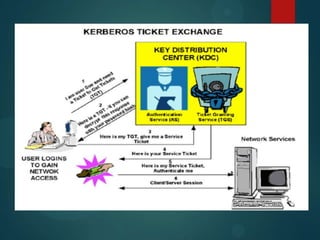
    It consists of following 3 components
1.   Client
2.   Authentication Server or Key Distribution Server (KDC)
3.   Server


And has 3 main exchanges
1.   Authentication Service (AS) Exchange
2.   Ticket Granting Service (TGS) Exchange
3.   Client Server (CS) Exchange
AS Exchange
   Exchange between client and Authentication Server
    (KDC)
   Client sends KRB_AS_REQ msg to KDC specifying
    credentials it wants
   Server replies with msg KRB_AS_REP containing the ticket
    and session key
   The Session key is encrypted with client’s secret key
   The TGT is encrypted with server’s secret key
   The encryption type is DES by default
TGS Exchange
   Is used to obtain additional tickets for the servers.
   Doesn’t need client’s secret key for encryption
   Transparent to the user
   TGS must have access to all secret keys
   But encrypts the ticket using server’s secret key
   Client sends KRB_TGS_REQ to the TGS server
   Server replies KRB_TGS_REP to the client with ticket
CS Exchange
   Client contacts with the real server
   Client sends KRB_AP_REQ to the server specifying the
    service
   Server validates client by decrypting ticket with server’s
    secret key and decrypting authenticator with sessions
    key contained in ticket
   Server optionally replies with KRB_AP_REP
Implementation

   Athena Project at MIT
   Microsoft WIndows
Limitations
   Only provides authentication
   Central Authentication server
   Cannot migrate existing password hashes into the
    Kerberos database
   Authentication is only as good as the user's password
   Assumes relatively secure hosts on an insecure network
   Strict time requirements
   Complicates virtual hosting
Kerberos Authentication Protocol

Kerberos Authentication Protocol

  • 1.
    Kerberos Authentication Protocol ASHOK BASNET (066BCT505) BIBEKSUBEDI (066BCT506) DINESH SUBEDI (066BCT512)
  • 2.
    What is Kerberos  Network authentication protocol  Developed at MIT in the mid 1980s  Available as open source or in supported commercial software
  • 3.
    Kerberos vs Firewall  Firewalls make a risky assumption: that attackers are coming from the outside. In reality, attacks frequently come from within.  Kerberos assumes that network connections (rather than servers and work stations) are the weak link in network security.
  • 4.
    Why Kerberos  Sending usernames and passwords in the clear jeopardizes the security of the network.  Each time a password is sent in the clear, there is a chance for interception.
  • 5.
    Architecture  It consists of following 3 components 1. Client 2. Authentication Server or Key Distribution Server (KDC) 3. Server And has 3 main exchanges 1. Authentication Service (AS) Exchange 2. Ticket Granting Service (TGS) Exchange 3. Client Server (CS) Exchange
  • 6.
    AS Exchange  Exchange between client and Authentication Server (KDC)  Client sends KRB_AS_REQ msg to KDC specifying credentials it wants  Server replies with msg KRB_AS_REP containing the ticket and session key  The Session key is encrypted with client’s secret key  The TGT is encrypted with server’s secret key  The encryption type is DES by default
  • 7.
    TGS Exchange  Is used to obtain additional tickets for the servers.  Doesn’t need client’s secret key for encryption  Transparent to the user  TGS must have access to all secret keys  But encrypts the ticket using server’s secret key  Client sends KRB_TGS_REQ to the TGS server  Server replies KRB_TGS_REP to the client with ticket
  • 8.
    CS Exchange  Client contacts with the real server  Client sends KRB_AP_REQ to the server specifying the service  Server validates client by decrypting ticket with server’s secret key and decrypting authenticator with sessions key contained in ticket  Server optionally replies with KRB_AP_REP
  • 10.
    Implementation  Athena Project at MIT  Microsoft WIndows
  • 11.
    Limitations  Only provides authentication  Central Authentication server  Cannot migrate existing password hashes into the Kerberos database  Authentication is only as good as the user's password  Assumes relatively secure hosts on an insecure network  Strict time requirements  Complicates virtual hosting