
”KERBEROS”

Mr. Rakesh R. Rajgopal


  Prof. D. A. Sananse
CONTENTS
 INTRODUCTION
   History
   Motivation
 WHAT IS KERBEROS?
 TERMINOLOGY
 WORKING
 KERBEROS ENVIRONMENT
 KERBEROS DATABASE
 KERBEROS ADMINISTRATOR
 ADVANTAGES & DISADVANTAGES
 PUBLIC KEY CRYPTOGRAPHY
 CONCLUSION
 REFERENCES
INTRODUCTION
History
  Developed at the MIT during development of Project called Athena
   started in 1983 with UNIX timesharing computers.


Motivation
  It must be secure.
  It must be reliable.
  It should be transparent.
  It should be scalable.
What is Kerberos?
In an open network computing environment, a workstation
cannot be trusted to identify its Users correctly.
 Trusted third-party authentication service.
Monstrous three-headed guard dog of Hades.
Authentication protocol for trusted hosts on un-trusted networks.
Provide reliable authentication over open and insecure networks.
Uses secret-key cryptography with symmetric Needham-
Schroeder protocol.
 Realm:
                 TERMINOLOGY
       Indicates an authentication administrator domain.
 Principal:
       It is the name used to refer to the entries in AS.
 Ticket:
       It is issued by AS & Encrypted using Secret key of Service.
 Encryption:
      Encryption type:

                 DES, RC4-HMAC, AES128 &AES256 algorithms.
         Encryption key
         Salt
         Key Version Number (kvno)
 Key Distribution Center (KDC):
     Database:

              Contains information about Users & Services.
         Authentication Server (AS):
              Give reply to initial authentication Request from Client & issues TGT.
         Ticket Granting Server (TGS):
               Distributes Service tickets to client.
 Session Key:
         It is secret between Users & Services for which a client has work session
  open on a server.
 Replay Cache
 Credential Cache:
          Used to store password & related session key.
Working of Kerberos

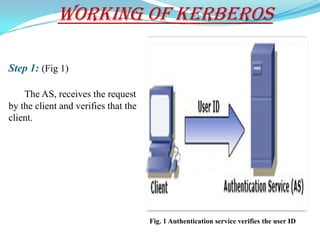
Step 1: (Fig 1)

    The AS, receives the request
by the client and verifies that the
client.


                                      Fig. 1 Authentication service verifies the user ID
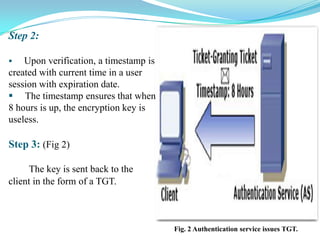
Step 2:

   Upon verification, a timestamp is
created with current time in a user
session with expiration date.
 The timestamp ensures that when
8 hours is up, the encryption key is
useless.

Step 3: (Fig 2)

      The key is sent back to the
client in the form of a TGT.


                                        Fig. 2 Authentication service issues TGT.
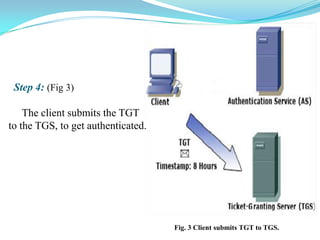
Step 4: (Fig 3)

    The client submits the TGT
to the TGS, to get authenticated.


                                    Fig. 3 Client submits TGT to TGS.
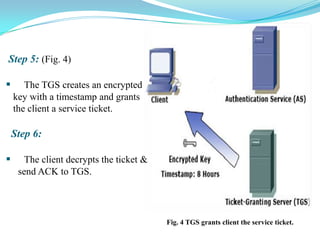
Step 5: (Fig. 4)

      The TGS creates an encrypted
    key with a timestamp and grants
    the client a service ticket.

    Step 6:

      The client decrypts the ticket &
     send ACK to TGS.


                                          Fig. 4 TGS grants client the service ticket.
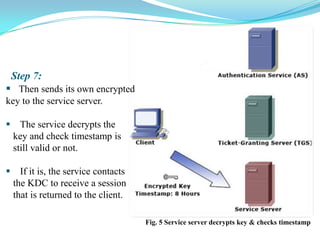
Step 7:
 Then sends its own encrypted
key to the service server.

 The service decrypts the
 key and check timestamp is
 still valid or not.

 If it is, the service contacts
 the KDC to receive a session
 that is returned to the client.

                                   Fig. 5 Service server decrypts key & checks timestamp
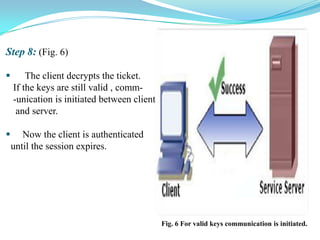
Step 8: (Fig. 6)

       The client decrypts the ticket.
    If the keys are still valid , comm-
    -unication is initiated between client
     and server.

      Now the client is authenticated
    until the session expires.


                                             Fig. 6 For valid keys communication is initiated.
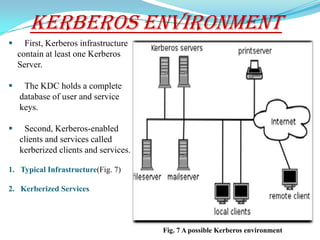
Kerberos Environment
     First, Kerberos infrastructure
    contain at least one Kerberos
    Server.

    The KDC holds a complete
    database of user and service
    keys.

    Second, Kerberos-enabled
    clients and services called
    kerberized clients and services.

1. Typical Infrastructure(Fig. 7)

2. Kerberized Services


                                       Fig. 7 A possible Kerberos environment
Kerberos Database

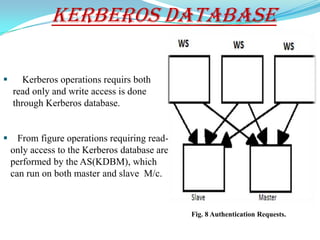
      Kerberos operations requirs both
    read only and write access is done
    through Kerberos database.


 From figure operations requiring read-
 only access to the Kerberos database are
 performed by the AS(KDBM), which
 can run on both master and slave M/c.


                                            Fig. 8 Authentication Requests.
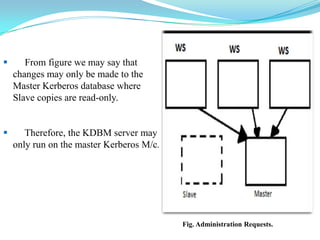
      From figure we may say that
    changes may only be made to the
    Master Kerberos database where
    Slave copies are read-only.


      Therefore, the KDBM server may
    only run on the master Kerberos M/c.


                                           Fig. Administration Requests.
Kerberos Administrator
 It manages and controls all the Operations & Functions of Kerberos.
           Running a program to initialize database.
           Register essential principals in the database.
           Kerberos administration server and AS must be started up properly.


 For new Kerberos application ,it must take few steps to get it working.
           It must be registered in the database
           Assigned a private key

   It must also ensure that Kerberos machines are physically secure & also
    able to maintain backups of the Master database.
Advantages:
 Passwords are never sent across the network unencrypted.
 Clients and applications services mutually authenticated.
 Tickets have a limited lifetime.
 Authentication through the AS only has to happen once.
 Sharing secret keys is more efficient than public-keys.


Disadvantages
 Kerberos only provides authentication for clients and
 services.
 Vulnerable to users making poor password choices.
 Client M/c and service(servers) M/c to be designed with
 Kerberos authentication in mind.
PUBLIC KEY CRYPTOGRAPHY
In Public Key Cryptography two different but mathematically related
keys are used.
The public key may be freely distributed, while its paired private key
must remain secret.
The public key is typically used for encryption, while the private or
secret key is used for decryption.
It give new direction to Kerberos as it eases key distribution a lot.
KDC doesn’t need to save client keys in its database.
To obtain a TGT, the client has to present his public key.
A trusted certification authority (CA) has to sign every valid public key.
CONCLUSION
Researched and developed for over 8 years.
Kerberos doesn’t fail to deliver services.
Ex:- Cisco, Microsoft, Apple, and many others.
As authentication is critical for the security of computer
systems, traditional authentication methods are not suitable
for use in computer networks
 The Kerberos authentication system is well suited for
authentication of users in such environments.
REFERENCES
Computer Networking by James Kurose and Keith Rose.
Kerberos: Network Authentication System by Brain Pung.
Introduction to Kerberos technology.
http://web.mit.edu/Kerberos/
http://searchsecurity.techtarget.com/sDefinition/
http://www.google.co.in/
Rakesh raj

Rakesh raj

  • 1.
    ”KERBEROS” Mr. Rakesh R.Rajgopal Prof. D. A. Sananse
  • 2.
    CONTENTS  INTRODUCTION  History  Motivation  WHAT IS KERBEROS?  TERMINOLOGY  WORKING  KERBEROS ENVIRONMENT  KERBEROS DATABASE  KERBEROS ADMINISTRATOR  ADVANTAGES & DISADVANTAGES  PUBLIC KEY CRYPTOGRAPHY  CONCLUSION  REFERENCES
  • 3.
    INTRODUCTION History  Developedat the MIT during development of Project called Athena started in 1983 with UNIX timesharing computers. Motivation  It must be secure.  It must be reliable.  It should be transparent.  It should be scalable.
  • 4.
    What is Kerberos? Inan open network computing environment, a workstation cannot be trusted to identify its Users correctly. Trusted third-party authentication service. Monstrous three-headed guard dog of Hades. Authentication protocol for trusted hosts on un-trusted networks. Provide reliable authentication over open and insecure networks. Uses secret-key cryptography with symmetric Needham- Schroeder protocol.
  • 5.
     Realm: TERMINOLOGY Indicates an authentication administrator domain.  Principal: It is the name used to refer to the entries in AS.  Ticket: It is issued by AS & Encrypted using Secret key of Service.  Encryption:  Encryption type: DES, RC4-HMAC, AES128 &AES256 algorithms.  Encryption key  Salt  Key Version Number (kvno)
  • 6.
     Key DistributionCenter (KDC):  Database: Contains information about Users & Services.  Authentication Server (AS): Give reply to initial authentication Request from Client & issues TGT.  Ticket Granting Server (TGS): Distributes Service tickets to client.  Session Key: It is secret between Users & Services for which a client has work session open on a server.  Replay Cache  Credential Cache: Used to store password & related session key.
  • 7.
    Working of Kerberos Step1: (Fig 1) The AS, receives the request by the client and verifies that the client. Fig. 1 Authentication service verifies the user ID
  • 8.
    Step 2:  Upon verification, a timestamp is created with current time in a user session with expiration date.  The timestamp ensures that when 8 hours is up, the encryption key is useless. Step 3: (Fig 2) The key is sent back to the client in the form of a TGT. Fig. 2 Authentication service issues TGT.
  • 9.
    Step 4: (Fig3) The client submits the TGT to the TGS, to get authenticated. Fig. 3 Client submits TGT to TGS.
  • 10.
    Step 5: (Fig.4)  The TGS creates an encrypted key with a timestamp and grants the client a service ticket. Step 6:  The client decrypts the ticket & send ACK to TGS. Fig. 4 TGS grants client the service ticket.
  • 11.
    Step 7:  Thensends its own encrypted key to the service server.  The service decrypts the key and check timestamp is still valid or not.  If it is, the service contacts the KDC to receive a session that is returned to the client. Fig. 5 Service server decrypts key & checks timestamp
  • 12.
    Step 8: (Fig.6)  The client decrypts the ticket. If the keys are still valid , comm- -unication is initiated between client and server.  Now the client is authenticated until the session expires. Fig. 6 For valid keys communication is initiated.
  • 13.
    Kerberos Environment  First, Kerberos infrastructure contain at least one Kerberos Server.  The KDC holds a complete database of user and service keys.  Second, Kerberos-enabled clients and services called kerberized clients and services. 1. Typical Infrastructure(Fig. 7) 2. Kerberized Services Fig. 7 A possible Kerberos environment
  • 14.
    Kerberos Database  Kerberos operations requirs both read only and write access is done through Kerberos database.  From figure operations requiring read- only access to the Kerberos database are performed by the AS(KDBM), which can run on both master and slave M/c. Fig. 8 Authentication Requests.
  • 15.
    From figure we may say that changes may only be made to the Master Kerberos database where Slave copies are read-only.  Therefore, the KDBM server may only run on the master Kerberos M/c. Fig. Administration Requests.
  • 16.
    Kerberos Administrator  Itmanages and controls all the Operations & Functions of Kerberos.  Running a program to initialize database.  Register essential principals in the database.  Kerberos administration server and AS must be started up properly.  For new Kerberos application ,it must take few steps to get it working.  It must be registered in the database  Assigned a private key  It must also ensure that Kerberos machines are physically secure & also able to maintain backups of the Master database.
  • 17.
    Advantages: Passwords arenever sent across the network unencrypted. Clients and applications services mutually authenticated. Tickets have a limited lifetime. Authentication through the AS only has to happen once. Sharing secret keys is more efficient than public-keys. Disadvantages Kerberos only provides authentication for clients and services. Vulnerable to users making poor password choices. Client M/c and service(servers) M/c to be designed with Kerberos authentication in mind.
  • 18.
    PUBLIC KEY CRYPTOGRAPHY InPublic Key Cryptography two different but mathematically related keys are used. The public key may be freely distributed, while its paired private key must remain secret. The public key is typically used for encryption, while the private or secret key is used for decryption. It give new direction to Kerberos as it eases key distribution a lot. KDC doesn’t need to save client keys in its database. To obtain a TGT, the client has to present his public key. A trusted certification authority (CA) has to sign every valid public key.
  • 19.
    CONCLUSION Researched and developedfor over 8 years. Kerberos doesn’t fail to deliver services. Ex:- Cisco, Microsoft, Apple, and many others. As authentication is critical for the security of computer systems, traditional authentication methods are not suitable for use in computer networks The Kerberos authentication system is well suited for authentication of users in such environments.
  • 20.
    REFERENCES Computer Networking byJames Kurose and Keith Rose. Kerberos: Network Authentication System by Brain Pung. Introduction to Kerberos technology. http://web.mit.edu/Kerberos/ http://searchsecurity.techtarget.com/sDefinition/ http://www.google.co.in/