Henric Johnson 1
Chapter 4
Authentication
Applications
Henric Johnson
Blekinge Institute of Technology,Sweden
http://www.its.bth.se/staff/hjo/
henric.johnson@bth.se
Henric Johnson 2
Outline
• Security Concerns
• Kerberos
• X.509 Authentication Service
• Recommended reading and Web Sites
Henric Johnson 3
Security Concerns
• key concerns are confidentiality and
timeliness
• to provide confidentiality must encrypt
identification and session key info
• which requires the use of previously shared
private or public keys
• need timeliness to prevent replay attacks
• provided by using sequence numbers or
timestamps or challenge/response
Henric Johnson 4
KERBEROS
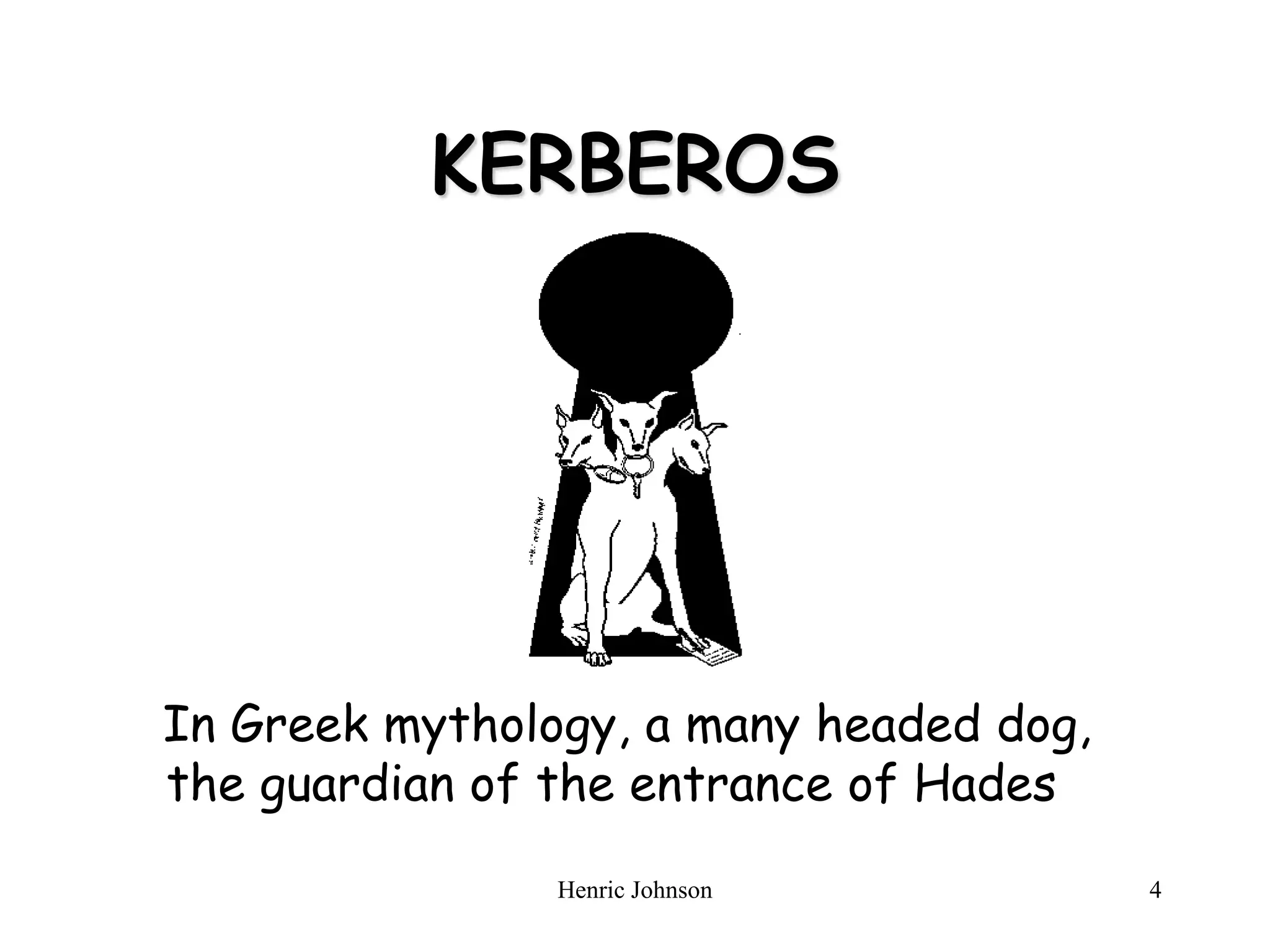
In Greek mythology, a many headed dog,
the guardian of the entrance of Hades
Henric Johnson 5
KERBEROS
• Users wish to access services on
servers.
• Three threats exist:
– User pretend to be another user.
– User alter the network address of a
workstation.
– User eavesdrop on exchanges and use a
replay attack.
Henric Johnson 6
KERBEROS
• Provides a centralized authentication
server to authenticate users to
servers and servers to users.
• Relies on conventional encryption,
making no use of public-key
encryption
• Two versions: version 4 and 5
• Version 4 makes use of DES
Henric Johnson 7
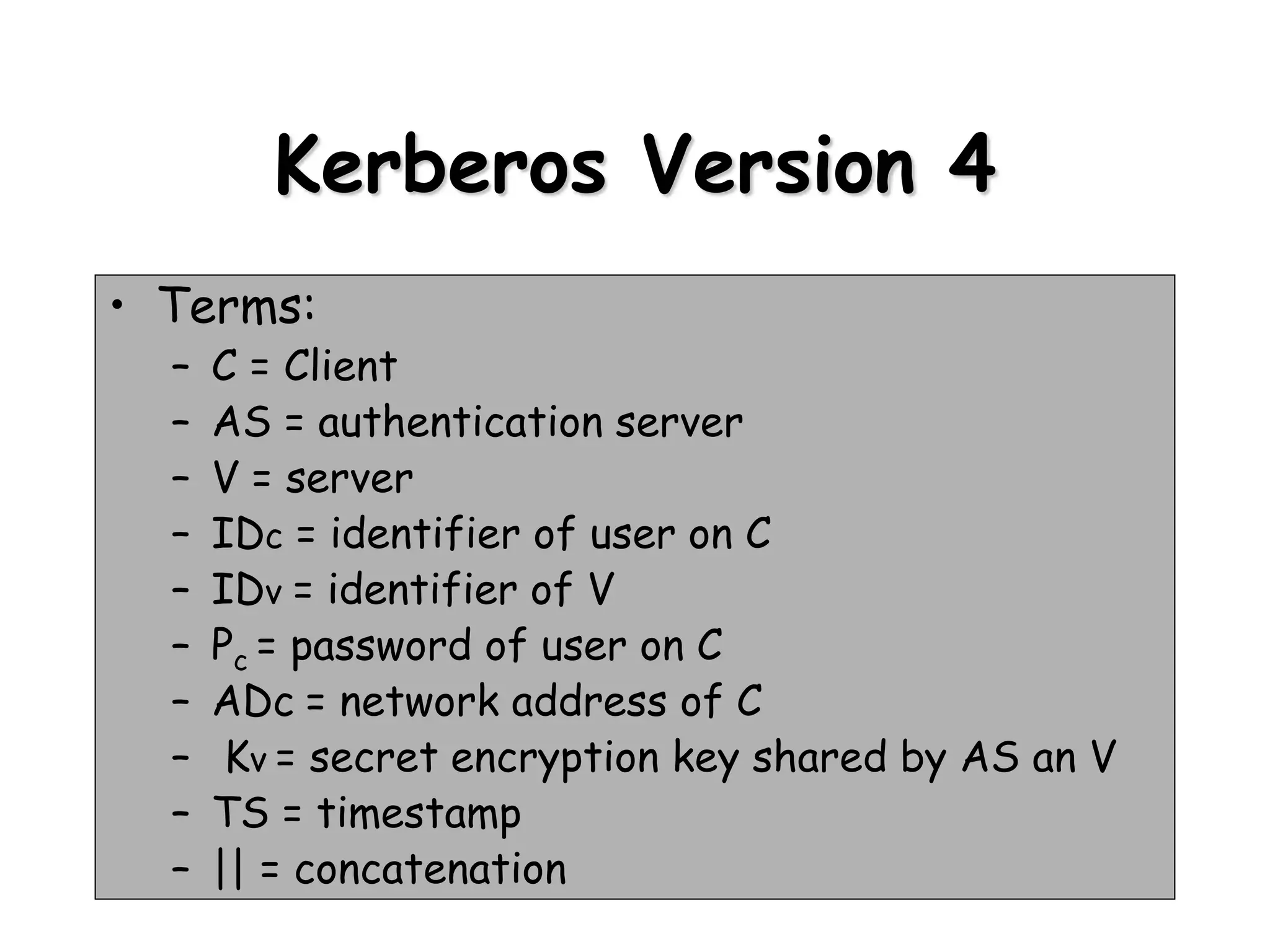
Kerberos Version 4
• Terms:
– C = Client
– AS = authentication server
– V = server
– IDc = identifier of user on C
– IDv = identifier of V
– Pc = password of user on C
– ADc = network address of C
– Kv = secret encryption key shared by AS an V
– TS = timestamp
– || = concatenation
Henric Johnson 8
A Simple Authentication
Dialogue
(1) C  AS: IDc || Pc || IDv
(2) AS  C: Ticket
(3) C  V: IDc || Ticket
Ticket = EKv[IDc || Pc || IDv]
Henric Johnson 9
Version 4 Authentication
Dialogue
• Problems:
– Lifetime associated with the ticket-granting
ticket
– If too short  repeatedly asked for password
– If too long  greater opportunity to replay
• The threat is that an opponent will steal the
ticket and use it before it expires
Henric Johnson 10
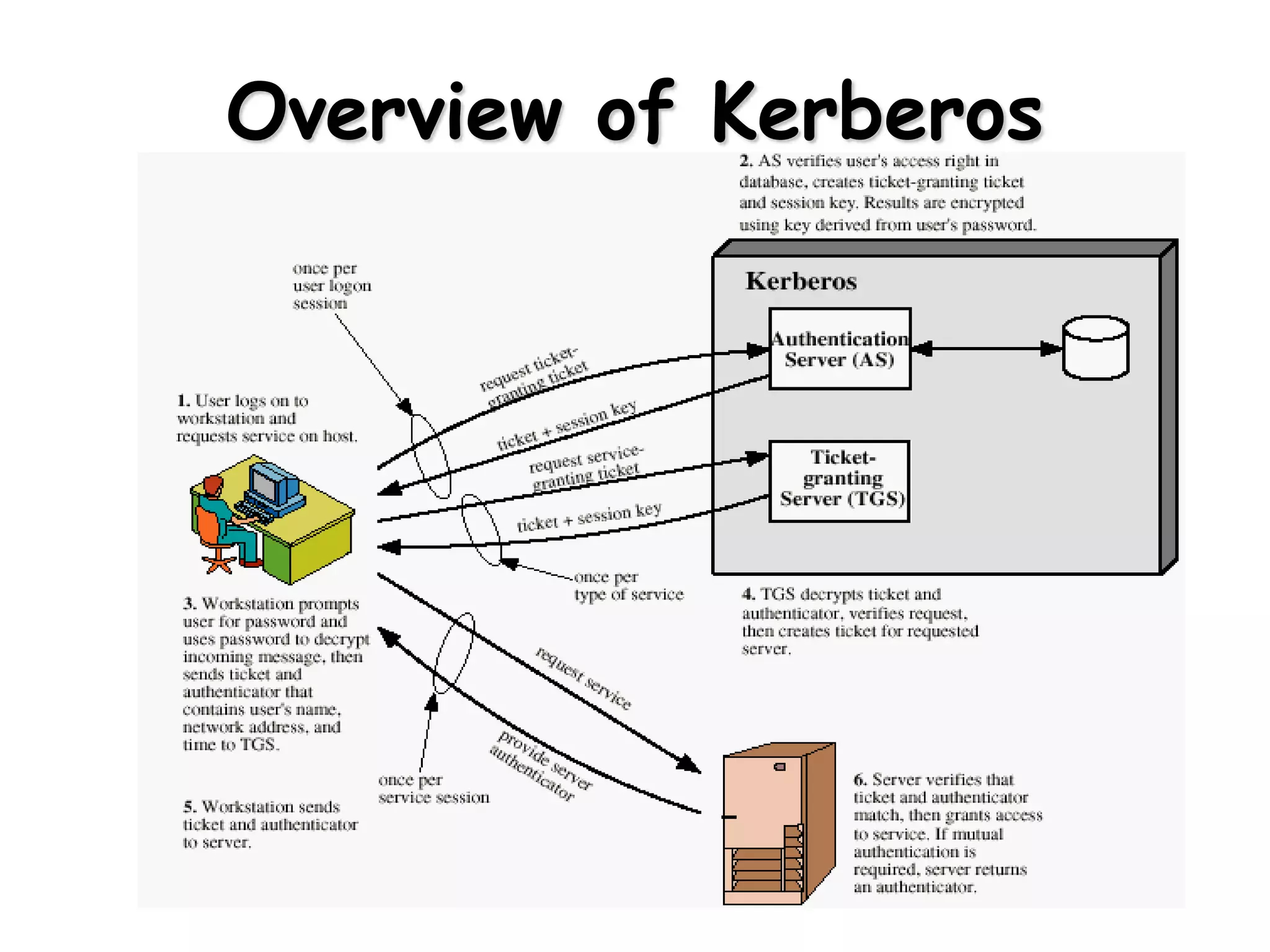
Version 4 Authentication Dialogue
Authentication Service Exhange: To obtain Ticket-Granting Ticket
(1) C  AS: IDc || IDtgs ||TS1
(2) AS  C: EKc [Kc,tgs|| IDtgs || TS2 || Lifetime2 || Tickettgs]
Ticket-Granting Service Echange: To obtain Service-Granting Ticket
(3) C  TGS: IDv ||Tickettgs ||Authenticatorc
(4) TGS  C: EKc [Kc,¨v|| IDv || TS4 || Ticketv]
Client/Server Authentication Exhange: To Obtain Service
(5) C  V: Ticketv || Authenticatorc
(6) V  C: EKc,v[TS5 +1]
Henric Johnson 11
Overview of Kerberos
Henric Johnson 12
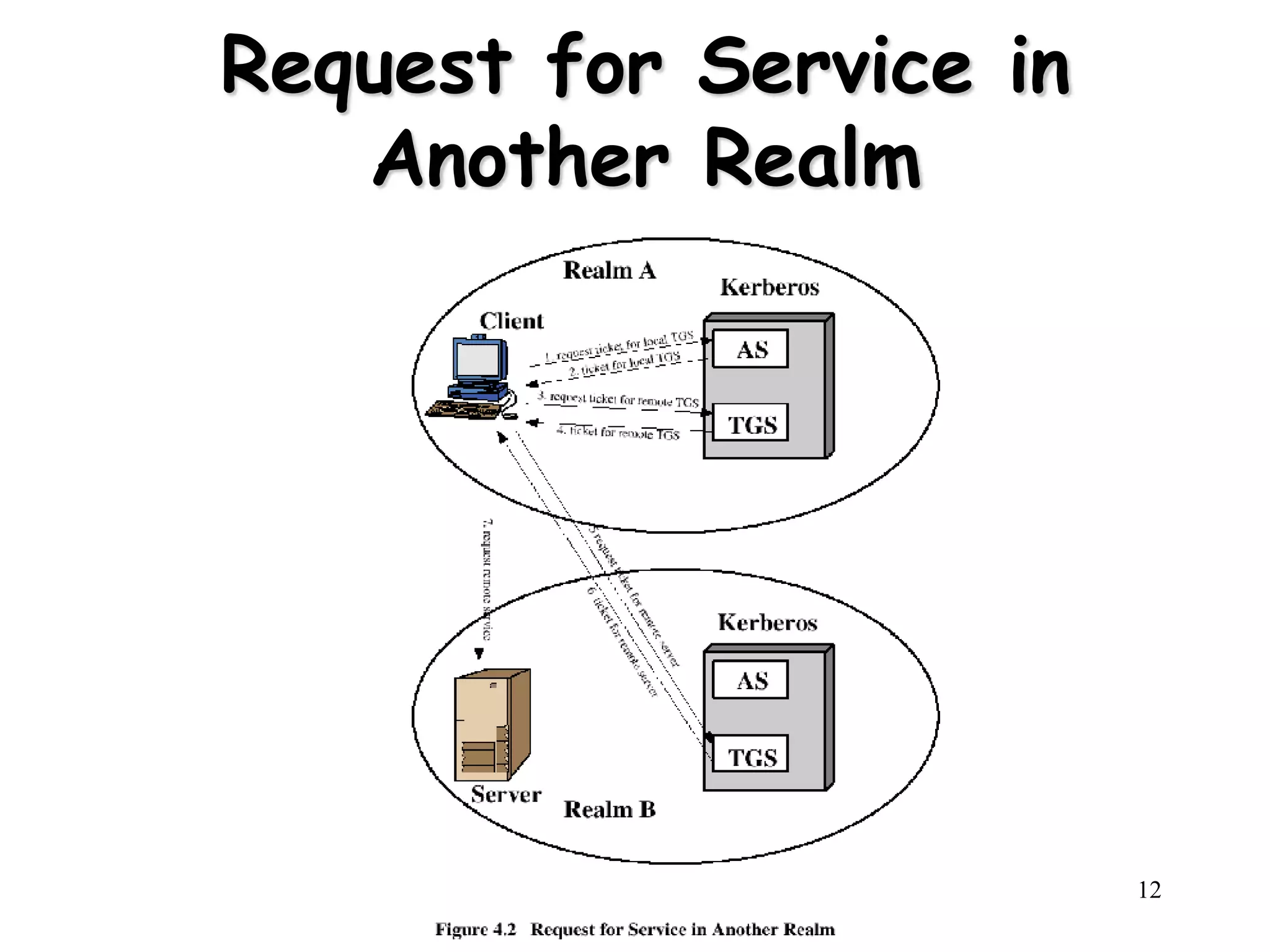
Request for Service in
Another Realm
Henric Johnson 13
Difference Between
Version 4 and 5
• Encryption system dependence (V.4 DES)
• Internet protocol dependence
• Message byte ordering
• Ticket lifetime
• Authentication forwarding
• Interrealm authentication
Henric Johnson 14
Kerberos Encryption Techniques
Henric Johnson 15
PCBC Mode
Henric Johnson 16
Kerberos - in practice
• Currently have two Kerberos versions:
• 4 : restricted to a single realm
• 5 : allows inter-realm authentication, in beta test
• Kerberos v5 is an Internet standard
• specified in RFC1510, and used by many utilities
• To use Kerberos:
• need to have a KDC on your network
• need to have Kerberised applications running on all
participating systems
• major problem - US export restrictions
• Kerberos cannot be directly distributed outside the
US in source format (& binary versions must obscure
crypto routine entry points and have no encryption)
• else crypto libraries must be reimplemented locally
Henric Johnson 17
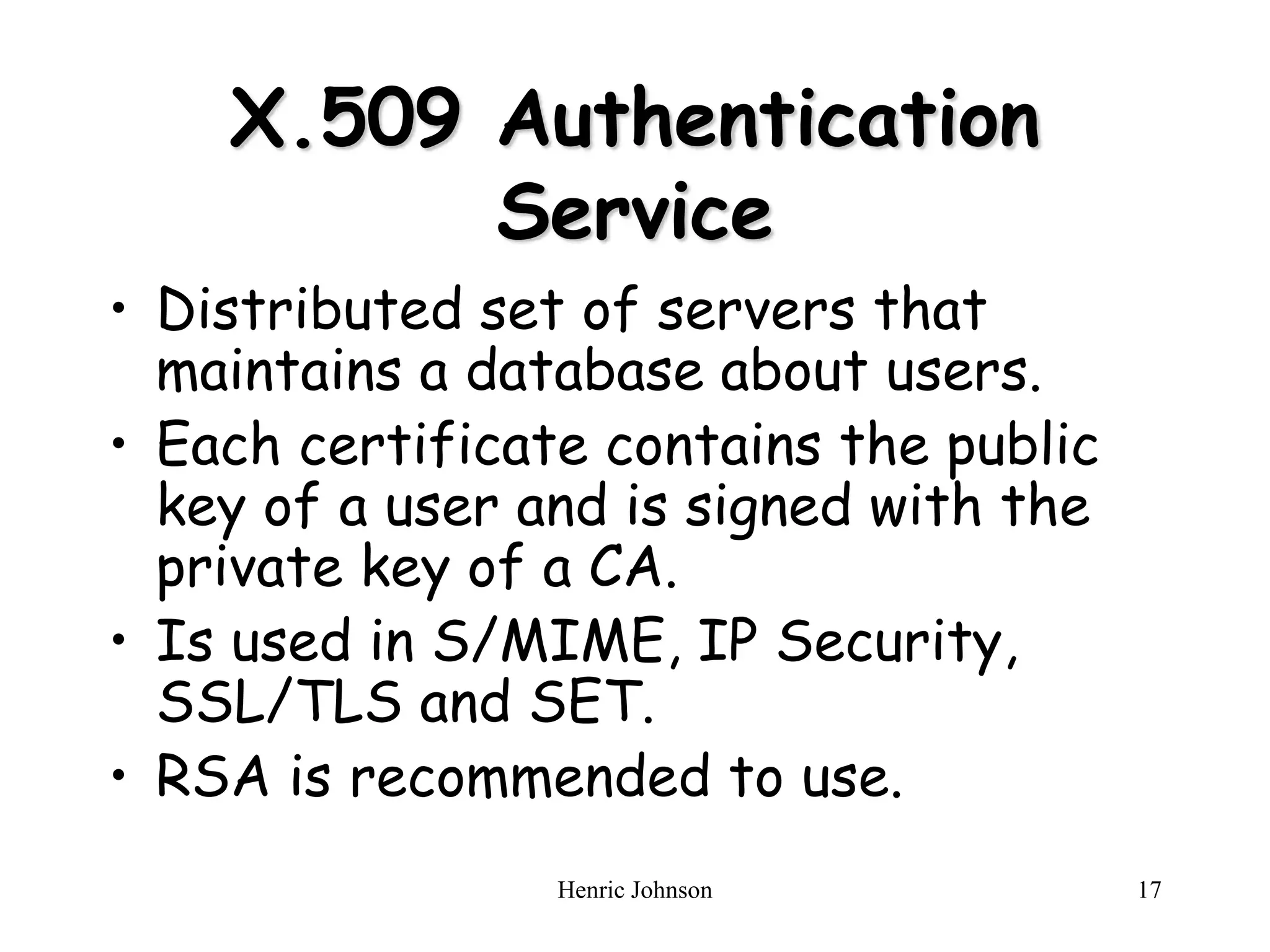
X.509 Authentication
Service
• Distributed set of servers that
maintains a database about users.
• Each certificate contains the public
key of a user and is signed with the
private key of a CA.
• Is used in S/MIME, IP Security,
SSL/TLS and SET.
• RSA is recommended to use.
Henric Johnson 18
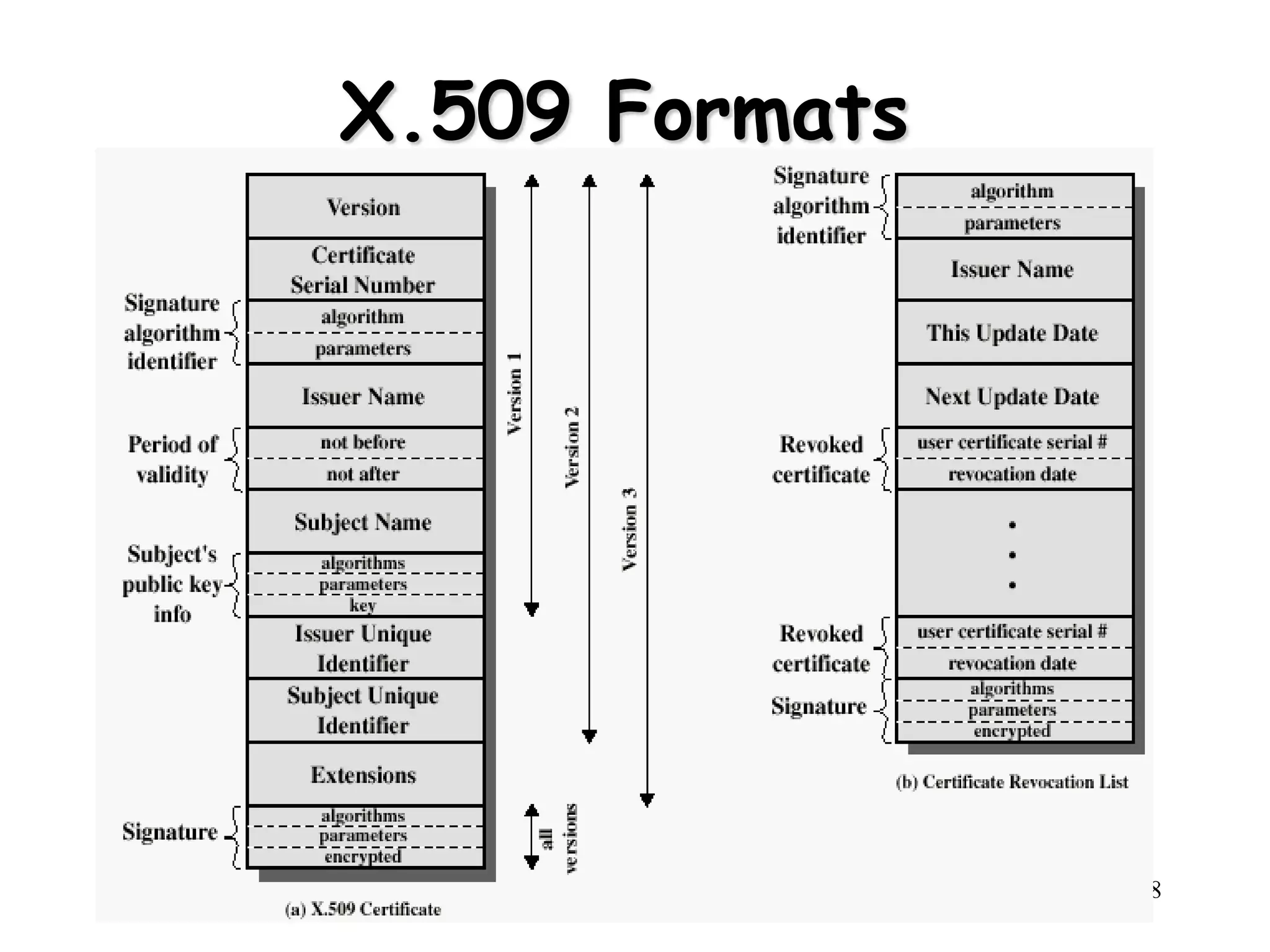
X.509 Formats
Henric Johnson 19
Typical Digital Signature
Approach
Henric Johnson 20
Obtaining a User’s
Certificate
• Characteristics of certificates
generated by CA:
– Any user with access to the public key of
the CA can recover the user public key
that was certified.
– No part other than the CA can modify
the certificate without this being
detected.
Henric Johnson 21
X.509 CA Hierarchy
Henric Johnson 22
Revocation of Certificates
• Reasons for revocation:
– The users secret key is assumed to be
compromised.
– The user is no longer certified by this
CA.
– The CA’s certificate is assumed to be
compromised.
Henric Johnson 23
Authentication Procedures
Henric Johnson 24
Recommended Reading and
WEB Sites
• www.whatis.com (search for kerberos)
• Bryant, W. Designing an Authentication
System: A Dialogue in Four Scenes.
http://web.mit.edu/kerberos/www/dialogue.html
• Kohl, J.; Neuman, B. “The Evolotion of
the Kerberos Authentication Service”
http://web.mit.edu/kerberos/www/papers.html
• http://www.isi.edu/gost/info/kerberos/

Chapter 4

  • 1.
    Henric Johnson 1 Chapter4 Authentication Applications Henric Johnson Blekinge Institute of Technology,Sweden http://www.its.bth.se/staff/hjo/ henric.johnson@bth.se
  • 2.
    Henric Johnson 2 Outline •Security Concerns • Kerberos • X.509 Authentication Service • Recommended reading and Web Sites
  • 3.
    Henric Johnson 3 SecurityConcerns • key concerns are confidentiality and timeliness • to provide confidentiality must encrypt identification and session key info • which requires the use of previously shared private or public keys • need timeliness to prevent replay attacks • provided by using sequence numbers or timestamps or challenge/response
  • 4.
    Henric Johnson 4 KERBEROS InGreek mythology, a many headed dog, the guardian of the entrance of Hades
  • 5.
    Henric Johnson 5 KERBEROS •Users wish to access services on servers. • Three threats exist: – User pretend to be another user. – User alter the network address of a workstation. – User eavesdrop on exchanges and use a replay attack.
  • 6.
    Henric Johnson 6 KERBEROS •Provides a centralized authentication server to authenticate users to servers and servers to users. • Relies on conventional encryption, making no use of public-key encryption • Two versions: version 4 and 5 • Version 4 makes use of DES
  • 7.
    Henric Johnson 7 KerberosVersion 4 • Terms: – C = Client – AS = authentication server – V = server – IDc = identifier of user on C – IDv = identifier of V – Pc = password of user on C – ADc = network address of C – Kv = secret encryption key shared by AS an V – TS = timestamp – || = concatenation
  • 8.
    Henric Johnson 8 ASimple Authentication Dialogue (1) C  AS: IDc || Pc || IDv (2) AS  C: Ticket (3) C  V: IDc || Ticket Ticket = EKv[IDc || Pc || IDv]
  • 9.
    Henric Johnson 9 Version4 Authentication Dialogue • Problems: – Lifetime associated with the ticket-granting ticket – If too short  repeatedly asked for password – If too long  greater opportunity to replay • The threat is that an opponent will steal the ticket and use it before it expires
  • 10.
    Henric Johnson 10 Version4 Authentication Dialogue Authentication Service Exhange: To obtain Ticket-Granting Ticket (1) C  AS: IDc || IDtgs ||TS1 (2) AS  C: EKc [Kc,tgs|| IDtgs || TS2 || Lifetime2 || Tickettgs] Ticket-Granting Service Echange: To obtain Service-Granting Ticket (3) C  TGS: IDv ||Tickettgs ||Authenticatorc (4) TGS  C: EKc [Kc,¨v|| IDv || TS4 || Ticketv] Client/Server Authentication Exhange: To Obtain Service (5) C  V: Ticketv || Authenticatorc (6) V  C: EKc,v[TS5 +1]
  • 11.
  • 12.
    Henric Johnson 12 Requestfor Service in Another Realm
  • 13.
    Henric Johnson 13 DifferenceBetween Version 4 and 5 • Encryption system dependence (V.4 DES) • Internet protocol dependence • Message byte ordering • Ticket lifetime • Authentication forwarding • Interrealm authentication
  • 14.
    Henric Johnson 14 KerberosEncryption Techniques
  • 15.
  • 16.
    Henric Johnson 16 Kerberos- in practice • Currently have two Kerberos versions: • 4 : restricted to a single realm • 5 : allows inter-realm authentication, in beta test • Kerberos v5 is an Internet standard • specified in RFC1510, and used by many utilities • To use Kerberos: • need to have a KDC on your network • need to have Kerberised applications running on all participating systems • major problem - US export restrictions • Kerberos cannot be directly distributed outside the US in source format (& binary versions must obscure crypto routine entry points and have no encryption) • else crypto libraries must be reimplemented locally
  • 17.
    Henric Johnson 17 X.509Authentication Service • Distributed set of servers that maintains a database about users. • Each certificate contains the public key of a user and is signed with the private key of a CA. • Is used in S/MIME, IP Security, SSL/TLS and SET. • RSA is recommended to use.
  • 18.
  • 19.
    Henric Johnson 19 TypicalDigital Signature Approach
  • 20.
    Henric Johnson 20 Obtaininga User’s Certificate • Characteristics of certificates generated by CA: – Any user with access to the public key of the CA can recover the user public key that was certified. – No part other than the CA can modify the certificate without this being detected.
  • 21.
  • 22.
    Henric Johnson 22 Revocationof Certificates • Reasons for revocation: – The users secret key is assumed to be compromised. – The user is no longer certified by this CA. – The CA’s certificate is assumed to be compromised.
  • 23.
  • 24.
    Henric Johnson 24 RecommendedReading and WEB Sites • www.whatis.com (search for kerberos) • Bryant, W. Designing an Authentication System: A Dialogue in Four Scenes. http://web.mit.edu/kerberos/www/dialogue.html • Kohl, J.; Neuman, B. “The Evolotion of the Kerberos Authentication Service” http://web.mit.edu/kerberos/www/papers.html • http://www.isi.edu/gost/info/kerberos/