Sanatana Dharma
“The Eternal Law”
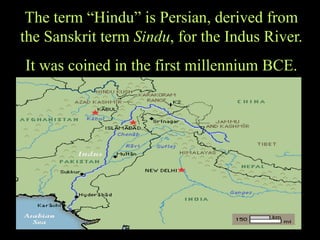
The term “Hindu” is Persian, derived from
the Sanskrit term Sindu, for the Indus River.
It was coined in the first millennium BCE.
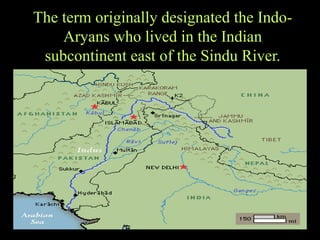
The term originally designated the Indo-
Aryans who lived in the Indian
subcontinent east of the Sindu River.
In contemporary scholarship “Hindu”
refers to a person who follows one of the
indigenous religious traditions of India,
where this includes the acceptance of the
sacred scriptures known as the Vedas
(circa 1750 - 600 BCE).
“Hinduism” designates a set of religious ideas
originating in a particular geographical region,
but it has no structure similar to the western
religious traditions.
• Hinduism has no specific founder or date of
origin, though the earliest texts date to the
second millennium BCE.
• Hinduism has nothing resembling an
ecclesiastical or church structure
Hinduism is not properly speaking a
particular religion at all.
“Hinduism” is an umbrella term that designates a
variety of different religions that share certain
features, but their differences in belief and
practices are significant.
Hinduism includes the religions of Vaishnavism,
Shaivism, Shaktism, and Smartism.
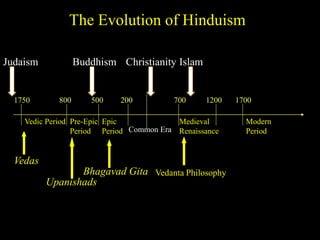
The Evolution of Hinduism
1750 800
Vedic Period Pre-Epic
Period
500 200
Epic
Period
Medieval
Renaissance
700 1200
Common Era
1700
Modern
Period
Bhagavad Gita
Vedas
Upanishads
Buddhism IslamChristianityJudaism
Vedanta Philosophy
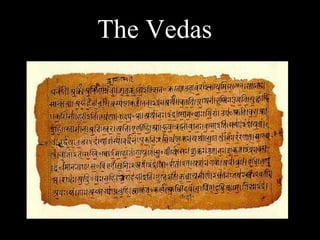
The Vedas
•Composed in Sanskrit beginning as early as
1,750 – 1,500 BCE
• Veda – Knowledge
• Hymns and mantras to various deities
viewed as controlling forces of nature
• Directions for sacred rituals, especially
sacrifices to the gods
• Outline of moral codes
The Concept of God in
the Rig Veda
The divine is sometimes represented as a
particular personal deity and at other times as an
impersonal absolute being, the Supreme God.
The Rig Veda depicts the divine in several
different ways.
Naturalistic Polytheism (many gods, forces of nature)
Henotheism (many gods, but some central deity)
Monotheism (one single personal supreme being)
Monism (one absolute, impersonal being)
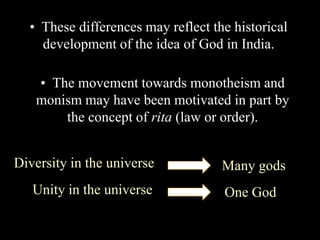
• These differences may reflect the historical
development of the idea of God in India.
• The movement towards monotheism and
monism may have been motivated in part by
the concept of rita (law or order).
Diversity in the universe Many gods
One GodUnity in the universe
• Polytheistic and monistic/monotheistic
elements are preserved together within
portions of text that date from the same
time period.
Harmonized?
Ekam vipra sat bahudha vadanti
“That which exists is One: sages call it
by different names.”
~ Rig-Veda I.164.46
The Upanishads
• Composed between 800-500 BCE by
various rishis (seers)
• Added as the final sections of the divisions
of Vedas. (Vedanta = end of the vedas)
• Upanishads are classified as sruti (“that
which is heard”) and are authoritative.
• Philosophical commentary on the early
portions of the Vedas, but is grounded in the
direct experiences of the rishis.
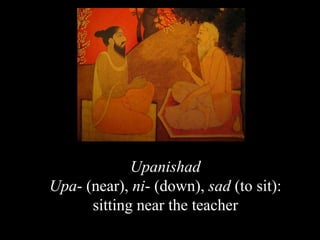
Upanishad
Upa- (near), ni- (down), sad (to sit):
sitting near the teacher
Six Primary Concepts of
the Upanishads
I.
BRAHMAN
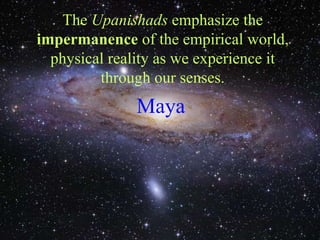
The Upanishads emphasize the
impermanence of the empirical world,
physical reality as we experience it
through our senses.
Maya
Beyond Maya, there is an
unchanging reality called
Brahman
(lit. “to expand”)
Four Claims about Brahman
• Brahman is the fundamental principle of
the universe. (Kena Upanishad IV and V)
• Brahman is the reality in all, and all things
are in Brahman. (Svetasvatara Upanishad,
IV. 2–4)
• Brahman is the state of non-duality.
(Brhadaranyaka Upanishad, IV.v.14–15)
• Brahman is Ineffable. (Kena Upanishad,
I.5-9)
Brahman as the Impersonal
Absolute
The central claims of the Upanishads about
Brahman suggest that Brahman is not a personal
being, not a being with attributes that
characterize “persons” (e.g., self-awareness,
perspectival experience, deliberative rationality,
and being the subject of intentional states).
On this view, Brahman is formless or
attributeless (nirguna) and not a personal God.
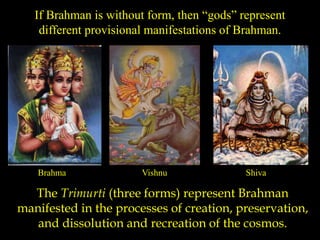
If Brahman is without form, then “gods” represent
different provisional manifestations of Brahman.
The Trimurti (three forms) represent Brahman
manifested in the processes of creation, preservation,
and dissolution and recreation of the cosmos.
Brahma Vishnu Shiva
Brahman as Personal God
• The Upanishads also refer to Brahman under
various attributes (saguna Brahman), including
those indicative of personhood: knowledge, will,
and moral goodness (Svetasvatara Upanishad,
VI.1-23).
• Some passages in Mundaka Upanishad
subordinate imperishable Brahman to the
supreme “Purusha” (person).
• Other later Upanishads emphasize personal
theism (e.g. Katha, Isa, and Svetasvatara).
Brahman as Creator?
The Upanishads speak of Brahman as creator.
However, even where Brahman is conceived
of in personal terms, “creation” refers to a
necessary emanation of the universe from
the being of Brahman, like the flowing of a
web from a spider.
The Upanishads affirm eternal, cyclical
processes of the origination of order, its
evolution, and eventual dissolution.
"Bliss [ananda] is Brahman, for
from bliss all beings are born; by
bliss, when born, they live; and into
bliss they enter at their death."
(Taittiriyaka Upanishad, III.6)
II.
ATMAN
The True Self (Atman)
The Upanishads teach the existence
of a true Self called Atman.
Atman is distinguished from the individual
personality or ego formed through
attachments to sense objects.
The true Self of each person is not identical
with the body or a person’s mind as
conditioned by sense experience.
“The wise one is not born, nor dies.
This one has not come from anywhere, has not become
anyone.
Unborn, constant, eternal, primeval, this one
Is not slain when the body is slain. . . .
He who is the bodiless among bodies,
Stable among the unstable.
The great, all pervading Self –
On recognizing Him, the wise man sorrows not.”
Kena Upanishad II.18,22
“That Self (Atman) is not this, it is not that (neti,
neti). It is unseizable, for it cannot be seized;
indestructible, for it cannot be destroyed;
unattached, for it does not attach itself; is unbound,
does not tremble, is not injured.”
Brhadaranyaka Upanishad, iv.v.15
Relation between
Brahman and Atman
Tat Tvam Asi
“Thou [Atman] art That [Brahman]”
(Chandogya Upanishad, VI)
A famous and controversial passage from
the Upanishads.
Atman and Brahman are identical?
Atman and Brahman are united in some
way without being entirely identical?
III. AVIDYA
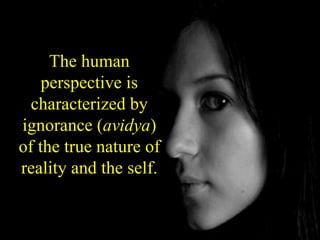
The human
perspective is
characterized by
ignorance (avidya)
of the true nature of
reality and the self.
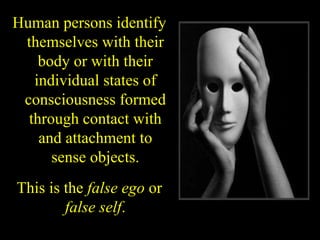
Human persons identify
themselves with their
body or with their
individual states of
consciousness formed
through contact with
and attachment to
sense objects.
This is the false ego or
false self.
The false ego is the source of human
suffering or unhappiness because the
false ego is a product of attachments
to what is non-enduring.
IV.
SAMSARA
and
KARMA
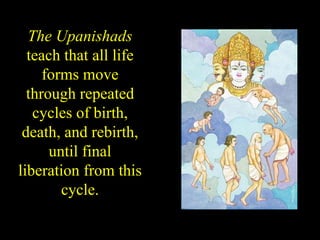
The Upanishads
teach that all life
forms move
through repeated
cycles of birth,
death, and rebirth,
until final
liberation from this
cycle.
The cycle of death and rebirth is called
Samsara.
Its fuel or energy is called
Karma.
The termination of the cycle is called
Moksha.
“Where one’s mind is attached – the inner self
Goes thereto with action, being attached to it alone.
Obtaining the end of his action,
Whatever he does in this world,
He comes again from that world
To this world of action.
- So the man who desires.”
Brhadaranyaka Upanishad, iv.iv.6
Rebirth is fueled and directed
by karma
(sanskrit root kri, meaning “action”).
Broadly stated, karma is a law of cause and
effect according to which actions in one
lifetime influence actions in the next life.
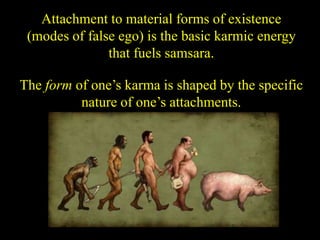
Attachment to material forms of existence
(modes of false ego) is the basic karmic energy
that fuels samsara.
The form of one’s karma is shaped by the specific
nature of one’s attachments.
Rebirth is not restricted to rebirth as a
human being, but it extends to the animal
world and other realms of existence.
The form of one’s karma (good or bad)
determines the realm of existence into which
one is reborn.
Rebirth is not desirable.
It implies that a person is still
trapped in ignorance about the
nature of reality through various
attachments to sense objects.
Suffering, associated with material
existence, has not yet been
transcended.
V. MOKSHA
Moksha is the state of release from
samsara.
Attachments => False Ego => Karma => Samsara
What is required is a dismantling or
dissolution of the false ego. Therefore, we
must let go of our attachments to sense
objects or material forms of existence.
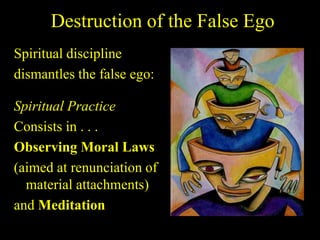
Destruction of the False Ego
Spiritual discipline
dismantles the false ego:
Spiritual Practice
Consists in . . .
Observing Moral Laws
(aimed at renunciation of
material attachments)
and Meditation
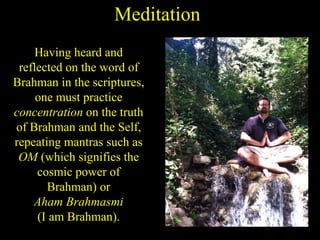
Meditation
Having heard and
reflected on the word of
Brahman in the scriptures,
one must practice
concentration on the truth
of Brahman and the Self,
repeating mantras such as
OM (which signifies the
cosmic power of
Brahman) or
Aham Brahmasmi
(I am Brahman).
Moksha is absolute consciousness: “Brahman
realization” and “Self realization” since the
true nature of reality (Brahman) and the true
self (Atman) is perceived.
The Ultimate State (Moksha)
Spiritual practice leads to Moksha
(liberation)
Moksha is freedom from samsara and thus
freedom from suffering.
Realization of Brahman and the Self
Sat-Chit-Ananda
Being (Sat)
Consciousness (Chit)
Bliss (Ananda)
Satchitananda is also the name of
Brahman.
So moksa is union with Brahman.
“As rivers flow into the sea and in so
doing lose name and form, even so
the wise man, freed from name and
form, attains the Supreme Being,
the Self-luminous, the Infinite.”
Chandogya, VI.i.5
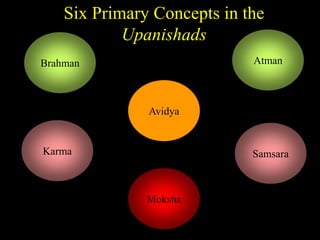
Six Primary Concepts in the
Upanishads
Brahman Atman
Karma Samsara
Moksha
Avidya
References
• Steven Rosen, Essential Hinduism (Westport, CT: Praeger, 2006).
• R.C. Zaehner, Hindu and Muslim Mysticism (New York: Schocken
Books, 1969), Chapters 2-4.
• R.C. Zaehner, Hinduism (New York: Oxford University Press, 1972).
• Swami Prabhavanda, The Spiritual Heritage of India: A Clear
Summary of Indian Philosophy and Religion (Hollywood, CA:
Vedanta Press, 1979), Chapters 1-3.
• Keith Ward, Concepts of God: Images of the Divine in Five Religious
Traditions (Oneworld, 1998), Chapters 1-2.
• Hans Torwesten, Vedanta: Heart of Hinduism (New York: Grove
Press, 1991), Chapter 1.
• Dominic Goodall (ed.), Hindu Scriptures (Berkeley, CA: University of
California Press, 1996).

Indian philosophyupanishadssp13

  • 1.
  • 2.
    The term “Hindu”is Persian, derived from the Sanskrit term Sindu, for the Indus River. It was coined in the first millennium BCE.
  • 3.
    The term originallydesignated the Indo- Aryans who lived in the Indian subcontinent east of the Sindu River.
  • 4.
    In contemporary scholarship“Hindu” refers to a person who follows one of the indigenous religious traditions of India, where this includes the acceptance of the sacred scriptures known as the Vedas (circa 1750 - 600 BCE).
  • 5.
    “Hinduism” designates aset of religious ideas originating in a particular geographical region, but it has no structure similar to the western religious traditions. • Hinduism has no specific founder or date of origin, though the earliest texts date to the second millennium BCE. • Hinduism has nothing resembling an ecclesiastical or church structure
  • 6.
    Hinduism is notproperly speaking a particular religion at all. “Hinduism” is an umbrella term that designates a variety of different religions that share certain features, but their differences in belief and practices are significant. Hinduism includes the religions of Vaishnavism, Shaivism, Shaktism, and Smartism.
  • 7.
    The Evolution ofHinduism 1750 800 Vedic Period Pre-Epic Period 500 200 Epic Period Medieval Renaissance 700 1200 Common Era 1700 Modern Period Bhagavad Gita Vedas Upanishads Buddhism IslamChristianityJudaism Vedanta Philosophy
  • 8.
  • 9.
    •Composed in Sanskritbeginning as early as 1,750 – 1,500 BCE • Veda – Knowledge • Hymns and mantras to various deities viewed as controlling forces of nature • Directions for sacred rituals, especially sacrifices to the gods • Outline of moral codes
  • 10.
    The Concept ofGod in the Rig Veda
  • 11.
    The divine issometimes represented as a particular personal deity and at other times as an impersonal absolute being, the Supreme God. The Rig Veda depicts the divine in several different ways. Naturalistic Polytheism (many gods, forces of nature) Henotheism (many gods, but some central deity) Monotheism (one single personal supreme being) Monism (one absolute, impersonal being)
  • 12.
    • These differencesmay reflect the historical development of the idea of God in India. • The movement towards monotheism and monism may have been motivated in part by the concept of rita (law or order). Diversity in the universe Many gods One GodUnity in the universe
  • 13.
    • Polytheistic andmonistic/monotheistic elements are preserved together within portions of text that date from the same time period. Harmonized? Ekam vipra sat bahudha vadanti “That which exists is One: sages call it by different names.” ~ Rig-Veda I.164.46
  • 14.
    The Upanishads • Composedbetween 800-500 BCE by various rishis (seers) • Added as the final sections of the divisions of Vedas. (Vedanta = end of the vedas) • Upanishads are classified as sruti (“that which is heard”) and are authoritative. • Philosophical commentary on the early portions of the Vedas, but is grounded in the direct experiences of the rishis.
  • 15.
    Upanishad Upa- (near), ni-(down), sad (to sit): sitting near the teacher
  • 16.
    Six Primary Conceptsof the Upanishads
  • 17.
  • 18.
    The Upanishads emphasizethe impermanence of the empirical world, physical reality as we experience it through our senses. Maya
  • 19.
    Beyond Maya, thereis an unchanging reality called Brahman (lit. “to expand”)
  • 20.
    Four Claims aboutBrahman • Brahman is the fundamental principle of the universe. (Kena Upanishad IV and V) • Brahman is the reality in all, and all things are in Brahman. (Svetasvatara Upanishad, IV. 2–4) • Brahman is the state of non-duality. (Brhadaranyaka Upanishad, IV.v.14–15) • Brahman is Ineffable. (Kena Upanishad, I.5-9)
  • 21.
    Brahman as theImpersonal Absolute The central claims of the Upanishads about Brahman suggest that Brahman is not a personal being, not a being with attributes that characterize “persons” (e.g., self-awareness, perspectival experience, deliberative rationality, and being the subject of intentional states). On this view, Brahman is formless or attributeless (nirguna) and not a personal God.
  • 22.
    If Brahman iswithout form, then “gods” represent different provisional manifestations of Brahman. The Trimurti (three forms) represent Brahman manifested in the processes of creation, preservation, and dissolution and recreation of the cosmos. Brahma Vishnu Shiva
  • 23.
    Brahman as PersonalGod • The Upanishads also refer to Brahman under various attributes (saguna Brahman), including those indicative of personhood: knowledge, will, and moral goodness (Svetasvatara Upanishad, VI.1-23). • Some passages in Mundaka Upanishad subordinate imperishable Brahman to the supreme “Purusha” (person). • Other later Upanishads emphasize personal theism (e.g. Katha, Isa, and Svetasvatara).
  • 24.
    Brahman as Creator? TheUpanishads speak of Brahman as creator. However, even where Brahman is conceived of in personal terms, “creation” refers to a necessary emanation of the universe from the being of Brahman, like the flowing of a web from a spider. The Upanishads affirm eternal, cyclical processes of the origination of order, its evolution, and eventual dissolution.
  • 25.
    "Bliss [ananda] isBrahman, for from bliss all beings are born; by bliss, when born, they live; and into bliss they enter at their death." (Taittiriyaka Upanishad, III.6)
  • 26.
  • 27.
    The True Self(Atman) The Upanishads teach the existence of a true Self called Atman. Atman is distinguished from the individual personality or ego formed through attachments to sense objects. The true Self of each person is not identical with the body or a person’s mind as conditioned by sense experience.
  • 28.
    “The wise oneis not born, nor dies. This one has not come from anywhere, has not become anyone. Unborn, constant, eternal, primeval, this one Is not slain when the body is slain. . . . He who is the bodiless among bodies, Stable among the unstable. The great, all pervading Self – On recognizing Him, the wise man sorrows not.” Kena Upanishad II.18,22
  • 29.
    “That Self (Atman)is not this, it is not that (neti, neti). It is unseizable, for it cannot be seized; indestructible, for it cannot be destroyed; unattached, for it does not attach itself; is unbound, does not tremble, is not injured.” Brhadaranyaka Upanishad, iv.v.15
  • 30.
  • 31.
    Tat Tvam Asi “Thou[Atman] art That [Brahman]” (Chandogya Upanishad, VI) A famous and controversial passage from the Upanishads. Atman and Brahman are identical? Atman and Brahman are united in some way without being entirely identical?
  • 32.
  • 33.
    The human perspective is characterizedby ignorance (avidya) of the true nature of reality and the self.
  • 34.
    Human persons identify themselveswith their body or with their individual states of consciousness formed through contact with and attachment to sense objects. This is the false ego or false self.
  • 35.
    The false egois the source of human suffering or unhappiness because the false ego is a product of attachments to what is non-enduring.
  • 36.
  • 37.
    The Upanishads teach thatall life forms move through repeated cycles of birth, death, and rebirth, until final liberation from this cycle.
  • 38.
    The cycle ofdeath and rebirth is called Samsara. Its fuel or energy is called Karma. The termination of the cycle is called Moksha.
  • 39.
    “Where one’s mindis attached – the inner self Goes thereto with action, being attached to it alone. Obtaining the end of his action, Whatever he does in this world, He comes again from that world To this world of action. - So the man who desires.” Brhadaranyaka Upanishad, iv.iv.6
  • 40.
    Rebirth is fueledand directed by karma (sanskrit root kri, meaning “action”). Broadly stated, karma is a law of cause and effect according to which actions in one lifetime influence actions in the next life.
  • 41.
    Attachment to materialforms of existence (modes of false ego) is the basic karmic energy that fuels samsara. The form of one’s karma is shaped by the specific nature of one’s attachments.
  • 42.
    Rebirth is notrestricted to rebirth as a human being, but it extends to the animal world and other realms of existence. The form of one’s karma (good or bad) determines the realm of existence into which one is reborn.
  • 43.
    Rebirth is notdesirable. It implies that a person is still trapped in ignorance about the nature of reality through various attachments to sense objects. Suffering, associated with material existence, has not yet been transcended.
  • 44.
  • 45.
    Moksha is thestate of release from samsara. Attachments => False Ego => Karma => Samsara What is required is a dismantling or dissolution of the false ego. Therefore, we must let go of our attachments to sense objects or material forms of existence.
  • 46.
    Destruction of theFalse Ego Spiritual discipline dismantles the false ego: Spiritual Practice Consists in . . . Observing Moral Laws (aimed at renunciation of material attachments) and Meditation
  • 47.
    Meditation Having heard and reflectedon the word of Brahman in the scriptures, one must practice concentration on the truth of Brahman and the Self, repeating mantras such as OM (which signifies the cosmic power of Brahman) or Aham Brahmasmi (I am Brahman).
  • 48.
    Moksha is absoluteconsciousness: “Brahman realization” and “Self realization” since the true nature of reality (Brahman) and the true self (Atman) is perceived. The Ultimate State (Moksha) Spiritual practice leads to Moksha (liberation) Moksha is freedom from samsara and thus freedom from suffering.
  • 49.
    Realization of Brahmanand the Self Sat-Chit-Ananda Being (Sat) Consciousness (Chit) Bliss (Ananda) Satchitananda is also the name of Brahman. So moksa is union with Brahman.
  • 50.
    “As rivers flowinto the sea and in so doing lose name and form, even so the wise man, freed from name and form, attains the Supreme Being, the Self-luminous, the Infinite.” Chandogya, VI.i.5
  • 51.
    Six Primary Conceptsin the Upanishads Brahman Atman Karma Samsara Moksha Avidya
  • 52.
    References • Steven Rosen,Essential Hinduism (Westport, CT: Praeger, 2006). • R.C. Zaehner, Hindu and Muslim Mysticism (New York: Schocken Books, 1969), Chapters 2-4. • R.C. Zaehner, Hinduism (New York: Oxford University Press, 1972). • Swami Prabhavanda, The Spiritual Heritage of India: A Clear Summary of Indian Philosophy and Religion (Hollywood, CA: Vedanta Press, 1979), Chapters 1-3. • Keith Ward, Concepts of God: Images of the Divine in Five Religious Traditions (Oneworld, 1998), Chapters 1-2. • Hans Torwesten, Vedanta: Heart of Hinduism (New York: Grove Press, 1991), Chapter 1. • Dominic Goodall (ed.), Hindu Scriptures (Berkeley, CA: University of California Press, 1996).