The Upanishads
Sacred Scriptures of Sanatana Dharma

   Sacred Scriptures of Hinduism
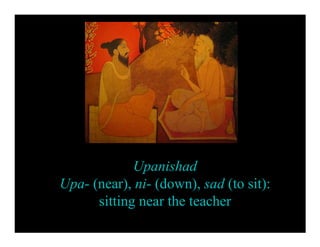
Upanishad
Upa- (near), ni- (down), sad (to sit):
      sitting near the teacher
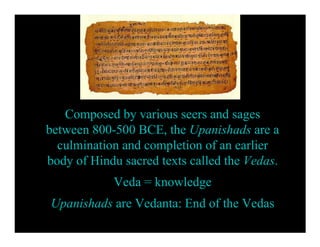
Composed by various seers and sages
between 800-500 BCE, the Upanishads are a
  culmination and completion of an earlier
body of Hindu sacred texts called the Vedas.
            Veda = knowledge
Upanishads are Vedanta: End of the Vedas
The Vedas

• Hymns and mantras to various deities
 viewed as controlling forces of nature
• Directions for sacred rituals, especially
          sacrifices to the gods
        • Outline of moral codes
Concept of God in
  the Rig Veda
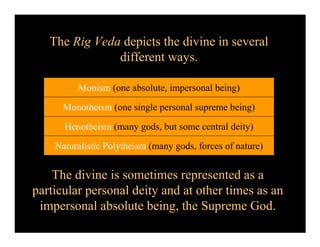
The Rig Veda depicts the divine in several
               different ways.

         Monism (one absolute, impersonal being)
      Monotheism (one single personal supreme being)

      Henotheism (many gods, but some central deity)

    Naturalistic Polytheism (many gods, forces of nature)


    The divine is sometimes represented as a
particular personal deity and at other times as an
 impersonal absolute being, the Supreme God.
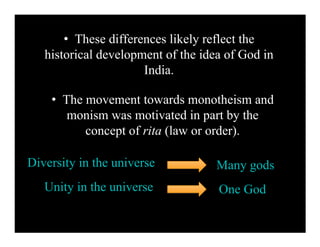
• These differences likely reflect the
   historical development of the idea of God in
                      India.

    • The movement towards monotheism and
       monism was motivated in part by the
          concept of rita (law or order).

Diversity in the universe           Many gods
   Unity in the universe            One God
The Teachings of the
    Upanishads
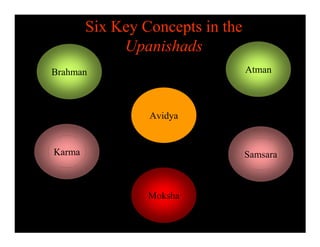
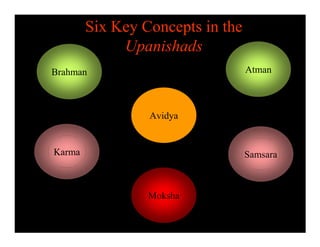
Six Key Concepts in the
             Upanishads
Brahman                           Atman


                 Avidya


Karma                             Samsara


                 Moksha
I.
BRAHMAN
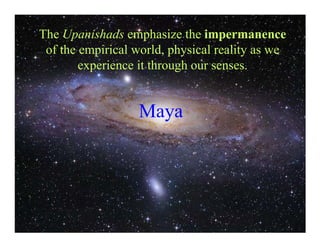
The Upanishads emphasize the impermanence
 of the empirical world, physical reality as we
        experience it through our senses.


                  Maya
The Upanishads distinguish between
 the changing, transient nature of the
    empirical universe and a single
ultimate transcendent reality that is
     unchanging and permanent.
Brahman


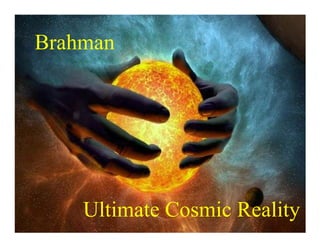
    Ultimate Cosmic Reality
The distinction between Maya and Brahman
allows Upanishadic thinkers to affirm the unity
           or oneness of all things.


All that is is Brahman. Reality is ultimately one
and unchanging, though it appears as many and
                    changing.
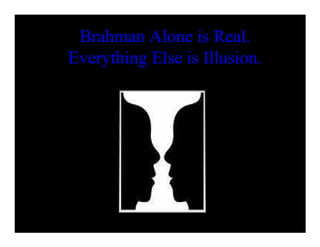
Brahman Alone is Real.
Everything Else is Illusion.
What more can be said
 about the nature of
     Brahman?
We can speak of Brahman as
“being” (sat), “consciousness”
  (cit), and “bliss” (ananda).

However, these are merely ways
  of talking about the human
  apprehension of Brahman.
In itself Brahman cannot be defined or
            positively described.

    Ultimately “Brahman” is a way of
designating a state in which subject-object
          duality ceases to exist.

     “There is no better description [of
  Brahman] than this: that it is not-this, it
 is not-that (neti, neti).” Brhad-aranyaka
             Upanishad, II, 3, 6.
Dual Aspect Theism

         Nirguna Brahman
Brahman in itself is beyond all human
categories and conceptualization. In
  itself Brahman has no attributes.

          Saguna Brahman
   Brahman in relation to maya and
   as an object of human discourse
    and devotion, with attributes.
Implications?
In itself the Supreme being cannot be known, as the
Infinite surpasses or transcends all human conception.
   The impersonal Supreme being is made personal
 through manifestations of the Infinite in finite form.
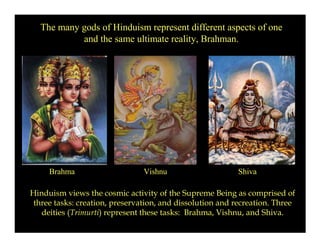
The many gods of Hinduism represent different aspects of one
           and the same ultimate reality, Brahman.


     Brahma                     Vishnu                    Shiva

Hinduism views the cosmic activity of the Supreme Being as comprised of
 three tasks: creation, preservation, and dissolution and recreation. Three
   deities (Trimurti) represent these tasks: Brahma, Vishnu, and Shiva.
II.
ATMAN
The True Self (Atman)

    The Upanishads teach the existence
        of a true Self called Atman.

    The individual personality, soul, or self
 (jiva) belongs to the realm of maya. The jiva
            is conditioned by Atman.

Atman is timeless, spaceless, unchanging pure
consciousness, only temporarily manifested as
                jiva in maya.
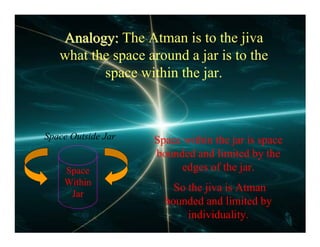
Relation between Atman and Jiva
Analogy: The Atman is to the jiva
   what the space around a jar is to the
          space within the jar.


Space Outside Jar   Space within the jar is space
                    bounded and limited by the
    Space                edges of the jar.
    Within
                        So the jiva is Atman
     Jar
                      bounded and limited by
                           individuality.
“The wise one is not born, nor dies.
This one has not come from anywhere, has not become
                       anyone.
    Unborn, constant, eternal, primeval, this one
       Is not slain when the body is slain. . . .
       He who is the bodiless among bodies,
             Stable among the unstable.
           The great, all pervading Self –
  On recognizing Him, the wise man sorrows not.”
                                Kena Upanishad II.18,22
“That Self (Atman) is not this, it is not that (neti,
   neti). It is unseizable, for it cannot be seized;
     indestructible, for it cannot be destroyed;
unattached, for it does not attach itself; is unbound,
          does not tremble, is not injured.”
                      Brhadaranyaka Upanishad, iv.v.15
Relation between
Brahman and Atman
Atman is Brahman
Tat Tvam Asi
“Thou [Atman] art That [Brahman]”
        (Chandogya Upanishad, VI)

There is a common consciousness between
           Atman and Brahman.

    “The individual self, apart from all
   factors that differentiate it from pure
 consciousness, is the same as the divine,
 apart from its differentiating conditions.”
  (Eliot Deutsch, Advaita Vedanta, p. 50)
Strip away all appearances
and every self is identical
 with the ultimate reality.
III.
AVIDYA and VIDYA
The human
    perspective is
  characterized by
ignorance (avidya)
of the true nature of
reality and the self.
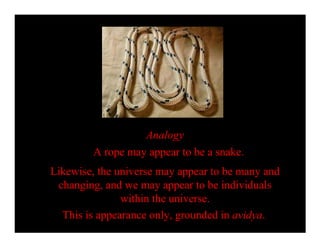
Analogy
         A rope may appear to be a snake.
Likewise, the universe may appear to be many and
 changing, and we may appear to be individuals
               within the universe.
  This is appearance only, grounded in avidya.
IV.
SAMSARA
   and
 KARMA
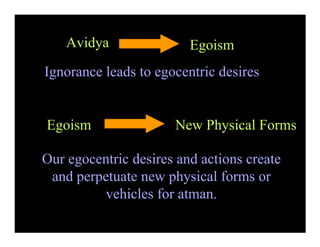
Avidya               Egoism
Ignorance leads to egocentric desires


Egoism                New Physical Forms

Our egocentric desires and actions create
 and perpetuate new physical forms or
          vehicles for atman.
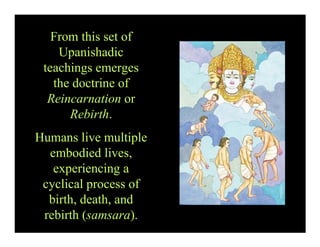
From this set of
    Upanishadic
 teachings emerges
   the doctrine of
  Reincarnation or
      Rebirth.
Humans live multiple
  embodied lives,
   experiencing a
 cyclical process of
  birth, death, and
 rebirth (samsara).
“Where one’s mind is attached – the inner self
Goes thereto with action, being attached to it alone.
          Obtaining the end of his action,
          Whatever he does in this world,
         He comes again from that world
              To this world of action.
            - So the man who desires.”
                      Brhadaranyaka Upanishad, iv.iv.6
“By the mind alone is It [Brahman] to be perceived.
          There is on earth no diversity.
            He gets death after death,
     Who perceives here seeming diversity.”
                    Brhadaranyaka Upanishad, iv.iv.19
Samsara and Suffering

   Human suffering – lack of
satisfaction in life - is associated
with material forms of existence.
 As long as samsara continues a
person is doomed to experience
            suffering.
Rebirth is governed by karma
     (literally “action”).


 In the Upanishads karma designates a law of
cosmic justice according to which every action
 has an effect that is proportioned to the moral
              quality of the action.
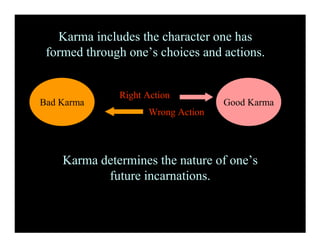
Karma includes the character one has
 formed through one’s choices and actions.


              Right Action
Bad Karma                          Good Karma
                    Wrong Action


    Karma determines the nature of one’s
           future incarnations.
Rebirth is not desirable.
 It implies that a person is still
trapped in ignorance about the
        nature of reality.

 Suffering, associated with
material existence, has not yet
      been transcended.
VI.
MOKSHA
The Ultimate State (Moksha)

    Suffering is transcended only by
 release from samsara and absorption
     into Brahman, the one ultimate
                  reality.
      This is a state of knowledge,
       enlightenment, or absolute
consciousness in which the true nature
 of reality (Brahman) and the true self
          (Atman) is perceived.
It is also a state of freedom (moksha).

 The only thing that can be free is that
which is one, for only that which is one
            has no desire.
Being all that there is, there is nothing
          else for it to desire.
    There is nothing left to suffer.
“Now the man who does not desire – He
 who is without desire, who is freed from
  desire, whose desire is satisfied, whose
desire is the Self (atman) – his breath does
not depart. Being very Brahman, he goes to
                 Brahman.”
              Brhadaranyaka Upanishad, iv.iv.6
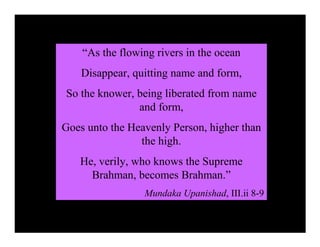
“As the flowing rivers in the ocean
    Disappear, quitting name and form,
So the knower, being liberated from name
               and form,
Goes unto the Heavenly Person, higher than
                the high.
   He, verily, who knows the Supreme
     Brahman, becomes Brahman.”
                 Mundaka Upanishad, III.ii 8-9
The ultimate goal is not to
  The goal is to obtain
mokshabe reborn. from
         and be free
 desire and the cycle of
   death and rebirth.
Six Key Concepts in the
             Upanishads
Brahman                           Atman


                 Avidya


Karma                             Samsara


                 Moksha

Upanishads

  • 1.
    The Upanishads Sacred Scripturesof Sanatana Dharma Sacred Scriptures of Hinduism
  • 2.
    Upanishad Upa- (near), ni-(down), sad (to sit): sitting near the teacher
  • 3.
    Composed by variousseers and sages between 800-500 BCE, the Upanishads are a culmination and completion of an earlier body of Hindu sacred texts called the Vedas. Veda = knowledge Upanishads are Vedanta: End of the Vedas
  • 4.
    The Vedas • Hymnsand mantras to various deities viewed as controlling forces of nature • Directions for sacred rituals, especially sacrifices to the gods • Outline of moral codes
  • 5.
    Concept of Godin the Rig Veda
  • 6.
    The Rig Vedadepicts the divine in several different ways. Monism (one absolute, impersonal being) Monotheism (one single personal supreme being) Henotheism (many gods, but some central deity) Naturalistic Polytheism (many gods, forces of nature) The divine is sometimes represented as a particular personal deity and at other times as an impersonal absolute being, the Supreme God.
  • 7.
    • These differenceslikely reflect the historical development of the idea of God in India. • The movement towards monotheism and monism was motivated in part by the concept of rita (law or order). Diversity in the universe Many gods Unity in the universe One God
  • 8.
    The Teachings ofthe Upanishads
  • 9.
    Six Key Conceptsin the Upanishads Brahman Atman Avidya Karma Samsara Moksha
  • 10.
  • 11.
    The Upanishads emphasizethe impermanence of the empirical world, physical reality as we experience it through our senses. Maya
  • 12.
    The Upanishads distinguishbetween the changing, transient nature of the empirical universe and a single ultimate transcendent reality that is unchanging and permanent.
  • 13.
    Brahman Ultimate Cosmic Reality
  • 14.
    The distinction betweenMaya and Brahman allows Upanishadic thinkers to affirm the unity or oneness of all things. All that is is Brahman. Reality is ultimately one and unchanging, though it appears as many and changing.
  • 15.
    Brahman Alone isReal. Everything Else is Illusion.
  • 16.
    What more canbe said about the nature of Brahman?
  • 17.
    We can speakof Brahman as “being” (sat), “consciousness” (cit), and “bliss” (ananda). However, these are merely ways of talking about the human apprehension of Brahman.
  • 18.
    In itself Brahmancannot be defined or positively described. Ultimately “Brahman” is a way of designating a state in which subject-object duality ceases to exist. “There is no better description [of Brahman] than this: that it is not-this, it is not-that (neti, neti).” Brhad-aranyaka Upanishad, II, 3, 6.
  • 19.
    Dual Aspect Theism Nirguna Brahman Brahman in itself is beyond all human categories and conceptualization. In itself Brahman has no attributes. Saguna Brahman Brahman in relation to maya and as an object of human discourse and devotion, with attributes.
  • 20.
  • 21.
    In itself theSupreme being cannot be known, as the Infinite surpasses or transcends all human conception. The impersonal Supreme being is made personal through manifestations of the Infinite in finite form.
  • 22.
    The many godsof Hinduism represent different aspects of one and the same ultimate reality, Brahman. Brahma Vishnu Shiva Hinduism views the cosmic activity of the Supreme Being as comprised of three tasks: creation, preservation, and dissolution and recreation. Three deities (Trimurti) represent these tasks: Brahma, Vishnu, and Shiva.
  • 23.
  • 24.
    The True Self(Atman) The Upanishads teach the existence of a true Self called Atman. The individual personality, soul, or self (jiva) belongs to the realm of maya. The jiva is conditioned by Atman. Atman is timeless, spaceless, unchanging pure consciousness, only temporarily manifested as jiva in maya.
  • 25.
  • 26.
    Analogy: The Atmanis to the jiva what the space around a jar is to the space within the jar. Space Outside Jar Space within the jar is space bounded and limited by the Space edges of the jar. Within So the jiva is Atman Jar bounded and limited by individuality.
  • 27.
    “The wise oneis not born, nor dies. This one has not come from anywhere, has not become anyone. Unborn, constant, eternal, primeval, this one Is not slain when the body is slain. . . . He who is the bodiless among bodies, Stable among the unstable. The great, all pervading Self – On recognizing Him, the wise man sorrows not.” Kena Upanishad II.18,22
  • 28.
    “That Self (Atman)is not this, it is not that (neti, neti). It is unseizable, for it cannot be seized; indestructible, for it cannot be destroyed; unattached, for it does not attach itself; is unbound, does not tremble, is not injured.” Brhadaranyaka Upanishad, iv.v.15
  • 29.
  • 30.
  • 31.
    Tat Tvam Asi “Thou[Atman] art That [Brahman]” (Chandogya Upanishad, VI) There is a common consciousness between Atman and Brahman. “The individual self, apart from all factors that differentiate it from pure consciousness, is the same as the divine, apart from its differentiating conditions.” (Eliot Deutsch, Advaita Vedanta, p. 50)
  • 32.
    Strip away allappearances and every self is identical with the ultimate reality.
  • 34.
  • 35.
    The human perspective is characterized by ignorance (avidya) of the true nature of reality and the self.
  • 36.
    Analogy A rope may appear to be a snake. Likewise, the universe may appear to be many and changing, and we may appear to be individuals within the universe. This is appearance only, grounded in avidya.
  • 37.
    IV. SAMSARA and KARMA
  • 38.
    Avidya Egoism Ignorance leads to egocentric desires Egoism New Physical Forms Our egocentric desires and actions create and perpetuate new physical forms or vehicles for atman.
  • 39.
    From this setof Upanishadic teachings emerges the doctrine of Reincarnation or Rebirth. Humans live multiple embodied lives, experiencing a cyclical process of birth, death, and rebirth (samsara).
  • 40.
    “Where one’s mindis attached – the inner self Goes thereto with action, being attached to it alone. Obtaining the end of his action, Whatever he does in this world, He comes again from that world To this world of action. - So the man who desires.” Brhadaranyaka Upanishad, iv.iv.6
  • 41.
    “By the mindalone is It [Brahman] to be perceived. There is on earth no diversity. He gets death after death, Who perceives here seeming diversity.” Brhadaranyaka Upanishad, iv.iv.19
  • 42.
    Samsara and Suffering Human suffering – lack of satisfaction in life - is associated with material forms of existence. As long as samsara continues a person is doomed to experience suffering.
  • 43.
    Rebirth is governedby karma (literally “action”). In the Upanishads karma designates a law of cosmic justice according to which every action has an effect that is proportioned to the moral quality of the action.
  • 44.
    Karma includes thecharacter one has formed through one’s choices and actions. Right Action Bad Karma Good Karma Wrong Action Karma determines the nature of one’s future incarnations.
  • 45.
    Rebirth is notdesirable. It implies that a person is still trapped in ignorance about the nature of reality. Suffering, associated with material existence, has not yet been transcended.
  • 46.
  • 47.
    The Ultimate State(Moksha) Suffering is transcended only by release from samsara and absorption into Brahman, the one ultimate reality. This is a state of knowledge, enlightenment, or absolute consciousness in which the true nature of reality (Brahman) and the true self (Atman) is perceived.
  • 48.
    It is alsoa state of freedom (moksha). The only thing that can be free is that which is one, for only that which is one has no desire. Being all that there is, there is nothing else for it to desire. There is nothing left to suffer.
  • 49.
    “Now the manwho does not desire – He who is without desire, who is freed from desire, whose desire is satisfied, whose desire is the Self (atman) – his breath does not depart. Being very Brahman, he goes to Brahman.” Brhadaranyaka Upanishad, iv.iv.6
  • 50.
    “As the flowingrivers in the ocean Disappear, quitting name and form, So the knower, being liberated from name and form, Goes unto the Heavenly Person, higher than the high. He, verily, who knows the Supreme Brahman, becomes Brahman.” Mundaka Upanishad, III.ii 8-9
  • 51.
    The ultimate goalis not to The goal is to obtain mokshabe reborn. from and be free desire and the cycle of death and rebirth.
  • 52.
    Six Key Conceptsin the Upanishads Brahman Atman Avidya Karma Samsara Moksha