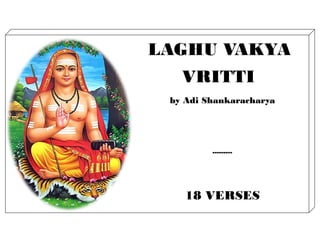
LAGHU VAKYA
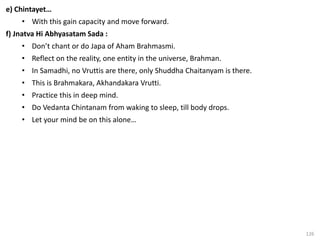
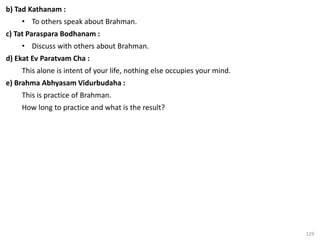
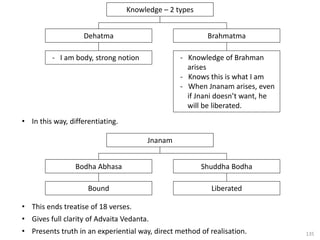
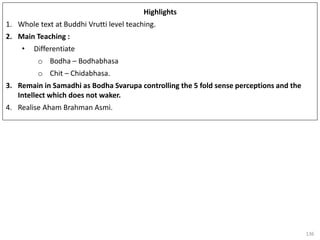
VRITTI
by Adi Shankaracharya
---------
18 VERSES
PRAYERS
OM SAHANA VAVATHU
SAHANAU BHUNAKTU
SAHA VEERYAM KARAVAAVAHAI
TEJAS VINAAVA DHEETA MASTU
MA VIDH VISHAVA HAI
OM SHANTI SHANTI SHANTI HI
May the Lord protect us.
May He make us enjoy our sessions together.
May we both strive together.
May our studies be bright and brilliant.
May there be no misunderstanding between us.
Let there be peace outside and with in.
Om Peace, Peace, Peace.
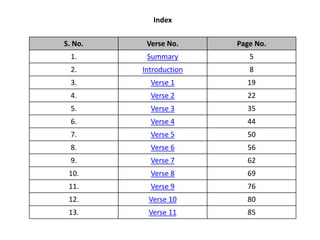
Index
S. No. Verse No. Page No.
1. Summary 5
2. Introduction 8
3. Verse 1 19
4. Verse 2 22
5. Verse 3 35
6. Verse 4 44
7. Verse 5 50
8. Verse 6 56
9. Verse 7 62
10. Verse 8 69
11. Verse 9 76
12. Verse 10 80
13. Verse 11 85
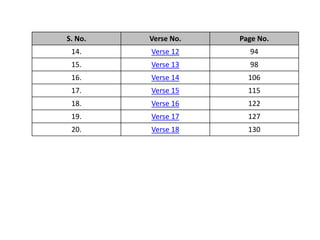
S. No. Verse No. Page No.
14. Verse 12 94
15. Verse 13 98
16. Verse 14 106
17. Verse 15 115
18. Verse 16 122
19. Verse 17 127
20. Verse 18 130
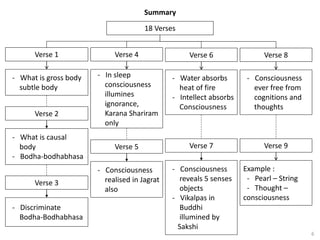
SUMMARY
6
Summary
Verse 4
Verse 1
18 Verses
- In sleep
consciousness
illumines
ignorance,
Karana Shariram
only
- What is gross body
subtle body
Verse 8
Verse 6
- Consciousness
ever free from
cognitions and
thoughts
- Water absorbs
heat of fire
- Intellect absorbs
Consciousness
Verse 2
- What is causal
body
- Bodha-bodhabhasa
Verse 3
- Discriminate
Bodha-Bodhabhasa
Verse 5
- Consciousness
realised in Jagrat
also
Verse 7
- Consciousness
reveals 5 senses
objects
- Vikalpas in
Buddhi
illumined by
Sakshi
Verse 9
Example :
- Pearl – String
- Thought –
consciousness
7
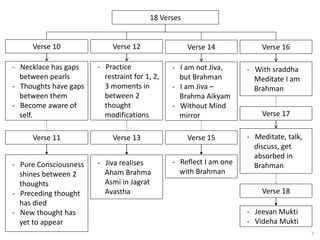
Verse 12
Verse 10
18 Verses
- Practice
restraint for 1, 2,
3 moments in
between 2
thought
modifications
- Necklace has gaps
between pearls
- Thoughts have gaps
between them
- Become aware of
self.
Verse 16
Verse 14
- With sraddha
Meditate I am
Brahman
- I am not Jiva,
but Brahman
- I am Jiva –
Brahma Aikyam
- Without Mind
mirror
Verse 11
- Pure Consciousness
shines between 2
thoughts
- Preceding thought
has died
- New thought has
yet to appear
Verse 13
- Jiva realises
Aham Brahma
Asmi in Jagrat
Avastha
Verse 15
- Reflect I am one
with Brahman
Verse 17
- Meditate, talk,
discuss, get
absorbed in
Brahman
Verse 18
- Jeevan Mukti
- Videha Mukti
INTRODUCTION
9
Introduction :
• Elaboration of Mahavakya Aham Brahma Asmi – Brihadaranayaka Upanishad
This (self) was indeed Brahman in the beginning. It knew only Itself as, ‘I am Brahman.’ Therefore It
became all. And whoever among the gods knew It also became That ; and the same with sages and men.
The sage Vamadeva, while realising this (self) as That, knew, ‘I was Manu, and the sun.’ And to this day
whoever in like manner knows It as, ‘I am Brahman,’ becomes all this (universe). Even the gods cannot
prevail against him, for he becomes their self. While he who worships another god thinking, ‘He is one, and
I am another,’ does not know. He is like an animal to the gods. As many animals serve a man, so does each
man serve the gods. Even if one animal is taken away, it causes anguish, what should one say of many
animals? Therefore it is not like by them that men should know this. [I – IV – 10]
10
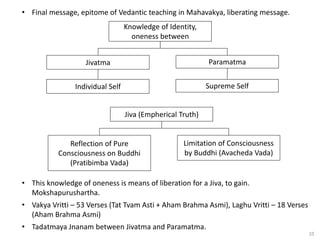
• Final message, epitome of Vedantic teaching in Mahavakya, liberating message.
Paramatma
Jivatma
Knowledge of Identity,
oneness between
Supreme Self
Individual Self
Limitation of Consciousness
by Buddhi (Avacheda Vada)
Reflection of Pure
Consciousness on Buddhi
(Pratibimba Vada)
Jiva (Empherical Truth)
• This knowledge of oneness is means of liberation for a Jiva, to gain.
Mokshapurushartha.
• Vakya Vritti – 53 Verses (Tat Tvam Asti + Aham Brahma Asmi), Laghu Vritti – 18 Verses
(Aham Brahma Asmi)
• Tadatmaya Jnanam between Jivatma and Paramatma.
11
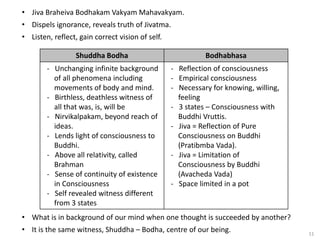
• Jiva Braheiva Bodhakam Vakyam Mahavakyam.
• Dispels ignorance, reveals truth of Jivatma.
• Listen, reflect, gain correct vision of self.
Shuddha Bodha Bodhabhasa
- Unchanging infinite background
of all phenomena including
movements of body and mind.
- Birthless, deathless witness of
all that was, is, will be
- Nirvikalpakam, beyond reach of
ideas.
- Lends light of consciousness to
Buddhi.
- Above all relativity, called
Brahman
- Sense of continuity of existence
in Consciousness
- Self revealed witness different
from 3 states
- Reflection of consciousness
- Empirical consciousness
- Necessary for knowing, willing,
feeling
- 3 states – Consciousness with
Buddhi Vruttis.
- Jiva = Reflection of Pure
Consciousness on Buddhi
(Pratibmba Vada).
- Jiva = Limitation of
Consciousness by Buddhi
(Avacheda Vada)
- Space limited in a pot
• What is in background of our mind when one thought is succeeded by another?
• It is the same witness, Shuddha – Bodha, centre of our being.
12
Story :
• Putting 4 Mahavakyas together.
I) Sishya :
• What is Brahman?
Guru : Lakshana Vakya
• Prajnanam Brahma
• Consciousness is Brahman.
Aitareya Upanishad : Rig Veda
Who is this one that we worship as this Self? Which of the two is the Self? Is it that by
which one sees, or that by which one hears, or that by which one smell fragrance, or that by
which one utters the speech or that by which one knows what is tasteful and what is not
tasteful. [III – I – 1]
13
II) Sishya :
• Where is Brahman?
Guru : Upadesa Vakyam
• Tat Tva Asi
• You are Brahman
Chandogya Upanishad : Sama Veda
‘That which is the subtlest of all is the Self of all this. It is the Truth. It is the Self. That thou art,
O Śvetaketu.’ [Śvetaketu then said,] ‘Sir, please explain this to me again.’ ‘Yes, Somya, I will
explain again,’ replied his father. [6 - 8 - 7]
III) Sishya Gets Realisation
Sishya : Anubhava Vakyam
• Aham Brahma Asmi
14
Brihadaranyaka Upanishad : Shukla Yajur Veda
This (self) was indeed Brahman in the beginning. It knew only Itself as, ‘I am Brahman.’ Therefore It
became all. And whoever among the gods knew It also became That ; and the same with sages and men.
The sage Vamadeva, while realising this (self) as That, knew, ‘I was Manu, and the sun.’ And to this day
whoever in like manner knows It as, ‘I am Brahman,’ becomes all this (universe). Even the gods cannot
prevail against him, for he becomes their self. While he who worships another god thinking, ‘He is one, and
I am another,’ does not know. He is like an animal to the gods. As many animals serve a man, so does each
man serve the gods. Even if one animal is taken away, it causes anguish, what should one say of many
animals? Therefore it is not like by them that men should know this. [I – IV – 10]
15
IV) Sishya :
• What should I do now?
Guru : Anusandhana Vakyam
• Ayam Atma Brahma
• This Atma is Brahman.
• Abide in this knowledge always.
Mandukya Upanishad : Atharvana Vada
All this is verily Brahman. This Atman is Brahman. This Atman has four quarters (Parts). [Mantra 2]
• All 4 Vedas have Mahavakyams.
• Mahavakyam of other Upanishads.
V) Isavasya Upanishad :
All this, whatsoever moves in this universe, including the universe, itself moving, is indwelt or
pervaded or enveloped or clothed by the Lord. That renounced, thou shouldst enjoy. Covet not
anybody’s wealth. [Verse 1]
16
VI) Keno Upanishad :
VII) Katho Upanishad :
The eye does not go there, not speech, nor mind, We do not know That. We do not know how
to instruct one about It. It is distinct from the known and above the unknown. We have heard
it, so stated the preceptors who taught us That. [I – 3]
That Atman by which man cognizes form, taste, smell, sounds, and the sexual joys… what is
there unknowable to that Atman in this world? This is verily that (Atman thou hast wanted to
know). [II – I – 3]
17
VIII) Kaivalya Upanishad :
• Etad Vai Tad – 12 times repeated – Chapter II – IV – 3 to Chapter II – VI – 1]
Katho Upanishad :
That which is the Supreme Brahman, the Self in all, the ample Support of the Universe, Subtler
than the subtle and Eternal… That alone thou art, thou alone art that.
He who knows this Atman, the enjoyer of honey, the sustainer of life and the lord of the past
and the future, as very near.. He fear no more thereafter. This is verily That.
• This text makes Vedanta simple, practical, experiential.
• Has technicality and beauty.
• Gives the teaching convincingly, directly in 18 Verses.
VERSE 1 TO 18
19
Verse 1 : What is gross and subtle Body?
Shankara follows :
• Shankha (Branch) Chandra (3rd day – thin semi circle crescent moon) Nyaya..
• To show our real nature as Atman, he starts showing, gross, subtle, causal body.
• From known to unknown.
The fleshy body is the gross adjunct of the Atman and the one made up of desires together
with the organs of perception and action, the Pranas, the intellect and the mind constitutes
the subtle adjunct. [Verse 1]
Sthula Shariram (Physical Body)
Tree
Sukshma Shariram (Subtle Body)
Branch
Karana Shariram (Causal Body)
Clouds
Chaitanyam
Moon
20
a) Sthula Manasa Maya Dehaha :
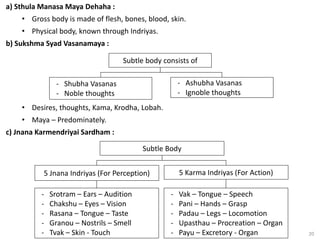
• Gross body is made of flesh, bones, blood, skin.
• Physical body, known through Indriyas.
b) Sukshma Syad Vasanamaya :
- Ashubha Vasanas
- Ignoble thoughts
- Shubha Vasanas
- Noble thoughts
Subtle body consists of
• Desires, thoughts, Kama, Krodha, Lobah.
• Maya – Predominately.
c) Jnana Karmendriyai Sardham :
5 Karma Indriyas (For Action)
5 Jnana Indriyas (For Perception)
Subtle Body
- Vak – Tongue – Speech
- Pani – Hands – Grasp
- Padau – Legs – Locomotion
- Upasthau – Procreation – Organ
- Payu – Excretory - Organ
- Srotram – Ears – Audition
- Chakshu – Eyes – Vision
- Rasana – Tongue – Taste
- Granou – Nostrils – Smell
- Tvak – Skin - Touch
21
d) Dhi Pranau :
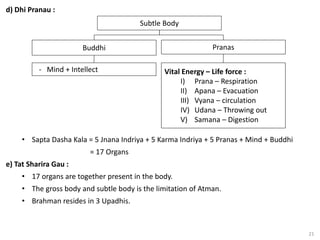
• Sapta Dasha Kala = 5 Jnana Indriya + 5 Karma Indriya + 5 Pranas + Mind + Buddhi
= 17 Organs
e) Tat Sharira Gau :
• 17 organs are together present in the body.
• The gross body and subtle body is the limitation of Atman.
• Brahman resides in 3 Upadhis.
Pranas
Buddhi
Subtle Body
Vital Energy – Life force :
I) Prana – Respiration
II) Apana – Evacuation
III) Vyana – circulation
IV) Udana – Throwing out
V) Samana – Digestion
- Mind + Intellect
22
Verse 2 : Important Verse
• What is causal Body?
• What is Real SELF?
a) Ajnanam Karanam :
• Ignorance is causal body.
• Ignorance veils the SELF.
• Once SELF veiled, identification begins with Sthula, Sukshma Sharira as the Self.
Ignorance makes the causal adjunct. Pure Consciousness stands behind them all (i.e. the three
adjuncts) as the witness and the illuminator. The reflection of the pure Consciousness on the
intellect (acquiring the sense of individuality due to ignorance) becomes the Jiva – the agent of
good and evil. [Verse 2]
Ignorance
Cause of 3 Bodies
23
• Mind and intellect merge in Karana Shariram, hence it is called causal body.
• When do we experience ignorance Ajnanam?
• Bava Rupam
• In Deep sleep, dense nothingness, blankness, absence of gross and subtle body =
Ajnanam.
• What is the purpose of enumerating Sthula, Sukshma, Karana Sharirams?
• To take us beyond the 3 bodies to the true “SELF”.
• What is Ajnanam – Ignorance?
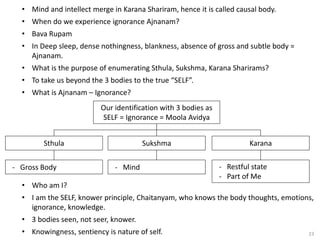
Our identification with 3 bodies as
SELF = Ignorance = Moola Avidya
Sthula
- Gross Body
Sukshma
- Mind
Karana
- Restful state
- Part of Me
• Who am I?
• I am the SELF, knower principle, Chaitanyam, who knows the body thoughts, emotions,
ignorance, knowledge.
• 3 bodies seen, not seer, knower.
• Knowingness, sentiency is nature of self.
24
b) Bodham Tesham Vibhasakaha :
• 3 Sharirams are illumined by the “SELF”, Sakshi, Chaitanyam.
Anyan Vibhati
Svayam Bhati
Vibhasakaha
- Gives Sphuranam, existence
to 3 Sharirams
- Self shines
- Bodaha
- Svaprakasha
• To illumine something, make something appear, illuminator has to be first present.
Drk – Drishya Viveka :
This (Consciousness) does not rise (is unborn) and does not set (is immortal). It does not
increase or decay (is immutable). It shines by Itself and It illumines others without any aid.
[Verse 5]
25
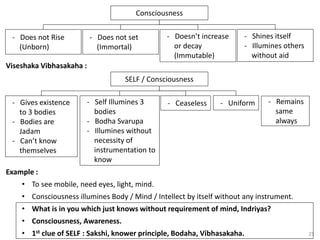
Consciousness
- Does not Rise
(Unborn)
- Does not set
(Immortal)
- Doesn’t increase
or decay
(Immutable)
- Shines itself
- Illumines others
without aid
Viseshaka Vibhasakaha :
SELF / Consciousness
- Gives existence
to 3 bodies
- Bodies are
Jadam
- Can’t know
themselves
- Self Illumines 3
bodies
- Bodha Svarupa
- Illumines without
necessity of
instrumentation to
know
- Ceaseless - Uniform - Remains
same
always
Example :
• To see mobile, need eyes, light, mind.
• Consciousness illumines Body / Mind / Intellect by itself without any instrument.
• What is in you which just knows without requirement of mind, Indriyas?
• Consciousness, Awareness.
• 1st clue of SELF : Sakshi, knower principle, Bodaha, Vibhasakaha.
26
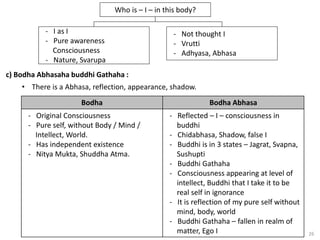
c) Bodha Abhasaha buddhi Gathaha :
• There is a Abhasa, reflection, appearance, shadow.
- Not thought I
- Vrutti
- Adhyasa, Abhasa
- I as I
- Pure awareness
Consciousness
- Nature, Svarupa
Who is – I – in this body?
Bodha Bodha Abhasa
- Original Consciousness
- Pure self, without Body / Mind /
Intellect, World.
- Has independent existence
- Nitya Mukta, Shuddha Atma.
- Reflected – I – consciousness in
buddhi
- Chidabhasa, Shadow, false I
- Buddhi is in 3 states – Jagrat, Svapna,
Sushupti
- Buddhi Gathaha
- Consciousness appearing at level of
intellect, Buddhi that I take it to be
real self in ignorance
- It is reflection of my pure self without
mind, body, world
- Buddhi Gathaha – fallen in realm of
matter, Ego I
27
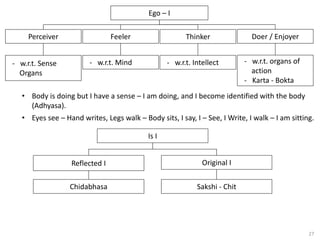
• Body is doing but I have a sense – I am doing, and I become identified with the body
(Adhyasa).
• Eyes see – Hand writes, Legs walk – Body sits, I say, I – See, I Write, I walk – I am sitting.
Ego – I
Perceiver Feeler Thinker Doer / Enjoyer
- w.r.t. Sense
Organs
- w.r.t. Mind - w.r.t. Intellect - w.r.t. organs of
action
- Karta - Bokta
Original I
Reflected I
Is I
Sakshi - Chit
Chidabhasa
28
Gita : Adhyasa in life
I do nothing at all, thus would the harmonised knower of Truth think – seeing, hearing,
touching, smelling, eating, going, sleeping, breathing... [Chapter 5 – Verse 8]
Speaking, letting go, seizing, opening and closing the eyes – convinced that the senses move
among the sense objects. [Chapter 5 – Verse 9]
• The I claiming doership, perceivership, enjoyership is Bodha Bhasa I, not Bodha – ever
free I.
29
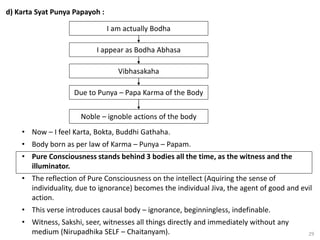
d) Karta Syat Punya Papayoh :
I am actually Bodha
I appear as Bodha Abhasa
Vibhasakaha
Due to Punya – Papa Karma of the Body
Noble – ignoble actions of the body
• Now – I feel Karta, Bokta, Buddhi Gathaha.
• Body born as per law of Karma – Punya – Papam.
• Pure Consciousness stands behind 3 bodies all the time, as the witness and the
illuminator.
• The reflection of Pure Consciousness on the intellect (Aquiring the sense of
individuality, due to ignorance) becomes the individual Jiva, the agent of good and evil
action.
• This verse introduces causal body – ignorance, beginningless, indefinable.
• Witness, Sakshi, seer, witnesses all things directly and immediately without any
medium (Nirupadhika SELF – Chaitanyam).
30
Quotes :
I) Jabala Upanishad :
There are sages called Paramahamsas (as in the days of yore, the
sages) Samvartaka, Aruni, Svetaketu, Durvasas, Ribhu, Nidagha,
Jadabharata, Dattatreya, Raivataka and others, wearing no
distinguishing marks, with conduct beyond the ken (of worldly
people) and who behaved as though bereft of their senses though
(perfectly) sane. Discarding all these, namely the threefold staff (of
bamboo), the water pot, the sling (to carry personal effects), the
(alms-)bowl, the cloth for purifying water (tied to the staff), tuft of
hair and sacred thread in water (i.e. a reservoir) by reciting ‘Bhuh
Svaha’, the Paramahamsa shall seek the Atman. Possessing a form as
one just born (i.e. unclad), unaffected by the pairs (of opposites,
such as heat and cold, pleasure and pain), accepting nothing (except
bare sustenance), well established in the path of the truth of
Brahman, of pure mind, receiving alms into the mouth (literally into
the vessel of the belly) at the prescribed hour in order to sustain life,
becoming equanimous at gain or loss (of alms), sheltering himself,
without an abode (of his own), in an unoccupied house, a temple, a
clump of (tall) grass (or a heap of straw), an anthill, the shade of a
tree, a potter’s hut, a cottage where sacred fire is kept, sandy bank
of a river, a mountain thicket or cavity, a hollow in a tree, the vicinity
of a water fall or a piece of clean ground; making no efforts (in any
kind of gainful activity), free from ‘mineness’ (i.e. a sense of
possessiveness), ever meditating on Brahman, devoted to the Self,
ever intent on eradication of the good and bad karman, (the sage)
finally gives up his body in the state of renunciation – (such a sage) is
indeed a Paramahamsa. Thus (ends) the Upanishad. [Verse 6]
31
II) Narada Parivrajaka Upanishad :
The wise man that is in supreme yoga should abandon the outer sutra (thread). He who wears
(in his heart) this sutra of Brahmic Reality is alone Brahmana. Through wearing this higher sutra,
it becomes not a rejected one, not an impure one. Those only whose sutra is internal, having the
holy thread as jnana are the real knowers of the sutra, they are said to possess the yajnopavita
(holy thread). To those whose sikha (tuft of hair) is jnana, whose holy thread is jnana, and whose
meditation is upon jnana, jnana alone is supreme. It is said that jnana alone is able to purify.
That wise man alone who possesses the jnana - sikha like the sikha (flame) of agni (fire) is said to
possess sikha (tuft of hair). Those that have mere sikha are no sikhas. The Brahmanas and other
that are entitled to perform the vedic karmas are allowed to wear the (external) thread, only as
an auxiliary to the karmas. It is only vedic. The knowers of Brahman know that all Brahmanya
(the state of Brahman) accrues to him only that has the jnanamaya sikha (knowledge-tuft of
hair) and the tanmaya (that or Brahmanful) upavita (holy thread). [Verse 84 to 89]
32
III) Katho Upanishad :
The two who enjoy the fruits of their good works being seated in the cavity of the heart, the
Seat of the Supreme, the knowers of Brahman call them shadow and light ; as also the
performer of the five-fold-fire and those who have propitiated three times the Naciketas-fire.
[I – III – 1]
Atman :
• Absolute reality, embodiment of supreme bliss, the SELF, immanent and immutable,
pure existence, consciousness.
• Illuminator of 3 bodies, imparts reality and self expression to them.
• Substratum.
Jivatman :
• Individual SELF.
• Bears sense of agency in regard to worldly existence.
• Bodha Abhsa, Chidabhasa.
• Acts through medium of intellect.
33
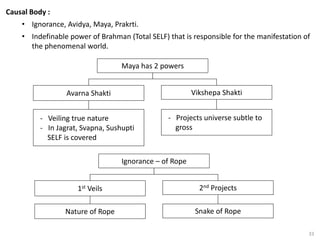
Causal Body :
• Ignorance, Avidya, Maya, Prakrti.
• Indefinable power of Brahman (Total SELF) that is responsible for the manifestation of
the phenomenal world.
Vikshepa Shakti
Avarna Shakti
Maya has 2 powers
- Projects universe subtle to
gross
- Veiling true nature
- In Jagrat, Svapna, Sushupti
SELF is covered
2nd Projects
1st Veils
Ignorance – of Rope
Snake of Rope
Nature of Rope
34
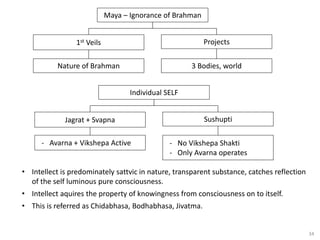
Projects
1st Veils
Maya – Ignorance of Brahman
3 Bodies, world
Nature of Brahman
Sushupti
Jagrat + Svapna
Individual SELF
- No Vikshepa Shakti
- Only Avarna operates
- Avarna + Vikshepa Active
• Intellect is predominately sattvic in nature, transparent substance, catches reflection
of the self luminous pure consciousness.
• Intellect aquires the property of knowingness from consciousness on to itself.
• This is referred as Chidabhasa, Bodhabhasa, Jivatma.
35
Verse 3 :
It is this Jiva that is incessantly migrating in the two worlds (here and hereatfter) due to the
resultant force of its own actions (in the form of good and evil). Therefore the supreme
problem of life lies in the effort to discriminate the pure Consciousness from its reflection (i.e.
the Jiva). [Verse 3]
Jiva
- Migrates to different
worlds like it migrates in
3 Avasthas
- Jiva = Traveller
- Why Jiva travels?
- Force of Prarabda
Karma Phalam.
- Discriminate Pure
Consciousness from its
reflection Jiva.
• Jiva experiences life – Existence – Samsara involving pleasure and pain in different
worlds.
36
Upadesha Sahasri :
Witness Jiva
- Supreme reality
- Has no object of experience
- Self evident
- With dawn of Atma Jnana, Sanchita,
Agami Karma Phalams end.
- Prarabdha exhausted by experience
of pleasure – pain, till death.
- Jiva attains self knowledge and loses
sense of agency, ceases connection
with whatever Actions done through
this body.
The self, its reflection and the intellect are comparable to the face, its reflection and
the mirror. The unreality of the reflection is known from the scriptures and reasoning.
[Chapter 18 - Verse 43]
Just as the reflection of a face which makes a mirror appear like it is the face itself, so, the
reflection of the self in the mirror of the ego making it appear like the self (Is the self). So
the meaning of the sentence, ‘i am Brahman’ is reasonable. [Chapter 18 - Verse 109]
37
Panchadasi :
(Reply) : Being merely conditioned by an object
(such as the intellect), Kutastha does not become
a Jiva. Otherwise, even a wall or a pot which
is also pervaded by Kutastha would become a Jiva.
[Chapter 8 – Verse 28]
“Abhasa” means slight or partial manifestation,
“Pratibimba” is also like that i.e., partial manifestation.
It does not have the properties of the real
entity but resembles it in having some of them.
[Chapter 8 – Verse 32]
As the Cidabhasa is associated and variable, it is devoid
of the characteristics of Kutastha. But as it renders
objects capable of being cognized, it resembles
Kutastha. Such is the opinion of the wise.
[Chapter 8 – Verse 33]
38
Brihadaranyaka Upanishad :
39
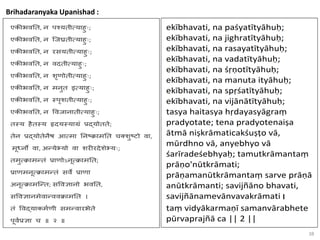
(The eye) becomes united (with the subtle body); then people say, ‘He does not see.’ (The
nose) becomes united; then they say, ‘He does not smell.’ (The tongue) becomes united; then
they say, ‘He does not taste.’ (The vocal organ) becomes united; then they say, ‘He does not
speak.’ (The ear) becomes united; then they say, ‘He does not hear.’ (The Manas) becomes
united; then they say, ‘He does not think.’ (The skin) becomes united; then they say, ‘He does
not touch.’ (The intellect) becomes united; then they say, ‘He does not know.’ The top of the
heart brightens. Through that brightened top the self departs, ‘either through the eye, or
through the head, or through any other part of the body. When it departs, the vital force
follows; when the vital force departs, all the organs follow. Then the self has particular
consciousness, and goes to the body which is related to that con-scioṇsness. It is followed by
knowledge, work and past experience. [4 - 4 - 2]
Aitareya Upanishad :
Then He opened the suture of the skull and entered by that door. This is the door named as
the Vidriti or ‘’cleft’’. This is the place of bliss, Nandana. He has three dwelling-places and three
conditions of sleep (dream). This is a dwelling place. This is a dwelling place. This is a dwelling
place. [I – III – 12]
40
Taittriya Upanishad :
He desired, “I shall become many and be born. He performed tapas; Having performed tapas, He
created all this whatsoever (We perceive). Having created it, He entered into it. Having entered it, He
become the manifest and the unmanifest, the defined and undefined, the housed and the
houseless, knowledge and ignorance, truth and falsehood, and all this whatsoever that exists.
Therefore, it is called existence. In this sense, there is the following Vaidika Verse! [2 - 6 - 3]
Bodhabasa
Karta, Bokta
Experience of Sukham – Dukham (Samsara)
Worlds come
41
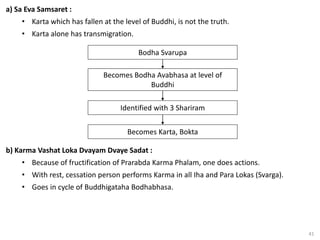
a) Sa Eva Samsaret :
• Karta which has fallen at the level of Buddhi, is not the truth.
• Karta alone has transmigration.
Bodha Svarupa
Becomes Bodha Avabhasa at level of
Buddhi
Identified with 3 Shariram
Becomes Karta, Bokta
b) Karma Vashat Loka Dvayam Dvaye Sadat :
• Because of fructification of Prarabda Karma Phalam, one does actions.
• With rest, cessation person performs Karma in all Iha and Para Lokas (Svarga).
• Goes in cycle of Buddhigataha Bodhabhasa.
42
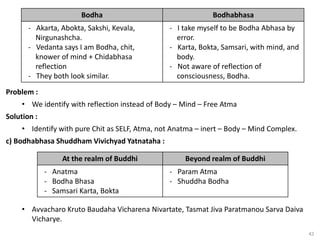
Problem :
• We identify with reflection instead of Body – Mind – Free Atma
Solution :
• Identify with pure Chit as SELF, Atma, not Anatma – inert – Body – Mind Complex.
c) Bodhabhasa Shuddham Vivichyad Yatnataha :
Bodha Bodhabhasa
- Akarta, Abokta, Sakshi, Kevala,
Nirgunashcha.
- Vedanta says I am Bodha, chit,
knower of mind + Chidabhasa
reflection
- They both look similar.
- I take myself to be Bodha Abhasa by
error.
- Karta, Bokta, Samsari, with mind, and
body.
- Not aware of reflection of
consciousness, Bodha.
At the realm of Buddhi Beyond realm of Buddhi
- Anatma
- Bodha Bhasa
- Samsari Karta, Bokta
- Param Atma
- Shuddha Bodha
• Avvacharo Kruto Baudaha Vicharena Nivartate, Tasmat Jiva Paratmanou Sarva Daiva
Vicharye.
43
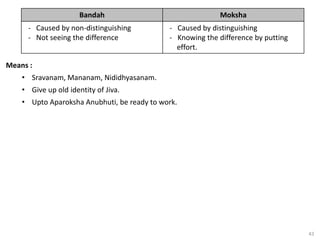
Means :
• Sravanam, Mananam, Nididhyasanam.
• Give up old identity of Jiva.
• Upto Aparoksha Anubhuti, be ready to work.
Bandah Moksha
- Caused by non-distinguishing
- Not seeing the difference
- Caused by distinguishing
- Knowing the difference by putting
effort.
44
Verse 4 : Consciousness illumines ignorance – Avidya in Sushupti
The relational activities of the reflected Consciousness (i.e. the Jiva) are restricted to the two
states of waking and dreaming : whereas in deep sleep the reflected Consciousness itself
together with the reflector, the intellect, being absorbed in ignorance, the pure Consciousness
shines upon ignorance only. [Verse 4]
• How to differentiate Bodha Abhasa and Bodha?
• Carefully observe both of them.
Immutable pure Consciousness
Shines upon ignorance only
• During deep sleep, even though everything vanishes, the immutable, pure
consciousness remains in itself, being ever unaffected.
45
Brihadaranyaka Upanishad :
• World gets absorbed in Consciousness.
• The knowledge of seer never annihilated.
That it does not see in that state is because, although seeing then, it does not see; for the
vision of the witness can never be lost, because it is immortal. But there is not that second
thing separate from it which it can see. [4 - 3 - 23]
- Ignorance
- Absence of awareness of
everything else
- Experience of Bliss
Person rising from sleep remembers
• This text is a deeper analysis of 3 states like Mandukya Upanishad for revealation of
Aham Brahma Asmi.
a) Jagrat Svapnayor Eva Bodhabhasa Vidambana :
• Ego I – Bodha Abhasa masquerades as the Bodha – Sakshi in Jagrat and Svapna.
46
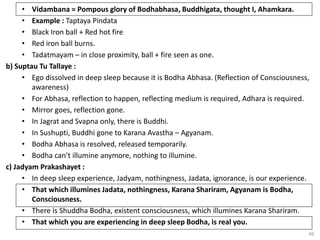
• Vidambana = Pompous glory of Bodhabhasa, Buddhigata, thought I, Ahamkara.
• Example : Taptaya Pindata
• Black Iron ball + Red hot fire
• Red iron ball burns.
• Tadatmayam – in close proximity, ball + fire seen as one.
b) Suptau Tu Tallaye :
• Ego dissolved in deep sleep because it is Bodha Abhasa. (Reflection of Consciousness,
awareness)
• For Abhasa, reflection to happen, reflecting medium is required, Adhara is required.
• Mirror goes, reflection gone.
• In Jagrat and Svapna only, there is Buddhi.
• In Sushupti, Buddhi gone to Karana Avastha – Agyanam.
• Bodha Abhasa is resolved, released temporarily.
• Bodha can’t illumine anymore, nothing to illumine.
c) Jadyam Prakashayet :
• In deep sleep experience, Jadyam, nothingness, Jadata, ignorance, is our experience.
• That which illumines Jadata, nothingness, Karana Shariram, Agyanam is Bodha,
Consciousness.
• There is Shuddha Bodha, existent consciousness, which illumines Karana Shariram.
• That which you are experiencing in deep sleep Bodha, is real you.
47
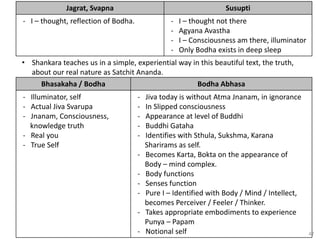
Jagrat, Svapna Susupti
- I – thought, reflection of Bodha. - I – thought not there
- Agyana Avastha
- I – Consciousness am there, illuminator
- Only Bodha exists in deep sleep
• Shankara teaches us in a simple, experiential way in this beautiful text, the truth,
about our real nature as Satchit Ananda.
Bhasakaha / Bodha Bodha Abhasa
- Illuminator, self
- Actual Jiva Svarupa
- Jnanam, Consciousness,
knowledge truth
- Real you
- True Self
- Jiva today is without Atma Jnanam, in ignorance
- In Slipped consciousness
- Appearance at level of Buddhi
- Buddhi Gataha
- Identifies with Sthula, Sukshma, Karana
Sharirams as self.
- Becomes Karta, Bokta on the appearance of
Body – mind complex.
- Body functions
- Senses function
- Pure I – Identified with Body / Mind / Intellect,
becomes Perceiver / Feeler / Thinker.
- Takes appropriate embodiments to experience
Punya – Papam
- Notional self
48
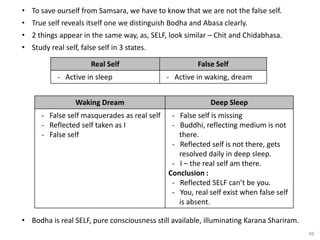
• To save ourself from Samsara, we have to know that we are not the false self.
• True self reveals itself one we distinguish Bodha and Abasa clearly.
• 2 things appear in the same way, as, SELF, look similar – Chit and Chidabhasa.
• Study real self, false self in 3 states.
Real Self False Self
- Active in sleep - Active in waking, dream
Waking Dream Deep Sleep
- False self masquerades as real self
- Reflected self taken as I
- False self
- False self is missing
- Buddhi, reflecting medium is not
there.
- Reflected self is not there, gets
resolved daily in deep sleep.
- I – the real self am there.
Conclusion :
- Reflected SELF can’t be you.
- You, real self exist when false self
is absent.
• Bodha is real SELF, pure consciousness still available, illuminating Karana Shariram.
49
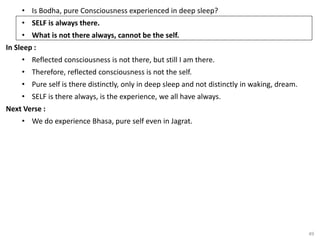
• Is Bodha, pure Consciousness experienced in deep sleep?
• SELF is always there.
• What is not there always, cannot be the self.
In Sleep :
• Reflected consciousness is not there, but still I am there.
• Therefore, reflected consciousness is not the self.
• Pure self is there distinctly, only in deep sleep and not distinctly in waking, dream.
• SELF is there always, is the experience, we all have always.
Next Verse :
• We do experience Bhasa, pure self even in Jagrat.
50
Verse 5 :
Even in wakefulness, the calm of the intellect is lit up by the pure Consciousness. So also the
activities of the intellect together with the reflected – Consciousness are subject to
manifestation by the pure Consciousness. [Verse 5]
- All activities of the intellect
with reflected
Consciousness.
- Sattvic Mind
- Non functioning mind lit by
Chaitanyam
Bhasa – SELF experienced in
2 states of Illumination
Quiet state
Active state in Jagrat
By Bhasa alone
By Bhasa and Chidabhasa
51
Panchadasi :
That consciousness which witnesses the interval between the
disappearance and the rise of successive Vrttis and the period
when they do not exist, and which is itself unmodifiable and
immutable, is called Kutastha. [Chapter 8 – Verse 21]
Similarly awareness illumines the space between the thought
modifications in the Subtle Body as well as the absence of
thoughts in deep sleep, but it can only be recognized in the
spaces between the thoughts because it is not absorbed by
the vrittis…or by deep sleep. [Chapter 8 – Verse 3]
For a short time after the waking up the impression of the bliss
of Brahman enjoyed during sleep continues. For he remains
for some time calm and happy, without taking any interest in
the enjoyment of external object. [Chapter 11 – verse 74]
Leave the vain argument alone and know that
whenever happiness is felt in the absence of objects, that
happiness is an impression of the bliss of Brahman.
[Chapter 11 – verse 85]
a) Jagare Api :
• Also in Jagrat Avastha this consciousness is experienced.
Deep Sleep :
• Shuddha Bodha illuminates Agyanam – ignorance.
52
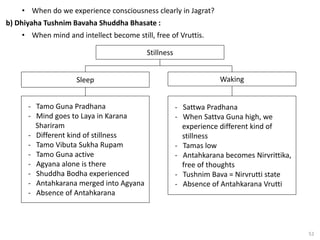
• When do we experience consciousness clearly in Jagrat?
b) Dhiyaha Tushnim Bavaha Shuddha Bhasate :
• When mind and intellect become still, free of Vruttis.
Waking
Sleep
Stillness
- Sattwa Pradhana
- When Sattva Guna high, we
experience different kind of
stillness
- Tamas low
- Antahkarana becomes Nirvrittika,
free of thoughts
- Tushnim Bava = Nirvrutti state
- Absence of Antahkarana Vrutti
- Tamo Guna Pradhana
- Mind goes to Laya in Karana
Shariram
- Different kind of stillness
- Tamo Vibuta Sukha Rupam
- Tamo Guna active
- Agyana alone is there
- Shuddha Bodha experienced
- Antahkarana merged into Agyana
- Absence of Antahkarana
53
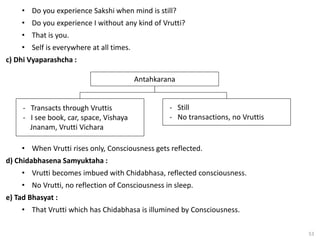
• Do you experience Sakshi when mind is still?
• Do you experience I without any kind of Vrutti?
• That is you.
• Self is everywhere at all times.
c) Dhi Vyaparashcha :
- Still
- No transactions, no Vruttis
- Transacts through Vruttis
- I see book, car, space, Vishaya
Jnanam, Vrutti Vichara
Antahkarana
• When Vrutti rises only, Consciousness gets reflected.
d) Chidabhasena Samyuktaha :
• Vrutti becomes imbued with Chidabhasa, reflected consciousness.
• No Vrutti, no reflection of Consciousness in sleep.
e) Tad Bhasyat :
• That Vrutti which has Chidabhasa is illumined by Consciousness.
54
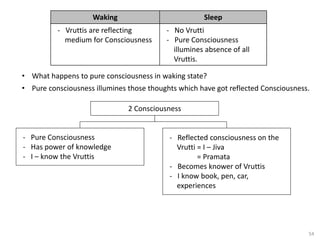
• What happens to pure consciousness in waking state?
• Pure consciousness illumines those thoughts which have got reflected Consciousness.
Waking Sleep
- Vruttis are reflecting
medium for Consciousness
- No Vrutti
- Pure Consciousness
illumines absence of all
Vruttis.
- Reflected consciousness on the
Vrutti = I – Jiva
= Pramata
- Becomes knower of Vruttis
- I know book, pen, car,
experiences
- Pure Consciousness
- Has power of knowledge
- I – know the Vruttis
2 Consciousness
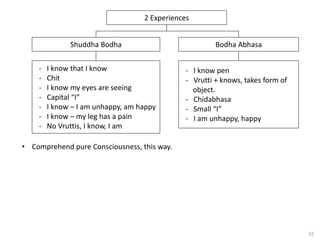
55
Bodha Abhasa
Shuddha Bodha
2 Experiences
- I know pen
- Vrutti + knows, takes form of
object.
- Chidabhasa
- Small “I”
- I am unhappy, happy
- I know that I know
- Chit
- I know my eyes are seeing
- Capital “I”
- I know – I am unhappy, am happy
- I know – my leg has a pain
- No Vruttis, I know, I am
• Comprehend pure Consciousness, this way.
56
Verse 6 :
Water heated on fire acquires heat and so becomes capable of heating the body; in like
manner, the intellect illumined by pure Consciousness acquires its lustre and thereby illumines
all other external objects. [Verse 6]
Example Intellect
- Water aquires heat of fire,
can scald the body
- Intellect illumined by
consciousness aquires the
lustre of consciousness and
illumines external objects
- Intellect manifests the
external objects like car,
pot, desk….
57
Panchadasi :
Reflection of consciousness on the
intellect
Intellect illumined by
Consciousness
2 things required for all
experiences
An external object, such as a pot, is cognized through the
Vrttis (modifications of the intellect) assuming its form, but
the knowledge ‘I know the pot’ comes (directly) through pure
consciousness, Brahman. [Chapter 8 – Verse 4]
- Knowledge
- I know the Pot
- My knowledge of the Pot
- Job of Kootastha Chaitanyam
- Knowledge of the Pot
- Eyes open, perception happens
- Removes ignorance of the pot
- Job of Vrutti
- Intellect assumes the Vrutti
2 Knowledges
58
Panchadasi :
As fire pervades a red-hot piece of iron, so Cidabhasa
pervades I – consciousness as well as lust, anger, and other
emotions. [Chapter 8 – Verse 18]
• Fire pervades cold iron.
• I – Consciousness pervades all emotions of lust, anger, desire, compassion.
a) Vanhi Taptau Jalam :
Water
Heated by fire
b) Tapah Yuktam :
• Nature of water – coldness.
• Because of association with fire, water becomes hot.
c) Dehasya Tapakam :
• Hot water scalds the skin.
• Water gets property of fire.
• As fire scalds, hot water also scalds.
59
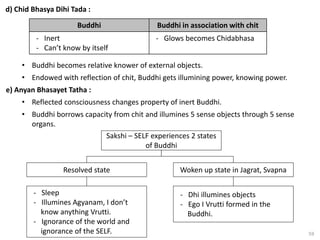
d) Chid Bhasya Dihi Tada :
• Buddhi becomes relative knower of external objects.
• Endowed with reflection of chit, Buddhi gets illumining power, knowing power.
e) Anyan Bhasayet Tatha :
• Reflected consciousness changes property of inert Buddhi.
• Buddhi borrows capacity from chit and illumines 5 sense objects through 5 sense
organs.
Buddhi Buddhi in association with chit
- Inert
- Can’t know by itself
- Glows becomes Chidabhasa
Woken up state in Jagrat, Svapna
Resolved state
Sakshi – SELF experiences 2 states
of Buddhi
- Dhi illumines objects
- Ego I Vrutti formed in the
Buddhi.
- Sleep
- Illumines Agyanam, I don’t
know anything Vrutti.
- Ignorance of the world and
ignorance of the SELF.
60
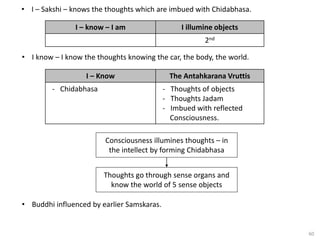
• I – Sakshi – knows the thoughts which are imbued with Chidabhasa.
• I know – I know the thoughts knowing the car, the body, the world.
I – know – I am I illumine objects
2nd
I – Know The Antahkarana Vruttis
- Chidabhasa - Thoughts of objects
- Thoughts Jadam
- Imbued with reflected
Consciousness.
Consciousness illumines thoughts – in
the intellect by forming Chidabhasa
Thoughts go through sense organs and
know the world of 5 sense objects
• Buddhi influenced by earlier Samskaras.
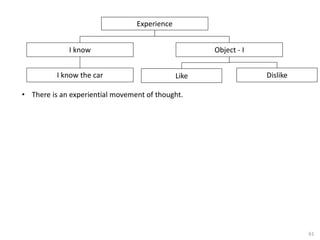
61
• There is an experiential movement of thought.
Object - I
I know
Experience
I know the car Dislike
Like
62
Verse 7 :
Water heated on fire acquires heat and so becomes capable of heating the body; in like
manner, the intellect illumined by pure Consciousness acquires its lustre and thereby illumines
all other external objects. [Verse 6]
Pure Consciousness Intellect
- Only reveals the sense
objects
- Its free from all
modifications
- Superimpose good, evil
notions on the sense
objects
- Colours them as this is
good, this is bad.
- Modifications of mind are
unreal and do not affect
Consciousness.
63
Panchadasi :
Objects of experience Enjoyment of objects
- Created by Ishvara
- Modification or functions of
Maya Shakti of Ishvara
- Modifications or functions
of inner organs of Jiva.
The Jiva creates these three feelings of happiness,
disappointment or indifference with regard to the gem, but
the nature of the gem as created by Isvara remains the
same throughout. [Chapter 4 – Verse 22]
Jiva creates 3 feelings
Happiness Disappointment Indifference
a) Rupadhau :
• In Shabda, Sparsha, Rupa, Rasah, Gandah Vruttis.
• Objects of thoughts are illumined by consciousness, Ishvara Srishti.
64
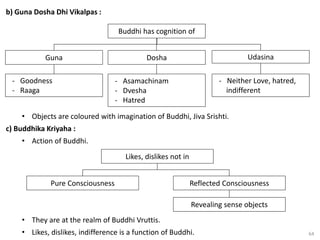
Buddhi has cognition of
Guna Dosha Udasina
b) Guna Dosha Dhi Vikalpas :
- Goodness
- Raaga
- Asamachinam
- Dvesha
- Hatred
- Neither Love, hatred,
indifferent
• Objects are coloured with imagination of Buddhi, Jiva Srishti.
c) Buddhika Kriyaha :
• Action of Buddhi.
Reflected Consciousness
Pure Consciousness
Likes, dislikes not in
Revealing sense objects
• They are at the realm of Buddhi Vruttis.
• Likes, dislikes, indifference is a function of Buddhi.
65
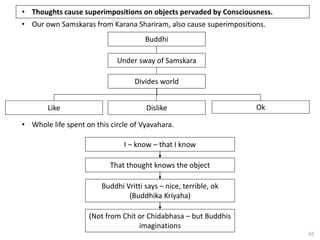
• Thoughts cause superimpositions on objects pervaded by Consciousness.
• Our own Samskaras from Karana Shariram, also cause superimpositions.
Divides world
Like Dislike Ok
Under sway of Samskara
Buddhi
• Whole life spent on this circle of Vyavahara.
I – know – that I know
That thought knows the object
Buddhi Vritti says – nice, terrible, ok
(Buddhika Kriyaha)
(Not from Chit or Chidabhasa – but Buddhis
imaginations
66
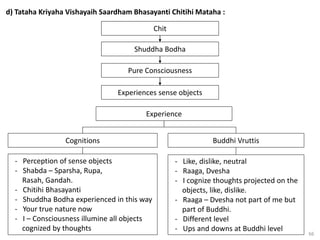
d) Tataha Kriyaha Vishayaih Saardham Bhasayanti Chitihi Mataha :
Chit
Shuddha Bodha
Pure Consciousness
Experiences sense objects
Buddhi Vruttis
Cognitions
Experience
- Like, dislike, neutral
- Raaga, Dvesha
- I cognize thoughts projected on the
objects, like, dislike.
- Raaga – Dvesha not part of me but
part of Buddhi.
- Different level
- Ups and downs at Buddhi level
- Perception of sense objects
- Shabda – Sparsha, Rupa,
Rasah, Gandah.
- Chitihi Bhasayanti
- Shuddha Bodha experienced in this way
- Your true nature now
- I – Consciousness illumine all objects
cognized by thoughts
67
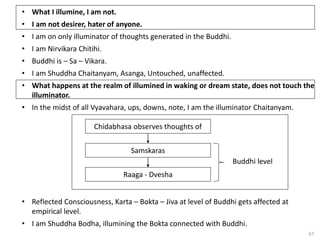
• What I illumine, I am not.
• I am not desirer, hater of anyone.
• I am on only illuminator of thoughts generated in the Buddhi.
• I am Nirvikara Chitihi.
• Buddhi is – Sa – Vikara.
• I am Shuddha Chaitanyam, Asanga, Untouched, unaffected.
• What happens at the realm of illumined in waking or dream state, does not touch the
illuminator.
• In the midst of all Vyavahara, ups, downs, note, I am the illuminator Chaitanyam.
Chidabhasa observes thoughts of
Samskaras
Raaga - Dvesha
Buddhi level
• Reflected Consciousness, Karta – Bokta – Jiva at level of Buddhi gets affected at
empirical level.
• I am Shuddha Bodha, illumining the Bokta connected with Buddhi.
68
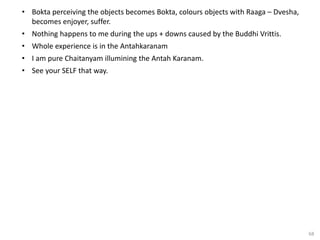
• Bokta perceiving the objects becomes Bokta, colours objects with Raaga – Dvesha,
becomes enjoyer, suffer.
• Nothing happens to me during the ups + downs caused by the Buddhi Vrittis.
• Whole experience is in the Antahkaranam
• I am pure Chaitanyam illumining the Antah Karanam.
• See your SELF that way.
69
Verse 8 :
The absolute pure Consciousness is distinct from the objects of senses as well as from the
notions of good and evil attributed to them by the intellect yet. She (pure Consciousness) it is
that stands behind the cognition of them all as the sole illumine. [Verse 8]
Absolute Consciousness
- Different from objects
of senses form, colour,
taste, smell, touch,
sound
- Notions of good, evil,
attributed to them by
the intellect
- Is only the illuminator of
cognitions and thoughts.
- Ever free
- Self luminous
- Untouched by any
modification at the
mind – intellect level.
70
Brihadaranyaka Upanishad :
That man has only two abodes, this and the next world. The dream state, which is the third, is
at the junction (of the two). Staying at that junction he surveys the two abodes, this and the
next world. Whatever outfit he may have for the next world, providing himself with that he
sees both evils (sufferings) and joys. When he dreams, he takes away a little of (the
impressions of) this all-embracing world (the waking state), himself puts the body aside and
himself creates (a dream body in its place), revealing his own lustre by his own light—and
dreams. In this state the man himself becomes the light. [4 - 3 - 9]
71
Yoga Vasishta :
• That by whom you experience sound, taste, form, smell, know him to be the Atman,
the transcendental Brahman, the supreme, over - Lord.
• Differentiate pure consciousness from all cognitions and thoughts.
• Then can see the presence of consciousness in every thought.
a) Rupachha :
• World = Shabda, Sparsha, Rupa, Rasah, Gandha = Vishayas.
= All objects of perceptions + combinations.
= Water – has sweet fragrance.
b) Guna – Doshabhyam :
Dosha
Guna
Buddhi Colours
On Vishaya
Normally Mind on
Objects Raaga Dvesha Never on Consciousness
72
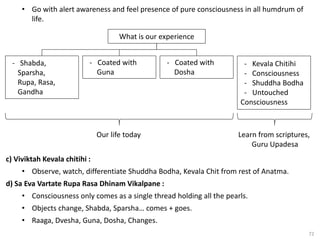
• Go with alert awareness and feel presence of pure consciousness in all humdrum of
life.
What is our experience
- Shabda,
Sparsha,
Rupa, Rasa,
Gandha
- Coated with
Guna
- Coated with
Dosha
- Kevala Chitihi
- Consciousness
- Shuddha Bodha
- Untouched
Consciousness
Our life today Learn from scriptures,
Guru Upadesa
c) Viviktah Kevala chitihi :
• Observe, watch, differentiate Shuddha Bodha, Kevala Chit from rest of Anatma.
d) Sa Eva Vartate Rupa Rasa Dhinam Vikalpane :
• Consciousness only comes as a single thread holding all the pearls.
• Objects change, Shabda, Sparsha… comes + goes.
• Raaga, Dvesha, Guna, Dosha, Changes.
73
• All Vikalpane.
• What keeps continuing?
• Anuvartate?
• Consciousness, awareness alone travels continuously in all cognitions of Vishayas
without a change.
• You alone, Shuddha bodha, travel without any change.
• This is how you see yourself in Jagrat + Svapna.
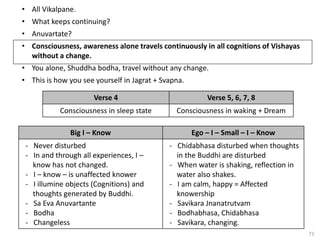
Verse 4 Verse 5, 6, 7, 8
Consciousness in sleep state Consciousness in waking + Dream
Big I – Know Ego – I – Small – I – Know
- Never disturbed
- In and through all experiences, I –
know has not changed.
- I – know – is unaffected knower
- I illumine objects (Cognitions) and
thoughts generated by Buddhi.
- Sa Eva Anuvartante
- Bodha
- Changeless
- Chidabhasa disturbed when thoughts
in the Buddhi are disturbed
- When water is shaking, reflection in
water also shakes.
- I am calm, happy = Affected
knowership
- Savikara Jnanatrutvam
- Bodhabhasa, Chidabhasa
- Savikara, changing.
74
• Beauty of Laghu – Vakya Vrutti is its experiential teaching.
• Moment to moment Shankara helps us to see our SELF.
Kevala Chitihi Vishaya Rupascha Guna, Dosha
- Pure Consciousness
- Shuddha Bodha
- Present in each and every Vrutti
- Experience pure Consciousness
- Buddhi Vrittis come to know Vishayas
- Buddhi paints on Vishayas – Guna –
Doshas, likes, dislikes
- Objects of knowledge
- Realm of mind
Katho Upanishad :
This Atman hidden in all beings reveals (itself) not (to all), but is seen (only) by Seers of the
subtle through sharp and subtle intellect. [I – III – 12]
The self-existent (Brahma) created the senses with outgoing tendencies ; therefore, man
beholds the external universe and not the internal Self (Atman). But only some wise man
desirous of Immortality, with eyes averted (turned within and with his senses turned away)
from sensual objects, sees the Atman within. [II – I – 1]
75
• When you make uturn in the mind, you can see the pervading, permeating,
consciousness in each and every Vrutti.
• Vrittu holds Shabda, Sparsha, Rupa, Rasah, Gandah.
• Cognitions change, Vikalpas change.
• You will find uniformly present, illuming consciousness, does not change.
• Discover and own up that light of changeless awareness as SELF and be ever free.
Gita :
There is nothing whatsoever higher than Me, O Dhananjaya. All this is strung in Me, as clusters
of gems on a string. [Chapter 7 - Verse 7]
76
Verse 9 :
The modifications of the intellect are changing from moment to moment, never so the pure
consciousness though it permeates through all those modifications like the thread in a string
of pearls. [Verse 9]
Pure Consciousness Modifications of Intellect
- Changeless
- Permeates all modifications of
intellect
Example :
- Thread in a string of pearls of
necklace
- Distinct witness
- Changing, variable
- Pearls
77
Panchadasi :
All modifications are produced one after another
(i.e., with gaps in between); and they all become latent
during deep sleep and in the States of swoon and Samadhi
[Chapter 18 Verse 20]
• Modifications in intellect come with gaps in between.
• Modifications are latent in sleep, Samadhi, swoon states.
a) Kshane Kshane Anyatha Buta :
• Every moment Vrutti changes.
• Parinamina Drishyante.
b) Natu Chitihi :
• What does not change?
• Illumining consciousness does not change.
I – Shuddha Bodha
Illumine
Thoughts in the intellect, knowing the object
Buddhi does colouration, good, bad through thoughts
78
• Thoughts hold objects and colourations.
Light of consciousness,
constant, morning to
evening
↓
Changeless, uniform
Illumines Buddhi
Vritti of Buddhi
Cognitions of Sense
Organs
• Fact of I – Consciousness – illumining light, uniform, changeless, throughout our life.
• Moment to moment, Vikalpa changes.
• Kevala Chiti Natu Vikalpate.
Brihadaranyaka Upanishad :
That it does not see in that state is because, although seeing then, it does not see; for the
vision of the witness can never be lost, because it is immortal. But there is not that second
thing separate from it which it can see. [4 - 3 - 23]
79
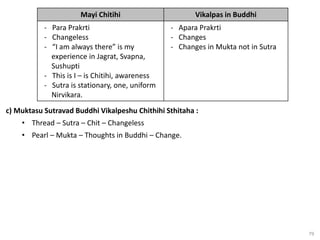
c) Muktasu Sutravad Buddhi Vikalpeshu Chithihi Sthitaha :
• Thread – Sutra – Chit – Changeless
• Pearl – Mukta – Thoughts in Buddhi – Change.
Mayi Chitihi Vikalpas in Buddhi
- Para Prakrti
- Changeless
- “I am always there” is my
experience in Jagrat, Svapna,
Sushupti
- This is I – is Chitihi, awareness
- Sutra is stationary, one, uniform
Nirvikara.
- Apara Prakrti
- Changes
- Changes in Mukta not in Sutra
80
Verse 10 : important Verse
The thread covered over by the pearls in a string can be seen in between two pearls. Similarly.
The pure Consciousness also, though hidden by the modifications of the intellect, can be
clearly perceived in between any two modifications. [Verse 10]
Thread covered by pearls Pure Consciousness
- String seen in between 2 pearls - Hidden by modifications of
intellect
- Clearly perceived between 2
modifications
• Consciousness, the immutable one, though hidden by the modification of the
intellect shines out distinctly, visible in the interval of 2 modifications or thoughts.
• The pure unaffected consciousness by which the intervals of modifications as well as
their absence are illumined is called the immutable one.
81
Panchadasi :
That consciousness which witnesses the interval between the
disappearance and the rise of successive Vrttis and the period
when they do not exist, and which is itself unmodifiable and
immutable, is called Kutastha. [Chapter 8 – Verse 21]
Consciousness witnesses
Disappearance of one Vritti Rise of new Vrutti Period when no Vruttis
exist
• Consciousness is immutable, unmodifiable, Kutastha.
Example :
• Like Anvil of blacksmith.
Panchadasi :
Since Cidabhasa is a double consciousness we see it
manifested and unmanifested, therefore, it cannot be called
immutable, Kutastha, whereas the other is Kutastha, for it
undergoes no such change. [Chapter 8 – Verse 24]
82
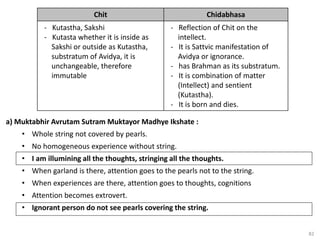
a) Muktabhir Avrutam Sutram Muktayor Madhye Ikshate :
• Whole string not covered by pearls.
• No homogeneous experience without string.
• I am illumining all the thoughts, stringing all the thoughts.
• When garland is there, attention goes to the pearls not to the string.
• When experiences are there, attention goes to thoughts, cognitions
• Attention becomes extrovert.
• Ignorant person do not see pearls covering the string.
Chit Chidabhasa
- Kutastha, Sakshi
- Kutasta whether it is inside as
Sakshi or outside as Kutastha,
substratum of Avidya, it is
unchangeable, therefore
immutable
- Reflection of Chit on the
intellect.
- It is Sattvic manifestation of
Avidya or ignorance.
- has Brahman as its substratum.
- It is combination of matter
(Intellect) and sentient
(Kutastha).
- It is born and dies.
83
b) Thatha Avruta Vikalpahi Chit :
• In the same way, Kevala Chit, Consciousness, is covered by Vikalpas, cognitions.
• Without Chit, consciousness, we won’t be able to connect Vruttis as wholistic life
experience for us.
• Use reasoning, inference to know Chit.
• Attention goes to Vikalpas, thought, chit forgotten.
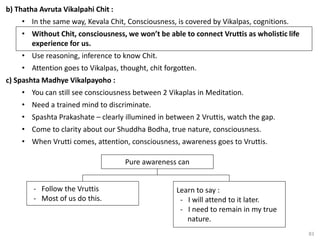
c) Spashta Madhye Vikalpayoho :
• You can still see consciousness between 2 Vikaplas in Meditation.
• Need a trained mind to discriminate.
• Spashta Prakashate – clearly illumined in between 2 Vruttis, watch the gap.
• Come to clarity about our Shuddha Bodha, true nature, consciousness.
• When Vrutti comes, attention, consciousness, awareness goes to Vruttis.
Learn to say :
- I will attend to it later.
- I need to remain in my true
nature.
- Follow the Vruttis
- Most of us do this.
Pure awareness can
84
• Notice that consciousness in you as your own nature.
Panchadasi :
That consciousness which witnesses the interval between the
disappearance and the rise of successive Vrttis and the period
when they do not exist, and which is itself unmodifiable and
immutable, is called Kutastha. [Chapter 8 – Verse 21]
• In the middle of 2 Vruttis when Vruttis are not there, what shines, is Nirvikara
Kutastha.
Thought 1
Nirvikara Kutastha
Chaitanyam
Thought 2
(Makes all thoughts into
holistic experience)
• How to get Shuddha Bodha?
• In between 2 thoughts you see clearly.
• Other time also you Kutastha are there.
• Without you there is no thought.
85
Verse 11 :
• How to see consciousness between 2 Vruttis?
The pure undifferentiated Consciousness shines forth clearly by itself in the interval of two
modifications of the intellect, when the preceding one has died down and another is yet to
appear. [Verse 11]
2 modifications of intellect
Pure undifferentiated
consciousness Thought 2
Thought 1
Tat Tvam Asi
You are That
Shines by itself
Yet to appear
Died down
Interval
86
• Mind free from modifications is revealed by the immutable, pure, Consciousness.
• Even in Jagrat, verse 5 says :
The Calm unmodified state of the intellect is lit up by the pure Consciousness.
Implied meaning
Direct meaning of Thou
Thou art That
- Pure Consciousness
- Universal SELF
- Individual self
• Individual self is nothing but pure consciousness, total.
Chandogya Upanishad :
‘That which is the subtlest of all is the Self of all this. It is the Truth. It is the Self. That thou art,
O Śvetaketu.’ [Śvetaketu then said,] ‘Sir, please explain this to me again.’ ‘Yes, Somya, I will
explain again,’ replied his father. [6 - 8 - 7]
87
Panchadasi :
Panchadasi :
That consciousness which witnesses the interval between the
disappearance and the rise of successive Vrttis and the period
when they do not exist, and which is itself unmodifiable and
immutable, is called Kutastha. [Chapter 8 – Verse 21]
Consciousness / Kutastha Witnesses
Interval between 2 Vruttis and in the
absence of all Vruttis in sleep
By discrimination of the subtle body (and recognition of its variable, transient character), the
sheaths of the mind, intellect, and vital airs are understood to be different from the self, for
the sheaths are conditions of the three Gunas, and differ from each other (qualitatively and
quantitatively). [Chapter 1 – Verse 40]
Pranamaya Kosha Manomaya Kosha Vijnanamaya Kosha
Rajas Sattva + Rajas Sattva
88
• Witnessing self is different from 3 Gunas.
Panchadasi :
Avidya (Manifested as the causal body or bliss sheath) is negated in the state of deep
meditation (in which neither subject nor object is experienced), but the self persists in that
state; so it is the in variable factor. But the causal body is a variable factor, for though the self
persists, it does not. [Chapter 1 – Verse 41]
Anandamaya Kosha
Avidya
Bliss Sheath
No subject, object experienced
Self remains
89
Panchadasi :
Brahman
Sattva mixed with Rajas + Tamas
Creates desires, activities
Referred as “Thou”- Jiva
When the supreme Brahman superimposes on Itself Avidya, that is, Sattva mixed with rajas and
tamas, creating desires and activities in It, then it is referred to as ‘thou’. [Chapter 1 – Verse 45]
Panchadasi :
When the three mutually contradictory aspects of Maya are rejected, there remains the one
indivisible Brahman whose nature is existence, consciousness and bliss. This is pointed out by
the great saying ‘That thou art’. [Chapter 1 – Verse 46]
90
• When Sattva, Rajas, Tamas, effect of Maya Shakti is rejected, there remains the one
indivisible Brahman whose nature is existence, Consciousness, bliss.
• “That thou art”
3 Aspects of Maya
Predominately Tamas Impure Sattva Pure Sattva
Jada Prapancha Jiva Ishvara
Panchadasi :
Similarly, when the adjuncts, Maya and Avidya (the conflicting connotations in the proposition
(That thou art) of Brahman, and Jiva, are negated, there remains the indivisible supreme
Brahman, whose nature is existence, consciousness and bliss. [Chapter 1 – Verse 48]
91
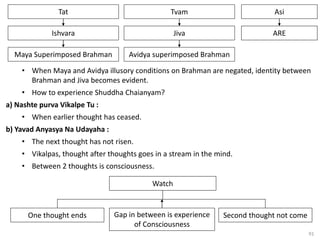
Tat Tvam
Ishvara Jiva
• When Maya and Avidya illusory conditions on Brahman are negated, identity between
Brahman and Jiva becomes evident.
• How to experience Shuddha Chaianyam?
a) Nashte purva Vikalpe Tu :
• When earlier thought has ceased.
b) Yavad Anyasya Na Udayaha :
• The next thought has not risen.
• Vikalpas, thought after thoughts goes in a stream in the mind.
• Between 2 thoughts is consciousness.
Maya Superimposed Brahman Avidya superimposed Brahman
Second thought not come
One thought ends
Watch
Gap in between is experience
of Consciousness
Asi
ARE
92
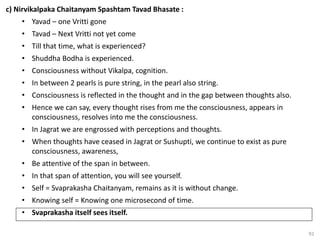
c) Nirvikalpaka Chaitanyam Spashtam Tavad Bhasate :
• Yavad – one Vritti gone
• Tavad – Next Vritti not yet come
• Till that time, what is experienced?
• Shuddha Bodha is experienced.
• Consciousness without Vikalpa, cognition.
• In between 2 pearls is pure string, in the pearl also string.
• Consciousness is reflected in the thought and in the gap between thoughts also.
• Hence we can say, every thought rises from me the consciousness, appears in
consciousness, resolves into me the consciousness.
• In Jagrat we are engrossed with perceptions and thoughts.
• When thoughts have ceased in Jagrat or Sushupti, we continue to exist as pure
consciousness, awareness,
• Be attentive of the span in between.
• In that span of attention, you will see yourself.
• Self = Svaprakasha Chaitanyam, remains as it is without change.
• Knowing self = Knowing one microsecond of time.
• Svaprakasha itself sees itself.
93
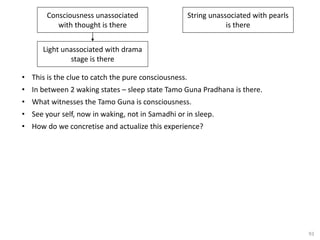
• This is the clue to catch the pure consciousness.
• In between 2 waking states – sleep state Tamo Guna Pradhana is there.
• What witnesses the Tamo Guna is consciousness.
• See your self, now in waking, not in Samadhi or in sleep.
• How do we concretise and actualize this experience?
Consciousness unassociated
with thought is there
String unassociated with pearls
is there
Light unassociated with drama
stage is there
94
Verse 12 :
Persons aspiring to the experience of Brahman should, therefore, practice by slow degrees this
restraint of modifications starting with one moment and then extending it to two, three, and
so on. [Verse 12]
• Practice restraining gradually first one, two, three moments to experience Brahman.
• It is possible to realise true nature of pure consciousness by making the mind clear of
all modifications and affections.
a) Brahman Anubava Kankshibihi :
• Those who are eager to have experience of Brahman, supreme reality.
• Not read, reflect but to concretise this knowledge.
• Those who want Aparoksha Jnanam, move from Jnanam to Vijananm (Mumukshus).
• It will not be immediately possible to be in the silence, gap between 2 thoughts as
thoughts are going in jet speed.
95
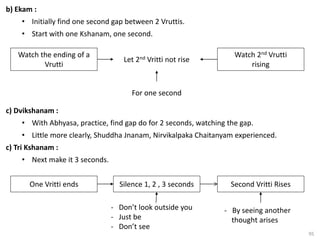
b) Ekam :
• Initially find one second gap between 2 Vruttis.
• Start with one Kshanam, one second.
c) Dvikshanam :
• With Abhyasa, practice, find gap do for 2 seconds, watching the gap.
• Little more clearly, Shuddha Jnanam, Nirvikalpaka Chaitanyam experienced.
c) Tri Kshanam :
• Next make it 3 seconds.
Watch the ending of a
Vrutti
Let 2nd Vritti not rise
Watch 2nd Vrutti
rising
For one second
One Vritti ends Silence 1, 2 , 3 seconds Second Vritti Rises
- Don’t look outside you
- Just be
- Don’t see
- By seeing another
thought arises
96
Ramana Mahrishi :
• Upadesa of Lord Subramanya to Arunagirinatha Muni (Saint).
• Summa Iru, just be, not be quiet, don’t see the be.
• Seeing is objectifying tendency of the mind instrument.
• Pure being = Consciousness.
• Unobjectified Nirvikalpa Chit.
• Cannot be objectified as Vikalpa.
• One Kshana you be, you will be gifted with 2 – 3 – 4 – Kshanams.
Gita :
Little by little, let him attain quietude by his intellect held firm; having made the mind
established in the Self, let him not think of anything. [Chapter 6 – Verse 25]
• No race to win, hasten slowly, let attention be there.
d) Vikalpasya Nirodhanam :
• Antahkarana Vrutti restrained, cognitions restrained.
97
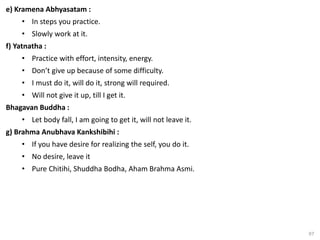
e) Kramena Abhyasatam :
• In steps you practice.
• Slowly work at it.
f) Yatnatha :
• Practice with effort, intensity, energy.
• Don’t give up because of some difficulty.
• I must do it, will do it, strong will required.
• Will not give it up, till I get it.
Bhagavan Buddha :
• Let body fall, I am going to get it, will not leave it.
g) Brahma Anubhava Kankshibihi :
• If you have desire for realizing the self, you do it.
• No desire, leave it
• Pure Chitihi, Shuddha Bodha, Aham Brahma Asmi.
98
Verse 13 :
This individual self (Jiva), which is now affected by modifications of the intellect, will in time
become one with the undifferentiated Brahman by realising the truth of the Vedantic teaching
– “I am Brahman”. That is the idea sought to be conveyed here, in this treatise. [Verse 13]
• Aham Brahma Asmi – is the teaching in this text.
• I am not the suffering individual self, with modifications of the intellect.
• I am undifferentiated Brahman.
• Brahman = Satchit Ananda Svarupa not attribute of the mind (If so, will come and go).
Rope Snake World / Individual Self
- Does not exist apart from Rope - Does not exist apart from
Brahman
99
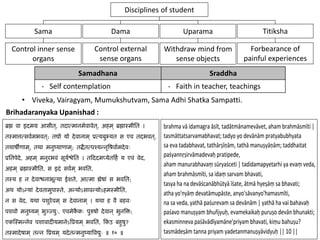
• Viveka, Vairagyam, Mumukshutvam, Sama Adhi Shatka Sampatti.
Brihadaranyaka Upanishad :
Samadhana Sraddha
- Self contemplation - Faith in teacher, teachings
Disciplines of student
Sama Dama Uparama Titiksha
Control inner sense
organs
Control external
sense organs
Withdraw mind from
sense objects
Forbearance of
painful experiences
100
Panchadasi :
This (self) was indeed Brahman in the beginning. It knew only Itself as, ‘I am Brahman.’
Therefore It became all. And whoever among the gods knew It also became That ; and the
same with sages and men. The sage Vamadeva, while realising this (self) as That, knew, ‘I was
Manu, and the sun.’ And to this day whoever in like manner knows It as, ‘I am Brahman,’
becomes all this (universe). Even the gods cannot prevail against him, for he becomes their
self. While he who worships another god thinking, ‘He is one, and I am another,’ does not
know. He is like an animal to the gods. As many animals serve a man, so does each man serve
the gods. Even if one animal is taken away, it causes anguish, what should one say of many
animals? Therefore it is not like by them that men should know this. [I – IV – 10]
The infinite, supreme self remains manifested in this world as the witness of the functions of
the intellect in the body, fit for Self-knowledge and is designated as ‘I’. [Chapter 5 – Verse 3]
By nature infinite, the supreme Self is described here by the word Brahman. The word ‘Asmi’
(am) denotes the identity of ‘Aham’ (I) and ‘Brahman’. Therefore ‘I am Brahman’ (is the
meaning of the text). [Chapter 5 – Verse 4]
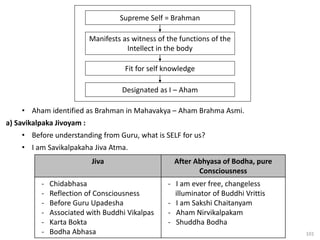
101
Supreme Self = Brahman
Manifests as witness of the functions of the
Intellect in the body
Fit for self knowledge
Designated as I – Aham
• Aham identified as Brahman in Mahavakya – Aham Brahma Asmi.
a) Savikalpaka Jivoyam :
• Before understanding from Guru, what is SELF for us?
• I am Savikalpakaha Jiva Atma.
Jiva After Abhyasa of Bodha, pure
Consciousness
- Chidabhasa
- Reflection of Consciousness
- Before Guru Upadesha
- Associated with Buddhi Vikalpas
- Karta Bokta
- Bodha Abhasa
- I am ever free, changeless
illuminator of Buddhi Vrittis
- I am Sakshi Chaitanyam
- Aham Nirvikalpakam
- Shuddha Bodha
102
b) Brahmasyat Nirvikalpakam :
• In ignorance, I positioned my SELF as the Jiva.
Atma Bodha :
Just as the person who regards a rope as a snake is overcome by fear, so also one considering
oneself as the ego (jiva) is overcome by fear. The egocentric individuality in us becomes
fearless by realising that it is not A Jiva but the supreme Self. [Verse 27]
As Rope Snake As Ego I
Fear rises Fear Rises
By Rope Jnanam By Brahman
Fear Goes Fear Goes
Adhishtanam
103
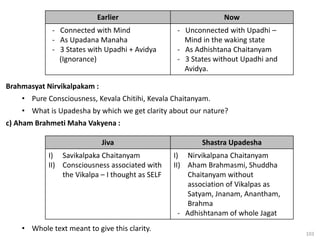
Earlier Now
- Connected with Mind
- As Upadana Manaha
- 3 States with Upadhi + Avidya
(Ignorance)
- Unconnected with Upadhi –
Mind in the waking state
- As Adhishtana Chaitanyam
- 3 States without Upadhi and
Avidya.
Brahmasyat Nirvikalpakam :
• Pure Consciousness, Kevala Chitihi, Kevala Chaitanyam.
• What is Upadesha by which we get clarity about our nature?
c) Aham Brahmeti Maha Vakyena :
Jiva Shastra Upadesha
I) Savikalpaka Chaitanyam
II) Consciousness associated with
the Vikalpa – I thought as SELF
I) Nirvikalpana Chaitanyam
II) Aham Brahmasmi, Shuddha
Chaitanyam without
association of Vikalpas as
Satyam, Jnanam, Anantham,
Brahma
- Adhishtanam of whole Jagat
• Whole text meant to give this clarity.
104
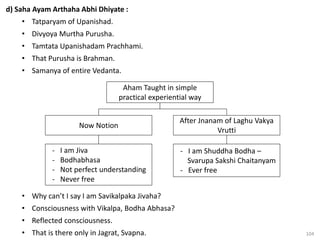
d) Saha Ayam Arthaha Abhi Dhiyate :
• Tatparyam of Upanishad.
• Divyoya Murtha Purusha.
• Tamtata Upanishadam Prachhami.
• That Purusha is Brahman.
• Samanya of entire Vedanta.
• Why can’t I say I am Savikalpaka Jivaha?
• Consciousness with Vikalpa, Bodha Abhasa?
• Reflected consciousness.
• That is there only in Jagrat, Svapna.
After Jnanam of Laghu Vakya
Vrutti
Now Notion
Aham Taught in simple
practical experiential way
- I am Shuddha Bodha –
Svarupa Sakshi Chaitanyam
- Ever free
- I am Jiva
- Bodhabhasa
- Not perfect understanding
- Never free
105
• Not there in Sushupti.
• Shuddha Bodha Svarupa, changeless, always there, pure I am, as Awareness,
illuminator of 3 Avasthas, Adhishtanam.
• I have seen my Nirvikalpaka Avastha between 2 thoughts.
• Its real for me.
• This is the experiential SELF of Brahman, Shuddha Chaitanyam (thread), in between 2
thoughts (2 beads) and in and through all the thoughts (beads).
• It is self evident, existent, awareness, bliss.
Keno Upanishad :
• Svarupa Ananda not experiential Priya, Moda, Pramoda Vrutti generated Ananda.
Indeed, he attains immortality, who intuits It in and through every modification of the mind.
Through the Atman he obtains real strength, and through Knowledge, immortality. [II – 4]
106
Verse 14 : Aikyam verse - Important
• Reflected Consciousness (involved now with modification of Intellect)
↓
One with undifferentiated Brahman
The reflected Consciousness, though involved in the modifications of the intellect, that I am
now, is really one with the undifferentiated Brahman. The apparent modifications, which are
self-evident (being always associated with the reflected Consciousness), have only to be
suppressed by all efforts (in order that this realisation of Brahman my come). [Verse 4]
One suppresses experiences of reflected
consciousness
To realise Brahman
Original Consciousness
107
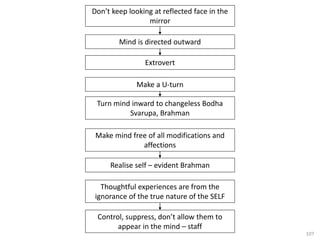
Don’t keep looking at reflected face in the
mirror
Mind is directed outward
Extrovert
Make a U-turn
Turn mind inward to changeless Bodha
Svarupa, Brahman
Make mind free of all modifications and
affections
Realise self – evident Brahman
Thoughtful experiences are from the
ignorance of the true nature of the SELF
Control, suppress, don’t allow them to
appear in the mind – staff
108
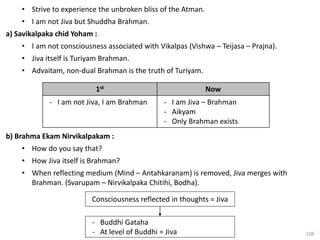
• Strive to experience the unbroken bliss of the Atman.
• I am not Jiva but Shuddha Brahman.
a) Savikalpaka chid Yoham :
• I am not consciousness associated with Vikalpas (Vishwa – Teijasa – Prajna).
• Jiva itself is Turiyam Brahman.
• Advaitam, non-dual Brahman is the truth of Turiyam.
1st Now
- I am not Jiva, I am Brahman - I am Jiva – Brahman
- Aikyam
- Only Brahman exists
b) Brahma Ekam Nirvikalpakam :
• How do you say that?
• How Jiva itself is Brahman?
• When reflecting medium (Mind – Antahkaranam) is removed, Jiva merges with
Brahman. (Svarupam – Nirvikalpaka Chitihi, Bodha).
Consciousness reflected in thoughts = Jiva
- Buddhi Gataha
- At level of Buddhi = Jiva
109
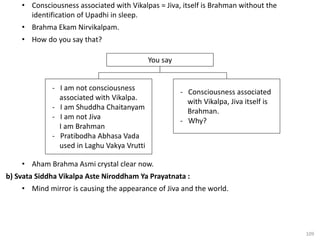
• Consciousness associated with Vikalpas = Jiva, itself is Brahman without the
identification of Upadhi in sleep.
• Brahma Ekam Nirvikalpam.
• How do you say that?
• Aham Brahma Asmi crystal clear now.
b) Svata Siddha Vikalpa Aste Niroddham Ya Prayatnata :
• Mind mirror is causing the appearance of Jiva and the world.
- Consciousness associated
with Vikalpa, Jiva itself is
Brahman.
- Why?
- I am not consciousness
associated with Vikalpa.
- I am Shuddha Chaitanyam
- I am not Jiva
I am Brahman
- Pratibodha Abhasa Vada
used in Laghu Vakya Vrutti
You say
110
Dakshinamurthi Stotram :
• Be yourself, Svata Siddha, that which is clear, Self evident.
• Siddha because consciousness illumines, makes it known itself.
• Aham Brahma Asmi, I alone am without a second.
• This is the ultimate realisation of the Jiva from Guru, Shastra Upadesha.
• Very profound, divine, when mind mirror goes, what appeared as Jiva is you only,
Brahman.
He who experiences at the time of realization his own immutable Self-in which the Self alone
plays as the universe of names and forms, like a city seen in a mirror, due to the Maya power
as though produced outside, as in a dream, to him, the divine teacher, Sri Dakshinamurthy, is
this prostration. [Verse 1]
111
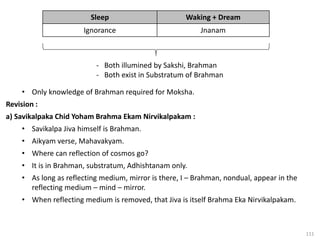
• Only knowledge of Brahman required for Moksha.
Revision :
a) Savikalpaka Chid Yoham Brahma Ekam Nirvikalpakam :
• Savikalpa Jiva himself is Brahman.
• Aikyam verse, Mahavakyam.
• Where can reflection of cosmos go?
• It is in Brahman, substratum, Adhishtanam only.
• As long as reflecting medium, mirror is there, I – Brahman, nondual, appear in the
reflecting medium – mind – mirror.
• When reflecting medium is removed, that Jiva is itself Brahma Eka Nirvikalpakam.
Sleep Waking + Dream
Ignorance Jnanam
- Both illumined by Sakshi, Brahman
- Both exist in Substratum of Brahman
112
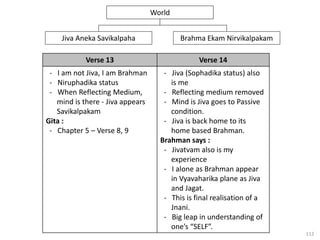
Brahma Ekam Nirvikalpakam
Jiva Aneka Savikalpaha
World
Verse 13 Verse 14
- I am not Jiva, I am Brahman
- Niruphadika status
- When Reflecting Medium,
mind is there - Jiva appears
Savikalpakam
Gita :
- Chapter 5 – Verse 8, 9
- Jiva (Sophadika status) also
is me
- Reflecting medium removed
- Mind is Jiva goes to Passive
condition.
- Jiva is back home to its
home based Brahman.
Brahman says :
- Jivatvam also is my
experience
- I alone as Brahman appear
in Vyavaharika plane as Jiva
and Jagat.
- This is final realisation of a
Jnani.
- Big leap in understanding of
one’s “SELF”.
113
Gita :
I do nothing at all, thus would the harmonised knower of Truth think – seeing, hearing,
touching, smelling, eating, going, sleeping, breathing... [Chapter 5 – Verse 8]
Speaking, letting go, seizing, opening and closing the eyes – convinced that the senses move
among the sense objects. [Chapter 5 – Verse 9]
• Without the medium, Jiva is me, Brahman, Paramartikam.
• With the medium, I am Jiva, Vyavaharikam.
• Don’t get confused, realise 2 levels in Vedanta.
114
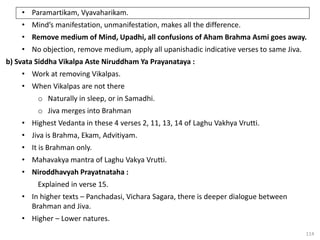
• Paramartikam, Vyavaharikam.
• Mind’s manifestation, unmanifestation, makes all the difference.
• Remove medium of Mind, Upadhi, all confusions of Aham Brahma Asmi goes away.
• No objection, remove medium, apply all upanishadic indicative verses to same Jiva.
b) Svata Siddha Vikalpa Aste Niruddham Ya Prayanataya :
• Work at removing Vikalpas.
• When Vikalpas are not there
o Naturally in sleep, or in Samadhi.
o Jiva merges into Brahman
• Highest Vedanta in these 4 verses 2, 11, 13, 14 of Laghu Vakhya Vrutti.
• Jiva is Brahma, Ekam, Advitiyam.
• It is Brahman only.
• Mahavakya mantra of Laghu Vakya Vrutti.
• Niroddhavyah Prayatnataha :
Explained in verse 15.
• In higher texts – Panchadasi, Vichara Sagara, there is deeper dialogue between
Brahman and Jiva.
• Higher – Lower natures.
115
Verse 15 :
If one is able to effect complete suppression of all modifications once for all, then one
becomes blessed with the concentration (Samadhi) which is lovingly cherished by all sages. If,
however, that is not possible, one should pursue with faith the effort to realise his own
Brahmanhood by controlling the modifications for a moment even. [Verse 15]
• Samadhi = Complete suppression of all modifications.
= Blessed with concentration, cherished by Vasishta Rishi
• If unable to control all modifications, try to control for a moment and contemplate
on identity of ones own SELF with Brahman.
Katho Upanishad :
When the five organs of knowledge are at rest together with the mind, and when the intellect
ceases functioning (becomes calm) that state they call the highest. [II – III – 10]
116
• When 5 fold sense perceptions repose in the Atman and the intellect knows it is not
waker, such a state is called the supreme goal.
• Firm control of senses = Yoga.
• Then abide in it, become watchful, for Yoga is aquired and lost.
Gita :
The firm control of the senses they regard as Yoga. Then the Yogin becomes free from all the
vagaries of the mind ; for the Yoga is subject to growth and decay.
When the mind, restrained by the practice of Yoga, attains quietitude and seeing the Self by
the self, he is satisfied in his won Self; [Chapter 6 – Verse 20]
117
When, he (the yogi) feels that infinite Bliss, which can be grasped by the (pure) intellect and
which transcends the senses – wherein established he never moves from the reality;
[Chapter 6 – Verse 21]
Which having obtained, he thinks there is no other gain superior to it; wherein established, he
is not moved even by heavy sorrow. [Chapter 6 – Verse 22]
Let it be known; the severance from the union with pain is yoga. This yoga should be practised
with determination and with a mind steady and undespairing. [Chapter 6 – Verse 23]
118
Panchadasi :
By Continued Practice of all kinds the ego becomes
exceedingly refined. This state is not sleep because
the ego is not completely absorbed; moreover the
body does not, as in Sleep, fell to the ground.
[Chapter 11 – Verse 99]
The Bliss in which there is no experience of duality
and which is not sleep either, is the bliss of
Brahman. So said Lord Krishna to Arjuna.
[Chapter 11 – Verse 100]
Samadhi Sleep
- Forgetting ones own ego
- Refined ego
- Ego not completely absorbed
- Body does not fall on the ground
- One can sit in Samadhi
- No experience of Duality
- Not sleep
- Bliss of Brahman
- Beyond all Gunas, Guna Ateeta
- One can comprehend through
intuitive perception, ones natural state
of bliss
- Ego totally absorbed
- Body falls on the ground
- Total cessation of duality
- Tamo Guna + Ignorance
119
a) Shakyaha Sarva Vrutti Nirdhashcha :
• In case it is not possible to put an end to all Vruttis Patanjali Yoga sutra :
Yoga is restraining the mind-stuff (Chitta) from taking various forms (Vrttis). [I – 2]
b) Samadhi Jnaninam Priyaha :
• That Samadhi state becomes the delight of Jeevan Mukta like Vasishta.
• For others, inclination may not be there, effort may not be there.
• Shuddha Bodha Chaitanyam is there when all Vruttis are gone.
• Svata Prakasha Chaitanyam alone is there, free of all Vruttis and objects
comprehended by Vruttis, free of all Vruttis and objects comprehended by Vruttis, free
of Raaga, Dvesha.
• Yoga Vasishta – Jeevan Mukti Viveka…
Gita :
120
Arjuna Said : What, O Kesava, is the description of him who has steady wisdom and who is
merged in the superconscious state? How does one of steady wisdom speak, how does he sit,
how does he walk? [Chapter 2 – Verse 54]
The Blessed Lord said : When a man completely casts off, O Partha, all the desires of the mind
and is satisfied in the Self by the Self, then is he said to be one of steady wisdom.
[Chapter 2 – Verse 55]
• Samadhi dear to Jnanis.
• After Tattwa Jnanam, what is practiced is this.
c) Tad Ashaktau :
• If Samadhi not within your capacity, if Sarva Vrutti Nirodha is not possible.
d) Kshanam Rudhva :
• For Eka, Dvi, Tri.. Moments, if you can’t sustain…
121
e) Sraddhya Brahma Atmanaha :
• Do reflection.
- See yourself in pure self
- For a few moments just be
yourself
- See oneness of self, Jeeva
Svarupam with Brahma
Svarupam.
- Chitta Vrutti Nirodha
- Samadhi
2 possibilities – for Jnani
122
Verse 16 :
Having comprehended the real implication of the teaching “I am Brahman,” a person imbued
with faith should meditate unremittingly upon his identity with Brahman to the fullest extent
of his capacity by means of all the faculties of the intellect attuned to that idea. [Verse 16]
• Contemplate I am Brahman with faith.. To the full extent possible.
• Mind should be absorbed in Atman.
• Realise ones own identity with Brahman.
• Don’t allow sensuous desires in the mind.
123
Brihadaranyaka Upanishad :
This (self) was indeed Brahman in the beginning. It knew only Itself as, ‘I am Brahman.’
Therefore It became all. And whoever among the gods knew It also became That ; and the
same with sages and men. The sage Vamadeva, while realising this (self) as That, knew, ‘I was
Manu, and the sun.’ And to this day whoever in like manner knows It as, ‘I am Brahman,’
becomes all this (universe). Even the gods cannot prevail against him, for he becomes their
self. While he who worships another god thinking, ‘He is one, and I am another,’ does not
know. He is like an animal to the gods. As many animals serve a man, so does each man serve
the gods. Even if one animal is taken away, it causes anguish, what should one say of many
animals? Therefore it is not like by them that men should know this. [I – IV – 10]
124
Panchadasi :
The infinite, supreme self remains manifested in this world as the witness of the functions of
the intellect in the body, fit for Self-knowledge and is designated as ‘I’. [Chapter 5 – Verse 3]
By nature infinite, the supreme Self is described here by the word Brahman. The word ‘Asmi’
(am) denotes the identity of ‘Aham’ (I) and ‘Brahman’. Therefore ‘I am Brahman’ (is the
meaning of the text). [Chapter 5 – Verse 4]
SELF
Manifested in the world as witness of
Intellect
Designated as I - Aham
125
• Before creation, reality one only without second, without name and form.
• Even now it exists in the same way… as “That”.
a) Sraddhalur :
• One who practices with Sraddha, has Sadhana Chatushtaya Sampatti.
b) Svasya Chintayet Buddhi Vruttibhih Vakya Vruttaya Yatha Shakya :
3 Methods
Be in Samadhi as Brahman Few moments experience
self as Brahman
Have clarity
• Reflect, meditate upon self’s identity with Brahman.
• Let thoughts not go and perceive objects.
• Let mind reflect upon nature of self being one with pure Brahman with Upadhi of
Jagat.
• What if I can’t do this?
c) With Vakya Vritti – Aham Brahma Asmi, with full clarity, reflect on Brahman.
• Get a glimpse of Brahman.
d) Yatha Shakti :
• As per your capacity, remain in it for one, two, three moments of Sarva Vrutti Nirodha.
126
e) Chintayet…
• With this gain capacity and move forward.
f) Jnatva Hi Abhyasatam Sada :
• Don’t chant or do Japa of Aham Brahmasmi.
• Reflect on the reality, one entity in the universe, Brahman.
• In Samadhi, no Vruttis are there, only Shuddha Chaitanyam is there.
• This is Brahmakara, Akhandakara Vrutti.
• Practice this in deep mind.
• Do Vedanta Chintanam from waking to sleep, till body drops.
• Let your mind be on this alone…
127
Verse 17 :
Meditating upon That, talking on Then lightening mutually on That and in a way getting
oneself absorbed in That – all these together have been known and taught by the wise ones as
constituting the practice of Brahman. [Verse 17]
Discussions
Meditation
Practice Brahman by
• Meditate on Brahman with mind divested of all other objects.
• Speak on Vedanta.
• Cherish ones own identity with pure consciousness.
• Know him alone.
128
Mundak Upanishad :
a) Tad Chintanam :
• Think of Brahman.
He in whom the heaven, the earth and the interspace are centered, together with the mind
and all life-breaths (Prana-s) – know Him alone as the one Self of all, and desist from all other
talk. This is the man’s bridge to the shore of Immortality (across the ocean of life). [II – II – 5]
Brihadaranyaka Upanishad :
The intelligent aspirant after Brahman, knowing about this alone, should attain intuitive
knowledge. (He) should not think of too many words, for it is particularly fatiguing to the organ
of speech. [4 - 4 - 21]
129
b) Tad Kathanam :
• To others speak about Brahman.
c) Tat Paraspara Bodhanam :
• Discuss with others about Brahman.
d) Ekat Ev Paratvam Cha :
This alone is intent of your life, nothing else occupies your mind.
e) Brahma Abhyasam Vidurbudaha :
This is practice of Brahman.
How long to practice and what is the result?
130
Verse 18 :
Consummation of this practice lies in the firm conviction of one’s identity with Brahman, like
what conviction is normally there in the sense of identity of the self with the body. One, who
has realised this, is liberated, indeed, without a doubt; his body may then drop off, any time,
any where. [Verse 18]
Brahma Bava
Deha Bava
Consume yourself with
- Attain Brahman firmly
- Be liberated
- Let body drop anytime
- Divine being
- Jiva
- Normal identity with body
- Ordinary person
131
Upadesa Sahasri :
The knowledge of one’s identity with the pure self
that negated the wrong notion of the identity of the
body and the self sets a man free even against his will
when it becomes as firm as the belief of the man that
he is a human being. All this, therefore, is established.
And reasons have been already given by us.
[ Chapter 4 – Verse 5 ]
• Discard body garment and rest in the infinite nature of Brahman.
• Disembodied liberation – Videha Mukti.
Mundak Upanishad :
When He is seen both in the higher and the lower, the knots of his heart becomes untied; all
doubts are dispelled; and all his Karma-s is consumed. [II – II – 8]
As flowing rivers get themselves disappeared in the ocean losing their special names and
distinct forms, so the wise man free from all his identifications with names and forms goes
unto the highest of the high – the Supreme Divinity. [III – II – 8]
132
Katho Upanishad :
“The wise sage, renounces joy and sorrow by means of meditation on the inner Self,
recognises the Ancient, who is difficult to be seen, is hidden in the cave of the heart,
dwells in the abyss, is lodged in the intelligence and seated amidst miserable surroundings
indeed.” [I – II – 12]
• Identify yourself as perennial existence, consciousness, bliss, Brahman
a) Dehatma Dhivad Brahmatma Dhi Dridhaye :
• When clarity of Aham Brahmasmi is very strong, without Viparita Bavana.
b) Kruta Akrityatvam :
Paramananda Prapti
Atyantika Dukha Nivritti
Fulfillment
• Only Brahma Abhyasa can give fulfillment in life.
133
Gita :
c) Yada Tadayam Mriyatam :
• Jnani has reached fulfillment in life, doesn’t care when he will die.
• Nothing more to be done, knows everything.
• Jeevan Mukta.
d) Muktaha Asau :
• He is already liberated.
• Even before, he was liberated only.
Thus, this most secret science (Teaching) has been taught by me, O sinless one. One knowing
this a man becomes wise and all his duties as accomplished, O Bharata. [Chapter 15 - Verse 20]
134
e) Na Atra Samshaya :
• On this there cannot be any doubt.
• Jnani has known his real nature.
Upadesa Sahasri :
Now
Earlier
Liberated
Videha Mukta
Jeevan Mukta
The knowledge of one’s identity with the pure self
that negated the wrong notion of the identity of the
body and the self sets a man free even against his will
when it becomes as firm as the belief of the man that
he is a human being. All this, therefore, is established.
And reasons have been already given by us.
[ Chapter 4 – Verse 5 ]
135
• In this way, differentiating.
Brahmatma
Dehatma
Knowledge – 2 types
- Knowledge of Brahman
arises
- Knows this is what I am
- When Jnanam arises, even
if Jnani doesn’t want, he
will be liberated.
- I am body, strong notion
Shuddha Bodha
Bodha Abhasa
Jnanam
Liberated
Bound
• This ends treatise of 18 verses.
• Gives full clarity of Advaita Vedanta.
• Presents truth in an experiential way, direct method of realisation.
136
Highlights
1. Whole text at Buddhi Vrutti level teaching.
2. Main Teaching :
• Differentiate
o Bodha – Bodhabhasa
o Chit – Chidabhasa.
3. Remain in Samadhi as Bodha Svarupa controlling the 5 fold sense perceptions and the
Intellect which does not waker.
4. Realise Aham Brahman Asmi.

Laghu-Vakya-Vritti-Class-Notes 18 verses

  • 1.
    LAGHU VAKYA VRITTI by AdiShankaracharya --------- 18 VERSES
  • 2.
    PRAYERS OM SAHANA VAVATHU SAHANAUBHUNAKTU SAHA VEERYAM KARAVAAVAHAI TEJAS VINAAVA DHEETA MASTU MA VIDH VISHAVA HAI OM SHANTI SHANTI SHANTI HI May the Lord protect us. May He make us enjoy our sessions together. May we both strive together. May our studies be bright and brilliant. May there be no misunderstanding between us. Let there be peace outside and with in. Om Peace, Peace, Peace.
  • 3.
    Index S. No. VerseNo. Page No. 1. Summary 5 2. Introduction 8 3. Verse 1 19 4. Verse 2 22 5. Verse 3 35 6. Verse 4 44 7. Verse 5 50 8. Verse 6 56 9. Verse 7 62 10. Verse 8 69 11. Verse 9 76 12. Verse 10 80 13. Verse 11 85
  • 4.
    S. No. VerseNo. Page No. 14. Verse 12 94 15. Verse 13 98 16. Verse 14 106 17. Verse 15 115 18. Verse 16 122 19. Verse 17 127 20. Verse 18 130
  • 5.
  • 6.
    6 Summary Verse 4 Verse 1 18Verses - In sleep consciousness illumines ignorance, Karana Shariram only - What is gross body subtle body Verse 8 Verse 6 - Consciousness ever free from cognitions and thoughts - Water absorbs heat of fire - Intellect absorbs Consciousness Verse 2 - What is causal body - Bodha-bodhabhasa Verse 3 - Discriminate Bodha-Bodhabhasa Verse 5 - Consciousness realised in Jagrat also Verse 7 - Consciousness reveals 5 senses objects - Vikalpas in Buddhi illumined by Sakshi Verse 9 Example : - Pearl – String - Thought – consciousness
  • 7.
    7 Verse 12 Verse 10 18Verses - Practice restraint for 1, 2, 3 moments in between 2 thought modifications - Necklace has gaps between pearls - Thoughts have gaps between them - Become aware of self. Verse 16 Verse 14 - With sraddha Meditate I am Brahman - I am not Jiva, but Brahman - I am Jiva – Brahma Aikyam - Without Mind mirror Verse 11 - Pure Consciousness shines between 2 thoughts - Preceding thought has died - New thought has yet to appear Verse 13 - Jiva realises Aham Brahma Asmi in Jagrat Avastha Verse 15 - Reflect I am one with Brahman Verse 17 - Meditate, talk, discuss, get absorbed in Brahman Verse 18 - Jeevan Mukti - Videha Mukti
  • 8.
  • 9.
    9 Introduction : • Elaborationof Mahavakya Aham Brahma Asmi – Brihadaranayaka Upanishad This (self) was indeed Brahman in the beginning. It knew only Itself as, ‘I am Brahman.’ Therefore It became all. And whoever among the gods knew It also became That ; and the same with sages and men. The sage Vamadeva, while realising this (self) as That, knew, ‘I was Manu, and the sun.’ And to this day whoever in like manner knows It as, ‘I am Brahman,’ becomes all this (universe). Even the gods cannot prevail against him, for he becomes their self. While he who worships another god thinking, ‘He is one, and I am another,’ does not know. He is like an animal to the gods. As many animals serve a man, so does each man serve the gods. Even if one animal is taken away, it causes anguish, what should one say of many animals? Therefore it is not like by them that men should know this. [I – IV – 10]
  • 10.
    10 • Final message,epitome of Vedantic teaching in Mahavakya, liberating message. Paramatma Jivatma Knowledge of Identity, oneness between Supreme Self Individual Self Limitation of Consciousness by Buddhi (Avacheda Vada) Reflection of Pure Consciousness on Buddhi (Pratibimba Vada) Jiva (Empherical Truth) • This knowledge of oneness is means of liberation for a Jiva, to gain. Mokshapurushartha. • Vakya Vritti – 53 Verses (Tat Tvam Asti + Aham Brahma Asmi), Laghu Vritti – 18 Verses (Aham Brahma Asmi) • Tadatmaya Jnanam between Jivatma and Paramatma.
  • 11.
    11 • Jiva BraheivaBodhakam Vakyam Mahavakyam. • Dispels ignorance, reveals truth of Jivatma. • Listen, reflect, gain correct vision of self. Shuddha Bodha Bodhabhasa - Unchanging infinite background of all phenomena including movements of body and mind. - Birthless, deathless witness of all that was, is, will be - Nirvikalpakam, beyond reach of ideas. - Lends light of consciousness to Buddhi. - Above all relativity, called Brahman - Sense of continuity of existence in Consciousness - Self revealed witness different from 3 states - Reflection of consciousness - Empirical consciousness - Necessary for knowing, willing, feeling - 3 states – Consciousness with Buddhi Vruttis. - Jiva = Reflection of Pure Consciousness on Buddhi (Pratibmba Vada). - Jiva = Limitation of Consciousness by Buddhi (Avacheda Vada) - Space limited in a pot • What is in background of our mind when one thought is succeeded by another? • It is the same witness, Shuddha – Bodha, centre of our being.
  • 12.
    12 Story : • Putting4 Mahavakyas together. I) Sishya : • What is Brahman? Guru : Lakshana Vakya • Prajnanam Brahma • Consciousness is Brahman. Aitareya Upanishad : Rig Veda Who is this one that we worship as this Self? Which of the two is the Self? Is it that by which one sees, or that by which one hears, or that by which one smell fragrance, or that by which one utters the speech or that by which one knows what is tasteful and what is not tasteful. [III – I – 1]
  • 13.
    13 II) Sishya : •Where is Brahman? Guru : Upadesa Vakyam • Tat Tva Asi • You are Brahman Chandogya Upanishad : Sama Veda ‘That which is the subtlest of all is the Self of all this. It is the Truth. It is the Self. That thou art, O Śvetaketu.’ [Śvetaketu then said,] ‘Sir, please explain this to me again.’ ‘Yes, Somya, I will explain again,’ replied his father. [6 - 8 - 7] III) Sishya Gets Realisation Sishya : Anubhava Vakyam • Aham Brahma Asmi
  • 14.
    14 Brihadaranyaka Upanishad :Shukla Yajur Veda This (self) was indeed Brahman in the beginning. It knew only Itself as, ‘I am Brahman.’ Therefore It became all. And whoever among the gods knew It also became That ; and the same with sages and men. The sage Vamadeva, while realising this (self) as That, knew, ‘I was Manu, and the sun.’ And to this day whoever in like manner knows It as, ‘I am Brahman,’ becomes all this (universe). Even the gods cannot prevail against him, for he becomes their self. While he who worships another god thinking, ‘He is one, and I am another,’ does not know. He is like an animal to the gods. As many animals serve a man, so does each man serve the gods. Even if one animal is taken away, it causes anguish, what should one say of many animals? Therefore it is not like by them that men should know this. [I – IV – 10]
  • 15.
    15 IV) Sishya : •What should I do now? Guru : Anusandhana Vakyam • Ayam Atma Brahma • This Atma is Brahman. • Abide in this knowledge always. Mandukya Upanishad : Atharvana Vada All this is verily Brahman. This Atman is Brahman. This Atman has four quarters (Parts). [Mantra 2] • All 4 Vedas have Mahavakyams. • Mahavakyam of other Upanishads. V) Isavasya Upanishad : All this, whatsoever moves in this universe, including the universe, itself moving, is indwelt or pervaded or enveloped or clothed by the Lord. That renounced, thou shouldst enjoy. Covet not anybody’s wealth. [Verse 1]
  • 16.
    16 VI) Keno Upanishad: VII) Katho Upanishad : The eye does not go there, not speech, nor mind, We do not know That. We do not know how to instruct one about It. It is distinct from the known and above the unknown. We have heard it, so stated the preceptors who taught us That. [I – 3] That Atman by which man cognizes form, taste, smell, sounds, and the sexual joys… what is there unknowable to that Atman in this world? This is verily that (Atman thou hast wanted to know). [II – I – 3]
  • 17.
    17 VIII) Kaivalya Upanishad: • Etad Vai Tad – 12 times repeated – Chapter II – IV – 3 to Chapter II – VI – 1] Katho Upanishad : That which is the Supreme Brahman, the Self in all, the ample Support of the Universe, Subtler than the subtle and Eternal… That alone thou art, thou alone art that. He who knows this Atman, the enjoyer of honey, the sustainer of life and the lord of the past and the future, as very near.. He fear no more thereafter. This is verily That. • This text makes Vedanta simple, practical, experiential. • Has technicality and beauty. • Gives the teaching convincingly, directly in 18 Verses.
  • 18.
  • 19.
    19 Verse 1 :What is gross and subtle Body? Shankara follows : • Shankha (Branch) Chandra (3rd day – thin semi circle crescent moon) Nyaya.. • To show our real nature as Atman, he starts showing, gross, subtle, causal body. • From known to unknown. The fleshy body is the gross adjunct of the Atman and the one made up of desires together with the organs of perception and action, the Pranas, the intellect and the mind constitutes the subtle adjunct. [Verse 1] Sthula Shariram (Physical Body) Tree Sukshma Shariram (Subtle Body) Branch Karana Shariram (Causal Body) Clouds Chaitanyam Moon
  • 20.
    20 a) Sthula ManasaMaya Dehaha : • Gross body is made of flesh, bones, blood, skin. • Physical body, known through Indriyas. b) Sukshma Syad Vasanamaya : - Ashubha Vasanas - Ignoble thoughts - Shubha Vasanas - Noble thoughts Subtle body consists of • Desires, thoughts, Kama, Krodha, Lobah. • Maya – Predominately. c) Jnana Karmendriyai Sardham : 5 Karma Indriyas (For Action) 5 Jnana Indriyas (For Perception) Subtle Body - Vak – Tongue – Speech - Pani – Hands – Grasp - Padau – Legs – Locomotion - Upasthau – Procreation – Organ - Payu – Excretory - Organ - Srotram – Ears – Audition - Chakshu – Eyes – Vision - Rasana – Tongue – Taste - Granou – Nostrils – Smell - Tvak – Skin - Touch
  • 21.
    21 d) Dhi Pranau: • Sapta Dasha Kala = 5 Jnana Indriya + 5 Karma Indriya + 5 Pranas + Mind + Buddhi = 17 Organs e) Tat Sharira Gau : • 17 organs are together present in the body. • The gross body and subtle body is the limitation of Atman. • Brahman resides in 3 Upadhis. Pranas Buddhi Subtle Body Vital Energy – Life force : I) Prana – Respiration II) Apana – Evacuation III) Vyana – circulation IV) Udana – Throwing out V) Samana – Digestion - Mind + Intellect
  • 22.
    22 Verse 2 :Important Verse • What is causal Body? • What is Real SELF? a) Ajnanam Karanam : • Ignorance is causal body. • Ignorance veils the SELF. • Once SELF veiled, identification begins with Sthula, Sukshma Sharira as the Self. Ignorance makes the causal adjunct. Pure Consciousness stands behind them all (i.e. the three adjuncts) as the witness and the illuminator. The reflection of the pure Consciousness on the intellect (acquiring the sense of individuality due to ignorance) becomes the Jiva – the agent of good and evil. [Verse 2] Ignorance Cause of 3 Bodies
  • 23.
    23 • Mind andintellect merge in Karana Shariram, hence it is called causal body. • When do we experience ignorance Ajnanam? • Bava Rupam • In Deep sleep, dense nothingness, blankness, absence of gross and subtle body = Ajnanam. • What is the purpose of enumerating Sthula, Sukshma, Karana Sharirams? • To take us beyond the 3 bodies to the true “SELF”. • What is Ajnanam – Ignorance? Our identification with 3 bodies as SELF = Ignorance = Moola Avidya Sthula - Gross Body Sukshma - Mind Karana - Restful state - Part of Me • Who am I? • I am the SELF, knower principle, Chaitanyam, who knows the body thoughts, emotions, ignorance, knowledge. • 3 bodies seen, not seer, knower. • Knowingness, sentiency is nature of self.
  • 24.
    24 b) Bodham TeshamVibhasakaha : • 3 Sharirams are illumined by the “SELF”, Sakshi, Chaitanyam. Anyan Vibhati Svayam Bhati Vibhasakaha - Gives Sphuranam, existence to 3 Sharirams - Self shines - Bodaha - Svaprakasha • To illumine something, make something appear, illuminator has to be first present. Drk – Drishya Viveka : This (Consciousness) does not rise (is unborn) and does not set (is immortal). It does not increase or decay (is immutable). It shines by Itself and It illumines others without any aid. [Verse 5]
  • 25.
    25 Consciousness - Does notRise (Unborn) - Does not set (Immortal) - Doesn’t increase or decay (Immutable) - Shines itself - Illumines others without aid Viseshaka Vibhasakaha : SELF / Consciousness - Gives existence to 3 bodies - Bodies are Jadam - Can’t know themselves - Self Illumines 3 bodies - Bodha Svarupa - Illumines without necessity of instrumentation to know - Ceaseless - Uniform - Remains same always Example : • To see mobile, need eyes, light, mind. • Consciousness illumines Body / Mind / Intellect by itself without any instrument. • What is in you which just knows without requirement of mind, Indriyas? • Consciousness, Awareness. • 1st clue of SELF : Sakshi, knower principle, Bodaha, Vibhasakaha.
  • 26.
    26 c) Bodha Abhasahabuddhi Gathaha : • There is a Abhasa, reflection, appearance, shadow. - Not thought I - Vrutti - Adhyasa, Abhasa - I as I - Pure awareness Consciousness - Nature, Svarupa Who is – I – in this body? Bodha Bodha Abhasa - Original Consciousness - Pure self, without Body / Mind / Intellect, World. - Has independent existence - Nitya Mukta, Shuddha Atma. - Reflected – I – consciousness in buddhi - Chidabhasa, Shadow, false I - Buddhi is in 3 states – Jagrat, Svapna, Sushupti - Buddhi Gathaha - Consciousness appearing at level of intellect, Buddhi that I take it to be real self in ignorance - It is reflection of my pure self without mind, body, world - Buddhi Gathaha – fallen in realm of matter, Ego I
  • 27.
    27 • Body isdoing but I have a sense – I am doing, and I become identified with the body (Adhyasa). • Eyes see – Hand writes, Legs walk – Body sits, I say, I – See, I Write, I walk – I am sitting. Ego – I Perceiver Feeler Thinker Doer / Enjoyer - w.r.t. Sense Organs - w.r.t. Mind - w.r.t. Intellect - w.r.t. organs of action - Karta - Bokta Original I Reflected I Is I Sakshi - Chit Chidabhasa
  • 28.
    28 Gita : Adhyasain life I do nothing at all, thus would the harmonised knower of Truth think – seeing, hearing, touching, smelling, eating, going, sleeping, breathing... [Chapter 5 – Verse 8] Speaking, letting go, seizing, opening and closing the eyes – convinced that the senses move among the sense objects. [Chapter 5 – Verse 9] • The I claiming doership, perceivership, enjoyership is Bodha Bhasa I, not Bodha – ever free I.
  • 29.
    29 d) Karta SyatPunya Papayoh : I am actually Bodha I appear as Bodha Abhasa Vibhasakaha Due to Punya – Papa Karma of the Body Noble – ignoble actions of the body • Now – I feel Karta, Bokta, Buddhi Gathaha. • Body born as per law of Karma – Punya – Papam. • Pure Consciousness stands behind 3 bodies all the time, as the witness and the illuminator. • The reflection of Pure Consciousness on the intellect (Aquiring the sense of individuality, due to ignorance) becomes the individual Jiva, the agent of good and evil action. • This verse introduces causal body – ignorance, beginningless, indefinable. • Witness, Sakshi, seer, witnesses all things directly and immediately without any medium (Nirupadhika SELF – Chaitanyam).
  • 30.
    30 Quotes : I) JabalaUpanishad : There are sages called Paramahamsas (as in the days of yore, the sages) Samvartaka, Aruni, Svetaketu, Durvasas, Ribhu, Nidagha, Jadabharata, Dattatreya, Raivataka and others, wearing no distinguishing marks, with conduct beyond the ken (of worldly people) and who behaved as though bereft of their senses though (perfectly) sane. Discarding all these, namely the threefold staff (of bamboo), the water pot, the sling (to carry personal effects), the (alms-)bowl, the cloth for purifying water (tied to the staff), tuft of hair and sacred thread in water (i.e. a reservoir) by reciting ‘Bhuh Svaha’, the Paramahamsa shall seek the Atman. Possessing a form as one just born (i.e. unclad), unaffected by the pairs (of opposites, such as heat and cold, pleasure and pain), accepting nothing (except bare sustenance), well established in the path of the truth of Brahman, of pure mind, receiving alms into the mouth (literally into the vessel of the belly) at the prescribed hour in order to sustain life, becoming equanimous at gain or loss (of alms), sheltering himself, without an abode (of his own), in an unoccupied house, a temple, a clump of (tall) grass (or a heap of straw), an anthill, the shade of a tree, a potter’s hut, a cottage where sacred fire is kept, sandy bank of a river, a mountain thicket or cavity, a hollow in a tree, the vicinity of a water fall or a piece of clean ground; making no efforts (in any kind of gainful activity), free from ‘mineness’ (i.e. a sense of possessiveness), ever meditating on Brahman, devoted to the Self, ever intent on eradication of the good and bad karman, (the sage) finally gives up his body in the state of renunciation – (such a sage) is indeed a Paramahamsa. Thus (ends) the Upanishad. [Verse 6]
  • 31.
    31 II) Narada ParivrajakaUpanishad : The wise man that is in supreme yoga should abandon the outer sutra (thread). He who wears (in his heart) this sutra of Brahmic Reality is alone Brahmana. Through wearing this higher sutra, it becomes not a rejected one, not an impure one. Those only whose sutra is internal, having the holy thread as jnana are the real knowers of the sutra, they are said to possess the yajnopavita (holy thread). To those whose sikha (tuft of hair) is jnana, whose holy thread is jnana, and whose meditation is upon jnana, jnana alone is supreme. It is said that jnana alone is able to purify. That wise man alone who possesses the jnana - sikha like the sikha (flame) of agni (fire) is said to possess sikha (tuft of hair). Those that have mere sikha are no sikhas. The Brahmanas and other that are entitled to perform the vedic karmas are allowed to wear the (external) thread, only as an auxiliary to the karmas. It is only vedic. The knowers of Brahman know that all Brahmanya (the state of Brahman) accrues to him only that has the jnanamaya sikha (knowledge-tuft of hair) and the tanmaya (that or Brahmanful) upavita (holy thread). [Verse 84 to 89]
  • 32.
    32 III) Katho Upanishad: The two who enjoy the fruits of their good works being seated in the cavity of the heart, the Seat of the Supreme, the knowers of Brahman call them shadow and light ; as also the performer of the five-fold-fire and those who have propitiated three times the Naciketas-fire. [I – III – 1] Atman : • Absolute reality, embodiment of supreme bliss, the SELF, immanent and immutable, pure existence, consciousness. • Illuminator of 3 bodies, imparts reality and self expression to them. • Substratum. Jivatman : • Individual SELF. • Bears sense of agency in regard to worldly existence. • Bodha Abhsa, Chidabhasa. • Acts through medium of intellect.
  • 33.
    33 Causal Body : •Ignorance, Avidya, Maya, Prakrti. • Indefinable power of Brahman (Total SELF) that is responsible for the manifestation of the phenomenal world. Vikshepa Shakti Avarna Shakti Maya has 2 powers - Projects universe subtle to gross - Veiling true nature - In Jagrat, Svapna, Sushupti SELF is covered 2nd Projects 1st Veils Ignorance – of Rope Snake of Rope Nature of Rope
  • 34.
    34 Projects 1st Veils Maya –Ignorance of Brahman 3 Bodies, world Nature of Brahman Sushupti Jagrat + Svapna Individual SELF - No Vikshepa Shakti - Only Avarna operates - Avarna + Vikshepa Active • Intellect is predominately sattvic in nature, transparent substance, catches reflection of the self luminous pure consciousness. • Intellect aquires the property of knowingness from consciousness on to itself. • This is referred as Chidabhasa, Bodhabhasa, Jivatma.
  • 35.
    35 Verse 3 : Itis this Jiva that is incessantly migrating in the two worlds (here and hereatfter) due to the resultant force of its own actions (in the form of good and evil). Therefore the supreme problem of life lies in the effort to discriminate the pure Consciousness from its reflection (i.e. the Jiva). [Verse 3] Jiva - Migrates to different worlds like it migrates in 3 Avasthas - Jiva = Traveller - Why Jiva travels? - Force of Prarabda Karma Phalam. - Discriminate Pure Consciousness from its reflection Jiva. • Jiva experiences life – Existence – Samsara involving pleasure and pain in different worlds.
  • 36.
    36 Upadesha Sahasri : WitnessJiva - Supreme reality - Has no object of experience - Self evident - With dawn of Atma Jnana, Sanchita, Agami Karma Phalams end. - Prarabdha exhausted by experience of pleasure – pain, till death. - Jiva attains self knowledge and loses sense of agency, ceases connection with whatever Actions done through this body. The self, its reflection and the intellect are comparable to the face, its reflection and the mirror. The unreality of the reflection is known from the scriptures and reasoning. [Chapter 18 - Verse 43] Just as the reflection of a face which makes a mirror appear like it is the face itself, so, the reflection of the self in the mirror of the ego making it appear like the self (Is the self). So the meaning of the sentence, ‘i am Brahman’ is reasonable. [Chapter 18 - Verse 109]
  • 37.
    37 Panchadasi : (Reply) :Being merely conditioned by an object (such as the intellect), Kutastha does not become a Jiva. Otherwise, even a wall or a pot which is also pervaded by Kutastha would become a Jiva. [Chapter 8 – Verse 28] “Abhasa” means slight or partial manifestation, “Pratibimba” is also like that i.e., partial manifestation. It does not have the properties of the real entity but resembles it in having some of them. [Chapter 8 – Verse 32] As the Cidabhasa is associated and variable, it is devoid of the characteristics of Kutastha. But as it renders objects capable of being cognized, it resembles Kutastha. Such is the opinion of the wise. [Chapter 8 – Verse 33]
  • 38.
  • 39.
    39 (The eye) becomesunited (with the subtle body); then people say, ‘He does not see.’ (The nose) becomes united; then they say, ‘He does not smell.’ (The tongue) becomes united; then they say, ‘He does not taste.’ (The vocal organ) becomes united; then they say, ‘He does not speak.’ (The ear) becomes united; then they say, ‘He does not hear.’ (The Manas) becomes united; then they say, ‘He does not think.’ (The skin) becomes united; then they say, ‘He does not touch.’ (The intellect) becomes united; then they say, ‘He does not know.’ The top of the heart brightens. Through that brightened top the self departs, ‘either through the eye, or through the head, or through any other part of the body. When it departs, the vital force follows; when the vital force departs, all the organs follow. Then the self has particular consciousness, and goes to the body which is related to that con-scioṇsness. It is followed by knowledge, work and past experience. [4 - 4 - 2] Aitareya Upanishad : Then He opened the suture of the skull and entered by that door. This is the door named as the Vidriti or ‘’cleft’’. This is the place of bliss, Nandana. He has three dwelling-places and three conditions of sleep (dream). This is a dwelling place. This is a dwelling place. This is a dwelling place. [I – III – 12]
  • 40.
    40 Taittriya Upanishad : Hedesired, “I shall become many and be born. He performed tapas; Having performed tapas, He created all this whatsoever (We perceive). Having created it, He entered into it. Having entered it, He become the manifest and the unmanifest, the defined and undefined, the housed and the houseless, knowledge and ignorance, truth and falsehood, and all this whatsoever that exists. Therefore, it is called existence. In this sense, there is the following Vaidika Verse! [2 - 6 - 3] Bodhabasa Karta, Bokta Experience of Sukham – Dukham (Samsara) Worlds come
  • 41.
    41 a) Sa EvaSamsaret : • Karta which has fallen at the level of Buddhi, is not the truth. • Karta alone has transmigration. Bodha Svarupa Becomes Bodha Avabhasa at level of Buddhi Identified with 3 Shariram Becomes Karta, Bokta b) Karma Vashat Loka Dvayam Dvaye Sadat : • Because of fructification of Prarabda Karma Phalam, one does actions. • With rest, cessation person performs Karma in all Iha and Para Lokas (Svarga). • Goes in cycle of Buddhigataha Bodhabhasa.
  • 42.
    42 Problem : • Weidentify with reflection instead of Body – Mind – Free Atma Solution : • Identify with pure Chit as SELF, Atma, not Anatma – inert – Body – Mind Complex. c) Bodhabhasa Shuddham Vivichyad Yatnataha : Bodha Bodhabhasa - Akarta, Abokta, Sakshi, Kevala, Nirgunashcha. - Vedanta says I am Bodha, chit, knower of mind + Chidabhasa reflection - They both look similar. - I take myself to be Bodha Abhasa by error. - Karta, Bokta, Samsari, with mind, and body. - Not aware of reflection of consciousness, Bodha. At the realm of Buddhi Beyond realm of Buddhi - Anatma - Bodha Bhasa - Samsari Karta, Bokta - Param Atma - Shuddha Bodha • Avvacharo Kruto Baudaha Vicharena Nivartate, Tasmat Jiva Paratmanou Sarva Daiva Vicharye.
  • 43.
    43 Means : • Sravanam,Mananam, Nididhyasanam. • Give up old identity of Jiva. • Upto Aparoksha Anubhuti, be ready to work. Bandah Moksha - Caused by non-distinguishing - Not seeing the difference - Caused by distinguishing - Knowing the difference by putting effort.
  • 44.
    44 Verse 4 :Consciousness illumines ignorance – Avidya in Sushupti The relational activities of the reflected Consciousness (i.e. the Jiva) are restricted to the two states of waking and dreaming : whereas in deep sleep the reflected Consciousness itself together with the reflector, the intellect, being absorbed in ignorance, the pure Consciousness shines upon ignorance only. [Verse 4] • How to differentiate Bodha Abhasa and Bodha? • Carefully observe both of them. Immutable pure Consciousness Shines upon ignorance only • During deep sleep, even though everything vanishes, the immutable, pure consciousness remains in itself, being ever unaffected.
  • 45.
    45 Brihadaranyaka Upanishad : •World gets absorbed in Consciousness. • The knowledge of seer never annihilated. That it does not see in that state is because, although seeing then, it does not see; for the vision of the witness can never be lost, because it is immortal. But there is not that second thing separate from it which it can see. [4 - 3 - 23] - Ignorance - Absence of awareness of everything else - Experience of Bliss Person rising from sleep remembers • This text is a deeper analysis of 3 states like Mandukya Upanishad for revealation of Aham Brahma Asmi. a) Jagrat Svapnayor Eva Bodhabhasa Vidambana : • Ego I – Bodha Abhasa masquerades as the Bodha – Sakshi in Jagrat and Svapna.
  • 46.
    46 • Vidambana =Pompous glory of Bodhabhasa, Buddhigata, thought I, Ahamkara. • Example : Taptaya Pindata • Black Iron ball + Red hot fire • Red iron ball burns. • Tadatmayam – in close proximity, ball + fire seen as one. b) Suptau Tu Tallaye : • Ego dissolved in deep sleep because it is Bodha Abhasa. (Reflection of Consciousness, awareness) • For Abhasa, reflection to happen, reflecting medium is required, Adhara is required. • Mirror goes, reflection gone. • In Jagrat and Svapna only, there is Buddhi. • In Sushupti, Buddhi gone to Karana Avastha – Agyanam. • Bodha Abhasa is resolved, released temporarily. • Bodha can’t illumine anymore, nothing to illumine. c) Jadyam Prakashayet : • In deep sleep experience, Jadyam, nothingness, Jadata, ignorance, is our experience. • That which illumines Jadata, nothingness, Karana Shariram, Agyanam is Bodha, Consciousness. • There is Shuddha Bodha, existent consciousness, which illumines Karana Shariram. • That which you are experiencing in deep sleep Bodha, is real you.
  • 47.
    47 Jagrat, Svapna Susupti -I – thought, reflection of Bodha. - I – thought not there - Agyana Avastha - I – Consciousness am there, illuminator - Only Bodha exists in deep sleep • Shankara teaches us in a simple, experiential way in this beautiful text, the truth, about our real nature as Satchit Ananda. Bhasakaha / Bodha Bodha Abhasa - Illuminator, self - Actual Jiva Svarupa - Jnanam, Consciousness, knowledge truth - Real you - True Self - Jiva today is without Atma Jnanam, in ignorance - In Slipped consciousness - Appearance at level of Buddhi - Buddhi Gataha - Identifies with Sthula, Sukshma, Karana Sharirams as self. - Becomes Karta, Bokta on the appearance of Body – mind complex. - Body functions - Senses function - Pure I – Identified with Body / Mind / Intellect, becomes Perceiver / Feeler / Thinker. - Takes appropriate embodiments to experience Punya – Papam - Notional self
  • 48.
    48 • To saveourself from Samsara, we have to know that we are not the false self. • True self reveals itself one we distinguish Bodha and Abasa clearly. • 2 things appear in the same way, as, SELF, look similar – Chit and Chidabhasa. • Study real self, false self in 3 states. Real Self False Self - Active in sleep - Active in waking, dream Waking Dream Deep Sleep - False self masquerades as real self - Reflected self taken as I - False self - False self is missing - Buddhi, reflecting medium is not there. - Reflected self is not there, gets resolved daily in deep sleep. - I – the real self am there. Conclusion : - Reflected SELF can’t be you. - You, real self exist when false self is absent. • Bodha is real SELF, pure consciousness still available, illuminating Karana Shariram.
  • 49.
    49 • Is Bodha,pure Consciousness experienced in deep sleep? • SELF is always there. • What is not there always, cannot be the self. In Sleep : • Reflected consciousness is not there, but still I am there. • Therefore, reflected consciousness is not the self. • Pure self is there distinctly, only in deep sleep and not distinctly in waking, dream. • SELF is there always, is the experience, we all have always. Next Verse : • We do experience Bhasa, pure self even in Jagrat.
  • 50.
    50 Verse 5 : Evenin wakefulness, the calm of the intellect is lit up by the pure Consciousness. So also the activities of the intellect together with the reflected – Consciousness are subject to manifestation by the pure Consciousness. [Verse 5] - All activities of the intellect with reflected Consciousness. - Sattvic Mind - Non functioning mind lit by Chaitanyam Bhasa – SELF experienced in 2 states of Illumination Quiet state Active state in Jagrat By Bhasa alone By Bhasa and Chidabhasa
  • 51.
    51 Panchadasi : That consciousnesswhich witnesses the interval between the disappearance and the rise of successive Vrttis and the period when they do not exist, and which is itself unmodifiable and immutable, is called Kutastha. [Chapter 8 – Verse 21] Similarly awareness illumines the space between the thought modifications in the Subtle Body as well as the absence of thoughts in deep sleep, but it can only be recognized in the spaces between the thoughts because it is not absorbed by the vrittis…or by deep sleep. [Chapter 8 – Verse 3] For a short time after the waking up the impression of the bliss of Brahman enjoyed during sleep continues. For he remains for some time calm and happy, without taking any interest in the enjoyment of external object. [Chapter 11 – verse 74] Leave the vain argument alone and know that whenever happiness is felt in the absence of objects, that happiness is an impression of the bliss of Brahman. [Chapter 11 – verse 85] a) Jagare Api : • Also in Jagrat Avastha this consciousness is experienced. Deep Sleep : • Shuddha Bodha illuminates Agyanam – ignorance.
  • 52.
    52 • When dowe experience consciousness clearly in Jagrat? b) Dhiyaha Tushnim Bavaha Shuddha Bhasate : • When mind and intellect become still, free of Vruttis. Waking Sleep Stillness - Sattwa Pradhana - When Sattva Guna high, we experience different kind of stillness - Tamas low - Antahkarana becomes Nirvrittika, free of thoughts - Tushnim Bava = Nirvrutti state - Absence of Antahkarana Vrutti - Tamo Guna Pradhana - Mind goes to Laya in Karana Shariram - Different kind of stillness - Tamo Vibuta Sukha Rupam - Tamo Guna active - Agyana alone is there - Shuddha Bodha experienced - Antahkarana merged into Agyana - Absence of Antahkarana
  • 53.
    53 • Do youexperience Sakshi when mind is still? • Do you experience I without any kind of Vrutti? • That is you. • Self is everywhere at all times. c) Dhi Vyaparashcha : - Still - No transactions, no Vruttis - Transacts through Vruttis - I see book, car, space, Vishaya Jnanam, Vrutti Vichara Antahkarana • When Vrutti rises only, Consciousness gets reflected. d) Chidabhasena Samyuktaha : • Vrutti becomes imbued with Chidabhasa, reflected consciousness. • No Vrutti, no reflection of Consciousness in sleep. e) Tad Bhasyat : • That Vrutti which has Chidabhasa is illumined by Consciousness.
  • 54.
    54 • What happensto pure consciousness in waking state? • Pure consciousness illumines those thoughts which have got reflected Consciousness. Waking Sleep - Vruttis are reflecting medium for Consciousness - No Vrutti - Pure Consciousness illumines absence of all Vruttis. - Reflected consciousness on the Vrutti = I – Jiva = Pramata - Becomes knower of Vruttis - I know book, pen, car, experiences - Pure Consciousness - Has power of knowledge - I – know the Vruttis 2 Consciousness
  • 55.
    55 Bodha Abhasa Shuddha Bodha 2Experiences - I know pen - Vrutti + knows, takes form of object. - Chidabhasa - Small “I” - I am unhappy, happy - I know that I know - Chit - I know my eyes are seeing - Capital “I” - I know – I am unhappy, am happy - I know – my leg has a pain - No Vruttis, I know, I am • Comprehend pure Consciousness, this way.
  • 56.
    56 Verse 6 : Waterheated on fire acquires heat and so becomes capable of heating the body; in like manner, the intellect illumined by pure Consciousness acquires its lustre and thereby illumines all other external objects. [Verse 6] Example Intellect - Water aquires heat of fire, can scald the body - Intellect illumined by consciousness aquires the lustre of consciousness and illumines external objects - Intellect manifests the external objects like car, pot, desk….
  • 57.
    57 Panchadasi : Reflection ofconsciousness on the intellect Intellect illumined by Consciousness 2 things required for all experiences An external object, such as a pot, is cognized through the Vrttis (modifications of the intellect) assuming its form, but the knowledge ‘I know the pot’ comes (directly) through pure consciousness, Brahman. [Chapter 8 – Verse 4] - Knowledge - I know the Pot - My knowledge of the Pot - Job of Kootastha Chaitanyam - Knowledge of the Pot - Eyes open, perception happens - Removes ignorance of the pot - Job of Vrutti - Intellect assumes the Vrutti 2 Knowledges
  • 58.
    58 Panchadasi : As firepervades a red-hot piece of iron, so Cidabhasa pervades I – consciousness as well as lust, anger, and other emotions. [Chapter 8 – Verse 18] • Fire pervades cold iron. • I – Consciousness pervades all emotions of lust, anger, desire, compassion. a) Vanhi Taptau Jalam : Water Heated by fire b) Tapah Yuktam : • Nature of water – coldness. • Because of association with fire, water becomes hot. c) Dehasya Tapakam : • Hot water scalds the skin. • Water gets property of fire. • As fire scalds, hot water also scalds.
  • 59.
    59 d) Chid BhasyaDihi Tada : • Buddhi becomes relative knower of external objects. • Endowed with reflection of chit, Buddhi gets illumining power, knowing power. e) Anyan Bhasayet Tatha : • Reflected consciousness changes property of inert Buddhi. • Buddhi borrows capacity from chit and illumines 5 sense objects through 5 sense organs. Buddhi Buddhi in association with chit - Inert - Can’t know by itself - Glows becomes Chidabhasa Woken up state in Jagrat, Svapna Resolved state Sakshi – SELF experiences 2 states of Buddhi - Dhi illumines objects - Ego I Vrutti formed in the Buddhi. - Sleep - Illumines Agyanam, I don’t know anything Vrutti. - Ignorance of the world and ignorance of the SELF.
  • 60.
    60 • I –Sakshi – knows the thoughts which are imbued with Chidabhasa. • I know – I know the thoughts knowing the car, the body, the world. I – know – I am I illumine objects 2nd I – Know The Antahkarana Vruttis - Chidabhasa - Thoughts of objects - Thoughts Jadam - Imbued with reflected Consciousness. Consciousness illumines thoughts – in the intellect by forming Chidabhasa Thoughts go through sense organs and know the world of 5 sense objects • Buddhi influenced by earlier Samskaras.
  • 61.
    61 • There isan experiential movement of thought. Object - I I know Experience I know the car Dislike Like
  • 62.
    62 Verse 7 : Waterheated on fire acquires heat and so becomes capable of heating the body; in like manner, the intellect illumined by pure Consciousness acquires its lustre and thereby illumines all other external objects. [Verse 6] Pure Consciousness Intellect - Only reveals the sense objects - Its free from all modifications - Superimpose good, evil notions on the sense objects - Colours them as this is good, this is bad. - Modifications of mind are unreal and do not affect Consciousness.
  • 63.
    63 Panchadasi : Objects ofexperience Enjoyment of objects - Created by Ishvara - Modification or functions of Maya Shakti of Ishvara - Modifications or functions of inner organs of Jiva. The Jiva creates these three feelings of happiness, disappointment or indifference with regard to the gem, but the nature of the gem as created by Isvara remains the same throughout. [Chapter 4 – Verse 22] Jiva creates 3 feelings Happiness Disappointment Indifference a) Rupadhau : • In Shabda, Sparsha, Rupa, Rasah, Gandah Vruttis. • Objects of thoughts are illumined by consciousness, Ishvara Srishti.
  • 64.
    64 Buddhi has cognitionof Guna Dosha Udasina b) Guna Dosha Dhi Vikalpas : - Goodness - Raaga - Asamachinam - Dvesha - Hatred - Neither Love, hatred, indifferent • Objects are coloured with imagination of Buddhi, Jiva Srishti. c) Buddhika Kriyaha : • Action of Buddhi. Reflected Consciousness Pure Consciousness Likes, dislikes not in Revealing sense objects • They are at the realm of Buddhi Vruttis. • Likes, dislikes, indifference is a function of Buddhi.
  • 65.
    65 • Thoughts causesuperimpositions on objects pervaded by Consciousness. • Our own Samskaras from Karana Shariram, also cause superimpositions. Divides world Like Dislike Ok Under sway of Samskara Buddhi • Whole life spent on this circle of Vyavahara. I – know – that I know That thought knows the object Buddhi Vritti says – nice, terrible, ok (Buddhika Kriyaha) (Not from Chit or Chidabhasa – but Buddhis imaginations
  • 66.
    66 d) Tataha KriyahaVishayaih Saardham Bhasayanti Chitihi Mataha : Chit Shuddha Bodha Pure Consciousness Experiences sense objects Buddhi Vruttis Cognitions Experience - Like, dislike, neutral - Raaga, Dvesha - I cognize thoughts projected on the objects, like, dislike. - Raaga – Dvesha not part of me but part of Buddhi. - Different level - Ups and downs at Buddhi level - Perception of sense objects - Shabda – Sparsha, Rupa, Rasah, Gandah. - Chitihi Bhasayanti - Shuddha Bodha experienced in this way - Your true nature now - I – Consciousness illumine all objects cognized by thoughts
  • 67.
    67 • What Iillumine, I am not. • I am not desirer, hater of anyone. • I am on only illuminator of thoughts generated in the Buddhi. • I am Nirvikara Chitihi. • Buddhi is – Sa – Vikara. • I am Shuddha Chaitanyam, Asanga, Untouched, unaffected. • What happens at the realm of illumined in waking or dream state, does not touch the illuminator. • In the midst of all Vyavahara, ups, downs, note, I am the illuminator Chaitanyam. Chidabhasa observes thoughts of Samskaras Raaga - Dvesha Buddhi level • Reflected Consciousness, Karta – Bokta – Jiva at level of Buddhi gets affected at empirical level. • I am Shuddha Bodha, illumining the Bokta connected with Buddhi.
  • 68.
    68 • Bokta perceivingthe objects becomes Bokta, colours objects with Raaga – Dvesha, becomes enjoyer, suffer. • Nothing happens to me during the ups + downs caused by the Buddhi Vrittis. • Whole experience is in the Antahkaranam • I am pure Chaitanyam illumining the Antah Karanam. • See your SELF that way.
  • 69.
    69 Verse 8 : Theabsolute pure Consciousness is distinct from the objects of senses as well as from the notions of good and evil attributed to them by the intellect yet. She (pure Consciousness) it is that stands behind the cognition of them all as the sole illumine. [Verse 8] Absolute Consciousness - Different from objects of senses form, colour, taste, smell, touch, sound - Notions of good, evil, attributed to them by the intellect - Is only the illuminator of cognitions and thoughts. - Ever free - Self luminous - Untouched by any modification at the mind – intellect level.
  • 70.
    70 Brihadaranyaka Upanishad : Thatman has only two abodes, this and the next world. The dream state, which is the third, is at the junction (of the two). Staying at that junction he surveys the two abodes, this and the next world. Whatever outfit he may have for the next world, providing himself with that he sees both evils (sufferings) and joys. When he dreams, he takes away a little of (the impressions of) this all-embracing world (the waking state), himself puts the body aside and himself creates (a dream body in its place), revealing his own lustre by his own light—and dreams. In this state the man himself becomes the light. [4 - 3 - 9]
  • 71.
    71 Yoga Vasishta : •That by whom you experience sound, taste, form, smell, know him to be the Atman, the transcendental Brahman, the supreme, over - Lord. • Differentiate pure consciousness from all cognitions and thoughts. • Then can see the presence of consciousness in every thought. a) Rupachha : • World = Shabda, Sparsha, Rupa, Rasah, Gandha = Vishayas. = All objects of perceptions + combinations. = Water – has sweet fragrance. b) Guna – Doshabhyam : Dosha Guna Buddhi Colours On Vishaya Normally Mind on Objects Raaga Dvesha Never on Consciousness
  • 72.
    72 • Go withalert awareness and feel presence of pure consciousness in all humdrum of life. What is our experience - Shabda, Sparsha, Rupa, Rasa, Gandha - Coated with Guna - Coated with Dosha - Kevala Chitihi - Consciousness - Shuddha Bodha - Untouched Consciousness Our life today Learn from scriptures, Guru Upadesa c) Viviktah Kevala chitihi : • Observe, watch, differentiate Shuddha Bodha, Kevala Chit from rest of Anatma. d) Sa Eva Vartate Rupa Rasa Dhinam Vikalpane : • Consciousness only comes as a single thread holding all the pearls. • Objects change, Shabda, Sparsha… comes + goes. • Raaga, Dvesha, Guna, Dosha, Changes.
  • 73.
    73 • All Vikalpane. •What keeps continuing? • Anuvartate? • Consciousness, awareness alone travels continuously in all cognitions of Vishayas without a change. • You alone, Shuddha bodha, travel without any change. • This is how you see yourself in Jagrat + Svapna. Verse 4 Verse 5, 6, 7, 8 Consciousness in sleep state Consciousness in waking + Dream Big I – Know Ego – I – Small – I – Know - Never disturbed - In and through all experiences, I – know has not changed. - I – know – is unaffected knower - I illumine objects (Cognitions) and thoughts generated by Buddhi. - Sa Eva Anuvartante - Bodha - Changeless - Chidabhasa disturbed when thoughts in the Buddhi are disturbed - When water is shaking, reflection in water also shakes. - I am calm, happy = Affected knowership - Savikara Jnanatrutvam - Bodhabhasa, Chidabhasa - Savikara, changing.
  • 74.
    74 • Beauty ofLaghu – Vakya Vrutti is its experiential teaching. • Moment to moment Shankara helps us to see our SELF. Kevala Chitihi Vishaya Rupascha Guna, Dosha - Pure Consciousness - Shuddha Bodha - Present in each and every Vrutti - Experience pure Consciousness - Buddhi Vrittis come to know Vishayas - Buddhi paints on Vishayas – Guna – Doshas, likes, dislikes - Objects of knowledge - Realm of mind Katho Upanishad : This Atman hidden in all beings reveals (itself) not (to all), but is seen (only) by Seers of the subtle through sharp and subtle intellect. [I – III – 12] The self-existent (Brahma) created the senses with outgoing tendencies ; therefore, man beholds the external universe and not the internal Self (Atman). But only some wise man desirous of Immortality, with eyes averted (turned within and with his senses turned away) from sensual objects, sees the Atman within. [II – I – 1]
  • 75.
    75 • When youmake uturn in the mind, you can see the pervading, permeating, consciousness in each and every Vrutti. • Vrittu holds Shabda, Sparsha, Rupa, Rasah, Gandah. • Cognitions change, Vikalpas change. • You will find uniformly present, illuming consciousness, does not change. • Discover and own up that light of changeless awareness as SELF and be ever free. Gita : There is nothing whatsoever higher than Me, O Dhananjaya. All this is strung in Me, as clusters of gems on a string. [Chapter 7 - Verse 7]
  • 76.
    76 Verse 9 : Themodifications of the intellect are changing from moment to moment, never so the pure consciousness though it permeates through all those modifications like the thread in a string of pearls. [Verse 9] Pure Consciousness Modifications of Intellect - Changeless - Permeates all modifications of intellect Example : - Thread in a string of pearls of necklace - Distinct witness - Changing, variable - Pearls
  • 77.
    77 Panchadasi : All modificationsare produced one after another (i.e., with gaps in between); and they all become latent during deep sleep and in the States of swoon and Samadhi [Chapter 18 Verse 20] • Modifications in intellect come with gaps in between. • Modifications are latent in sleep, Samadhi, swoon states. a) Kshane Kshane Anyatha Buta : • Every moment Vrutti changes. • Parinamina Drishyante. b) Natu Chitihi : • What does not change? • Illumining consciousness does not change. I – Shuddha Bodha Illumine Thoughts in the intellect, knowing the object Buddhi does colouration, good, bad through thoughts
  • 78.
    78 • Thoughts holdobjects and colourations. Light of consciousness, constant, morning to evening ↓ Changeless, uniform Illumines Buddhi Vritti of Buddhi Cognitions of Sense Organs • Fact of I – Consciousness – illumining light, uniform, changeless, throughout our life. • Moment to moment, Vikalpa changes. • Kevala Chiti Natu Vikalpate. Brihadaranyaka Upanishad : That it does not see in that state is because, although seeing then, it does not see; for the vision of the witness can never be lost, because it is immortal. But there is not that second thing separate from it which it can see. [4 - 3 - 23]
  • 79.
    79 c) Muktasu SutravadBuddhi Vikalpeshu Chithihi Sthitaha : • Thread – Sutra – Chit – Changeless • Pearl – Mukta – Thoughts in Buddhi – Change. Mayi Chitihi Vikalpas in Buddhi - Para Prakrti - Changeless - “I am always there” is my experience in Jagrat, Svapna, Sushupti - This is I – is Chitihi, awareness - Sutra is stationary, one, uniform Nirvikara. - Apara Prakrti - Changes - Changes in Mukta not in Sutra
  • 80.
    80 Verse 10 :important Verse The thread covered over by the pearls in a string can be seen in between two pearls. Similarly. The pure Consciousness also, though hidden by the modifications of the intellect, can be clearly perceived in between any two modifications. [Verse 10] Thread covered by pearls Pure Consciousness - String seen in between 2 pearls - Hidden by modifications of intellect - Clearly perceived between 2 modifications • Consciousness, the immutable one, though hidden by the modification of the intellect shines out distinctly, visible in the interval of 2 modifications or thoughts. • The pure unaffected consciousness by which the intervals of modifications as well as their absence are illumined is called the immutable one.
  • 81.
    81 Panchadasi : That consciousnesswhich witnesses the interval between the disappearance and the rise of successive Vrttis and the period when they do not exist, and which is itself unmodifiable and immutable, is called Kutastha. [Chapter 8 – Verse 21] Consciousness witnesses Disappearance of one Vritti Rise of new Vrutti Period when no Vruttis exist • Consciousness is immutable, unmodifiable, Kutastha. Example : • Like Anvil of blacksmith. Panchadasi : Since Cidabhasa is a double consciousness we see it manifested and unmanifested, therefore, it cannot be called immutable, Kutastha, whereas the other is Kutastha, for it undergoes no such change. [Chapter 8 – Verse 24]
  • 82.
    82 a) Muktabhir AvrutamSutram Muktayor Madhye Ikshate : • Whole string not covered by pearls. • No homogeneous experience without string. • I am illumining all the thoughts, stringing all the thoughts. • When garland is there, attention goes to the pearls not to the string. • When experiences are there, attention goes to thoughts, cognitions • Attention becomes extrovert. • Ignorant person do not see pearls covering the string. Chit Chidabhasa - Kutastha, Sakshi - Kutasta whether it is inside as Sakshi or outside as Kutastha, substratum of Avidya, it is unchangeable, therefore immutable - Reflection of Chit on the intellect. - It is Sattvic manifestation of Avidya or ignorance. - has Brahman as its substratum. - It is combination of matter (Intellect) and sentient (Kutastha). - It is born and dies.
  • 83.
    83 b) Thatha AvrutaVikalpahi Chit : • In the same way, Kevala Chit, Consciousness, is covered by Vikalpas, cognitions. • Without Chit, consciousness, we won’t be able to connect Vruttis as wholistic life experience for us. • Use reasoning, inference to know Chit. • Attention goes to Vikalpas, thought, chit forgotten. c) Spashta Madhye Vikalpayoho : • You can still see consciousness between 2 Vikaplas in Meditation. • Need a trained mind to discriminate. • Spashta Prakashate – clearly illumined in between 2 Vruttis, watch the gap. • Come to clarity about our Shuddha Bodha, true nature, consciousness. • When Vrutti comes, attention, consciousness, awareness goes to Vruttis. Learn to say : - I will attend to it later. - I need to remain in my true nature. - Follow the Vruttis - Most of us do this. Pure awareness can
  • 84.
    84 • Notice thatconsciousness in you as your own nature. Panchadasi : That consciousness which witnesses the interval between the disappearance and the rise of successive Vrttis and the period when they do not exist, and which is itself unmodifiable and immutable, is called Kutastha. [Chapter 8 – Verse 21] • In the middle of 2 Vruttis when Vruttis are not there, what shines, is Nirvikara Kutastha. Thought 1 Nirvikara Kutastha Chaitanyam Thought 2 (Makes all thoughts into holistic experience) • How to get Shuddha Bodha? • In between 2 thoughts you see clearly. • Other time also you Kutastha are there. • Without you there is no thought.
  • 85.
    85 Verse 11 : •How to see consciousness between 2 Vruttis? The pure undifferentiated Consciousness shines forth clearly by itself in the interval of two modifications of the intellect, when the preceding one has died down and another is yet to appear. [Verse 11] 2 modifications of intellect Pure undifferentiated consciousness Thought 2 Thought 1 Tat Tvam Asi You are That Shines by itself Yet to appear Died down Interval
  • 86.
    86 • Mind freefrom modifications is revealed by the immutable, pure, Consciousness. • Even in Jagrat, verse 5 says : The Calm unmodified state of the intellect is lit up by the pure Consciousness. Implied meaning Direct meaning of Thou Thou art That - Pure Consciousness - Universal SELF - Individual self • Individual self is nothing but pure consciousness, total. Chandogya Upanishad : ‘That which is the subtlest of all is the Self of all this. It is the Truth. It is the Self. That thou art, O Śvetaketu.’ [Śvetaketu then said,] ‘Sir, please explain this to me again.’ ‘Yes, Somya, I will explain again,’ replied his father. [6 - 8 - 7]
  • 87.
    87 Panchadasi : Panchadasi : Thatconsciousness which witnesses the interval between the disappearance and the rise of successive Vrttis and the period when they do not exist, and which is itself unmodifiable and immutable, is called Kutastha. [Chapter 8 – Verse 21] Consciousness / Kutastha Witnesses Interval between 2 Vruttis and in the absence of all Vruttis in sleep By discrimination of the subtle body (and recognition of its variable, transient character), the sheaths of the mind, intellect, and vital airs are understood to be different from the self, for the sheaths are conditions of the three Gunas, and differ from each other (qualitatively and quantitatively). [Chapter 1 – Verse 40] Pranamaya Kosha Manomaya Kosha Vijnanamaya Kosha Rajas Sattva + Rajas Sattva
  • 88.
    88 • Witnessing selfis different from 3 Gunas. Panchadasi : Avidya (Manifested as the causal body or bliss sheath) is negated in the state of deep meditation (in which neither subject nor object is experienced), but the self persists in that state; so it is the in variable factor. But the causal body is a variable factor, for though the self persists, it does not. [Chapter 1 – Verse 41] Anandamaya Kosha Avidya Bliss Sheath No subject, object experienced Self remains
  • 89.
    89 Panchadasi : Brahman Sattva mixedwith Rajas + Tamas Creates desires, activities Referred as “Thou”- Jiva When the supreme Brahman superimposes on Itself Avidya, that is, Sattva mixed with rajas and tamas, creating desires and activities in It, then it is referred to as ‘thou’. [Chapter 1 – Verse 45] Panchadasi : When the three mutually contradictory aspects of Maya are rejected, there remains the one indivisible Brahman whose nature is existence, consciousness and bliss. This is pointed out by the great saying ‘That thou art’. [Chapter 1 – Verse 46]
  • 90.
    90 • When Sattva,Rajas, Tamas, effect of Maya Shakti is rejected, there remains the one indivisible Brahman whose nature is existence, Consciousness, bliss. • “That thou art” 3 Aspects of Maya Predominately Tamas Impure Sattva Pure Sattva Jada Prapancha Jiva Ishvara Panchadasi : Similarly, when the adjuncts, Maya and Avidya (the conflicting connotations in the proposition (That thou art) of Brahman, and Jiva, are negated, there remains the indivisible supreme Brahman, whose nature is existence, consciousness and bliss. [Chapter 1 – Verse 48]
  • 91.
    91 Tat Tvam Ishvara Jiva •When Maya and Avidya illusory conditions on Brahman are negated, identity between Brahman and Jiva becomes evident. • How to experience Shuddha Chaianyam? a) Nashte purva Vikalpe Tu : • When earlier thought has ceased. b) Yavad Anyasya Na Udayaha : • The next thought has not risen. • Vikalpas, thought after thoughts goes in a stream in the mind. • Between 2 thoughts is consciousness. Maya Superimposed Brahman Avidya superimposed Brahman Second thought not come One thought ends Watch Gap in between is experience of Consciousness Asi ARE
  • 92.
    92 c) Nirvikalpaka ChaitanyamSpashtam Tavad Bhasate : • Yavad – one Vritti gone • Tavad – Next Vritti not yet come • Till that time, what is experienced? • Shuddha Bodha is experienced. • Consciousness without Vikalpa, cognition. • In between 2 pearls is pure string, in the pearl also string. • Consciousness is reflected in the thought and in the gap between thoughts also. • Hence we can say, every thought rises from me the consciousness, appears in consciousness, resolves into me the consciousness. • In Jagrat we are engrossed with perceptions and thoughts. • When thoughts have ceased in Jagrat or Sushupti, we continue to exist as pure consciousness, awareness, • Be attentive of the span in between. • In that span of attention, you will see yourself. • Self = Svaprakasha Chaitanyam, remains as it is without change. • Knowing self = Knowing one microsecond of time. • Svaprakasha itself sees itself.
  • 93.
    93 • This isthe clue to catch the pure consciousness. • In between 2 waking states – sleep state Tamo Guna Pradhana is there. • What witnesses the Tamo Guna is consciousness. • See your self, now in waking, not in Samadhi or in sleep. • How do we concretise and actualize this experience? Consciousness unassociated with thought is there String unassociated with pearls is there Light unassociated with drama stage is there
  • 94.
    94 Verse 12 : Personsaspiring to the experience of Brahman should, therefore, practice by slow degrees this restraint of modifications starting with one moment and then extending it to two, three, and so on. [Verse 12] • Practice restraining gradually first one, two, three moments to experience Brahman. • It is possible to realise true nature of pure consciousness by making the mind clear of all modifications and affections. a) Brahman Anubava Kankshibihi : • Those who are eager to have experience of Brahman, supreme reality. • Not read, reflect but to concretise this knowledge. • Those who want Aparoksha Jnanam, move from Jnanam to Vijananm (Mumukshus). • It will not be immediately possible to be in the silence, gap between 2 thoughts as thoughts are going in jet speed.
  • 95.
    95 b) Ekam : •Initially find one second gap between 2 Vruttis. • Start with one Kshanam, one second. c) Dvikshanam : • With Abhyasa, practice, find gap do for 2 seconds, watching the gap. • Little more clearly, Shuddha Jnanam, Nirvikalpaka Chaitanyam experienced. c) Tri Kshanam : • Next make it 3 seconds. Watch the ending of a Vrutti Let 2nd Vritti not rise Watch 2nd Vrutti rising For one second One Vritti ends Silence 1, 2 , 3 seconds Second Vritti Rises - Don’t look outside you - Just be - Don’t see - By seeing another thought arises
  • 96.
    96 Ramana Mahrishi : •Upadesa of Lord Subramanya to Arunagirinatha Muni (Saint). • Summa Iru, just be, not be quiet, don’t see the be. • Seeing is objectifying tendency of the mind instrument. • Pure being = Consciousness. • Unobjectified Nirvikalpa Chit. • Cannot be objectified as Vikalpa. • One Kshana you be, you will be gifted with 2 – 3 – 4 – Kshanams. Gita : Little by little, let him attain quietude by his intellect held firm; having made the mind established in the Self, let him not think of anything. [Chapter 6 – Verse 25] • No race to win, hasten slowly, let attention be there. d) Vikalpasya Nirodhanam : • Antahkarana Vrutti restrained, cognitions restrained.
  • 97.
    97 e) Kramena Abhyasatam: • In steps you practice. • Slowly work at it. f) Yatnatha : • Practice with effort, intensity, energy. • Don’t give up because of some difficulty. • I must do it, will do it, strong will required. • Will not give it up, till I get it. Bhagavan Buddha : • Let body fall, I am going to get it, will not leave it. g) Brahma Anubhava Kankshibihi : • If you have desire for realizing the self, you do it. • No desire, leave it • Pure Chitihi, Shuddha Bodha, Aham Brahma Asmi.
  • 98.
    98 Verse 13 : Thisindividual self (Jiva), which is now affected by modifications of the intellect, will in time become one with the undifferentiated Brahman by realising the truth of the Vedantic teaching – “I am Brahman”. That is the idea sought to be conveyed here, in this treatise. [Verse 13] • Aham Brahma Asmi – is the teaching in this text. • I am not the suffering individual self, with modifications of the intellect. • I am undifferentiated Brahman. • Brahman = Satchit Ananda Svarupa not attribute of the mind (If so, will come and go). Rope Snake World / Individual Self - Does not exist apart from Rope - Does not exist apart from Brahman
  • 99.
    99 • Viveka, Vairagyam,Mumukshutvam, Sama Adhi Shatka Sampatti. Brihadaranyaka Upanishad : Samadhana Sraddha - Self contemplation - Faith in teacher, teachings Disciplines of student Sama Dama Uparama Titiksha Control inner sense organs Control external sense organs Withdraw mind from sense objects Forbearance of painful experiences
  • 100.
    100 Panchadasi : This (self)was indeed Brahman in the beginning. It knew only Itself as, ‘I am Brahman.’ Therefore It became all. And whoever among the gods knew It also became That ; and the same with sages and men. The sage Vamadeva, while realising this (self) as That, knew, ‘I was Manu, and the sun.’ And to this day whoever in like manner knows It as, ‘I am Brahman,’ becomes all this (universe). Even the gods cannot prevail against him, for he becomes their self. While he who worships another god thinking, ‘He is one, and I am another,’ does not know. He is like an animal to the gods. As many animals serve a man, so does each man serve the gods. Even if one animal is taken away, it causes anguish, what should one say of many animals? Therefore it is not like by them that men should know this. [I – IV – 10] The infinite, supreme self remains manifested in this world as the witness of the functions of the intellect in the body, fit for Self-knowledge and is designated as ‘I’. [Chapter 5 – Verse 3] By nature infinite, the supreme Self is described here by the word Brahman. The word ‘Asmi’ (am) denotes the identity of ‘Aham’ (I) and ‘Brahman’. Therefore ‘I am Brahman’ (is the meaning of the text). [Chapter 5 – Verse 4]
  • 101.
    101 Supreme Self =Brahman Manifests as witness of the functions of the Intellect in the body Fit for self knowledge Designated as I – Aham • Aham identified as Brahman in Mahavakya – Aham Brahma Asmi. a) Savikalpaka Jivoyam : • Before understanding from Guru, what is SELF for us? • I am Savikalpakaha Jiva Atma. Jiva After Abhyasa of Bodha, pure Consciousness - Chidabhasa - Reflection of Consciousness - Before Guru Upadesha - Associated with Buddhi Vikalpas - Karta Bokta - Bodha Abhasa - I am ever free, changeless illuminator of Buddhi Vrittis - I am Sakshi Chaitanyam - Aham Nirvikalpakam - Shuddha Bodha
  • 102.
    102 b) Brahmasyat Nirvikalpakam: • In ignorance, I positioned my SELF as the Jiva. Atma Bodha : Just as the person who regards a rope as a snake is overcome by fear, so also one considering oneself as the ego (jiva) is overcome by fear. The egocentric individuality in us becomes fearless by realising that it is not A Jiva but the supreme Self. [Verse 27] As Rope Snake As Ego I Fear rises Fear Rises By Rope Jnanam By Brahman Fear Goes Fear Goes Adhishtanam
  • 103.
    103 Earlier Now - Connectedwith Mind - As Upadana Manaha - 3 States with Upadhi + Avidya (Ignorance) - Unconnected with Upadhi – Mind in the waking state - As Adhishtana Chaitanyam - 3 States without Upadhi and Avidya. Brahmasyat Nirvikalpakam : • Pure Consciousness, Kevala Chitihi, Kevala Chaitanyam. • What is Upadesha by which we get clarity about our nature? c) Aham Brahmeti Maha Vakyena : Jiva Shastra Upadesha I) Savikalpaka Chaitanyam II) Consciousness associated with the Vikalpa – I thought as SELF I) Nirvikalpana Chaitanyam II) Aham Brahmasmi, Shuddha Chaitanyam without association of Vikalpas as Satyam, Jnanam, Anantham, Brahma - Adhishtanam of whole Jagat • Whole text meant to give this clarity.
  • 104.
    104 d) Saha AyamArthaha Abhi Dhiyate : • Tatparyam of Upanishad. • Divyoya Murtha Purusha. • Tamtata Upanishadam Prachhami. • That Purusha is Brahman. • Samanya of entire Vedanta. • Why can’t I say I am Savikalpaka Jivaha? • Consciousness with Vikalpa, Bodha Abhasa? • Reflected consciousness. • That is there only in Jagrat, Svapna. After Jnanam of Laghu Vakya Vrutti Now Notion Aham Taught in simple practical experiential way - I am Shuddha Bodha – Svarupa Sakshi Chaitanyam - Ever free - I am Jiva - Bodhabhasa - Not perfect understanding - Never free
  • 105.
    105 • Not therein Sushupti. • Shuddha Bodha Svarupa, changeless, always there, pure I am, as Awareness, illuminator of 3 Avasthas, Adhishtanam. • I have seen my Nirvikalpaka Avastha between 2 thoughts. • Its real for me. • This is the experiential SELF of Brahman, Shuddha Chaitanyam (thread), in between 2 thoughts (2 beads) and in and through all the thoughts (beads). • It is self evident, existent, awareness, bliss. Keno Upanishad : • Svarupa Ananda not experiential Priya, Moda, Pramoda Vrutti generated Ananda. Indeed, he attains immortality, who intuits It in and through every modification of the mind. Through the Atman he obtains real strength, and through Knowledge, immortality. [II – 4]
  • 106.
    106 Verse 14 :Aikyam verse - Important • Reflected Consciousness (involved now with modification of Intellect) ↓ One with undifferentiated Brahman The reflected Consciousness, though involved in the modifications of the intellect, that I am now, is really one with the undifferentiated Brahman. The apparent modifications, which are self-evident (being always associated with the reflected Consciousness), have only to be suppressed by all efforts (in order that this realisation of Brahman my come). [Verse 4] One suppresses experiences of reflected consciousness To realise Brahman Original Consciousness
  • 107.
    107 Don’t keep lookingat reflected face in the mirror Mind is directed outward Extrovert Make a U-turn Turn mind inward to changeless Bodha Svarupa, Brahman Make mind free of all modifications and affections Realise self – evident Brahman Thoughtful experiences are from the ignorance of the true nature of the SELF Control, suppress, don’t allow them to appear in the mind – staff
  • 108.
    108 • Strive toexperience the unbroken bliss of the Atman. • I am not Jiva but Shuddha Brahman. a) Savikalpaka chid Yoham : • I am not consciousness associated with Vikalpas (Vishwa – Teijasa – Prajna). • Jiva itself is Turiyam Brahman. • Advaitam, non-dual Brahman is the truth of Turiyam. 1st Now - I am not Jiva, I am Brahman - I am Jiva – Brahman - Aikyam - Only Brahman exists b) Brahma Ekam Nirvikalpakam : • How do you say that? • How Jiva itself is Brahman? • When reflecting medium (Mind – Antahkaranam) is removed, Jiva merges with Brahman. (Svarupam – Nirvikalpaka Chitihi, Bodha). Consciousness reflected in thoughts = Jiva - Buddhi Gataha - At level of Buddhi = Jiva
  • 109.
    109 • Consciousness associatedwith Vikalpas = Jiva, itself is Brahman without the identification of Upadhi in sleep. • Brahma Ekam Nirvikalpam. • How do you say that? • Aham Brahma Asmi crystal clear now. b) Svata Siddha Vikalpa Aste Niroddham Ya Prayatnata : • Mind mirror is causing the appearance of Jiva and the world. - Consciousness associated with Vikalpa, Jiva itself is Brahman. - Why? - I am not consciousness associated with Vikalpa. - I am Shuddha Chaitanyam - I am not Jiva I am Brahman - Pratibodha Abhasa Vada used in Laghu Vakya Vrutti You say
  • 110.
    110 Dakshinamurthi Stotram : •Be yourself, Svata Siddha, that which is clear, Self evident. • Siddha because consciousness illumines, makes it known itself. • Aham Brahma Asmi, I alone am without a second. • This is the ultimate realisation of the Jiva from Guru, Shastra Upadesha. • Very profound, divine, when mind mirror goes, what appeared as Jiva is you only, Brahman. He who experiences at the time of realization his own immutable Self-in which the Self alone plays as the universe of names and forms, like a city seen in a mirror, due to the Maya power as though produced outside, as in a dream, to him, the divine teacher, Sri Dakshinamurthy, is this prostration. [Verse 1]
  • 111.
    111 • Only knowledgeof Brahman required for Moksha. Revision : a) Savikalpaka Chid Yoham Brahma Ekam Nirvikalpakam : • Savikalpa Jiva himself is Brahman. • Aikyam verse, Mahavakyam. • Where can reflection of cosmos go? • It is in Brahman, substratum, Adhishtanam only. • As long as reflecting medium, mirror is there, I – Brahman, nondual, appear in the reflecting medium – mind – mirror. • When reflecting medium is removed, that Jiva is itself Brahma Eka Nirvikalpakam. Sleep Waking + Dream Ignorance Jnanam - Both illumined by Sakshi, Brahman - Both exist in Substratum of Brahman
  • 112.
    112 Brahma Ekam Nirvikalpakam JivaAneka Savikalpaha World Verse 13 Verse 14 - I am not Jiva, I am Brahman - Niruphadika status - When Reflecting Medium, mind is there - Jiva appears Savikalpakam Gita : - Chapter 5 – Verse 8, 9 - Jiva (Sophadika status) also is me - Reflecting medium removed - Mind is Jiva goes to Passive condition. - Jiva is back home to its home based Brahman. Brahman says : - Jivatvam also is my experience - I alone as Brahman appear in Vyavaharika plane as Jiva and Jagat. - This is final realisation of a Jnani. - Big leap in understanding of one’s “SELF”.
  • 113.
    113 Gita : I donothing at all, thus would the harmonised knower of Truth think – seeing, hearing, touching, smelling, eating, going, sleeping, breathing... [Chapter 5 – Verse 8] Speaking, letting go, seizing, opening and closing the eyes – convinced that the senses move among the sense objects. [Chapter 5 – Verse 9] • Without the medium, Jiva is me, Brahman, Paramartikam. • With the medium, I am Jiva, Vyavaharikam. • Don’t get confused, realise 2 levels in Vedanta.
  • 114.
    114 • Paramartikam, Vyavaharikam. •Mind’s manifestation, unmanifestation, makes all the difference. • Remove medium of Mind, Upadhi, all confusions of Aham Brahma Asmi goes away. • No objection, remove medium, apply all upanishadic indicative verses to same Jiva. b) Svata Siddha Vikalpa Aste Niruddham Ya Prayanataya : • Work at removing Vikalpas. • When Vikalpas are not there o Naturally in sleep, or in Samadhi. o Jiva merges into Brahman • Highest Vedanta in these 4 verses 2, 11, 13, 14 of Laghu Vakhya Vrutti. • Jiva is Brahma, Ekam, Advitiyam. • It is Brahman only. • Mahavakya mantra of Laghu Vakya Vrutti. • Niroddhavyah Prayatnataha : Explained in verse 15. • In higher texts – Panchadasi, Vichara Sagara, there is deeper dialogue between Brahman and Jiva. • Higher – Lower natures.
  • 115.
    115 Verse 15 : Ifone is able to effect complete suppression of all modifications once for all, then one becomes blessed with the concentration (Samadhi) which is lovingly cherished by all sages. If, however, that is not possible, one should pursue with faith the effort to realise his own Brahmanhood by controlling the modifications for a moment even. [Verse 15] • Samadhi = Complete suppression of all modifications. = Blessed with concentration, cherished by Vasishta Rishi • If unable to control all modifications, try to control for a moment and contemplate on identity of ones own SELF with Brahman. Katho Upanishad : When the five organs of knowledge are at rest together with the mind, and when the intellect ceases functioning (becomes calm) that state they call the highest. [II – III – 10]
  • 116.
    116 • When 5fold sense perceptions repose in the Atman and the intellect knows it is not waker, such a state is called the supreme goal. • Firm control of senses = Yoga. • Then abide in it, become watchful, for Yoga is aquired and lost. Gita : The firm control of the senses they regard as Yoga. Then the Yogin becomes free from all the vagaries of the mind ; for the Yoga is subject to growth and decay. When the mind, restrained by the practice of Yoga, attains quietitude and seeing the Self by the self, he is satisfied in his won Self; [Chapter 6 – Verse 20]
  • 117.
    117 When, he (theyogi) feels that infinite Bliss, which can be grasped by the (pure) intellect and which transcends the senses – wherein established he never moves from the reality; [Chapter 6 – Verse 21] Which having obtained, he thinks there is no other gain superior to it; wherein established, he is not moved even by heavy sorrow. [Chapter 6 – Verse 22] Let it be known; the severance from the union with pain is yoga. This yoga should be practised with determination and with a mind steady and undespairing. [Chapter 6 – Verse 23]
  • 118.
    118 Panchadasi : By ContinuedPractice of all kinds the ego becomes exceedingly refined. This state is not sleep because the ego is not completely absorbed; moreover the body does not, as in Sleep, fell to the ground. [Chapter 11 – Verse 99] The Bliss in which there is no experience of duality and which is not sleep either, is the bliss of Brahman. So said Lord Krishna to Arjuna. [Chapter 11 – Verse 100] Samadhi Sleep - Forgetting ones own ego - Refined ego - Ego not completely absorbed - Body does not fall on the ground - One can sit in Samadhi - No experience of Duality - Not sleep - Bliss of Brahman - Beyond all Gunas, Guna Ateeta - One can comprehend through intuitive perception, ones natural state of bliss - Ego totally absorbed - Body falls on the ground - Total cessation of duality - Tamo Guna + Ignorance
  • 119.
    119 a) Shakyaha SarvaVrutti Nirdhashcha : • In case it is not possible to put an end to all Vruttis Patanjali Yoga sutra : Yoga is restraining the mind-stuff (Chitta) from taking various forms (Vrttis). [I – 2] b) Samadhi Jnaninam Priyaha : • That Samadhi state becomes the delight of Jeevan Mukta like Vasishta. • For others, inclination may not be there, effort may not be there. • Shuddha Bodha Chaitanyam is there when all Vruttis are gone. • Svata Prakasha Chaitanyam alone is there, free of all Vruttis and objects comprehended by Vruttis, free of all Vruttis and objects comprehended by Vruttis, free of Raaga, Dvesha. • Yoga Vasishta – Jeevan Mukti Viveka… Gita :
  • 120.
    120 Arjuna Said :What, O Kesava, is the description of him who has steady wisdom and who is merged in the superconscious state? How does one of steady wisdom speak, how does he sit, how does he walk? [Chapter 2 – Verse 54] The Blessed Lord said : When a man completely casts off, O Partha, all the desires of the mind and is satisfied in the Self by the Self, then is he said to be one of steady wisdom. [Chapter 2 – Verse 55] • Samadhi dear to Jnanis. • After Tattwa Jnanam, what is practiced is this. c) Tad Ashaktau : • If Samadhi not within your capacity, if Sarva Vrutti Nirodha is not possible. d) Kshanam Rudhva : • For Eka, Dvi, Tri.. Moments, if you can’t sustain…
  • 121.
    121 e) Sraddhya BrahmaAtmanaha : • Do reflection. - See yourself in pure self - For a few moments just be yourself - See oneness of self, Jeeva Svarupam with Brahma Svarupam. - Chitta Vrutti Nirodha - Samadhi 2 possibilities – for Jnani
  • 122.
    122 Verse 16 : Havingcomprehended the real implication of the teaching “I am Brahman,” a person imbued with faith should meditate unremittingly upon his identity with Brahman to the fullest extent of his capacity by means of all the faculties of the intellect attuned to that idea. [Verse 16] • Contemplate I am Brahman with faith.. To the full extent possible. • Mind should be absorbed in Atman. • Realise ones own identity with Brahman. • Don’t allow sensuous desires in the mind.
  • 123.
    123 Brihadaranyaka Upanishad : This(self) was indeed Brahman in the beginning. It knew only Itself as, ‘I am Brahman.’ Therefore It became all. And whoever among the gods knew It also became That ; and the same with sages and men. The sage Vamadeva, while realising this (self) as That, knew, ‘I was Manu, and the sun.’ And to this day whoever in like manner knows It as, ‘I am Brahman,’ becomes all this (universe). Even the gods cannot prevail against him, for he becomes their self. While he who worships another god thinking, ‘He is one, and I am another,’ does not know. He is like an animal to the gods. As many animals serve a man, so does each man serve the gods. Even if one animal is taken away, it causes anguish, what should one say of many animals? Therefore it is not like by them that men should know this. [I – IV – 10]
  • 124.
    124 Panchadasi : The infinite,supreme self remains manifested in this world as the witness of the functions of the intellect in the body, fit for Self-knowledge and is designated as ‘I’. [Chapter 5 – Verse 3] By nature infinite, the supreme Self is described here by the word Brahman. The word ‘Asmi’ (am) denotes the identity of ‘Aham’ (I) and ‘Brahman’. Therefore ‘I am Brahman’ (is the meaning of the text). [Chapter 5 – Verse 4] SELF Manifested in the world as witness of Intellect Designated as I - Aham
  • 125.
    125 • Before creation,reality one only without second, without name and form. • Even now it exists in the same way… as “That”. a) Sraddhalur : • One who practices with Sraddha, has Sadhana Chatushtaya Sampatti. b) Svasya Chintayet Buddhi Vruttibhih Vakya Vruttaya Yatha Shakya : 3 Methods Be in Samadhi as Brahman Few moments experience self as Brahman Have clarity • Reflect, meditate upon self’s identity with Brahman. • Let thoughts not go and perceive objects. • Let mind reflect upon nature of self being one with pure Brahman with Upadhi of Jagat. • What if I can’t do this? c) With Vakya Vritti – Aham Brahma Asmi, with full clarity, reflect on Brahman. • Get a glimpse of Brahman. d) Yatha Shakti : • As per your capacity, remain in it for one, two, three moments of Sarva Vrutti Nirodha.
  • 126.
    126 e) Chintayet… • Withthis gain capacity and move forward. f) Jnatva Hi Abhyasatam Sada : • Don’t chant or do Japa of Aham Brahmasmi. • Reflect on the reality, one entity in the universe, Brahman. • In Samadhi, no Vruttis are there, only Shuddha Chaitanyam is there. • This is Brahmakara, Akhandakara Vrutti. • Practice this in deep mind. • Do Vedanta Chintanam from waking to sleep, till body drops. • Let your mind be on this alone…
  • 127.
    127 Verse 17 : Meditatingupon That, talking on Then lightening mutually on That and in a way getting oneself absorbed in That – all these together have been known and taught by the wise ones as constituting the practice of Brahman. [Verse 17] Discussions Meditation Practice Brahman by • Meditate on Brahman with mind divested of all other objects. • Speak on Vedanta. • Cherish ones own identity with pure consciousness. • Know him alone.
  • 128.
    128 Mundak Upanishad : a)Tad Chintanam : • Think of Brahman. He in whom the heaven, the earth and the interspace are centered, together with the mind and all life-breaths (Prana-s) – know Him alone as the one Self of all, and desist from all other talk. This is the man’s bridge to the shore of Immortality (across the ocean of life). [II – II – 5] Brihadaranyaka Upanishad : The intelligent aspirant after Brahman, knowing about this alone, should attain intuitive knowledge. (He) should not think of too many words, for it is particularly fatiguing to the organ of speech. [4 - 4 - 21]
  • 129.
    129 b) Tad Kathanam: • To others speak about Brahman. c) Tat Paraspara Bodhanam : • Discuss with others about Brahman. d) Ekat Ev Paratvam Cha : This alone is intent of your life, nothing else occupies your mind. e) Brahma Abhyasam Vidurbudaha : This is practice of Brahman. How long to practice and what is the result?
  • 130.
    130 Verse 18 : Consummationof this practice lies in the firm conviction of one’s identity with Brahman, like what conviction is normally there in the sense of identity of the self with the body. One, who has realised this, is liberated, indeed, without a doubt; his body may then drop off, any time, any where. [Verse 18] Brahma Bava Deha Bava Consume yourself with - Attain Brahman firmly - Be liberated - Let body drop anytime - Divine being - Jiva - Normal identity with body - Ordinary person
  • 131.
    131 Upadesa Sahasri : Theknowledge of one’s identity with the pure self that negated the wrong notion of the identity of the body and the self sets a man free even against his will when it becomes as firm as the belief of the man that he is a human being. All this, therefore, is established. And reasons have been already given by us. [ Chapter 4 – Verse 5 ] • Discard body garment and rest in the infinite nature of Brahman. • Disembodied liberation – Videha Mukti. Mundak Upanishad : When He is seen both in the higher and the lower, the knots of his heart becomes untied; all doubts are dispelled; and all his Karma-s is consumed. [II – II – 8] As flowing rivers get themselves disappeared in the ocean losing their special names and distinct forms, so the wise man free from all his identifications with names and forms goes unto the highest of the high – the Supreme Divinity. [III – II – 8]
  • 132.
    132 Katho Upanishad : “Thewise sage, renounces joy and sorrow by means of meditation on the inner Self, recognises the Ancient, who is difficult to be seen, is hidden in the cave of the heart, dwells in the abyss, is lodged in the intelligence and seated amidst miserable surroundings indeed.” [I – II – 12] • Identify yourself as perennial existence, consciousness, bliss, Brahman a) Dehatma Dhivad Brahmatma Dhi Dridhaye : • When clarity of Aham Brahmasmi is very strong, without Viparita Bavana. b) Kruta Akrityatvam : Paramananda Prapti Atyantika Dukha Nivritti Fulfillment • Only Brahma Abhyasa can give fulfillment in life.
  • 133.
    133 Gita : c) YadaTadayam Mriyatam : • Jnani has reached fulfillment in life, doesn’t care when he will die. • Nothing more to be done, knows everything. • Jeevan Mukta. d) Muktaha Asau : • He is already liberated. • Even before, he was liberated only. Thus, this most secret science (Teaching) has been taught by me, O sinless one. One knowing this a man becomes wise and all his duties as accomplished, O Bharata. [Chapter 15 - Verse 20]
  • 134.
    134 e) Na AtraSamshaya : • On this there cannot be any doubt. • Jnani has known his real nature. Upadesa Sahasri : Now Earlier Liberated Videha Mukta Jeevan Mukta The knowledge of one’s identity with the pure self that negated the wrong notion of the identity of the body and the self sets a man free even against his will when it becomes as firm as the belief of the man that he is a human being. All this, therefore, is established. And reasons have been already given by us. [ Chapter 4 – Verse 5 ]
  • 135.
    135 • In thisway, differentiating. Brahmatma Dehatma Knowledge – 2 types - Knowledge of Brahman arises - Knows this is what I am - When Jnanam arises, even if Jnani doesn’t want, he will be liberated. - I am body, strong notion Shuddha Bodha Bodha Abhasa Jnanam Liberated Bound • This ends treatise of 18 verses. • Gives full clarity of Advaita Vedanta. • Presents truth in an experiential way, direct method of realisation.
  • 136.
    136 Highlights 1. Whole textat Buddhi Vrutti level teaching. 2. Main Teaching : • Differentiate o Bodha – Bodhabhasa o Chit – Chidabhasa. 3. Remain in Samadhi as Bodha Svarupa controlling the 5 fold sense perceptions and the Intellect which does not waker. 4. Realise Aham Brahman Asmi.