THE FUNDAMENTALS OF
COLLECTION DEVELOPMENT
AND
E-RESOURCE MANAGEMENT
IN DIGITAL LIBRARIES
SHARON MA. S. ESPOSO-BETAN
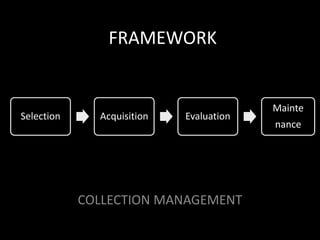
FRAMEWORK
COLLECTION MANAGEMENT
Selection Acquisition Evaluation
Mainte
nance
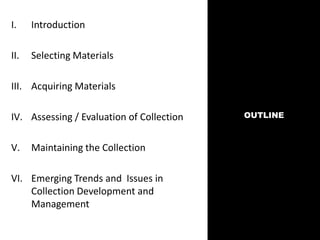
OUTLINE
I. Introduction
II. Selecting Materials
III. Acquiring Materials
IV. Assessing / Evaluation of Collection
V. Maintaining the Collection
VI. Emerging Trends and Issues in
Collection Development and
Management
COLLECTION DEVELOPMENT
POLICY (CDP)
PURPOSE
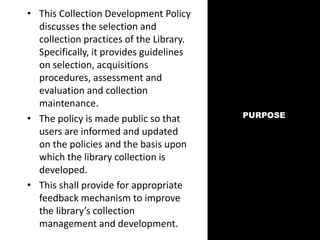
• This Collection Development Policy
discusses the selection and
collection practices of the Library.
Specifically, it provides guidelines
on selection, acquisitions
procedures, assessment and
evaluation and collection
maintenance.
• The policy is made public so that
users are informed and updated
on the policies and the basis upon
which the library collection is
developed.
• This shall provide for appropriate
feedback mechanism to improve
the library’s collection
management and development.
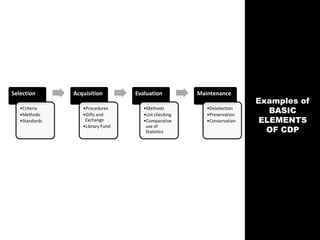
Examples of
BASIC
ELEMENTS
OF CDP
Selection
•Criteria
•Methods
•Standards
Acquisition
•Procedures
•Gifts and
Exchange
•Library Fund
Evaluation
•Methods
•List checking
•Comparative
use of
Statistics
Maintenance
•Deselection
•Preservation
•Conservation
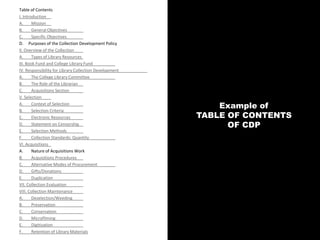
Example of
TABLE OF CONTENTS
OF CDP
Table of Contents
I. Introduction
A. Mission
B. General Objectives
C. Specific Objectives
D. Purposes of the Collection Development Policy
II. Overview of the Collection
A. Types of Library Resources
III. Book Fund and College Library Fund
IV. Responsibility for Library Collection Development
A. The College Library Committee
B. The Role of the Librarian
C. Acquisitions Section
V. Selection
A. Context of Selection
B. Selection Criteria
C. Electronic Resources
D. Statement on Censorship
E. Selection Methods
F. Collection Standards: Quantity
VI. Acquisitions
A. Nature of Acquisitions Work
B. Acquisitions Procedures
C. Alternative Modes of Procurement
D. Gifts/Donations
E. Duplication
VII. Collection Evaluation
VIII. Collection Maintenance
A. Deselection/Weeding
B. Preservation
C. Conservation
D. Microfilming
E. Digitization
F. Retention of Library Materials
ASSESSING USER NEEDS
The Starting Point
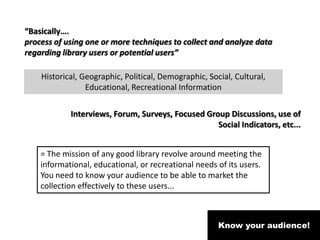
Know your audience!
“Basically….
process of using one or more techniques to collect and analyze data
regarding library users or potential users”
Historical, Geographic, Political, Demographic, Social, Cultural,
Educational, Recreational Information
Interviews, Forum, Surveys, Focused Group Discussions, use of
Social Indicators, etc...
= The mission of any good library revolve around meeting the
informational, educational, or recreational needs of its users.
You need to know your audience to be able to market the
collection effectively to these users...
SELECTION
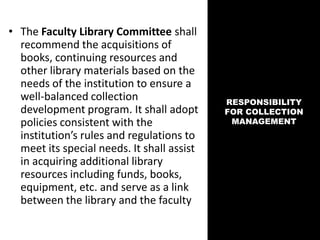
• The Faculty Library Committee shall
recommend the acquisitions of
books, continuing resources and
other library materials based on the
needs of the institution to ensure a
well-balanced collection
development program. It shall adopt
policies consistent with the
institution’s rules and regulations to
meet its special needs. It shall assist
in acquiring additional library
resources including funds, books,
equipment, etc. and serve as a link
between the library and the faculty
RESPONSIBILITY
FOR COLLECTION
MANAGEMENT
• The Acquisition Librarian shall
facilitate the implementation
of the Collection Development
Policy and share the
responsibility for developing
the library collection with the
Faculty and/or other
stakeholders. S/he shall be
responsible for managing the
Library Book Fund and
coordinate with the Library
Acquisitions Section.
RESPONSIBILITY
FOR COLLECTION
MANAGEMENT
• The Library Acquisitions
Section shall coordinate the
management of Book Fund. It
shall facilitate bookkeeping,
ordering and processing of
payments. It serves as the
liaison with other offices in
matters related to acquisitions
and use of book funds like the
budget, accounting and
property offices.
RESPONSIBILITY
FOR COLLECTION
MANAGEMENT
1. Subject matter (Relevance of the subject
matter to the curriculum)
2. Authority (Authorship, publisher, sources of
information)
3. Treatment (Accuracy, objectivity, style and
audience)
4. Scope (Purpose, coverage and up-to-
dateness)
5. Format (Binding, materials used, paper
quality and arrangement)
6. Potential demand for the material
7. Relation to the collection (Will it strengthen
the current collection?)
8. Special features (Ease of use, illustrations)
9. Cost (Worthiness, value for money)
GENEAL
CRITERIA
FOR SELECTING
MATERIALS
1. Interface
2. Technical requirements
3. Cost
4. Functionality and reliability
5. Vendor support
6. Licensing/license conditions
7. Supply - range of
purchase/pricing models
CRITERIA FOR
SELECTING
E-RESOURCES
1. Pick and Choose Model
2. By Subject Collection
3. Patron Driven Acquisition
4. Consortium Arrangement
METHODS FOR
SELECTING
E-RESOURCES
ACQUISITION
NATURE OF
ACQUISITION WORK
1. canvassing and ordering of recommended
title
2. ordering materials from vendors or
publishers
3. claiming and physical processing of library
materials
4. processing of payments of materials
acquired by the Library
5. managing the book fund and determining
allocations for materials acquisitions
6. negotiating license agreements and
contracts for electronic resources
7. soliciting library materials and maintaining
linkages with different institutions to
augment library collection
SELECTING THE
VENDOR and The ART
of REVIEWING
CONTRACTS
1. Normal stock (what is commonly
carried)
2. Technological capability
3. Speed of delivery
4. Financial condition, and
discounts offered
5. Range of services available
6. Customer service
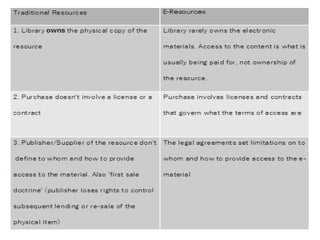
For e-resources, there is a contract
prepared once a choice is made which
specify the terms and conditions, many of
which could have serious financial
consequence for the Library, should the
Library wish to cancel or modify the
agreement
FISCAL MANAGEMENT
• Management of Library Fund is one of
the most important planning activity
that a Library has to perform . It
translate the organization’s mission
and goals into monetary terms
• Budget is the total amount of fund
available over a fixed period of time
Another important phase of Acquisitions work relates to
what amounts to very careful record keeping, most of
which are financial in character.
Ex. CDP: Library Fund
III. Library Book Fund
Sources of fund and its use shall be as stated in Article VIII Sec. 13 to 15 of the University Library Organic Act.
Sec. 13. Source and Purpose of the Library Acquisition and Maintenance [Book] Fund. The Library Acquisition
and Maintenance [Book] Fund shall consist of the library fees collected by colleges, schools and institutes. It shall be
used exclusively for acquisitions and maintenance of library collections, computer software, databases and
equipment of the Main Library and the various units. It shall be augmented by allocations from the University.
(Revised and approved per 1147th Meeting of Board of Regents
Sec. 14. Sources and Purpose of the College Library Fund. In addition to its share in the Book Fund, the College
Library fund shall consist of fines, payments for lost books, proceeds from sale of library publications, waste
materials & discards, fees collected from library services and other similar fees; and donations from public or private
sources. It shall be used exclusively for the College Library’s acquisition and maintenance needs.
Sec. 15. Collection and Disbursement of Funds.
Library fees collected from students shall be deposited with the Cashier of the University in a Library Account
coded for the purpose by the Chief Accountant. The Chief Accountant shall furnish the University Librarian with a
report of library fees collected every semester. Purchase of books and other library materials chargeable against the
Book Fund shall be approved by the University Librarian.
Fines, payments for lost books, proceeds from sale of library publications, waste materials, discards, fees from
library services and other similar fees shall be collected by the College Librarian. The money collected shall be
deposited with the Cashier or the University in the College Library Account coded for the purpose by the Chief
Accountant. Expenses for acquisition and maintenance needs of the College Library shall be approved by the College
Librarian.
The Library Book Fund comes primarily from the Library Fees collected from students. This is supplemented by a
Library Trust Fund from fines and other fees. Other sources of funds may come from donations, endowments and
grants. The Book Fund may be used to acquire printed and electronic/online resources.
CRITERIA FOR
CONTINUING
SUBSCRIPTION
OR RENEWAL
1. Documented use and potential use
2. Reviews by acknowledged experts in
the field
3. Abstracting or indexing source
available
4. Availability and access to the latest
issue in other formats
5. Documented request for cancellation
6. Abolition of academic
program/course for which its
subscription was originally
considered.
PROCUREMENT
PROCESS
(GOVERNMENT)
• As a general rule, all procurement shall
adopt public bidding as the general mode
of procurement.
• Alternative modes of procurement shall
be resorted to only in the high exceptional
cases or whenever justified by the
conditions provided in Republic Act 9184,
otherwise known as the Government
Procurement Reform Act
– Alternative Modes of Procurement
1. Direct Contracting
2. Shopping
3. Negotiated Procurement
a. Failed bidding
b. Small value procurement
ASSESSMENT / EVALUATION
OF COLLECTION
WHAT IS IN THE
COLLECTION?
WHAT IS LACKING?
ASSESSMENT /
EVALUATION OF
COLLECTION
1. To determine if the collection meet the
mission and goals of the Library.
2. To find out how well the existing
collection meet the teaching and
research needs of its users, in what areas
it is deficient and what remains to be
done to develop the collection.
3. To identify materials for preservation
treatment, replacement, transfer to
storage, or deselection, justifying for
budget requests and funding, grants,
explaining decisions and expenditures
and demonstrating the degree to which a
library can or cannot support program or
major.
ASSESSMENT /
EVALUATION OF
COLLECTION
• The Library may use a combination of
standard qualitative and quantitative
methods of evaluation. Different subjects
may require different techniques of
assessments. The choice of method to be
adapted and type of data to be collected
will depend on the purpose of the
evaluation
• Examples:
1.List checking
2.Comparative Use Statistics
3.Using collection standards
4. Circulation studies
5. Customer perceptions
6. Conspectus, etc.
ASSESSMENT /
EVALUATION OF
COLLECTION
• For electronic resources, these standard
methods of analysis are not easily
applicable. The Library may use data
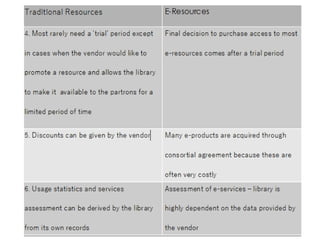
provided by publishers and vendors to
measure its effectiveness or consider
their cost-effectiveness and success in
meeting users’ needs.
• System should be able to provide Usage
Statistics on the following:
1. Turnaways/ Access Denials
2. Most accessed article
3. Most viewed title
4. May conduct study on ROI (*Return of
Investment)
COLLECTION MAINTENANCE
COLLECTION
MAINTENANCE
1. Deselection/Weeding
2. Preservation
3. Conservation
4. Microfilming
5. Digitization
6. Retention of Library Materials
CRITERIA FOR WEEDING
1. Relevance to the curriculum. Irrelevant to current
curricular or research needs
2. Trivial. Titles with no discernable literary or scientific merit
3. Obsolescence/timeliness. Titles containing out-of-date
information
4. Functionality and system requirements. Outdated software,
electronic resources, internet or online resources links and
incapable/incompatible hardware
5. Technical quality. Visual materials are faded, off color, or
scratched. Sound productions are faulty or inferior.
6. Ephemeral materials such as newspaper clippings,
pamphlets, or brochures may be discarded after a given
period of time.
7. Redundancy/over representation. Individual titles
containing information found elsewhere in the collection
8. Use pattern. Titles no longer borrowed or used in the
library for at least ten years
9. Physical condition. Materials in poor and unserviceable
condition (worn out beyond mending or rebinding, termite
infested, etc.)
10. Duplicates. Multiple copies of a title that are no longer in
demand.
11. Superseded edition. Old editions may be replaced by a
current one.
PRESERVATION
Methods and techniques of preservation
of library materials may include but not
limited to the following:
1. Binding
2. Mending/simple repair
3. Reformatting
4. Replacement
5. Suitable storage facility
6. Regular housekeeping
7. Security measures
8. Disaster Risk Reduction
Management Plan
CONSERVATION
• The Library shall apply specialized
techniques involving physical or
chemical intervention to ensure the
survival of manuscripts, books, and
other documents.
• Decisions on conservation treatment
and reformatting of valuable rare and
special materials is carried out by the
Librarian/Archivist or Curator subject
to availability of funds.
MICROFILMING
The following materials are priority for
microfilming:
1. Rare books and serials
2. Special collections
DIGITIZATION
Special collections e.g. theses, archival
records, personal papers are
digitized to preserve its historical
and research value in accordance
with copyright laws.
RETENTION OF
LIBRARY MATERIALS
Materials should not be discarded are
the following:
1. All Filipiniana and rare materials
2. Materials with historical and
archival value
3. Irreplaceable materials with
research value
4. Classic, standard works and award-
winning items not readily
available elsewhere
TRENDS AND ISSUES in COLLECTION
DEVELOPMENT AND MANAGEMENT
Technology-related Issues
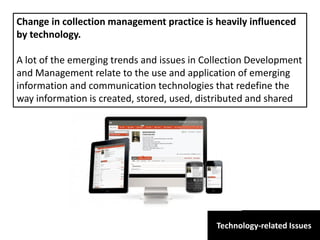
Change in collection management practice is heavily influenced
by technology.
A lot of the emerging trends and issues in Collection Development
and Management relate to the use and application of emerging
information and communication technologies that redefine the
way information is created, stored, used, distributed and shared
How Technology Helps?
Use of Google Apps and ifree tools for Selections and
Recommendations
Marketing physical & virtual library services
How Technology Helps?
Online book ordering and purchasing
How Technology Helps?
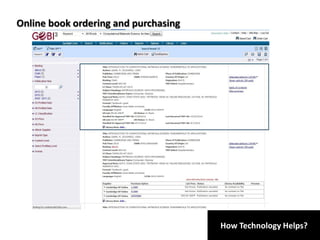
Online book ordering and purchasing
How Technology Helps?
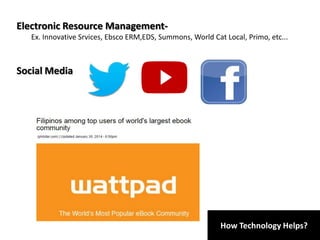
Electronic Resource Management-
Ex. Innovative Srvices, Ebsco ERM,EDS, Summons, World Cat Local, Primo, etc...
Social Media
How Technology Helps?
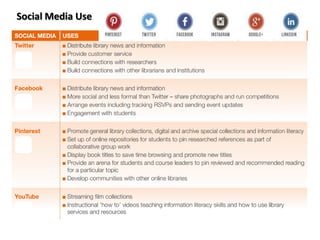
Social Media Use
How is it used in the library?
1. to engage patrons, initate conversations (e.g. seek opinion of its services)
2. patron-initiated collection development (i.e. solicit collection requests)
3. tools for reference and public service outreach (e.g. recruiting volunteers
for helping transcribe digitized restaurant menus)
4. Social media presence must be part of a larger program of marketing,
reference, and event promotion
5. to encourage collaboration (between other libraries/librarians, also
users)
Libraries can create social media policies that govern the use of social
media by librarians and by users. Social media is also increasingly being seen
as a collection management tool, offering flexible ways to present resources
(e.g. YouTube for video delivery) and categorize them (e.g. Folksonomies).
Social Media Use
Issues
Challenges associated with using social media in libraries include the following:
1. Social media can require considerable time commitment from library staff;
2. Social media can require technological expertise, for example customizing
applications to provide access to online catalogs;
3. It can be a challenge for librarians to use an informal but presentable tone, or
deliver social media content in a bilingual or multilingual region;
4. Levels of interest in and skills with using social media vary enormously across
library staff;
5. There are limited funds to support more advanced social media usage/
features and the training that would be required to enable this;
6. A library needs to work hard to maintain engagement with library users and
attract popularity (followers, likes and so on);
7. It can be difficult to maintain library branding for content/resources made
accessible via social media;
8. There are potential copyright issues when using social media such as YouTube
to build collections;
9. External factors such as Internet connectivity, technological infrastructure and
government restrictions on the use of social media may restrict access
eBooks, eReader and
eLending
E-book
What is an e-book?
The term e-book is used to refer to digital objects specifically made
to be read with reading applications operating on either a handheld device
or a personal computer.
It can also be defined as a book created in digital format, or print
converted to digital format, for electronic distribution (Johnson. 2004)
E-reader
An e-reader is a portable electronic device that is designed primarily
for the purpose of reading e-books and periodicals. (Wikipedia)
e.g Kindle, Sony E-book Readers
E-Lending
What is eLending?
eLending is the temporary provision of an eBook by a library to a registered
user for use away from the library premises and in the library should the user
wish. (IFLA background paper. 2014)
eBooks, eReader and
eLending
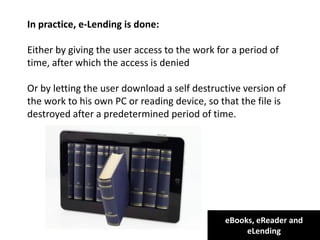
In practice, e-Lending is done:
Either by giving the user access to the work for a period of
time, after which the access is denied
Or by letting the user download a self destructive version of
the work to his own PC or reading device, so that the file is
destroyed after a predetermined period of time.
eBooks, eReader and
eLending
For clarity:
the terms under which the eBook is lent may be
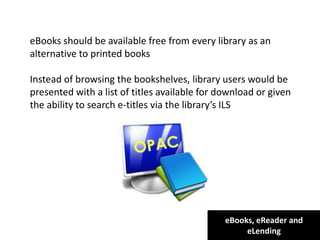
eBooks should be available free from every library as an
alternative to printed books
Instead of browsing the bookshelves, library users would be
presented with a list of titles available for download or given
the ability to search e-titles via the library’s ILS
dictated by purchase agreement, license or by the library itself, including
number of simultaneous users, length of loan etc.
The eBook may be supplied to the reader’s device from a vendor,
publisher or library server
eBooks, eReader and
eLending
How the difference between traditional lending and e-
lending affects acquisition policy:
Lending - the library decides in accordance with its
acquisition policy what books to buy and use for public
lending
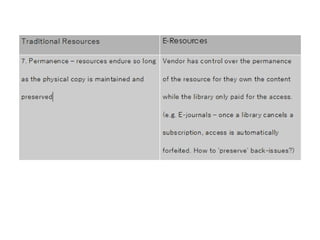
E-Lending- the acquisition policy may be decided by the
publisher and not by the library
The ideal situation is for the library to have a firm control
over its acquisition policies. Contract terms with publishers
and vendors may directly impact the way the library does its
acquisitions since these will dictate the terms of access to
the resources.
eBooks, eReader and
eLending
Issues
1. Digital collections are not yet fully developed
2. Consumers do not have access to eReaders, tablets….
moreso eBooks
3. Compatibility of some e-reading devices with aggregator
services used by libraries
4. eBook platforms in the market are not user friendly or
accessible
5. There are different business models and they take very
different approaches for digital sales to libraries.
eBooks, eReader and
eLending
Issues
6. Content –including refusal to supply, and collection
development issues
7. Procurement –including issues around flexible or inflexible
business models, ownership, consortia and fair dealing
8. Operations –including integrating ebooksinto the larger
library systems, interoperability, reporting and analytics,
and lending rights schemes
9. Lending and access –including barriers to access, DRM,
inter-library lending and open access
Digital Rights Management
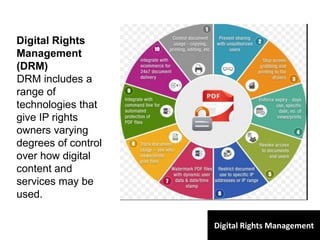
Digital Rights
Management
(DRM)
DRM includes a
range of
technologies that
give IP rights
owners varying
degrees of control
over how digital
content and
services may be
used.
Digital Rights Management
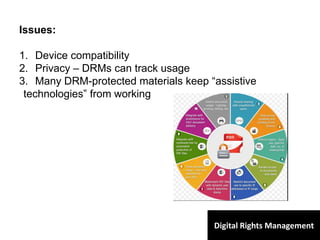
Issues:
1. Device compatibility
2. Privacy – DRMs can track usage
3. Many DRM-protected materials keep “assistive
technologies” from working
Patron Driven Acquisition
What is Patron-Driven Acquisition?
PDA, sometimes known as demand-driven
purchasing, is a supply model in which users select ebooks
from their institution’s chosen supplier’s lists, which are
usually integrated into the library catalogue.
Users are provided with a free preview of the item,
and are then allowed further access either on a request or
on an automated basis, according to the supply model.
Libraries can select from a range of purchase or rental
models, and are also able to specify price limits.
Patron Driven Acquisition
Issues
Challenges associated with the
acquisition of e-books through PDA
which cause academic libraries to be
slow in adopting an e-book PDA
system:
1. limited accessibility of e-book
titles
2. concerns related to DRM
3. difficult user interfaces
4. managing long-term licensing
costs
5. government procurement process
(bidding)
Consortia
Resource Sharing or Cooperative Collection
Development (CCD) is “cooperation, coordination, or
sharing in the development and management of
collections by two or more libraries entering into an
agreement for this purpose”.
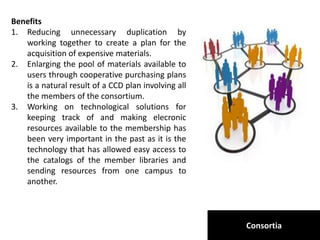
Consortia – are formal structures that pool the
resources of members to achieve benefits that are, or
may be, too costly or at a lower cost than any one
member could realize independently.
Consortia
Benefits
1. Reducing unnecessary duplication by
working together to create a plan for the
acquisition of expensive materials.
2. Enlarging the pool of materials available to
users through cooperative purchasing plans
is a natural result of a CCD plan involving all
the members of the consortium.
3. Working on technological solutions for
keeping track of and making elecronic
resources available to the membership has
been very important in the past as it is the
technology that has allowed easy access to
the catalogs of the member libraries and
sending resources from one campus to
another.
Consortia
Issues
1. Reductions in budgets can hurt consortial
activities of any type.
Budgets constrained by consortium
commitments
Vendors can limit cost advantages to
consortia
2. Internal politics and conflict between local
interests and consortium goals
Maintaining local interests can generate
problems for libraries participating in
consortial programs
Personal conflicts can seriously affect
cooperation.
3. High demand on staff time
Consortia
With emerging technologies, increasing costs, and
diminishing budgets, some librarians observe that resource
sharing and cooperation among libraries are the way to go.
Indeed, different libraries have a common goal – not just to
provide the right information but to offer a wide selection of
resources.
Consortia and CCD helps with that.
Code of Ethics for Philippine Librarians
*Librarians with the Suppliers, Publishers, Dealers, etc.
1. Librarians shall choose suppliers and publishers exclusively on
the basis of the quality of goods, costs, and services.
2. Librarians shall refuse all personal gratuities.
3. Librarians shall never enter into business transactions prejudicial
to the library, but unwisely favorable to their own interest.
*Librarians with the Clients and/or other Users of their Professional
Services.
1. Librarians shall refuse gifts or favors from clients and library
suppliers for personal interest.
2. Librarians shall avoid using the library’s resources to the
detriment of services which the library render to its users.
References
Evans, G. & Saponaro, M. 2012. Collection Management Basics, 6th ed.
Gregory, V. 2011. Collection Development and Management for 21st Century Library Collections: An Introduction
Johnson, P. 2004. Fundamentals of Collection Development and Management
IFLA 2012& 2014 eLending Background Paper. http://www.ifla.org/node/8851
Key Trends Affecting Libraries. Retrieved from
http://www.si.edu/content/opanda/docs/rpts2004/04.07.silkeytrends.final.pdf
Emerging Collection Development Trends in Academic Libraries https://prezi.com/i3ei2h3-ejqo/emerging-collection-
development-trends-in-academic-libraries/
Keeping up with...Patron Driven Acquisitions. Retrieved from
http://www.ala.org/acrl/publications/keeping_up_with/pda
Reiners, L. 2012. Patron-driven acquisition: the experience of three university libraries. Retrieved from
http://www.sconul.ac.uk/sites/default/files/documents/11.pdf
Anderson, R. 2011. What Patron-Driven Acquisition (PDA) Does and Doesn’t Mean: An FAQ. Retrieved from
http://scholarlykitchen.sspnet.org/2011/05/31/what-patron-driven-acquisition-pda-does-and-doesnt-mean-an-
faq/
Libraries are Champions for Academic Freedom and Balanced Copyright (infographic)
http://www.arl.org/storage/images/infographic-academic-freedom-balanced-copyright-2014.png
Use of Social Media by the Library: Current practices and future opportunities. Retrieved from:
http://www.tandf.co.uk/journals/access/white-paper-social-media.pdf
Petit, Joan, "Twitter and Facebook for User Collection Requests" (2011). Library Faculty Publications and Presentations.
Paper 103. http://archives.pdx.edu/ds/psu/9806

Keeping Updated: The Fundamentals of Collection Development and E-resource Management in Digital Libraries

  • 1.
    THE FUNDAMENTALS OF COLLECTIONDEVELOPMENT AND E-RESOURCE MANAGEMENT IN DIGITAL LIBRARIES SHARON MA. S. ESPOSO-BETAN
  • 2.
  • 3.
    OUTLINE I. Introduction II. SelectingMaterials III. Acquiring Materials IV. Assessing / Evaluation of Collection V. Maintaining the Collection VI. Emerging Trends and Issues in Collection Development and Management
  • 4.
  • 5.
    PURPOSE • This CollectionDevelopment Policy discusses the selection and collection practices of the Library. Specifically, it provides guidelines on selection, acquisitions procedures, assessment and evaluation and collection maintenance. • The policy is made public so that users are informed and updated on the policies and the basis upon which the library collection is developed. • This shall provide for appropriate feedback mechanism to improve the library’s collection management and development.
  • 6.
    Examples of BASIC ELEMENTS OF CDP Selection •Criteria •Methods •Standards Acquisition •Procedures •Giftsand Exchange •Library Fund Evaluation •Methods •List checking •Comparative use of Statistics Maintenance •Deselection •Preservation •Conservation
  • 7.
    Example of TABLE OFCONTENTS OF CDP Table of Contents I. Introduction A. Mission B. General Objectives C. Specific Objectives D. Purposes of the Collection Development Policy II. Overview of the Collection A. Types of Library Resources III. Book Fund and College Library Fund IV. Responsibility for Library Collection Development A. The College Library Committee B. The Role of the Librarian C. Acquisitions Section V. Selection A. Context of Selection B. Selection Criteria C. Electronic Resources D. Statement on Censorship E. Selection Methods F. Collection Standards: Quantity VI. Acquisitions A. Nature of Acquisitions Work B. Acquisitions Procedures C. Alternative Modes of Procurement D. Gifts/Donations E. Duplication VII. Collection Evaluation VIII. Collection Maintenance A. Deselection/Weeding B. Preservation C. Conservation D. Microfilming E. Digitization F. Retention of Library Materials
  • 8.
  • 9.
    Know your audience! “Basically…. processof using one or more techniques to collect and analyze data regarding library users or potential users” Historical, Geographic, Political, Demographic, Social, Cultural, Educational, Recreational Information Interviews, Forum, Surveys, Focused Group Discussions, use of Social Indicators, etc... = The mission of any good library revolve around meeting the informational, educational, or recreational needs of its users. You need to know your audience to be able to market the collection effectively to these users...
  • 10.
  • 11.
    • The FacultyLibrary Committee shall recommend the acquisitions of books, continuing resources and other library materials based on the needs of the institution to ensure a well-balanced collection development program. It shall adopt policies consistent with the institution’s rules and regulations to meet its special needs. It shall assist in acquiring additional library resources including funds, books, equipment, etc. and serve as a link between the library and the faculty RESPONSIBILITY FOR COLLECTION MANAGEMENT
  • 12.
    • The AcquisitionLibrarian shall facilitate the implementation of the Collection Development Policy and share the responsibility for developing the library collection with the Faculty and/or other stakeholders. S/he shall be responsible for managing the Library Book Fund and coordinate with the Library Acquisitions Section. RESPONSIBILITY FOR COLLECTION MANAGEMENT
  • 13.
    • The LibraryAcquisitions Section shall coordinate the management of Book Fund. It shall facilitate bookkeeping, ordering and processing of payments. It serves as the liaison with other offices in matters related to acquisitions and use of book funds like the budget, accounting and property offices. RESPONSIBILITY FOR COLLECTION MANAGEMENT
  • 14.
    1. Subject matter(Relevance of the subject matter to the curriculum) 2. Authority (Authorship, publisher, sources of information) 3. Treatment (Accuracy, objectivity, style and audience) 4. Scope (Purpose, coverage and up-to- dateness) 5. Format (Binding, materials used, paper quality and arrangement) 6. Potential demand for the material 7. Relation to the collection (Will it strengthen the current collection?) 8. Special features (Ease of use, illustrations) 9. Cost (Worthiness, value for money) GENEAL CRITERIA FOR SELECTING MATERIALS
  • 15.
    1. Interface 2. Technicalrequirements 3. Cost 4. Functionality and reliability 5. Vendor support 6. Licensing/license conditions 7. Supply - range of purchase/pricing models CRITERIA FOR SELECTING E-RESOURCES
  • 16.
    1. Pick andChoose Model 2. By Subject Collection 3. Patron Driven Acquisition 4. Consortium Arrangement METHODS FOR SELECTING E-RESOURCES
  • 17.
  • 18.
    NATURE OF ACQUISITION WORK 1.canvassing and ordering of recommended title 2. ordering materials from vendors or publishers 3. claiming and physical processing of library materials 4. processing of payments of materials acquired by the Library 5. managing the book fund and determining allocations for materials acquisitions 6. negotiating license agreements and contracts for electronic resources 7. soliciting library materials and maintaining linkages with different institutions to augment library collection
  • 19.
    SELECTING THE VENDOR andThe ART of REVIEWING CONTRACTS 1. Normal stock (what is commonly carried) 2. Technological capability 3. Speed of delivery 4. Financial condition, and discounts offered 5. Range of services available 6. Customer service For e-resources, there is a contract prepared once a choice is made which specify the terms and conditions, many of which could have serious financial consequence for the Library, should the Library wish to cancel or modify the agreement
  • 20.
    FISCAL MANAGEMENT • Managementof Library Fund is one of the most important planning activity that a Library has to perform . It translate the organization’s mission and goals into monetary terms • Budget is the total amount of fund available over a fixed period of time Another important phase of Acquisitions work relates to what amounts to very careful record keeping, most of which are financial in character.
  • 21.
    Ex. CDP: LibraryFund III. Library Book Fund Sources of fund and its use shall be as stated in Article VIII Sec. 13 to 15 of the University Library Organic Act. Sec. 13. Source and Purpose of the Library Acquisition and Maintenance [Book] Fund. The Library Acquisition and Maintenance [Book] Fund shall consist of the library fees collected by colleges, schools and institutes. It shall be used exclusively for acquisitions and maintenance of library collections, computer software, databases and equipment of the Main Library and the various units. It shall be augmented by allocations from the University. (Revised and approved per 1147th Meeting of Board of Regents Sec. 14. Sources and Purpose of the College Library Fund. In addition to its share in the Book Fund, the College Library fund shall consist of fines, payments for lost books, proceeds from sale of library publications, waste materials & discards, fees collected from library services and other similar fees; and donations from public or private sources. It shall be used exclusively for the College Library’s acquisition and maintenance needs. Sec. 15. Collection and Disbursement of Funds. Library fees collected from students shall be deposited with the Cashier of the University in a Library Account coded for the purpose by the Chief Accountant. The Chief Accountant shall furnish the University Librarian with a report of library fees collected every semester. Purchase of books and other library materials chargeable against the Book Fund shall be approved by the University Librarian. Fines, payments for lost books, proceeds from sale of library publications, waste materials, discards, fees from library services and other similar fees shall be collected by the College Librarian. The money collected shall be deposited with the Cashier or the University in the College Library Account coded for the purpose by the Chief Accountant. Expenses for acquisition and maintenance needs of the College Library shall be approved by the College Librarian. The Library Book Fund comes primarily from the Library Fees collected from students. This is supplemented by a Library Trust Fund from fines and other fees. Other sources of funds may come from donations, endowments and grants. The Book Fund may be used to acquire printed and electronic/online resources.
  • 22.
    CRITERIA FOR CONTINUING SUBSCRIPTION OR RENEWAL 1.Documented use and potential use 2. Reviews by acknowledged experts in the field 3. Abstracting or indexing source available 4. Availability and access to the latest issue in other formats 5. Documented request for cancellation 6. Abolition of academic program/course for which its subscription was originally considered.
  • 23.
    PROCUREMENT PROCESS (GOVERNMENT) • As ageneral rule, all procurement shall adopt public bidding as the general mode of procurement. • Alternative modes of procurement shall be resorted to only in the high exceptional cases or whenever justified by the conditions provided in Republic Act 9184, otherwise known as the Government Procurement Reform Act – Alternative Modes of Procurement 1. Direct Contracting 2. Shopping 3. Negotiated Procurement a. Failed bidding b. Small value procurement
  • 24.
  • 25.
    WHAT IS INTHE COLLECTION? WHAT IS LACKING? ASSESSMENT / EVALUATION OF COLLECTION 1. To determine if the collection meet the mission and goals of the Library. 2. To find out how well the existing collection meet the teaching and research needs of its users, in what areas it is deficient and what remains to be done to develop the collection. 3. To identify materials for preservation treatment, replacement, transfer to storage, or deselection, justifying for budget requests and funding, grants, explaining decisions and expenditures and demonstrating the degree to which a library can or cannot support program or major.
  • 26.
    ASSESSMENT / EVALUATION OF COLLECTION •The Library may use a combination of standard qualitative and quantitative methods of evaluation. Different subjects may require different techniques of assessments. The choice of method to be adapted and type of data to be collected will depend on the purpose of the evaluation • Examples: 1.List checking 2.Comparative Use Statistics 3.Using collection standards 4. Circulation studies 5. Customer perceptions 6. Conspectus, etc.
  • 27.
    ASSESSMENT / EVALUATION OF COLLECTION •For electronic resources, these standard methods of analysis are not easily applicable. The Library may use data provided by publishers and vendors to measure its effectiveness or consider their cost-effectiveness and success in meeting users’ needs. • System should be able to provide Usage Statistics on the following: 1. Turnaways/ Access Denials 2. Most accessed article 3. Most viewed title 4. May conduct study on ROI (*Return of Investment)
  • 28.
  • 29.
    COLLECTION MAINTENANCE 1. Deselection/Weeding 2. Preservation 3.Conservation 4. Microfilming 5. Digitization 6. Retention of Library Materials
  • 30.
    CRITERIA FOR WEEDING 1.Relevance to the curriculum. Irrelevant to current curricular or research needs 2. Trivial. Titles with no discernable literary or scientific merit 3. Obsolescence/timeliness. Titles containing out-of-date information 4. Functionality and system requirements. Outdated software, electronic resources, internet or online resources links and incapable/incompatible hardware 5. Technical quality. Visual materials are faded, off color, or scratched. Sound productions are faulty or inferior. 6. Ephemeral materials such as newspaper clippings, pamphlets, or brochures may be discarded after a given period of time. 7. Redundancy/over representation. Individual titles containing information found elsewhere in the collection 8. Use pattern. Titles no longer borrowed or used in the library for at least ten years 9. Physical condition. Materials in poor and unserviceable condition (worn out beyond mending or rebinding, termite infested, etc.) 10. Duplicates. Multiple copies of a title that are no longer in demand. 11. Superseded edition. Old editions may be replaced by a current one.
  • 31.
    PRESERVATION Methods and techniquesof preservation of library materials may include but not limited to the following: 1. Binding 2. Mending/simple repair 3. Reformatting 4. Replacement 5. Suitable storage facility 6. Regular housekeeping 7. Security measures 8. Disaster Risk Reduction Management Plan
  • 32.
    CONSERVATION • The Libraryshall apply specialized techniques involving physical or chemical intervention to ensure the survival of manuscripts, books, and other documents. • Decisions on conservation treatment and reformatting of valuable rare and special materials is carried out by the Librarian/Archivist or Curator subject to availability of funds.
  • 33.
    MICROFILMING The following materialsare priority for microfilming: 1. Rare books and serials 2. Special collections
  • 34.
    DIGITIZATION Special collections e.g.theses, archival records, personal papers are digitized to preserve its historical and research value in accordance with copyright laws.
  • 35.
    RETENTION OF LIBRARY MATERIALS Materialsshould not be discarded are the following: 1. All Filipiniana and rare materials 2. Materials with historical and archival value 3. Irreplaceable materials with research value 4. Classic, standard works and award- winning items not readily available elsewhere
  • 36.
    TRENDS AND ISSUESin COLLECTION DEVELOPMENT AND MANAGEMENT
  • 40.
    Technology-related Issues Change incollection management practice is heavily influenced by technology. A lot of the emerging trends and issues in Collection Development and Management relate to the use and application of emerging information and communication technologies that redefine the way information is created, stored, used, distributed and shared
  • 41.
    How Technology Helps? Useof Google Apps and ifree tools for Selections and Recommendations Marketing physical & virtual library services
  • 42.
    How Technology Helps? Onlinebook ordering and purchasing
  • 43.
    How Technology Helps? Onlinebook ordering and purchasing
  • 44.
    How Technology Helps? ElectronicResource Management- Ex. Innovative Srvices, Ebsco ERM,EDS, Summons, World Cat Local, Primo, etc... Social Media
  • 45.
    How Technology Helps? SocialMedia Use How is it used in the library? 1. to engage patrons, initate conversations (e.g. seek opinion of its services) 2. patron-initiated collection development (i.e. solicit collection requests) 3. tools for reference and public service outreach (e.g. recruiting volunteers for helping transcribe digitized restaurant menus) 4. Social media presence must be part of a larger program of marketing, reference, and event promotion 5. to encourage collaboration (between other libraries/librarians, also users) Libraries can create social media policies that govern the use of social media by librarians and by users. Social media is also increasingly being seen as a collection management tool, offering flexible ways to present resources (e.g. YouTube for video delivery) and categorize them (e.g. Folksonomies).
  • 46.
  • 47.
    Issues Challenges associated withusing social media in libraries include the following: 1. Social media can require considerable time commitment from library staff; 2. Social media can require technological expertise, for example customizing applications to provide access to online catalogs; 3. It can be a challenge for librarians to use an informal but presentable tone, or deliver social media content in a bilingual or multilingual region; 4. Levels of interest in and skills with using social media vary enormously across library staff; 5. There are limited funds to support more advanced social media usage/ features and the training that would be required to enable this; 6. A library needs to work hard to maintain engagement with library users and attract popularity (followers, likes and so on); 7. It can be difficult to maintain library branding for content/resources made accessible via social media; 8. There are potential copyright issues when using social media such as YouTube to build collections; 9. External factors such as Internet connectivity, technological infrastructure and government restrictions on the use of social media may restrict access
  • 48.
    eBooks, eReader and eLending E-book Whatis an e-book? The term e-book is used to refer to digital objects specifically made to be read with reading applications operating on either a handheld device or a personal computer. It can also be defined as a book created in digital format, or print converted to digital format, for electronic distribution (Johnson. 2004) E-reader An e-reader is a portable electronic device that is designed primarily for the purpose of reading e-books and periodicals. (Wikipedia) e.g Kindle, Sony E-book Readers E-Lending What is eLending? eLending is the temporary provision of an eBook by a library to a registered user for use away from the library premises and in the library should the user wish. (IFLA background paper. 2014)
  • 49.
    eBooks, eReader and eLending Inpractice, e-Lending is done: Either by giving the user access to the work for a period of time, after which the access is denied Or by letting the user download a self destructive version of the work to his own PC or reading device, so that the file is destroyed after a predetermined period of time.
  • 50.
    eBooks, eReader and eLending Forclarity: the terms under which the eBook is lent may be eBooks should be available free from every library as an alternative to printed books Instead of browsing the bookshelves, library users would be presented with a list of titles available for download or given the ability to search e-titles via the library’s ILS dictated by purchase agreement, license or by the library itself, including number of simultaneous users, length of loan etc. The eBook may be supplied to the reader’s device from a vendor, publisher or library server
  • 51.
    eBooks, eReader and eLending Howthe difference between traditional lending and e- lending affects acquisition policy: Lending - the library decides in accordance with its acquisition policy what books to buy and use for public lending E-Lending- the acquisition policy may be decided by the publisher and not by the library The ideal situation is for the library to have a firm control over its acquisition policies. Contract terms with publishers and vendors may directly impact the way the library does its acquisitions since these will dictate the terms of access to the resources.
  • 52.
    eBooks, eReader and eLending Issues 1.Digital collections are not yet fully developed 2. Consumers do not have access to eReaders, tablets…. moreso eBooks 3. Compatibility of some e-reading devices with aggregator services used by libraries 4. eBook platforms in the market are not user friendly or accessible 5. There are different business models and they take very different approaches for digital sales to libraries.
  • 53.
    eBooks, eReader and eLending Issues 6.Content –including refusal to supply, and collection development issues 7. Procurement –including issues around flexible or inflexible business models, ownership, consortia and fair dealing 8. Operations –including integrating ebooksinto the larger library systems, interoperability, reporting and analytics, and lending rights schemes 9. Lending and access –including barriers to access, DRM, inter-library lending and open access
  • 54.
    Digital Rights Management DigitalRights Management (DRM) DRM includes a range of technologies that give IP rights owners varying degrees of control over how digital content and services may be used.
  • 55.
    Digital Rights Management Issues: 1.Device compatibility 2. Privacy – DRMs can track usage 3. Many DRM-protected materials keep “assistive technologies” from working
  • 56.
    Patron Driven Acquisition Whatis Patron-Driven Acquisition? PDA, sometimes known as demand-driven purchasing, is a supply model in which users select ebooks from their institution’s chosen supplier’s lists, which are usually integrated into the library catalogue. Users are provided with a free preview of the item, and are then allowed further access either on a request or on an automated basis, according to the supply model. Libraries can select from a range of purchase or rental models, and are also able to specify price limits.
  • 57.
    Patron Driven Acquisition Issues Challengesassociated with the acquisition of e-books through PDA which cause academic libraries to be slow in adopting an e-book PDA system: 1. limited accessibility of e-book titles 2. concerns related to DRM 3. difficult user interfaces 4. managing long-term licensing costs 5. government procurement process (bidding)
  • 58.
    Consortia Resource Sharing orCooperative Collection Development (CCD) is “cooperation, coordination, or sharing in the development and management of collections by two or more libraries entering into an agreement for this purpose”. Consortia – are formal structures that pool the resources of members to achieve benefits that are, or may be, too costly or at a lower cost than any one member could realize independently.
  • 59.
    Consortia Benefits 1. Reducing unnecessaryduplication by working together to create a plan for the acquisition of expensive materials. 2. Enlarging the pool of materials available to users through cooperative purchasing plans is a natural result of a CCD plan involving all the members of the consortium. 3. Working on technological solutions for keeping track of and making elecronic resources available to the membership has been very important in the past as it is the technology that has allowed easy access to the catalogs of the member libraries and sending resources from one campus to another.
  • 60.
    Consortia Issues 1. Reductions inbudgets can hurt consortial activities of any type. Budgets constrained by consortium commitments Vendors can limit cost advantages to consortia 2. Internal politics and conflict between local interests and consortium goals Maintaining local interests can generate problems for libraries participating in consortial programs Personal conflicts can seriously affect cooperation. 3. High demand on staff time
  • 61.
    Consortia With emerging technologies,increasing costs, and diminishing budgets, some librarians observe that resource sharing and cooperation among libraries are the way to go. Indeed, different libraries have a common goal – not just to provide the right information but to offer a wide selection of resources. Consortia and CCD helps with that.
  • 62.
    Code of Ethicsfor Philippine Librarians *Librarians with the Suppliers, Publishers, Dealers, etc. 1. Librarians shall choose suppliers and publishers exclusively on the basis of the quality of goods, costs, and services. 2. Librarians shall refuse all personal gratuities. 3. Librarians shall never enter into business transactions prejudicial to the library, but unwisely favorable to their own interest. *Librarians with the Clients and/or other Users of their Professional Services. 1. Librarians shall refuse gifts or favors from clients and library suppliers for personal interest. 2. Librarians shall avoid using the library’s resources to the detriment of services which the library render to its users.
  • 63.
    References Evans, G. &Saponaro, M. 2012. Collection Management Basics, 6th ed. Gregory, V. 2011. Collection Development and Management for 21st Century Library Collections: An Introduction Johnson, P. 2004. Fundamentals of Collection Development and Management IFLA 2012& 2014 eLending Background Paper. http://www.ifla.org/node/8851 Key Trends Affecting Libraries. Retrieved from http://www.si.edu/content/opanda/docs/rpts2004/04.07.silkeytrends.final.pdf Emerging Collection Development Trends in Academic Libraries https://prezi.com/i3ei2h3-ejqo/emerging-collection- development-trends-in-academic-libraries/ Keeping up with...Patron Driven Acquisitions. Retrieved from http://www.ala.org/acrl/publications/keeping_up_with/pda Reiners, L. 2012. Patron-driven acquisition: the experience of three university libraries. Retrieved from http://www.sconul.ac.uk/sites/default/files/documents/11.pdf Anderson, R. 2011. What Patron-Driven Acquisition (PDA) Does and Doesn’t Mean: An FAQ. Retrieved from http://scholarlykitchen.sspnet.org/2011/05/31/what-patron-driven-acquisition-pda-does-and-doesnt-mean-an- faq/ Libraries are Champions for Academic Freedom and Balanced Copyright (infographic) http://www.arl.org/storage/images/infographic-academic-freedom-balanced-copyright-2014.png Use of Social Media by the Library: Current practices and future opportunities. Retrieved from: http://www.tandf.co.uk/journals/access/white-paper-social-media.pdf Petit, Joan, "Twitter and Facebook for User Collection Requests" (2011). Library Faculty Publications and Presentations. Paper 103. http://archives.pdx.edu/ds/psu/9806