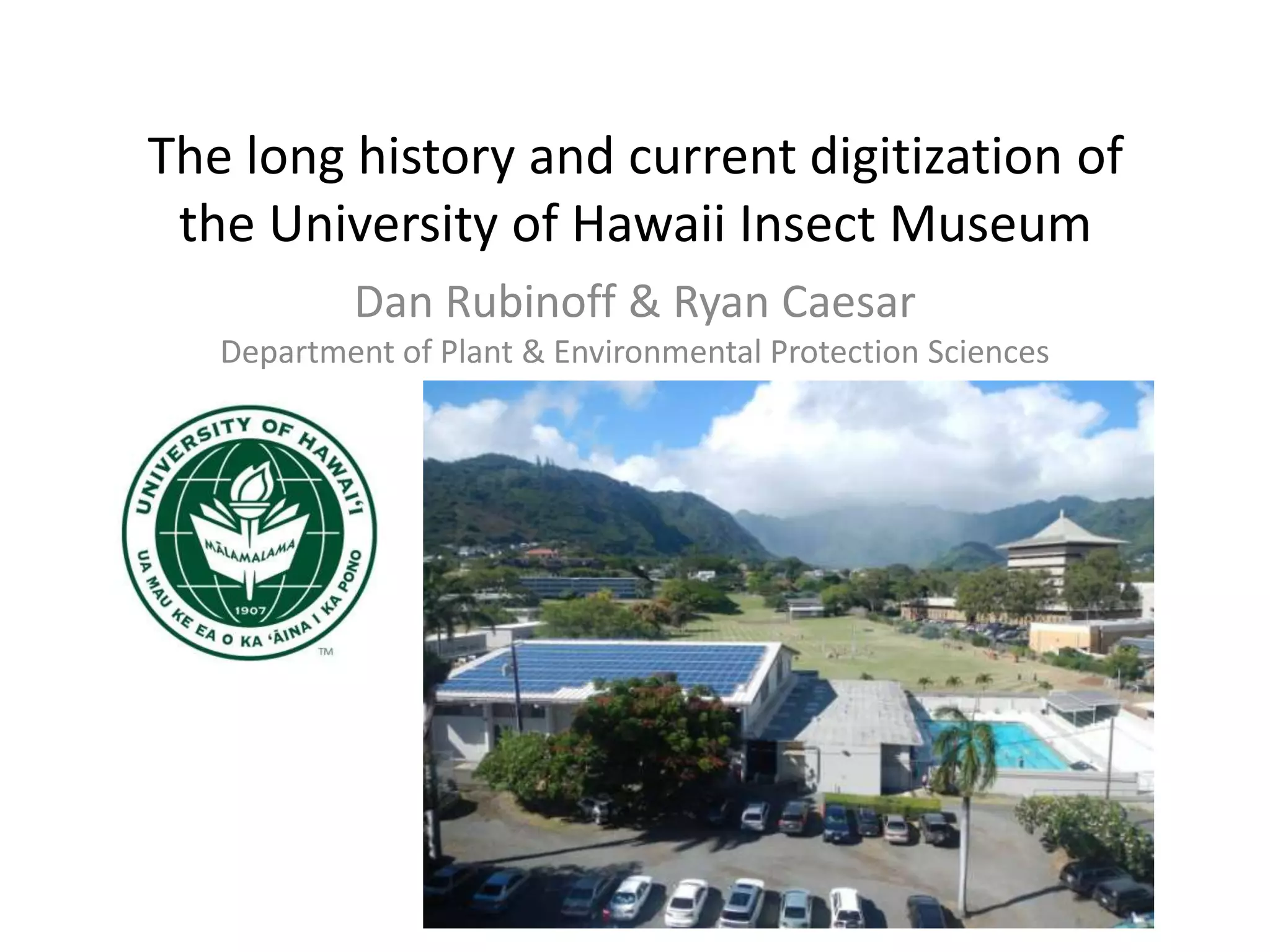
The long history and current digitization of
the University of Hawaii Insect Museum
Dan Rubinoff & Ryan Caesar
Department of Plant & Environmental Protection Sciences
Mission
• The mission of the UHIM is to improve land
management in the state of Hawaii by documenting
and preserving a record of native and introduced
terrestrial arthropods.
• We serve the broader community by
preserving, archiving, and expanding the collection to
make a thorough representation of the Hawaiian and
Pacific Island insect biodiversity.
• We are a scientific research unit that emphasizes insect
systematics, evolution and conservation.
• Finally, we are a resource for education about the
function and importance of natural history collections.
Background
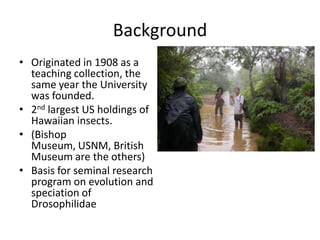
• Originated in 1908 as a
teaching collection, the
same year the University
was founded.
• 2nd largest US holdings of
Hawaiian insects.
• (Bishop
Museum, USNM, British
Museum are the others)
• Basis for seminal research
program on evolution and
speciation of
Drosophilidae
Overview of Holdings
• Currently approx. 250,000 specimens
• 1536 drawer capacity in 8*24 drawer cabinets
• Actively adding specimens
– E.g. UV light trapping bycatch

• Room to grow: space for approx. 450 empty
drawers
• Records of arrival of invasives and last records of
extinct (?) native species
• Nearly 40 types, more to come as taxonomic
work continues
1
1844

1
52

1
0

1

2 10052
537
64
47
20
0
84

810

54

1

2 10804

Paratypes

731
35
7
12
5
20

Allotypes

927
159
368
426
15
191
6
57
7
16
20
3
7
2202

Plesiotypes

944
160
124
258
112
196
25
3
15
6
0

Holotypes

1871
319
492
684
127
387
31
60
22
22
20
3
8
4046

Species with
types

Native species

142762
19966
19750
15162
11725
9241
831
804
469
445
298
203
79
221735

Non-Native
species

Total number
of species

Order
Diptera
Lepidoptera
Hymenoptera
Coleoptera
Acari
Hemiptera
Neuroptera
Orthopteroids
Odonata
Psocoptera
Thysanoptera
Trichoptera
Other orders
TOTAL

Number of
curated
specimens

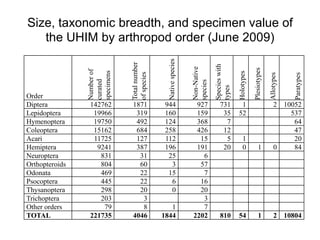
Size, taxonomic breadth, and specimen value of
the UHIM by arthropod order (June 2009)
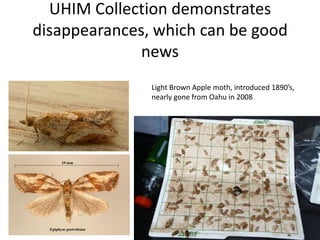
UHIM Collection demonstrates
disappearances, which can be good
news
Light Brown Apple moth, introduced 1890’s,
nearly gone from Oahu in 2008
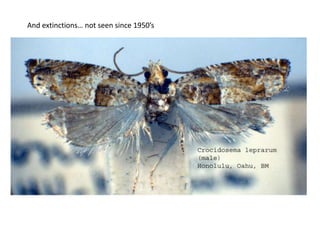
And extinctions… not seen since 1950’s
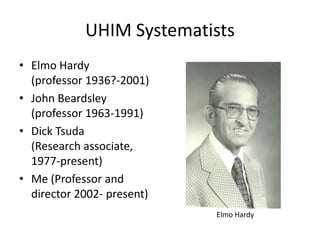
UHIM Systematists
• Elmo Hardy
(professor 1936?-2001)
• John Beardsley
(professor 1963-1991)
• Dick Tsuda
(Research associate,
1977-present)
• Me (Professor and
director 2002- present)
Elmo Hardy
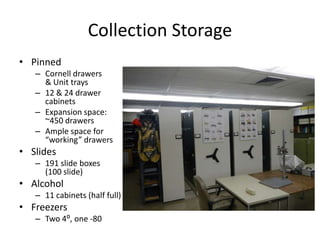
Collection Storage
• Pinned
– Cornell drawers
& Unit trays
– 12 & 24 drawer
cabinets
– Expansion space:
~450 drawers
– Ample space for
“working” drawers

• Slides
– 191 slide boxes
(100 slide)

• Alcohol
– 11 cabinets (half full)

• Freezers
– Two 4:, one -80
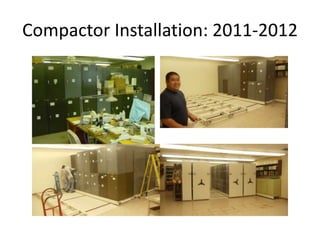
Compactor Installation: 2011-2012
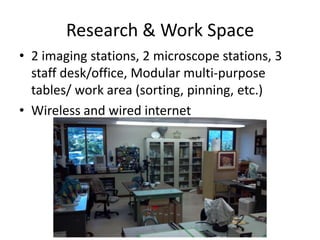
Research & Work Space
• 2 imaging stations, 2 microscope stations, 3
staff desk/office, Modular multi-purpose
tables/ work area (sorting, pinning, etc.)
• Wireless and wired internet
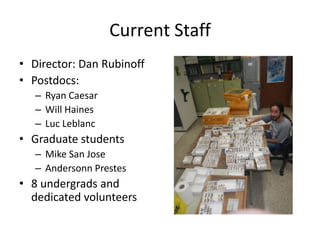
Current Staff
• Director: Dan Rubinoff
• Postdocs:
– Ryan Caesar
– Will Haines
– Luc Leblanc

• Graduate students
– Mike San Jose
– Andersonn Prestes

• 8 undergrads and
dedicated volunteers
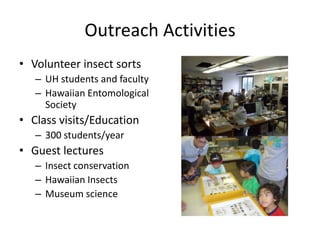
Outreach Activities
• Volunteer insect sorts
– UH students and faculty
– Hawaiian Entomological
Society

• Class visits/Education
– 300 students/year

• Guest lectures
– Insect conservation
– Hawaiian Insects
– Museum science
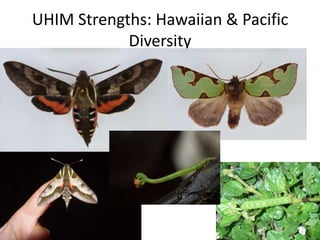
UHIM Strengths: Hawaiian & Pacific
Diversity
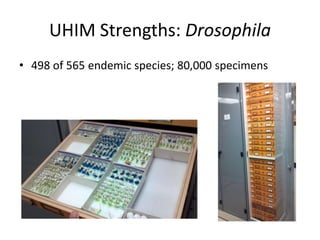
UHIM Strengths: Drosophila
• 498 of 565 endemic species; 80,000 specimens
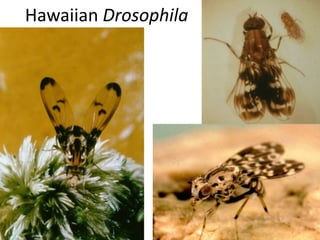
Hawaiian Drosophila
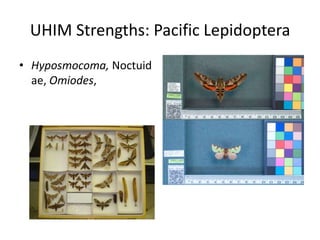
UHIM Strengths: Pacific Lepidoptera
• Hyposmocoma, Noctuid
ae, Omiodes,
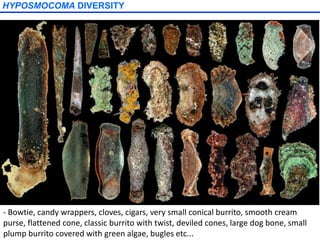
HYPOSMOCOMA DIVERSITY

- Bowtie, candy wrappers, cloves, cigars, very small conical burrito, smooth cream
purse, flattened cone, classic burrito with twist, deviled cones, large dog bone, small
plump burrito covered with green algae, bugles etc...
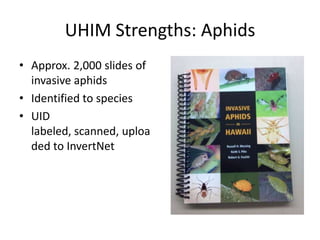
UHIM Strengths: Aphids
• Approx. 2,000 slides of
invasive aphids
• Identified to species
• UID
labeled, scanned, uploa
ded to InvertNet
Current & Recent Research
• Systematics
– Lepidoptera
• Hyposmocoma
(Lepidoptera: )
• Omiodes
• Hawaiian Noctuidae
• Eupithecia (Geometridae)

– Diptera:
Bactrocera, Dacine fruit
flies
– Hemiptera: Nyssius
(weiku bug)

• Biodiversity &
Conservation
– Vanessa tamehameha
Kamehameha butterfly
– Scotorythra Koa moth
outbreak
– Hawaiian Drosophila
– Tephritid ecology in Asia
& Pacific
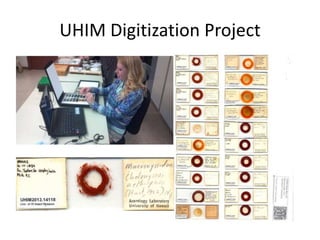
UHIM Digitization Project
• Currently digitizing all specimens in collection
– Transcription of label data
– Imaging

• Funding: NSF and Hawaii DLNR
• Project is part of InvertNet efforts in
conjunction with midwestern collections
Department of Land & Natural
Resources Database
• Purpose: transcribe relevant UHIM records for
integration into a spatially-hierarchical, georeferenced database for invertebrate species
throughout the Hawaiian Islands
• Methods
– Funding for 2 student workers and one part time
postdoc
– Transcribe label data into spreadsheet
– Focus solely on Hawaii collection records

• Progress: 28,942 pinned specimens transcribed
since June 2012
UHIM Digitization Project
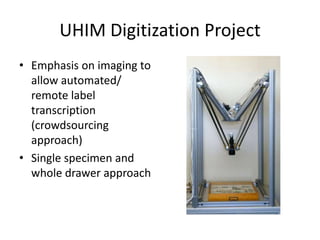
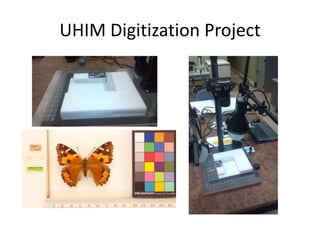
• Emphasis on imaging to
allow automated/
remote label
transcription
(crowdsourcing
approach)
• Single specimen and
whole drawer approach
UHIM Digitization Project
UHIM Digitization Project: Progress
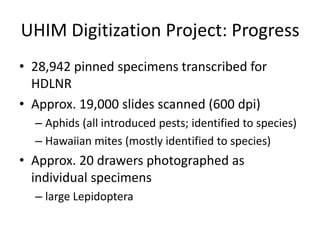
• 28,942 pinned specimens transcribed for
HDLNR
• Approx. 19,000 slides scanned (600 dpi)
– Aphids (all introduced pests; identified to species)
– Hawaiian mites (mostly identified to species)

• Approx. 20 drawers photographed as
individual specimens
– large Lepidoptera
Social Networking
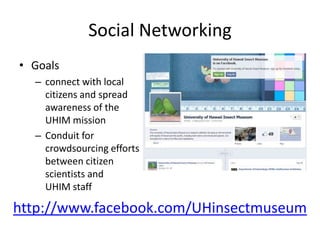
• Goals
– connect with local
citizens and spread
awareness of the
UHIM mission
– Conduit for
crowdsourcing efforts
between citizen
scientists and
UHIM staff

http://www.facebook.com/UHinsectmuseum
Crowdsourcing Biodiversity
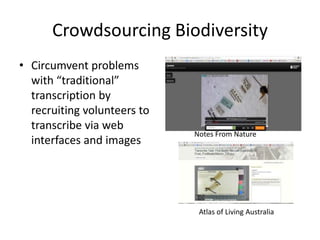
• Circumvent problems
with “traditional”
transcription by
recruiting volunteers to
transcribe via web
interfaces and images

Notes From Nature

Atlas of Living Australia
Crowdsourcing Biodiversity
• InvertNet linking with existing crowdsourcing
project?
• Need to try and connect with local community
• Educational resources
– Provide incentive for students via grades
– Develop lab exercises and assignments
Acknowledgements
• NSF
• College of Tropical Agriculture and Human
Resources
• Luc Leblanc & Will Haines
• Grad students: Andersson Prestes & Mike San
Jose
• Undergrads: Kristen Jamieson

Rubinoff ecn2013 uhim

  • 1.
    The long historyand current digitization of the University of Hawaii Insect Museum Dan Rubinoff & Ryan Caesar Department of Plant & Environmental Protection Sciences
  • 2.
    Mission • The missionof the UHIM is to improve land management in the state of Hawaii by documenting and preserving a record of native and introduced terrestrial arthropods. • We serve the broader community by preserving, archiving, and expanding the collection to make a thorough representation of the Hawaiian and Pacific Island insect biodiversity. • We are a scientific research unit that emphasizes insect systematics, evolution and conservation. • Finally, we are a resource for education about the function and importance of natural history collections.
  • 3.
    Background • Originated in1908 as a teaching collection, the same year the University was founded. • 2nd largest US holdings of Hawaiian insects. • (Bishop Museum, USNM, British Museum are the others) • Basis for seminal research program on evolution and speciation of Drosophilidae
  • 4.
    Overview of Holdings •Currently approx. 250,000 specimens • 1536 drawer capacity in 8*24 drawer cabinets • Actively adding specimens – E.g. UV light trapping bycatch • Room to grow: space for approx. 450 empty drawers • Records of arrival of invasives and last records of extinct (?) native species • Nearly 40 types, more to come as taxonomic work continues
  • 5.
    1 1844 1 52 1 0 1 2 10052 537 64 47 20 0 84 810 54 1 2 10804 Paratypes 731 35 7 12 5 20 Allotypes 927 159 368 426 15 191 6 57 7 16 20 3 7 2202 Plesiotypes 944 160 124 258 112 196 25 3 15 6 0 Holotypes 1871 319 492 684 127 387 31 60 22 22 20 3 8 4046 Specieswith types Native species 142762 19966 19750 15162 11725 9241 831 804 469 445 298 203 79 221735 Non-Native species Total number of species Order Diptera Lepidoptera Hymenoptera Coleoptera Acari Hemiptera Neuroptera Orthopteroids Odonata Psocoptera Thysanoptera Trichoptera Other orders TOTAL Number of curated specimens Size, taxonomic breadth, and specimen value of the UHIM by arthropod order (June 2009)
  • 6.
    UHIM Collection demonstrates disappearances,which can be good news Light Brown Apple moth, introduced 1890’s, nearly gone from Oahu in 2008
  • 7.
    And extinctions… notseen since 1950’s
  • 8.
    UHIM Systematists • ElmoHardy (professor 1936?-2001) • John Beardsley (professor 1963-1991) • Dick Tsuda (Research associate, 1977-present) • Me (Professor and director 2002- present) Elmo Hardy
  • 9.
    Collection Storage • Pinned –Cornell drawers & Unit trays – 12 & 24 drawer cabinets – Expansion space: ~450 drawers – Ample space for “working” drawers • Slides – 191 slide boxes (100 slide) • Alcohol – 11 cabinets (half full) • Freezers – Two 4:, one -80
  • 10.
  • 11.
    Research & WorkSpace • 2 imaging stations, 2 microscope stations, 3 staff desk/office, Modular multi-purpose tables/ work area (sorting, pinning, etc.) • Wireless and wired internet
  • 12.
    Current Staff • Director:Dan Rubinoff • Postdocs: – Ryan Caesar – Will Haines – Luc Leblanc • Graduate students – Mike San Jose – Andersonn Prestes • 8 undergrads and dedicated volunteers
  • 13.
    Outreach Activities • Volunteerinsect sorts – UH students and faculty – Hawaiian Entomological Society • Class visits/Education – 300 students/year • Guest lectures – Insect conservation – Hawaiian Insects – Museum science
  • 14.
    UHIM Strengths: Hawaiian& Pacific Diversity
  • 15.
    UHIM Strengths: Drosophila •498 of 565 endemic species; 80,000 specimens
  • 16.
  • 17.
    UHIM Strengths: PacificLepidoptera • Hyposmocoma, Noctuid ae, Omiodes,
  • 18.
    HYPOSMOCOMA DIVERSITY - Bowtie,candy wrappers, cloves, cigars, very small conical burrito, smooth cream purse, flattened cone, classic burrito with twist, deviled cones, large dog bone, small plump burrito covered with green algae, bugles etc...
  • 19.
    UHIM Strengths: Aphids •Approx. 2,000 slides of invasive aphids • Identified to species • UID labeled, scanned, uploa ded to InvertNet
  • 20.
    Current & RecentResearch • Systematics – Lepidoptera • Hyposmocoma (Lepidoptera: ) • Omiodes • Hawaiian Noctuidae • Eupithecia (Geometridae) – Diptera: Bactrocera, Dacine fruit flies – Hemiptera: Nyssius (weiku bug) • Biodiversity & Conservation – Vanessa tamehameha Kamehameha butterfly – Scotorythra Koa moth outbreak – Hawaiian Drosophila – Tephritid ecology in Asia & Pacific
  • 21.
    UHIM Digitization Project •Currently digitizing all specimens in collection – Transcription of label data – Imaging • Funding: NSF and Hawaii DLNR • Project is part of InvertNet efforts in conjunction with midwestern collections
  • 22.
    Department of Land& Natural Resources Database • Purpose: transcribe relevant UHIM records for integration into a spatially-hierarchical, georeferenced database for invertebrate species throughout the Hawaiian Islands • Methods – Funding for 2 student workers and one part time postdoc – Transcribe label data into spreadsheet – Focus solely on Hawaii collection records • Progress: 28,942 pinned specimens transcribed since June 2012
  • 23.
    UHIM Digitization Project •Emphasis on imaging to allow automated/ remote label transcription (crowdsourcing approach) • Single specimen and whole drawer approach
  • 24.
  • 25.
  • 26.
    UHIM Digitization Project:Progress • 28,942 pinned specimens transcribed for HDLNR • Approx. 19,000 slides scanned (600 dpi) – Aphids (all introduced pests; identified to species) – Hawaiian mites (mostly identified to species) • Approx. 20 drawers photographed as individual specimens – large Lepidoptera
  • 27.
    Social Networking • Goals –connect with local citizens and spread awareness of the UHIM mission – Conduit for crowdsourcing efforts between citizen scientists and UHIM staff http://www.facebook.com/UHinsectmuseum
  • 28.
    Crowdsourcing Biodiversity • Circumventproblems with “traditional” transcription by recruiting volunteers to transcribe via web interfaces and images Notes From Nature Atlas of Living Australia
  • 29.
    Crowdsourcing Biodiversity • InvertNetlinking with existing crowdsourcing project? • Need to try and connect with local community • Educational resources – Provide incentive for students via grades – Develop lab exercises and assignments
  • 30.
    Acknowledgements • NSF • Collegeof Tropical Agriculture and Human Resources • Luc Leblanc & Will Haines • Grad students: Andersson Prestes & Mike San Jose • Undergrads: Kristen Jamieson