COLLECTIONS MANAGEMENT POLICY September 17, 2010 Whallonsburgh Grange Hall Collections Care  and Conservation Alliance
Agenda Defining Collection Development Collection Development Policy Collection Development Plan Collections and the organizations’s mission and purpose Selection criteria Responsibility for selection Client initiated collection issues Intellectual freedom Tools for Collection Development Knowing your Community Knowing your Needs Selection Aids
Collection Development Policy A collection development policy should provide an overall view of what your institution/organization will be collecting and the extent of the your collection. A Collection policy needs to be general enough to be useable but detailed enough to communicate the collections purpose to the public and guide purchasing.
Who is your institution/organization serving & who is selecting? What materials are selected? When are selection decisions made? Where will the material come from? Why are these materials selected? How can patrons be involved?
Collections Policy Outline Introduction I. Mission Statement or Statement of Purpose II. Statement of Authority III. Collecting Plan IV. Definition of Collections a. Buildings and Sites b. Artifact Collection c. Research Library Collections d. Archeological Collections e. Archival Collections
Outline Continued V. Collections Management Activity a. Documentation b. Acquisition of Objects c. Disposal- Deaccession of Objects d. Access e. Care and Maintenance f. Risk Management g. Security h. Inventory Controls i. Temporary Custody j. Lending and Borrowing VI. Monitoring and Revisiting the Collections Management Policy VII. Appendices
Provenance Fit the mission of your institution
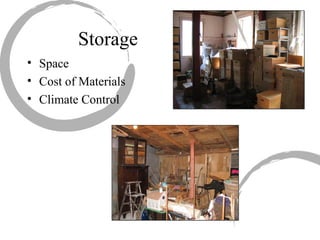
Storage Space  Cost of Materials Climate Control
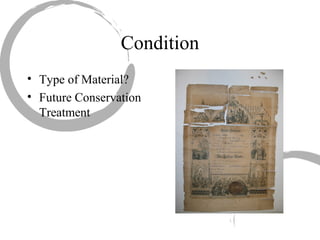
Condition Type of Material? Future Conservation Treatment
Accessioning Registration Methods Deed of Gift Loan Agreement Past Perfect Software Labeling
Deaccessioning AAM finds the decision of the NY State Board of Regents to permit museums to sell objects in their collections to cover operating costs disturbing, holding possibly severe ramifications for the museum field. Museums are all about public service, conserving their collections in the public trust. The potential to deaccession objects to raise operating funds is counter to the museum mission, while potentially eroding the trust and confidence of donors, patrons, financial backers and the public at large  th at trust is the coin of the realm for museums nationwide. Giving museums an  ou t clause of the generally accepted ethics and standards of the museum field in times of financial exigency is a bad precedent and sends the wrong message to the public about the role and values of museums. The idea of  ju st this one time is the beginning of a slippery slope. Since the first museum was founded on this continent in 1773, one axiom has always held true: the museum is there to preserve the collection; the collection is not there to preserve the museum. Museums have lived by this creed for more than 200 years, and contrary behavior affects the credibility of all museums and their integral role in our educational infrastructure
Website information American Association of Museums California Historical Society-CMP http://www.californiahistoricalsociety.org/collections/COLLEC~1.PDF
Storage and Housing Boxes Textile Storage Glass Plate Negatives Painting/Framed Object Storage
Pest Management Physical Space o Collections storage should be a dedicated space and separate from exhibition areas, food preparation and consumption areas, staff offices, and other work areas. o Collections storage should be located in an interior room of the building. o All access to the storage area should be through an interior door.  o Drop ceilings should be eliminated o Flooring materials should be made of easily cleaned material; ex: tile. o Artifacts should not be overcrowded.
Storage Equipment and Supplies o Storage equipment should elevated at least 6 �  to permit cleaning. o Cabinets should be properly placed and accessible for inspection and cleaning. o All cabinets should have floors o Cabinets should be white in color.  o All drawers in cabinets should be completely removable. o All storage and packing supplies should be stored outside of collection storage areas.
Building Maintenance o The building should be routinely inspected for problems such as roof leaks, condensation, and leaking pipes and faucets. Repairs should be made immediately o All doors should be inspected on a regular basis and repaired. o Cracks in walls, floors and ceilings should be filed.  o Collection storage areas should be kept clean and free of dust and clutter and vacuumed frequently. o All trash receptacles should be emptied frequently. o All cleaning supplies and equipment should be stored outside of collections storage.
Collections Storage Maintenance o Artifacts should be inspected thoroughly and determined to be pest-free before placement in storage. Pest Awareness and Monitoring o All staff should receive training in pest awareness.  o A pest monitoring program should be established.  o One person should be in charge to receive, report, and interpret pest monitoring data and to determine a response.  o All materials susceptible to pests should be inspected at least once a year.
Infestations o Infested material should be bagged and removed from storage areas. Pest should be eradicated by appropriate methods.
Web Resources- Collections Care Northeast Document Conservation Center http://www. nedcc .org/resources/leaflets.list. php http://www. nedcc .org/resources/suppliers. php http://www.preservation101.org/session5/index.asp Conserv O Grams- National Park Service http://www. nps . gov/history/museum/publications/conserveogram/cons_toc .html Council on Library and Information Resources http://www. clir .org/pubs/reports/reports.html Canadien Conservation Institute http://www. cci-icc . gc . ca/crc/notes/index-eng . aspx
Collections Care and Conservation Alliance Website: www.collectionscarealliance.wordpress.com Email: [email_address] Phone: 802.428.4188

Collections Care 101 Workshop 9/17/10

  • 1.
    COLLECTIONS MANAGEMENT POLICYSeptember 17, 2010 Whallonsburgh Grange Hall Collections Care and Conservation Alliance
  • 2.
    Agenda Defining CollectionDevelopment Collection Development Policy Collection Development Plan Collections and the organizations’s mission and purpose Selection criteria Responsibility for selection Client initiated collection issues Intellectual freedom Tools for Collection Development Knowing your Community Knowing your Needs Selection Aids
  • 3.
    Collection Development PolicyA collection development policy should provide an overall view of what your institution/organization will be collecting and the extent of the your collection. A Collection policy needs to be general enough to be useable but detailed enough to communicate the collections purpose to the public and guide purchasing.
  • 4.
    Who is yourinstitution/organization serving & who is selecting? What materials are selected? When are selection decisions made? Where will the material come from? Why are these materials selected? How can patrons be involved?
  • 5.
    Collections Policy OutlineIntroduction I. Mission Statement or Statement of Purpose II. Statement of Authority III. Collecting Plan IV. Definition of Collections a. Buildings and Sites b. Artifact Collection c. Research Library Collections d. Archeological Collections e. Archival Collections
  • 6.
    Outline Continued V.Collections Management Activity a. Documentation b. Acquisition of Objects c. Disposal- Deaccession of Objects d. Access e. Care and Maintenance f. Risk Management g. Security h. Inventory Controls i. Temporary Custody j. Lending and Borrowing VI. Monitoring and Revisiting the Collections Management Policy VII. Appendices
  • 7.
    Provenance Fit themission of your institution
  • 8.
    Storage Space Cost of Materials Climate Control
  • 9.
    Condition Type ofMaterial? Future Conservation Treatment
  • 10.
    Accessioning Registration MethodsDeed of Gift Loan Agreement Past Perfect Software Labeling
  • 11.
    Deaccessioning AAM findsthe decision of the NY State Board of Regents to permit museums to sell objects in their collections to cover operating costs disturbing, holding possibly severe ramifications for the museum field. Museums are all about public service, conserving their collections in the public trust. The potential to deaccession objects to raise operating funds is counter to the museum mission, while potentially eroding the trust and confidence of donors, patrons, financial backers and the public at large th at trust is the coin of the realm for museums nationwide. Giving museums an ou t clause of the generally accepted ethics and standards of the museum field in times of financial exigency is a bad precedent and sends the wrong message to the public about the role and values of museums. The idea of ju st this one time is the beginning of a slippery slope. Since the first museum was founded on this continent in 1773, one axiom has always held true: the museum is there to preserve the collection; the collection is not there to preserve the museum. Museums have lived by this creed for more than 200 years, and contrary behavior affects the credibility of all museums and their integral role in our educational infrastructure
  • 12.
    Website information AmericanAssociation of Museums California Historical Society-CMP http://www.californiahistoricalsociety.org/collections/COLLEC~1.PDF
  • 13.
    Storage and HousingBoxes Textile Storage Glass Plate Negatives Painting/Framed Object Storage
  • 14.
    Pest Management PhysicalSpace o Collections storage should be a dedicated space and separate from exhibition areas, food preparation and consumption areas, staff offices, and other work areas. o Collections storage should be located in an interior room of the building. o All access to the storage area should be through an interior door. o Drop ceilings should be eliminated o Flooring materials should be made of easily cleaned material; ex: tile. o Artifacts should not be overcrowded.
  • 15.
    Storage Equipment andSupplies o Storage equipment should elevated at least 6 � to permit cleaning. o Cabinets should be properly placed and accessible for inspection and cleaning. o All cabinets should have floors o Cabinets should be white in color. o All drawers in cabinets should be completely removable. o All storage and packing supplies should be stored outside of collection storage areas.
  • 16.
    Building Maintenance oThe building should be routinely inspected for problems such as roof leaks, condensation, and leaking pipes and faucets. Repairs should be made immediately o All doors should be inspected on a regular basis and repaired. o Cracks in walls, floors and ceilings should be filed. o Collection storage areas should be kept clean and free of dust and clutter and vacuumed frequently. o All trash receptacles should be emptied frequently. o All cleaning supplies and equipment should be stored outside of collections storage.
  • 17.
    Collections Storage Maintenanceo Artifacts should be inspected thoroughly and determined to be pest-free before placement in storage. Pest Awareness and Monitoring o All staff should receive training in pest awareness. o A pest monitoring program should be established. o One person should be in charge to receive, report, and interpret pest monitoring data and to determine a response. o All materials susceptible to pests should be inspected at least once a year.
  • 18.
    Infestations o Infestedmaterial should be bagged and removed from storage areas. Pest should be eradicated by appropriate methods.
  • 19.
    Web Resources- CollectionsCare Northeast Document Conservation Center http://www. nedcc .org/resources/leaflets.list. php http://www. nedcc .org/resources/suppliers. php http://www.preservation101.org/session5/index.asp Conserv O Grams- National Park Service http://www. nps . gov/history/museum/publications/conserveogram/cons_toc .html Council on Library and Information Resources http://www. clir .org/pubs/reports/reports.html Canadien Conservation Institute http://www. cci-icc . gc . ca/crc/notes/index-eng . aspx
  • 20.
    Collections Care andConservation Alliance Website: www.collectionscarealliance.wordpress.com Email: [email_address] Phone: 802.428.4188