
by Fe Angela M. Verzosa   De La Salle University Establishing a Collection Management Program
Collection Management is…  facing a crisis   *price increases *diminished resources   *abundance of materials    and published information
    academic budgets pay increasing homage to serials to the    neglect of book  purchases . Collection Management is…  facing a crisis
traditional concept of ownership is challenged by the idea of access (whether  automated access to information or to information resources through document delivery or interlibrary lending) in lieu of ownership. Collection Management is…  facing a crisis
Collection Management is…  facing a crisis   emphasis is on intellectual content , rather than the traditional format
electronic access to online databases is now the reality.  Students and faculty are gaining access to a multitude of library catalogs worldwide.  More capital funds are being rechannelled to buy computer equipment, licenses and access fees. Collection Management is…  facing a crisis
Interest in resource-sharing,   collaborative purchasing,   and cooperative collection   has replaced the   competitive   instinct  of   librarians. Collection Management is…  facing a crisis
multimedia (interactive videos) and cd-rom technology are becoming more and more attractive than prints, because they present a better alternative to reading and information retrieval.  Collection Management is…  facing a crisis
developing core collections rather than comprehensive holdings will dominate collection policies. Collection Management is…  facing a crisis
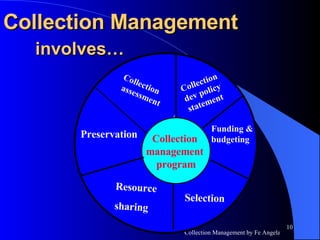
Collection Management  involves… Collection  management  program Collection dev policy statement Collection assessment Funding & budgeting Selection Preservation Resource  sharing
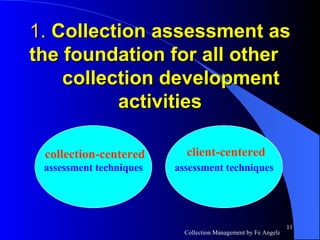
1 .  Collection assessment as the foundation for all other    collection development activities assessment techniques assessment techniques collection-centered client-centered
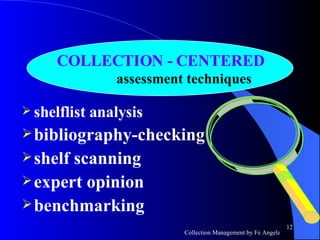
shelflist analysis bibliography-checking shelf scanning expert opinion benchmarking COLLECTION - CENTERED assessment techniques
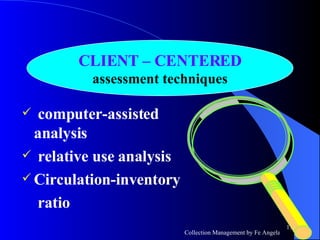
computer-assisted  analysis relative use analysis Circulation-inventory ratio CLIENT – CENTERED assessment techniques
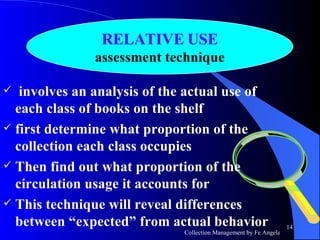
involves an analysis of the actual use of each class of books on the shelf first determine what proportion of the collection each class occupies Then find out what proportion of the circulation usage it accounts for This technique will reveal differences between “expected” from actual behavior RELATIVE USE assessment technique
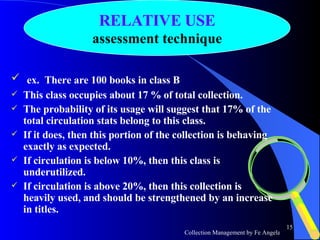
ex.  There are 100 books in class B This class occupies about 17 % of total collection. The probability of its usage will suggest that 17% of the total circulation stats belong to this class. If it does, then this portion of the collection is behaving exactly as expected.  If circulation is below 10%, then this class is underutilized. If circulation is above 20%, then this collection is heavily used, and should be strengthened by an increase in titles.  RELATIVE USE assessment technique
is the simplest approach in determining discrepancy between holdings and circulation usage. The turn-over rate is the no. of times the books in a given class are borrowed divided by the no. of books in the class. Circulation-Inventory Ratio assessment technique
If there are 100 books on Philosophy,  and for a period of six months, the total circulation figure for this class is 1000, then the formula is:  Circulation  =  1000   Turn-over is inventory  =  100  10 per book This suggests that every book is used at least ten times within six months.  But this is not the exact or accurate assessment. Circulation-Inventory Ratio assessment technique
2.  Documenting   Collection policies outline institutional goals determine who are responsible for materials  selection  identify tools for selection Define criteria for selection Define scope of particular   collections  and collecting levels
Institutional goals Support instructional, curricular, and research needs of the faculty Support informational, classroom, and general reading interests of the students Fast delivery of information resources Facilitate access into other research collections Support extension programs of the university
Formulating short and long –term plans for coldev program Revision of collection policies Conducting assessment studies on profile & quality of the collection Searching, selecting, and assessing standard tools Dissemination of information on new materials to clientele Recommending titles for acquisition / subscription Evaluating, selecting, and de-selecting book/serial donations Coordinating with faculty on deselection of holdings Collection development librarian is responsible for ….
Tools for selection ALA’s Books for College Libraries ALA’s Guide to Reference Books  Katz’s Magazines for Libraries ACRL’s Choice Bowker’s Global Books in Print Ulrich’s Plus Bibliofile – cataloged books in the Library of Congress
Criteria for selection Anticipated or actual usage Accuracy Reputation and authoritativeness Timeliness of the publication Strength of present holdings in the subject area or discipline Literary quality Level of treatment Contribution to the field of knowledge Availability
Collecting levels Level 1– Minimal/basic reference  Level 2– Selective  Level 3– Undergraduate  Teaching  Level 4 – Comprehensive or Beginning research  Level 5 – Exhaustive
MODEL COLLECTION POLICY Statement of purpose of institution/collection Types of programs supported by collection Clientele served by the collection Priorities and limitations of the collection Cooperative agreements affecting this policy Resource-sharing policy Deaccessioning policy Procedures enforcing the collecting policy
Priorities/Limitations of the Collection Identified strengths Collecting level Identified weaknesses Desired level of collection to meet program needs Geographical areas collected Chronological periods collected Subject areas collected Languages, other than English, collected Exclusions
3.  Financial Considerations matching funds with needs setting limits on spending monitoring expenditures
4.  Selection/deselection the point of no return the decision-making process that implements collection goals articulated in the policy
5.  Resource-sharing the goal of many consortia is cooperative collection development. by knowing their strengths/weaknesses, they could take advantage of the strengths and work together to cover the weaknesses.
BARRIERS TO COOPERATION COMPETITIVENESS (RANKINGS) AUTONOMY (SELF-RELIANCE) OWNERSHIP PARADIGM
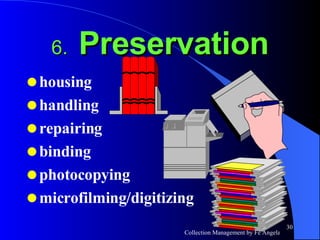
6.  Preservation housing handling repairing binding photocopying microfilming/digitizing
thank you and have a nice day!

Establishing a Collection Management Program

  • 1.
    by Fe AngelaM. Verzosa De La Salle University Establishing a Collection Management Program
  • 2.
    Collection Management is… facing a crisis *price increases *diminished resources *abundance of materials and published information
  • 3.
    academic budgets pay increasing homage to serials to the neglect of book purchases . Collection Management is… facing a crisis
  • 4.
    traditional concept ofownership is challenged by the idea of access (whether automated access to information or to information resources through document delivery or interlibrary lending) in lieu of ownership. Collection Management is… facing a crisis
  • 5.
    Collection Management is… facing a crisis emphasis is on intellectual content , rather than the traditional format
  • 6.
    electronic access toonline databases is now the reality. Students and faculty are gaining access to a multitude of library catalogs worldwide. More capital funds are being rechannelled to buy computer equipment, licenses and access fees. Collection Management is… facing a crisis
  • 7.
    Interest in resource-sharing, collaborative purchasing, and cooperative collection has replaced the competitive instinct of librarians. Collection Management is… facing a crisis
  • 8.
    multimedia (interactive videos)and cd-rom technology are becoming more and more attractive than prints, because they present a better alternative to reading and information retrieval. Collection Management is… facing a crisis
  • 9.
    developing core collectionsrather than comprehensive holdings will dominate collection policies. Collection Management is… facing a crisis
  • 10.
    Collection Management involves… Collection management program Collection dev policy statement Collection assessment Funding & budgeting Selection Preservation Resource sharing
  • 11.
    1 . Collection assessment as the foundation for all other collection development activities assessment techniques assessment techniques collection-centered client-centered
  • 12.
    shelflist analysis bibliography-checkingshelf scanning expert opinion benchmarking COLLECTION - CENTERED assessment techniques
  • 13.
    computer-assisted analysisrelative use analysis Circulation-inventory ratio CLIENT – CENTERED assessment techniques
  • 14.
    involves an analysisof the actual use of each class of books on the shelf first determine what proportion of the collection each class occupies Then find out what proportion of the circulation usage it accounts for This technique will reveal differences between “expected” from actual behavior RELATIVE USE assessment technique
  • 15.
    ex. Thereare 100 books in class B This class occupies about 17 % of total collection. The probability of its usage will suggest that 17% of the total circulation stats belong to this class. If it does, then this portion of the collection is behaving exactly as expected. If circulation is below 10%, then this class is underutilized. If circulation is above 20%, then this collection is heavily used, and should be strengthened by an increase in titles. RELATIVE USE assessment technique
  • 16.
    is the simplestapproach in determining discrepancy between holdings and circulation usage. The turn-over rate is the no. of times the books in a given class are borrowed divided by the no. of books in the class. Circulation-Inventory Ratio assessment technique
  • 17.
    If there are100 books on Philosophy, and for a period of six months, the total circulation figure for this class is 1000, then the formula is: Circulation = 1000 Turn-over is inventory = 100 10 per book This suggests that every book is used at least ten times within six months. But this is not the exact or accurate assessment. Circulation-Inventory Ratio assessment technique
  • 18.
    2. Documenting Collection policies outline institutional goals determine who are responsible for materials selection identify tools for selection Define criteria for selection Define scope of particular collections and collecting levels
  • 19.
    Institutional goals Supportinstructional, curricular, and research needs of the faculty Support informational, classroom, and general reading interests of the students Fast delivery of information resources Facilitate access into other research collections Support extension programs of the university
  • 20.
    Formulating short andlong –term plans for coldev program Revision of collection policies Conducting assessment studies on profile & quality of the collection Searching, selecting, and assessing standard tools Dissemination of information on new materials to clientele Recommending titles for acquisition / subscription Evaluating, selecting, and de-selecting book/serial donations Coordinating with faculty on deselection of holdings Collection development librarian is responsible for ….
  • 21.
    Tools for selectionALA’s Books for College Libraries ALA’s Guide to Reference Books Katz’s Magazines for Libraries ACRL’s Choice Bowker’s Global Books in Print Ulrich’s Plus Bibliofile – cataloged books in the Library of Congress
  • 22.
    Criteria for selectionAnticipated or actual usage Accuracy Reputation and authoritativeness Timeliness of the publication Strength of present holdings in the subject area or discipline Literary quality Level of treatment Contribution to the field of knowledge Availability
  • 23.
    Collecting levels Level1– Minimal/basic reference Level 2– Selective Level 3– Undergraduate Teaching Level 4 – Comprehensive or Beginning research Level 5 – Exhaustive
  • 24.
    MODEL COLLECTION POLICYStatement of purpose of institution/collection Types of programs supported by collection Clientele served by the collection Priorities and limitations of the collection Cooperative agreements affecting this policy Resource-sharing policy Deaccessioning policy Procedures enforcing the collecting policy
  • 25.
    Priorities/Limitations of theCollection Identified strengths Collecting level Identified weaknesses Desired level of collection to meet program needs Geographical areas collected Chronological periods collected Subject areas collected Languages, other than English, collected Exclusions
  • 26.
    3. FinancialConsiderations matching funds with needs setting limits on spending monitoring expenditures
  • 27.
    4. Selection/deselectionthe point of no return the decision-making process that implements collection goals articulated in the policy
  • 28.
    5. Resource-sharingthe goal of many consortia is cooperative collection development. by knowing their strengths/weaknesses, they could take advantage of the strengths and work together to cover the weaknesses.
  • 29.
    BARRIERS TO COOPERATIONCOMPETITIVENESS (RANKINGS) AUTONOMY (SELF-RELIANCE) OWNERSHIP PARADIGM
  • 30.
    6. Preservationhousing handling repairing binding photocopying microfilming/digitizing
  • 31.
    thank you andhave a nice day!