Page 1 of 17
Nairobi, Kenya
30th
May 2015
Ipsos’ 1st
Quarter SPEC (Social, Political,
Economic and Cultural) Survey:
9th Media Release:
Election and Political Issues
This summary is based on results from Ipsos’ 1st
Quarter SPEC survey of 2015 that
was conducted between March 28 and April 7. It is the 9th
such release. Given that
the tragic attack on Garissa University College occurred on April 2, about 25% of the
interviews took place after that date. However, in comparing the results obtained
before and after April 2, their distribution was clearly affected more on some issues
than others, or not at all. For example, the proportion of those perceiving al-
Shabaab as “very much a threat” after April 2 was 14% higher than before that date.
By contrast the results presented here (on issues unrelated to security, presidential
approval, etc.) were not affected by that tragic attack.
Highlights:
 About three-quarters of all Kenyans know the currently-set date of the next
election (August, 2017), but nearly two-thirds support it being pushed back (to
December, 2017). Further, there is no contrast between Jubilee and CORD
supporters on this issue.
 Only one-fifth of Kenyans are aware of any voter registration that has been
conducted in their locality since the last election.
 Fewer than half believe that the public has sufficient confidence in the IEBC to
manage the next election without major reforms, though a clear contrast
between Jubilee and CORD supporters is evident here, with nearly three
times as many of the former satisfied with the IEBC as is presently
constituted.
 Kenyans remain very divided over the continuation vs. termination of the
remaining ICC case involving Deputy President William Ruto and radio
journalist Joshua arap Sang, though somewhat more prefer its termination.
 They are similarly divided over the likelihood that DP Ruto will be convicted
and, if he is, whether any violence would erupt.
 There is somewhat more support for the establishment of an African Human
Rights Court than for Kenya’s withdrawal from the ICC, but in both cases, a
stark contrast between Jubilee and CORD supporters over these two issues,
that also takes a clear regional dime
Page 2 of 17
 More than four-in-five are aware of at least one prominent person who has
died mysteriously in the recent past, and nearly three-quarters want the
causes of such deaths to be made public.
 Jubilee and its affiliate political parties remain more popular than do CORD
and its affiliated parties.
 Kenyans remain divided over their preferred option for Raila Odinga’s political
future, though since November, 2014, the proportion who want him to contest
the next election has increased (nearly equal to the figures obtained in 5
earlier surveys beginning with that in June, 2013). About fve times as many
CORD as Jubilee supporters prefer this option, however.
 About three times as many of those who do not feel the IEBC has sufficient
public confidence to manage the next elections prefer this “he should contest”
option.
Election Issues
Last year a substantial number of MPs proposed that the date of the next election be
moved from August to December, 2017. Yet due to the fact that this date is set by
the constitution, robust (two-thirds) majorities in both the National Assembly and the
Senate would be required to change it, doing this will require strong support from
both Jubilee and CORD Members. Initially, most support for this change came from
the CORD side, described by commentators as a strategy to ensure that the most
senior members of the current election commission (IEBC) in whom CORD has less
than full confidence will have vacated office, as their terms expire in November of
that year. In response, the Jubilee leadership threatened to bring a bill extending
their terms of office for six months so that in the event the date is pushed back, the
current IEBC team – rather than another one having been in place for just a few
weeks – would have this major responsibility.
(In addition, since the last election was held in 2013, some are claiming the next one
should not be held until 2018, but this position so far does not appear to have
received significant backing, at least in terms of constitutional interpretation, given
that the original date for the first election under the new constitution was supposed to
be August, 2012, and was only moved back by a High Court decision.)
While ‘final’ positions on this issue are still unclear, it was considered useful to
explore several issues related to the 2017 election date in this survey.
Knowledge of the Next Election Date
The first question relating to election issues sought to determine how many Kenyans
are aware of the date of the next general election, and the extent to which such
Page 3 of 17
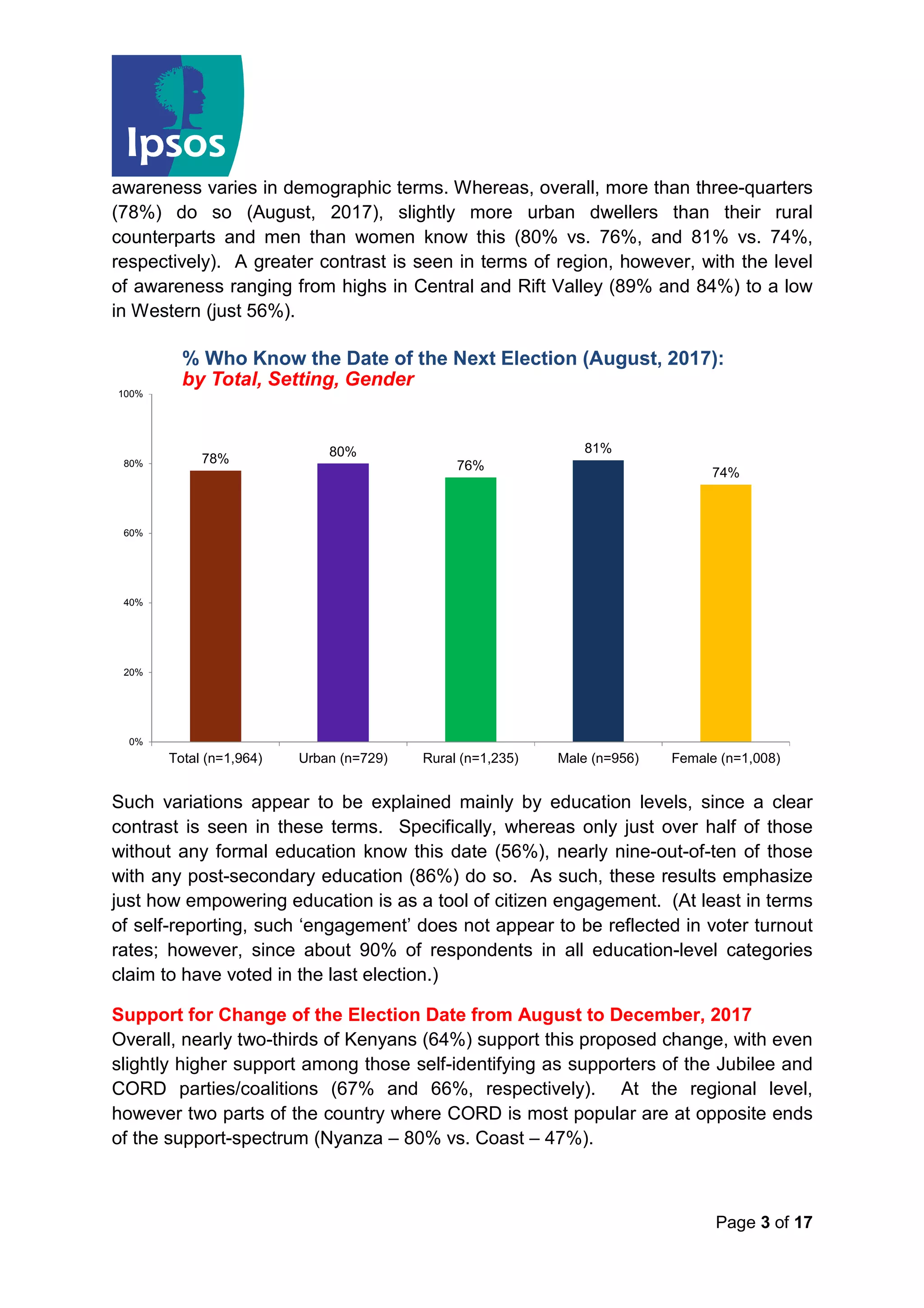
awareness varies in demographic terms. Whereas, overall, more than three-quarters
(78%) do so (August, 2017), slightly more urban dwellers than their rural
counterparts and men than women know this (80% vs. 76%, and 81% vs. 74%,
respectively). A greater contrast is seen in terms of region, however, with the level
of awareness ranging from highs in Central and Rift Valley (89% and 84%) to a low
in Western (just 56%).
Such variations appear to be explained mainly by education levels, since a clear
contrast is seen in these terms. Specifically, whereas only just over half of those
without any formal education know this date (56%), nearly nine-out-of-ten of those
with any post-secondary education (86%) do so. As such, these results emphasize
just how empowering education is as a tool of citizen engagement. (At least in terms
of self-reporting, such ‘engagement’ does not appear to be reflected in voter turnout
rates; however, since about 90% of respondents in all education-level categories
claim to have voted in the last election.)
Support for Change of the Election Date from August to December, 2017
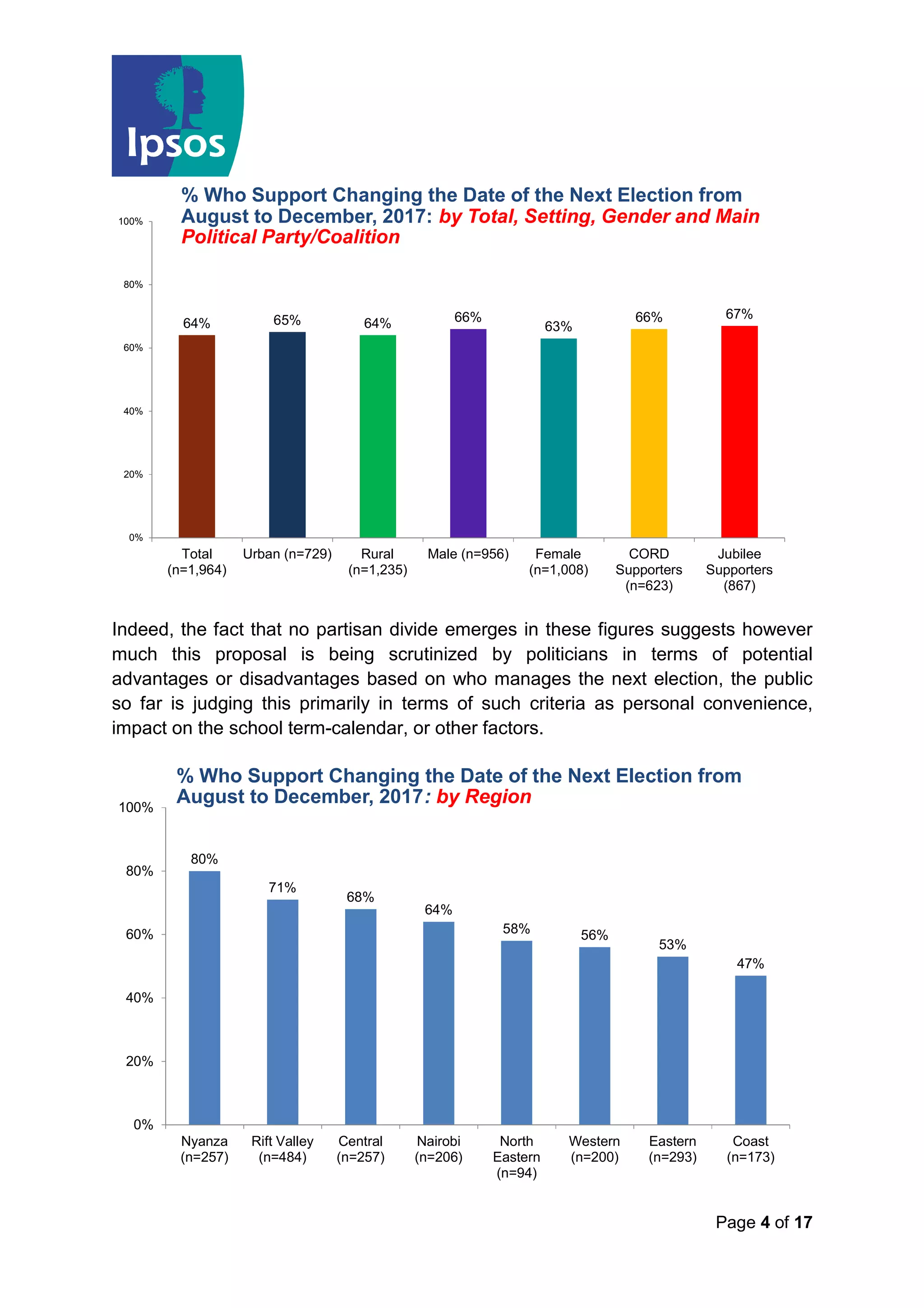
Overall, nearly two-thirds of Kenyans (64%) support this proposed change, with even
slightly higher support among those self-identifying as supporters of the Jubilee and
CORD parties/coalitions (67% and 66%, respectively). At the regional level,
however two parts of the country where CORD is most popular are at opposite ends
of the support-spectrum (Nyanza – 80% vs. Coast – 47%).
% Who Know the Date of the Next Election (August, 2017):
by Total, Setting, Gender
78%
80%
76%
81%
74%
0%
20%
40%
60%
80%
100%
Total (n=1,964) Urban (n=729) Rural (n=1,235) Male (n=956) Female (n=1,008)
Page 4 of 17
Indeed, the fact that no partisan divide emerges in these figures suggests however
much this proposal is being scrutinized by politicians in terms of potential
advantages or disadvantages based on who manages the next election, the public
so far is judging this primarily in terms of such criteria as personal convenience,
impact on the school term-calendar, or other factors.
% Who Support Changing the Date of the Next Election from
August to December, 2017: by Total, Setting, Gender and Main
Political Party/Coalition
64% 65% 64% 66%
63%
66% 67%
0%
20%
40%
60%
80%
100%
Total
(n=1,964)
Urban (n=729) Rural
(n=1,235)
Male (n=956) Female
(n=1,008)
CORD
Supporters
(n=623)
Jubilee
Supporters
(867)
% Who Support Changing the Date of the Next Election from
August to December, 2017: by Region
80%
71%
68%
64%
58% 56%
53%
47%
0%
20%
40%
60%
80%
100%
Nyanza
(n=257)
Rift Valley
(n=484)
Central
(n=257)
Nairobi
(n=206)
North
Eastern
(n=94)
Western
(n=200)
Eastern
(n=293)
Coast
(n=173)
Page 5 of 17
Awareness of Voter Registration Since the Last Election
Even without the counting coming-of-age of 18 year-olds, only about two-thirds of
eligible Kenyans were registered before the March, 2013 election. As such, the
IEBC – in accordance with its constitutional responsibility to undertake continuous
voter-registration – has made some effort in this regard over the last two years.
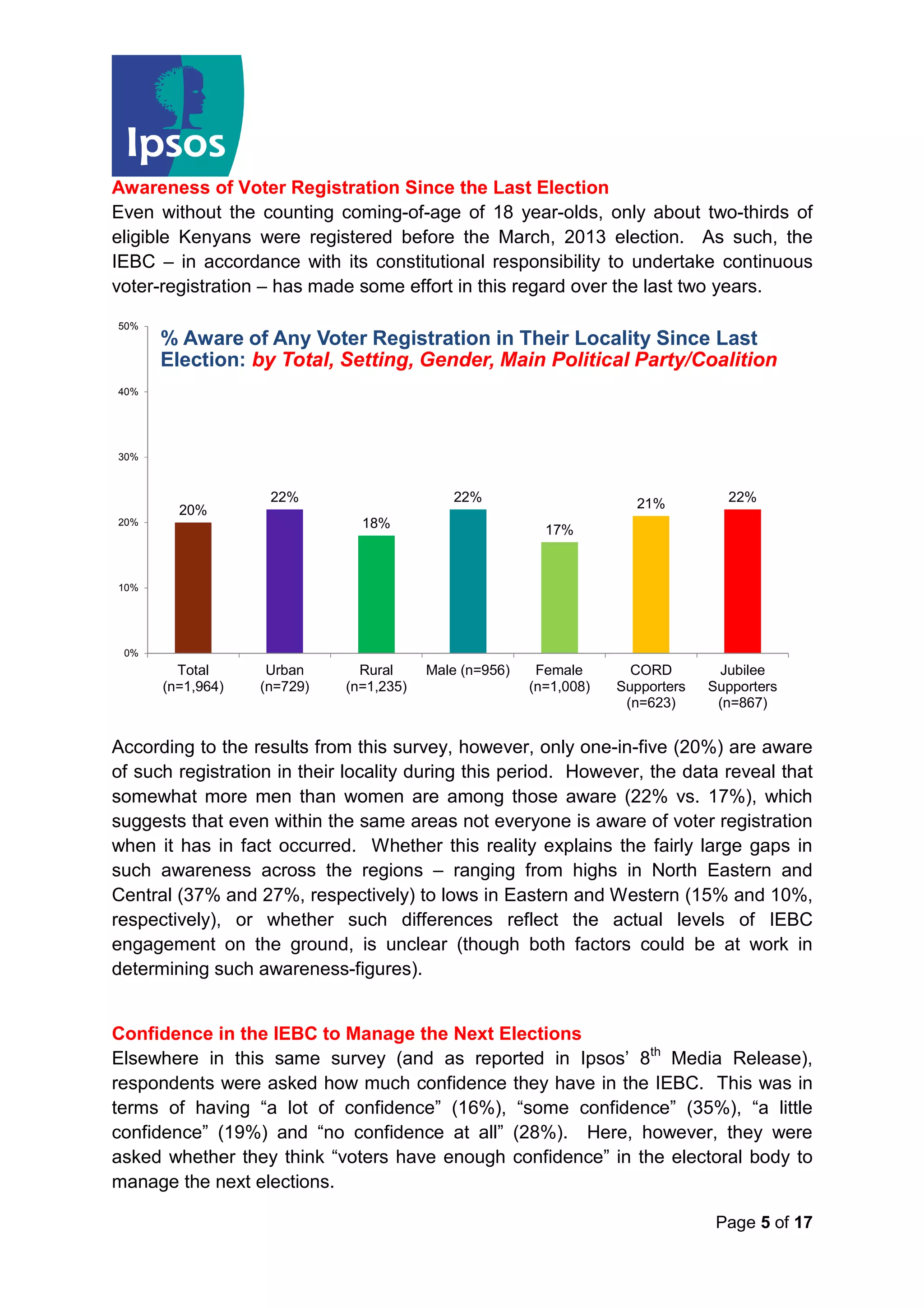
According to the results from this survey, however, only one-in-five (20%) are aware
of such registration in their locality during this period. However, the data reveal that
somewhat more men than women are among those aware (22% vs. 17%), which
suggests that even within the same areas not everyone is aware of voter registration
when it has in fact occurred. Whether this reality explains the fairly large gaps in
such awareness across the regions – ranging from highs in North Eastern and
Central (37% and 27%, respectively) to lows in Eastern and Western (15% and 10%,
respectively), or whether such differences reflect the actual levels of IEBC
engagement on the ground, is unclear (though both factors could be at work in
determining such awareness-figures).
Confidence in the IEBC to Manage the Next Elections
Elsewhere in this same survey (and as reported in Ipsos’ 8th
Media Release),
respondents were asked how much confidence they have in the IEBC. This was in
terms of having “a lot of confidence” (16%), “some confidence” (35%), “a little
confidence” (19%) and “no confidence at all” (28%). Here, however, they were
asked whether they think “voters have enough confidence” in the electoral body to
manage the next elections.
20%
22%
18%
22%
17%
21% 22%
0%
10%
20%
30%
40%
50%
Total
(n=1,964)
Urban
(n=729)
Rural
(n=1,235)
Male (n=956) Female
(n=1,008)
CORD
Supporters
(n=623)
Jubilee
Supporters
(n=867)
% Aware of Any Voter Registration in Their Locality Since Last
Election: by Total, Setting, Gender, Main Political Party/Coalition
Page 6 of 17
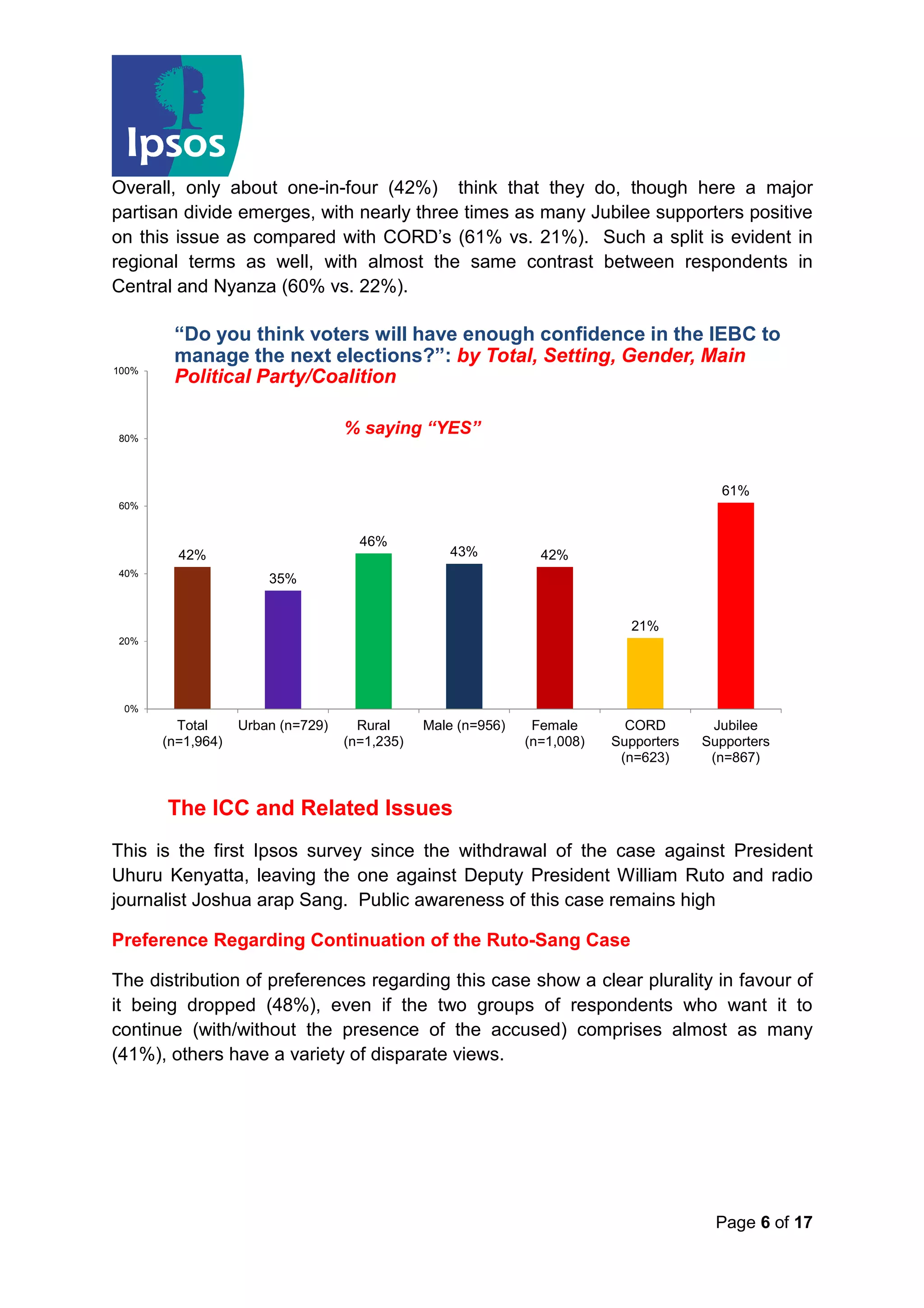
Overall, only about one-in-four (42%) think that they do, though here a major
partisan divide emerges, with nearly three times as many Jubilee supporters positive
on this issue as compared with CORD’s (61% vs. 21%). Such a split is evident in
regional terms as well, with almost the same contrast between respondents in
Central and Nyanza (60% vs. 22%).
The ICC and Related Issues
This is the first Ipsos survey since the withdrawal of the case against President
Uhuru Kenyatta, leaving the one against Deputy President William Ruto and radio
journalist Joshua arap Sang. Public awareness of this case remains high
Preference Regarding Continuation of the Ruto-Sang Case
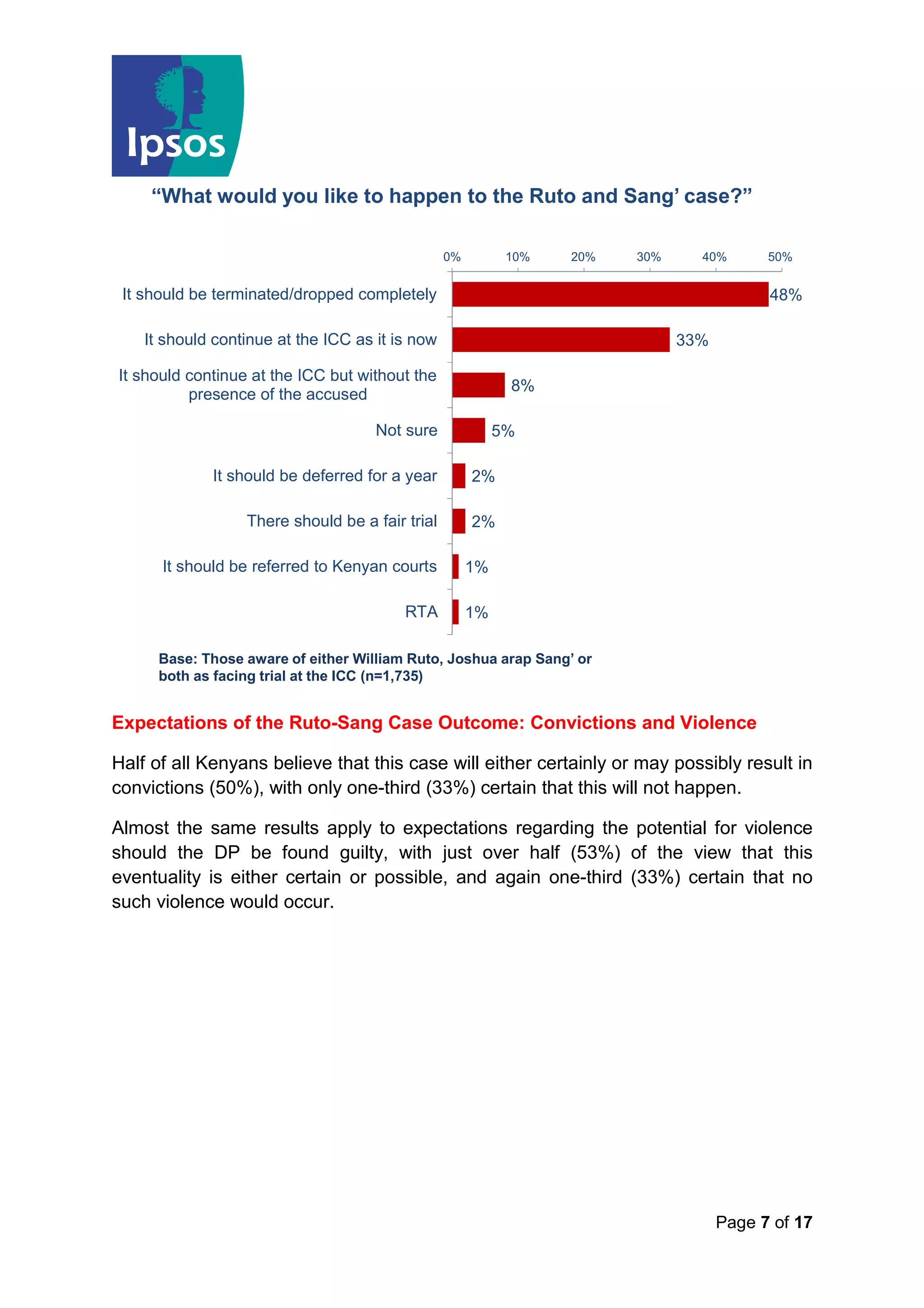
The distribution of preferences regarding this case show a clear plurality in favour of
it being dropped (48%), even if the two groups of respondents who want it to
continue (with/without the presence of the accused) comprises almost as many
(41%), others have a variety of disparate views.
“Do you think voters will have enough confidence in the IEBC to
manage the next elections?”: by Total, Setting, Gender, Main
Political Party/Coalition
42%
35%
46%
43% 42%
21%
61%
0%
20%
40%
60%
80%
100%
Total
(n=1,964)
Urban (n=729) Rural
(n=1,235)
Male (n=956) Female
(n=1,008)
CORD
Supporters
(n=623)
Jubilee
Supporters
(n=867)
% saying “YES”
Page 7 of 17
Expectations of the Ruto-Sang Case Outcome: Convictions and Violence
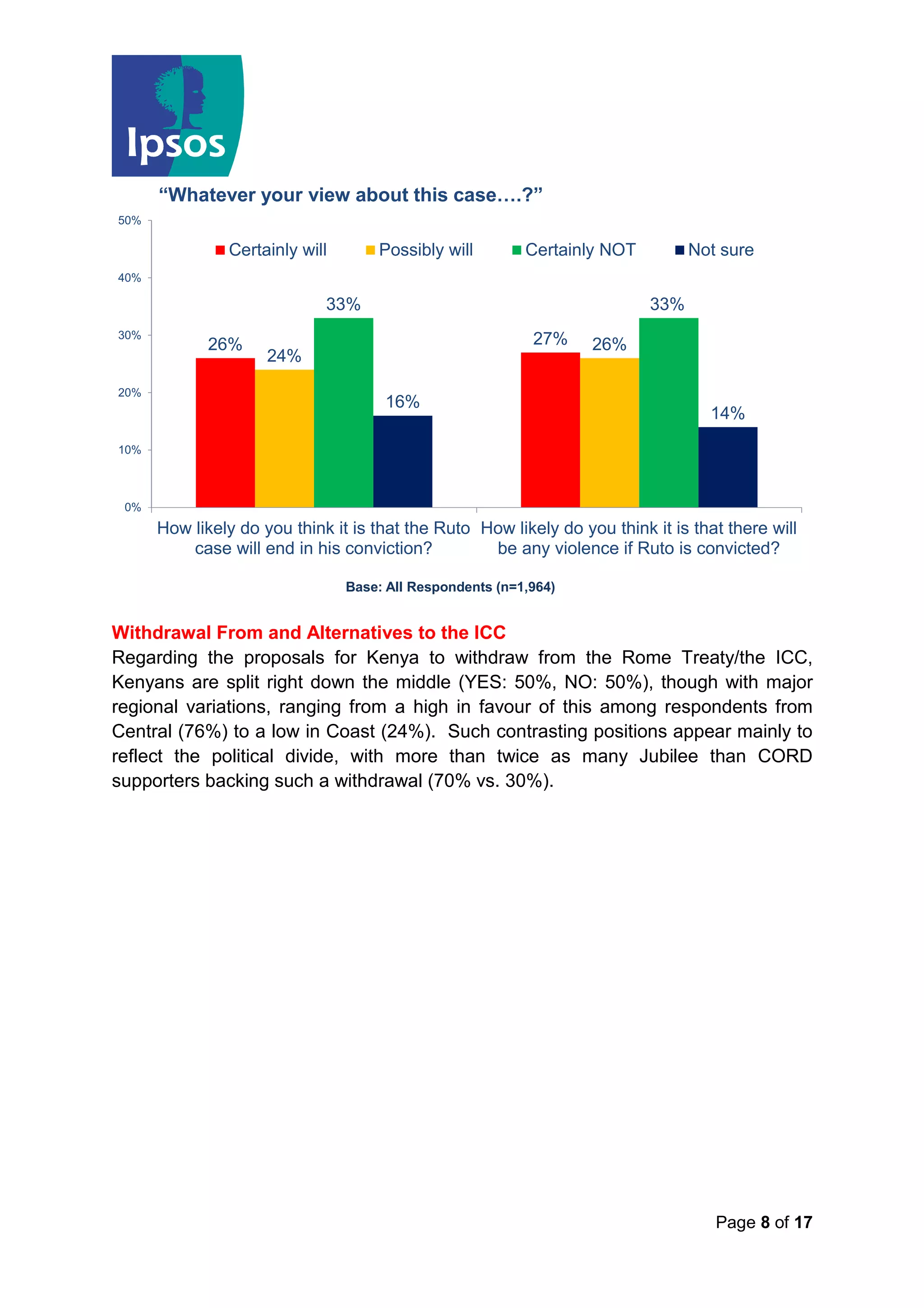
Half of all Kenyans believe that this case will either certainly or may possibly result in
convictions (50%), with only one-third (33%) certain that this will not happen.
Almost the same results apply to expectations regarding the potential for violence
should the DP be found guilty, with just over half (53%) of the view that this
eventuality is either certain or possible, and again one-third (33%) certain that no
such violence would occur.
“What would you like to happen to the Ruto and Sang’ case?”
48%
33%
8%
5%
2%
2%
1%
1%
0% 10% 20% 30% 40% 50%
It should be terminated/dropped completely
It should continue at the ICC as it is now
It should continue at the ICC but without the
presence of the accused
Not sure
It should be deferred for a year
There should be a fair trial
It should be referred to Kenyan courts
RTA
Base: Those aware of either William Ruto, Joshua arap Sang’ or
both as facing trial at the ICC (n=1,735)
Page 8 of 17
Withdrawal From and Alternatives to the ICC
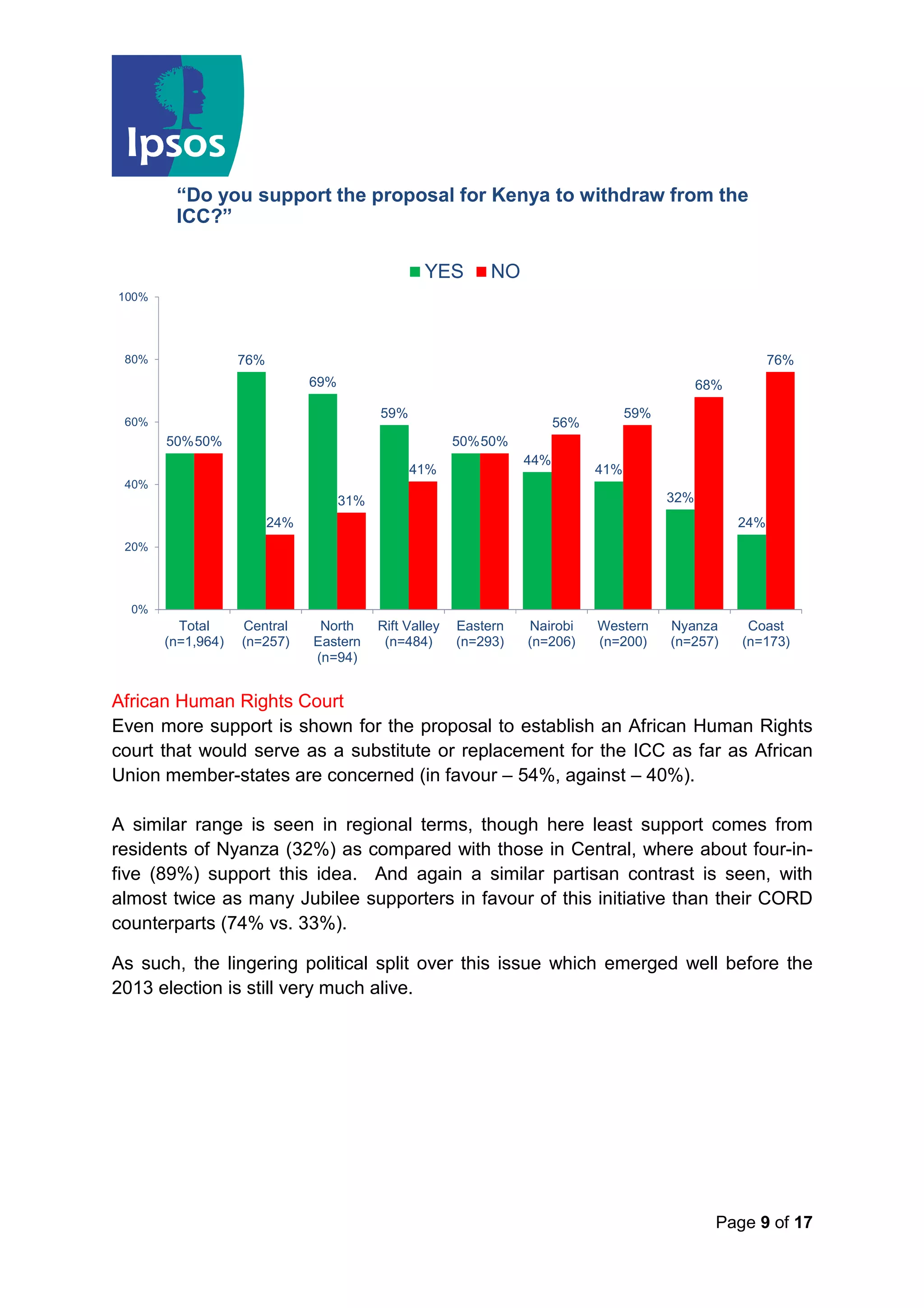
Regarding the proposals for Kenya to withdraw from the Rome Treaty/the ICC,
Kenyans are split right down the middle (YES: 50%, NO: 50%), though with major
regional variations, ranging from a high in favour of this among respondents from
Central (76%) to a low in Coast (24%). Such contrasting positions appear mainly to
reflect the political divide, with more than twice as many Jubilee than CORD
supporters backing such a withdrawal (70% vs. 30%).
26% 27%
24%
26%
33% 33%
16%
14%
0%
10%
20%
30%
40%
50%
How likely do you think it is that the Ruto
case will end in his conviction?
How likely do you think it is that there will
be any violence if Ruto is convicted?
Certainly will Possibly will Certainly NOT Not sure
“Whatever your view about this case….?”
Base: All Respondents (n=1,964)
Page 9 of 17
African Human Rights Court
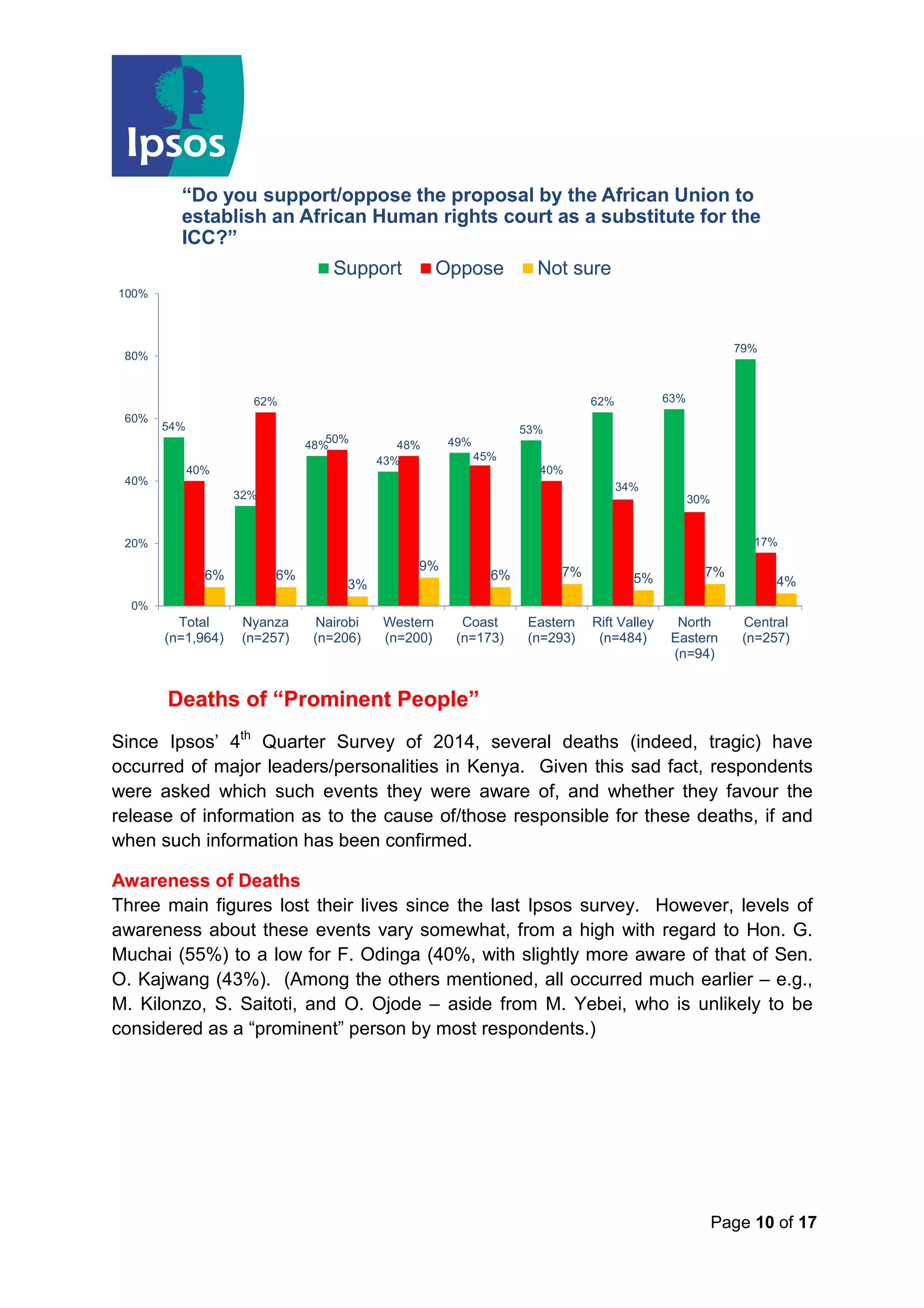
Even more support is shown for the proposal to establish an African Human Rights
court that would serve as a substitute or replacement for the ICC as far as African
Union member-states are concerned (in favour – 54%, against – 40%).
A similar range is seen in regional terms, though here least support comes from
residents of Nyanza (32%) as compared with those in Central, where about four-in-
five (89%) support this idea. And again a similar partisan contrast is seen, with
almost twice as many Jubilee supporters in favour of this initiative than their CORD
counterparts (74% vs. 33%).
As such, the lingering political split over this issue which emerged well before the
2013 election is still very much alive.
“Do you support the proposal for Kenya to withdraw from the
ICC?”
50%
76%
69%
59%
50%
44%
41%
32%
24%
50%
24%
31%
41%
50%
56%
59%
68%
76%
0%
20%
40%
60%
80%
100%
Total
(n=1,964)
Central
(n=257)
North
Eastern
(n=94)
Rift Valley
(n=484)
Eastern
(n=293)
Nairobi
(n=206)
Western
(n=200)
Nyanza
(n=257)
Coast
(n=173)
YES NO
Page 10 of 17
Deaths of “Prominent People”
Since Ipsos’ 4th
Quarter Survey of 2014, several deaths (indeed, tragic) have
occurred of major leaders/personalities in Kenya. Given this sad fact, respondents
were asked which such events they were aware of, and whether they favour the
release of information as to the cause of/those responsible for these deaths, if and
when such information has been confirmed.
Awareness of Deaths
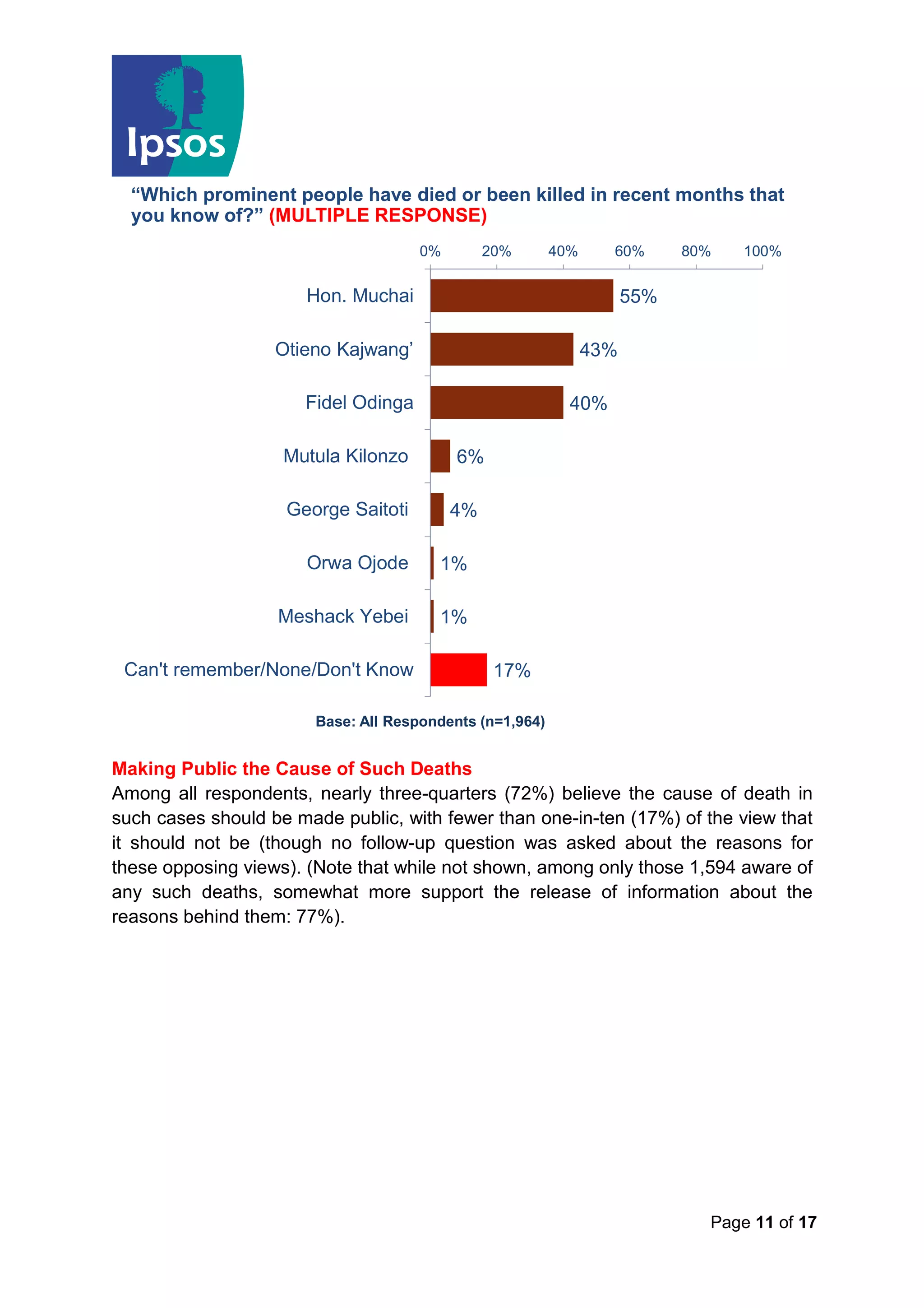
Three main figures lost their lives since the last Ipsos survey. However, levels of
awareness about these events vary somewhat, from a high with regard to Hon. G.
Muchai (55%) to a low for F. Odinga (40%, with slightly more aware of that of Sen.
O. Kajwang (43%). (Among the others mentioned, all occurred much earlier – e.g.,
M. Kilonzo, S. Saitoti, and O. Ojode – aside from M. Yebei, who is unlikely to be
considered as a “prominent” person by most respondents.)
“Do you support/oppose the proposal by the African Union to
establish an African Human rights court as a substitute for the
ICC?”
54%
32%
48%
43%
49%
53%
62% 63%
79%
40%
62%
50%
48%
45%
40%
34%
30%
17%
6% 6%
3%
9%
6% 7% 5% 7%
4%
0%
20%
40%
60%
80%
100%
Total
(n=1,964)
Nyanza
(n=257)
Nairobi
(n=206)
Western
(n=200)
Coast
(n=173)
Eastern
(n=293)
Rift Valley
(n=484)
North
Eastern
(n=94)
Central
(n=257)
Support Oppose Not sure
Page 11 of 17
Making Public the Cause of Such Deaths
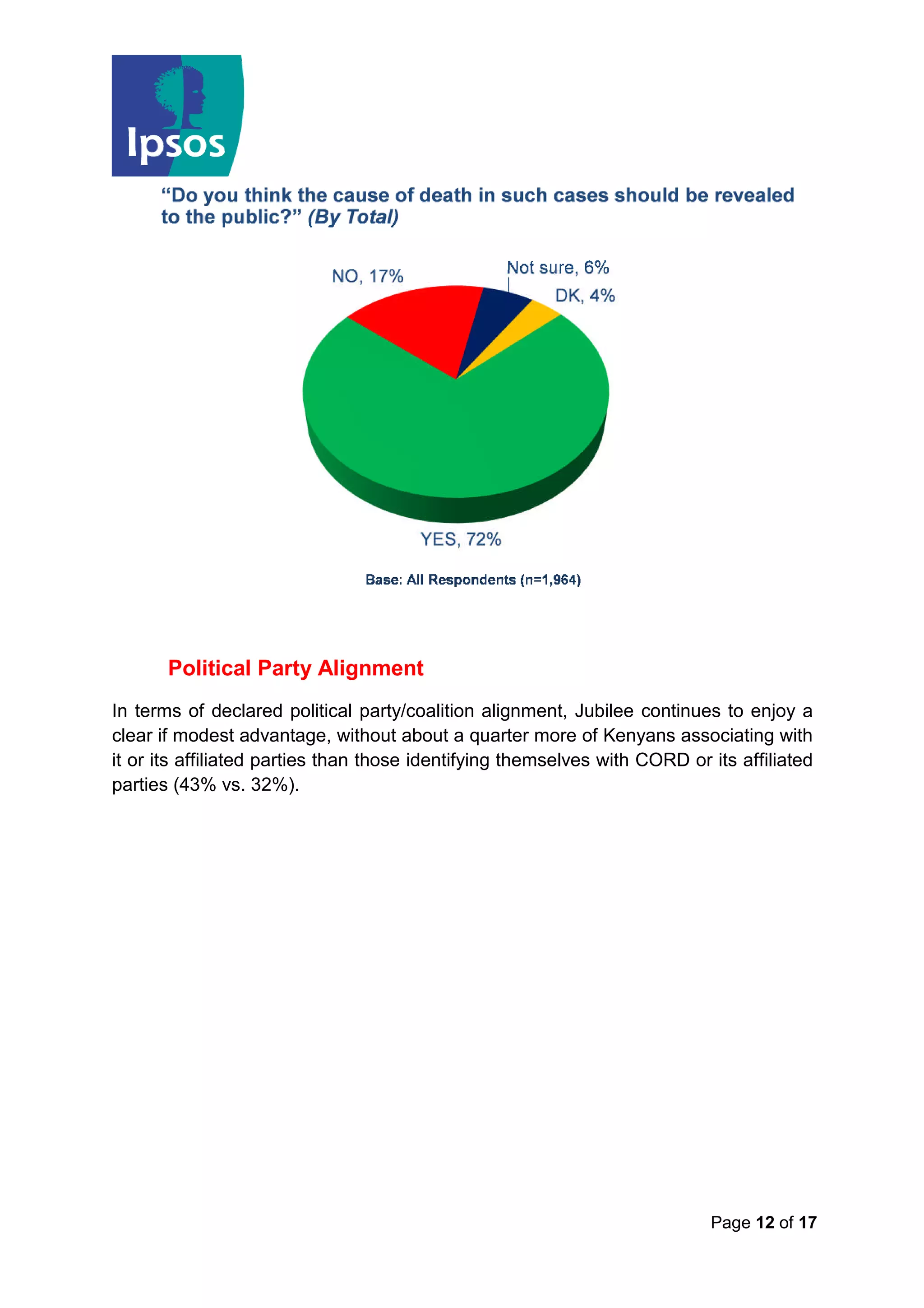
Among all respondents, nearly three-quarters (72%) believe the cause of death in
such cases should be made public, with fewer than one-in-ten (17%) of the view that
it should not be (though no follow-up question was asked about the reasons for
these opposing views). (Note that while not shown, among only those 1,594 aware of
any such deaths, somewhat more support the release of information about the
reasons behind them: 77%).
“Which prominent people have died or been killed in recent months that
you know of?” (MULTIPLE RESPONSE)
55%
43%
40%
6%
4%
1%
1%
17%
0% 20% 40% 60% 80% 100%
Hon. Muchai
Otieno Kajwang’
Fidel Odinga
Mutula Kilonzo
George Saitoti
Orwa Ojode
Meshack Yebei
Can't remember/None/Don't Know
Base: All Respondents (n=1,964)
Page 12 of 17
Political Party Alignment
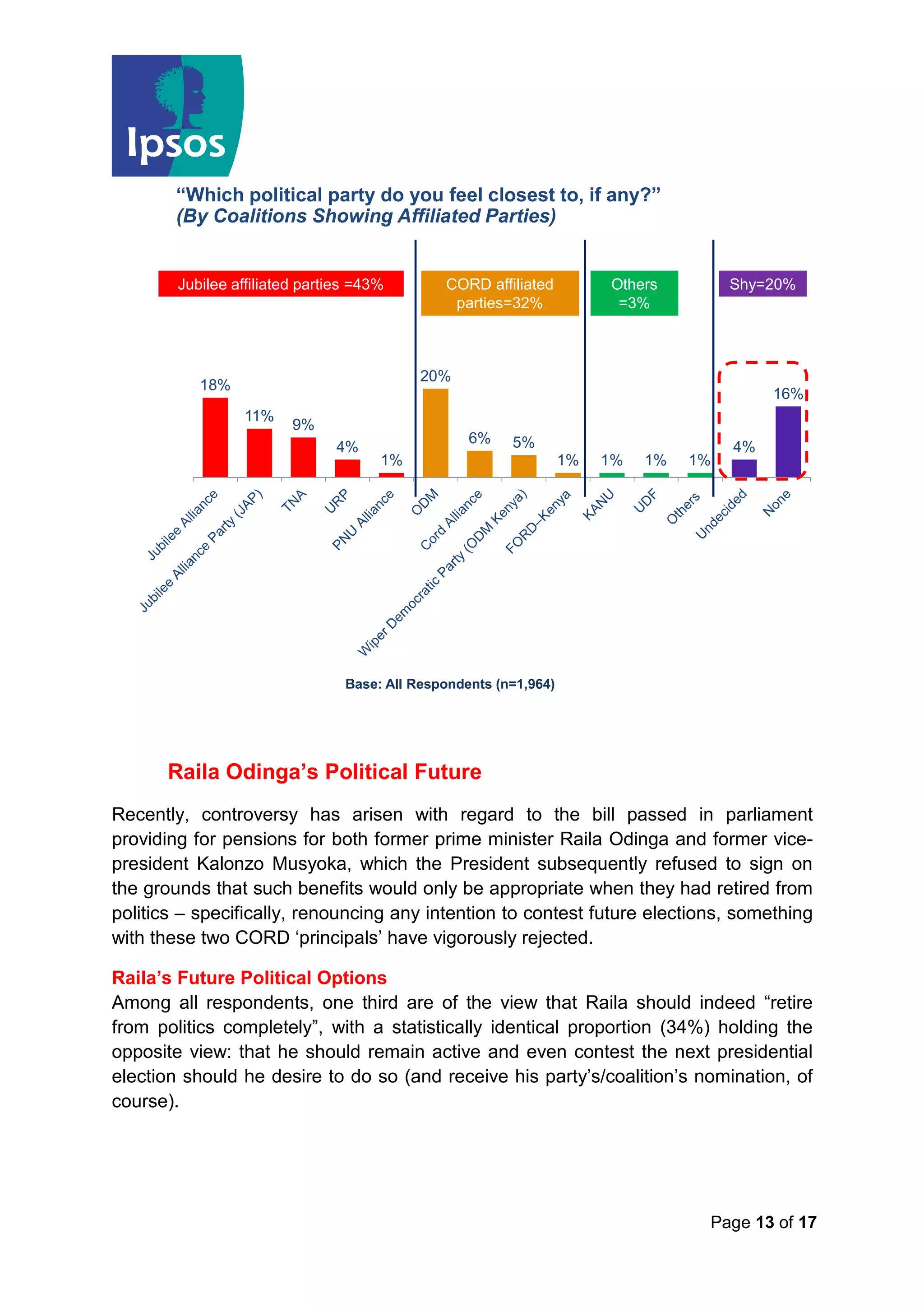
In terms of declared political party/coalition alignment, Jubilee continues to enjoy a
clear if modest advantage, without about a quarter more of Kenyans associating with
it or its affiliated parties than those identifying themselves with CORD or its affiliated
parties (43% vs. 32%).
Page 13 of 17
Raila Odinga’s Political Future
Recently, controversy has arisen with regard to the bill passed in parliament
providing for pensions for both former prime minister Raila Odinga and former vice-
president Kalonzo Musyoka, which the President subsequently refused to sign on
the grounds that such benefits would only be appropriate when they had retired from
politics – specifically, renouncing any intention to contest future elections, something
with these two CORD ‘principals’ have vigorously rejected.
Raila’s Future Political Options
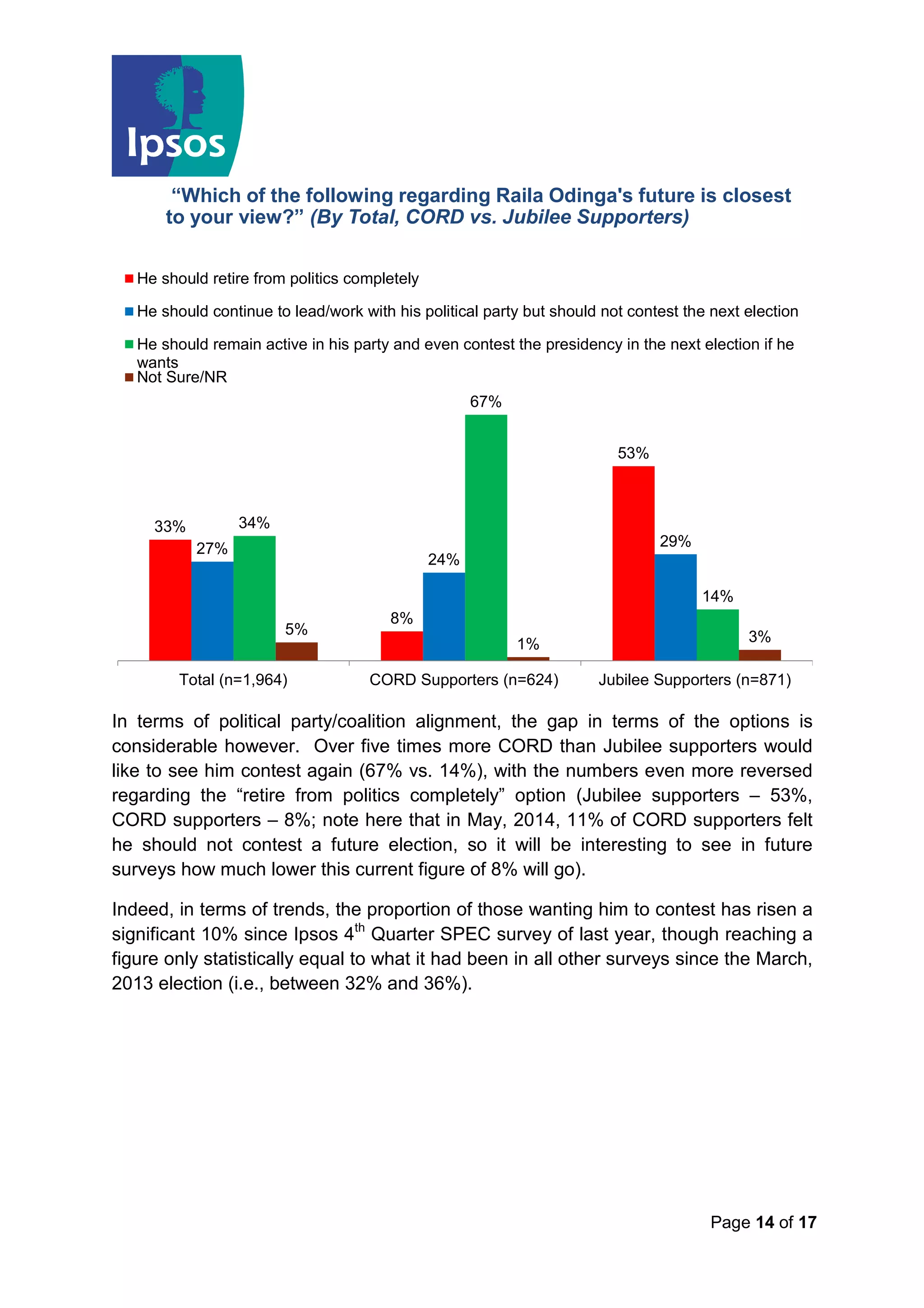
Among all respondents, one third are of the view that Raila should indeed “retire
from politics completely”, with a statistically identical proportion (34%) holding the
opposite view: that he should remain active and even contest the next presidential
election should he desire to do so (and receive his party’s/coalition’s nomination, of
course).
“Which political party do you feel closest to, if any?”
(By Coalitions Showing Affiliated Parties)
18%
11%
9%
4%
1%
20%
6% 5%
1% 1% 1% 1%
4%
16%
Jubilee affiliated parties =43% CORD affiliated
parties=32%
Others
=3%
Shy=20%
Base: All Respondents (n=1,964)
Page 14 of 17
In terms of political party/coalition alignment, the gap in terms of the options is
considerable however. Over five times more CORD than Jubilee supporters would
like to see him contest again (67% vs. 14%), with the numbers even more reversed
regarding the “retire from politics completely” option (Jubilee supporters – 53%,
CORD supporters – 8%; note here that in May, 2014, 11% of CORD supporters felt
he should not contest a future election, so it will be interesting to see in future
surveys how much lower this current figure of 8% will go).
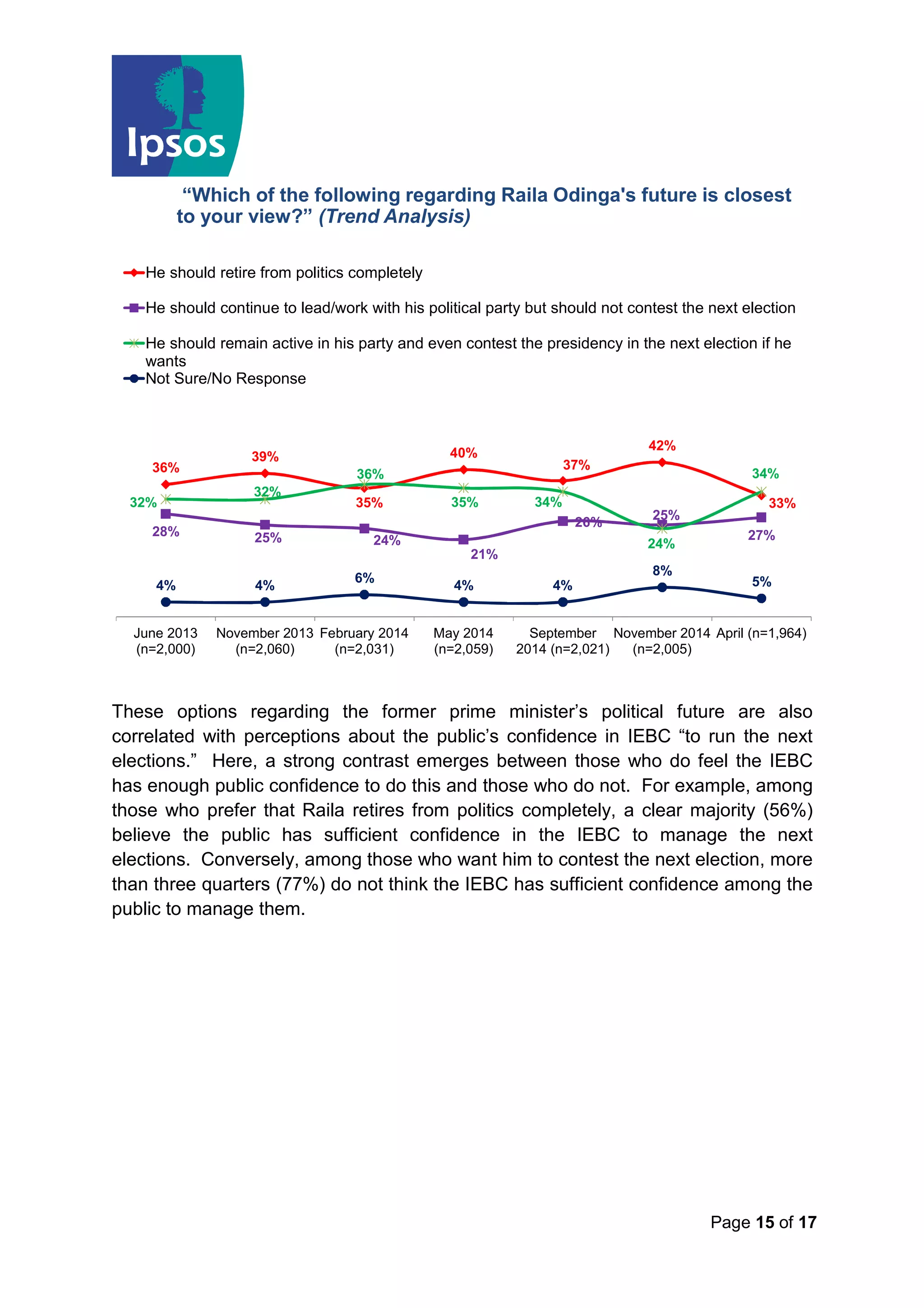
Indeed, in terms of trends, the proportion of those wanting him to contest has risen a
significant 10% since Ipsos 4th
Quarter SPEC survey of last year, though reaching a
figure only statistically equal to what it had been in all other surveys since the March,
2013 election (i.e., between 32% and 36%).
“Which of the following regarding Raila Odinga's future is closest
to your view?” (By Total, CORD vs. Jubilee Supporters)
33%
8%
53%
27%
24%
29%
34%
67%
14%
5%
1% 3%
Total (n=1,964) CORD Supporters (n=624) Jubilee Supporters (n=871)
He should retire from politics completely
He should continue to lead/work with his political party but should not contest the next election
He should remain active in his party and even contest the presidency in the next election if he
wants
Not Sure/NR
Page 15 of 17
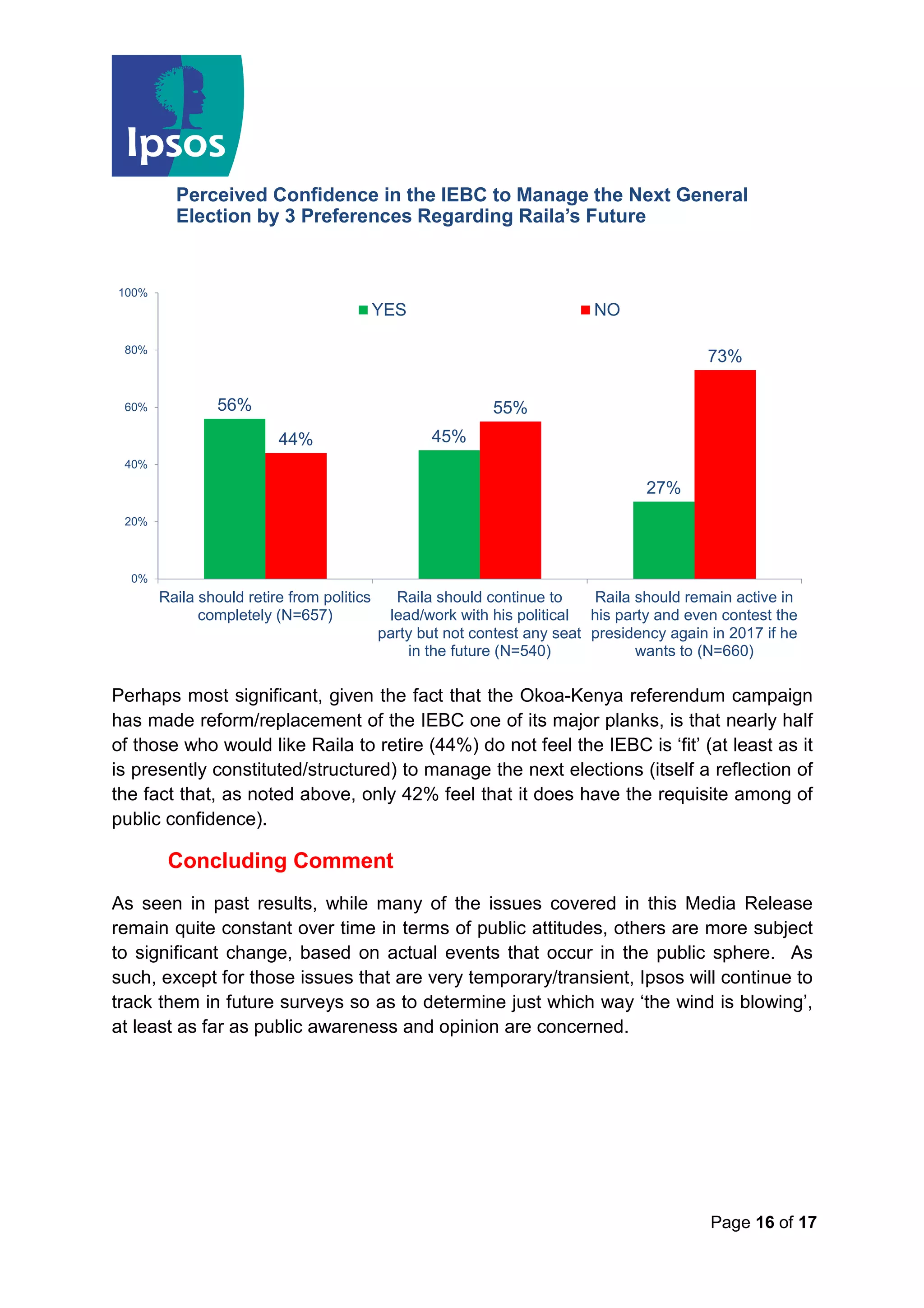
These options regarding the former prime minister’s political future are also
correlated with perceptions about the public’s confidence in IEBC “to run the next
elections.” Here, a strong contrast emerges between those who do feel the IEBC
has enough public confidence to do this and those who do not. For example, among
those who prefer that Raila retires from politics completely, a clear majority (56%)
believe the public has sufficient confidence in the IEBC to manage the next
elections. Conversely, among those who want him to contest the next election, more
than three quarters (77%) do not think the IEBC has sufficient confidence among the
public to manage them.
“Which of the following regarding Raila Odinga's future is closest
to your view?” (Trend Analysis)
36%
39%
35%
40%
37%
42%
33%
28% 25% 24%
21%
26%
25%
27%
32%
32%
36%
35% 34%
24%
34%
4% 4%
6%
4% 4%
8%
5%
June 2013
(n=2,000)
November 2013
(n=2,060)
February 2014
(n=2,031)
May 2014
(n=2,059)
September
2014 (n=2,021)
November 2014
(n=2,005)
April (n=1,964)
He should retire from politics completely
He should continue to lead/work with his political party but should not contest the next election
He should remain active in his party and even contest the presidency in the next election if he
wants
Not Sure/No Response
Page 16 of 17
Perhaps most significant, given the fact that the Okoa-Kenya referendum campaign
has made reform/replacement of the IEBC one of its major planks, is that nearly half
of those who would like Raila to retire (44%) do not feel the IEBC is ‘fit’ (at least as it
is presently constituted/structured) to manage the next elections (itself a reflection of
the fact that, as noted above, only 42% feel that it does have the requisite among of
public confidence).
Concluding Comment
As seen in past results, while many of the issues covered in this Media Release
remain quite constant over time in terms of public attitudes, others are more subject
to significant change, based on actual events that occur in the public sphere. As
such, except for those issues that are very temporary/transient, Ipsos will continue to
track them in future surveys so as to determine just which way ‘the wind is blowing’,
at least as far as public awareness and opinion are concerned.
Perceived Confidence in the IEBC to Manage the Next General
Election by 3 Preferences Regarding Raila’s Future
56%
45%
27%
44%
55%
73%
0%
20%
40%
60%
80%
100%
Raila should retire from politics
completely (N=657)
Raila should continue to
lead/work with his political
party but not contest any seat
in the future (N=540)
Raila should remain active in
his party and even contest the
presidency again in 2017 if he
wants to (N=660)
YES NO
Page 17 of 17
Survey Methodology
The target population for this survey was Kenyans aged 18 years and above, of whom 1,964
living in urban and rural areas were interviewed. The margin-of-error attributed to sampling
and other random effects of this poll’s sample size is +/- 2.2 with a 95% confidence level.
The fieldwork for this survey was conducted between 28th
March and 7th
April 2015. Data
was collected through face-to-face interviews using hand held devices (smart phones). Ipsos
Limited (Kenya) funded the survey.
As is always the case, the full data-set for this survey in SPSS and Excel or any parts
thereof are available for purchase from Ipsos.
For further details on this press release or commercial enquiries please contact:
Dr. Tom Wolf Victor Rateng
Research Analyst Opinion Polls Project Manager
tpwolf1944@gmail.com victor.rateng@ipsos.com
Tel: 386 2721-33 Tel: 386 2721-33
www.ipsos.co.ke www.ipsos.co.ke

Ipsos’ 1st Quarter SPEC (Social, Political, Economic and Cultural) Survey: 9th Media Release: Election and Political Issues

  • 1.
    Page 1 of17 Nairobi, Kenya 30th May 2015 Ipsos’ 1st Quarter SPEC (Social, Political, Economic and Cultural) Survey: 9th Media Release: Election and Political Issues This summary is based on results from Ipsos’ 1st Quarter SPEC survey of 2015 that was conducted between March 28 and April 7. It is the 9th such release. Given that the tragic attack on Garissa University College occurred on April 2, about 25% of the interviews took place after that date. However, in comparing the results obtained before and after April 2, their distribution was clearly affected more on some issues than others, or not at all. For example, the proportion of those perceiving al- Shabaab as “very much a threat” after April 2 was 14% higher than before that date. By contrast the results presented here (on issues unrelated to security, presidential approval, etc.) were not affected by that tragic attack. Highlights:  About three-quarters of all Kenyans know the currently-set date of the next election (August, 2017), but nearly two-thirds support it being pushed back (to December, 2017). Further, there is no contrast between Jubilee and CORD supporters on this issue.  Only one-fifth of Kenyans are aware of any voter registration that has been conducted in their locality since the last election.  Fewer than half believe that the public has sufficient confidence in the IEBC to manage the next election without major reforms, though a clear contrast between Jubilee and CORD supporters is evident here, with nearly three times as many of the former satisfied with the IEBC as is presently constituted.  Kenyans remain very divided over the continuation vs. termination of the remaining ICC case involving Deputy President William Ruto and radio journalist Joshua arap Sang, though somewhat more prefer its termination.  They are similarly divided over the likelihood that DP Ruto will be convicted and, if he is, whether any violence would erupt.  There is somewhat more support for the establishment of an African Human Rights Court than for Kenya’s withdrawal from the ICC, but in both cases, a stark contrast between Jubilee and CORD supporters over these two issues, that also takes a clear regional dime
  • 2.
    Page 2 of17  More than four-in-five are aware of at least one prominent person who has died mysteriously in the recent past, and nearly three-quarters want the causes of such deaths to be made public.  Jubilee and its affiliate political parties remain more popular than do CORD and its affiliated parties.  Kenyans remain divided over their preferred option for Raila Odinga’s political future, though since November, 2014, the proportion who want him to contest the next election has increased (nearly equal to the figures obtained in 5 earlier surveys beginning with that in June, 2013). About fve times as many CORD as Jubilee supporters prefer this option, however.  About three times as many of those who do not feel the IEBC has sufficient public confidence to manage the next elections prefer this “he should contest” option. Election Issues Last year a substantial number of MPs proposed that the date of the next election be moved from August to December, 2017. Yet due to the fact that this date is set by the constitution, robust (two-thirds) majorities in both the National Assembly and the Senate would be required to change it, doing this will require strong support from both Jubilee and CORD Members. Initially, most support for this change came from the CORD side, described by commentators as a strategy to ensure that the most senior members of the current election commission (IEBC) in whom CORD has less than full confidence will have vacated office, as their terms expire in November of that year. In response, the Jubilee leadership threatened to bring a bill extending their terms of office for six months so that in the event the date is pushed back, the current IEBC team – rather than another one having been in place for just a few weeks – would have this major responsibility. (In addition, since the last election was held in 2013, some are claiming the next one should not be held until 2018, but this position so far does not appear to have received significant backing, at least in terms of constitutional interpretation, given that the original date for the first election under the new constitution was supposed to be August, 2012, and was only moved back by a High Court decision.) While ‘final’ positions on this issue are still unclear, it was considered useful to explore several issues related to the 2017 election date in this survey. Knowledge of the Next Election Date The first question relating to election issues sought to determine how many Kenyans are aware of the date of the next general election, and the extent to which such
  • 3.
    Page 3 of17 awareness varies in demographic terms. Whereas, overall, more than three-quarters (78%) do so (August, 2017), slightly more urban dwellers than their rural counterparts and men than women know this (80% vs. 76%, and 81% vs. 74%, respectively). A greater contrast is seen in terms of region, however, with the level of awareness ranging from highs in Central and Rift Valley (89% and 84%) to a low in Western (just 56%). Such variations appear to be explained mainly by education levels, since a clear contrast is seen in these terms. Specifically, whereas only just over half of those without any formal education know this date (56%), nearly nine-out-of-ten of those with any post-secondary education (86%) do so. As such, these results emphasize just how empowering education is as a tool of citizen engagement. (At least in terms of self-reporting, such ‘engagement’ does not appear to be reflected in voter turnout rates; however, since about 90% of respondents in all education-level categories claim to have voted in the last election.) Support for Change of the Election Date from August to December, 2017 Overall, nearly two-thirds of Kenyans (64%) support this proposed change, with even slightly higher support among those self-identifying as supporters of the Jubilee and CORD parties/coalitions (67% and 66%, respectively). At the regional level, however two parts of the country where CORD is most popular are at opposite ends of the support-spectrum (Nyanza – 80% vs. Coast – 47%). % Who Know the Date of the Next Election (August, 2017): by Total, Setting, Gender 78% 80% 76% 81% 74% 0% 20% 40% 60% 80% 100% Total (n=1,964) Urban (n=729) Rural (n=1,235) Male (n=956) Female (n=1,008)
  • 4.
    Page 4 of17 Indeed, the fact that no partisan divide emerges in these figures suggests however much this proposal is being scrutinized by politicians in terms of potential advantages or disadvantages based on who manages the next election, the public so far is judging this primarily in terms of such criteria as personal convenience, impact on the school term-calendar, or other factors. % Who Support Changing the Date of the Next Election from August to December, 2017: by Total, Setting, Gender and Main Political Party/Coalition 64% 65% 64% 66% 63% 66% 67% 0% 20% 40% 60% 80% 100% Total (n=1,964) Urban (n=729) Rural (n=1,235) Male (n=956) Female (n=1,008) CORD Supporters (n=623) Jubilee Supporters (867) % Who Support Changing the Date of the Next Election from August to December, 2017: by Region 80% 71% 68% 64% 58% 56% 53% 47% 0% 20% 40% 60% 80% 100% Nyanza (n=257) Rift Valley (n=484) Central (n=257) Nairobi (n=206) North Eastern (n=94) Western (n=200) Eastern (n=293) Coast (n=173)
  • 5.
    Page 5 of17 Awareness of Voter Registration Since the Last Election Even without the counting coming-of-age of 18 year-olds, only about two-thirds of eligible Kenyans were registered before the March, 2013 election. As such, the IEBC – in accordance with its constitutional responsibility to undertake continuous voter-registration – has made some effort in this regard over the last two years. According to the results from this survey, however, only one-in-five (20%) are aware of such registration in their locality during this period. However, the data reveal that somewhat more men than women are among those aware (22% vs. 17%), which suggests that even within the same areas not everyone is aware of voter registration when it has in fact occurred. Whether this reality explains the fairly large gaps in such awareness across the regions – ranging from highs in North Eastern and Central (37% and 27%, respectively) to lows in Eastern and Western (15% and 10%, respectively), or whether such differences reflect the actual levels of IEBC engagement on the ground, is unclear (though both factors could be at work in determining such awareness-figures). Confidence in the IEBC to Manage the Next Elections Elsewhere in this same survey (and as reported in Ipsos’ 8th Media Release), respondents were asked how much confidence they have in the IEBC. This was in terms of having “a lot of confidence” (16%), “some confidence” (35%), “a little confidence” (19%) and “no confidence at all” (28%). Here, however, they were asked whether they think “voters have enough confidence” in the electoral body to manage the next elections. 20% 22% 18% 22% 17% 21% 22% 0% 10% 20% 30% 40% 50% Total (n=1,964) Urban (n=729) Rural (n=1,235) Male (n=956) Female (n=1,008) CORD Supporters (n=623) Jubilee Supporters (n=867) % Aware of Any Voter Registration in Their Locality Since Last Election: by Total, Setting, Gender, Main Political Party/Coalition
  • 6.
    Page 6 of17 Overall, only about one-in-four (42%) think that they do, though here a major partisan divide emerges, with nearly three times as many Jubilee supporters positive on this issue as compared with CORD’s (61% vs. 21%). Such a split is evident in regional terms as well, with almost the same contrast between respondents in Central and Nyanza (60% vs. 22%). The ICC and Related Issues This is the first Ipsos survey since the withdrawal of the case against President Uhuru Kenyatta, leaving the one against Deputy President William Ruto and radio journalist Joshua arap Sang. Public awareness of this case remains high Preference Regarding Continuation of the Ruto-Sang Case The distribution of preferences regarding this case show a clear plurality in favour of it being dropped (48%), even if the two groups of respondents who want it to continue (with/without the presence of the accused) comprises almost as many (41%), others have a variety of disparate views. “Do you think voters will have enough confidence in the IEBC to manage the next elections?”: by Total, Setting, Gender, Main Political Party/Coalition 42% 35% 46% 43% 42% 21% 61% 0% 20% 40% 60% 80% 100% Total (n=1,964) Urban (n=729) Rural (n=1,235) Male (n=956) Female (n=1,008) CORD Supporters (n=623) Jubilee Supporters (n=867) % saying “YES”
  • 7.
    Page 7 of17 Expectations of the Ruto-Sang Case Outcome: Convictions and Violence Half of all Kenyans believe that this case will either certainly or may possibly result in convictions (50%), with only one-third (33%) certain that this will not happen. Almost the same results apply to expectations regarding the potential for violence should the DP be found guilty, with just over half (53%) of the view that this eventuality is either certain or possible, and again one-third (33%) certain that no such violence would occur. “What would you like to happen to the Ruto and Sang’ case?” 48% 33% 8% 5% 2% 2% 1% 1% 0% 10% 20% 30% 40% 50% It should be terminated/dropped completely It should continue at the ICC as it is now It should continue at the ICC but without the presence of the accused Not sure It should be deferred for a year There should be a fair trial It should be referred to Kenyan courts RTA Base: Those aware of either William Ruto, Joshua arap Sang’ or both as facing trial at the ICC (n=1,735)
  • 8.
    Page 8 of17 Withdrawal From and Alternatives to the ICC Regarding the proposals for Kenya to withdraw from the Rome Treaty/the ICC, Kenyans are split right down the middle (YES: 50%, NO: 50%), though with major regional variations, ranging from a high in favour of this among respondents from Central (76%) to a low in Coast (24%). Such contrasting positions appear mainly to reflect the political divide, with more than twice as many Jubilee than CORD supporters backing such a withdrawal (70% vs. 30%). 26% 27% 24% 26% 33% 33% 16% 14% 0% 10% 20% 30% 40% 50% How likely do you think it is that the Ruto case will end in his conviction? How likely do you think it is that there will be any violence if Ruto is convicted? Certainly will Possibly will Certainly NOT Not sure “Whatever your view about this case….?” Base: All Respondents (n=1,964)
  • 9.
    Page 9 of17 African Human Rights Court Even more support is shown for the proposal to establish an African Human Rights court that would serve as a substitute or replacement for the ICC as far as African Union member-states are concerned (in favour – 54%, against – 40%). A similar range is seen in regional terms, though here least support comes from residents of Nyanza (32%) as compared with those in Central, where about four-in- five (89%) support this idea. And again a similar partisan contrast is seen, with almost twice as many Jubilee supporters in favour of this initiative than their CORD counterparts (74% vs. 33%). As such, the lingering political split over this issue which emerged well before the 2013 election is still very much alive. “Do you support the proposal for Kenya to withdraw from the ICC?” 50% 76% 69% 59% 50% 44% 41% 32% 24% 50% 24% 31% 41% 50% 56% 59% 68% 76% 0% 20% 40% 60% 80% 100% Total (n=1,964) Central (n=257) North Eastern (n=94) Rift Valley (n=484) Eastern (n=293) Nairobi (n=206) Western (n=200) Nyanza (n=257) Coast (n=173) YES NO
  • 10.
    Page 10 of17 Deaths of “Prominent People” Since Ipsos’ 4th Quarter Survey of 2014, several deaths (indeed, tragic) have occurred of major leaders/personalities in Kenya. Given this sad fact, respondents were asked which such events they were aware of, and whether they favour the release of information as to the cause of/those responsible for these deaths, if and when such information has been confirmed. Awareness of Deaths Three main figures lost their lives since the last Ipsos survey. However, levels of awareness about these events vary somewhat, from a high with regard to Hon. G. Muchai (55%) to a low for F. Odinga (40%, with slightly more aware of that of Sen. O. Kajwang (43%). (Among the others mentioned, all occurred much earlier – e.g., M. Kilonzo, S. Saitoti, and O. Ojode – aside from M. Yebei, who is unlikely to be considered as a “prominent” person by most respondents.) “Do you support/oppose the proposal by the African Union to establish an African Human rights court as a substitute for the ICC?” 54% 32% 48% 43% 49% 53% 62% 63% 79% 40% 62% 50% 48% 45% 40% 34% 30% 17% 6% 6% 3% 9% 6% 7% 5% 7% 4% 0% 20% 40% 60% 80% 100% Total (n=1,964) Nyanza (n=257) Nairobi (n=206) Western (n=200) Coast (n=173) Eastern (n=293) Rift Valley (n=484) North Eastern (n=94) Central (n=257) Support Oppose Not sure
  • 11.
    Page 11 of17 Making Public the Cause of Such Deaths Among all respondents, nearly three-quarters (72%) believe the cause of death in such cases should be made public, with fewer than one-in-ten (17%) of the view that it should not be (though no follow-up question was asked about the reasons for these opposing views). (Note that while not shown, among only those 1,594 aware of any such deaths, somewhat more support the release of information about the reasons behind them: 77%). “Which prominent people have died or been killed in recent months that you know of?” (MULTIPLE RESPONSE) 55% 43% 40% 6% 4% 1% 1% 17% 0% 20% 40% 60% 80% 100% Hon. Muchai Otieno Kajwang’ Fidel Odinga Mutula Kilonzo George Saitoti Orwa Ojode Meshack Yebei Can't remember/None/Don't Know Base: All Respondents (n=1,964)
  • 12.
    Page 12 of17 Political Party Alignment In terms of declared political party/coalition alignment, Jubilee continues to enjoy a clear if modest advantage, without about a quarter more of Kenyans associating with it or its affiliated parties than those identifying themselves with CORD or its affiliated parties (43% vs. 32%).
  • 13.
    Page 13 of17 Raila Odinga’s Political Future Recently, controversy has arisen with regard to the bill passed in parliament providing for pensions for both former prime minister Raila Odinga and former vice- president Kalonzo Musyoka, which the President subsequently refused to sign on the grounds that such benefits would only be appropriate when they had retired from politics – specifically, renouncing any intention to contest future elections, something with these two CORD ‘principals’ have vigorously rejected. Raila’s Future Political Options Among all respondents, one third are of the view that Raila should indeed “retire from politics completely”, with a statistically identical proportion (34%) holding the opposite view: that he should remain active and even contest the next presidential election should he desire to do so (and receive his party’s/coalition’s nomination, of course). “Which political party do you feel closest to, if any?” (By Coalitions Showing Affiliated Parties) 18% 11% 9% 4% 1% 20% 6% 5% 1% 1% 1% 1% 4% 16% Jubilee affiliated parties =43% CORD affiliated parties=32% Others =3% Shy=20% Base: All Respondents (n=1,964)
  • 14.
    Page 14 of17 In terms of political party/coalition alignment, the gap in terms of the options is considerable however. Over five times more CORD than Jubilee supporters would like to see him contest again (67% vs. 14%), with the numbers even more reversed regarding the “retire from politics completely” option (Jubilee supporters – 53%, CORD supporters – 8%; note here that in May, 2014, 11% of CORD supporters felt he should not contest a future election, so it will be interesting to see in future surveys how much lower this current figure of 8% will go). Indeed, in terms of trends, the proportion of those wanting him to contest has risen a significant 10% since Ipsos 4th Quarter SPEC survey of last year, though reaching a figure only statistically equal to what it had been in all other surveys since the March, 2013 election (i.e., between 32% and 36%). “Which of the following regarding Raila Odinga's future is closest to your view?” (By Total, CORD vs. Jubilee Supporters) 33% 8% 53% 27% 24% 29% 34% 67% 14% 5% 1% 3% Total (n=1,964) CORD Supporters (n=624) Jubilee Supporters (n=871) He should retire from politics completely He should continue to lead/work with his political party but should not contest the next election He should remain active in his party and even contest the presidency in the next election if he wants Not Sure/NR
  • 15.
    Page 15 of17 These options regarding the former prime minister’s political future are also correlated with perceptions about the public’s confidence in IEBC “to run the next elections.” Here, a strong contrast emerges between those who do feel the IEBC has enough public confidence to do this and those who do not. For example, among those who prefer that Raila retires from politics completely, a clear majority (56%) believe the public has sufficient confidence in the IEBC to manage the next elections. Conversely, among those who want him to contest the next election, more than three quarters (77%) do not think the IEBC has sufficient confidence among the public to manage them. “Which of the following regarding Raila Odinga's future is closest to your view?” (Trend Analysis) 36% 39% 35% 40% 37% 42% 33% 28% 25% 24% 21% 26% 25% 27% 32% 32% 36% 35% 34% 24% 34% 4% 4% 6% 4% 4% 8% 5% June 2013 (n=2,000) November 2013 (n=2,060) February 2014 (n=2,031) May 2014 (n=2,059) September 2014 (n=2,021) November 2014 (n=2,005) April (n=1,964) He should retire from politics completely He should continue to lead/work with his political party but should not contest the next election He should remain active in his party and even contest the presidency in the next election if he wants Not Sure/No Response
  • 16.
    Page 16 of17 Perhaps most significant, given the fact that the Okoa-Kenya referendum campaign has made reform/replacement of the IEBC one of its major planks, is that nearly half of those who would like Raila to retire (44%) do not feel the IEBC is ‘fit’ (at least as it is presently constituted/structured) to manage the next elections (itself a reflection of the fact that, as noted above, only 42% feel that it does have the requisite among of public confidence). Concluding Comment As seen in past results, while many of the issues covered in this Media Release remain quite constant over time in terms of public attitudes, others are more subject to significant change, based on actual events that occur in the public sphere. As such, except for those issues that are very temporary/transient, Ipsos will continue to track them in future surveys so as to determine just which way ‘the wind is blowing’, at least as far as public awareness and opinion are concerned. Perceived Confidence in the IEBC to Manage the Next General Election by 3 Preferences Regarding Raila’s Future 56% 45% 27% 44% 55% 73% 0% 20% 40% 60% 80% 100% Raila should retire from politics completely (N=657) Raila should continue to lead/work with his political party but not contest any seat in the future (N=540) Raila should remain active in his party and even contest the presidency again in 2017 if he wants to (N=660) YES NO
  • 17.
    Page 17 of17 Survey Methodology The target population for this survey was Kenyans aged 18 years and above, of whom 1,964 living in urban and rural areas were interviewed. The margin-of-error attributed to sampling and other random effects of this poll’s sample size is +/- 2.2 with a 95% confidence level. The fieldwork for this survey was conducted between 28th March and 7th April 2015. Data was collected through face-to-face interviews using hand held devices (smart phones). Ipsos Limited (Kenya) funded the survey. As is always the case, the full data-set for this survey in SPSS and Excel or any parts thereof are available for purchase from Ipsos. For further details on this press release or commercial enquiries please contact: Dr. Tom Wolf Victor Rateng Research Analyst Opinion Polls Project Manager tpwolf1944@gmail.com victor.rateng@ipsos.com Tel: 386 2721-33 Tel: 386 2721-33 www.ipsos.co.ke www.ipsos.co.ke